Professional virtual currency information station welcome
We have been making efforts.

vc Page 26

Cryptocurrency is a non-legal monetary asset based on digital technology and blockchain, possessing the functions of a medium of exchange and a store of value. Cryptocurrency is a transaction medium that uses cryptographic principles to ensure transaction security and control the creation of transaction units. Cryptocurrency is a type of digital currency (or virtual currency). Bitcoin became the first decentralized cryptocurrency in 2009, after which the term “cryptocurrency” was more commonly used to refer to such designs. Since then, several similar cryptocurrencies have been created, and they are usually referred to as altcoins. Cryptocurrency is based on a decentralized consensus mechanism, in contrast to the banking financial system that relies on a centralized regulatory system.

The Shanghai And Shenzhen Stock Exchanges Have Taken Intensive Measures To Strengthen Quantitative Trading Supervision And Maintain Market Stability.

On February 20, according to the Shanghai and Shenzhen Stock Exchange websites, the quantitative transaction reporting system was smoothly implemented. In the next stage, the Shanghai and Shenzhen Stock Exchanges will take comprehensive measures from the institutional end, access end, trading end, information end, and institutional end to continue to strengthen the monitoring and analysis of quantitative transactions, especially high-frequency transactions, and include the quantitative transactions of northbound investors in the reporting scope in accordance with the principle of consistency between domestic and foreign investors.

The reporter learned that this is the first time that the Shanghai and Shenzhen Stock Exchanges have launched a series of regulatory measures focused on quantitative trading, clarifying the regulatory attitude and reflecting the determination of the regulatory authorities to strengthen the supervision of quantitative trading and maintain market stability. In the future, relevant quantitative trading supervision measures will be matured and launched, and communication with various investors in the market will be fully strengthened to grasp the pace and intensity of work, standardize quantitative trading, and maintain the stable operation of the market.

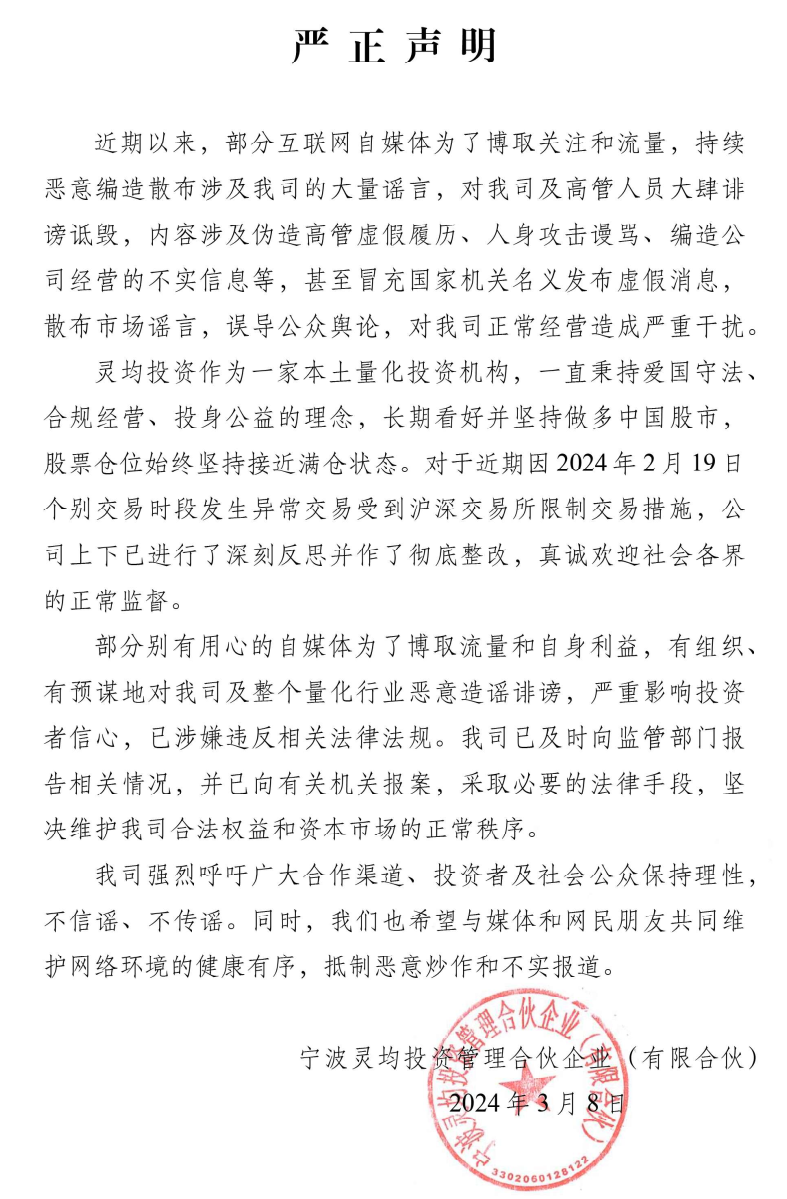
On that day, the Shanghai and Shenzhen Stock Exchanges issued a "penalty" for abnormal transactions of Ningbo Lingjun Investment Management Partnership (Limited Partnership) (hereinafter referred to as "Ningbo Lingjun"), restricted trading and initiated public condemnation procedures for Ningbo Lingjun. Industry insiders believe that supervision has "tears with thorns" and is intended to promote standardization and guide quantitative development. Regulatory authorities will respond quickly and strike hard at illegal activities that affect the normal trading order of the market and damage the legitimate rights and interests of investors.

A series of measures highlight investor-oriented

According to the website of the Shanghai and Shenzhen Stock Exchanges, quantitative trading regulatory measures include strictly implementing the reporting system and clarifying the access arrangements of "reporting first, trading later"; strengthening the authorization management of quantitative trading market conditions, and improving the differentiated charging mechanism; improving abnormal transaction monitoring and monitoring standards, strengthening the supervision of abnormal transactions and abnormal order cancellations; strengthening the monitoring and regulation of leveraged quantitative products, and strengthening futures and spot linkage supervision.

According to market analysts, the policies introduced this time are highly targeted and emphasize investor-oriented. For example, the requirement to "report first, then trade" will help to further accurately identify quantitative transactions; in view of the information advantages of quantitative transactions, clearly strengthen market authorization management; in view of recent quantitative transactions in small market capitalization stocks, clearly strengthen the monitoring and regulation of leveraged products to prevent stampedes in a short period of time. Including the self-regulatory management measures taken against Ningbo Lingjun this time, it is a reflection of the regulatory authorities’ strengthening supervision of abnormal trading behaviors.

"In the early stage, the regulatory authorities established a quantitative transaction reporting system. In accordance with the requirements, we have completed the reporting of existing customers, established a customer transaction monitoring system, and organized and mobilized relevant customers to report." A relevant person from Huatai Securities said that in the future, the company will continue to dynamically follow up on new additions, changes, etc., strictly implement the reporting system, and strengthen the detection of abnormal trading behavior.

The Shanghai and Shenzhen Stock Exchanges have also proposed specific measures from the institutional side, including further consolidating the customer management responsibilities of securities companies, improving the self-regulatory management cooperation mechanism with the Securities Association and the Fund Industry Association, and strengthening the transaction supervision of quantitative private equity and other institutions; strengthening communication with the Hong Kong Stock Exchange, in accordance with the principle of consistency between domestic and foreign capital, clarifying the reporting arrangements for northbound investors in the Shanghai-Shenzhen-Hong Kong Stock Connect, and including quantitative transactions by northbound investors within the reporting scope.

He Wenqi, chairman of Shenzhen Chengqi, said that the measures introduced this time will help reduce the impact of illegal quantitative transactions on the market and maintain the stability and fairness of transactions. The quantitative trading reporting system has been implemented for nearly half a year. This quantitative trading regulatory measure emphasizes the supervision of frequent orders and withdrawals, strengthens the monitoring of leveraged products, and clarifies the principles of northbound quantitative trading reporting, releasing a signal for supervision to further standardize quantitative trading.

The Shanghai and Shenzhen Stock Exchanges also stated that in the next step, they will adhere to the investor-oriented approach, take the maintenance of fairness as the starting point and end point of their work, learn from international regulatory practices, seek advantages and avoid disadvantages, and establish and improve quantitative trading regulatory arrangements. For abnormal transactions that affect market order, the Shanghai and Shenzhen Stock Exchanges will resolutely take self-regulatory management measures, and those suspected of violating laws and regulations and serious circumstances will be reported to the China Securities Regulatory Commission for investigation and punishment.

Mature one, launch one

For the first time, the Shanghai and Shenzhen Stock Exchanges have launched a policy "combination punch" from the institutional end, access end, trading end, information end, institutional end, etc. to further strengthen the pertinence and accuracy of quantitative trading supervision.

A relevant person from the Market Supervision Department of the China Securities Regulatory Commission told reporters that the China Securities Regulatory Commission has always paid attention to the development and supervision of quantitative trading. In recent years, it has successively promoted many tasks, including bringing quantitative trading into the scope of securities laws, establishing a data collection mechanism for leading quantitative institutions, strengthening quantitative trading monitoring and analysis, establishing a programmed transaction reporting system, strengthening private placement and securities lending supervision, etc. The "combination" of quantitative trading supervision launched this time is strong, strengthening supervision from multiple dimensions, and basically covering the main aspects of quantitative trading business operations.

"The series of quantitative trading supervision measures introduced in the next stage will be mature one by one and launched one by one, and we will fully strengthen communication with various investors in the market, grasp the pace and intensity of work, promote the standardized and healthy development of quantitative trading, and maintain the stable operation of the market." The above-mentioned person said.

Relevant people from Huatai Securities said that the relevant regulatory measures this time proposed a series of arrangements from various aspects such as access reporting mechanism, regulatory coverage, trading behavior and supporting systems, focusing on the programmed transaction reporting management system that has been implemented in the early stage, reflecting the "thorny" supervision, and further eliminating regulatory gaps.

Quantitative trading supervision emphasizes seeking advantages and avoiding disadvantages

There is currently a lot of market discussion about quantitative regulation. Many opinions believe that quantitative trading started late, but developed rapidly and had a greater impact on the market.

"The impact of quantitative trading on the market must be viewed dialectically." Relevant people from the Shanghai and Shenzhen exchanges said that on the one hand, quantitative trading is usually operated with full or high positions, which provides more liquidity to the market and helps promote price discovery. On the other hand, quantitative trading, especially high-frequency trading, has characteristics such as fast transaction speed, strong processing power, and the use of artificial intelligence. It has strong technical advantages, information advantages, and trading advantages over the majority of investors. In addition, some micro-cap trading behaviors have convergence in strategies, transactions, and even trading hours, which further amplifies the fluctuations of individual stocks, thereby causing market resonance.

A relevant person from the Market Supervision Department of the China Securities Regulatory Commission told a reporter from the Shanghai Stock Exchange that the Shanghai and Shenzhen Stock Exchanges have comprehensively implemented policies to supervise quantitative trading, not to kill quantitative trading with one stick, nor to ban quantitative trading. Instead, during the daily supervision process, it has been found that there are more quantitative transactions, the frequency of transactions, the frequency of placing and canceling orders is too high, there are phenomena such as excessive use of information advantages, exacerbating information asymmetry, etc., and the unfairness brought to the market has become increasingly obvious.

"Considering the current market situation of 200 million investors, and the risk of increasing market volatility in quantitative high-frequency trading under a specific market environment, it is necessary to take advantage of the situation to promote its standardized development and make it more investor-oriented." said the person above.

Focus on high-frequency trading, in line with international practice

A relevant person from the Market Supervision Department of the China Securities Regulatory Commission said that the focus of this quantitative trading supervision is on high-frequency trading. Judging from international experience, overseas markets generally implement stricter supervision on quantitative transactions, especially high-frequency transactions, to prevent negative impacts on market order.

For example, Germany, Japan, etc. have centralized regulations on quantitative trading in the form of written laws and implement access registration management for high-frequency traders. Germany stipulates the definition and characteristics of algorithmic trading and high-frequency trading, exchange fees, transaction monitoring indicators, system requirements, etc.; Japan has formulated and issued regulatory guidelines specifically for the supervision of high-frequency trading actors.

Markets such as the United States limit the speed at which high-frequency traders can obtain trading information, reduce information asymmetry, and ensure optimal execution of investor orders. At the same time, they clearly prohibit any market participant from participating in, specifying, or intending to conduct destructive trading behaviors, including "spoofing" and other market manipulation behaviors that have emerged with the rise of high-frequency trading.

Many market participants have also reported that the quantitative transaction reporting system established in the early stage imposes additional reporting requirements on high-frequency transactions, so as not to affect the security of the exchange system and normal trading order. This is also in line with internationally accepted practices.

The quantitative transaction reporting system was implemented smoothly

On September 1 last year, the Shanghai and Shenzhen Stock Exchanges issued the "Notice on Matters Concerning the Reporting of Stock Programmed Trading" and the "Notice on Matters Concerning Strengthening the Management of Programmed Trading", establishing a special reporting system and corresponding regulatory arrangements for quantitative trading, which will be officially implemented on October 9, 2023. At present, the above-mentioned system has been implemented smoothly.

The reporter learned from the Market Supervision Department of the China Securities Regulatory Commission that at present, existing investors have achieved "repayment of all dues", and incremental investors "report first, then trade". The quality of reports from all parties generally meets the requirements, laying the foundation for further strengthening and improving quantitative trading supervision.

It is reported that the content of the quantitative trading report is very detailed, including basic account information, account fund information, transaction information, trading software information and other major categories. There are also specific requirements under the major categories. For example, the account fund information requires filling in the account fund size, fund source, and source proportion. For leveraged funds, the leveraged fund source and leverage ratio need to be filled in. The transaction information requires filling in the transaction type, whether it is a quantitative transaction, the main strategy type and overview, auxiliary strategies and overview, futures market account name and code, trading order execution method and overview, the highest account declaration rate, the highest number of declarations in a single day, etc.

A relevant person from the Market Supervision Department of the China Securities Regulatory Commission said that unreported investors cannot conduct programmed transactions, which is equivalent to allowing investors to "driving with a license" in the first place, providing institutional conditions for timely discovery of violations and real-time monitoring.

Editor: Tao Jiyan | Reviewer: Li Zhen | Supervisor: Wan Junwei

Quantitative Trading Has Once Again Fallen Into A Storm Of Public Opinion After Shanghai Stock Index 5 Consecutive Positives, And Three Major Questions In The Industry Need To Be Answered

The Shanghai Composite Index has been positive for five consecutive times, the market liquidity crisis has been resolved, and Lingjun was punished with a "boomerang", but quantitative trading has once again been pushed into the spotlight of public opinion.

After experiencing a sharp retracement of net worth and a series of pressures from customer redemptions, micro-cap stocks rose sharply for two days. Unexpectedly, the 24 hours before and after the quantitative private equity giant Lingjun was fined was the real "darkest moment" of quantification.

The resurgence of rumors, the announcement of Lingjun’s punishment, and the late-night apology have triggered a huge discussion in the entire industry about “why we have come to this point” and “where we will go from here” in quantification. Reporters from the Financial Associated Press have followed up on quantification for a long time and interviewed many institutions. They reviewed the 24 hours of quantification and the three major doubts that still exist in the industry.

Where does quantification go from here? Three major questions in the industry

Following Lingjun’s punishment, it was reported on the Internet that a quantitative private equity person said that “China’s stock market quantitative funds have closed down.” Such remarks were immediately denied by the parties involved.

What is unavoidable is that after the fermentation of news events, the great discussion about quantification has once again begun: How did the industry review the unprecedented tragedy of quantification? Investors asked, "Can I still invest in quantitative trading after a sharp retracement?" Some people once again mentioned the 828 incident in 2023 and reiterated the quantitative selling.

Some asset managers also believe that quantitative supervision needs to put the establishment of capital gains tax on short-term trading on the agenda.

Focusing on this, reporters from the Financial Associated Press interviewed industry insiders and learned that the current industry still has the following three major questions that need to be answered:

First of all, how to control the size of orders when placing quantitative trading orders?

Previously, the new regulations on programmatic trading clarified that high-frequency trading is the focus of supervision: that is, if the maximum declaration rate reaches more than 300 transactions per second or the maximum number of declarations in a single day reaches more than 20,000 transactions, the transaction can adjust the abnormal transaction identification standards according to the situation. In the announcement of the punishment of Lingjun by the Shanghai and Shenzhen Stock Exchanges, the reason was that "a large number of orders were concentrated in a short period of time, which accounted for a high proportion of the market turnover during the period, triggering a rapid decline in the index and seriously affecting the trading order."

Quantitative private equity said that even if it is not high-frequency trading, there is a lot of quantitative daily rolling trading frequency. Generally, it is sold at the opening and the funds are withdrawn before buying. From the current regulatory direction, in addition to avoiding high-frequency trading, it is also necessary to consider whether it will affect the index performance.

Secondly, will quantification “stop”? How to balance benefits and risks?

From the perspective of the industry, the risks of quantitative private equity are not without signs, but most people choose to run blindly.

A certain quantitative private equity said that the company adjusted its strategy last year because it realized that the CSI 500 was very risky and not cost-effective. However, the market enthusiasm concealed that the index had no excess risk. Looking at the excess and returns brought by the risk, how to balance it?

The above-mentioned people said that at that time, the risks had not yet emerged, and not doing this part of the excess would bring about underperformance and investor complaints. Today, if you review the market, you will find that rationally facing the excess of 300, 500, and 1,000, accepting the attenuation of alpha is an objective law. Trying to use opportunistic tricks such as iteration to chase false excess will ultimately be short-lived, and the worse result will be backlash.

However, in the face of huge temptation, how many institutions in the market can predict the risks? Dare to make adjustments? In most cases, extreme risks come and it is impossible to escape unscathed.

Third, how big is the current scale of DMA? How much money has 4 times leverage leveraged in the market?

It is undeniable that some quantitative private equity companies have criticized the restrictions on DMA trading before the holidays, and some institutions have blamed this for the retracement of net worth. In fact, in reviewing the sharp decline in micro-cap stocks, how much impact will DMA's restricted trading have on the product? The industry is inconclusive.

Industry insiders said that the path to triggering the liquidity crisis of micro-cap stocks is very clear. It was triggered by Snowball’s knock-in, and Snowball hedged and sold futures. The bulls chose to wait and see because they were waiting for the risk to be released, which in turn triggered a widening of the discount, a domino effect, and quantitative neutral strategies to close positions and sell CSI 500 and CSI 1000 constituent stocks. Subsequently, regulatory measures such as securities lending accelerated the decline of small and micro stocks, and the liquidity crisis really began. High-leverage DMA positions were liquidated. The DMA was restricted from February 5 to February 8 of the same month, for a total of 4 days.

Judging from the decline in quantitative net worth, it started with the decline of the Wind micro-cap index in January this year, reaching its maximum retracement in the last week before the Spring Festival, with individual products falling by more than 20% in a single week. In the view of most observers, the selling restrictions have exacerbated the retracement of net worth, but the retracement cannot be entirely attributed to regulatory measures.

In addition, it is worth noting that regarding whether securities firms can restrict the selling of quantitative private placements, in fact, there is a clear explanation in the 2023 programmatic trading. In strengthening the front-end management of members (brokerages), the exchange proposed that if customers’ programmed transactions may affect the security of the trading system or the normal trading order, members (brokerages) can take measures such as rejecting their programmed trading entrustments and canceling relevant declarations.

From the last day before the Spring Festival to the present, small and micro-cap stocks have started to rebound. In four trading days, the Wind micro-cap stock index has increased by nearly 30%. While the micro-cap market is still worth looking forward to, what is the size of DMA? What potential risks does high leverage bring? It deserves industry attention.

Regarding the scale of DMA, the industry speculates that as of the end of last year, the stock scale may have reached 100 billion. Counting 4 times leverage, the market capital leveraged is about 400 billion to 500 billion.

How big is the impact on the market? An analysis by an organization estimates that there is a certain diminishing effect when the scale changes hands. From observation, the turnover rate of tens of billions of private equity can reach 200 times when it reaches 500 million, about 120 times when it reaches 4 billion, and the turnover rate of tens of billions of scale is about 30 to 40 times. From this, we also refer to the turnover rate of DMA. Returning to what the regulator mentioned, "there are also problems such as strategic convergence and transaction resonance at some points in time, which increase market fluctuations". There are also traces to follow.

Full review 24 hours before quantification

The first stage (February 20, 12:00-15:00): Storm is coming, rumors are flying everywhere

Beginning at noon on February 20, a link to a collection of rumors about quantitative private equity giants was spread on social platforms. The rumors were mixed with "the liquidation of hundreds of billions of quantitative products, a huge loss of 1.5 billion in self-operated products, a DMA debt of 6 billion, the company's bankruptcy and even jumping off the building." The main body of the rumors involves Huanfang Investment, Mingtun Investment, Jiukun Asset and other leading quantitative private equity institutions.

These rumors before the Spring Festival have once again spread in the form of a collection and intensified. A reporter from the Financial Associated Press verified with a number of quantitative private equity and third-party institutions that the micro-cap liquidity crisis has caused the net value of some products to retreat. It is true that some products have encountered greater redemption pressure and even been liquidated, but there is no "liquidation of hundreds of billions of products." Some companies bluntly said: "The above screenshots are rumors. There were rumors of bankruptcy and jumping off buildings before the Spring Festival. These extreme statements are not true." Some leading quantitative private equity companies also said that the company does not have DMA products, and there is no problem of owing huge amounts of money to brokers.

The second stage (15:00-24:00 on February 20): Punishment is implemented, supervision is quantitative and qualitative

There are still a lot of messages asking for confirmation, and regulatory penalties have pushed the discussion to a climax. It is worth noting that this is the first time a penalty decision has been implemented after the new regulations on programmed trading in September last year, and the target of punishment is Lingjun, a giant in quantitative private equity.

February 20, 17:03 pm: The Shenzhen Stock Exchange announced that the Shenzhen Stock Exchange discovered during its transaction monitoring that within 42 seconds from 9:30:00 to 9:30:42, multiple securities accounts owned by Lingjun Investment automatically generated trading instructions through computer programs, placed a large number of orders in a short period of time, and sold a total of 1.372 billion yuan in Shenzhen Stock Exchange stocks. During this period, the Shenzhen Stock Exchange Component Index fell rapidly, affecting the normal trading order. The Shenzhen Stock Exchange decided to suspend trading in Lingjun’s account for three days and initiate a public censure record disciplinary procedure.

At around 17:40, the Shanghai Stock Exchange also announced that because Lingjun sold a large number of Shanghai stocks totaling 1.195 billion yuan in one minute, it had suspended trading for three days and issued a public censure record.

At 19:05, the Shanghai and Shenzhen Stock Exchanges respectively announced the smooth implementation of the quantitative trading reporting system. This is also the first time since the new regulations on programmed trading that the supervision has issued an announcement with "quantitative trading" as the clear subject. The two exchanges have the same caliber and have given characterization to quantitative trading: While quantitative trading helps provide liquidity to the market and promote price discovery, quantitative trading, especially high-frequency trading, also has problems such as strategic convergence and trading resonance at some points in time, increasing market volatility.

Subsequently, the exchange stated that it will continue to strengthen the monitoring and analysis of quantitative trading, especially high-frequency trading, with six major measures.

First, strictly implement the reporting system and clarify the access arrangements of “report first, trade later”;

The second is to strengthen the authorization management of quantitative trading prices and improve the differentiated charging mechanism;

The third is to improve the monitoring and control standards for abnormal transactions and strengthen the supervision of abnormal transactions and abnormal order cancellations;

The fourth is to strengthen the monitoring and regulation of leveraged quantitative products and strengthen the joint supervision of futures and spots.

The fifth is to further consolidate the customer management responsibilities of securities companies, improve the self-regulatory management cooperation mechanism with the Securities Industry Association and the Fund Industry Association, and strengthen the transaction supervision of quantitative private equity and other institutions, etc.

Sixth, the exchange will strengthen communication with the Hong Kong Stock Exchange, clarify the reporting arrangements for northbound investors in Shanghai-Hong Kong Stock Connect in accordance with the principle of consistency between domestic and foreign investors, and include quantitative transactions by northbound investors within the reporting scope.

A number of quantitative private equity firms have also launched self-certifications and clarifications. At around 21:24 in the evening, media reported that the quantitative giant Huanfang denied the liquidation of its products and stated that the company had never done any DMA leverage transactions.

In the evening, the recent product operation instructions and apologies of quantitative private equity companies such as World Frontier Assets, Xuanxin Assets, and Longqi Fund were also reported one after another. Most of the quantitative four times said that they would strengthen risk control constraints and reduce risk exposure.

In addition, a leading quantitative private equity reporter told a reporter from the Financial Associated Press that he "changed his strategy overnight". The initial plan is to change the trading frequency in some specific time periods to reduce the frequency of triggering transactions.

The third stage (0:00-8:00 on February 21) Lingjun, the punished institution, apologized late at night

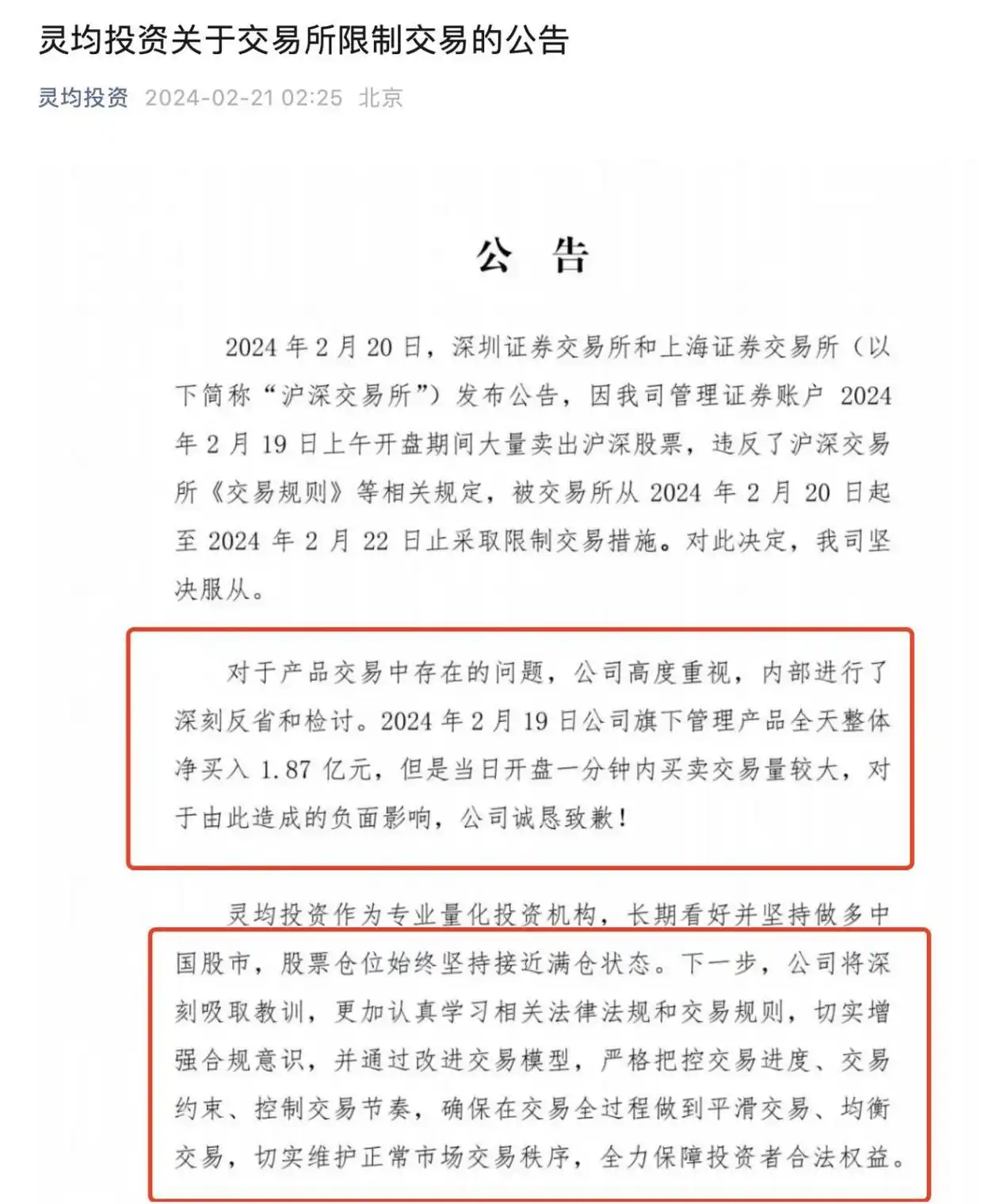
At 2:25 a.m. on February 21, Lingjun Investment issued an announcement on the exchange's trading restrictions, expressing "firm obedience", in-depth review, and apology to the investment.

Lingjun Investment stated in the announcement that the company will resolutely comply with the trading restrictions imposed by the Shanghai and Shenzhen Stock Exchanges. The company attaches great importance to the problems existing in product transactions and has conducted deep introspection and review internally.

The announcement also explained the transactions on the day of the penalty: On February 19, 2024, Lingjun’s management products had an overall net purchase of 187 million yuan throughout the day, but the trading volume was large within one minute of the opening of the day. The company sincerely apologizes for the negative impact caused.

The announcement also mentioned that Lingjun Investment, as a professional quantitative investment institution, is optimistic about and insists on being long in the Chinese stock market in the long term, and its stock positions have always been close to full. In the next step, the company will learn lessons deeply, study relevant laws, regulations and trading rules more seriously, effectively enhance compliance awareness, and by improving the trading model, strictly control the transaction progress, transaction constraints, and transaction rhythm to ensure smooth and balanced transactions throughout the transaction process, effectively maintain the normal market transaction order, and fully protect the legitimate rights and interests of investors.

Where will the quantitative industry go after Lingjun was fined_Quantitative Trading_Shanghai Index 5 consecutive positive quantitative trading supervision

The fourth stage (8:00-12:00 on February 21) The China Securities Regulatory Commission emphasizes that "one item will be matured and another item will be launched in the future" for quantitative supervision.

After the exchange took action, the China Securities Regulatory Commission also explained and emphasized quantitative supervision. According to multiple media reports, the Market Supervision Department of the China Securities Regulatory Commission stated that the China Securities Regulatory Commission has always paid attention to the development and supervision of quantitative trading. In recent years, it has successively promoted many tasks, including bringing quantitative trading into the scope of securities laws, establishing a data collection mechanism for leading quantitative institutions, strengthening quantitative trading monitoring and analysis, establishing a programmed transaction reporting system, strengthening private placement and securities lending supervision, etc.

The series of quantitative trading supervision measures introduced in the next stage will be matured one by one and launched one by one. We will fully strengthen communication with various investors in the market, grasp the pace and intensity of work, promote the standardized and healthy development of quantitative trading, and maintain the stable operation of the market.

“The focus of this quantitative trading supervision is on high-frequency trading.” The above-mentioned person further said that judging from international experience, overseas markets generally implement stricter supervision on quantitative trading, especially high-frequency trading, to prevent negative impacts on market order.

Germany, Japan, etc. have centralized regulations on quantitative trading in the form of written laws and implement access registration management for high-frequency traders. Germany stipulates the definition and characteristics of algorithmic trading and high-frequency trading, exchange fees, transaction monitoring indicators, system requirements, etc.; Japan has formulated and issued regulatory guidelines specifically for the supervision of high-frequency trading actors.

Markets such as the United States limit the speed at which high-frequency traders can obtain trading information, reduce information asymmetry, and ensure optimal execution of investor orders. At the same time, they clearly prohibit any market participant from participating in, specifying, or intending to conduct destructive trading behaviors, including "spoofing" and other market manipulation behaviors that have emerged with the rise of high-frequency trading.

Regarding the special reporting system for quantitative transactions currently implemented, supervision emphasizes that existing investors are currently "repaying all their dues" and incremental investors are "reporting first and then trading." Unreported investors cannot conduct programmed transactions, which is equivalent to allowing investors to "driving with a license" in the first place, providing institutional conditions for timely discovery of violations and real-time monitoring. (Reporter Yan Jun)

Trainee editor: Li Wenyu | Reviewer: Li Zhen | Supervisor: Wan Junwei

Under The Favorable Policies Of A-shares, Quantitative Private Equity Has Been Pushed To The Forefront, And Regulatory Measures Have Been Re-examined.

Implementation of Programmed Transaction Reporting System_Quantitative Trading_A-share Quantitative Private Equity Programmed Trading Supervision

Reporting from Shanghai by reporter Hu Jinhua of our newspaper (chinatimes.net.cn)

A-shares have recently received frequent favorable policies, but under the market conditions where the index is suppressed as soon as it rises, domestic quantitative private equity institutions that have become an important trading force have been pushed to the forefront. Whether they are bad elements who "help the stock market rise and kill the fall" in the stock market, or are "good students" who increase the activity of stock market transactions, the market cannot agree. However, in the eyes of regulators, it is necessary to re-examine domestic programmed transactions.

On the evening of September 1, the China Securities Regulatory Commission guided the three major stock exchanges in Shanghai and Shenzhen to issue the "Notice on Matters Concerning the Reporting of Programmed Stock Trading" and the "Notice on Matters Concerning Strengthening the Management of Programmed Trading". In these two notices, the three major exchanges clearly stated that they will implement real-time monitoring of the securities trading behavior of program trading investors, and focus on monitoring four types of matters: First, abnormal trading behaviors that may affect securities trading prices, securities trading volume, or exchange system security as stipulated in business rules; The second is a transaction with a maximum filing rate of more than 300 orders per second, or a maximum number of orders in a single day of more than 20,000. Third, the trading prices or trading volumes of multiple securities are obviously abnormal, during which a large number of programmed transactions are involved. Fourth, other matters that the exchange considers need to be monitored.

After the above two notices were issued, many well-known quantitative private equity institutions in the market spoke out, pointing out that their proportion of ultra-high-frequency trading was small and controllable, and the notices would have little impact on the company's trading level.

"In the past week, quantitative investment and private equity quantitative institutions have suddenly become the focus of market attention. The reason is that the A-share market has adjusted sharply after jumping from the high opening on Monday, coupled with the recent purchase of a luxury house by a private equity boss. After the fermentation of the Internet media, many investors believe that the stock market decline is 'cutting leeks' by quantitative institutions. The introduction of the above notice is the first time that my country has formally established a programmed transaction reporting system and corresponding regulatory arrangements in the stock market, clearly stipulating that stock exchanges include possible impacts. Strengthen monitoring and control of key matters such as abnormal trading behavior that affects securities trading prices, securities trading volume, or exchange system security. The purpose is to incorporate programming into the legal supervision system, crack down on illegal transactions using programmed trading, and maintain a healthy market environment. At the same time, the latest requirements will also promote the development of standardized trading and help the quantitative investment industry move forward steadily." Xu Jiaying, general manager of Shanghai Qianfulai Asset Management Company, said in an interview with China Times.

However, some people in the industry are worried that once high-frequency programmatic trading withdraws from the market, the activity of A-shares may be even lower.

Quantitative private equity players have spoken out

In recent years, the scale of quantitative private equity institutions has expanded rapidly. A number of tens of billions or even hundreds of billions of quantitative private equity giants have emerged in Beijing, Shanghai, and Shenzhen. These institutions have also lived up to customer expectations. When A-shares did not have large-level market prices and the index only fluctuated within a narrow range, they created considerable returns for customers. Although some quantitative products have poor returns, they far outperformed the net worth financial management of last year and the year before. However, quantitative private equity's focus on high-frequency trading and fast-in and fast-out style has also attracted the attention of more investors and fundamentalists.

On September 4, He Bin (pseudonym), a tens-billion-level quantitative private equity investor in Shanghai, analyzed during an interview that exchanges have been closely monitoring abnormal quantitative trading behaviors. Therefore, this time the focus of attention is on transactions with a maximum filing rate of more than 300 transactions per second, or a maximum daily filing rate of more than 20,000 transactions. Assume that the average order cancellation rate of a quantitative product is 6%, the minimum transaction amount is 10,000 yuan, and there are 20,000 transactions in a single day, the transaction volume is approximately 200 million yuan. If the turnover rate is 20% bilaterally per day, only products with a scale of about 1 billion yuan will be monitored intensively. Therefore, quantitative products with extremely high turnover rates or large scale may be focused on and additionally report multiple aspects of information.

According to statistics from a reporter from China Times, after the notice was issued, a number of quantitative institutions, including Qianxiang Assets, Niankong Technology, Siyuan Quantification, Century Frontier, Wenbo Investment, etc., expressed their attitudes.

Qianxiang Asset stated that the company’s alpha strategy includes three types: high frequency, medium frequency and low frequency, and the strategy is relatively balanced. At present, the proportion of stocks exchanged by the company every day is about 20%, which does not belong to ultra-high-frequency trading. The total daily declaration volume of products with a scale of less than 500 million yuan in the Shanghai and Shenzhen stock markets is less than 20,000 times. Therefore, the relevant measures introduced this time will not have much impact on the practicality of the company's current strategy. Relevant measures are expected to have a greater impact on strategies such as high-frequency bottom positions T0 and high-frequency securities lending T0.

"At present, the latest regulatory requirements have little impact on the operation of the company's strategy itself. Moreover, there is about a month's interval between the release of the "Reporting Notice" and "Management Notice" from the release to the official implementation. Each company has sufficient time to make adjustments and adaptations at the transaction execution level." Jukuan Investment said.

After the issuance of the above two notices, Siyuan Quantitative Investment Director Wang Xiong said that the China Securities Regulatory Commission guided major stock exchanges to introduce a series of measures to strengthen the supervision of programmed trading, which means that programmed trading will be included in a reasonable and legal regulatory system, which will help to further improve market transparency, crack down on illegal and illegal transactions using programmed trading, and maintain a healthy market order and ecology. At the same time, the latest requirements will also promote the standardized development of programmatic trading and help the quantitative investment industry move forward steadily.

Qianfulai Asset Management stated that the company’s quantitative transactions of convertible bonds did not reach this level in terms of declaration speed and quantity. And before the release of these two documents, most of the quantitative interfaces that I came into contact with also set limits on the frequency of declarations and the number of declarations. As an asset management company that interfaces with them, the company's system is actually designed according to the descriptions in the documents from beginning to end, so the new regulations basically have no impact on the company's trading behavior.

"For a mature and orderly capital market, standardized program transactions are indispensable. Therefore, the inclusion of program transactions in the regulatory system is of great significance for improving the resilience and vitality of the capital market. At the same time, regular reporting helps regulators understand the market situation more clearly, thereby improving the foresight and effectiveness of the entire market risk response, which will benefit the development of quantitative investment in the long run." Wang Xiao, chairman of Niankong Technology, pointed out.

On September 5, relevant people from Century Frontier told a reporter from China Times that since September 2021, regulators and multiple quantitative institutions have had many active communications, and established an information registration and reporting mechanism. In the process, they gradually understood the essence of quantitative trading, and finally settled into the content of this release.

"Judging from the results, the supervision recognizes programmatic trading as an important trading method, and also recognizes the positive significance of programmatic trading in improving transaction efficiency and enhancing market liquidity. We are still waiting for the further release of specific details. Based on the information we have seen so far, the standards of 300 declarations per second and 20,000 declarations per day are loose enough, and only require more information for exceeding the situation. We judge that it will not have a negative impact on the product." The person said frankly.

"Wenbo Investment calculates based on existing algorithmic trading that there are basically no strategies for trading more than 300 transactions per second. Calculated based on an average transaction amount of 10,000 yuan and a transaction rate of 70%, 20,000 subscriptions, an annualized change of hands 50 times, and a single product with an upper limit of 700 million yuan or more will receive special attention; such as If the company changes hands 200 times, special attention will be paid to those with a single product scale of more than 500 million yuan. Based on the overall assessment, it will not have a negative impact on the current strategy. The standardized development of the industry will be beneficial to the healthy development of the entire quantitative industry," the relevant person in charge of Wenbo Investment told this reporter.

What is the future of quantitative trading?

Currently, how much of the daily trading volume of A-shares is quantitative trading has always attracted market attention.

The Private Equity Filing Monthly Report of the Asset Management Association shows that as of the end of 2022, the scale of private securities investment funds will be approximately 5.6 trillion yuan. Calculated based on a 15% ratio, the scale of quantitative/hedge strategy funds at the end of 2022 may be between 800 billion and 900 billion yuan.

According to research and communication data released by Shenwan Hongyuan Securities, the average daily turnover rate of large-scale quantitative private equity is between 10% and 20%. Based on an estimated daily average turnover rate of 15% (the turnover rate of small and medium-sized quantitative private equity is generally higher), the daily trading amount contributed by quantitative private equity can reach more than 120 billion yuan, accounting for 13% of the average daily trading amount of A-shares in 2022.

“Compared with U.S. stocks, the current absolute scale and relative transaction proportion of A-share quantitative private placements are low, but it is already a part that cannot be ignored in the transaction structure of the A-share market. However, the notice issued by the regulatory authorities predicts that three types of products may be affected: The first is private equity high-frequency self-operated trading; the second is a time-selected hedging strategy product, that is, a product that uses A-shares to open lower in the morning to do T-quantity if the position is not satisfied overnight; the third is a product that combines large-scale holding reduction and uses securities lending," Xu Jiaying told a reporter from China Times.

Xu Jiaying believes that China's quantitative trading is dominated by medium and low frequency. At present, the average turnover rate of my country's leading quantitative institutions is far from reaching the standards of high-frequency trading, and high-frequency quantification often has relatively small strategic capacity, which will not have a great impact on the overall stock market trading volume and liquidity.

It is worth noting that the management recently proposed to continue to increase and promote the issuance of ETF funds to introduce more long-term funds into the market. Quantitative private equity institutions seem to be acting in unison to prepare to be long in the market.

"Comparing domestic and overseas markets, the situation where funds make money but investors do not is often due to investors being accustomed to procyclical operations. Especially during periods when market performance is unsatisfactory and the index is at a relatively low point, many investors lack confidence. As far as the current A-share market is concerned, market valuations have basically met the requirements. The absolute bottom characteristics are not significantly different from the historical bottoms of previous rounds of A-shares. It should be an excellent time to go long on the index and configure a quantitative index increase strategy, especially a fundamental index increase strategy.” On September 5, Xu Zhongxiang, founder of Ruilian Jingchun, a well-known foreign quantitative private equity firm, expressed his opinion.

Wang Li, general manager of Niankong Investment, said that at this stage, the A-share policy bottom has appeared, and the market bottom has yet to be verified. But overall, when the policy is basically established, it should be a better time to deploy quantitative index products. In addition, quantitative index growth products are always fully operated, and the inflow of related incremental funds will make a positive contribution to the overall funding of the A-share market.

The relevant person in charge of Mengxi Investment pointed out that the current A-share market is at a low level for many years, and the downside risk is much smaller than when the market was at a high level. Therefore, the "potential beta upside" of the quantitative index growth strategy is larger. From an asset allocation perspective, now is a good time to invest in quantitative index growth strategies. In addition, quantitative strategies such as quantitative index growth strategies have the characteristics of high positions and will have a significant positive effect on stabilizing and assisting market capital.

"The sound development path of quantitative trading involves multiple key factors. The first is transparency and supervision. It is very important to improve the transparency of quantitative trading and ensure that regulatory agencies have sufficient supervisory powers. Regulators need to understand quantitative trading strategies, algorithms and trading processes to monitor market manipulation, malicious trading and systemic risks. Regulators should also constantly update regulations to adapt to the rapid development of quantitative trading technology; secondly, risk management, quantitative trading companies should develop strict risk management Risk management policies, including limiting trading leverage, setting risk exposure limits and implementing risk control processes, can help prevent potential huge losses and market shocks; finally, there is market liquidity. Quantitative trading usually provides market liquidity, but it may also withdraw from the market in extreme circumstances. In order to ensure the stability of the market, quantitative traders need to cooperate with market regulators and other traders to ensure that sufficient liquidity is provided when the market fluctuates violently." Xu Jiaying told this reporter.

Bitcoin Price Plummets, What Impact Will Musk’s Remarks Have On It? Bitcoin Client Related Analysis

Sino-Singapore Jingwei client reported on May 19 that at noon Beijing time that day, the price of Bitcoin fell below the US$40,000/coin mark, falling by more than 9% during the day. Other virtual currencies also continued to fall, with Ethereum falling below $2,890 per coin, down 14.52% on the day. Dogecoin fell to US$0.4 per coin, and the intraday decline expanded to 20%.

Bitcoin price fell below $40,000_Bitcoin client_Virtual currency prices continued to fall

Source: Bitcoin.com

Is the sudden rise and fall all due to Musk?

In the past month, Bitcoin has gone out of the "jumping up and down" market, and the Bitcoin market during the year is also inseparable from Musk.

Bitcoin price fell below $40,000_Virtual currency prices continued to fall_Bitcoin client

Source: Bitcoin.com

In January 2021, after Musk changed his personal social media profile to "Bitcoin", Bitcoin rose by nearly 20% in a single day. On February 8, after Tesla’s purchase of Bitcoin documents was made public, Bitcoin rose by as much as 18.8% that day, exceeding US$46,000 per coin. On March 24, Musk announced on social media that Tesla could be purchased with Bitcoin, and then Bitcoin experienced a surge. On April 14, Bitcoin hit a record high of $64,800 per coin, and then began a downward trend. Perhaps because it fell too much, Musk announced on Twitter on May 13 that Tesla would suspend accepting Bitcoin as a payment method, and Bitcoin immediately fell wildly. On May 17, Musk hinted on social media that Tesla may have sold its remaining Bitcoin holdings, causing Bitcoin to plummet by more than 10%. That morning, Musk issued a statement clarifying that Tesla did not sell any Bitcoin. As soon as the news came out, Bitcoin rose in the short term.

Associations join forces to curb virtual currency risks, and some places have issued "mining" regulatory announcements

On the 18th, the China Internet Finance Association, China Banking Association, and China Payment and Clearing Association jointly issued an announcement on matters related to virtual currency transactions. The announcement emphasized that carrying out related transaction activities such as the exchange of legal currency and virtual currency and between virtual currencies, serving as a central counterparty to buy and sell virtual currencies, providing information intermediaries and pricing services for virtual currency transactions, token issuance financing, and virtual currency derivatives transactions, violates relevant laws and regulations, and is suspected of illegal fund-raising, illegal issuance of securities, illegal sales of tokens and other criminal activities.

On the same day, the Resource Conservation and Environmental Protection Division of the Inner Mongolia Development and Reform Commission issued the "Announcement on Accepting Letters and Reports on Problems with Virtual Currency Mining Enterprises." The announcement pointed out that the Office of the Autonomous Region's Energy Consumption Dual Control Emergency Command has established a virtual currency "mining" enterprise reporting platform to comprehensively clean up and shut down virtual currency "mining" projects, and improve the reporting channels for virtual currency "mining" enterprise problems.

(Original title: "Bitcoin fell below the $40,000 mark, what else is Musk going to say?")

Agricultural Bank Of China Issued A Statement: Prohibiting The Use Of Its Services To Trade Virtual Currencies Such As Bitcoin To Combat Illegal Activities

Sino-Singapore Jingwei Client, June 21 (Xinhua) The Agricultural Bank of China issued a "Statement on Prohibiting the Use of Our Bank's Services for Bitcoin and Other Virtual Currency Transactions" (hereinafter referred to as the statement) on its official website on the 21st.

The statement stated that in order to further implement the spirit of the meeting of the Financial Affairs Committee of the State Council and strictly implement the "Announcement on Preventing the Financing Risks of Token Issuance" and the "Announcement on Preventing Speculation Risks in Virtual Currency Transactions" and other regulations, in accordance with the recent interview and guidance requirements of the relevant departments of the People's Bank of China, we will continue to carry out crackdowns and governance actions against virtual currency transactions.

The statement mainly makes three points:

First, we will resolutely not carry out or participate in any business activities related to virtual currency. We prohibit the access of customers involved in virtual currency transactions and will increase the investigation and monitoring of customers and fund transactions. Once relevant behavior is discovered, measures such as suspending account transactions and terminating customer relationships will be immediately taken and reported to the relevant departments in a timely manner.

Second, in order to protect the legitimate rights and interests of customers and the security of funds in their accounts, please actively cooperate with due diligence, assist in fulfilling legal obligations, and combat illegal and criminal activities involving virtual currency mining and fund transactions.

Third, customers should be highly vigilant about the risks of virtual currency-related business activities, improve risk prevention awareness and identification capabilities, and beware of being deceived. If you discover the above-mentioned relevant behaviors, you can call the customer service hotline to report it.

The Agricultural Bank of China emphasized that it will strictly implement relevant national regulatory requirements, abide by industry self-discipline commitments, and resolutely crack down on virtual currency-related business activities. No institution or individual is allowed to use our bank accounts, products, services, etc. for token issuance financing and virtual currency transactions.

Introduction To The Background Of The Birth Of Bitcoin And Methods To Solve Two Major Problems In The Electronic Payment Industry

In 8 years, Bitcoin created a myth-the price increased nearly 3 million times, and the domestic price once exceeded 20,000 yuan. In this myth, different people see different stories. Speculators see opportunities to make money, technology geeks see technology that will change the future, and traditional financial institutions may see a growing ghost…

Today, Galaxy Research Institute will talk about something lighter and introduce the two most popular brothers in the electronic payment industry, Bitcoin and Ethereum, and their underlying blockchain technology. Can they really reshape the world economy? After reading this article, I hope you can get your own answer.

The birth of Bitcoin, the beginning of the revolution?

When it comes to the electronic payment industry, the first thing we think of is either Alipay or WeChat. In fact, behind these two giants, there are two problems that have been plaguing researchers, and they are also problems that truly show the "ambition" of the electronic payment industry:

The first is how to conduct online transfers between the two parties in need without going through an authoritative third party;

The second is how to record payment information while conducting electronic transfers to avoid repeated payments and ensure the safety of funds.

The solution of these two problems means that there will be an independent electronic currency system that has basically nothing to do with the current banking system.

In 2008, a person or a technical group published a white paper titled "A Person-to-Person Electronic Cash Payment System" under the pseudonym Satoshi Nakamoto. Nakamoto proposed two solutions to these two problems:

First, in person-to-person transfers, there is a need for an electronic currency whose value can be judged without being attached to a third-party pricing agency;

Then, we need to have a decentralized digital ledger (once there is a center, it means there is still an "authoritative third-party institution" equivalent to a traditional bank, which is obviously not in line with the ideal world of these geeks) that can distribute transaction records and stored transaction information to computers around the world. Of course, the ledger operates in roughly the same way as other traditional accounting methods.

In 2009, this technical solution that can transmit electronic wealth was officially launched. Its product form is Bitcoin, which has attracted widespread attention today. The underlying technical algorithm it relies on, which is now called blockchain technology, has been proven to have wider practical value and significance.

Although blockchain technology has not yet entered the mainstream government thinking and discourse system, as mentioned before, it has revolutionized the world's economic development.

The impact of Bitcoin and Ethereum on the world economy_Bitcoin mining principle_Electronic payment industry Bitcoin and Ethereum blockchain technology

1. Bitcoin surpasses Amazon

Bitcoin is essentially a decentralized, person-to-person electronic currency system. This kind of electronic banknote has no asset collateral, and it can be issued and circulated without going through clearing and custody institutions such as central banks and banks. Transaction and asset data are stored in every corner of the world connected to the Internet.

The transformation of human trading in the minds of geeks may look like this:

barter

Things – RMB, US dollars, rupees, rubles, pounds… – barter exchange

Things-Electronic Currency-Exchange

The first standardized value of Bitcoin was set at US$0.0008 on October 5, 2009, calculated based on the calculation that 1 US dollar equals 1309.03 Bitcoins. Each Bitcoin is currently trading at over $2,300. The intrinsic value of each Bitcoin has increased 2.9 million times.

According to the Washington Post, if you had purchased $100 worth of Bitcoin seven years ago, those bitcoins would be worth more than $73 million today. By comparison, if you had invested $100 in Amazon stock during its IPO in 1997, your investment would be worth about $64,000 now.

However, the intrinsic value of Bitcoin itself cannot be measured. Therefore, the speculative nature of Bitcoin as an electronic currency is much stronger than the stocks of companies such as Amazon. This means that short-term price fluctuations are very violent, and there is no basis for judgment on forward price trends.

As Bitcoin continues to dominate news headlines around the world, many onlookers naturally have a question: How did Bitcoin come about?

2. Are Bitcoins mined?

One of the characteristics of Bitcoin is that there is no central bank as an issuing institution, so how did they come into being? In fact, it can be said that it was gradually mined by Bitcoin miners.

Bitcoin mining principle_The impact of Bitcoin and Ethereum on the world economy_Electronic payment industry Bitcoin and Ethereum blockchain technology

The simplest analogy is to imagine the mining method of gold miners. Gold miners mine gold from the earth. As the gold is dug out and processed, the gold flowing into the market becomes part of the wealth and currency of the economy. The same is true for Bitcoin.

Newly mined Bitcoins are obtained through a complex competitive mining process – miners are rewarded with Bitcoins by running computational programs using highly specialized hardware facilities.

3. How to use Bitcoin?

When Bitcoins are mined, how will they be used and in what situations?

Bitcoin is traded on exchanges just like stocks, bonds, and currencies, and it can also be used as a currency to exchange services or goods.

Japan is the first country in the world to officially announce that it accepts Bitcoin as a legal currency. As Japan treats Bitcoin as a currency, it is expected that the number of suppliers and merchants that accept Bitcoin as a currency for purchasing goods and services will increase from 1,000 to 100,000.

The impact of Bitcoin Ethereum on the world economy_Bitcoin mining principles_Bitcoin Ethereum blockchain technology for the electronic payment industry

Such awesome technology and products that may "subvert the world" have received great attention since their emergence, and their value has continued to skyrocket. At present, the number of Bitcoin investors, enthusiasts, including some business people and even financial institutions is already very large.

The most important thing is that with its development, the two functions originally envisioned have been gradually realized and improved, and the idea of ​​whether it can be used as an equivalent electronic currency has been confirmed. Seeing that the originator of electronic currency was so popular and did not die on the beach, thousands of digital currencies were designed and generally kept their value rising. Among them, the most famous latecomer with high market value is Ethereum.

The current total market value of Bitcoin is approximately US$37 billion, and the total market value of Ethereum during the same period is approximately US$16 billion. While Bitcoin was the first electronic currency to appear on the market and thus received most of the media attention, many believe that the Ethereum blockchain and the Ethereum currency based on this technology will become a more powerful tool.

Competitor Ethereum

In the electronic payment industry, another white paper "impacting the world" has appeared.

In 2013, 19-year-old Vitalik Buterin first mentioned the idea of ​​Ethereum in a book titled "Ethereum White Paper: The Next Generation of Intelligent Connection and Decentralized Application Platform". Then in 2014, the Ethereum algorithm and protocol were officially implemented, and US$150 million was raised. The system itself was finally completed on July 30, 2015.

The impact of Bitcoin and Ethereum on the world economy_Bitcoin mining principle_Electronic payment industry Bitcoin and Ethereum blockchain technology

Vitalik Buterin

There is an issue that we need to understand very much, and it is also the biggest competitive potential and focus of debate on this platform: that is, Ethereum is not only an electronic currency, but also a platform and smart contract system based on blockchain technology, which can be used to build applications, and electronic currency is just one of the manifestations of this technology.

Similar to financial instruments, properties, domain names, and more complex financial product transactions, derivatives, gambling, as well as identity recognition and personal credit systems that involve the circulation and recording of information and wealth, Ethereum theoretically has a lot of room for development.

Take smart contracts as an example:

Smart contracts are Ethereum’s important contribution to the rapidly expanding field of electronic currency and blockchain technology. It can be seen as a way to use digital means to ensure the security of value exchange and other links. It can save the expensive services provided by professionals such as lawyers and notaries in a transparent and disintermediated way, and instead ensure the validity of the contract by executing the digital terms of the smart contract itself.

1. Ethereum VS Bitcoin

Now, let’s talk about another unique feature of Ethereum – the digital currency Ethereum.

Ethereum is a digital currency like Bitcoin, but the difference is that Ethereum has two digital currencies circulating and trading in the market. One of them uses ETH as the transaction token, and the other is called classic Ethereum, which circulates transactions under the token of ETC.

The impact of Bitcoin Ethereum on the world economy_Bitcoin mining principles_Bitcoin Ethereum blockchain technology for the electronic payment industry

ETC

The impact of Bitcoin and Ethereum on the world economy_Bitcoin mining principle_Electronic payment industry Bitcoin and Ethereum blockchain technology

ETH

The Ethereum Foundation defines the role of Ethereum as a fuel, or a means of payment that allows customers to pay for performing requested operations on servers in the Ethereum platform.

In 2016, a huge scandal shocked the Ethereum community. A still-unidentified hacker exploited a software vulnerability to try to steal more than $50 million worth of Ethereum. The result of this incident was the birth of the second type of Ethereum for transactions.

2. Where did Ethereum come from? What does it do?

Similar to Bitcoin, Ethereum is obtained through mining, with teams of miners verifying and storing Ether, which is then traded on the Ethereum platform. While Bitcoin and other digital currencies can be used to purchase goods or services, as mentioned before, Ethereum is primarily used to pay for fees incurred by users on the Ethereum network.

The value foundation of Bitcoin and Ethereum: Blockchain

Finally, let’s talk about the value foundation of Bitcoin and Ethereum—blockchain technology. The original idea of ​​the framework proposed by Nakamoto was to allow individuals to quickly complete online transactions without the need for traditional middlemen or third parties. This technical framework is currently known as blockchain.

Blockchain is an indestructible digital ledger that can be set up to record not just financial transactions, but almost any valuable information without fear of tampering.

In the simplest model, the blockchain is a simple distributed ledger, but the inherent meaning of the blockchain is far greater than the superficial meaning of its name. Blockchain can transfer value itself during the transaction process. As Sally Rivers, a technology writer at the Financial Times, said, for Bitcoin, blockchain is to it what the Internet is to email.

Just as email facilitates the communication of information, blockchain facilitates the transfer of wealth.

Areas where blockchain technology is being rapidly explored and deployed include capital markets, financial services, payment and remittance, derivatives trading, credit management, government governance, sharing economy, supply chain, auditing, stock trading, the Internet of Things, insurance, healthcare, and many more.

Although digital currencies such as Bitcoin and Ethereum have achieved extraordinary development speed, their size and value are still insignificant compared to the traditional monetary system. It is still difficult to predict how much impact digital currencies will have on the traditional monetary system backed by assets or sovereign credit in the future.

But the development value of blockchain technology goes without saying. It is foreseeable that the blockchain technology hidden in the gorgeous figure of digital currency will be well integrated with the traditional financial industry. In the future, currency transactions, financial asset transactions and transfers, including personal credit records will all rely on the security protection brought by blockchain technology. Perhaps blockchain will be the "ghost" that accompanies the traditional financial system's transition to an unknown digital monetary and financial system.

Reference article: Billy Silva, “Blockchain for the Rest of Us”.

Introduction To Litecoin: Based On The Bitcoin Protocol, Transactions Are Confirmed Quickly And Mining Is Open To The Public.

Litecoin

Litecoin is an online currency based on peer-to-peer technology, which can help users make instant payments to anyone in the world.

Introduction to Litecoin

It is based on the Bitcoin protocol, but unlike Bitcoin, it can be "mined" efficiently with consumer-grade hardware. Litecoin provides you with faster transaction confirmations (2.5 minutes on average), uses hard memory and a mining proof-of-work algorithm based on scrypt (an encryption algorithm), targeting ordinary computers and graphics processing units (GPUs) used by most people. The Litecoin network is expected to produce 84 million currency units.

One of the design goals of Litecoin is to provide a mining algorithm that can be run simultaneously on the machines that mine Bitcoin. While application-specific integrated circuits (ASICs) designed for mining Bitcoin are gradually emerging, Litecoin is also following the technological evolution. But until Litecoin currency is widely adopted, it is unlikely that there will be an application specific integrated circuit (ASIC) designed specifically for Litecoin.

>>>Litecoin LTC mining tutorial: cpu mining and gpu mining

What is the difference between Litecoin and Bitcoin?

Litecoin is inspired by Bitcoin (BTC) and technically shares the same implementation principles. The creation and transfer of Litecoin is based on an open source cryptographic protocol that is not governed by any central authority. Litecoin aims to improve Bitcoin and has three significant differences compared to it:

First, the Litecoin network can process a block every 2.5 minutes (instead of 10 minutes), thus providing faster transaction confirmations.

Second, the Litecoin network is expected to produce 84 million Litecoins, which is four times the amount of currency issued by the Bitcoin network.

Third, Litecoin uses the scrypt encryption algorithm first proposed by Colin Percival in its proof-of-work algorithm, which makes Litecoin mining easier on ordinary computers compared to Bitcoin. Each Litecoin is divided into 100,000,000 smaller units, defined by eight decimal places.

Litecoin History

Litecoin was released on October 7, 2011 through the open source client on Github. The current (as of April 19, 2013) version of the client is v0.6.3c. Other clients have also been released.

Litecoin has been in the news recently as an alternative to Bitcoin.

On April 30, 2013, Mt. Gox, the world's largest Bitcoin trader, announced that it would temporarily postpone its plan to support Litecoin trading. Mt.Gox said it originally planned to launch a platform that supports Litecoin transactions in the past two weeks, but the plan was delayed due to a large-scale DDOS attack on the website.

On July 3, 2013, Mt.Gox launched the API for LTC trading today in preparation for its official launch.

Litecoin client

Litecoin

Litecoin is a free software project released under the MIT/X11 license, which allows you to run, modify and copy the software according to your needs. If you wish, you may also distribute modified versions of the software.

The software is released with full transparency, allowing users to independently verify the binary version as well as the corresponding source code.

Litecoin data block chain

The Litecoin blockchain is capable of handling larger transaction volumes than its competitor, Bitcoin. Since data blocks are generated more frequently, the network can support more transactions without the need to modify the software in the future.

As a result, merchants can get faster transaction confirmations and still be able to wait for more transaction confirmations when selling large-ticket items.

Litecoin wallet encryption

Wallet encryption keeps the private keys in your wallet safe, allowing you to view transactions and account balances, but you must enter your password before using Litecoin.

This function not only prevents the intrusion of viruses and Trojans, but is also an effective legality check before payment.

award

"Miners" can initially produce 50 coins per data block. Every 4 years, the amount of currency produced is reduced by half (840,000 blocks).

Therefore, the total amount of currency produced by the Litecoin network will be approximately 4 times that of Bitcoin, or 84 million Litecoins. (The content of this article is based on Baidu Encyclopedia and Wikipedia)

Litecoin trading

Litecoin transactions, balances, and issuance are processed by a peer-to-peer network similar to Bitcoin through the Scrypt proof-of-work scheme (when a sufficiently small hash value is discovered, a block is created, and Litecoin is issued, and the process of discovering this hash value and creating the block is called "mining").

The issuance rate of Litecoin follows a geometric sequence, halving every four years (every 840,000 blocks), eventually reaching a total of 84 million LTC. Unlike Bitcoin, the memory-intensive nature of Scrypt makes Litecoin more suitable for "mining" with graphics processing units (GPUs). The FPGA (Field Programmable Gate Array) and ASIC (Application Specific Integrated Circuit) implemented for Scrypt are more expensive than the sha256 used by Bitcoin.

Litecoin can currently be exchanged for fiat currencies as well as Bitcoin, mostly through online exchanges. Reversible transactions (such as those made with a credit card) are generally not used to purchase Litecoin because Litecoin transactions are irreversible and therefore pose chargeback risks.

As of April 25, 2013, one Litecoin was worth approximately $3.97 or 0.028 Bitcoin. This makes Litecoin the second-largest electronic currency with a market capitalization of approximately $35,000,000.

Bitcoin Theft Solved! Be Wary Of Security Risks Posed By Bitcoin Clients

Bitcoin is a virtual commodity whose price has continued to skyrocket due to speculation in recent years. Recently, the Henan Province Zhongyuan Oilfield Public Security Bureau successfully cracked the country's first Bitcoin theft case after more than three months of investigation.

On July 27 this year, the Henan Province Zhongyuan Oilfield Public Security Bureau received a call from Wu, a resident of the jurisdiction, claiming that more than 3.4 million yuan worth of Bitcoins he had stored in his online wallet were lost. Wu is a professional investor who started investing in Bitcoin in 2016. In early 2017, he was pulled into a WeChat group of Bitcoin investors.

Zhang Hongzhou, a police officer from the Criminal Investigation Detachment of Zhongyuan Petroleum Field Public Security Bureau in Henan Province: The group leader often posts some messages in the group, saying that it is not safe to put Bitcoin on the trading platform, and it is not absolutely safe. Then he contacts the victim, and when chatting through WeChat, he says that I have a software, and the (electronic) wallet generated by this software is absolutely safe. He sends this software to the victim, and the victim puts all the Bitcoins into this wallet.

WeChat chat records show that WeChat group leader Dai sent the software to Wu on July 16 this year. Following Dai's instructions, Wu deposited 188.31 Bitcoins into the online wallet that day. On July 25, Wu went online after returning from travel and found that the number of Bitcoins in his online wallet was actually 0. Subsequently, Wu contacted Dai many times, but Dai always used various reasons to deal with Wu and was unwilling to have direct contact with him. Under Wu's repeated questioning, Dai actually made an unexpected move.

​Victim Wu: In the end, he said that he was also responsible. Although he taught me that I lost my coins, he was also out of good intentions and said that he would compensate me 10 (bit) coins, saying that he could only bear the part that he was responsible for. Later, he actually transferred money to me using Alipay. If it had nothing to do with him, how could he casually accompany others? Hundreds of thousands, not a small amount.

Crack password-stealing software, police arrest suspect

After preliminary investigation, the police determined that Dai, the owner of the WeChat group, was suspected of committing a major crime. On August 9 this year, the police detained Dai in Shanghai. In Dai's home, the police found 27 bank cards and multiple computers. In one of the computers, the police found an online wallet software that was exactly the same as that used by the victim Wu.

It turned out that Dai was proficient in software programming. After cracking the downloaded genuine wallet software, he added a program to transfer usernames and passwords to steal Bitcoins. Once someone else deposited Bitcoins into an electronic wallet, he would know the other person's account name and password and transfer the Bitcoins in the electronic wallet. He stored the stolen Bitcoins in hundreds of online wallets, transferred them back and forth, and sold them at a low price on the trading platform after confirming their safety. In this way, Dai has committed three crimes, involving more than 20 million yuan. At present, the police have identified Dai's account and frozen it, and have recovered more than 2 million yuan in stolen money.

The police reminded that Bitcoin is a virtual commodity and it is difficult to recover it if something goes wrong during the transaction.

​Su Haizhou, Captain of the Serious Case Brigade of the Criminal Investigation Detachment of the Zhongyuan Petroleum Field Public Security Bureau of Henan Province: Our country has closed all three Bitcoin trading platforms before the end of October 2017. The country currently only recognizes Bitcoin as a virtual commodity and does not recognize its identity as a virtual currency. Therefore, you need to be cautious if you want to invest in Bitcoin.

(Originally titled "Henan Police cracked the country's first Bitcoin theft case")

Bitcoin Mining Principle: How To Obtain Virtual Currency Rewards Through Calculation Code?

The so-called "mining" is to calculate and produce virtual currency through special computers, namely "mining machines". The "miners" only ensure the power supply and network connection of the mining machines.

Take Bitcoin “mining” as an example.

Bitcoin is the first decentralized cryptocurrency. At every other point in time, the Bitcoin system generates a random code on the node. All computers on the Internet can look for this code. Whoever finds this code will generate a block. According to the reward mechanism issued by Bitcoin, every time a block is generated, the node will receive corresponding rewards.

[Note: Cryptocurrency is a trading medium that uses cryptographic principles to ensure transaction security and control the creation of trading units. 】

This process of finding codes and getting rewards is called “mining”.

But there is a problem with Bitcoin "mines", that is, the total number is limited. However, after all, virtual currency is just a few lines of code. Slightly modifying the Bitcoin code becomes a new virtual currency. As a result, various virtual currencies are like crucian carps crossing the river, and those named after animals include Dogecoin, Shiba Inu Coin, Cat Coin, Duck Coin, etc.

In each "mine", countless "miners" are digging day and night, and many people make a lot of money by relying on their first-mover advantage. But as the number of people increased, the competition for mining equipment began, with most miners using powerful, specialized computers to mine cryptocurrencies around the clock. From CPUs, GPUs, FPGAs, to giant warehouses with ASIC Bitcoin mining machines, the computing power has increased astonishingly.

[Note: Computing power, also known as hash rate, is a unit of measurement for the processing power of the Bitcoin network. 】

In addition to constantly upgrading "mining" equipment, many people choose to join forces to form a "mining pool."

The principle is: bring together a group of scattered "miners", and everyone will "mining" together and go hand in hand. There is power in numbers, and the possibility of a group of people poaching is much higher than working alone. When the digital currency is mined, it will be distributed according to the computing power of the equipment. Even if you are unlucky and don't get it, you can still get a share of the pie as long as you enter the "mining pool".

What's more, "mines" have been built. The interior of the huge factory building is divided into about 30 computer rooms with white partitions. The metal racks in each computer room are filled with servers, and the messy wires and power strips are covered with thick dust. There were no workers in the factory, only the roar of fans could be heard.

Electric black hole

Behind the huge computing power that supports "mining", there is also even more terrible power consumption.

As the types of virtual currencies continue to increase, the power consumption caused by virtual currency “mining” is increasing explosively. A "mine owner" once revealed that the electricity consumption of a "mine" in a year is equivalent to the total electricity consumption of several cities in a year.

Bitcoin Mining Principle_Bitcoin Mining Principle_Bitcoin Mining

Cryptocurrency mining machines consume an astonishing amount of power. Picture|Picture Chong Creative

According to the Cambridge University Bitcoin Power Consumption Index, Bitcoin mining consumes an estimated 133.68 terawatt hours of electricity per year (1 terawatt hour is 1 billion kilowatt hours of electricity). This number exceeds the electricity consumption of Sweden, ranking 27th in the world.

However, the Financial Times further pointed out that Cambridge University’s prediction is calculated based on Bitcoin “miners” using the least efficient computers to “mine”, so the actual power consumption of “mining” may be higher than the above estimates.

Why does “mining” consume so much power?

We can do some math.

Generally speaking, "mining" is mainly divided into graphics card mining machines and ASIC (professional) mining machines.

[Note: ASIC refers to application specific integrated circuit. 】

Graphics card mining machines mainly use graphics cards to mine. For example, the power of the RX570 graphics card is 150-160 watts, and the total power of a mining machine with 6 graphics cards is generally close to kilowatts.

Let’s look at professional mining machines that use chip mining. The Antminer S9 mining machine has a smaller power consumption of 1,400 watts, while the Shenma M3 mining machine has a larger power consumption, exceeding 2,000 watts.

From this, it can be estimated that the power consumption of a mining machine working normally for one hour is 1-2 degrees.

Although this number may not seem like much, Bitcoin mining machines need to run 24 hours a day. The Antminer S9 mining machine requires 33.6 kilowatt-hours of electricity a day, while the Whatsminer M3 mining machine requires at least 48 kilowatt-hours a day, consuming 1,440 kilowatt-hours of electricity a month. A normal household only consumes 200-400 kilowatt hours of electricity per month.

In the "mine", many mining machines are placed densely, which consumes power and also releases a lot of heat. In order to ensure the normal operation of the mining machine, the "mine" must also be equipped with large fans to ventilate and dissipate heat. A three-phase large fan has a power of 1,000-2,000 watts, and the fans all over the walls outside the "mine" also consume an astonishing amount of power.

For a "mine", "revenue = produced Bitcoin × currency price – mining machine cost – electricity fee – maintenance fee and labor cost – mine depreciation fee." The most important expense is the electricity fee.

Therefore, places with cheap electricity rates have become a natural choice for “mining”.

Washington State in the United States has relatively low electricity bills and is home to many “mining” companies including GigaWatt. Wenatchee, a small town east of Seattle, has extremely low electricity prices, only 2-3 cents/kWh. It has attracted dozens of "miners" to settle there and has become the center of Bitcoin "mining" in the United States.

In Sichuan, China, abundant hydropower resources also provide convenience for “mining”. In order to purchase electricity from the nearest power station, some "mines" were built on river embankments without environmental impact assessment or construction approval. It is reported that for every 100 Bitcoins mined in the world, 5 are produced in the Dadu River.

"Mining" that depends on the weather is occasionally affected by the weather. If there is too much rainfall and the hydropower station cuts off the power supply of the "mine", the "mining pool" will no longer be able to operate; if there is too little rainfall, a large number of mining machines cannot be started, which invisibly increases the sunk cost.

To solve these problems, "mines" will also migrate with the seasons like migratory birds. When the flood season ends and electricity prices rise, “mine owners” often move their equipment to areas where thermal power is cheaper.

eliminate! No mercy!

Since 2020, various regions in Sichuan have begun to introduce policies one after another, hoping to use sufficient hydropower resources to support the development of the Bitcoin "mining" industry to alleviate the economic pressure caused by the epidemic. However, some mining companies use "big data, blockchain projects, supercomputing centers" as guise to defraud local government support and cause serious waste of public resources.

In a certain province in the west, a so-called "data business" company consumes as much as 25 million kilowatt-hours of electricity per month; monitoring by the Jiangsu Provincial Communications Administration found that virtual currency activities in the province consume 260,000 kilowatt-hours of electricity per day.

Someone from a domestic power plant calculated an account for us. If a family consumes 300 kilowatt-hours of electricity a month, 260,000 kilowatt-hours of electricity a day is equivalent to the electricity consumption of 866 families for a month. A small-unit power plant uses 320 grams of standard coal (7,000 kcal of standard coal) to generate 1 kilowatt hour of electricity, and "mining" consumes 78 tons of standard coal a day.

Bitcoin Mining_Bitcoin Mining Principle_Bitcoin Mining Principle

On September 25, 2021, a store in Shenzhen sold virtual currency mining machines. Picture | Visual China

Currently, more than 120 countries and two-thirds of the world's economies have joined the "carbon neutrality" transition. Under this trend, the high energy consumption issue of virtual currency “mining” has become the focus of heated discussions in the industry.

At the same time, unlike traditional currencies, cryptocurrencies are not backed by a specific government or bank, and their decentralized and anonymous nature means there is no regulator deciding how much money will flow into the market.

The endless growth of the "mining" industry has also led many domestic retail investors to illegally participate in virtual currency transactions and speculation, seriously disrupting the economic and financial order, spawning illegal and criminal activities, and becoming an illegal channel for money laundering, tax evasion, terrorist financing, and cross-border fund transfers.

Purging is imperative.

On May 18, 2021, the Internet Finance Association, the Banking Association, and the Payment and Clearing Association jointly issued the "Announcement on Preventing the Risks of Speculation in Virtual Currency Transactions", requiring member institutions not to carry out virtual currency transaction exchanges and other related financial businesses, resolutely resist illegal financial activities related to virtual currency, and not provide accounts, payment settlement, publicity and display and other services for virtual currency transactions.

On the same day, the Inner Mongolia Autonomous Region Development and Reform Commission announced on its website that it would comprehensively clean up and shut down virtual currency mining projects. Soon after, the Natural Resources and Planning Bureau of Kangding City in Sichuan stated that multiple departments in Kangding City had set up a working group to conduct a thorough investigation of Bitcoin mining on the Dadu River and then clean up violations. The Hainan Provincial Development and Reform Commission also clarified that differential electricity prices will be implemented for virtual currency "mining" activities, with the price increase standard being 0.80 yuan per kilowatt hour.

On September 24, ten departments including the central bank, the China Banking and Insurance Regulatory Commission, the Cyberspace Administration of China, and the State Administration of Foreign Exchange issued the "Notice on Further Preventing and Dealing with the Risks of Speculation in Virtual Currency Transactions." The notice pointed out that virtual currencies such as Bitcoin and Ethereum do not have the same legal status as legal tender and cannot be circulated in the market as currencies; virtual currency-related business activities are illegal financial activities and should be resolutely banned in accordance with the law.

At the same time, the National Development and Reform Commission also issued a document, targeting "mining": prohibiting "mining" in any name, including the relevant commitments of data center companies in credit reporting; classifying virtual currency "mining" activities as an eliminated industry, and stopping all fiscal and tax support.

In December, the Beijing Chaoyang District Court and the Dongcheng District Court successively declared the Bitcoin mining contract invalid, making it difficult to even file a case for cryptocurrency-related telecommunications fraud.

Virtual currency “mining” is officially listed as a phased-out industry, which will release a large amount of power resources that are occupied by ineffective and harmful production capacity, so that efficient and beneficial production capacity can obtain relatively sufficient power guarantee, which will help reduce the degree of power shortage, narrow the scope of power restrictions, and effectively reduce greenhouse gas emissions caused by ineffective energy demand.

At the same time, this will also help promote the development of new industries such as energy storage, support the construction of new power systems, serve wind power, photovoltaics and other renewable energy power generation on a large scale, and achieve large-scale substitution of fossil energy with low-carbon renewable energy. It is of great significance to promote the optimization of my country's industrial structure, promote energy conservation and emission reduction, and achieve carbon peak and carbon neutrality goals as scheduled.

Cao Xiao, a professor at the School of Finance at Shanghai University of Finance and Economics, said: Technology itself is not right or wrong. While cracking down on "mining," we must pay attention to distinguishing it from blockchain technology, and adopt a regulatory approach that separates "chains" and "coins."

China has the advantages of massive data and rich application scenarios, and has broad application prospects in the future. How to keep relevant industries from going astray, how to clarify the boundaries of rights and responsibilities of all parties, and how to improve the big data governance system will be the focus of future supervision.

References:

Why Is Bitcoin So Popular? This Article Will Help You Understand The Principles And Advantages Of Bitcoin Mining

Bitcoin, which can be called the "digital gold" of virtual currencies, has seen a sharp rise in global transaction prices in recent days. On June 6, the price of one Bitcoin rose to nearly 20,000 yuan, a record high.

Previously, a "Want to Cry" ransomware attack that ravaged the world attracted global attention. Different from previous virus attacks, this time the hacker did not block the road, but put forward a condition: If you want to recover the data, you can exchange it for Bitcoin!

Anonymous, tax-free, supervision-free, and borderless… the mysterious Bitcoin has once again attracted the attention of all sectors of society and even financial regulatory agencies in various countries. Although the virus attack has been controlled to a certain extent, all parties are still worried that Bitcoin will once again become a money laundering tool for hackers.

Why is Bitcoin so popular? Xiao Lei, chief researcher of Gold Wallet, analyzed that Bitcoin has several advantages that existing financial systems do not have, such as its anonymity. Secondly, it skips the traditional financial system of financial intermediaries, such as banks. Another point is that it is global, especially if it is spread on the Internet, you actually don’t know where the person who initiated the payment is. Bitcoin is now a very expensive thing, its price has exceeded that of gold.

Obtaining is like mining, Bitcoin is equal to "digital gold"

In 2008, when the global financial crisis broke out, a person calling himself Satoshi Nakamoto posted a research report titled "Bitcoin: A Peer-to-Peer Electronic Cash System" on a secret cryptography review group, and Bitcoin was born. On January 3, 2009, the world’s first batch of Bitcoins were “digged”.

Bitcoin is a digital virtual currency. Compared with legal currency, its biggest feature is "decentralization", that is, it does not rely on any issuer, but is generated by calculation. Anyone can obtain it through specific 64-bit operations. Issuance and system security are based on mathematical principles. According to Satoshi Nakamoto's design, the total number of Bitcoins is only 21 million. Currently, more than 16 million Bitcoins are owned by individuals, and the remaining nearly 5 million Bitcoins require a large amount of data calculations to obtain.

The process of obtaining Bitcoin is vividly called "mining", and the participants in mining are "miners", and the supercomputers needed for mining are "mining machines". The process of "mining" is essentially the process of using a computer to solve a complex mathematical problem. In short, mining is like using a computer to solve a complex mathematical problem. Every time a qualified answer is obtained, the Bitcoin network will generate a certain amount of Bitcoin as a reward.

Today, the number of Bitcoins is getting smaller and smaller, and the difficulty of mining is constantly rising, so latecomers mostly obtain them through transactions. Bitcoins can be traded around the world with the help of the Internet. Deng Jianpeng, a professor at the Law School of Minzu University of China and vice president of the China Technology and Finance Law Research Association, said that transferring Bitcoin to the other side of the world is as simple as sending an email, with low cost and no restrictions. Therefore, Bitcoin is used in cross-border trade, payment, remittance and other fields.

Users can use Bitcoin to purchase some virtual items, such as clothes, hats, equipment, etc. in online games. As long as someone accepts it, Bitcoin can also be used to purchase items in real life.

The first transaction in Bitcoin history occurred on May 22, 2010. On that day, a Florida programmer named Han Yates purchased two pizzas for 10,000 Bitcoins.

At the end of November 2013, a restaurant in Beijing launched Bitcoin payment. At the end of the meal, consumers can complete the payment by transferring a certain amount of Bitcoin to the restaurant's account. The whole process is similar to a bank transfer. The restaurant once settled a meal of 650 yuan with 0.13 Bitcoins.

Digital currency is coming, is it worth investing in?

Currently, there are dozens of active Bitcoin trading platforms around the world. According to the latest statistics from the Huobi Blockchain Research Department of the Chinese Bitcoin trading platform, the Japanese yen ranks highest in recent currency-denominated Bitcoin transaction volumes around the world, accounting for more than 30.8%. Previously, Japan’s transaction volume once reached 46%, and nearly half of the world’s Bitcoin transactions occurred in Japan.

Japan introduced regulatory policies around February and March this year, allowing digital currencies like Bitcoin to flow legally within Japan. Globally, this is the first developed country to officially have a relatively positive policy attitude toward digital currencies like Bitcoin. Announced recognition of Bitcoin as a legal payment method. Subsequently, Peach Airlines, Japan’s largest low-cost airline, announced that it would become the first airline in Japan to accept Bitcoin tickets. Peach Airlines is not the first company to announce that it will use Bitcoin for payment. Big Camera, a large electronics chain, has previously announced that it fully supports Bitcoin payment.

However, Bitcoin transactions are not only risky, but are often bundled with illegal activities, so they have been questioned since its birth. The Bitcoin trading market has no price limit, and the price is easily controlled, resulting in violent fluctuations and extremely high risks. In December 2013, the price of Bitcoin reached a historical high of US$1,147, but then plummeted, falling to more than US$100 by early January 2015. Experts exclaimed that "Bitcoin contains huge investment risks, which is worrying."

Xiao Lei believes that Bitcoin looks very attractive, but it is only a speculative product and cannot be called an investment product. Because it does not have a complete price model, the rapid appreciation of Bitcoin is actually a kind of speculation demand by everyone.

Whether Bitcoin is worth investing in? According to Xu Baolong, director of Huobi Blockchain Research Center, from an investment perspective, it is really not recommended that you buy Bitcoin after seeing it rise. The risk of its skyrocketing or plummeting is very high. For investors, first of all, do not blindly follow the trend, and make prudent decisions after having a certain understanding. In addition, Bitcoin is called a cryptocurrency, which does not mean that it is really a currency. It is actually a high-risk, high-yield thing. If you consider it as a long-term investment based on understanding, you can also consider it.

However, Xiao Lei pointed out that the price of Bitcoin depends on everyone’s acceptance. If everyone believes that this thing will be valuable in the future, then the demand will increase, and under the premise of limited supply, the price may rise to a very high price. But it cannot be ruled out that if at a certain point, everyone finds that its payment function is not as convenient as WeChat and Alipay, and suddenly does not recognize it, then the possibility of collapse is also very high.

"China should rush to study the issue of digital currency, explore scientific and systematic regulatory methods and means, support relevant systems, bring it into the scope of supervision as soon as possible, standardize the development of Bitcoin, and lay a good foundation for my country's future legal digital currency." Yin Lei, deputy director of the Department of Finance at Nanjing University of Finance and Economics, said.

Sign In

Forgot Password

Sign Up