Litecoin
Litecoin is an online currency based on peer-to-peer technology, which can help users make instant payments to anyone in the world.
Introduction to Litecoin
It is based on the Bitcoin protocol, but unlike Bitcoin, it can be "mined" efficiently with consumer-grade hardware. Litecoin provides you with faster transaction confirmations (2.5 minutes on average), uses hard memory and a mining proof-of-work algorithm based on scrypt (an encryption algorithm), targeting ordinary computers and graphics processing units (GPUs) used by most people. The Litecoin network is expected to produce 84 million currency units.
One of the design goals of Litecoin is to provide a mining algorithm that can be run simultaneously on the machines that mine Bitcoin. While application-specific integrated circuits (ASICs) designed for mining Bitcoin are gradually emerging, Litecoin is also following the technological evolution. But until Litecoin currency is widely adopted, it is unlikely that there will be an application specific integrated circuit (ASIC) designed specifically for Litecoin.
>>>Litecoin LTC mining tutorial: cpu mining and gpu mining
What is the difference between Litecoin and Bitcoin?
Litecoin is inspired by Bitcoin (BTC) and technically shares the same implementation principles. The creation and transfer of Litecoin is based on an open source cryptographic protocol that is not governed by any central authority. Litecoin aims to improve Bitcoin and has three significant differences compared to it:
First, the Litecoin network can process a block every 2.5 minutes (instead of 10 minutes), thus providing faster transaction confirmations.
Second, the Litecoin network is expected to produce 84 million Litecoins, which is four times the amount of currency issued by the Bitcoin network.
Third, Litecoin uses the scrypt encryption algorithm first proposed by Colin Percival in its proof-of-work algorithm, which makes Litecoin mining easier on ordinary computers compared to Bitcoin. Each Litecoin is divided into 100,000,000 smaller units, defined by eight decimal places.
Litecoin History
Litecoin was released on October 7, 2011 through the open source client on Github. The current (as of April 19, 2013) version of the client is v0.6.3c. Other clients have also been released.
Litecoin has been in the news recently as an alternative to Bitcoin.
On April 30, 2013, Mt. Gox, the world's largest Bitcoin trader, announced that it would temporarily postpone its plan to support Litecoin trading. Mt.Gox said it originally planned to launch a platform that supports Litecoin transactions in the past two weeks, but the plan was delayed due to a large-scale DDOS attack on the website.
On July 3, 2013, Mt.Gox launched the API for LTC trading today in preparation for its official launch.
Litecoin client
Litecoin
Litecoin is a free software project released under the MIT/X11 license, which allows you to run, modify and copy the software according to your needs. If you wish, you may also distribute modified versions of the software.
The software is released with full transparency, allowing users to independently verify the binary version as well as the corresponding source code.
Litecoin data block chain
The Litecoin blockchain is capable of handling larger transaction volumes than its competitor, Bitcoin. Since data blocks are generated more frequently, the network can support more transactions without the need to modify the software in the future.
As a result, merchants can get faster transaction confirmations and still be able to wait for more transaction confirmations when selling large-ticket items.
Litecoin wallet encryption
Wallet encryption keeps the private keys in your wallet safe, allowing you to view transactions and account balances, but you must enter your password before using Litecoin.
This function not only prevents the intrusion of viruses and Trojans, but is also an effective legality check before payment.
award
"Miners" can initially produce 50 coins per data block. Every 4 years, the amount of currency produced is reduced by half (840,000 blocks).
Therefore, the total amount of currency produced by the Litecoin network will be approximately 4 times that of Bitcoin, or 84 million Litecoins. (The content of this article is based on Baidu Encyclopedia and Wikipedia)
Litecoin trading
Litecoin transactions, balances, and issuance are processed by a peer-to-peer network similar to Bitcoin through the Scrypt proof-of-work scheme (when a sufficiently small hash value is discovered, a block is created, and Litecoin is issued, and the process of discovering this hash value and creating the block is called "mining").
The issuance rate of Litecoin follows a geometric sequence, halving every four years (every 840,000 blocks), eventually reaching a total of 84 million LTC. Unlike Bitcoin, the memory-intensive nature of Scrypt makes Litecoin more suitable for "mining" with graphics processing units (GPUs). The FPGA (Field Programmable Gate Array) and ASIC (Application Specific Integrated Circuit) implemented for Scrypt are more expensive than the sha256 used by Bitcoin.
Litecoin can currently be exchanged for fiat currencies as well as Bitcoin, mostly through online exchanges. Reversible transactions (such as those made with a credit card) are generally not used to purchase Litecoin because Litecoin transactions are irreversible and therefore pose chargeback risks.
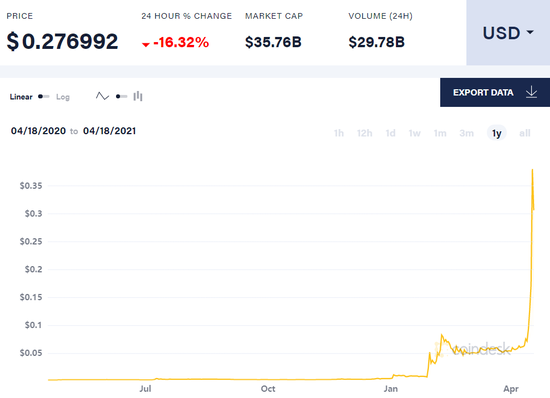
As of April 25, 2013, one Litecoin was worth approximately $3.97 or 0.028 Bitcoin. This makes Litecoin the second-largest electronic currency with a market capitalization of approximately $35,000,000.