See the living inheritance of traditional skills through the live broadcast of spring tea.
The tea proverb goes, "Spring rain is as valuable as oil, and spring tea is as valuable as gold." For tea lovers, sipping spring tea is the ritual of spring. Only this year, there is something new in the way of opening this sense of ritual – more than 270 million users choose to follow and learn about Spring Tea in the live broadcast room, using the screen as the "first scene".
On April 8, Douyin e-commerce released "Spring in the Live Broadcast Room: 2026 Douyin E-commerce Spring Tea Consumption Illustrated Guide" (referred to as the "Illustrated Guide"). The "Illustrated Book" shows that during this year's spring tea season, more than 270 million users on the platform followed Spring Tea in the live broadcast room, and the topic "The first sip of spring tea on Douyin" has a cumulative reading volume of 830 million. These figures clearly convey a signal: Spring tea consumption is experiencing a quiet increase from offline to online, and online channels are becoming an important growth pole for the development of the traditional tea industry.
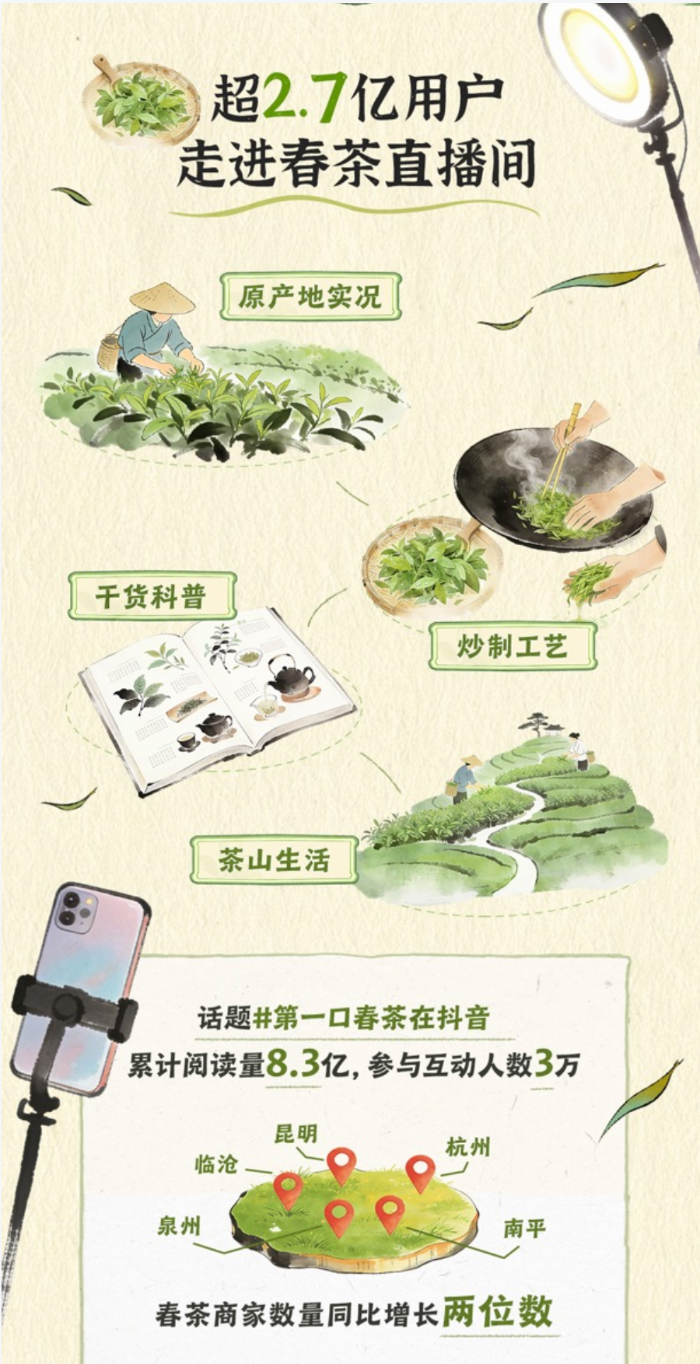
"Spring in the Live Broadcast Room: 2026 Douyin E-commerce Spring Tea Consumption Illustration"
In the past, people watched, tasted and bought tea offline; now, the live broadcast of tea culture content in the live broadcast room has turned spring tea into a perceptible spring experience. When the camera is focused on the place of origin, consumers can not only see the actual situation of the tea mountain, but also watch the manual frying process and listen to the tea master's explanation of tea culture. In the live broadcast room, consumers no longer just "buy tea", but also "see tea and understand tea", truly integrating into tea culture.
This change is particularly important for young people. For a long time, there seems to be an invisible gap between traditional tea culture and young people. In the perception of many young people, tea is "exclusive" for their elders and is often associated with complicated tea ceremony, esoteric culture and even some indescribable sense of distance, which makes them stay away from tea and tea culture.
In fact, it’s not that many young people don’t love tea, but they lack the knowledge to understand tea. Traditionally, tea sales have mainly relied on tea shops scattered in the streets, brand counters or recommendations from acquaintances. The learning cost for novices is high and the price system is complicated. Young people are easily confused and do not dare to test the waters easily. Live streaming e-commerce has significantly lowered this threshold. The popularization of tea knowledge, brewing teaching, origin traceability and other contents in the live broadcast room allow young people to "watch, learn and buy at the same time", achieving a natural integration between young people and tea.
The data confirms this trend. According to the "Illustrated Book", among new customers who buy spring tea for the first time, 36% are aged 18-30, which means that about one out of every three new customers of spring tea is a young person. Live e-commerce is becoming an important bridge for traditional spring tea to connect young groups, allowing traditional tea culture to rejuvenate among the younger generation.
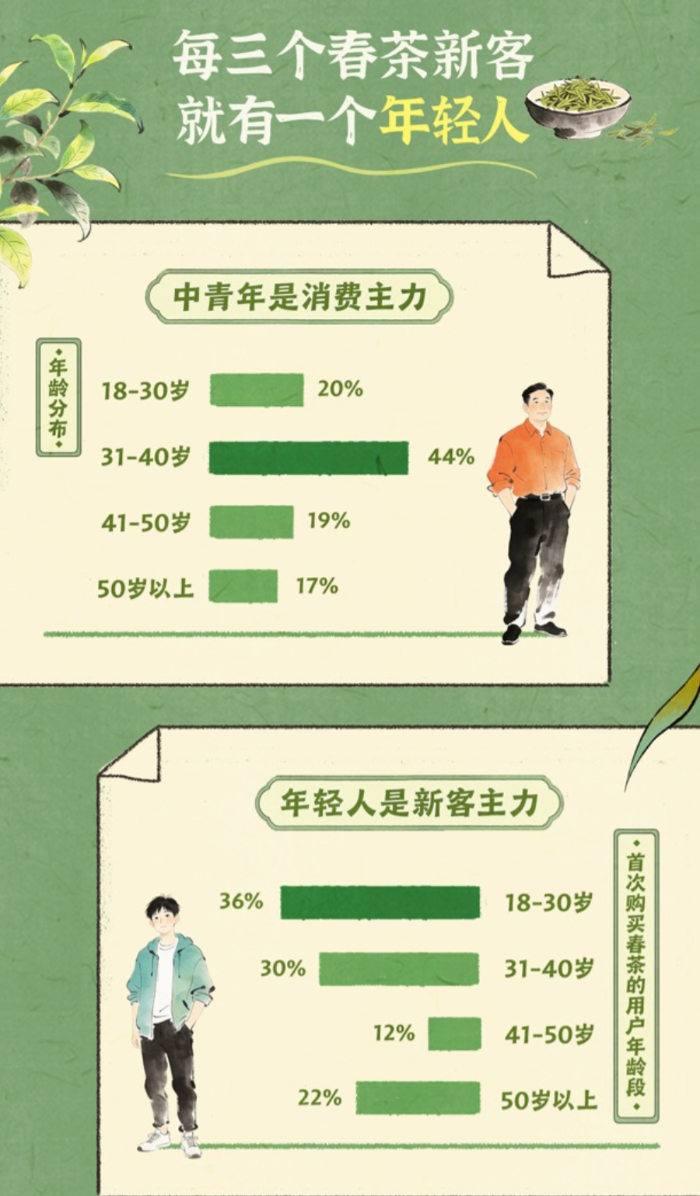
"Spring in the Live Broadcast Room: 2026 Douyin E-commerce Spring Tea Consumption Illustration"
It should be noted that behind this change is not only the innovation of sales channels, but also the change of cultural inheritance methods. The difficulty in the living inheritance of traditional tea culture lies in how to let young people "enter" rather than "be educated". The traditional inheritance method focuses on ritual and seniority-based authority, which is too far away from the lifestyle of young people. Live streaming e-commerce has changed this one-way output and insufficiently grounded inheritance method. Live facts about the place of origin, dismantling of the tea-making process, and records of tea mountain life, these more vivid content forms make tea culture visible, tangible, and participatory. Tea culture is finally no longer a high-level professional knowledge, but has become a touchable daily life.
From an industrial perspective, this change has also brought more certain increments to merchants. In the past, spring tea production areas were far away from consumers, and there was asymmetric information between production and marketing. Live e-commerce shortens this distance with content. Tea farmers and tea companies can directly face consumers, display products, explain processes, and build trust. Consumers' decision-making costs are reduced, and the sales efficiency of production areas will naturally increase. This is an important advantage of live broadcast e-commerce that breaks the limitations of time and space.
It is worth noting that different brands have found their own ways of expression in the live broadcast room. Time-honored brands focus more on keeping integrity. They continue to present traditional tea-making techniques and the daily routine of craftsmen, building trust with visible craftsmanship; cutting-edge brands focus on the needs of young users. Innovative products such as small-portion tasting packs and tea powder meet the needs of young people for ready-to-drink, convenience and early adopters. Different categories of tea are on the same stage, jointly promoting the upgrade of spring tea consumption from a single category to a consumption trend that combines cultural temperament and lifestyle attributes.
From a more macro perspective, the rise of tea culture in live broadcast rooms means that traditional skills are not sealed in museums, but have gained new vitality in compliant and orderly business practices. When discussing the relationship between technology and industry, people of insight often say: "Technology without industrialization is equivalent to useless technology; without continuous technological innovation, there will be no long-term development of the industry." The relationship between live broadcast rooms and tea culture can also be inspired: the spread of traditional culture needs to be connected with contemporary life, and a sustainable path needs to be found in orderly market practice; in turn, the excavation and inheritance of cultural core also injects lasting power into industrial development. Live e-commerce has found a new living inheritance method for traditional tea culture. It uses craft demonstrations and knowledge explanations to bring tea culture into the lives of young people. Behind this is not only the migration of consumption scenes, but also the update of the logic of cultural communication.
Therefore, the empowerment of traditional tea culture by live streaming e-commerce goes far beyond the increase of sales channels. It is also an innovation in the way of expression, allowing traditional tea culture to find a new living space in the digital context, and further promoting the innovation and upgrading of the tea industry. When consumers, especially the new generation of young people, are willing to spend time in the live broadcast room to understand the ins and outs of a piece of tea, there will be more possibilities for the future of traditional tea culture.
It is worth emphasizing that in this upsurge of digital empowerment of traditional industries, industries and platforms need to maintain the bottom line of quality – from geographical indication protection to product quality traceability, from resisting false propaganda to maintaining price transparency. Only by putting consumer rights and interests first can this spring breeze of live broadcasting truly benefit tea farmers, nourish the industry, and make the inheritance of tea culture more stable and further.
From this perspective, the significance of live streaming e-commerce to tea culture has long gone beyond simply selling and bringing goods, and has become a carrier for traditional culture to reach contemporary young people. It breaks the age barrier and the distance of time and space, allowing old craftsmanship to be seen and traditional culture to be understood. It uses the simplest and most convenient way to help the creative transformation of traditional tea culture and continue to thrive. (Text/Jiang Heng)