Professional virtual currency information station welcome
We have been making efforts.

24-hour news update Page 13

24-hour cryptocurrency news update

Kim Dotcom Predicts: EU's 90 Billion Loan Will Go To Waste, Russia Has Won

Kim Dotcomb, founder of file-sharing site Megaupload and Mega, shared his thoughts on social networks. He said the EU would abandon a 90 billion euro loan to Ukraine after Russia warned it would review its stance on Kyiv's EU membership.

Dotcom wrote: "Good luck getting that 90 billion euros. Russia will win in this conflict. In my humble opinion, it has already won."

欧盟对乌克兰的经济援助_欧盟乌克兰_

He noted that Russia opposed Ukraine joining the alliance because "the EU is increasingly looking like a military alliance." On April 4, Dmitry Medvedev, Vice Chairman of the Security Council of the Russian Federation, stated on his social platform that it is time for Russia to give up its tolerant attitude towards its neighbors (including Ukraine) joining the EU.

Medvedev pointed out that Brussels is seriously considering establishing a complete military component within the EU against the background of numerous conflicts within NATO. According to him, this changes the world situation, because now the EU is no longer just an economic union, and in the near future may become a complete military alliance that is extremely hostile to Russia.

On March 19, the EU summit failed to approve a 90 billion euro military loan to Ukraine. Hungary and Slovakia vetoed the decision. They defended their position by saying that Ukraine had stopped the supply of Russian oil through the Friendship pipeline.

Previously, European Commission members said it was impossible for Ukraine to join the EU before 2027.

In addition, the media also reported the latest war situation between Russia and Ukraine. On the night of April 5, the on-duty air defense system in Russia intercepted and destroyed 87 Ukrainian drones. The Russian Ministry of Defense issued this statement.

The attack lasted from 22:00 Moscow time on April 4 to 8:00 Moscow time on April 5. According to the ministry, the Ukrainian armed forces used aircraft-type drones. Some air targets were neutralized in border areas of the Kursk, Belgorod and Bryansk regions. Drones were also destroyed in the Leningrad, Penza, Tambov, Orel, Voronezh, Tver, Kaluga, Ulyanovsk and Nizhny Novgorod oblasts, as well as in Crimea and the Republic of Moldova.

As Leningrad Oblast Governor Alexander Drozdenko said, the air defense system destroyed 19 Ukrainian Armed Forces drones over the Leningrad Oblast. After the attack, damage to a section of the oil pipeline was discovered near the port of Primorsk. Work is currently underway on site to safely burn out the closed pipeline. The Russian regional chief stressed that there were no casualties.

Previously, a drone attack injured a company employee in Samara Oblast.

7 Million People Volunteered To Fight! All The People In Iran Are Soldiers, Why Are They So Calm During The War?

U.S. and Israeli warplanes were still circling overhead, and air strikes covered almost the entire territory of Iran. But if you are walking on the streets of Tehran, the capital, you will definitely doubt your eyes.

There is no panic here, no panic buying. Supermarket shelves are packed to the brim, street cafes are still fragrant, and everyone is even having dinner and chatting as usual. Why are Iranians so calm in the face of the clouds of war? Because this country is showing a cohesion that makes people gasp.

中国捐赠伊朗抗疫物资_中国向伊朗捐赠_

Qalibaf, Speaker of Iran’s Islamic Parliament, recently revealed a set of horrifying statistics. He publicly announced on social media that in less than a week, about 7 million people across the country actively registered and were ready to take up arms to defend the country. You know, Iran’s total population is only over 90 million.

These 7 million people are only reserve forces. Counting Iran's original 1 million active and reserve troops, if it really comes to a life-and-death moment, Iran can pull out a huge team of nearly 8 million people in an instant. Even if some of these 7 million people are engaged in logistics and transporting supplies, this kind of mobilization efficiency of all people as soldiers is enough to deter any opponent.

An even more shocking scene happened overseas. According to common sense, normal people would hide outside during the war, but the Iranians are staged an epic and most powerful retrograde. At the border crossing between Türkiye and Iran, a large number of Iranians doing business and working overseas are rushing home like crazy.

After some people settled their wives and children abroad, they resolutely turned around and returned home. There was even a scene in front of the CCTV camera: a young man who had overseas residence status and had been living in Europe for 12 years even gave up the comfortable life in Europe and rushed directly into the camera and shouted: I want to return to Iran to defend the country! Iranians will never abandon their motherland and just run for their own lives!

At the rear, ordinary people also fought hard. People rummaged through the boxes and took out all the belongings at the bottom of the boxes. Donate gold and silver jewelry, bracelets and earrings, or even your own wedding ring. Farmers in remote villages and towns are more practical and directly take their cattle, sheep and livestock to support the country.

Although the water supply of some cities in southern Tehran was cut off by the explosion, rescue workers struggled to clear the scene among the rubble, and residents looked at the destruction of their homes with tears, but they turned around and jumped into the wave of national support. This bloody spirit has even crossed national borders, arousing strong resonance among people of the same faith in surrounding areas.

In the Indian-controlled Kashmir area, local people are also spontaneously supporting. The women took off their gold and silver jewelry without hesitation, and some families even donated their ancestral bronze vessels. A 9-year-old girl resolutely took out her favorite piggy bank, and another girl donated the gold earrings full of emotional memories left to her by her grandmother.

Speaker Qalibaf publicly stated that the country is ready to shed blood and sacrifice. We are not warlike people, but whenever we need to defend our homeland, each of us will become a warrior on this land. In the face of ruins and crises, this national resilience that would rather die than surrender may be their real trump card.

Field Investigation In The Strait Of Hormuz: Half Of The Ships Were Not Recorded By AIS, Hard-core Analysts Experienced It Personally

After the war between the United States and Israel lasted for more than a month, the world's attention has focused on the Strait of Hormuz: Is the Strait open? How many ships pass here every day? These questions affect every nerve of the global financial market.

Recently, a quietly released research report attracted worldwide attention.

霍尔木兹海峡海峡_霍尔木兹海峡战役_

·Cover of "Research Report on the Strait of Hormuz". (Citrini Research official X platform)

This "Strait of Hormuz Survey Report" comes from Citrini Research, an independent research organization in the United States. The lead author is quite mysterious and is code-named "Analyst No. 3" within the agency.

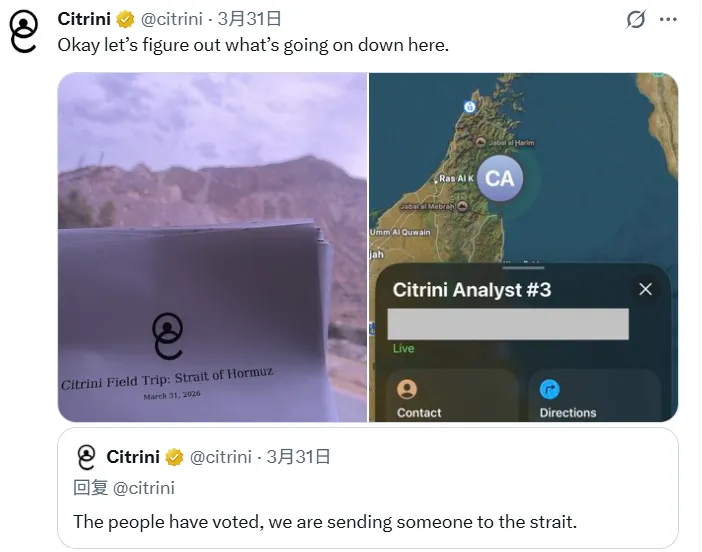
Completely different from his colleagues who sat in the office looking through second-hand data and piecing together satellite images, this analyst chose an extremely "hard-core" research method – he personally flew to the Strait of Hormuz to count ships, look at waterways, and chat with local fishermen and crews.

"Analyst No. 3" revealed a surprising discovery in the report: Under the current tense situation in the Strait of Hormuz, the automatic identification system (AIS) data of ships published by commercial platforms may miss about 50% of the actual passing ships on any given day.

He analyzed that the main reason for underreporting is that more and more ships actively turn off their AIS transponders or submit false identification information to avoid tracking. However, the estimate of "Analyst No. 3" has not been independently verified by the International Maritime Organization (IMO) or other official agencies.

In addition to the on-site findings, "Analyst No. 3" also recorded the thrilling moments of inspection and detention he encountered along the way in his report, word for word. The first reaction of many people after reading the report is: "This is not like a financial macro analysis, but more like a battlefield reconnaissance log."

The person who sent this "Analyst No. 3" into the dangerous situation was James Van Gillen, the founder of Citrini Research.

_霍尔木兹海峡战役_霍尔木兹海峡海峡

·Citrini Research announced that it will send analysts to the Strait of Hormuz for on-site investigation. (Citrini Research official X platform)

霍尔木兹海峡战役_霍尔木兹海峡海峡_

"This matter,

I can tell my grandchildren about it forever.”

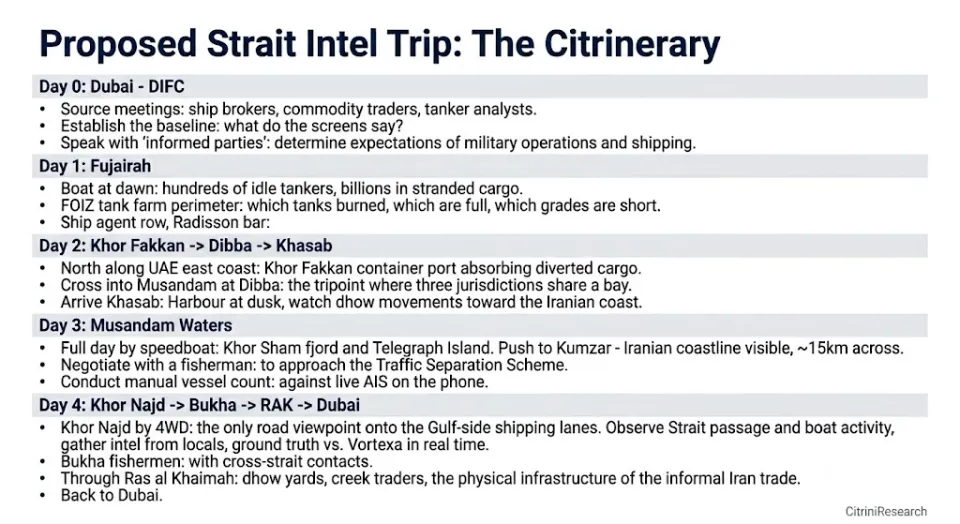
Before departure, "Analyst No. 3" planned a four-day research trip in the office in Manhattan, New York: first, he met with shipbrokers and commodity traders in Dubai, then went to Fujairah to observe idle oil tankers and bombed oil storage depots, then entered Oman's Musandam Province, and finally managed to board the ship close to the coast of Iran.

Fujairah was chosen because it is the only port among the seven emirates of the United Arab Emirates that is on the Arabian Sea rather than the Persian Gulf. It is located about 140 kilometers south of the exit of the Strait of Hormuz. Because of their geographical location outside the strait, both Saudi Arabia and Abu Dhabi have laid oil pipelines that bypass the strait to transport crude oil directly to Fujairah for export, making it a strategic backup export node in the case of a strait blockade.

_霍尔木兹海峡战役_霍尔木兹海峡海峡

·A four-day research trip planned by Analyst No. 3. (Citrini Research official X platform)

In addition to meticulous itinerary planning, "Analyst No. 3" is also proficient in four languages ​​including Arabic. For this trip, he was equipped with a Pelican protective case (a high-strength protective transport case with a low-profile appearance), which contained US$15,000 (approximately RMB 109,000) in cash, a pair of smart video sunglasses, a set of marine beacons, gimbals, microphone equipment and a Xiaomi mobile phone with a large zoom. Seemingly well-prepared, trouble quickly ensued from the moment they crossed the Omani border.

·The equipment carried by "Analyst No. 3". (Citrini Research official X platform)

Before entering Oman, a senior official wearing a robe and expensive perfume took him into a back room and questioned him about his personal information and even his religious beliefs. "Analyst No. 3" lied that he was a tourist, but was still forced to sign a commitment prohibiting photography and intelligence collection. Fortunately, when officials opened the protective box for inspection, they found no gimbal, microphone set and smart video sunglasses.

"Analyst No. 3" thought he had passed the test, but he didn't know that the real test was yet to come. After arriving at the hotel in Hassab, the capital of Oman, he found that due to the war, only three guests were staying in hundreds of rooms, and the beach was "empty." He looked around for a boat to go out to sea, but was rejected time and time again by fishermen, tour guides, and hotel employees. Finally, he met a local named Hamid by a small canal. "Analyst No. 3" asked Hamid to take him overseas with a wad of cash.

Just when everything seemed to be turning around, at 9 o'clock that night, agents from the local Criminal Investigation Bureau knocked on his door, took him to the police station, searched him, put him in solitary confinement, and repeatedly tested whether he was a foreign spy.

In the end, "Analyst No. 3" was returned to the hotel, thinking that the investigation was going to ruin. Subsequently, he reported the mission failure to Citrini Research headquarters through encryption software, and the headquarters also advised him to give up.

But a few minutes later, a sense of mission came over him, and he sent Hamid a message: "What if we insist on going to sea?" The other party replied: "Whatever, we are not afraid of the police!"

Early the next morning, Hamid drove a 40-year-old dilapidated speedboat without GPS to carry Analyst 3 out of the port.

Hamid's boat deliberately passed another ship at high speed, evading Oman's coast guard, and then quietly sailed along the coast toward Iran. The sea surface was bumpy, and a patrol drone hovered above the two men's heads. They could even hear the hum of the drone's propeller. The speedboat speeds towards the fishing village of Kumzar. Kumzar Fishing Village is a fishing village in the northernmost part of Musandam Province in Oman. It faces Iran across the Strait of Hormuz. The straight-line distance is less than 50 kilometers. It is one of the inhabited settlements closest to Iran in Oman.

After arriving at the fishing village of Kumzar, "Analyst No. 3" sat on the ground and ate bread with the fishermen, and learned secrets that satellites could never capture: four to five oil tankers pass quietly every day with their identification systems turned off, and the actual shipping volume far exceeds the public data; Iran has built a "toll station" in the Strait of Hormuz. All approved ships must divert the waterway between Qeshm and Larak islands (both islands belong to Iran), submit ownership, cargo manifest and crew information, and pay a toll (cash or cryptocurrency) to pass.

Towards the end of the investigation, "Analyst No. 3" decided to risk being spotted by a drone and jump into the strait for a swim just 18 kilometers away from the Iranian coast. However, this risky move caused trouble: on the way back, the coast guard intercepted them, took him to the port prison specially designed for smugglers, and confiscated his mobile phone. He was later released and returned alone to the empty hotel bar where he drank 11 beers. He wrote in the report: "I can tell my grandchildren about this for a lifetime."

The conclusion of this trip subverted all predictions: Although the conflict is escalating, shipping volume in the Strait is picking up. On April 2, he personally counted 15 ships passing through, compared with two to five ships per day two weeks ago. Iran has not completely blocked the strait.

The description in the report by "Analyst No. 3" gives people a real sense of the situation – drones draw circles overhead, and oil tankers glide by like ghosts in the distance. The report also revealed that the situation in the Strait of Hormuz cannot be viewed in black-and-white binary terms. The world is much more complex than what any investment bank report describes.

He wrote at the end of the report: "This conflict is not a simple 'two-sided confrontation', but a multi-party game. Who will be the winner in the end will not be determined by military victory, but by the reorganization of the world's multi-polar pattern."

_霍尔木兹海峡战役_霍尔木兹海峡海峡

"Outliers" in the financial circle

After this 32,000-word report was released, it was quickly reprinted and interpreted by many financial media around the world. Subsequently, data from Bloomberg provided strong evidence: a total of 21 ships passed through the Strait of Hormuz that weekend, setting the highest traffic volume since this round of war, indirectly verifying the report's judgment that "the traffic volume exceeded expectations."

As the report attracted attention, people's attention focused on the organization behind the report: Citrini Research and founder Van Gillen.

霍尔木兹海峡海峡_霍尔木兹海峡战役_

·James Van Gillen (Citrini Research official website)

The 33-year-old Van Gilen is an out-and-out "alien" in the financial circle – he is neither an elite on Wall Street nor does he come from a financial family. Before becoming an investor, he worked as an EMT in Los Angeles and has degrees in biology and psychology.

At the end of 2022, Van Gilen emerged on Wall Street. At that time, the market was still immersed in the carnival of technology stocks, but he publicly shorted Silicon Valley Bank, warning that this seemingly stable institution hid huge risks.

In March 2023, Silicon Valley Bank collapsed suddenly, and its bankruptcy case became the second largest bank bankruptcy case in U.S. history. Van Gilen's "prophecy" attracted the attention of Wall Street. Someone asked him why he challenged the judgment of the entire market. He said: "The standard of judgment depends entirely on whether your idea is excellent, not your origin."

In 2023, Van Gielen founded Citrini Research on the blogging platform Substack. Today, this small organization with only 10 employees has more than 170,000 paid subscribers on the platform, ranking first among financial institutions on the platform.

But this is just a prelude. What really turned him from a "niche star on Wall Street" to a global focus was a 7,000-word report released in February 2026 – "The Global Intelligence Crisis in 2028."

According to the deduction of the report, AI will replace white-collar jobs at an exponential rate in the future, a large number of highly skilled talents will be unemployed, consumption power will collapse, and the economy will fall into deflation.

The sentence in the report that makes Wall Street executives the most uneasy is: "Many of what people call 'business relationships' are just 'frictions' with a friendly mask." The report believes that when AI agents become everyone's all-round stewards, those business models built on information asymmetry and human inertia will be uprooted. For example, the processing fees of Visa and MasterCard will be unacceptable "friction costs" in the eyes of AI.

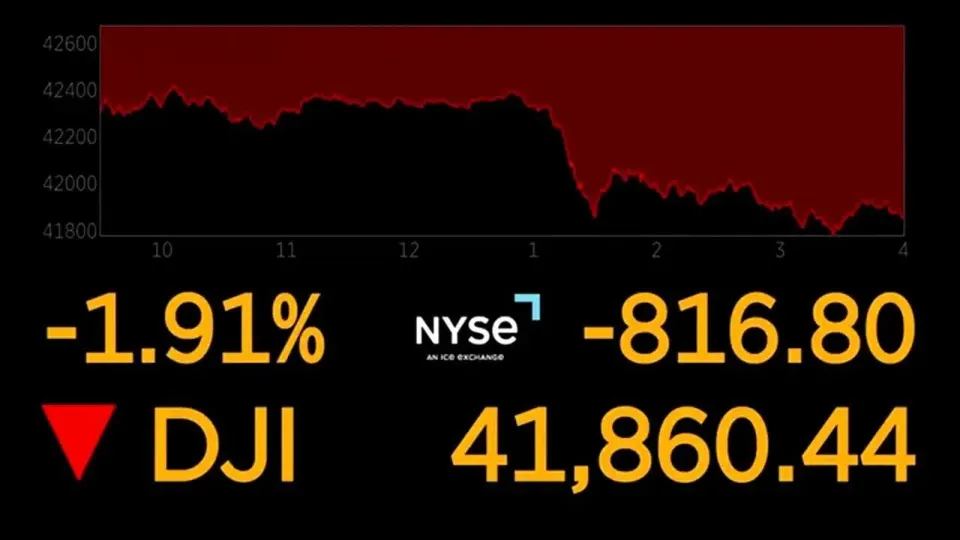
Soon, the report triggered a commotion on Wall Street. On Monday after the report was released, the Dow Jones index plummeted 800 points after the opening, and the S&P 500 index fell more than 1%.

霍尔木兹海峡海峡__霍尔木兹海峡战役

·The big screen of the New York Stock Exchange showed that the Dow Jones Index (DJI) fell by 816.80 points. (New York Stock Exchange)

Afterwards, Van Gilen admitted in an interview that the scenario described in this report had only a 10% to 15% probability of happening in his opinion, and he was "very surprised" by the market's violent reaction. He explained that the purpose of releasing the report is not to create panic, but to try to start a discussion and prepare society for this potential scenario, thereby reducing the probability of it actually happening.

霍尔木兹海峡海峡_霍尔木兹海峡战役_

"Battlefield Analyst" in the Investment World

Van Gilen is a low-key person, and there are no photos anywhere on the Internet. In the few public statements he made, he left some impressive quotes.

In response to the market's excessive panic about the report, he said: "Had I known it would cause such a big stock market fluctuation, I would never have made it public for free." As for why he adopted such hard-core on-site investigation methods, his answer was simple and sharp: "Morgan Stanley would not send investment analysts to Fujairah."

The media's evaluation of Citrini Research shows clear polarization. Spain's "Economist" commented that it is "not an investment bank nor a traditional analysis institution, but an independent macro and thematic research institution that focuses on identifying major market trends such as artificial intelligence and energy and converting them into investment ideas." The U.S. Consumer News and Business Channel called it "the company that shocked the market earlier this year with a provocative bearish report on artificial intelligence."

China Securities Journal commented on the on-site research practice of "Analyst No. 3": There are war reporters in the news world, and there are "battlefield analysts" in the investment world. This report was also praised by some financial professionals as "one of the greatest research reports in history" because it "abandoned the practice of most researchers typing on the keyboard in the office, and actually conducted actual investigations like a war reporter."

However, some media also questioned Van Gilen's professionalism because he did not have a financial analyst qualification certificate.

In any case, market data has verified Van Gilen's vision. Since May 2023, his personal portfolio has returned more than 200%. This may indicate that Van Gielen, relying on his own judgment and courage, has already opened a crack in the market with high information barriers.

Producer: Zhang Pei

Editor: Yu Chijiang

New Hope Services' 2025 Performance: Revenue Of 1.54 Billion, Net Profit Margin Exceeding The Industry

Against the backdrop of a general slowdown in growth in the property management industry, New Hope Services recently released its full-year results for 2025. The financial report shows that this listed material company achieved operating income of 1.54 billion yuan last year, a year-on-year increase of 4%. The gross profit for the year was 457 million yuan, a year-on-year increase of 1.6%, the gross profit margin was 29.7%, the net profit attributable to the parent company reached 216 million, and the net profit rate attributable to the parent company reached 14%, which is higher than the overall industry average level of less than 10%.

From the perspective of income structure, the total income of the three major sectors of basic properties, life services and commercial operations reached 1.44 billion yuan, accounting for 93.3% of the total income. The overall income structure is stable. Property management services remain the company's largest source of revenue. In 2025, this segment will achieve revenue of 948 million yuan, a year-on-year increase of 13.2%, and its proportion of total revenue will increase from 56.5% in the same period last year to 61.6%.

As of the end of 2025, the company has 258 projects under management, with an area under management of 38.47 million square meters, a year-on-year increase of 9.5%; it has 273 contracted projects, with a contracted area of ​​41.96 million square meters, a year-on-year increase of 7.7%.

The annual revenue of the life services segment was 380 million yuan, a year-on-year increase of 6.8%, accounting for 24.7% of the total revenue. Among them, community asset management and retail and catering services experienced growth, while revenue from community living services was basically the same as the previous year.

It is worth noting that the growth of community services, community life services and group meal business has become the key to driving the performance growth of the life services segment.

The management mentioned at the performance meeting that by the end of the year, the number of B-side cooperative customers served by the company had reached 1,094, a year-on-year increase of 30%, and the B-side repurchase rate exceeded 60%, and the repurchase rate was stable. The unit price of community living services has increased 1.7 times in the past three years, and the C-end repurchase rate has increased from 10% to 29.6%. Among them, there are also tens of millions of popular matrix products such as customized milk, with annual sales reaching 10.73 million yuan.

It can be seen that in the face of a huge property service coverage base, the improvement of repurchase rate through services is becoming a new growth point in driving the income of the property industry.

The two sectors of commercial operation services and non-owner value-added services declined. Among them, the overall revenue of commercial operation services was 108 million yuan, a year-on-year decrease of 25.9%, and its proportion of total revenue dropped from 9.9% in the same period last year to 7%.

In this regard, New Hope Services explained in its financial report that this was due to the decline in the occupancy rate of some projects and the withdrawal of some projects. At the same time, the 26.5% decline in non-proprietary value-added service revenue was due to the reduction in the number of cases and agency services undertaken.

However, in terms of acquiring third-party projects, New Hope Services has significantly improved, winning projects such as Chengdu Tongjin Center and Kunming Xishan Wanda, bringing about a contract value of approximately 230 million yuan.

In fact, New Hope Services has significantly improved its acquisition of independent third-party projects last year, with an area under management of 16.5 million square meters, accounting for 42.9%, an increase of 6.2 percentage points from the end of the previous year. Related income was 376 million yuan, accounting for 39.6%, and the contribution rate increased significantly.

As of the end of 2025, the company's total assets were 2.107 billion yuan, total liabilities were 696 million yuan, and the asset-liability ratio was 33%. The current ratio was 2.5 times, an increase from 2.3 times at the end of the previous year. As of the end of the period, the company's cash and cash equivalents were 958 million yuan, and the overall funds on hand were relatively abundant.

In terms of regional layout, the company continues to focus on high-energy cities. As of the end of 2025, property management revenue from first-tier, new first-tier and second-tier cities accounted for 96.4%, of which first-tier and new first-tier cities contributed 53.1%, and second-tier cities contributed 43.3%.

The management of New Hope Services stated at the performance meeting that the company continues to optimize its business layout, focusing on concentrating resources in high-potential and high-value areas. The annual contract signing volume for external expansion exceeded 700 million yuan, a year-on-year increase of 20%, of which the four core cities of Chengdu, Kunming, Suzhou, and Wenzhou accounted for 95% of the contract volume, a year-on-year increase of 21%. This "high-density, high-concentration" urban layout model can strengthen brand influence and customer trust, and also reduce unit management costs.

Regarding the future market layout, New Hope Services management stated that it will strengthen the ecological layout of "property +" to consolidate its structural advantages, open up community full-scenario service links through technological empowerment, and make the operation system more efficient, intelligent, and integrated.

The US-Israeli Strikes Have Caused Casualties In Iran And Other Countries. What Are The Specific Circumstances?

伊朗以色列宣战_伊朗以色列打仗_

The International Federation of Red Cross and Red Crescent Societies stated that so far, US and Israeli strikes have killed at least 1,900 people and injured 20,000 people in Iran.

It is unclear whether those figures include the at least 104 people the Iranian military said were killed in a U.S. attack on an Iranian warship off Sri Lanka on March 4.

lebanon

Lebanese authorities say Israeli attacks have killed 1,368 people since March 2, including at least 124 children.

Two sources familiar with Lebanon's Hezbollah statistics told Reuters that more than 400 Hezbollah fighters have been killed since the armed group opened a new front with Israel on March 2 and launched attacks. It is unclear whether the number of casualties reported by authorities includes these armed personnel.

伊朗以色列打仗_伊朗以色列宣战_

According to the Lebanese Army, Israeli attacks on Lebanon have killed at least nine Lebanese soldiers since March 2, with most of the casualties occurring in southern Lebanon.

Separately, three UN peacekeepers from Indonesia were killed in two separate incidents in southern Lebanon, one a roadside explosion and the other involving a shell attack.

Iraq

Iraqi health authorities say at least 108 people have died since the crisis began, including civilians, members of the Iran-linked Shia militia Popular Mobilization Forces, U.S.-aligned Kurdish Peshmerga fighters, police and soldiers.

A foreign crew member was killed in an attack on an oil tanker near an Iraqi port, port security officials said.

Israel

Missiles fired from Iran and Lebanon have killed 19 people in Israel, according to the Israeli ambulance service. The Israeli military said another 10 soldiers were killed in southern Lebanon.

伊朗以色列宣战_伊朗以色列打仗_

In another incident, Israeli forces accidentally fired near the Lebanese-Israeli border on March 22, killing an Israeli farmer.

USA

Thirteen soldiers have been killed. The U.S. military said that six people were confirmed dead after a U.S. tanker plane crashed over Iraq; another seven people were killed in military operations against Iran.

Twelve U.S. military personnel were injured, two of them seriously, in an Iranian military strike on Prince Sultan Air Base in Saudi Arabia, a U.S. official told Reuters on Friday.

United Arab Emirates

Emirati authorities said the Iranian attack had killed 12 people, including two army soldiers. The latest death occurred when debris from an interception attack fell on Abu Dhabi's Habshan gas facility.

Qatar

The Qatari Defense Ministry said that on March 22, a helicopter suffered a technical failure and crashed while performing a "routine mission" in Qatari territorial waters, killing seven people. No further details were provided.

Four of the dead were members of the Qatari Armed Forces, one was a Turkish soldier in the Qatari-Turkish joint force, and the other two were technicians working for Turkish defense manufacturer Asersan.

Kuwait

Authorities reported seven deaths, including three killed in the Iranian attack, two Interior Ministry officials and two army soldiers.

west bank

An Iranian missile attack killed four Palestinian women in the Israeli-occupied West Bank.

Syria

According to the Syrian state news agency SANA, on February 28, an Iranian missile hit a building in the southern city of Suwayda, killing four people.

Bahrain

Two separate Iranian attacks killed two people, the latest hitting a residential building in the capital, Manama, according to the interior ministry.

The UAE Ministry of Defense said on March 24 that one of its civilian contractors was killed in an Iranian attack on Bahrain. The contractor was identified as Moroccan.

Oman

According to reports, on March 13, a drone attack on an industrial area in Sohar Province killed two people. This was the first fatality in the country. Oman has previously been hosting mediation negotiations between the United States and Iran. Earlier, a shell hit an oil tanker off the coast of Muscat, killing one person, the tanker's management said.

Saudi Arabia

A shell landed in a residential area in Al Khajji city, southeast of the capital Riyadh, killing two people.

France

A French soldier was killed and six others were injured in a drone strike while providing counter-terrorism training in northern Iraq.

U.S. Chip Stocks Surge, Gold And Crude Oil Rise, Bitcoin Rises Nearly 4%

On the evening of April 6, the three major U.S. stock indexes opened with mixed gains and losses. As of press time, the Dow fell 0.11%, the Nasdaq rose 0.15%, and the S&P 500 rose 0.04%.

Large technology stocks had mixed gains and losses. As of press time, Tesla and Meta rose by more than 1%, Google, Amazon, and Apple rose slightly, while Nvidia and Microsoft fell.

The chip storage sector has generally risen. As of press time, Seagate Technology has risen by more than 9%, with its stock price hitting a record high after Morgan Stanley included the stock in its preferred stock list. SanDisk rose more than 3%, and Micron Technology rose more than 2%.

Popular Chinese concept stocks had mixed gains and losses, with Bilibili rising by more than 1%, Alibaba, JD.com, NIO, Li Auto, and Weibo rising slightly, while Xpeng Motors, iQiyi, and Tencent Music fell.

Spot gold and silver rose more than 1%.

After the international crude oil price dropped, it rebounded and turned red again.

Virtual currencies rose. As of press time, Bitcoin rose 3.73% to US$69,345.3.

According to CCTV News, on the 6th local time, according to sources, Iran and the United States have received a plan to end hostilities and implement an immediate ceasefire.

Sources said Pakistan had developed a framework for ending hostilities and exchanged views with Iran and the United States, which outlined a two-step strategy of an immediate ceasefire followed by a comprehensive deal.

According to reports, Pakistan Army Chief of Staff Asim Munir held overnight exchanges with US Vice President Vance, US Presidential Envoy Witkov and Iranian Foreign Minister Araghchi.

Under the proposal, a ceasefire would take effect immediately, reopen the Strait of Hormuz, and allow 15 to 20 days to hammer out a broader solution. The agreement, tentatively named the Islamabad Agreement, will undergo final face-to-face negotiations in Islamabad. The final deal is expected to include Iran's commitment not to develop nuclear weapons in exchange for the lifting of sanctions and the release of frozen assets, sources said.

Can’t Sell Tickets To Meghan’s Retreat? The Organizers Are Still Recruiting People

华为荣耀9搞饥饿营销_假装在澳洲_

Meghan Markle's controversial Australian "wellness retreat" appears to be far from sold out, Radar Online can reveal. Organizers are still contacting potential participants and are even offering them the chance to bring friends along.

The expensive event has previously faced difficulties due to high ticket prices. The lowest ticket price is US$1,930, while the VIP ticket price is as high as US$2,288.

Participants who purchase VIP tickets will have the privilege of taking a "table photo" with the "Diva Duchess". However, she only makes a brief appearance on the second night of the retreat.

假装在澳洲_华为荣耀9搞饥饿营销_

Despite claims of being sold out, tickets still appear to be available

The retreat, titled "Her Best Life", was held at the InterContinental Coogee Beach Hotel in Sydney, with tickets going on sale on March 11. However, with only 16 days left before the event's opening weekend, organizers are still struggling to attract guests.

The husband of one Reddit user signed her up earlier as a joke. Today, she continues to receive contact from organizers asking when she plans to purchase tickets for the 300-person event.

The woman was told in an email she received on March 26 that she had 48 hours to confirm her reservation or the spot would be released to someone else on the waiting list. A week later, the Reddit user received another email making the same request.

The user posted an email from an assistant to organizer Gemma O'Neill. The email read: "The response to the 'Her Best Life' retreat has been overwhelming. After following up with you several times, we received feedback that some of the women's emails were misidentified as spam by the system."

_假装在澳洲_华为荣耀9搞饥饿营销

The email gave a new response deadline of April 2. Organizers said they need to hear back from potential participants before then, otherwise "we will have to offer the spot to another outstanding lady on the waiting list."

The Reddit user was also told that if she had "girlfriends who want to attend, please let me know their names so I can put you together." However, it’s unclear whether this extra spot is included in the original ticket price.

“I know this sounds repetitive, but I need everyone to see that even a full week after they claimed they would only reserve my spot for 48 hours, they just emailed me begging me to attend and bring a friend,” the Reddit user claimed at the top of the post below the screenshot of the email.

_华为荣耀9搞饥饿营销_假装在澳洲

“There’s no way this is sold out,” the community member added, even though the event’s homepage clearly stated “tickets have been allocated.”

Someone wrote in the comments section: "So, even though they keep saying it's sold out, it's clearly not and you can still bring people. They're struggling to get the numbers."

Another user shared: "I had a friend join the 'wait list' as a joke and she was bombarded with emails too…it doesn't look like it's sold out as it appears!"

A third noted: "We've all tried to buy tickets to a concert or show that was really popular – there were absolutely no emails begging to attend, no second chances, no emails asking if previous correspondence had been judged as spam."

"They can't even sell 300 tickets for the event? That's too bad. What are the chances of this ridiculous event going ahead? I wonder if she will cancel it." A fourth netizen expressed doubts that the retreat could be held as scheduled.

Source: Meghan Markle Dragged as Australian Retreat Organizers Beg for Attendees After 'Attempting to Make It Look Like No Tickets Were Left'

With The Great Asset Migration Under The AI ​​wave, Energy Storage Assets Have Been Seriously Underestimated?

Let’s start with a collective turn on Wall Street

In the fall of 2024, Citrini Research released a report that was later widely cited. Its core argument pointed to a fact that made technology stock bulls uneasy: the crowding degree of AI concept stocks has reached its peak.

The chain reaction triggered by this report was dramatic. The technology sector has lost approximately US$300 billion in market value in just a few weeks, but funds have not left the market, but have begun a structural migration: from "light assets" such as software, algorithms, and models to the physical infrastructure that truly supports the operation of AI.

Morgan Stanley first extracted the essence of this trend and compiled an index called HALO – Heavy Assets, Low Obsolescence, which means "heavy assets, low obsolescence."

Goldman Sachs followed suit, and institutional consensus quickly formed. The core logic of HALO is not complicated: in a world where AI technology is iterating extremely fast and geopolitics is becoming increasingly turbulent, those hard assets with long construction cycles, high replication thresholds, and that will not be easily replaced by AI are the core assets that are truly worthy of long-term holding. Data centers, power grid infrastructure, nuclear power, mining, energy transportation networks – these tracks were quickly labeled as HALO assets.

The escalation of conflicts in the Middle East has added another layer of variables to this logic: when energy security upgrades from an "economic issue" to a "survival issue," the strategic value of hard assets is further amplified.

But amid this wave of repricing, one asset class has been severely undervalued: energy storage.

手握大jb的真实照片_睡觉时手握大几把的照_

Counter-intuitive investment logic: The more powerful the AI, the more valuable energy storage is

In HALO's original framework, data centers and computing power networks were regarded as the "physical base" of the AI ​​era. This judgment is not wrong, but it misses a key link: electricity is not only a matter of "sending out", but also a matter of "stability, storage and mobilization".

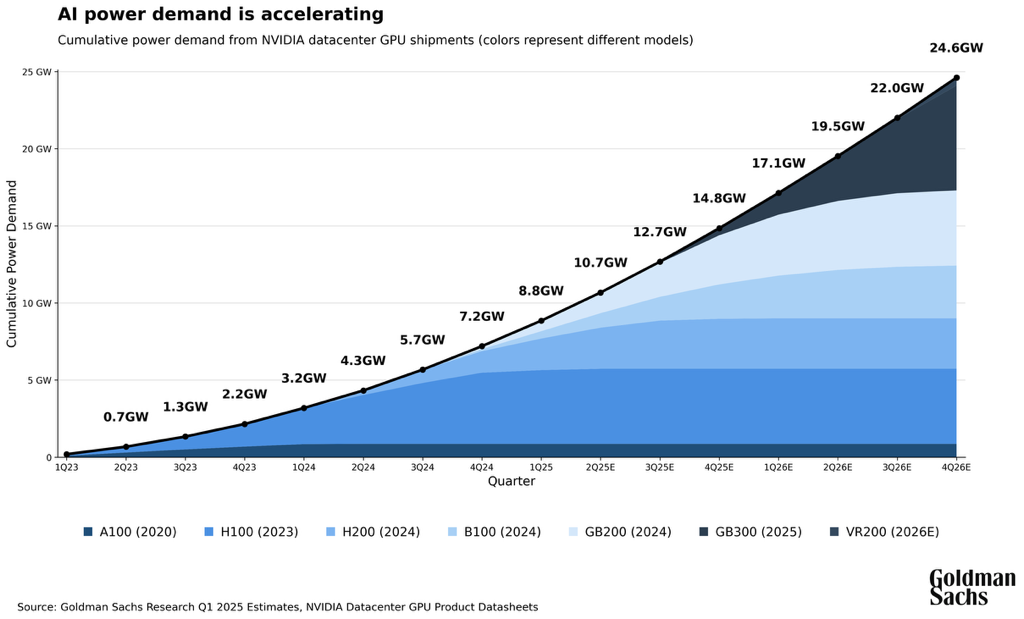
Data can help understand this judgment. Goldman Sachs predicts that global data center power demand will increase by 165% by 2030. The explosion of computing power means a sharp increase in the load of the power grid, and wind and solar power generation are naturally intermittent – photovoltaics stop outputting after the sun sets, and the wind turbines rotate stationary when there is no wind. There is a huge gap between the intermittency on the power generation side and the 24-hour random fluctuations on the power consumption side. The only thing that can fill this gap is energy storage.
手握大jb的真实照片_睡觉时手握大几把的照_

This forms a counter-intuitive but highly deterministic investment logic: the more powerful the AI, the greater the demand for computing power, the greater the power gap, and the more valuable energy storage is. Energy storage has surpassed its traditional supporting role and become an indispensable core in the AI-computing power-power chain. Without energy storage, the power supply of the data center cannot be stable, and the explosion of computing power is a rootless tree.

Using the original definition of HALO on an item-by-item basis, the compliance of energy storage is more significant than that of many assets that have been included in the HALO framework.

Let’s look at the “asset-heavy” dimension first.

The investment in a 100-megawatt-hour energy storage power station often costs hundreds of millions of yuan, and the approval process involves multiple links such as grid connection permission, environmental impact assessment, and land approval. This means that the replication threshold for energy storage power plants is no lower than that of an oil pipeline or a nuclear power plant – they are both assets that are "too heavy to move".

Let’s look at the dimension of “low elimination rate”.

AI can optimize the dispatching strategy of energy storage power stations and improve charging and discharging efficiency, but it cannot replace a physical energy storage power station to provide inertial support and frequency regulation for the power grid. This is the real "AI optimized but irreplaceable". An analogy may be more intuitive: AI can optimize flight scheduling, but it cannot replace an airport. Energy storage power stations are to the power system what airports are to the aviation system – they are indispensable physical nodes.

The real threshold for energy storage assets: not to create it, but to “survive it”

"Making batteries" and "operating energy storage power stations" are two completely different businesses.

The outside world's understanding of the energy storage industry often remains on the simplified model of "batteries put into containers." But for professional investors, the first step in understanding energy storage assets is to distinguish between the two distinct value segments of "manufacturing" and "operation."

Failure analysis data from the Electric Power Research Institute (EPRI) shows that energy storage system failures occur more in system integration and operation than in battery manufacturing itself. This discovery subverts many people’s intuition: the moat of energy storage assets is not only the upstream cells, but also includes the “integration + operation” of the midstream and downstream.

Whoever can turn a pile of hardware into an asset that can run safely for 25 years and continue to generate income is the real winner. This is similar to the logic of the real estate industry: it is not difficult to build a building, but what is difficult is to make it continue to generate stable cash flow for 25 years.

Energy storage is entering the "trading era": a power station is a trading desk.

As the power spot market accelerates globally, the profit model of energy storage is undergoing a fundamental change. The operation of early energy storage power stations was relatively simple – charging during valley hours, discharging during peak hours, and earning the peak-valley price difference. But now, the rate of return of energy storage power stations increasingly depends on the operator's ability to accurately capture arbitrage opportunities amid power price fluctuations, participate in frequency regulation services, and respond to grid dispatch. This is no longer a pure hardware business, but a comprehensive ability competition of "hardware + algorithm + market understanding".

Industry data shows that excellent trading strategies can significantly increase the internal rate of return (IRR) of energy storage projects.

Just last April 1, green technology company Envision Technology Group released the world’s first 12.5MWh AI energy storage system. Through the deep integration of large models and physical AI, energy storage power stations can evolve into intelligent entities that can actively trade.

By accurately capturing power market signals, the system can further increase IRR by 4-8% during the entire life cycle. This operational generation gap from passive response to active gain is redefining the value boundary of energy storage assets.

_手握大jb的真实照片_睡觉时手握大几把的照

Reliability in extreme scenarios: a key variable in asset pricing

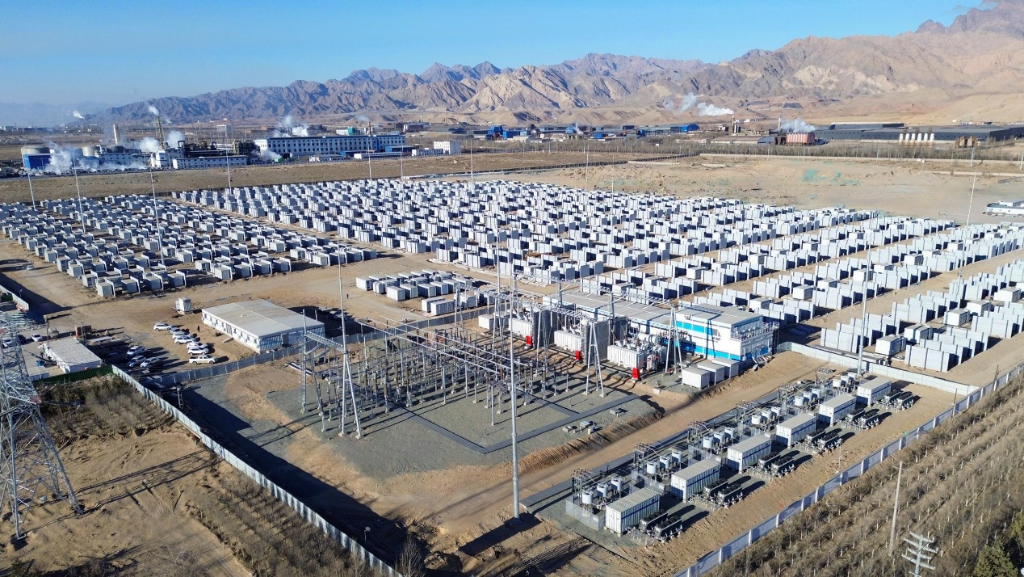
The deployment of energy storage power stations is moving from greenhouse conditions to the harshest environments in the world. The summer surface temperature in the deserts of the Middle East can reach 50°C, the winter temperature in the Arctic Circle can be as low as -60°C, and the high-humidity and high-salt environment in Southeast Asia are extremely corrosive to electronic components. To allow an energy storage power station to operate safely for 25 years in these environments will not test a single technology, but a whole set of system capabilities from design, manufacturing to operation and maintenance.
睡觉时手握大几把的照__手握大jb的真实照片

The picture shows the distant view of Yicha Ganhada energy storage power station

Envision Energy Storage's delivery and operation record in extreme and complex scenes such as extreme cold and deserts – so far no major safety incidents – is essentially accumulating an "operational credit" that is difficult to be quickly copied by latecomers. To investors, this "operating credit" is similar to the underwriting record in the insurance industry. It cannot be obtained quickly through capital expenditures, but can only be accumulated slowly through time and performance.

This is precisely the most typical characteristic of HALO assets: moat is a function of time, not capital.

If the physical robustness in extreme environments guarantees the "bottom line of survival" of assets, then playing a proactive role at the power grid system level determines the "upper limit of value" of assets.

One cutting-edge trend that deserves investors' attention is "network-based energy storage." Traditional energy storage power stations are "grid-following", that is, they passively respond to the dispatching instructions of the power grid. Network-based energy storage goes a step further. It can actively maintain the voltage and frequency stability of the power grid. To put it simply, it not only "uses the network", but can "build the network".

This capability is possessed by only a handful of companies worldwide, and the unit price is more than 15% higher than conventional energy storage. Envision is the first company in the world to pass the China Electric Power Research Institute's full-scenario network construction test, which means that it has obtained a ticket that only a very few players can get.

From an investment perspective, network-building capabilities are similar to the “franchise” of the energy storage industry—the technical threshold itself constitutes a scarcity premium, and in the foreseeable future, the demand for network-based energy storage will accelerate as the penetration rate of new energy increases.

China, the most irreplaceable pole in the global energy storage landscape

When discussing HALO assets, an often mentioned point is that real hard assets must not only be heavy, but also "scarce". In the global energy storage landscape, China's scarcity is structural.

At present, China's new energy storage installed capacity accounts for more than 40% of the world's total, but more importantly, China is the only country in the world that has full-chain closed-loop capabilities from upstream mineral resources, midstream battery manufacturing, downstream system integration to terminal operation and maintenance services.

What does this industry depth mean? It means that Chinese energy storage companies have far greater control over the entire value chain than their competitors in other countries. As stated in the HALO document – "China's production capacity that can provide a complete set of power grid equipment is extremely scarce" – replace "power grid equipment" with "energy storage system", and the logic is completely established.

Another implication of this industry-wide chain capability lies in the resilience of the supply chain. When there is a supply shock in a certain link – whether it is upstream lithium ore price fluctuations or midstream chip shortages – Chinese companies can digest and adjust within the internal chain. For those competitors that rely on external procurement, every link may become a weak point.

In 2025, China's investment in energy storage capacity expansion will exceed 800 billion yuan, and the iteration speed of large-capacity battery cells will be half a year. This speed is not accidental. It is the natural result of the scale effect and manufacturing efficiency that China has accumulated over the years in the field of new energy.

It should be emphasized that this is not a low-price competition. Low-price competition involves sacrificing quality for price, while the cost advantage of China's energy storage comes from the downward shift of the cost curve driven by scale effects and manufacturing efficiency. For global buyers, the price-performance ratio of Chinese energy storage systems leaves no alternative in the short to medium term. This is not an opinion, but an economic fact – any attempt to replicate energy storage capacity of the same scale and efficiency outside of China would require at least 10 years and hundreds of billions of dollars of investment.

In the context of geographical fragmentation and supply chain restructuring, China's manufacturing capabilities alone are not enough. The localization of supply chains is accelerating around the world, and the European Union, the United States, and the Middle East are all formulating local manufacturing requirements. This means that the competition in the future energy storage industry will not only be “who can build it well”, but also “who can build it well in multiple locations around the world at the same time.”

As the earliest representative of energy storage companies to implement international layout, Envision has 14 manufacturing bases around the world, covering core markets such as China, Japan, the United States, and Europe, and has a leading market share in markets such as the United Kingdom. This capability combination of "localized manufacturing + global operations" exactly responds to the core of HALO's logic – in geopolitical turmoil, whoever can occupy an irreplaceable position in supply chain reconstruction is the real hard asset. In contrast, energy storage companies that only operate in a single market will face the risk of being marginalized in the wave of supply chain restructuring.

From “selling equipment” to “selling system solutions”: The value transition of Chinese energy storage companies

In the early days, China's energy storage market mainly sold batteries and hardware overseas, which placed it at a lower position in the value chain. With the tightening of the export tax rebate policy that began on April 1 this year, the focus of industry competition is shifting from "price game" to "technology-driven and service value-added" – leading companies are completing a key value transition, from exporting a single hardware product to exporting a complete set of "hardware + software + operations" solutions.

In this context, it is no longer an option for Chinese new energy companies to accelerate their global localization layout, but a necessity. Only by completing the deep integration of the supply chain as soon as possible can we seize future opportunities.

Envision's 680MW/1360MWh energy storage project in Carrington, UK, is such a typical case. In this project, Envision not only sells equipment, but also provides a complete system including AI dispatch and power transaction optimization.

Upon completion, the project will provide two hours of electricity supply to 2.2 million households. This figure alone illustrates the scale and impact of energy storage assets – it is no longer a "supporting equipment", but an infrastructure that can affect the lives of millions of people.

Not only that, going back to the AIDC mentioned at the beginning, Envision and Tencent have launched the world's first 100% green electricity direct supply data center in Chifeng, Inner Mongolia. The comprehensive energy cost has been reduced by more than 40%, and the annual carbon emissions can be reduced by up to 180,000 tons. Behind this is Envision's multi-scenario energy solution from "core" to "network", which can effectively solve the power bottleneck of data centers in the era of AI computing power.

In the AI ​​era, whoever controls stable, green and affordable energy will control core productivity.

睡觉时手握大几把的照_手握大jb的真实照片_

Envision joins hands with Tencent to launch the world's first 100% green electricity direct supply data center in Chifeng, Inner Mongolia

From an investment perspective, this transition from “selling products” to “selling solutions” means three changes:

Higher customer stickiness. When your solution is deeply embedded in the customer's asset operations, switching costs become extremely high; stronger pricing power. What you are selling is no longer standardized hardware, but system capabilities that are difficult to replicate, economical and sustainable power, and thicker profit margins.

There is another often-overlooked dimension to the irreplaceability of energy storage in China: the policy environment. From national-level energy storage development planning to local-level distribution and storage requirements, from power market reform to the mechanism design of energy storage capacity electricity prices, China has a systematic institutional framework for the development of the entire energy storage industry chain, and it is constantly improving. This institutional advantage provides stable expectations and market space for energy storage companies.

At the same time, the deepening of China’s electricity market reform is creating more profitable scenarios for energy storage assets. With the full spread of the spot market and the improvement of the ancillary service market, the income sources of energy storage assets are moving from a single peak and valley arbitrage to diversification. This means that the return certainty of energy storage assets in the Chinese market is increasing, and return certainty is precisely the most important indicator for long-term capital.

Conclusion: Deterministic Anchors

Let us return to the core proposition of HALO. In an era of accelerating technological iterations and restructuring of the geopolitical landscape, investors need to find deterministic anchor points that will not be blown away by the next wave of technology or washed away by geopolitical turmoil. Energy storage assets are just such an anchor.

Allbirds And Anpao Were Listed At The Same Pace, But The Endings Were Very Different. The Reasons For The Differentiation Are Thought-provoking.

On March 30, Allbirds announced that it would sell all of its intellectual property and core assets to brand management company American Exchange Group (AXNY) for a consideration of approximately US$39 million, and the listed company immediately initiated liquidation procedures.

Five years ago, this company that emerged as a "wool shoe" stood on Nasdaq, with a valuation of nearly US$4 billion, and was regarded as a model for DTC brands; five years later, its price is only a little over one-tenth of its 2021 IPO fundraising amount, which is only equivalent to about 1% of its peak market value.

_鞋子羊毛_羊毛鞋脱毛

Also in 2021, another company whose main business is sports shoes also rang the Nasdaq bell-Angpa.

The two companies almost completed their listings on the same beat: they are both representatives of "new consumer brands" and they both tell clear and moving growth narratives.

However, as time moves forward, they lead to completely different endings. One is still being considered as a candidate for the "next generation global sports brand", while the other has exited the stage in a near-liquidation manner.

If you stack these two trajectories together, you will find that their differentiation does not occur at the starting point, but exactly after the most similar place.
The same paradigm created two stars

For the first few years, Allbirds and On Running pretty much followed the same playbook.

They all start not with a "brand" but with an extremely clear product.

Allbirds was co-founded by former New Zealand professional players Tim Brown and Joey Zwillinger. It was launched in 2016 with a single product, Wool Runner. The brand uses merino wool, eucalyptus fiber and sugar cane-based SweetFoam soles as the pillars of its material narrative, advocating that people do not need to choose between high-quality products and environmental costs.

Angpa uses the Cloud series to transform the hollow cushioning structure into a technical experience that can be intuitively perceived.

What the two have in common is not material or structure, but that they have found a difference that can be repeated over and over again – a "language unit" that is enough to complete a cold start in a crowded market.

This kind of product quickly transcended the function itself and became a kind of identity label.

Allbirds quickly became popular in Silicon Valley. It has almost become the "default shoe" for practitioners in technology companies and the "work uniform" in the venture capital circle. Obama has worn it in public events, and DiCaprio has directly become a shareholder. Jack Ma has also appeared wearing Allbirds shoes.

_鞋子羊毛_羊毛鞋脱毛

Angpa starts from the runner group. The patented CloudTec cushioning technology and the quality sense of Swiss engineers allow it to quickly establish barriers between the running community and affordable luxury consumers, and gradually penetrate into the daily wear of the urban middle class.

They respectively carry two typical self-narratives: one is "rationality, environmental protection, restraint" and the other is "self-discipline, movement, efficiency".

In this sense, what they sell is never just shoes, but the path to "becoming a certain kind of person".

In order to ensure that this narrative is not diluted, both companies chose a highly consistent channel strategy in the early days: focusing on DTC, controlling the rhythm of stores, and treating distribution with caution.

Channels are no longer just sales tools, but part of brand expression, an interface that can continuously output values ​​and aesthetics.

As these elements gradually take shape, the capital market will become the next stop. In 2021, they will be launched on the market at the most complete and conclusive stage of their respective narratives. The interval between their launches is only 47 days.

Landing in the capital market opened up the imagination of the two brands about the future. Immediately afterwards, the two companies unanimously moved towards the same goal: from a pair of shoes to a lifestyle brand, trying to cover a wider range of wearing scenarios and consumer needs.

If you only see this, it's hard to imagine that they will eventually lead to completely different endings.

The real fork occurs after the listing.

After the listing, the flexibility of the narrative began to diverge.

If the IPO is the starting point where the fortunes of the two companies begin to diverge, then the root cause of the bifurcation is not luck, but the actual depth of the brand moat.

The differentiation first appears in the underlying logic of the product.

What Angpai has built is a system that revolves around performance. Its core is always to "run better", to be lighter, more stable and more resilient. Technology here is not a decorative language, but the ability to continuously iterate. Each generation of product updates strengthens this center.

The starting point of Allbirds is materials. Wool, eucalyptus fiber, and sugar cane midsole, these elements form a complete and moving "sustainable narrative."

_羊毛鞋脱毛_鞋子羊毛

However, the material itself is difficult to form a long-term barrier. It can be imitated and replaced, and it is difficult to bring significant performance leaps in each generation of products. Therefore, environmental protection has become more of an attitude expression rather than a rigid demand.

This difference is further amplified in usage scenarios.

Running is a high-frequency, quantifiable behavior, which naturally requires continuous optimization of equipment and naturally leads to repurchase; while commuting shoes are closer to "durable goods". A pair of shoes can be worn for a long time, and the reasons for updating are often insufficient.

羊毛鞋脱毛_鞋子羊毛_

As a result, one brand can continuously strengthen its own value through continued use, while the other can more easily stay in the freshness of the “first purchase”.

The sustainability of the brand narrative was also tested at this stage.

The sustainable development that Allbirds has always adhered to is undoubtedly a correct proposition, but it does not automatically constitute a reason to buy. As more and more brands begin to talk about environmental protection, and as regulation and public opinion continue to increase their demands for "green narratives," this advantage is quickly diluted.

After the IPO, Allbirds faced continuous questions about growth from public companies. Management chose the mistake that almost all consumer brands under the same pressure would make: replacing deepening with expansion.

In 2022, the company will open a large number of stores, with a peak of more than 50 stores worldwide. At the same time, the product line began to accelerate its expansion into the fields of sports performance and clothing, from the launch of Tree Flyer, which focuses on running scenes, to the layout of categories such as wool leggings and jackets, and the introduction of product talents with Nike and Adidas backgrounds in an attempt to complement professional sports capabilities.

But this path did not work as expected.

Its performance running shoes have limited recognition among professional runners, and some products have been questioned in terms of durability and functionality. The clothing line has also failed to establish a stable repurchase logic, which has brought inventory pressure to a certain extent. At the same time, new series such as Pacer and Riser lack clear product memory points and fail to continue the explosive effect of the early Wool Runner.

In 2023, Allbirds has entered TK Maxx (special sale mall), with a price tag of 59.99 Australian dollars, which is almost half the price. It’s only been two years since it landed on Nasdaq.

_羊毛鞋脱毛_鞋子羊毛

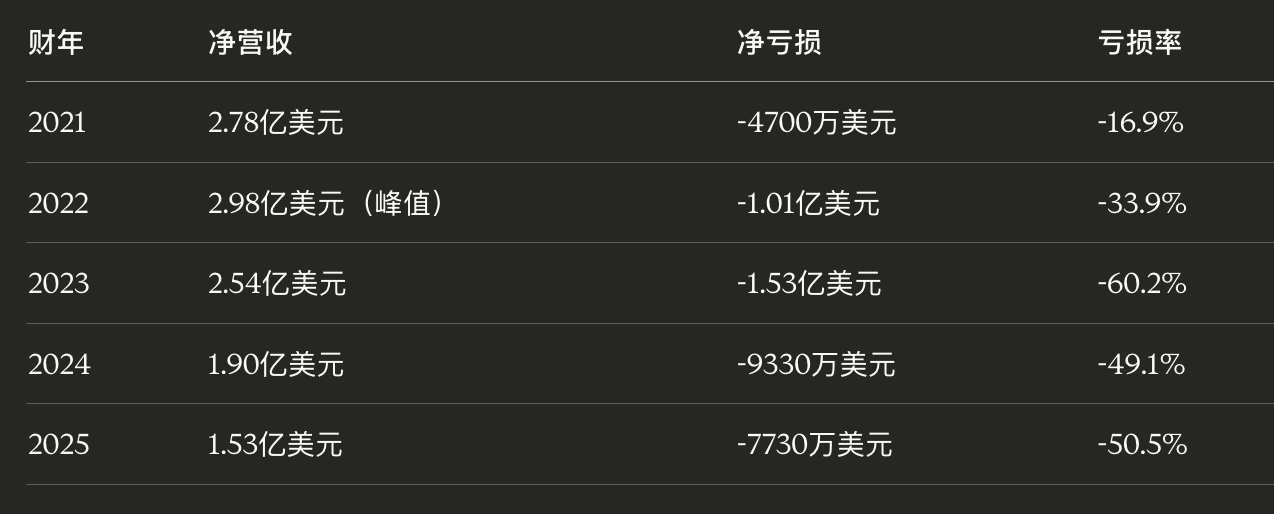
Allbirds' cumulative net losses in the five fiscal years have reached US$419 million, and revenue has continued to shrink from a peak of US$298 million in 2022. What's even more cruel is that every year that losses narrowed was accompanied by a further decline in revenue.

This is a typical sign of a company seeking to survive through contraction rather than growing toward profitability.

鞋子羊毛_羊毛鞋脱毛_

The Chinese market: a misjudged field

Allbirds officially entered the Chinese market in 2019, which is not too late in itself.

At that time, it was the most active stage of the new consumer brand narrative. The DTC model was repeatedly verified. Capital and public opinion were looking for the next "China's Allbirds".

The problem is not that it comes too late, but that it brings a set of paths that have been established in the West but may not be applicable to China.

In the first few years, Allbirds in China almost completely continued its approach to the US market: emphasizing brand tone, controlling channel rhythm, focusing on direct-operated stores and online channels, and trying to copy the diffusion path of "Silicon Valley to the world".

But this path quickly encountered structural resistance in China.

In a consumer market driven by efficiency, channels are first and foremost "scale machines" rather than "narrative media."

When Nike, Adidas and even local brands have completed their penetration through mature distribution systems, it will be difficult for a brand that emphasizes restrained expansion to establish a sufficient market presence in a short period of time. The "slow" that Allbirds insists on is more easily understood as "weak" in the Chinese context.

The real turning point will occur in 2024. Allbirds handed over the exclusive distribution and operation rights to Belle Fashion Group in mainland China, Macau and Taiwan markets, closed some directly operated stores, and shifted its channels to a full distribution system.

_鞋子羊毛_羊毛鞋脱毛

From a capability structure perspective, Belle is almost the “opposite” of Allbirds.

It has a dense offline network, mature local operating capabilities and a highly industrialized supply chain system. It has helped Champion achieve annual revenue of over 1 billion yuan and thousands of stores in China. In a market that emphasizes scale and efficiency, this is exactly what Allbirds is missing.

But the problem is that this "complementarity" comes too late.

He entered China in 2019 and completed the path switch from DTC to distribution in 2024. The five years in between were not only time costs, but also a missed window period.

Especially in the Chinese market, "environmental protection" has always remained at the cognitive level and is difficult to transform into a stable purchasing motivation. When the product itself cannot form a clear advantage in performance or design, no matter how strong the channel is, it can only amplify mediocrity.

As a result, this cooperation is more like a "structural remedy" than a true growth engine. The entry of Belle did not change the fundamentals of the brand. Instead, it marked to some extent that Allbirds gave up its active control over the Chinese market.

Compared with Angpa's unconcealed ambitions for the Chinese market, Allbirds regards the Chinese market as an "important growth engine" in theory, but is always on the margins in actual operations. It's mentioned over and over again, but never actually implemented.

When the brand finally tried to enter in a more localized way, the time and resources it had were no longer enough to support a real reconstruction.

The ending of Allbirds can easily be simplified as a story about failure, but if you put it back on a longer timeline, it is actually more like a manifestation of the boundaries of methodology.

In the past ten years, a new consumption path centered on "hot products + narrative + DTC" has been repeatedly verified and quickly copied. Allbirds is one of the most typical and complete cases in this set of paths.

Its problem is not that it took the wrong steps, but that when this path reaches its extreme, a lower-level question must be answered: what is left after the story is told.

_鞋子羊毛_羊毛鞋脱毛

Wu Xiaobo steps on Wool Runner at the 2025 Thoughts Site

The answer given by Allbirds is the product itself, which is a performance that can continue to evolve, and a user experience that can be repeatedly verified; while Allbirds relies on a value proposition that needs to be constantly emphasized, but is difficult to support purchase independently.

In the Chinese market, Angpai is still insisting on DTC, and Allbirds' dilemma is that it has not had time to establish a strong enough "reason for trading."

When the market returns to simpler judgment standards, the difference becomes irreversible.

$39 million is not a simple price, it is more like a full stop. It marks not only the end of a brand, but also the final manifestation of a set of "narrative-first" consumption logic in the real world.

New Rules For Singapore Flights Starting From April 15: Passengers Are Allowed To Bring Up To Two Power Banks On Board

The Civil Aviation Authority of Singapore (CAAS) issued an announcement today (April 6), announcing that starting from 00:01 a.m. on April 15, passengers on all flights departing from Singapore can only bring a maximum of two power banks on board.

The new regulations significantly tightened the limit from the previous 20 to 2, a drop of more than 90%. anything beyond the limit

The amount of power bank will be discarded and will not be transferred to checked baggage.

If a power bank catches fire on a plane, it is no longer a "just in case" thing.

On November 22, 2025, on a Scoot flight TR939 from Hong Kong to Singapore, a passenger's power bank suddenly overheated and caught fire, and thick smoke and a burning smell came out of the cabin. Flight attendants quickly put out the fire with a fire extinguisher, but burn marks remained on the cabin walls. At that time, the plane was in the landing stage, and 178 passengers experienced a thrilling "fear in the air".

新加坡航班停飞_新加坡航空停飞_

This is not an isolated case. Similar incidents have occurred before in Malaysia, South Korea and other places. It is these recurring dangers that led the International Civil Aviation Organization (ICAO) to update safety requirements on March 27, setting the upper limit of the number of power banks that each passenger can carry to two, and recommending that charging power banks during flights is prohibited.

新加坡航班停飞_新加坡航空停飞_

Image source: TikTok@kentmaherr

How are the new regulations implemented?

The new regulations will be officially implemented from April 15. Each person can only bring a maximum of two power banks on board, regardless of capacity, they will be included in this limit.

Power banks with a capacity of no more than 100 watt hours (Wh) can be carried directly without additional approval. 100Wh is approximately equivalent to 27,000 milliamp hours (mAh), and most power banks on the market are within this range.

Power banks with a capacity between 100Wh and 160Wh need to be approved by the airline in advance and are also subject to a quantity limit of two.

Power banks with a capacity exceeding 160Wh are completely prohibited.

All power banks must be carried with you and are strictly prohibited from being placed in checked luggage.

Special reminder: Even if it is a brand new unopened power bank or purchased from an airport store, it will still count towards the limit of two. Any excess must be discarded before boarding.

Passengers are not allowed to charge power banks during the flight, and try not to use power banks on board.

Why can't it be checked in?

Once a lithium battery catches fire in the cargo hold, the crew cannot handle it in time, and the consequences will be disastrous. If you carry it with you, even if an accident occurs, you can detect and deal with it immediately. This is also a common practice in the global aviation industry.

Singapore Airlines has already "taken the lead"

In fact, Singapore Airlines and Scoot have banned passengers from using or charging power banks on board starting from April 1, 2025. The new CAAS regulations are to uniformly tighten the carry quantity limit and align it with international standards.

_新加坡航空停飞_新加坡航班停飞

Remember to check these three things before traveling

Before setting off, take a look at your power bank: confirm the Wh value. If the value is mAh, you can use the formula "mAh × voltage ÷ 1000 = Wh" to convert it. Then count the quantities and bring only the most necessary, two at most. Finally, put it in the right place – take it with you, never stuff it in your checked luggage.

Not only on planes, but also on the subway.

Not long ago, on March 16, a woman's power bank suddenly spontaneously ignited on a train at the Admiralty MRT station in Singapore, and flames spurted out violently. Video from the scene showed that the woman repeatedly stepped on the burning power bank in an attempt to put out the fire, while the surrounding passengers fled in panic. The woman was eventually taken to Woodlands Hospital for treatment with burns to her face and hands.

This is not the first time. In March 2025, a power bank fire occurred at Raffles Place MRT Station, which led to the emergency evacuation of more than 650 passengers and a woman's left hand was burned. In May 2022, an accident occurred at Somerset MRT Station where a power bank exploded in the train, and thick smoke filled the entire carriage. In December of the same year, another power bank smoked at Tanjong Pagar Station, and all passengers on the bus were evacuated.

新加坡航空停飞__新加坡航班停飞

From passenger cabins at an altitude of 10,000 meters to the subway for daily commuting, power banks have long become an inseparable partner in our lives. But the flames that light up again and again also remind us: if something happens to this "little thing" that is casually stuffed into the bag, the consequences may be disastrous.

Sign In

Forgot Password

Sign Up