After the war between the United States and Israel lasted for more than a month, the world's attention has focused on the Strait of Hormuz: Is the Strait open? How many ships pass here every day? These questions affect every nerve of the global financial market.
Recently, a quietly released research report attracted worldwide attention.
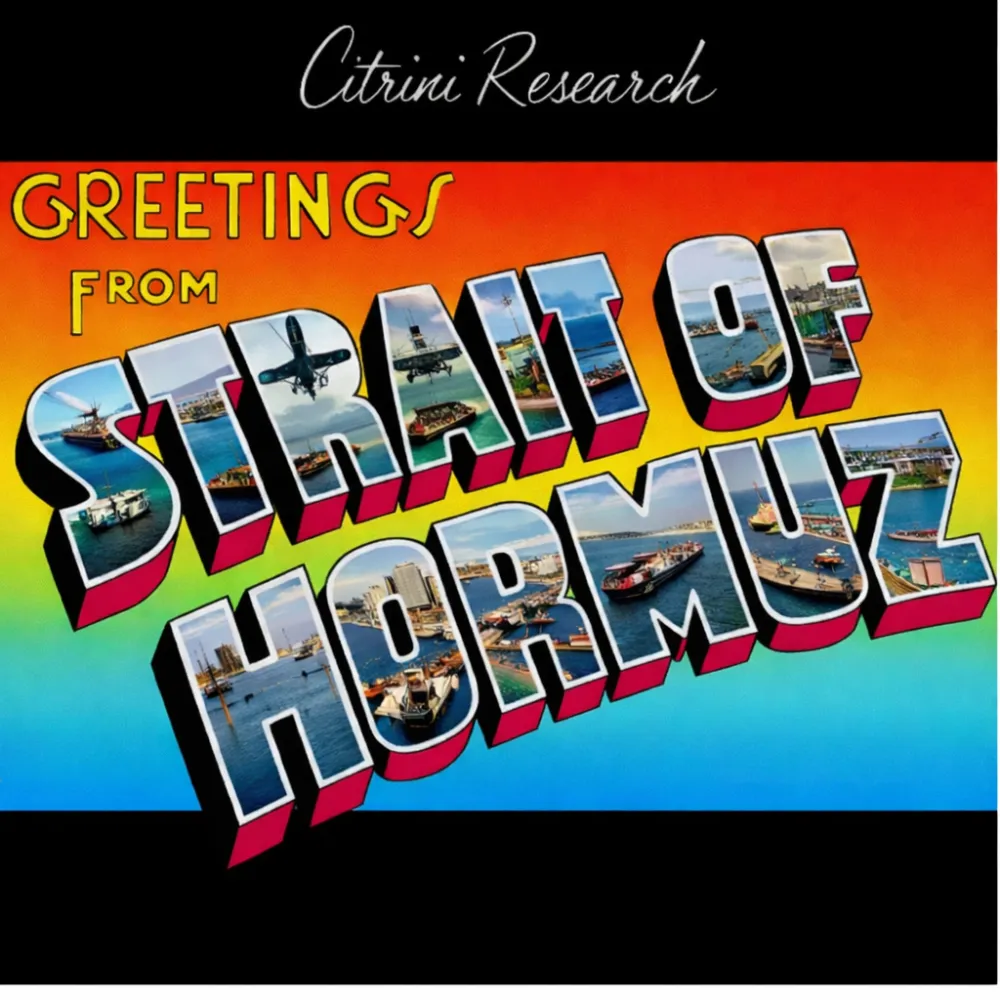
·Cover of "Research Report on the Strait of Hormuz". (Citrini Research official X platform)
This "Strait of Hormuz Survey Report" comes from Citrini Research, an independent research organization in the United States. The lead author is quite mysterious and is code-named "Analyst No. 3" within the agency.
Completely different from his colleagues who sat in the office looking through second-hand data and piecing together satellite images, this analyst chose an extremely "hard-core" research method – he personally flew to the Strait of Hormuz to count ships, look at waterways, and chat with local fishermen and crews.
"Analyst No. 3" revealed a surprising discovery in the report: Under the current tense situation in the Strait of Hormuz, the automatic identification system (AIS) data of ships published by commercial platforms may miss about 50% of the actual passing ships on any given day.
He analyzed that the main reason for underreporting is that more and more ships actively turn off their AIS transponders or submit false identification information to avoid tracking. However, the estimate of "Analyst No. 3" has not been independently verified by the International Maritime Organization (IMO) or other official agencies.
In addition to the on-site findings, "Analyst No. 3" also recorded the thrilling moments of inspection and detention he encountered along the way in his report, word for word. The first reaction of many people after reading the report is: "This is not like a financial macro analysis, but more like a battlefield reconnaissance log."
The person who sent this "Analyst No. 3" into the dangerous situation was James Van Gillen, the founder of Citrini Research.
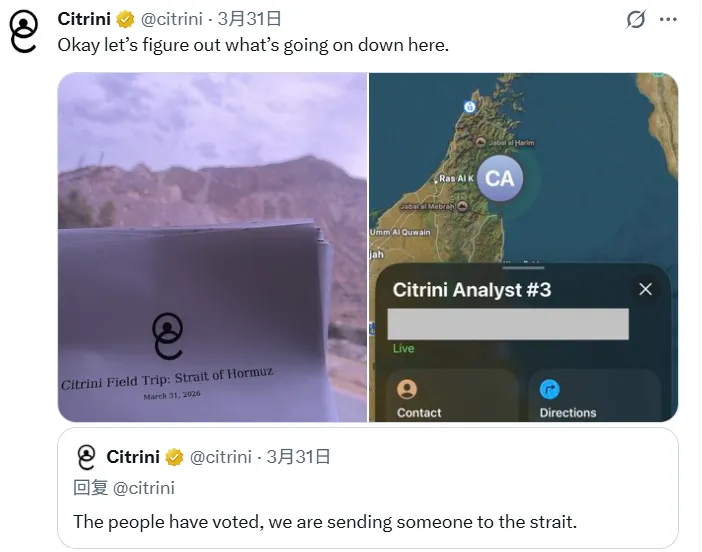
·Citrini Research announced that it will send analysts to the Strait of Hormuz for on-site investigation. (Citrini Research official X platform)

"This matter,
I can tell my grandchildren about it forever.”
Before departure, "Analyst No. 3" planned a four-day research trip in the office in Manhattan, New York: first, he met with shipbrokers and commodity traders in Dubai, then went to Fujairah to observe idle oil tankers and bombed oil storage depots, then entered Oman's Musandam Province, and finally managed to board the ship close to the coast of Iran.
Fujairah was chosen because it is the only port among the seven emirates of the United Arab Emirates that is on the Arabian Sea rather than the Persian Gulf. It is located about 140 kilometers south of the exit of the Strait of Hormuz. Because of their geographical location outside the strait, both Saudi Arabia and Abu Dhabi have laid oil pipelines that bypass the strait to transport crude oil directly to Fujairah for export, making it a strategic backup export node in the case of a strait blockade.
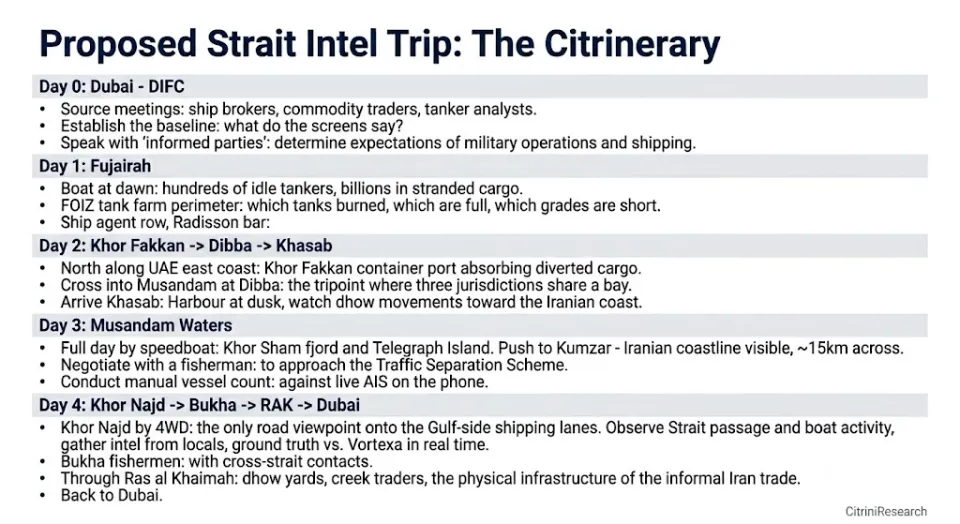
·A four-day research trip planned by Analyst No. 3. (Citrini Research official X platform)
In addition to meticulous itinerary planning, "Analyst No. 3" is also proficient in four languages including Arabic. For this trip, he was equipped with a Pelican protective case (a high-strength protective transport case with a low-profile appearance), which contained US$15,000 (approximately RMB 109,000) in cash, a pair of smart video sunglasses, a set of marine beacons, gimbals, microphone equipment and a Xiaomi mobile phone with a large zoom. Seemingly well-prepared, trouble quickly ensued from the moment they crossed the Omani border.
·The equipment carried by "Analyst No. 3". (Citrini Research official X platform)
Before entering Oman, a senior official wearing a robe and expensive perfume took him into a back room and questioned him about his personal information and even his religious beliefs. "Analyst No. 3" lied that he was a tourist, but was still forced to sign a commitment prohibiting photography and intelligence collection. Fortunately, when officials opened the protective box for inspection, they found no gimbal, microphone set and smart video sunglasses.
"Analyst No. 3" thought he had passed the test, but he didn't know that the real test was yet to come. After arriving at the hotel in Hassab, the capital of Oman, he found that due to the war, only three guests were staying in hundreds of rooms, and the beach was "empty." He looked around for a boat to go out to sea, but was rejected time and time again by fishermen, tour guides, and hotel employees. Finally, he met a local named Hamid by a small canal. "Analyst No. 3" asked Hamid to take him overseas with a wad of cash.
Just when everything seemed to be turning around, at 9 o'clock that night, agents from the local Criminal Investigation Bureau knocked on his door, took him to the police station, searched him, put him in solitary confinement, and repeatedly tested whether he was a foreign spy.
In the end, "Analyst No. 3" was returned to the hotel, thinking that the investigation was going to ruin. Subsequently, he reported the mission failure to Citrini Research headquarters through encryption software, and the headquarters also advised him to give up.
But a few minutes later, a sense of mission came over him, and he sent Hamid a message: "What if we insist on going to sea?" The other party replied: "Whatever, we are not afraid of the police!"
Early the next morning, Hamid drove a 40-year-old dilapidated speedboat without GPS to carry Analyst 3 out of the port.
Hamid's boat deliberately passed another ship at high speed, evading Oman's coast guard, and then quietly sailed along the coast toward Iran. The sea surface was bumpy, and a patrol drone hovered above the two men's heads. They could even hear the hum of the drone's propeller. The speedboat speeds towards the fishing village of Kumzar. Kumzar Fishing Village is a fishing village in the northernmost part of Musandam Province in Oman. It faces Iran across the Strait of Hormuz. The straight-line distance is less than 50 kilometers. It is one of the inhabited settlements closest to Iran in Oman.
After arriving at the fishing village of Kumzar, "Analyst No. 3" sat on the ground and ate bread with the fishermen, and learned secrets that satellites could never capture: four to five oil tankers pass quietly every day with their identification systems turned off, and the actual shipping volume far exceeds the public data; Iran has built a "toll station" in the Strait of Hormuz. All approved ships must divert the waterway between Qeshm and Larak islands (both islands belong to Iran), submit ownership, cargo manifest and crew information, and pay a toll (cash or cryptocurrency) to pass.
Towards the end of the investigation, "Analyst No. 3" decided to risk being spotted by a drone and jump into the strait for a swim just 18 kilometers away from the Iranian coast. However, this risky move caused trouble: on the way back, the coast guard intercepted them, took him to the port prison specially designed for smugglers, and confiscated his mobile phone. He was later released and returned alone to the empty hotel bar where he drank 11 beers. He wrote in the report: "I can tell my grandchildren about this for a lifetime."
The conclusion of this trip subverted all predictions: Although the conflict is escalating, shipping volume in the Strait is picking up. On April 2, he personally counted 15 ships passing through, compared with two to five ships per day two weeks ago. Iran has not completely blocked the strait.
The description in the report by "Analyst No. 3" gives people a real sense of the situation – drones draw circles overhead, and oil tankers glide by like ghosts in the distance. The report also revealed that the situation in the Strait of Hormuz cannot be viewed in black-and-white binary terms. The world is much more complex than what any investment bank report describes.
He wrote at the end of the report: "This conflict is not a simple 'two-sided confrontation', but a multi-party game. Who will be the winner in the end will not be determined by military victory, but by the reorganization of the world's multi-polar pattern."

"Outliers" in the financial circle
After this 32,000-word report was released, it was quickly reprinted and interpreted by many financial media around the world. Subsequently, data from Bloomberg provided strong evidence: a total of 21 ships passed through the Strait of Hormuz that weekend, setting the highest traffic volume since this round of war, indirectly verifying the report's judgment that "the traffic volume exceeded expectations."
As the report attracted attention, people's attention focused on the organization behind the report: Citrini Research and founder Van Gillen.

·James Van Gillen (Citrini Research official website)
The 33-year-old Van Gilen is an out-and-out "alien" in the financial circle – he is neither an elite on Wall Street nor does he come from a financial family. Before becoming an investor, he worked as an EMT in Los Angeles and has degrees in biology and psychology.
At the end of 2022, Van Gilen emerged on Wall Street. At that time, the market was still immersed in the carnival of technology stocks, but he publicly shorted Silicon Valley Bank, warning that this seemingly stable institution hid huge risks.
In March 2023, Silicon Valley Bank collapsed suddenly, and its bankruptcy case became the second largest bank bankruptcy case in U.S. history. Van Gilen's "prophecy" attracted the attention of Wall Street. Someone asked him why he challenged the judgment of the entire market. He said: "The standard of judgment depends entirely on whether your idea is excellent, not your origin."
In 2023, Van Gielen founded Citrini Research on the blogging platform Substack. Today, this small organization with only 10 employees has more than 170,000 paid subscribers on the platform, ranking first among financial institutions on the platform.
But this is just a prelude. What really turned him from a "niche star on Wall Street" to a global focus was a 7,000-word report released in February 2026 – "The Global Intelligence Crisis in 2028."
According to the deduction of the report, AI will replace white-collar jobs at an exponential rate in the future, a large number of highly skilled talents will be unemployed, consumption power will collapse, and the economy will fall into deflation.
The sentence in the report that makes Wall Street executives the most uneasy is: "Many of what people call 'business relationships' are just 'frictions' with a friendly mask." The report believes that when AI agents become everyone's all-round stewards, those business models built on information asymmetry and human inertia will be uprooted. For example, the processing fees of Visa and MasterCard will be unacceptable "friction costs" in the eyes of AI.
Soon, the report triggered a commotion on Wall Street. On Monday after the report was released, the Dow Jones index plummeted 800 points after the opening, and the S&P 500 index fell more than 1%.
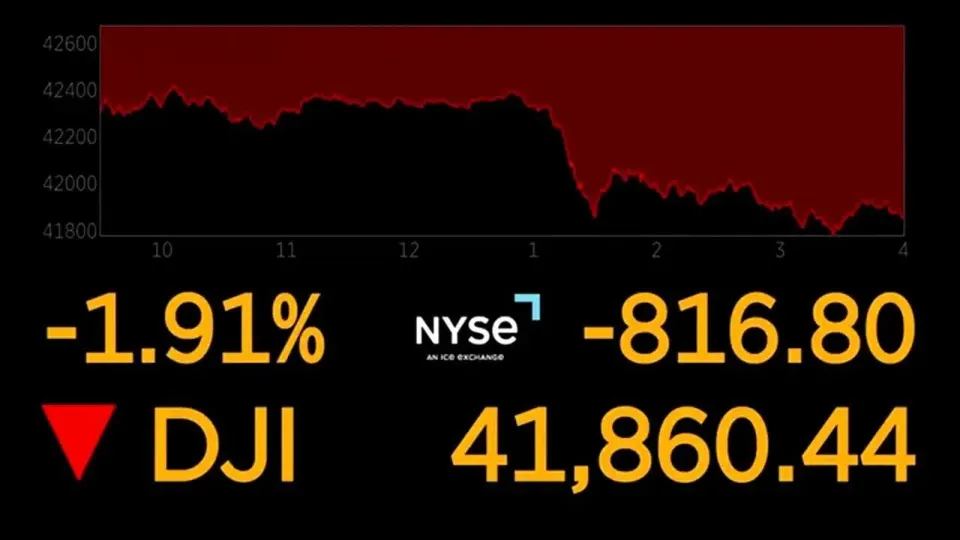
·The big screen of the New York Stock Exchange showed that the Dow Jones Index (DJI) fell by 816.80 points. (New York Stock Exchange)
Afterwards, Van Gilen admitted in an interview that the scenario described in this report had only a 10% to 15% probability of happening in his opinion, and he was "very surprised" by the market's violent reaction. He explained that the purpose of releasing the report is not to create panic, but to try to start a discussion and prepare society for this potential scenario, thereby reducing the probability of it actually happening.

"Battlefield Analyst" in the Investment World
Van Gilen is a low-key person, and there are no photos anywhere on the Internet. In the few public statements he made, he left some impressive quotes.
In response to the market's excessive panic about the report, he said: "Had I known it would cause such a big stock market fluctuation, I would never have made it public for free." As for why he adopted such hard-core on-site investigation methods, his answer was simple and sharp: "Morgan Stanley would not send investment analysts to Fujairah."
The media's evaluation of Citrini Research shows clear polarization. Spain's "Economist" commented that it is "not an investment bank nor a traditional analysis institution, but an independent macro and thematic research institution that focuses on identifying major market trends such as artificial intelligence and energy and converting them into investment ideas." The U.S. Consumer News and Business Channel called it "the company that shocked the market earlier this year with a provocative bearish report on artificial intelligence."
China Securities Journal commented on the on-site research practice of "Analyst No. 3": There are war reporters in the news world, and there are "battlefield analysts" in the investment world. This report was also praised by some financial professionals as "one of the greatest research reports in history" because it "abandoned the practice of most researchers typing on the keyboard in the office, and actually conducted actual investigations like a war reporter."
However, some media also questioned Van Gilen's professionalism because he did not have a financial analyst qualification certificate.
In any case, market data has verified Van Gilen's vision. Since May 2023, his personal portfolio has returned more than 200%. This may indicate that Van Gielen, relying on his own judgment and courage, has already opened a crack in the market with high information barriers.
Producer: Zhang Pei
Editor: Yu Chijiang