Professional virtual currency information station welcome
We have been making efforts.

vc Page 4

Cryptocurrency is a non-legal monetary asset based on digital technology and blockchain, possessing the functions of a medium of exchange and a store of value. Cryptocurrency is a transaction medium that uses cryptographic principles to ensure transaction security and control the creation of transaction units. Cryptocurrency is a type of digital currency (or virtual currency). Bitcoin became the first decentralized cryptocurrency in 2009, after which the term “cryptocurrency” was more commonly used to refer to such designs. Since then, several similar cryptocurrencies have been created, and they are usually referred to as altcoins. Cryptocurrency is based on a decentralized consensus mechanism, in contrast to the banking financial system that relies on a centralized regulatory system.

I've Been A Web3 Detective For The Past Few Years: I've Watched The "decentralization Dream" Collapse One After Another.

Mysteries involving millions of dollars are displayed on a wall in Coffezilla's office until they are solved. Just like in a Sherlock Holmes detective novel, several red lines intersect with each other, connecting photos of different "suspects."

Coffezilla has 120,000 followers on Twitter. He calls himself a "cyber detective" and focuses on exposing scams in the fields of cryptocurrency, Web3.0 and DeFi (decentralized finance).

Over the past decade, cryptocurrencies have gone from a niche, fringe thing to an important part of financial markets and pop culture, with their market capitalization soaring from $5.4 billion to $1.8 trillion, according to statistics website CoinMarketCap.

Coffezilla exposed the scam on social media. It takes courage to dare to show your face | Picture screenshot from Coffezilla’s YouTube

Also booming are “scams”. Starting in 2021, the popularity of NFT, DeFi and other projects has made scammers and hackers smell "business opportunities." It seems that every other day, some famous collectors will have an NFT stolen, an anonymous developer will run away with the money, or an encryption project will be hacked away with millions of dollars – this is the B-side of Web3.0 today.

"Everyone keeps emphasizing how cryptocurrencies make the world a better place, but they don't talk about how the people at the bottom are exploited by them. There are a lot of scams in cryptocurrencies." Coffezilla described Web3.0 in an interview with VICE. "It's like the Wild West out there, and regulators are a little slow to catch up."

The uniqueness of Web3.0 gave birth to the profession of "Web3 Detective". For now, it appears to be better positioned to address investors' questions and concerns than regulators and cybersecurity companies. Coffezilla is not alone. There are more and more like him. They are active on various social media and have become an important part of Web3. They expose scammers and track down hackers, then publicize them to warn the public to stay away from them. You can also understand them as Web3 bounty hunters and counterfeiters, dedicated to giving netizens a "clear cyberspace."

01 Web3 Detective Rise

ZachXBT never shows his face or uses his real name, but his impact on Web3 and the crypto world is as important as Coffeezilla's. ZachXBT calls himself a "rug pulls survivor". The so-called rug pulls scam refers to the project team immediately taking the money and running away after raising funds. After being scammed, I started focusing on researching crypto scams. He has more than 200,000 followers on Twitter.

Unlike Coffeezilla, he has made a full-time job as a blockchain detective, making a living by trading cryptocurrencies and collecting donations from the crowdfunding platform Gitcoin. So far, he has exposed more than 30 crypto scams and the people involved in them on the Internet.

Unfortunately, these scams are always associated with celebrities.

For example, ZachXBT once exposed that rapper Gunna was involved in promoting a crypto scam; he also accused a YouTube blogger with 500,000 followers of calling on viewers to buy an altcoin called The Famous Token (TFT) during a live broadcast in early 2022. ZachXBT discovered that the token had been abandoned by developers in September 2021.

"It frustrates me why famous people with so many fans keep lying to their fans." ZachXBT was confused.

Molly White is a software engineer and crypto blogger who runs a Twitter account and website called "Web3 is going just great". The purpose of the website is to provide an archive of scams, hackers, and lawsuits in the Web3 world.

Molly White feels that there is "a lack of any consumer protection" in the Web3 ecosystem. Without the "critical" work done by ZachXBT and people like him, numerous scams would never have been exposed. Web3 is becoming more and more popular, there are more and more scams, and Web3 detectives are also emerging in large numbers.

March 15, 2022, New York, USA, an NFT vending machine | Image source: Visual China

According to technology channel Motherboard, Alessandro Ribeiro, the founder of the Rug Pull Finder social media account, began investigating Web3 scams as an independent detective after he fell into three rug pulls scams. In February this year, he registered Rug Pull Finder as a company and formed a team of 16 people. “In this way, it will be easier to establish business relationships with other institutions and companies.”

One of the reasons these Web3 sleuths exist, he said, is that the Web3 ecosystem relies on public blockchains, which allow anyone to view the activity of smart contracts, public Discord channels, and social media accounts.

"Web3 detectives have access to more information than other ecosystems. This means talented investigators can more easily uncover clues and expose scams," said Nick Bax, director of research at Web3 cybersecurity company Convex Labs. Convex Labs, one of the few cybersecurity companies in the crypto space, recently launched its first project called HonestNFT, which promises to audit "the fairness of NFT projects." It also sells its own line of NFTs, called "Vigilante NFTs."

Web3 vulnerabilities give Web3 detectives room to "flex their talents", and there are more than just ways to protect Web3. For example, artist and cybersecurity veteran Simona Panzica, in addition to tracking down clues of scammers or hackers and helping to recover stolen digital assets, she also does some fraud prevention-related education projects.

Panzica is aimed at NFT artists and collectors and has published a book dedicated to teaching cybersecurity. She also hosts Twitter Spaces and Clubhouse sessions to teach people in the community how to avoid becoming a victim.

Web3 detectives are often anonymous. Because they constantly expose other people's scams, they will inevitably be targeted by some "enemies". ZachBXT said, “It’s not nice to receive death threats, but I’m glad that there are many people who support me.” ZachXBT has received offers from some encryption companies, but he hopes to remain independent. “Working for any entity does not allow the same level of freedom and creativity.”

02 The formation of a scam

Celebrity endorsements have accelerated Web3's popularity, but are often the starting point for scams.

Many celebrities have endorsed cryptocurrencies: Matt Damon promoted Crypto.com, an app for trading cryptocurrencies. Tampa Bay Buccaneers quarterback Tom Brady and his wife Gisele Bundchen have advertised for cryptocurrency exchange FTX. Cryptocurrency bloggers on YouTube, TikTok, Instagram and Twitter often show off their lives filled with first-class flights, luxury suites, and top-notch swimming pools. They are trying their best to express: Cryptocurrency is an excellent way to get rich quickly.

Matt Damon stars in Crypto.com encryption company's commercial | Picture from commercial screenshot

Scam writers know how to influence the psyche of the masses. They know how to use more money to impress key people and key communication nodes who can influence the encryption circle.

A recent publication report circulated on the Internet, revealing how much it costs to retweet a tweet and publish an original tweet, ranging from a few hundred dollars to tens or hundreds of thousands of dollars. The list includes dozens of influencers, many of whom have profiles that say they are promoting a certain crypto project. They call themselves cryptocurrency promoters, KOLs, Web3 builders, and Crypto traders.

The content of these paid tweets is often exaggerated, and the text usually contains the following familiar words: "Millionaire maker!", "Led by two of the most transparent people in the cryptocurrency field", "Doubling every 36 days!", "Super high fixed annual return of 159,402.57%". ——Projects like this often end up running out of money. Coffeezilla said the ads make it seem like celebrities and influencers can make "easy money," but it turns out these people are often being taken advantage of.

“What’s most prevalent right now is the promotion of undisclosed ‘private placement’ projects by influential bloggers and celebrities on social media platforms such as Twitter, YouTube and Instagram,” he said when explaining how these scams work.

ZachXTB exposed such a scam not long ago. He found that behind 9 fraudulent NFT projects were 4 young Croatians, aged between 20-23 years old. In total, they "walked away" with $2.8 million.

ZachXTB exposed their names on Twitter. "It is obvious that these fraudsters have not fully understood the principles of blockchain and have left too many clues. These clues can eventually be traced back to them." He explained that due to carelessness (perhaps ignorance), they forgot to delete all traces and configuration files that might connect them to the project.

These fraud projects all claim to have great plans and prospects, creating a "big pie" for investors. They are constantly hyped in the crypto community and various social media to attract more novice investors, and then the project team disappears overnight with the money.

"The strategies used by scammers have been evolving. Placing false advertisements or directing users to copycat websites with similar domain names to actual products is more popular now," said a "white hat" from a security company.

In addition, hackers are also the hunting targets of Web3 detectives. In the past few months, hackers have targeted large cryptocurrency companies such as money-making games Axie Infinity and WonderHero, stablecoin Beanstalk, Poly Network, cross-chain bridge Wormhole, exchange Crypto.com, Multichain, crypto gaming company Vulcan Forge, BadgerDAO and crypto exchange BitMart, among others, profiting by directly stealing their accounts.

03 Smart contracts: the root of gaming

According to data from blockchain analytics firm Elliptic, DeFi protocols have lost $12 billion to date. A core issue is that there are inherent risks in the smart contracts that many cryptocurrency or DeFi projects rely on.

Smart contracts refer to highly complex self-executing code that exists on the blockchain. They're public, can't be deleted, and are difficult to change, which means you can't easily fix a vulnerability when you find it. Many crypto project initiators always want to build projects and smart contracts as quickly as possible to enter the market first, which also leads to more contract loopholes.

All software has flaws, but in the Web3 world where "code is law", this risk is magnified. Security in the crypto world is in "dire straits."

It's all fun until you lose $5 billion due to a software vulnerability, said Jennifer Fernick, senior vice president at cybersecurity firm NCC Group.

Jennifer Fernick said that another challenge of Web3 is that "many vulnerabilities in smart contracts come from external interactions with other smart contracts, so even if your application code is secure, if other applications you interact with have vulnerabilities, it can cause catastrophic losses."

And Web3 detectives exploit contract vulnerabilities to track down hackers and scammers. A white hat hacker revealed several simple investigation methods. He said that based on the "non-tampering", "transaction openness and transparency", "traceability" and other characteristics of blockchain technology, you can use the blockchain browser to view the wallet balance, transaction records, transaction-related fees, and the whereabouts of the money and other information; and then combine it with some open source intelligence tools to find relevant emails, social media information and other clues.

04 The future of “regulation”

"Get ready for an SEC enforcement onslaught," said one former SEC employee.

The SEC announced on May 3 that the U.S. Securities and Exchange Commission’s crypto enforcement team will double in size, bringing the division’s total headcount to 50 people, in order to deal with the growing crypto industry. The SEC renamed the division the “Crypto-Assets and Networks Division,” explaining that it did so to better protect investors in the fast-growing, scam-ridden and often unregulated world of cryptocurrencies. The unit will focus on investigating NFTs, decentralized finance (or “DeFi”) platforms, stablecoins, crypto assets and exchanges, as well as crypto asset lending and staking products.

There Are Huge Differences In Bitcoin Trend Predictions In 2026, And The Range Of Views Of Each Camp Is Here

Previously, we summarized institutions’ judgments on Bitcoin’s trend in 2025, and the result was a “collective miscalculation” – whether it was predictions of growth, rhythm, or retracement paths, they all deviated from the final market trend. Under this premise, the market's trust in "target price narratives" has significantly declined, and forecasts are viewed more as scenario deductions rather than "committed guidance." Despite this, each company still gave a new framework and range: the optimistic camp bet on the structural buying brought about by the expansion of institutional allocations and spot ETF capital channels, with targets mostly focusing on US$150,000-250,000; the cautious and bearish camps emphasized that slowing demand, macro tightening or damage to the technical structure may trigger a deep retracement, which could reach US$70,000, 56,000, 25,000 or even US$10,000. The following table retains the "core conclusions" of each viewpoint and visually presents the scope of disagreements and main logic in 2026.

Tom Lee: 200,000–250,000

In many public discussions in 2025, Tom Lee pointed to the upside in 2026 as being in the range of US$200,000-250,000 by the end of 2026. The core reason he gives is usually the marginal buying brought about by the expansion of institutional allocation and funding channels such as ETFs. He also believes that the cyclical structure may be changed by institutional funds.

https://finance.yahoo.com/news/bitcoin-reach-250-000-2026-110500453.html

However, Sean Farrell, head of digital asset strategy at Tom Lee’s fund Fundstrat, said in his latest 2026 cryptocurrency strategy recommendations to internal clients that there will be a deeper correction in the first half of the year, with target prices of BTC 60000–65000, ETH 1800–2000, and SOL 50–75. In response to this, he replied to Wu that Fundstrat is composed of multiple analysts. Each analyst has an independent research framework and time dimension to serve the different needs of different types of customers. He himself prefers to serve investment portfolios with a high proportion of crypto assets, and his strategy emphasizes active management and risk rebalancing; while TomLee targets institutional investors who only allocate 1%-5% of their funds to BTC and ETH, so he focuses more on long-term macro trends and structural judgments, which are not contradictory.

https://x.com/SeanMFarrell/status/2002475989033758740

Ripple CEO: 180,000 Solana Foundation Chairman: more than 100,000

On December 4, 2025, Ripple CEO Brad Garlinghouse made a bold Bitcoin price prediction during the Binance Blockchain Week discussion with Solana Foundation Chairman Lily Liu and Binance CEO Richard Teng. He said he expects BTC to reach $180,000 by the end of 2026. Richard Teng did not give a specific price target but said he expected prices to be higher than current levels. Lily Liu said the price could be higher than $100,000.

https://www.coindesk.com/markets/2025/12/04/ripple-ceo-s-bold-call-bitcoin-to-hit-usd180k-by-end-of-2026

JPMorgan: 170,000

Based on the "volatility-adjusted BTC-gold relative valuation" framework, JPMorgan (Team of Nikolaos Panigirtzoglou) believes that the theoretical price/implied fair price of BTC is close to 170,000, and based on this judgment, there is still room for upside "in the next 6-12 months". It's more like a model-derived valuation upper edge than a "committed end-2026 price target."

https://www.businessinsider.com/bitcoin-price-prediction-btc-170k-jpmorgan-gold-forecast-2025-12

Standard Chartered Bank: 150,000

Standard Chartered Bank has previously been very optimistic about the long-term trend of Bitcoin. It has predicted that the price of BTC may reach about US$200,000 by the end of 2025 (even higher expectations are expected) and a target of about US$300,000 in 2026. Now the bank has significantly lowered its forecast: Bitcoin is expected to reach about $100,000 by the end of 2025, halved from the previous forecast; the target price in 2026 has been reduced to about $150,000, which is about half of the original expectation. Standard Chartered believes that this is an adjustment to the recent market weakness and weakening driving forces (such as reduced DAT buying and slowing ETF inflows). At the same time, although it is still optimistic that Bitcoin can eventually reach higher levels in the long term, the realization time has been delayed.

The following is Standard Chartered’s prediction of Bitcoin’s price trend over the next four years:

https://www.businessinsider.com/bitcoin-price-prediction-btc-2026-forecast-standard-chartered-150k-2025-12

Bernstein: 150,000

Wall Street investment bank Bernstein released its latest Bitcoin outlook in the context of the recent market correction, believing that the recent BTC correction does not mean the end of the bull market and that Bitcoin will continue to rise. The agency predicts a Bitcoin price target of approximately $150,000 in 2026 and believes that the Bitcoin price cycle is no longer limited by the traditional four-year halving rhythm, but has entered an extended bull market cycle driven by institutional funds. In the long term, Bernstein maintains his view of a longer-term target (such as about $1 million in 2033), emphasizing institutional demand and ETF inflows as the core driving forces supporting future gains.

https://finance.yahoo.com/news/bernstein-reveals-bitcoin-target-amid-204043033.html

BSTR President: 150,000

Katherine Dowling, president of Bitcoin Reserve Company BSTR, recently stated that although BTC is still about 20% lower than its previous high, she expects Bitcoin to rise to US$150,000 by the end of 2026; her bullish logic mainly comes from three clues: US encryption regulations and legislation (such as stable currency/market structure related bills, regulatory guidelines) are gradually becoming clearer, the monetary environment may become more relaxed (such as the end of QT, interest rate cuts expectations), and Wall Street and institutional allocations are accelerating (spot BTC ETF With continued penetration, some large banks have begun to allow investment advisors to recommend allocations to Bitcoin ETFs to their clients, giving an allocation range of approximately 1%–4%).

https://finance.yahoo.com/news/bitcoin-hit-150-000-2026-193349256.html?utm_source=chatgpt.com

Citigroup: 143,000

Citigroup predicts that Bitcoin is expected to rise to $143,000 in the next 12 months, which is about 62% higher than the current price (about $88,000). The forecast is based on expected increases in inflows into spot Bitcoin ETFs and the potential for digital asset-related legislation in the United States to drive market adoption. Citi analysts set a key support level of about US$70,000 and gave three directions in the scenario analysis: the basic scenario target is US$143,000, the pessimistic scenario may drop to about US$78,500, and the optimistic scenario may rise to US$189,000 with the large-scale participation of institutions and retail investors.

https://www.marketwatch.com/story/bitcoin-will-climb-to-143-000-according-to-this-wall-street-forecast-cd202b39

Arthur Hayes: 124,000 to 200,000

In his article "Love Language" on December 19, veteran crypto trader Arthur Hayes discussed the new term RMP (Reserve Management Purchases) launched by the Federal Reserve, arguing that it is essentially equivalent to quantitative easing (QE) – that is, money printing in disguise. The article points out that the Federal Reserve and political officials use complicated terminology to cover up that they are actually expanding the money supply. This monetary expansion will eventually push up the prices of financial assets (such as Bitcoin, gold, etc.). The analysis of the article believes that as major central banks around the world accelerate money creation, Bitcoin has the potential to exceed approximately US$124,000 in 2026 and further impact the level of ~US$200,000. Hayes' logic is based on: money supply expansion → inflationary pressure → investors turn to limited supply assets (such as BTC) as a hedge.

https://cryptohayes.substack.com/p/love-language

Jocy, founding partner of IOSG: 120,000 to 150,000

Jocy, the founding partner of IOSG, gave a more "half-year perspective" judgment in a long public post/paraphrase: the mid-term (first half of 2026) target is US$120,000-150,000, and summarized the driving factors as "dual drivers of policy and institutions"; he also explained the market structure in 2025 (long-term holders are distributed in batches, etc.), believing that multiple waves of allocation make the trend more tortuous.

https://x.com/jocyiosg/status/2002730918142783882

Grayscale: A new high in the first half of the year

Asset management company Grayscale predicted in its latest 2026 Digital Asset Outlook report that Bitcoin will hit a new all-time high in the first half of 2026. Grayscale believes that the main factors driving price increases include the continued growth of institutional investment demand and the gradual clarity of the U.S. regulatory environment, which will attract more funds to enter the market. The company also pointed out that as demand for alternative value storage instruments (such as BTC) rises at the macro level, and regulatory progress brings mainstream adoption, Bitcoin’s valuation is overall bullish in 2026, and believes that the traditional “four-year cycle theory” may be invalid in the current cycle.

https://cointelegraph.com/news/grayscale-predicts-bitcoin-all-time-high-q1-2026

Bitwise: Hit new highs

Bitwise judged in its annual outlook "The Year Ahead: 10 Crypto Predictions for 2026" (December 15, 2025): Although mainstream currencies will retreat from their highs at the end of 2025 and market sentiment is cautious, 2026 is more likely to be "bullish", and institutional adoption and regulatory progress will overwhelm the retracement expectations brought about by the traditional "four-year cycle", and gave 10 predictions: BTC breaks the four-year cycle and reaches new highs, BTC Volatility will be lower than Nvidia, U.S. spot ETFs will buy more than 100% of the annual new supply of BTC/ETH/SOL, crypto-related stocks outperform technology stocks, Polymarket open interest hits a new all-time high, stablecoins will be "accused" of disturbing an emerging market currency, on-chain treasury ("ETF 2.0") AUM doubles, ETH and SOL if the "CLARITY Act" is passed Another new high, half of the Ivy League foundations have allocated crypto assets, and more than 100 crypto-related ETFs will be launched in the United States; additional judgments are that the correlation between BTC and stocks has declined.

https://bitwiseinvestments.com/crypto-market-insights/the-year-ahead-10-crypto-predictions-for-2026

CryptoQuant: 56,000 to 70,000

CryptoQuant, an on-chain data analysis agency, said that the market may have entered a bear market stage due to a significant slowdown in demand growth for Bitcoin. Based on its model, there are downside risks to the current Bitcoin price: it may first fall towards the support level of about $70,000 in the medium term. If momentum continues to weaken, a deeper correction may touch about $56,000, a level close to the so-called "realized price". Historically, the bottom of bear markets is often aligned with this indicator. Factors such as weak institutional demand (such as spot ETFs turning into net sales) and declining risk appetite in the derivatives market are regarded as the main reasons. In terms of timing, a drop to $70,000 may occur in the next few months, while $56,000 is more of a longer-term scenario in the second half of 2026.

https://www.theblock.co/post/383407/cryptoquant-bitcoin-bear-market

Peter Brandt: 25,000

Senior trader Peter Brandt warned that Bitcoin’s current parabolic growth structure has broken down, which historically usually means that the market will see a major correction. Based on historical cycles, Brandt observed that Bitcoin bull markets exhibit what’s known as “exponential decay”—each bull cycle’s rise becomes progressively smaller, making price corrections likely to be deeper and faster once trend support is broken. Based on his analysis of past cycles, if Bitcoin retraces significantly by about 80% from its historical high, the price may drop to about $25,000 as a reference for the bottom of a potential pullback. This view emphasizes the downside risks caused by technical structural failures rather than upward predictions in the traditional sense.

https://cointelegraph.com/news/peter-brandt-bitcoin-price-exponential-decay-model-2026-25k

Mike McGlone: ​​10,000

Mike McGlone, senior commodities strategist at Bloomberg Intelligence, issued an extremely pessimistic warning, saying that after experiencing a recent shock above $100,000, Bitcoin may fall sharply back to about $10,000 in 2026 – equivalent to a drop of about 88%–90% from its historical high. He believes that this risk comes from the shift in the macroeconomic environment to "post-inflationary deflation", tightening liquidity, and deep adjustments in the speculative asset market, which may lead to the overall collapse of the crypto asset market and prompt a sharp decline in Bitcoin prices. McGlone noted that a breakout of price highs may have initiated a reverse correction cycle, similar to the deep retracements that have historically followed asset bubbles.

https://www.coindesk.com/markets/2025/12/18/bloomberg-intelligence-strategist-mike-mcglone-sees-bitcoin-at-10000-in-2026

Barclays Bank: No clear price

Barclays Bank released a research report stating that in the absence of major market catalysts (such as regulatory breakthroughs, product launches or policy promotions), the cryptocurrency market may perform flat or even weak in 2026, and trading activity and investor enthusiasm will be difficult to significantly rebound. The bank pointed out that spot trading volume continued to decline and retail investor participation weakened, which put pressure on platforms that rely on trading volume for profitability (such as Coinbase, Robinhood). Barclays believes that the market is more likely to enter a "transitional" stage, with insufficient motivation for sharp price increases, and it is difficult to see new growth drivers in the short term; it also mentioned that regulatory clarity (such as CLARITY Act) and long-term technological development may be potential benefits in the future, but they will have limited effect in 2026.

VanEck: Consolidation stage, partial to “consolidation/consolidation year”

In its 2026 investment outlook report, investment management company VanEck expressed cautious optimism about Bitcoin and market direction but no longer issued a clear price target. The report believes that Bitcoin is more likely to enter a "consolidation" stage in 2026 – neither an explosive rise nor a collapse, but a sideways fluctuation and digestion of previous fluctuations. VanEck pointed out: Bitcoin’s four-year cycle is still there, but its current trend lags behind the performance of assets such as the Nasdaq, reflecting the short-term weakness in market risk appetite and liquidity; as global liquidity, credit environment and on-chain activities gradually improve, 2026 may be a relatively mature year of integration, suitable for accumulating positions through disciplined strategies such as fixed investment. The report emphasizes that opportunities come from ecological developments such as Bitcoin mining economic structural adjustment and stable currency payment, rather than specific price expectations.

https://www.vaneck.com/us/en/blogs/investment-outlook/plan-for-2026-predictions-from-our-portfolio-managers/

There Are Still 180 Days Until Zhao Changpeng Is Pardoned

In the middle of the night on October 23, 2025, Changpeng Zhao, the richest man in Chinese cryptography, was announced to have been pardoned by President Trump of the United States.

According to public information, President Trump previously expressed to advisers that he sympathized with the notion that Zhao Changpeng faced "political persecution in the United States."

However, just a year ago, on April 30, 2024, Zhao Changpeng was experiencing the darkest moment in his life: he was stripped naked, underwent a humiliating body search, showed his buttocks, and was then locked in a cold cell. The inmates are muscular men with tattoos on their faces and designs carved on their heads.

In the federal court in Seattle, Zhao Changpeng, wearing prison uniform, admitted his crime. This man, known as the "richest man in China", voluntarily chose to pay a fine of US$4.3 billion, and said in front of the media: "I choose to pay a political fine."

If someone had told him at that time: Not only would you be pardoned by the United States in a year, but you would also be able to set foot in China again, and the cold eyes and fists in the Seattle jail at this moment, as well as the 4.3 billion political fine, would be cleared. He would probably curse in his mind, what kind of black humor is this?

The signal about Zhao Changpeng’s pardon will be released starting from September 17, 2025. On the same day, CZ suddenly updated his Twitter profile and changed "ex-@binance" back to "@binance". To some extent, it shows that the dust has settled that he can return to Binance.

At the same time, just in October, the two major "compliant trading portals" in the United States almost gave signals: the crypto listing platform Coinbase and the mainstream brokerage Robinhood regulated by the SEC successively opened BNB trading. This platform coin from the Binance ecosystem founded by Changpeng Zhao has obtained an official entry into the mainstream financial system in the United States for the first time.

White House Press Secretary Karoline Leavitt announced the pardon was effective and emphasized: "The Biden administration's war on cryptocurrency has come to an end."

Let's turn the clock back to 180 days before the amnesty. When Changpeng Zhao, the richest man in China and founder of Binance, is one step away from "political amnesty", what is he doing?

In the spring of 2025, the air in Victoria Harbor was filled with a long-lost excitement, and a group photo quickly swept the screen.

There are four people standing in seat C of the group photo: Huobi founder Li Lin, Changpeng Zhao CZ, Justin Sun, and Kong Jianping.

The ninth from the left is Li Lin, the founder of Huobi, the tenth from the left is Changpeng Zhao, the founder of Binance, and the sixth from the left is Kong Jianping

To others, this is just a group photo of a few big guys in the cryptocurrency industry, but in the eyes of knowledgeable people, this scene itself is a signal.

Eight years ago, China completely banned ICOs and trading platforms. Binance hurriedly went overseas, and Changpeng Zhao became "the person least likely to return to China." Eight years later, he reappeared in this photo. This was his opening salvo to reconnect with local capital and institutions.

The host of this party, Li Lin, was the founder of Huobi, one of the top three trading platforms in the world. Three years ago, he sold the company he founded to Justin Sun, who was also at the dinner party. After the dinner, the person who had the most contact with CZ was Kong Jianping who stood beside them.

Kong Jianping was once the co-chairman of the board of directors of Canaan Technology, a well-known mining machine manufacturer. In 2020, he founded Nano Labs and served as chairman. He is also a director of Hong Kong Cyberport, a member of Hong Kong’s “Task Force to Promote Web3 Development”, and was even appointed by the Secretary for Financial Services and the Treasury of the Hong Kong SAR Government to serve as a member of the tribunal.

Two months after the party, Kong Jianping announced in a high profile that he would build a $1 billion BNB treasury, with the goal of hoarding 5% to 10% of the circulation, and packaging the Binance platform currency BNB into a "US stock listed company."

CZ's tweet was forwarded personally, which immediately ignited market sentiment and the stock price soared, with an intraday increase of even as high as 107%+. Changpeng Zhao emphasized that he and his associated entities "did not participate in this round of financing." However, they "remain very supportive."

Since then, Kong Jianping can be seen behind most of Zhao Changpeng's public speaking events in Hong Kong.

Four months later, when Changpeng Zhao returned to Hong Kong for the second time, he was no longer just a "mysterious guest" at the Binance event, but came with a clear agenda: on the one hand, he officially announced the cooperation with China Renaissance before the event; on the other hand, he finalized the connection with OSL after the event. The echoes before and after marked the gradual clarity of his landing path in Hong Kong.

The story of China Renaissance has a lot in common with Binance, where glamor and dissociation coexist. Founder Bao Fan is the most disruptive person in the investment banking circle. He has brokered mergers of the century between Didi and Kuaidi, Meituan and Dianping, and has invested in Circle, the largest listed stablecoin company.

But in February 2023, Bao Fan suddenly "disappeared", so Huaxing became a sensitive name in the capital market. The investment banking business is still running, but because the founder is "in custody", it has been in a free position for a long time: traditional finance does not dare to fully trust it, and emerging Internet capital feels that its power has been exhausted.

At the end of August 2025, Binance officially announced its cooperation with China Renaissance.

Before the cooperation between China Renaissance and BNB came to fruition, a subtle coincidence occurred. On August 8, 2025, Caixin disclosed that Huaxing founder Bao Fan was "released", ending a two-and-a-half-year disappearance investigation; just three weeks later, Huaxing announced an investment of US$100 million in BNB and joined hands with the Changpeng Zhao family fund YZi Labs to launch a compliance fund. Bao Fan’s wife Xu Yanqing, who is also the current chairman of Huaxing’s board of directors, participated in the BNB Ecology fifth anniversary event as a guest speaker.

In addition, Changpeng Zhao and Huaxing also implemented a seemingly inconspicuous initiative: promoting BNB to be listed on a virtual asset trading platform licensed by the Hong Kong Securities Regulatory Commission.

Just 12 days later, OSL, Hong Kong's first licensed trading platform, made an announcement online: Binance Platform Token BNB became the fifth crypto asset approved for trading on a licensed trading platform in Hong Kong.

As the earliest trading platform to obtain a license in Hong Kong, OSL is backed by its parent company BC Technology, a licensed financial technology group listed on the Hong Kong Stock Exchange. OSL itself has obtained the first batch of virtual asset trading platform licenses in Hong Kong. It also has custody and brokerage businesses, and has a network that directly connects local brokers, ETF custodians and institutional distribution.

The reason why this company is special in the industry is considered to be related to the "financialization background" of its early management. Its largest shareholder, accounting for 25.43% of the shares, was originally from a traditional brokerage, but later entered encryption. He is also the founder of the trading platform Bitget, and has the most thorough integration of compliance and capital markets.

Zhao Changpeng's return to China is written between these coincidences and operations, relying on pieces of capital and politics to complete the puzzle.

In the 180 days before receiving the pardon from the US President, Zhao Changpeng's seemingly loose actions actually served the same goal: to first reestablish the legitimacy of CZ's return to China.

Changpeng Zhao said this during an event at the University of Hong Kong, "When I left the mainland four years ago, I thought I would never return to the core stage of the Chinese-speaking world. But standing in Hong Kong today, I clearly know that the previous wandering was just a foreshadowing, and the real story has just begun."

Some people think this is just a statement, but once you know the story behind it, you will find that it may be something from the bottom of your heart.

In July 2017, Binance started in Shanghai. Two months later, ICOs and trading platforms were completely banned in China, and CZ was forced to evacuate with a team of more than 30 people. In six weeks, they moved data from Alibaba Cloud to AWS, and applied for visas for engineers who had never been abroad. Like a makeshift expedition team, they arrived in Tokyo.

At that time, Japan seemed to be an ideal safe haven, and the government had recognized virtual currencies as legal. So Binance rented an office, and it was the "global headquarters" for about ten people.

The bull market in 2017 was raging, with Bitcoin rushing from US$3,000 to US$19,000. Binance reached the top spot in terms of global trading volume in just five months. During that time, they worked almost non-stop, and the number of registrations soared to the point where they temporarily closed down account openings.

But the tide quickly reversed. In early 2018, scammers used fake Google ad phishing to defraud investors of their Binance accounts and funds. The Japan Financial Services Agency suddenly tightened its policies and directly warned Binance of unlicensed business activities in Japan in March. The cold face of the regulators was more terrifying than the hackers. CZ once again packed up and evacuated Tokyo.

After retreating from Tokyo, CZ bet on Malta in the Mediterranean. In 2018, Prime Minister Muskat shouted the slogan "Blockchain Island". So Changpeng Zhao cooperated with the local government and announced that Binance’s global headquarters would be here. Within three months, the team expanded to employees from 39 countries. But two years later, the Malta Monetary Authority issued a cold statement: Binance has never been registered.

After this back and forth, Japan looked coldly and Malta repented, forcing CZ to simply announce that Binance will no longer be looking for a headquarters.

In September 2021, this "headquarterless model" began to play a special role in supervision. In 2021, a trading platform opponent sued Binance in the United States, and a class action lawsuit brought Binance, CoinMarketCap and Changpeng Zhao to court.

Here comes the place of being a god: the company can still be found with the summons, but the address cannot be found for "no headquarters", and in the end we can only go after the founder. So the plaintiff's lawyer hired a private detective who was a retired Marine to track down CZ's whereabouts. The investigation spanned Asia, Europe and the Middle East, looking through flight data, business registrations and social media. Months passed and still nothing.

Until the end, the detective left a sentence in the report: "We have made great efforts to track Zhao Changpeng, but Zhao Changpeng's whereabouts are almost impossible to detect."

The lawyer finally suggested sending the subpoena directly through Twitter, after all, CZ speaks on it every day. Of course, this was rejected by the judge.

Drifting is just a preparation. The headquarters can disappear and the passport can be replaced. But soon, Zhao Changpeng will face another more difficult identity test question – when the Americans point the finger at his Chinese ancestry, what answer can Zhao Changpeng give?

On the poker table of the world's power game, one's origins are revealed first, followed by passports. As for ability, it is often just the final talking point.

From a U.S. prison to a U.S. presidential pardon, Changpeng Zhao’s dedication to so-called “compliance” has always been “more than just” compliance.

At the end of 2022, FTX, the second largest trading platform in the United States, collapsed and closed, resulting in a huge funding gap due to losses. Immediately seven months later, the US SEC began to prosecute Binance CZ for illegal operations, and issued a sky-high US$4.3 billion fine at the end of the year.

Outside the courtroom, the power play in Washington never stops. The regulatory storm led by the Democratic Party has shaped CZ into a perfect target: a Chinese entrepreneur who controls half of the crypto world but is suspected of violating anti-money laundering laws and sanctions. In the prosecutor's charge sheet, Binance was accused of "serving illegal activities", and CZ's background, a Chinese who was born in China and lived in Shanghai in his early years, became the cheapest and most efficient entrance for attacks.

On November 24, 2023, a hot post on Reddit, an overseas social media, became a hot search topic in the crypto sector, discussing whether Binance can really afford a US$4.3 billion fine, and comparing it with FTX's US$6.8 billion hole. Many American netizens even suggested that the government is "squeezing blood" from Binance to fill the shortfall in the U.S. encryption industry.

But money can only solve financial problems, and doubts about one's origins always follow.

U.S. Congressman Stacey Plaskett said bluntly at a hearing: "Although he is a Canadian citizen, he is Chinese."

In the Forbes article, Changpeng Zhao said: "My Chinese identity is brought up again, as if it is important." Zhao has been the target of discrimination in the past because of his Chinese identity, especially when some people tried to associate him with relevant governments in Asia.

In the spring of 2024, Zhao Changpeng paid a fine of US$4.3 billion, put on prison uniform and entered the Seattle Prison in the United States to commit suicide. This period of prison life, which he called "the most difficult moment in his life," did not completely bring about a political identity reset.

The real turning point was when Republican Trump returned to the White House and gave the encryption industry an "amnesty."

The 4.3 billion fine that Changpeng Zhao handed over to the Democratic Party has become a sunk cost of political sacrifice. He had to start betting again.

In March 2025, Binance announced a $2 billion investment from Abu Dhabi sovereign fund MGX. The proportions, governance rights, and use of funds are not disclosed, but what really stands out is the settlement method. Not US dollar cash, but USD1 stablecoin – behind it stands World Liberty, which has close ties with the Trump family.

Soon after, Changpeng Zhao posted a photo with Zach Witkoff on social media. Zach is both a co-founder of USD1 and an ally of the Trump camp. His father, Steve Witkoff, is serving as the Trump administration’s special envoy for the Middle East.

This gave a financial investment more political meaning. Middle Eastern capital entered the market, the Trump family’s stablecoin came to the stage, and CZ used this in exchange for a new layer of asylum.

Just two weeks later, the Trump family’s stablecoin USD1 announced its official launch on the Binance ecosystem BNB Chain.

USD1’s slogan is simple: “A digital dollar for Americans.” The first thing CZ did was to connect it to its basic disk. BNB Chain is originally a lively food market, with everything from lending, DEX, and Meme. As soon as USD1 was put on the shelves, lending pools were launched, cross-chain tools were connected, and the Trump Family Fund even brought Meme coins directly related to Binance’s Four.meme project.

In fact, nearly 90% of the total issuance of USD1 stablecoins is circulating on the BNB chain.

On the surface, this is a product cooperation; in fact, everyone is envious of this political blessing that is difficult to obtain even if they squeeze their heads. Even so, Changpeng Zhao formally applied for a presidential pardon from Trump in April this year, and it took five months for him to receive an official document saying "pardon has been approved."

Bob Dylan once sang in his famous song "Blowin' in the wind":

How many roads must a man walkdown

How many roads does a person have to walk?

Before you can call him a man

To be called a real man.

For Binance, this problem is equally difficult: "How many roads do we have to go through and how many hurdles do we have to cross before we can truly stand on the stage of compliance?"

For Zhao Changpeng, this is a personal disaster; for Chinese entrepreneurs, it is a collective problem. The nationality page of the passport can be changed, but in the political narrative, Chinese identity has become an irresolvable label in the game.

This kind of label brings structural fragility. Business competition is a contest under a legal framework, but war is different. The opponent will hardly consider any rules and restrictions, and will use any means to achieve its strategic goals.

Changpeng Zhao once said: "If there is an audience, I might be willing to serve as a mentor to a few emerging entrepreneurs in private. If for no other reason, I can at least tell them what not to do."

After all, for Chinese entrepreneurs, "compliance" is not just compliance, it often also means a higher threshold of "identity redemption."

On the surface, this is the institutional friction behind business competition, but on a deeper level, it is the projection of identity politics in the global market. Even if a German entrepreneur, a Japanese entrepreneur, or a Korean entrepreneur faces supervision, their "nationality background" is rarely magnified indefinitely. But when the subject is Chinese, the identity naturally takes on a geopolitical metaphor, as if every expansion of the company implies the will of the country.

Shein’s CEO Xu Yangtian obtained a Singaporean passport, but failed to exchange for Shein’s smooth listing; TikTok replaced Singaporean CEO Zhou Shouzi, but it could not stop Congress’s continued questioning of “Chinese identity”; Temu moved its headquarters to Ireland, but could not get rid of Washington’s accusations of “forced labor”.

Because of this, there is always a disconnect between the "passport" and "identity" of Chinese entrepreneurs. Passports can be changed again and again: Canada, Singapore, Grenada… But "identity" is a deeper brand, written on the face, engraved in the experience, and difficult to erase. It makes these entrepreneurs always have to pay extra costs on the road to cross-border expansion, with more explanations, more scrutiny, and even more compromises.

Some people say that this is the inevitable result of globalization reaching deep waters: capital can flow freely, but people's identities cannot easily cross political barriers. The success and difficulties of Chinese entrepreneurs are a concentrated expression of this contradiction.

On the one hand, they have proved the hard work of the Chinese community. On the other hand, they are constantly reminded that no matter how big the market is and how strong the capital is, they are always in a position where they need to prove that they are harmless.

This may be the common pain of Changpeng Zhao: they can change the company structure and embrace different markets, but they must learn to find asylum in different power structures in the United States, Europe, and the Middle East; they must accept that passports can become tools and identity is another fate that is difficult to escape.

Changpeng Zhao tweeted immediately after receiving the pardon: Thank you to President Trump for the pardon and will make every effort to help the United States become the capital of cryptocurrency.

Perhaps for Chinese entrepreneurs, this game about "identity" is far from over.

References

.Binance CZ talks about his prison experience for the first time: the body search process was embarrassing, the roommate turned out to be a double murderer, an in-depth interview with Farokh Sarmad and CZ

. Official Gazette of the Hong Kong Special Administrative Region

.Plaskett uses “anti-Asian discrimination” against Canadian crypto CEO in congressional hearing, Federal Newswire Report

alert! Pig-killing Plate Borrowed Foreign Exchange Investment Fraud, A Woman Invested A Large Amount Of Money In Insurance And Was Defrauded

"Pig-killing plate" refers to a fraud gang using online social platforms to make false friends, marriages, and then commit fraud. Different from ordinary telecommunications fraud, "Pig Killing Plate" is more deceptive and difficult to see through. Scammers use fake "personas" to slowly interact with the victim and cultivate feelings. After gaining the victim's trust, the scammer will lure the victim to borrow, invest, and recharge on fake investment websites to achieve "harvest."

Case 1

Ms. B arrived in South Australia to visit relatives. Because she was depressed, she downloaded karaoke songs on her mobile phone app to entertain herself. Recently, a male singer named "Stone" Z sent a personal song to B, and the two became friends on WhatsApp. Soon, Z began to introduce foreign exchange investment and financial management to B, and guided B to register on the foreign exchange trading platform coinspot and conduct foreign exchange transactions online. After B invested US$5,000, he gained US$500. Z then guided B to register for investment in Metatrade5 app, another gold and foreign exchange trading platform. After B invested US$50,000, Z suggested that B collect US$100,000 to make greater profits, and expressed his willingness to lend money to B. After B persuaded his family to raise US$200,000, he asked Z to assist in foreign exchange speculation. B once again made US$20,000. After that, when Z continued to persuade B to collect US$300,000 for reinvestment, B realized that he might be cheated and tried to withdraw the principal invested before but failed. For further verification, B added several strange netizens to the national karaoke with whom he wanted to chat privately, and found that their fraud tactics were the same as Z's. B then called the police and contacted the Consulate General for help.

Case 2

C met a stranger named X online, and soon joined Whatsapp to discuss investment and financial management matters. First, After successive profits, X suggested that C transfer the money to the foreign exchange speculation platform Full Crown Market to continue investing. When C said that he needed to withdraw money, X said that C needed to pay a deposit of tens of thousands of Australian dollars and register for another operating platform before he could withdraw money. Only then did C realize that he had been cheated. At this time, C’s accumulated investment in Full Crown Market of nearly 100,000 Australian dollars could no longer be withdrawn. Although C has changed his mobile phone and blocked X, he still often receives various scam calls and feels very anxious about this.

The Consulate General in Adelaide solemnly reminds:

You should be cautious when making friends online, especially when it comes to recommendations involving online investment and financial management, speculation in digital currency (virtual currency), speculation in gold, buying lottery tickets, etc. You must maintain a high degree of vigilance and enhance your discernment to avoid unnecessary losses.

Contact number:

Global Consular Protection and Service Emergency Hotline of the Ministry of Foreign Affairs (24 hours):

+8610-12308

+8610-59913991

Consular Protection and Assistance Telephone Number of the Consulate General in Adelaide:

+61-882688806

Pay attention to consular express trains to ensure overseas safety and avoid getting lost

GitHub Hot Project Report On January 19, 2026 - Artificial Intelligence, Development Tools And Financial Technology Projects

Today’s hot spots: AI, development tools and financial technology projects dominate the hot list

Today's GitHub hot list covers a diverse range of fields, from practical tools such as yt-dlp and tobi/try to AI speech synthesis VoxCPM, to the high-performance algorithmic trading platform nautilus_trader. The specific project summary is as follows:

yt-dlp/yt-dlp (142678) – in-depth analysis report

Executive Summary: yt-dlp is a tool that redefines command line media download standards through continuous iteration and plug-in architecture. It solves the core pain points of users in cross-platform and multi-site content acquisition, and has become an indispensable tool for developers and individual users.

Value Proposition Technical Architecture and Implementation Highlights (Technical Architecture)• Key technology choices:• Code sample interpretation: # JSON field traversal design of output template

'%(subtitles.{lang}.{-1}.ext)s' # Dynamically obtain the last subtitle format. This design embodies the metadata-driven philosophy: replacing hard coding with a template language to enable the tool to adapt to unknown media format changes in the future. Community Health and Ecosystem (Community & Ecosystem)• Ecological niche analysis: youtube-dl has an average daily update volume of 15 times (vs 1 time) in the field of differentiated and complementary competitive products, with a CI automation rate of 100%. Enterprise-level customized solution N_m3u8DL-CLI supports more complex DRM protection flows, but only in m3u8 format. Professional-level streaming media reverse engineering yt-dlp unified API + plug-in ecology, covering 95% of mainstream sites. Full-scenario media acquisition solution️ Adoption & Application• Best practice scenarios: 1. Scientific research data collection: –match-filters "duration>?600" Filter long videos +–write-info-json structured metadata 2. Multi-language content archiving: –sub-langs 'en.*,ja' –write-subs Multi-subtitle batch download 3. Live content backup: –live-from-start –hls-use-mpegts Real-time stream segment recording• Potential risks and pitfall avoidance guide: Quick overview of project link developers/organizations

Technical influence: As a star project driven by the open source community, yt-dlp has established its technical leadership in the field of video downloading and streaming media processing with a core warehouse of 142,000+ stars, and has become an indispensable basic tool in the developer ecosystem.

Technology stack preference: Focus on Python (core tool development), Shell (construction and dependency management, such as FFmpeg integration) and TypeScript (auxiliary tool interaction) to form a lightweight, cross-platform tool chain technology stack, emphasizing efficiency and scalability.

Core areas: Focus on multimedia processing tool chains, especially in the fields of video downloading, streaming media parsing and format conversion, providing developers with stable, open source underlying infrastructure support.

natechsystems/nautilus_trader (17793) – in-depth analysis report

One sentence summary (Executive Summary):

NautilusTrader is a high-performance algorithmic trading platform with Rust as the core and Python as the interface. It achieves zero-code switching between backtesting and real trading through event-driven architecture, provides quantitative traders with a unified, safe and scalable solution, and directly addresses the core pain point of "backtesting ≠ real trading" in traditional quantitative development.

Value Proposition Technical Architecture and Implementation Highlights (Technical Architecture)• Key technology selection• Code sample interpretation // High-precision price type definition (core model layer)

repr(transparent)

derive(Copy, Clone, PartialEq, Debug)

pub struct Price(i128); // 128-bit integer supports 16-digit decimal precision

//Asynchronous order processing (engine layer)

async fn process_order(order: Order) -> Result {

let venue = venue_adapter_map.get(&order.venue_id)?;

venue.execute_order(order).await

}Design highlights: transparent packaging (#

repr(transparent)

) Ensure FFI layer type safety, asynchronous function chain calling avoids callback hell, and error type enumeration clearly distinguishes the reasons for execution failure. Community Health and Ecosystem (Community & Ecosystem) • Niche Analysis ️ Getting Started and Application (Adoption & Application) • Best Practice Scenario 1. Cross-market arbitrage system: Connect to 5+ exchanges (Binance/Kraken/Deribit, etc.) at the same time, and use nanosecond timestamps to achieve triangular arbitrage 2. AI Training pipeline: Use the backtest engine as a reinforcement learning environment to train high-frequency market making strategies (supports distributed backtesting) 3. Options market maker system: Advanced order types (OCO/iceberg orders) + precise risk management (128-bit precision) • Potential risks and pit avoidance guide project link developer/organization overview

Technical influence: Nautech Systems occupies a prominent position in the algorithmic trading technology community. Its Rust implementation of the nautilus_trader project has 17,794 stars, demonstrating the wide recognition of its high-performance trading solutions.

Technology stack preference: Mainly using Rust to build a high-performance core engine, supplemented by Python for data processing, integration and experimentation, reflecting the dual pursuit of performance and flexibility.

Core areas: Focus on next-generation algorithmic trading technology, which belongs to the fields of financial technology and quantitative finance.

OpenBMB/VoxCPM (4496) – In-depth analysis report

Executive Summary: VoxCPM uses innovative continuous spatial speech modeling technology to achieve high-fidelity speech synthesis and zero-sample cloning without a word segmenter, opening up a new paradigm for AI speech applications that pursue the ultimate in naturalness.

Value Proposition Technical Architecture and Implementation Highlights (Technical Architecture)• Key technology selection Reasons for technology selection Strategic value MiniCPM-4 open source bilingual LM base low-cost reuse of NLP capabilities to support cross-language understanding AudioVAE high-fidelity audio coding achieves 24kHz → 44.1kHz quality transition (VoxCPM1.5) LoRA fine-tuning parameters efficiently update enterprise-level customization needs, reducing fine-tuning costs by 80%• Code sample interpretation wav = model.generate(

text="VoxCPM is innovative…",

prompt_wav_path="voice.wav", #Key: Zero sample cloning entry

cfg_value=2.0, # LM ​​boot strength: quality vs speed trade-off

inference_timesteps=10 # Number of diffusion steps: 10 steps = 0.15RTF, 50 steps = broadcast quality

) Design subtleties: Community Health and Ecosystem (Community & Ecosystem) • Niche analysis dimension VoxCPM Competitor (CosyVoice) Competitor (VALL-E) Technology Paradigm Continuous Space Modeling Discrete token Discrete token clone dimension Full dimension (emotion/rhythm) Basic timbre Basic timbre Open source strategy Full weight + fine-tuning Support partial weight Code only Real-time performance RTF 0.15 RTF 0.25 Does not support streaming differentiation competition strategy:

Advantages of technology generation: the nature of continuous modeling surpasses discrete token solutions

Engineering leadership: 0.15RTF+44.1kHz builds a performance moat

Ecological openness: LoRA fine-tuning lowers the threshold for enterprise customization️ Get started and apply (Adoption & Application) Project link developers/organizations quick overview

Technical influence: With the explosive growth of 60 public warehouses and over 50,000 total stars (including ChatDev, MiniCPM-V and other star projects) in two years, OpenBMB has quickly become a core force in the large model open source community, with significant technical radiation and developer recognition.

Technology stack preference: Deeply integrated with the Python ecosystem (accounting for over 90%), supplemented by Jupyter Notebook for rapid iteration, highlighting its dual pursuit of engineering efficiency and experimental flexibility in AI model development.

Core areas: Focus on large model basic technology and AGI system research and development, covering key directions such as multi-modality (MiniCPM-V), agent (XAgent), tool chain (ToolBench), and building a full-stack technology base for general artificial intelligence.

tobi/try (2786) – in-depth analysis report

Executive Summary: try is a command line navigation tool designed for developers to experiment. Through intelligent fuzzy search and automatic date archiving, it transforms scattered temporary projects into traceable "experimental homes" and solves the problem of chaotic experimental management caused by developers' jumping thinking.

Value Proposition Technical Architecture and Implementation Highlights (Technical Architecture)• Interpretation of code examples# Core fragment of intelligent sorting algorithm

projects.sort_by do |p|

# Time weight (recently used first)

time_weight = (Time.now – p.mtime) / (60*60*24)

# Name matching weight

name_weight = fuzzy_score(p.name, query)

# Comprehensive score (time weight coefficient 0.7, name weight 0.3)

– (0.7 * time_weight + 0.3 * name_weight)

endThis design cleverly balances time decay and semantic matching, making the experimental items "memory". Community Health and Ecosystem• Niche Analysis️ Adoption & Application• Best Practice Scenario 1. Technology stack verification:

try graphql → Create 2025-08-17-graphql-experiment to avoid contaminating the main project 2. Temporary task processing:

try fix-123 → Quickly build a repair environment and automatically archive it after completion 3. Knowledge accumulation:

try design-patterns → Establish a searchable experimental case library• Potential risks and pitfall avoidance guide

️ Path dependency trap:

It is stored in ~/src/tries by default. It needs to be re-initialized after modifying TRY_PATH, otherwise historical projects cannot be accessed.

️ Git working tree limitations:

When using try. to create a working tree, the source repository must be a Git repository and in a clean state. Project Link Developer/Organization Quick Overview

Technical influence: As an active technology developer in 2008, his Ruby library (delayed_job) and tool chain projects (try, qmd) have accumulated more than 7.5k stars, and he has a medium-sized technical community influence in the field of developer tools and back-end infrastructure.

Technology stack preference: With Ruby as the core, supplemented by Shell script and TypeScript, it focuses on building lightweight, highly available development tools and back-end service components, reflecting the priority consideration of engineering efficiency and pragmatism.

Core areas: Focus on developer tools and back-end infrastructure, especially in the areas of asynchronous task processing (delayed_job), command line tools (try) and multi-language tool chains (qmd).

The Nine Best Blockchain Platforms

The fixed programming language created for developing blockchain smart contracts has become the crypto industry standard. This language is used for smart contracts on Etherum, the largest network for decentralized applications.

Robustness allows you to create Turing-complete smart contracts, meaning no third parties are required. The language is the foundation of Tendermint, one of the most advanced consensus mechanisms based on Byzantine Fault Tolerance (BFT) and the core of the Cosmos blockchain network. We'll review large platforms that support ruggedness.

Ethereum

Application of Solidity in Ethereum_Real-time Binance Coin Market_Blockchain Smart Contract Fixed Programming Language

Solidity was developed by the Etherum team, who also created a blockchain platform using this language. Today, the Ethereum network leads the world in smart contract-based projects. Etherum was founded in 2014 by Vitalik Buterin, one of the most influential figures in the crypto industry.

Etherum provides an ecosystem for the development of decentralized applications (DAPPs) and serves as the basis for the largest DEFI protocols such as Uniswap, MakerDAO, COMPLATE, AAVE and many others. In fact, this is not the advantage of Ethernet – the more applications, the heavier the load.

The rapid growth in Defi’s popularity clearly proves this. High user activity has led to unprecedented increases in transaction costs, sometimes exceeding $100 per transaction.

Over the 7 years of Ethereum's existence, a huge community has formed to support the platform. Despite its popularity, the Etherum network still has some scalability issues that make transactions slow and costly.

Developers are trying to fix this issue with an update to Etherum 2.0. The updated platform will use the Proof-of-Stake (PoS) consensus algorithm, which will be based on the tightening mechanism that emerged on the network after the London hard fork event. This means that part of the coins paid for Gas will be permanently burned and the amount of ETH issued will be reduced.

Ethereum Classic

Blockchain Smart Contract Fixed Programming Language_Real-time Binance Coin Market_Application of Solidity in Ethereum

Few people know that Ethereum Classic is the original Ethereum blockchain, which was "broken" after the hard fork. As a result, the notorious knife was hacked and the ETC coins became ERC-20 tokens. Recovering lost funds is necessary and major blockchains continue to function as forks.

Etherum Classic runs a proof-of-work algorithm, just like Etherum currently does. Proponents of the original blockchain are maintaining the original protocol. This is the main drawback of the platform, as the original blockchain limited cryptocurrency issuance to 210 million, etc., while ETH issuance will only decrease over time.

Despite these shortcomings, the Ethereum Classic token ranks 19th by market capitalization in the CoinMarketcap ratings, indicating strong support from the community. However, the outdated POW algorithm and lack of scalability do the platform no favors.

Polkadot

Real-time Binance Coin Market_Application of Solidity in Ethereum_Blockchain Smart Contract Fixed Programming Language

The platform uses a reliable language for smart contracts. The Polkadot ecosystem combines multiple blockchains into one network, making the platform scalable. These blockchains in the Polkadot Network are called parachutes. They increase network bandwidth and interact with each other. This property is called interoperability or, in other words, blockchain compatibility.

The Paracadot network is segmented, and unlike other blockchain networks such as Bitcoin or Ethereum, Paracchain is not isolated. They can process transactions in parallel, and if one network is overloaded, users can use another blockchain to conduct transactions.

Furthermore, this architecture allows a single blockchain to be optimized to solve specific tasks, such as identity management or data storage. Decentralized applications based on Polkadot will also be able to interact with each other. Polkadot is one of the main competitors of Etherum and other similar networks.

Binance Smart Chain

Blockchain Smart Contract Fixed Programming Language_Application of Solidity in Ethereum_Real-time Binance Coin Market

All projects and tokens based on the Binnis Smart Chat (BSC) ecosystem use smart contracts in a reliable language. BEP-20 tokens such as Binance Coin (BNB), Binance USD (BUSD), PancakeSwp (cake), and Venus (XVS) are robustly used in smart contracts.

Binnis Smart Chat Room is the second most popular decentralized application ecosystem after Etherum. The BSC network has better bandwidth, making transactions faster and cheaper.

Initially, Binance Coin (BNB) was created as an ERC-20 token based on the Ethereum blockchain. Later, Binance developers improved the smart contract and launched their own Binance main chain network, where the BNB token migrated and became a cryptocurrency. Then the Binance Smart Chat Room Network appeared, becoming an improved version of Binance Chain. Although BSC network has higher bandwidth compared to Ethernet, it has the same disadvantages. They are becoming apparent as blockchain becomes more popular. Under high load, transactions become slower and more expensive.

TRON

Blockchain Smart Contract Fixed Programming Language_Application of Solidity in Ethereum_Real-time Binance Coin Market

It is another large network for decentralized applications and the largest platform for blockchain games. TRON specializes in the entertainment industry, providing decentralized games, markets, and token exchanges.

The TRON architecture is based on the Ethereum blockchain. The platform was created in 2017 by Justin Sun, head of the non-profit TRON Foundation. Developers use solidity to create decentralized applications that are part of the TRON ecosystem.

TRON has been accused many times of plagiarizing the Ethereum architecture without introducing anything new. However, like Binnis Smart Chat, the TRON network has improved its scalability, making transactions fast and cheap. Furthermore, unlike Ethereum, the TRON blockchain is based on the POS consensus mechanism.

In reality, holders can trade freely by freezing TRX coins to obtain the energy that powers the platform. Aside from its narrow focus on the media industry, the TRON blockchain is no different from its competitors.

Uniswap

Real-time Binance Coin Market_Application of Solidity in Ethereum_Blockchain Smart Contract Fixed Programming Language

The ZCash team demonstrated tools for quickly developing their own smart contracts, Dapps and issuing Ethereum-based tokens. Users can quickly launch effective applications using the Solidity language with minimal programming skills.

Unlike centralized crypto exchanges, Uniswap does not rely on intermediaries, with liquidity providers providing liquidity to decentralized platforms. Users can simultaneously and securely exchange digital tokens on exchanges and earn income from liquidity mining by adding tokens to pools.

The main problem with Uniswap is its dependence on the Ethereum ecosystem. This means that it will suffer from the same problems as the main blockchain. As demand for the platform increases, more scaling issues will arise, forcing users to look for alternative platforms. This is what happened on Binnis Smart Chat Room. The high fees have caused many users to switch to BSC networks, which in turn has led to scalability issues.

Avalanche

Blockchain Smart Contract Fixed Programming Language_Application of Solidity in Ethereum_Real-time Binance Coin Market

The zhCash platform is based on a hybrid approach, providing the flexibility of Ethereum-based smart contracts. zhash combines blockchain and Ethereum Virtual Machine (EVM) to create flexible and efficient blockchain applications.

The ZCash team demonstrated tools for quickly developing their own smart contracts, Dapps and issuing Ethereum-based tokens. Users can quickly launch effective applications using the Solidity language with minimal programming skills.

Zchash is a Bitcoin fork with the Ethereum Virtual Machine. In other words, developers leveraged the best features of both protocols to create an innovative blockchain network.

The decentralized platform uses a combination of three consensus algorithms at once:

The zhCash network uses a separate full-size blockchain instead of the Ethereum blockchain. The independence of zhash makes it not tied to Bitcoin or Ethereum, so users can add new and improved features.

avalanche

Application of Solidity in Ethereum_Real-time Binance Coin Market_Blockchain Smart Contract Fixed Programming Language

Avalanche is an open, decentralized platform for creating Ethereum-based blockchain networks and applications, created by AVA Labs. The Avalanche Platform aims to replace Ethereum as the primary network for launching decentralized applications.

Developers have created their own Defi ecosystem. This caught the attention of crypto enthusiasts, with Avax becoming one of the fastest-growing tokens in 2020. Some well-known crypto projects, such as BZX, Reef, SushiSwp, and TrueUSD, have integrated their solutions with the Avalanche platform.

The Avalanche architecture is based on a subnet, also known as the main network, which is a set of validators responsible for ensuring the security of the entire network, confirming transactions and adding blocks.

The main network consists of three blockchains:

The developers demonstrated their own Avalanche virtual machine and a verified consensus algorithm called Snowball. The main difference from classic POS is that if a validator operates maliciously, Snowball will completely remove rewards instead of cutting them. While the concept seems interesting, blockchain experts are not sure whether Avalanche is a serious threat to ether.

Hedera Hashgraph

Application of Solidity in Ethereum_Blockchain Smart Contract Fixed Programming Language_Real-time Binance Coin Market

This network was built entirely from scratch, without using existing blockchain network technologies included in the global DEFI ecosystem. Note that the developers use the Solidity programming language, which proves its extensive capabilities for the development of advanced blockchain networks.

Instead of complex and time-consuming mining, the Hedera Hashgraph platform offers a different algorithm, Directed Acyclic Graph (DAG). Hedera Hashgraph is not a typical blockchain. This network is like a graph tree.

This structure is noteworthy because transaction speed increases as new transactions are added to the network. In other words, transactions in the Hedera Hashgraph network are processed and confirmed in parallel, rather than sequentially like in the Bitcoin or Ethereum networks. The goal is to achieve a throughput of over 100,000 transactions per second with minimal computational cost.

The Hedera Hashgraph team uses the same language as the creators of Etherum to develop smart contracts. Smart contracts in the Hedera Hashgraph network allow users to create their own Dapps for games, Defi platforms, digital identification, and more.

However, Hedera Hashgraph has a clear drawback: unlike most projects, the platform contains closed source code, which makes auditing complicated and making it impossible to reveal the founders’ intentions. Additionally, the creators of Hedera Hashgraph have patented the technology, so independent developers cannot create forks to improve the protocol operations.

in conclusion

Only a few platforms use the Solidity language to create architecture and smart contracts. However, this programming language has become a blockchain industry standard. After all, many leading platforms, such as Etherum, Binnis Smart Chat Room, Polkadot, etc., were created out of solidity. But most developers of these platforms are not following their own path. They are trying to replace Ether by replacing it in the DeFi ecosystem.

Rather than just competing with Etherum, zhash developers created a unique concept based on the most efficient blockchain properties. zhash uses a hybrid model of blockchain functionality, allowing validators and standard nodes to easily and quickly switch between consensus algorithms for the most efficient interaction.

Practical Dismantling Of AI Quantitative Trading System: The Whole Process From Construction To Implementation

In the field of quantitative trading, traditional systems are often limited by the lag of manual factor mining, the inaccuracy of market sentiment capture, and the high delay of order execution. The AI-driven comprehensive quantitative trading system precisely solves these pain points through the full pipeline closed loop of "data collection – AI analysis – strategy generation – risk control – real offer execution". This article will use a practical perspective, combined with mature system architecture (refer to the QuantMuse project), from environment construction, core module implementation to real-time simulation, to teach you step by step how to implement a usable AI quantitative trading system.

1. First understand: What is the core value of the AI ​​quantification system?

Before we start, we need to clarify the "irreplaceability" of AI in quantitative trading – it is not a simple "technical stack", but solves the three core problems of traditional quantification:

Factor mining efficiency improvement: Traditional manual screening of momentum, value and other factors takes several weeks, AI (such as XGBoost, neural network) can automatically identify effective features from massive data, and the efficiency is increased by more than 10 times; market sentiment dynamic capture: through NLP processing of news and social media texts, AI can output sentiment scores in real time, making up for the traditional pure technical analysis that "ignores market expectations" Defects; Enhanced strategy adaptability: LLM (such as GPT) can combine real-time market conditions to generate dynamic strategy suggestions to avoid the failure of traditional fixed strategies when market styles switch.

The system dismantled in this article is designed around these three points and has "production-ready" capabilities – supporting multi-exchange data, low-latency execution, and full-link risk control. It is by no means a laboratory-level demo.

2. The first step in actual combat: environment construction and configuration (pit avoidance guide)

The first step for the implementation of any system is to "run through the environment". This part is the easiest to encounter pitfalls (such as dependency conflicts, C++ compilation failure). We follow the steps of "minimum available → complete expansion":

1. Basic environmental requirements (must be met)

bash

# 克隆代码库(实战中替换为自己的仓库)
git clone https://github.com/0xemmkty/QuantMuse.git
cd QuantMuse
# 创建并激活虚拟环境
python -m venv venv
# Windows激活:venvScriptsactivate
# Linux/macOS激活:source venv/bin/activate

2. Dependency installation: choose as needed to avoid redundancy

The system supports "modular installation". Newbies are advised to install "Basic + AI + Visualization" first, which is enough to cover 80% of scenarios:

bash

# 基础+AI+可视化(推荐新手)
pip install -e .[ai,visualization]
# 如需实时数据(如WebSocket连接币安),再补充安装
pip install -e .[realtime]
# 如需Web界面(供团队共享数据),最后安装
pip install -e .[web]

3. Key configuration: API keys and data storage

To achieve "data acquisition + AI calling", an API key must be configured (not required, but without a key only public data can be used, and the functions are limited):

Copy the configuration template: cp config.example.json config.json; fill in the key (you need to apply for it yourself, such as Binance API, OpenAI API):

json

{
  "binance": {
    "api_key": "你的币安APIKey",
    "secret_key": "你的币安SecretKey"
  },
  "openai": {
    "api_key": "你的OpenAI APIKey"
  }
}

3. Data storage selection: SQLite for light use (single user), PostgreSQL for multi-user high concurrency, and Redis for real-time data caching (requires additional installation of Redis service).

3. Dismantling of core modules: implementation details from data to AI

The core of the system is "data-driven AI, AI-driven strategy". We follow the process of "data → AI → strategy → risk control" to dismantle the practical points of each module.

1. Data management: the “foundation” of quantitative trading

Without high-quality data, no matter how powerful the AI ​​is, it is useless. In actual combat, three issues of "data source, real-timeness, and cleaning" need to be solved:

python

# 从币安获取BTC/USDT的1小时K线(无需密钥,公开数据)
from data_service.fetchers import BinanceFetcher
fetcher = BinanceFetcher()
# 参数:交易对、时间周期、获取天数
btc_kline = fetcher.get_historical_data("BTCUSDT", "1h", 30)
print(f"获取到{len(btc_kline)}条BTC数据")

python

from data_service.realtime import BinanceWebSocket
def on_message(message):
    # 处理实时行情(如更新K线图)
    print(f"实时价格:{message['c']}")
# 初始化WebSocket,设置重连间隔5秒
ws = BinanceWebSocket("BTCUSDT", "1h", on_message, reconnect_interval=5)
ws.start()

Missing values: use forward filling (suitable for K-line data to avoid damaging timing); outliers: use the IQR method (interquartile range) to filter data exceeding 1.5 times IQR (such as sudden surges and falls); feature engineering: automatically calculate technical indicators (MA, RSI, MACD), code example:

python

from data_service.feature import TechIndicator
indicator = TechIndicator()
# 计算5日MA、14日RSI
btc_kline = indicator.add_ma(btc_kline, window=5)
btc_kline = indicator.add_rsi(btc_kline, window=14)

2. AI/ML module: the “brain” of quantitative trading

This part is the core of the system. In actual practice, it needs to focus on the three scenarios of "LLM market analysis, NLP emotion capture, and ML prediction":

python

from data_service.ai import LLMIntegration
llm = LLMIntegration(provider="openai")  # 初始化GPT连接
# 构造精准Prompt:结合因子数据+行情
prompt = f"""
基于以下BTC数据,回答2个问题:
1. 动量因子(5日收益率)1.2,波动率因子0.8,当前是否适合做多?
2. 若做多,建议持仓周期和止损点位(基于历史数据)?
数据:{btc_kline.tail(5)[['close', 'ma5', 'rsi14']].to_dict()}
"""
# 获取AI分析结果
analysis = llm.analyze_market(prompt)
print(f"AI建议:{analysis.content}")

python

from data_service.ai import SentimentAnalyzer
analyzer = SentimentAnalyzer()
# 输入新闻文本,输出情绪分数(-1负面,1正面)
news = "美联储加息预期降温,加密货币市场迎来利好"
score = analyzer.analyze(news)
print(f"新闻情绪分数:{score}")  # 输出约0.8(正面)

Practical training example (using XGBoost to predict the rise and fall of BTC):

python

from data_service.ml import XGBoostModel
from sklearn.model_selection import train_test_split
# 准备数据:特征(MA、RSI)、标签(下一根K线是否上涨)
X = btc_kline[['ma5', 'rsi14']].values
y = (btc_kline['close'].shift(-1) > btc_kline['close']).astype(int).values
# 划分训练集/测试集(时序数据不能随机划分!)
train_size = int(len(X)*0.8)
X_train, X_test = X[:train_size], X[train_size:]
y_train, y_test = y[:train_size], y[train_size:]
# 训练模型
model = XGBoostModel()
model.train(X_train, y_train)
# 预测准确率
accuracy = model.evaluate(X_test, y_test)
print(f"涨跌预测准确率:{accuracy:.2f}")

3. Strategic framework: the bridge from “backtesting” to “real offer”

Strategy is the carrier of AI implementation. In actual combat, three problems need to be solved: "scalability, reliable backtesting, and parameter optimization":

python

from data_service.strategies import BaseStrategy
class AIDrivenMomentum(BaseStrategy):
    def __init__(self, llm, ml_model):
        self.llm = llm  # 注入AI模型
        self.ml_model = ml_model
    def generate_signal(self, data):
        # 结合AI预测生成信号:1=做多,-1=做空,0=观望
        ml_pred = self.ml_model.predict(data[['ma5', 'rsi14']].values[-1:])[0]
        llm_signal = 1 if "适合做多" in self.llm_analysis else -1
        # 综合信号:AI预测和LLM建议一致才下单
        return 1 if ml_pred == 1 and llm_signal == 1 else (-1 if ml_pred == 0 and llm_signal == -1 else 0)

python

from data_service.backtest import BacktestEngine
# 初始化回测引擎:初始资金10000 USDT,手续费0.1%
engine = BacktestEngine(initial_capital=10000, fee_rate=0.001)
# 实例化自定义策略
strategy = AIDrivenMomentum(llm, model)
# 运行回测(用30天历史数据)
results = engine.run_backtest(strategy, btc_kline)
# 输出回测结果(关键指标)
print(f"年化收益:{results['annual_return']:.2%}")
print(f"最大回撤:{results['max_drawdown']:.2%}")
print(f"夏普比率:{results['sharpe_ratio']:.2f}")

python

import optuna
def objective(trial):
    # 待优化参数:止损比例(1%~5%)、持仓周期(1~5根K线)
    stop_loss = trial.suggest_float("stop_loss", 0.01, 0.05)
    hold_period = trial.suggest_int("hold_period", 1, 5)
    
    # 用该参数运行回测,返回年化收益(目标:最大化收益)
    strategy.set_params(stop_loss=stop_loss, hold_period=hold_period)
    results = engine.run_backtest(strategy, btc_kline)
    return results['annual_return']
# 运行优化(100次试验)
study = optuna.create_study(direction="maximize")
study.optimize(objective, n_trials=100)
print(f"最优参数:{study.best_params}")

4. Risk management: the “safety cushion” for quantitative trading

No matter how much profit you make, it can't withstand a "full position". Four risk control measures must be implemented in actual combat:

python

from data_service.risk import VaRCalculator
var_calc = VaRCalculator(confidence_level=0.95)  # 95%置信度
# 计算1天VaR:如10000 USDT本金,VaR=500,即95%概率下1天亏损不超过500
var = var_calc.calculate(btc_kline['returns'], initial_capital=10000)
# 头寸上限=本金*2%/(当前价格*合约乘数)(实战中需根据品种调整)
position_limit = (10000 * 0.02) / btc_kline['close'].iloc[-1]
print(f"BTC最大持仓:{position_limit:.4f}")

Maximum drawdown: no more than 5% for a single strategy, no more than 8% for the entire account; leverage: no more than 3 times for cryptocurrency, no more than 1.5 times for stocks; single product position: no more than 10% of the total account value (risk diversification).

python

from data_service.risk import RiskMonitor
from data_service.alert import EmailAlert
# 初始化警报:发送到指定邮箱
alert = EmailAlert(sender="your@email.com", receiver="risk@your.com", password="邮箱授权码")
# 初始化监控:当回撤超5%触发警报
monitor = RiskMonitor(alert, max_drawdown=0.05)
# 实时更新账户数据,触发监控
def update_account(account_value):
    monitor.check_drawdown(account_value)  # 检查回撤
    monitor.check_leverge(Current_leverge)  # 检查杠杆
# 模拟实时更新
update_account(9800)  # 账户从10000跌到9800(回撤2%,无警报)
update_account(9400)  # 回撤6%,触发邮件警报

4. Complete practical case: BTC/USDT strategy from backtesting to simulated real trading

We use a complete case to connect the previous modules to let you see the whole process of "from data to order":

1. Step 1: Obtain data and preprocess

python

run

# 1. 获取30天BTC/USDT 1小时K线
from data_service.fetchers import BinanceFetcher
from data_service.feature import TechIndicator
fetcher = BinanceFetcher()
indicator = TechIndicator()
# 获取数据
btc_kline = fetcher.get_historical_data("BTCUSDT", "1h", 30)
# 加技术指标(MA5、RSI14、MACD)
btc_kline = indicator.add_ma(btc_kline, 5)
btc_kline = indicator.add_rsi(btc_kline, 14)
btc_kline = indicator.add_macd(btc_kline)
# 计算收益率(用于回测)
btc_kline['returns'] = btc_kline['close'].pct_change()

2. Step 2: Training AI model (XGBoost rise and fall prediction)

python

run

from data_service.ml import XGBoostModel
# 准备特征和标签
X = btc_kline[['ma5', 'rsi14', 'macd']].dropna()
y = (btc_kline['close'].shift(-1) > btc_kline['close']).astype(int)[X.index]
# 训练模型
model = XGBoostModel()
model.train(X.values[:-200], y.values[:-200])  # 留200条做测试
# 测试集准确率
test_acc = model.evaluate(X.values[-200:], y.values[-200:])
print(f"模型测试准确率:{test_acc:.2f}")  # 若准确率>0.55,说明模型有效

3. Step 3: Backtest AI-driven strategies

python

run

from data_service.strategies import AIDrivenMomentum
from data_service.backtest import BacktestEngine
# 实例化策略(注入模型和LLM)
from data_service.ai import LLMIntegration
llm = LLMIntegration(provider="openai")
strategy = AIDrivenMomentum(model=model, llm=llm, stop_loss=0.03, take_profit=0.05)
# 回测
engine = BacktestEngine(initial_capital=10000, fee_rate=0.001)
results = engine.run_backtest(strategy, btc_kline)
# 输出回测结果
print("="*50)
print(f"回测周期:30天")
print(f"初始资金:10000 USDT")
print(f"最终资金:{results['final_capital']:.2f} USDT")
print(f"年化收益:{results['annual_return']:.2%}")
print(f"最大回撤:{results['max_drawdown']:.2%}")
print(f"夏普比率:{results['sharpe_ratio']:.2f}")
print("="*50)

4. Step 4: Start real-time simulation

python

run

# 1. 启动WebSocket获取实时数据
from data_service.realtime import BinanceWebSocket
# 2. 启动Streamlit仪表盘(可视化实时行情和策略信号)
import streamlit as st
from data_service.visualization import PlotKline
# 3. 模拟下单(实盘需替换为币安API下单接口)
def place_order(signal, price):
    if signal == 1:
        print(f"模拟做多:BTC/USDT,价格{price},数量0.001")
    elif signal == -1:
        print(f"模拟做空:BTC/USDT,价格{price},数量0.001")
# 4. 实时处理逻辑
def on_realtime_data(data):
    # 1. 处理实时数据(加指标)
    realtime_data = indicator.add_ma(pd.DataFrame([data]), 5)
    # 2. 生成策略信号
    signal = strategy.generate_signal(realtime_data)
    # 3. 可视化更新
    PlotKline.update(realtime_data)
    # 4. 模拟下单
    place_order(signal, data['c'])
# 启动WebSocket
ws = BinanceWebSocket("BTCUSDT", "1h", on_realtime_data)
ws.start()
# 启动Streamlit仪表盘(终端运行:streamlit run app.py)
st.title("AI量化策略实时监控")
PlotKline.init()

5. Practical pitfall avoidance guide: 90% of people will ignore these 5 problems. Data overfitting: "future data" is used in backtesting (such as using the closing price of day T to calculate the MA of day T). Solution: process strictly in chronological order, and feature calculation only uses data from T-1 and before; API call over limit: Alpha Vantage free version only has 5 calls per minute. Solution: use Redis to cache data, same request 10 No repeated calls within minutes; C++ backend compilation fails: Windows users need to ensure that Visual Studio is installed and "C++ Desktop Development" is checked, and Linux users need to install build-essential (command: sudo apt install build-essential); LLM's answer is unstable: GPT sometimes gives contradictory advice, the solution: use "multiple rounds of dialogue + result voting", such as letting GPT generate 3 It is recommended to take the majority result; the risk threshold is set too high: novices often set the maximum retracement to 10%, but the position will be lost after a black swan. The solution: refer to the maximum retracement of the strategy backtest, and then set it at a 20% discount (for example, the maximum retracement of the backtest is 5%, and the real offer is set to 4%). 6. Summary

The core of the AI ​​quantitative trading system is not "showing off skills", but "stable, reliable and implementable". This article breaks down the entire process of environment construction, data processing, AI models, strategy backtesting, and risk control from a practical perspective. You can start from the "minimum available version" (only data + basic strategy) and gradually iteratively add AI and real-time functions.

Thank you for paying attention to [AI Code Power]!

Cryptocurrency Justin Sun Won The 13th Corporate Legal Person Buffett Charity Luncheon

China Net Finance News, June 5 (Reporter Yang Chang) Yesterday, Justin Sun posted on Weibo that he successfully bought Warren Buffett’s 20th anniversary charity luncheon with a record high of US$4,567,888. He expressed his hope to invite celebrities in the blockchain industry to communicate with Buffett, thereby enhancing the understanding and friendship between top traditional investors and digital currencies. Justin Sun's Weibo mentioned that foreign media reported that "Justin Sun expressed his hope to fully communicate with Buffett about cryptocurrency and its underlying blockchain technology. Buffett expressed that he was very much looking forward to meeting with Justin Sun and his friends." Public information shows that Buffett once compared Bitcoin to "rat poison" and said that currency speculation is "similar to gambling."

A ChinaNet financial reporter confirmed to Sun on Weibo whether "bidding for Buffett's charity luncheon is a personal or corporate act", but did not receive a reply before publishing.

According to statistics from CoinMarketCap.com, Tron is the 11th largest cryptocurrency in the world by market value, with a market value of US$2.56 billion, while the market value of industry leader Bitcoin is nearly US$152 billion. There have been media reports that Tron's currency rose by 1.43% after the news was announced, and the price has increased by approximately 100% this year.

Sun Yuchen calls the bidding luncheon "pursuing mutual understanding and growth"

In a Weibo post after Justin Sun announced the successful bid, he talked about the TRON and BitTorrent projects. He wrote, "I am very happy to have lunch with Mr. Buffett, a senior alumnus. I believe that this time I can not only learn investment and life experience, but also a new starting point for the TRON and BitTorrent projects. It is also of great significance to the entire blockchain industry." (In July 2017, Justin Sun created the blockchain project "TRON" and is committed to building a global decentralized free content entertainment system.)

In addition, the Weibo post also included a "letter to the community." In the letter, Justin Sun talked about his views on Buffett's negative remarks about Bitcoin. "The CEO of Berkshire Hathaway has publicly stated that he believes that Bitcoin, the world's largest cryptocurrency, does not have "unique value." But he also pointed out the potential of blockchain as the underlying technology of all cryptocurrencies."

Justin Sun also talked about his purpose and views on this luncheon: "I believe that this luncheon with Buffett will be an opportunity to seek mutual understanding and growth. In order to enhance dialogue and support the entire cryptocurrency and blockchain community, I will invite several blockchain industry leaders to go to New York for the luncheon."

During his career in the currency circle, Justin Sun once declared that “34.2 billion TRX will be locked up until 2020” in response to the question of “cutting leeks”

According to public information, since 2013 to the present, Justin Sun has served as chief representative, special representative, and consultant of Ripple Labs Greater China. In 2014, he returned to China to found Ripple and served as CEO. Ripple also became China's first Internet technology company engaged in the development of decentralized clearing system products. In the same year, RippleLabs appointed Justin Sun as the chief representative of the Greater China Representative Office, fully responsible for all business in Greater China.

In July 2017, Justin Sun created the second project "TRON", with Li Feng and Xue Manzi as project investors. The project claims to be committed to building a global decentralized free content entertainment system, and its business model is ICO, which means issuing coins.

Public information shows that at 12:00 on August 22, 2017, TRON, a decentralized content protocol based on the blockchain, conducted a snap-up sale for a total of 500 million TRON official tokens (TRX) on Binance.com, one of the world's largest blockchain asset trading platforms. All shares were sold out within 53 seconds.

According to media reports, “Tron” completed its ICO a week ahead of schedule due to regulatory pressure. The next day, the regulator issued the "Announcement on Preventing Token Issuance Financing Risks", halting ICO activities and requiring the currency to be returned. Some media reported that Sun Yuchen had raised more than 400 million in funds at this time, and for safety reasons he returned the funds raised.

In April 2018, a self-media article stated that there were rumors in the circle that Justin Sun had converted TRX into Ethereum, cashed out 12 billion, and fled to the United States. According to reports, Justin Sun's wallet records show that he sends 200 million TRON coins to the trading platform every day to exchange for Ethereum, and has exchanged a total of 6 billion TRON coins for 19 consecutive days, cashing out nearly 12 billion based on the current price.

Justin Sun issued a statement refuting the rumors on the evening of April 9, 2018. The statement mentioned that "Tron Foundation holds 34.2 billion TRX and has publicly locked it up at a public address on December 19, 2017 to provide public supervision to the community. It has never reduced its holdings and cashed out, and the lock-up period is until 2020. This is in response to the question of 'cutting leeks'."

(Picture note: Screenshot of Sun Yuchen’s Weibo)

Sun Yuchen's encyclopedia uses a large space to display people's deeds and 13 corporate legal persons

The reporter noticed that Justin Sun’s Weibo profile was “Ruibo & Paiwo, Chairman and CEO, Founder of TRON Foundation, BitTorrent CEO.” His Weibo signature is "Jack Ma Yun Hupan University's first batch of students, Chairman and CEO of Paiwo APP Weibo signed a contract with self-media".

Baidu Encyclopedia shows that Sun Yuchen is an entrepreneur who returned from overseas after graduating from a prestigious school in the 1990s. His main achievements are listed in 8 items, with more than 6,000 words in the column about people and deeds, and 60 reference materials.

(Illustration: taken from Baidu Encyclopedia)

According to Qixinbao data, Sun Yuchen has 17 affiliated companies and serves as legal representative for 13 companies, mainly in the fields of software and information technology services, technology promotion and application services, and commercial services.

Will The Cryptocurrency Market Change Dramatically? FDIC’s New Regulations Release New Signals, And Banks Are Counting Down To Entering The Market!

On the 28th, the U.S. Federal Deposit Insurance Corporation (FDIC) issued new regulations clarifying that banks can carry out crypto-asset-related businesses without prior approval. This policy shift not only paves the way for U.S. banks to participate in the crypto market, but also triggers ripple effects around the world.

Banks carry out crypto-asset-related businesses_Real-time price of Binance Exchange official website_New U.S. Federal Deposit Insurance Corporation regulations

On March 28, 2025, the U.S. Federal Deposit Insurance Corporation (FDIC) issued the "Procedural Guidelines for Banks to Engage in Crypto-Related Activities" (FIL-7-2025), clarifying that FDIC-supervised banks can carry out crypto-asset-related businesses without prior approval (FDIC Clarifies Process for Banks to Engage in Crypto-Related Activities | FDIC.gov). This new regulation revokes the notification requirement for 2022 (FIL-16-2022), marking a major change in US regulatory attitudes towards banks’ involvement in the crypto field.

The following will provide an in-depth analysis of the impact of this guidance on the cryptocurrency market from four dimensions: regulatory impact, market confidence, bank participation, and changes in trading volume.

(Note: Based on the summary and analysis of public information on the Internet, reference sources are attached to the article and do not constitute investment advice. Please abide by the law)
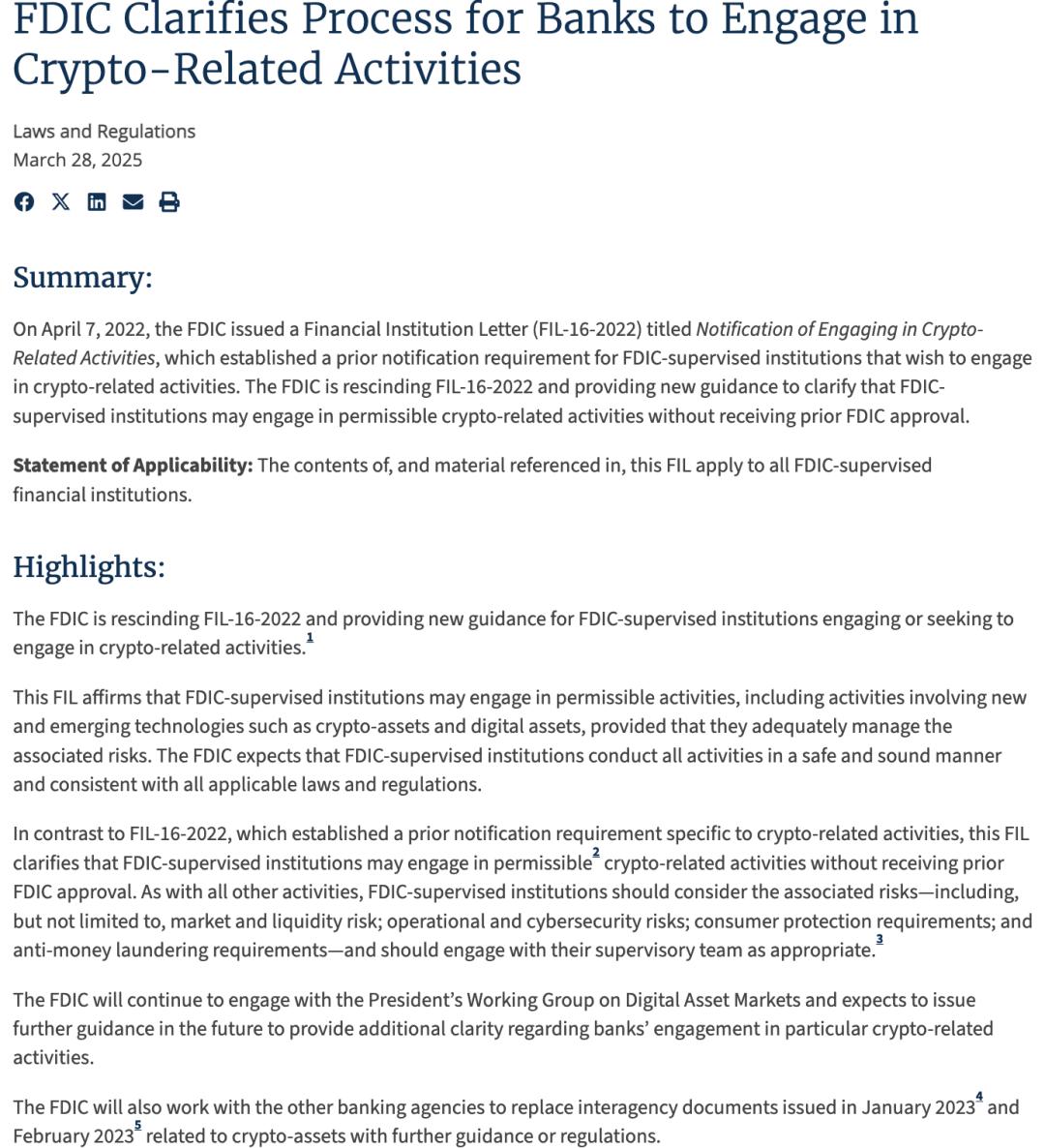
Banks carry out crypto-asset-related businesses_New U.S. Federal Deposit Insurance Corporation regulations_Real-time price of Binance Exchange official website

1. Brief introduction to FDIC and FIL-16-2022

The FDIC is an important banking regulatory agency in the United States. It is responsible for the depositor protection of American banks and the resolution of bankrupt banks, and eliminates the risk of runs through the deposit insurance system. For example, when Silicon Valley Bank went bankrupt in 2023, the FDIC completed the repayment of insured deposits within 48 hours and recovered funds through asset auctions.

In order to avoid bank bankruptcy, the FDIC pays special attention to the review and supervision of financial indicators such as bank capital adequacy, liquidity, compliance, risk management, and risk ratings.

The revoked FIL-16-2022 is a regulatory requirement introduced in 2022 to deal with the risks of cryptocurrency. The core is that if banks want to engage in cryptocurrency-related business, they need to apply for approval in advance.

2. U.S. regulatory deregulation and global linkage 2.1. Local regulatory changes in the United States

The FDIC’s new guidelines remove the requirement for banks to apply for prior approval to conduct crypto business, and instead allow banks to independently participate in crypto asset activities within the “permissible” scope, but emphasize that they must follow the principles of safety and soundness and do a good job in risk management.

This means that Bank of America has greater autonomy in various types of encryption businesses such as custody, stable currency reserves, issuance of digital assets, and node operations. FDIC Acting Chairman Travis Hill said that the new policy is "a reversal of the flawed practices of the past three years" and that the FDIC will take a series of measures to provide new paths for banks to participate in encryption and blockchain activities. He criticized previous regulations for discouraging innovation through non-public means and acknowledged that banks had not been given clear guidance in the past.

This change in stance is consistent with the actions of the U.S. Office of Comptroller of the Currency (OCC): The OCC also clarified in early March that national banks can carry out crypto custody, stablecoin payments and other businesses, and revoked the old guidance requiring pre-approval.

As for the Federal Reserve, Governor Michelle Bowman also agreed in the same speech that "legitimate companies should not be excluded from the banking system in the name of regulatory policies" and called for a "reasonable and supportive" regulatory attitude towards new technologies.

Overall, U.S. regulatory agencies, under the leadership of the new government, are returning to the main line of "supporting innovative development", easing compliance resistance but requiring banks to strengthen their own risk controls. This will enable the U.S. banking industry’s compliance requirements for encryption businesses to shift from “pre-licensing” to “on-the-fly monitoring”, maintaining high standards in anti-money laundering, network security, consumer protection, etc., while not erecting unnecessary obstacles to new businesses.

2.2. Potential effects in Europe

The shift in U.S. policy immediately attracted European attention. To put it bluntly, the European Union does not want the negative impact of digital dollar hegemony on Europe.

Eurozone finance ministers discussed the new stance of the United States on March 10, 2025, expressing concerns that the United States’ embrace of crypto-assets may affect Europe’s monetary sovereignty and financial stability. Eurogroup Chairman Donoghue made it clear that he linked this issue to Europe's own autonomy and the resilience of the euro, and emphasized that the launch of a digital euro has become even more critical.

Villeroy, executive member of the European Central Bank and President of the Bank of France, warned: "The United States' encouragement of crypto assets and non-bank finance may be sowing the seeds for future turmoil." Once a financial crisis occurs, it may come from the United States and Europe. It can be seen that European regulators are cautious about the encryption-friendly policies of the United States and are worried about the expansion of US dollar-denominated stable coins in the euro zone.

However, on the other hand, the EU itself is also advancing the framework: the "Crypto Asset Market Regulation" (MiCA) passed in 2024 sets licenses and specifications for stablecoin issuance and encryption service providers, and supports innovative development under the premise of "clear regulatory requirements."

Some large banks in Europe have already laid out their digital asset business in advance. For example, Standard Chartered Bank has obtained a Luxembourg license to carry out crypto custody, and Societe Generale has issued Euro stablecoins. This shows that the EU's overall strategy is to strictly control risks while not giving up digital financial innovation.

The U.S. policy shift may prompt the EU to accelerate the implementation of MiCA and strengthen the digital euro process to prevent the impact of U.S. dollar crypto assets on the euro system while ensuring that Europe does not fall behind in a new round of financial innovation.

As for the UK, although it has left the EU, it has similar concerns to the EU in terms of financial supervision.

On the one hand, large British banks (such as HSBC and SCB) pay close attention to U.S. trends due to their global business; on the other hand, the British government announced its vision of building a "global crypto asset center" as early as 2022. Under the new policy environment, the United Kingdom may be more active in promoting its own version of crypto regulatory reform and releasing signals to support innovation in sync with the United States.

In short, all walks of life in Europe are taking the lead in the United States to prevent risks and promote regulations. The policy tone may be fine-tuned but there will not be extreme changes in deregulation.

2.3. Singapore continues to open up

The Monetary Authority of Singapore (MAS) has taken an open and cautious attitude towards the crypto industry in recent years, and the US move is expected to strengthen this trend.

In fact, Singapore has already adopted a license system to manage digital payment token exchanges, allowing Crypto.com, Coinbase Singapore, etc. to operate under licenses, and will release a regulatory framework for stablecoins in 2023 (requiring single-currency stablecoins to have sufficient reserves, etc.).

MAS also leads projects such as "Project Guardian" and explores the application of DeFi (Decentralized Finance) in the financial market with banks such as JPMorgan Chase and DBS. As it is already at the forefront of regulating innovation, Singaporean regulators may not respond directly to the FDIC statement, but the loosening of US regulations has reduced Singapore's concerns, proving that its policy of "supporting regulated innovation" is correct.

It is foreseeable that MAS will continue to improve local regulations (such as expanding guidance on banks' custody of cryptoassets and promoting more institutional-level innovation pilots), and strengthen cooperation and communication with the United States and Europe through international forums (such as the Financial Stability Board and the Basel Committee).

Overall, Singapore will view the U.S. pivot as a positive sign, cementing its position as Asia-Pacific’s crypto-finance hub.

2.4. Hong Kong follow-up strategy

Hong Kong has restarted its encryption hub strategy in 2023, and the new decree will undoubtedly add impetus to it.

The Hong Kong Monetary Authority (HKMA) sent a letter to banks in April 2023, clearly requiring support for the banking service needs of licensed crypto exchanges and not excessively raising the due diligence threshold.

At that time, banks such as Standard Chartered, HSBC, and Bank of China Hong Kong were cautious due to concerns about regulatory risks. In response, the HKMA emphasized that "do not let due diligence become an unnecessary obstacle." Now that the United States has lifted its implicit restrictions on banks, international banks will have less concerns about providing encryption services in Hong Kong. The previous efforts of Hong Kong regulators have been confirmed.

Since 2024, Hong Kong has issued the first batch of virtual asset exchange licenses and continues to promote the implementation of stable currency regulatory arrangements. It is expected that the Hong Kong Monetary Authority and the Securities Regulatory Commission (SFC) will take the opportunity to increase publicity to show that Hong Kong's regulatory environment is in line with the latest international trends, and encourage local and overseas banks and financial institutions to carry out compliant encryption businesses in Hong Kong.

In fact, Hong Kong is actively recruiting mainland and overseas crypto companies, and "seizing the opportunity of the U.S. shift" is expected to attract more trading volume and companies to Hong Kong. It is worth noting that the Hong Kong subsidiaries of Bank of China Hong Kong and China Construction Bank Asia with Chinese backgrounds have previously kept a low profile due to the mainland's attitude. However, as policies become clearer, these banks' participation in digital asset innovation in Hong Kong may accelerate.

In terms of regulatory response, Hong Kong government officials have repeatedly expressed in public recently that they welcome the world's balanced policy on encryption, emphasizing Hong Kong's institutional advantages.

It can be expected that Hong Kong will strengthen its "regulatory sandbox" and "firewall" mechanisms: on the one hand, it will maintain separation from mainland regulations and avoid cross-border risks; on the other hand, it will make full use of the increased confidence of U.S. and international capital in the compliant encryption market to consolidate and expand Hong Kong's influence as a bridgehead for the compliant encryption market.

Generally speaking, mainland China continues to use Hong Kong as a bridgehead for encrypted digital currencies, which can isolate risks without completely breaking away from new trends in the world, so as to maintain a situation in which it can advance, attack, and retreat.

2.5. Mainland China continues to exert high pressure

Mainland regulatory authorities still adopt a high-pressure ban on cryptocurrency transactions (digital currency transactions, mining and other activities are strictly prohibited). In the short term, U.S. deregulation will not directly change mainland China’s policy orientation.

Official media and regulatory agencies are likely to maintain their consistent tone, emphasizing the risks of crypto speculation, saying that previous strict supervision has effectively isolated external risks. This point can also be found in the warnings of some European officials (that the United States' vigorous development of cryptocurrency may cause crisis risks and adversely affect Europe), and the mainland may use this to support the necessity of its financial risk prevention policies.

However, some Chinese economists have begun to call for a review of global trends. Shen Jianguang, vice president of JD.com and an economist, wrote that the United States has shifted its focus to promoting responsible innovation and development, and the new framework is expected to attract more institutions and technological innovations and strengthen the United States' dominant position.

He specifically reminded that as the world's largest crypto market, the policy shift of the United States has a huge driving effect on other countries, including the European Union, the United Kingdom, Japan, Singapore, the United Arab Emirates, etc., which are all formulating regulations to support the development of stable coins and cryptography. It is recommended that China pay close attention to and conduct a comprehensive evaluation. This shows that domestic think tanks are beginning to worry that China will fall behind due to "one size fits all" in this round of financial technology competition.

It is expected that mainland officials will not relax the transaction ban in the short term, but may double investment in areas such as blockchain technology and digital renminbi to cope with the development of overseas crypto finance. At the same time, it is not ruled out that regulators may study and formulate new policies in a low-key manner: while insisting on prohibiting currency speculation, they will also provide certain guidance for domestic enterprises to participate in international digital financial cooperation (such as cross-border trade currency, overseas listed companies’ chain-related business).

In short, mainland China’s regulatory attitude is still mainly wait-and-see and risk warning in the short term, but in the long term, it does not rule out adjusting the regulatory framework for legal blockchain applications and tokenized asset transactions after evaluating global experience to avoid being at a disadvantage in digital economic competition.

3. Changes in investor sentiment and risk preferences

The release of new guidance from the FDIC and the overall shift in the U.S. regulatory environment have significantly boosted the confidence of market participants. Overall, investor sentiment has turned from wait-and-see to optimism, and risk appetite has increased. The specific manifestations are as follows:

Investor sentiment picked up and prices responded positively.

The United States clearly supports banks' participation in encryption, which is regarded as an important milestone in the further mainstreaming of cryptocurrency, and investors are therefore inclined to increase allocations. In fact, since the results of the US election were clear at the end of 2024, the price of Bitcoin has rebounded sharply. Although it has fallen back somewhat, it is still as high as $80,000. Industry analysts attribute this to the new administration making encryption policy a national priority and providing regulatory clarity.

After the release of the FDIC statement, although the prices of Bitcoin and Ethereum fluctuated in the short term, they generally remained at a high level, indicating that the market has factored in most of the positive regulatory benefits. Crypto-related stocks also performed strongly: Take the US Coinbase exchange as an example, its stock price has continued to rise since the first quarter in anticipation of an improvement in the regulatory environment. Bernstein and other institutions predict that Coinbase's stock price is expected to rise another 64% from the current level, on the grounds that clear U.S. regulatory clarity will push encryption deeper into the financial mainstream.

There are also signs of increased risk appetite in traditional financial markets. For example, some chain-related concept stocks (mining companies, blockchain companies) in the U.S. stock market outperformed the market after the news was released.

Overall, policy easing has swept away the cloud of uncertainty that has shrouded the market, with investor confidence rising and buying willingness increasing.

Market evaluation and media opinions diverge.

The crypto industry responded enthusiastically to the guidance, while the mainstream media was relatively rational and positive.

Rob Nichols, president of the American Bankers Association (ABA), publicly praised the FDIC’s new guidance, saying he “welcomes the FDIC’s decision to allow regulated institutions to conduct crypto-related businesses without prior approval,” noting that such regulatory clarity is critical to promoting innovation. This kind of endorsement from the top management of traditional finance has greatly enhanced the market's confidence in the durability of the policy.

Crypto media such as Decrypt and CoinDesk have described this move as a "major turning point", believing that this marks the end of the United States' "Operation Chokepoint 2.0"-style suppression. Many commentators compared it with the conservative approach of the previous government and believed that the current policy is friendly and open.

At the same time, some conservative voices also appeared in the media. Some financial commentators warn that the regulatory shift could lead to bubbles and accumulation of risks. ECB officials bluntly stated that the U.S. move may "sow the seeds of a financial crisis." Some traditional economists in China used Wall Street's bubble in the 1930s as a metaphor, joking that "the next Wall Street crash may make people miss the Great Depression." These voices have generated certain risk warning reports in the mainstream media.

But overall, the tone of the media is positive: when reporting on this matter, mainstream U.S. financial media (such as the Wall Street Journal, Reuters, etc.) focused on how the policy can lift the shackles of industry development and the positive reactions of all parties. For example, Reuters mentioned that the new regulations "completed a major shift in federal bank policy" and cited the views of market participants to affirm its significance. This kind of positive public opinion guidance has further consolidated investor confidence. New dynamics emerged in risk appetite and capital flows.

With regulatory endorsement, market participants’ risk appetite has significantly increased.

In the past few years, due to regulatory uncertainty, many institutional investors and commercial banks were cautious or even wait-and-see about getting involved in crypto. Now with clear policies, many institutions have begun to include crypto as a legal asset class in their strategic allocations. The CEO of DBS Bank Digital Exchange pointed out that professional investors are increasingly considering digital assets as a "legitimate part" of alternative investment portfolios.

U.S. hedge funds and family office funds reportedly returned to the Bitcoin market in large numbers in the first quarter, partly in response to the policy shift.

At the same time, the increase in market risk appetite is also reflected in the decline in volatility: after the introduction of good news, the volatility index of Bitcoin and others fell for a time, indicating that investors have weakened their expectations for downside risks and are more willing to hold them for the long term.

From the perspective of capital flows, the net inflow of stablecoins has increased, and investors are more confident about entering the market through stablecoins such as USDC and USDT, because the United States allows banks to hold stablecoin reserves, which is interpreted as official recognition of mainstream stablecoins. USDC issued by Circle received capital inflows in late March and returned to 1:1 anchoring. The shadow of trust that had previously plagued its development (such as the brief de-anchoring caused by bank failure) has obviously dissipated.

Generally speaking, the policy shift has made venture capital more willing to invest in crypto start-up projects, institutional investors have become more bold in allocating assets other than Bitcoin (such as Ethereum, Solana, etc.), and the sentiment of the entire market has changed from defensive to aggressive. Under this positive feedback mechanism, market confidence has improved significantly, laying the foundation for subsequent trading activity and market value growth.

4. Boost from traditional banks getting involved in crypto business

The new FDIC guidelines have undoubtedly lowered the threshold for traditional banks to enter the crypto field and are expected to significantly affect the participation of major banks in crypto asset-related businesses. In general, this move will encourage more banks to try services such as custody, payment, DeFi and trading, but the responses of different banks may vary depending on their geographical strategies.

In the context of deregulated regulation, all types of banks in the United States, from community banks to large banks, have shown a higher willingness to participate.

The chairman of the American Banking Association's statement has conveyed a unified voice: the banking industry welcomes regulatory clarity and actively evaluates how to "compete safely and responsibly." This means that plans previously put on hold due to uncertainty will be restarted. For example, there are reports that more than 20 U.S. banks have received informal letters from regulators asking them to suspend their encryption business attempts, and now these institutions are expected to resume related projects.

On Wall Street, large investment banks and custodian banks are also moving quickly – Wells Fargo, Bank of America and others have established internal working groups to study the risk control requirements for crypto custody; asset management giant Fidelity has already been involved in digital assets and is expected to expand its service scope.

It is foreseeable that the U.S. banking industry will gradually move from marginal involvement (such as providing channels for customers to invest in Bitcoin funds) to directly providing encryption services (self-operated custody, trading, etc.), and the boundaries between traditional finance and digital asset ecology will become increasingly blurred.

The following lists the trends of some well-known banks to reflect the changes in bank participation in different regions:
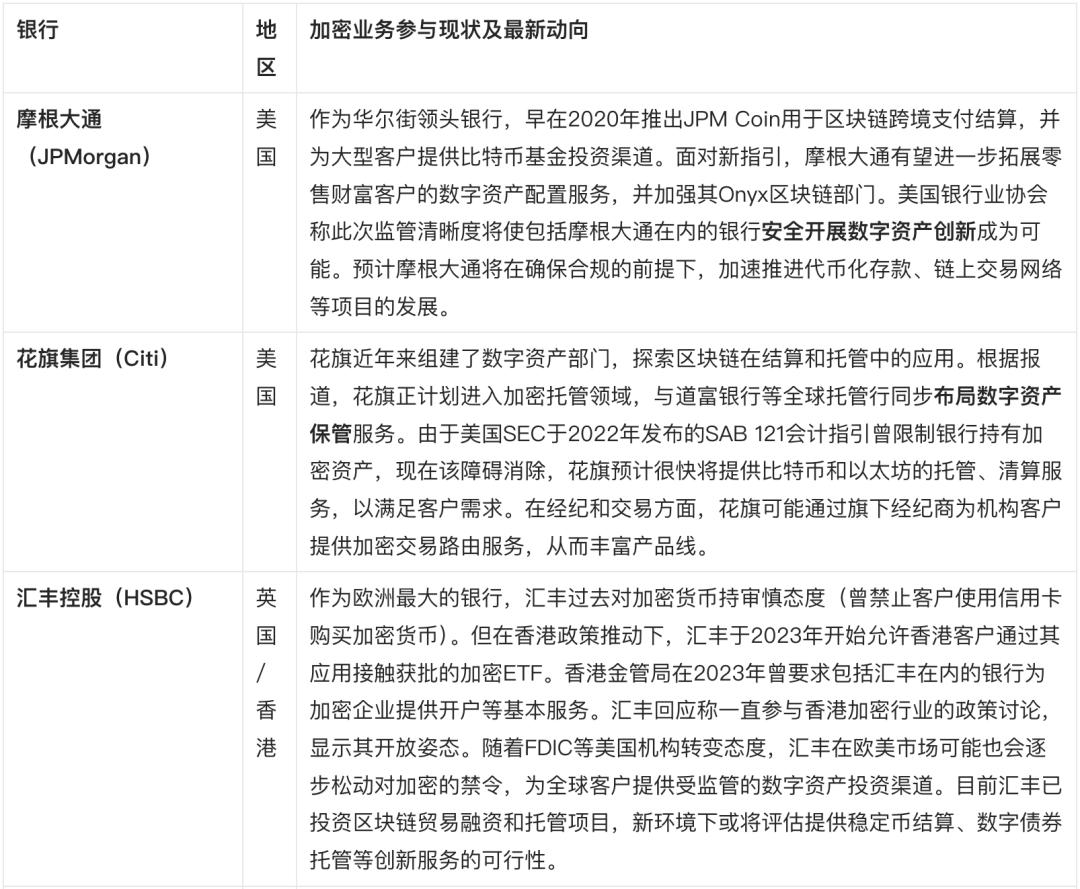
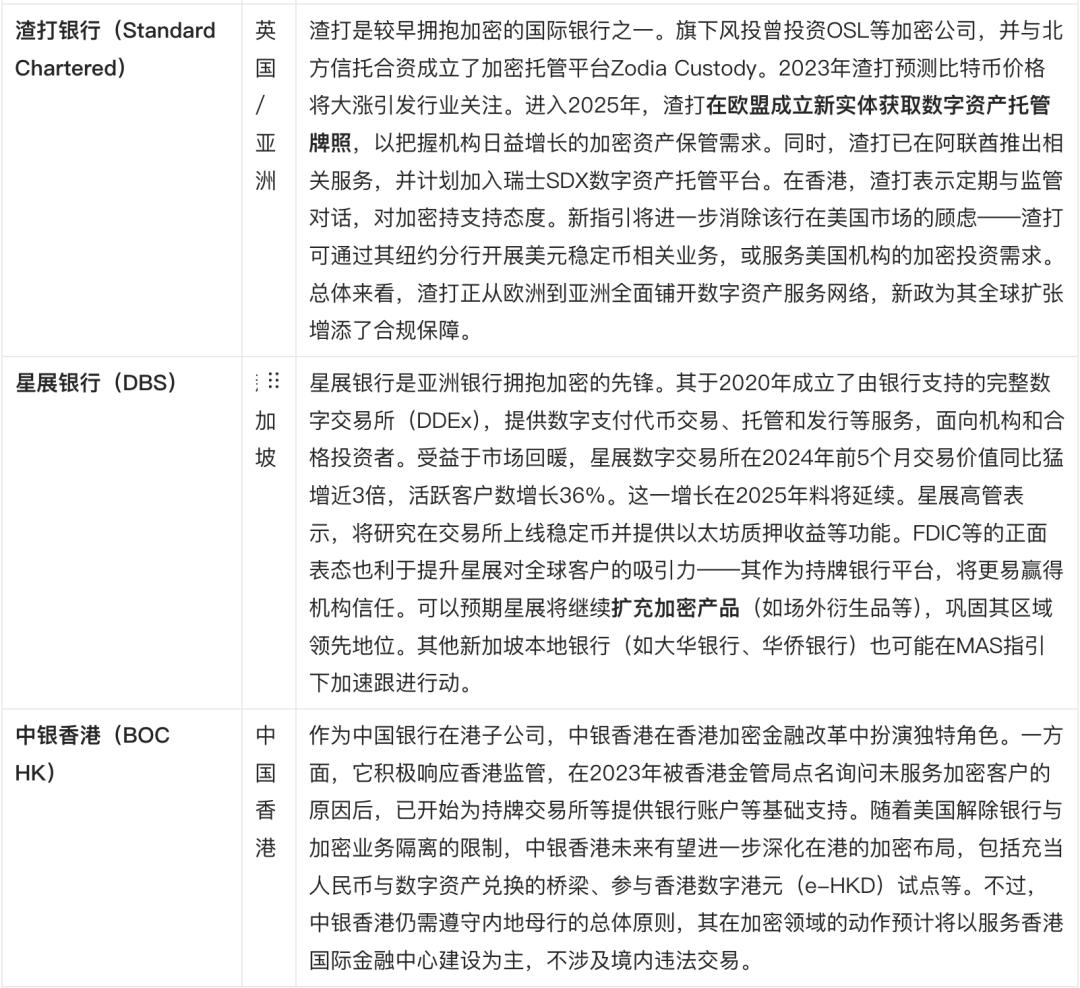
Banks carry out crypto-asset-related businesses_Real-time price of Binance Exchange official website_New U.S. Federal Deposit Insurance Corporation regulations

The above-mentioned bank cases show that the interest of global banks in participating in encryption has increased significantly. Major American banks have begun to regard encryption as one of their legitimate business lines; European and Asian banks have been gradually piloting and expanding related services. It is foreseeable that more traditional banks will announce their entry into this field in the medium term: US custodian banks such as State Street Bank and Wells Fargo are planning to launch digital asset custody services as early as 2026 to meet strong customer demand.

These developments suggest that banks recognize that missing out on the crypto wave could mean losing future market position.

The new guidance serves as a “positive demonstration”: global banking regulators will pay close attention to the U.S. experience to remove obstacles or provide guidance and coordination for banks to participate in encryption in their respective jurisdictions. Of course, banks’ large-scale foray into crypto also depends on supporting policies (such as capital adequacy requirements). The Basel Committee has developed a framework for capital provisions for banks’ holdings of crypto-assets, and these prudential regulatory requirements remain a boundary condition for bank participation.

But overall, the FDIC's new policy has greatly raised the upper limit of bank participation: it sends a clear signal – compliant encryption business is no longer prohibited "one size fits all", but is recognized by supervision and will receive further guidance support. This will undoubtedly accelerate the integration of traditional finance and encryption markets, bringing more institutional funds, professional talents and reliable infrastructure to the encryption market.

5. Short-term fluctuations and mid- and long-term trend predictions 5.1. Short-term trading volume trends after the news is released

After the announcement of the FDIC guidance, the trading volume of major crypto assets showed obvious signs of amplification. The market interpreted the favorable regulations as a bullish signal, and buying activity increased. On the day the news was released and in the days that followed:

Bitcoin (BTC) and Ethereum (ETH): As a market benchmark, Bitcoin’s trading volume increased at the end of March. According to statistics, the 24-hour transaction volume of Bitcoin on March 29 was approximately US$27.06 billion. This level is somewhat higher than the average weekly level of the week before the news (Bitcoin’s average daily trading volume in mid-March was about 20-25 billion US dollars), indicating that a large number of funds quickly entered the market or adjusted positions after the news came out.

The futures market was also quite active during the same period, with CME Bitcoin futures positions reaching a new annual high, indicating that institutional investors also participated in the market reaction. In terms of Ethereum, the price is relatively sluggish but the trading volume has increased simultaneously – on March 27, the single-day trading volume of ETH exceeded US$20 billion, which was the first time in several months. This may reflect that investors expect Bitcoin to be more directly driven by favorable policies, and at the same time they also adjust some funds to mainstream currencies such as ETH during high prices, resulting in an increase in ETH volume and a stable price.

Overall, the total transaction volume of BTC and ETH increased by 10-20% month-on-month in the week after the policy was announced, indicating ample market liquidity.

Stablecoins (USDT, USDC, etc.): As a trading medium, stablecoins’ transaction and circulation scale has also increased simultaneously. In the week when the news was announced, USDT’s on-site trading volume on major exchanges once accounted for more than 60% of the total market trading volume, which shows that a large amount of funds poured into the digital dollar system from legal currency.

USDC market sentiment has also improved: the proportion of USDC transactions in many trading pairs has increased, indicating that investors’ trust in USDC is recovering (in contrast to the banking crisis in March 2023). According to blockchain data, the total amount of on-chain transfers of stablecoins jumped between 2024 and 2025: monthly transfer volume has increased from US$1.9 trillion in February 2024 to US$4.1 trillion in February 2025, an increase of 115%.

The growth rate during this year is quite astonishing, partly due to the policy shift in the first quarter of 2025 to attract large amounts of funds in and out through stablecoins, which accelerated circulation. As Reuters analysis stated, stablecoins are now a key cog in the multi-trillion-dollar crypto trading market, undertaking the function of moving funds between different currencies and legal currencies. The United States' statement of allowing banks to hold stablecoin reserves will further consolidate the status of USDT, USDC, etc. as trading infrastructure. In the short term, their trading volume and issuance market value have shown an upward trend. It is worth mentioning that World Liberty Financial, supported by former U.S. President Trump, plans to launch a new U.S. dollar stable currency "USD1" and says it will be fully supported by reserves such as U.S. Treasury bonds and cash. This news attracted market attention in late March. The addition of new stablecoins may lead to a battle for the market share of existing stablecoins. However, in the short term, USDT and USDC still firmly dominate, ranking among the top in terms of trading volume.

Mainstream trading platforms: The trading volume of major crypto exchanges in the United States, Europe and Asia increased overall under the influence of the news. Among them, in the U.S. market, compliant exchanges such as Coinbase and Kraken have benefited significantly – favorable regulations have prompted some platform funds that had previously moved offshore to return to the country. Coinbase's single-day spot trading volume at the end of March increased by about 20% from the beginning of the month, and the rise in its stock price also reflected the increase in trading activity. Kraken’s volume on USD trading pairs also amplified.

In comparison, global platforms such as Binance and OKX are still ahead in terms of size. Binance’s 24-hour global spot trading volume in the week of the announcement was stable at tens of billions of dollars, more than twice that of the second largest exchange. This shows that despite regulatory changes in the United States, Binance and others have a large user base in Asia Pacific and Europe and still occupy the leading position in transaction volume in the short term.

However, it is worth noting that changes in U.S. policies may push Binance US and others to adjust their strategies and even seek closer cooperation with U.S. regulations in terms of compliance to retain local users.

In the Asian market, exchanges such as OKX and Huobi maintain high popularity among Chinese-speaking and Southeast Asian users, and their BTC and ETH trading volumes increased by double digits at the end of March.

In addition, the Korean market has always responded quickly to regulatory and market changes. The day after Upbit, South Korea's largest exchange, announced good news in the United States, the trading volume of the Bitcoin Korean Won pair surged, and its ranking once jumped to second place in the world, second only to Binance. This reflects that Asian retail investors are encouraged by international policy signals and actively enter the market. In Hong Kong, the trading volume of newly licensed exchanges (such as OSL and HashKey) is still at a small start, but favorable regulations have attracted more local investors to try to open accounts, which has also laid the foundation for the future growth of these platforms.

5.2. Mid- to long-term trend outlook

Looking to the mid-to-long term, crypto market trading volume is expected to maintain growth and undergo structural changes under the new regulatory environment:

Overall transaction volume continues to rise.

As traditional financial institutions enter the market and more investors participate, the depth and breadth of the crypto market will expand. The participation of institutional investors will bring huge incremental funds, making the market's average daily trading volume expected to reach a higher level than the current level. Some analysts predict that if the macro environment cooperates and supervision remains friendly, the price of Bitcoin may hit a new high in 2025, and its global daily transaction volume may reach hundreds of billions of dollars by then. The daily trading volume center of the entire crypto market will also increase with the increase in market capitalization.

Although there is still a gap between the average daily volume of the foreign exchange market of US$7.5 trillion, the encryption market, as an emerging asset, is growing much faster than the traditional market – the annual growth rate of transaction volume is expected to remain at double digits, higher than the growth rate of the stock and foreign exchange markets. Especially considering the transactions of derivatives and on-chain DEX (decentralized exchanges), these parts that are not fully reflected in traditional statistical calibers are also expanding rapidly.

The regional market is changing, and the share of compliance platforms is increasing.

In the long term, as regulatory frameworks in various regions improve, global transaction volumes may become more geographically dispersed and balanced. Currently, Asia (including transactions by North American users on offshore platforms) accounts for about half of the global volume, while Europe lags behind. In the future, Europe has the potential to increase the proportion of European time zone trading volume after MiCA is implemented and the trading platform obtains compliance status. At the same time, the domestic market share of the United States is expected to rebound: over time, U.S.-compliant exchanges (such as Coinbase) and Wall Street’s traditional market makers will occupy a larger proportion of the trading volume list. Once the United States approves spot ETFs such as Bitcoin, a large amount of trading volume will flow between exchanges and traditional markets through ETF arbitrage and other forms, which will also significantly increase the trading volume during the daytime period in the United States. Accordingly, the market share of giants such as Binance may be gradually eroded, and the market will move from "one super and many strong" to "multi-polar competition." However, since Binance and OKX already have a large user base and liquidity network, it is expected that they will still maintain the lead in Asia and emerging markets, but their share will decrease relatively. In addition, exchange compliance will lead to healthier volumes: as false wash volume and the like are curbed, the quality of reported trading volumes increases.

In the long term, the rise of compliance platforms in various countries will help put an end to the "wash sales" criticized in the industry and allow true supply and demand to be reflected in transaction data.

Trading varieties and structures evolve.

In the medium to long term, the composition of transaction volume may change—the proportion of Bitcoin and mainstream currencies decreases, and the proportion of other assets increases. As the market matures, investors will not only trade "blue-chip" coins such as Bitcoin and Ethereum, but will also participate more in the transactions of new varieties such as tokenized physical assets and central bank digital currency (CBDC). For example, if the United States launches a Bitcoin ETF or a new type of treasury bond token backed by government-held Bitcoin reserves, its transactions may divert some transactions of traditional crypto assets. In addition, if CBDC issued by central banks of various countries can be interoperable, they may also enter the market through trading pairs similar to stable currencies. The transaction volume in the DeFi field is also expected to increase and occupy a place – after banks enter DeFi, they may launch compliant decentralized trading platforms or liquidity pools, allowing some transactions to be migrated to the chain for completion. Although these changes will be limited in scale in the short term, in the long run, the "crypto market" will no longer refer only to Bitcoin, but will include a wider range of digital financial products, and its transaction volume statistics will also need to keep pace with the times. It can be expected that in the medium to long term, the trading ecology of the crypto market will be more diverse and the distribution of volume and energy will be more balanced.

Improved liquidity and reduced volatility.

Increased trading volume usually means greater market liquidity and thicker buying and selling orders. In the medium to long term, this should help reduce price volatility and reduce the possibility of a single large player manipulating the market. Especially when banks and licensed institutions participate in market making, the market depth is greatly increased and can absorb larger transactions without impacting prices. However, it should be noted that new entry of funds may also bring risks such as increased leverage transactions. If excessive leverage accumulates, it may amplify short-term fluctuations. Therefore, we expect the overall volatility of crypto assets to trend downward (gradually approaching the levels of traditional assets) in the medium to long term, but may still experience severe oscillations under specific events (such as negative macro or changes in regulatory winds). The continued improvement of supervision and the development of risk management tools (such as options, futures and other derivatives markets) will be important factors in calming volatility.

6. Conclusion

In summary, the new guidelines issued by the FDIC not only have an immediate impact on the U.S. banking industry's participation in the crypto market, but also enhance global market confidence through the regulatory "demonstration effect" and promote the injection of traditional financial forces into this emerging field.

In the short term, the trading volume of major crypto assets and trading platforms has increased significantly, and market sentiment is optimistic. In the medium to long term, under the dual effects of regulatory support and the influx of institutions, the crypto market is expected to usher in a new stage of steady expansion in transaction volume and optimization of the participant structure.

Of course, easing supervision does not mean laissez-faire – how local supervision refines rules and harmonizes international standards will determine how far this “encryption trend” can go.

Overall, the FDIC's new policy sends a positive signal: as long as risks are controllable and compliance is in place, the development space of the cryptocurrency market will be further opened up, and its trading activity and integration with traditional finance will increase significantly in the next few years.

(over)

Bitcoin Hits $100,000, Global Financial Regulations Are Catching Up

On December 17, 2024, the price of Bitcoin reached a record high of $107,000.

The direct reason is the change in the attitude of the US government. The newly elected U.S. President Trump recently stated publicly that the next U.S. government will be committed to creating a friendly regulatory agency for cryptocurrency. He has vowed to make the United States a "cryptocurrency capital."

Since Trump was elected, the price of Bitcoin has risen by more than 40% from US$60,000. The ups and downs of prices not only affect the nerves of investors, but are also reshaping the landscape of global financial supervision.

Unlike the Biden administration's crackdown on digital assets, Trump has publicly stated more than once that he wants to implement "friendly regulation" of cryptocurrencies.

Trump has recently nominated former Paypal COO David Sacks to serve as the White House head of artificial intelligence and cryptocurrency affairs, indicating his intention to promote the development of the encryption industry. At the same time, Atkins, a conservative lawyer and currency fan, was also nominated to head the US Securities Regulatory Commission.

The steady rise in cryptocurrency assets is related to the "catch-up" between financial regulations in various countries.

At the end of November 2024, ZA Bank, the first and largest digital bank in Hong Kong, announced that it had become the first bank in Asia to provide cryptocurrency trading services to retail users. The bank provides services to users by cooperating with Hashkey Exchange, a licensed virtual asset exchange in Hong Kong.

On December 6, 2024, the Hong Kong Special Administrative Region government published the "Stable Currency Bill" in the Gazette, intending to introduce a regulatory system for fiat currency stable currency issuers in Hong Kong. The Bill is scheduled to be submitted to the Legislative Council for its first reading on December 18. A stablecoin is a virtual asset that maintains a stable value with reference to some asset, usually a fiat currency.

Reasons why Bitcoin price will hit a new high in 2024_Real-time Binance Coin Market_Trump’s attitude and measures towards cryptocurrency

Bitcoin ETF advertisement on Hong Kong tram. Visual China Map

“It is still not feasible for mainland residents to go to Hong Kong to buy currency.”

When a reporter from Southern Weekend opened the Zhongan Bank App, the home page prompted users to buy and sell cryptocurrencies directly in Hong Kong dollars and US dollars without switching to other apps or platforms.

According to the company announcement, after Hong Kong residents open an investment account with Zhongan Bank, they need to complete the risk assessment and other processes before they can buy and sell two currencies on the app. The entry fee is US$70 or HK$600 respectively, and the commission fee for each transaction is 1.99. US dollars or HK$15, and the platform fee is 1.5% of the transaction amount (the minimum fee per transaction is US$1.99 or HK$15). The bank will waive transaction commissions until the end of June 2025, and the platform fee will also be reduced to 0.8% of the transaction amount.

The company's CEO, Wu Zhonghao, told the media that Hong Kong will only provide retail investors with virtual currency trading services in 2023. The bank has been preparing for the service for nearly a year. In addition to compliance standards, the trading time is 24 hours. Due to the high risk level of the assets, marketing will also focus on user education.

Currently, the Hong Kong Securities and Futures Commission has launched 4 types of cryptocurrency assets for retail investors to buy and sell. Wu Zhonghao said that this time ZhongAn will launch Bitcoin and Ethereum transactions first, and will gradually add the remaining two virtual currencies in the future. At the same time, he also pointed out that ZhongAn turned a loss into a profit in a single month in July 2024. After deploying the virtual currency trading business, it hopes to increase fee income and attract new customers, which will play a positive role in turning a loss into a profit.

Xiao Sa, a senior partner at Beijing Dacheng Law Firm, explained to Southern Weekend reporters that according to the current relevant laws between the mainland and Hong Kong, it is still not feasible for mainland residents to go to Hong Kong to buy currency.

She explained that although ZhongAn Bank allows customers from all over the world to register on the mobile app, ZhongAn did not directly obtain the crypto asset exchange license itself, but cooperated with the licensed exchange HashKey to assist users in trading crypto assets through the platform. Therefore, it must comply with the relevant regulations of Hong Kong's licensed exchanges.

The requirements at least include holding a Hong Kong identity card, being able to provide proof of your address and phone number, and undergoing relevant financial risk assessments.

In addition, Zhongan Bank will limit the proportion of crypto assets held by users. According to Wu Zhonghao's statement, this proportion will be controlled within 20% of the customer's total investment assets.

In September 2021, the "Notice on Further Preventing and Dealing with Speculation Risks in Virtual Currency Transactions" jointly issued by the central bank and ten other departments clearly defined "carrying out virtual currency-related business activities such as legal currency and virtual currency exchange business, exchange business between virtual currencies, buying and selling virtual currencies as a central counterparty, providing information intermediary and pricing services for virtual currency transactions, token issuance financing, and virtual currency derivatives transactions" as illegal financial activities.

However, if you already hold cryptocurrency, it is not necessarily illegal to go to Hong Kong to withdraw the currency or exchange it for legal tender.

For example, Xiao Sa said that if you ask a friend who is a Hong Kong resident to provide help, and at the same time ensure that the source of the funds is clear, small, incidental, and based on friendship between the two parties, it is not an illegal act. However, if Hong Kong residents use their identities to act as "currency dealers" to conduct transactions with mainland residents and implement regulatory arbitrage, they will violate the above notice and pose a criminal risk.

Asia Cryptocurrency Hub

It is worth mentioning that Zhongan Bank’s partner HashKey is also a local “incubated” virtual asset trader in Hong Kong. HashKey provides Zhongan Bank with custody transaction and clearing support for user assets.

Public information shows that HashKey Exchange is affiliated with HashKey Group and is Hong Kong’s first compliant cryptocurrency exchange for retail investors.

Xiao Feng, chairman of the group, is also known in the industry as the godfather of domestic "blockchain". He once worked at the Shenzhen Branch of the People's Bank of China and the Shenzhen Securities Management Office. After joining Wanxiang Holdings, a private enterprise, as vice chairman, the Wanxiang Blockchain Laboratory he is responsible for has invested in many well-known projects in the industry, such as Ethereum, ConsenSys, MakerDAO, etc. Southern Weekend reporters sent an interview invitation to Xiao Feng himself, but did not receive a response as of press time.

In a public speech in October 2024, Xiao Feng said that looking back on the development of blockchain in the past ten years, the industry is actually building a new crypto financial market (Crypto Financial Market). Compared with traditional financial markets such as banks, it is obvious that these are two sets of financial market systems. "But these two sets of financial market systems are gradually beginning to become interconnected."

An important driving force for this kind of interconnection comes from the regulatory level’s active embrace of new business formats.

In October 2022, the Hong Kong SAR government issued the "Policy Declaration on the Development of Virtual Assets in Hong Kong", which pointed out the direction for the development of Hong Kong's virtual asset industry. In June 2023, Hong Kong’s virtual asset service provider licensing system will take effect.

Currently, three exchanges in Hong Kong are licensed by the Securities and Futures Commission (SFC). They are OSL, HashKey and the Hong Kong Virtual Asset Exchange (HKVAX), which was only approved in October 2024. The Hong Kong Securities and Futures Commission has previously stated that it may issue more licenses to cryptocurrency exchanges and digital asset companies operating in Hong Kong before the end of 2024.

"Hong Kong is an international financial center and has an open and inclusive attitude towards innovators from around the world engaged in the virtual asset business." This is the first sentence on the first page of the above-mentioned declaration.

Chen Haolin, deputy director of the Treasury Bureau of the Hong Kong SAR Government, said that the Hong Kong government plans to conduct public consultations on the over-the-counter trading of virtual assets and the licensing system for custody service providers in 2025 to promote the sustainable development of different sectors of the virtual asset market.

Starting from July 2024, the Hong Kong Financial Supervisory Authority has passed the regulatory "sandbox" and launched a pilot program for the issuance of stable coins. So far, stablecoins issued by three institutions including JD Coin Chain Technology (Hong Kong) Co., Ltd. (affiliated to JD.com Group), Yuanbi Innovation Technology Co., Ltd., and Standard Chartered Bank (Hong Kong) Co., Ltd. have been included in the pilot.

"This sandbox can be understood as a 'positive list model.'" Zhang Feng, a technology evaluation expert at the Shanghai Blockchain Technology Association and a partner at Wanshang Tianqin Law Firm, explained to Southern Weekend reporters that the purpose is to allow financial institutions to test and collect data and user opinions in a risk-controllable and smaller-scale environment before launching new services and products, thereby speeding up the launch of relevant products and services and ensuring that services and products comply with regulatory requirements.

Zhang Feng has communicated with Hong Kong's financial regulatory agencies. He described Hong Kong's financial regulatory agencies as a group of industry managers at the forefront of the world. "Currently, Hong Kong has begun pilot projects or layouts in almost all financial fields involved, such as exchanges, stablecoins, asset management, funds, etc."

At the same time, the Hong Kong Securities and Futures Commission is also accelerating the license applications for 15 virtual asset trading platforms under review and is expected to issue licenses to several qualified operators within this year.

More than a month ago, the Hong Kong Exchange also launched the Hong Kong Exchange Virtual Asset Index Series to provide reliable benchmark prices for virtual assets, a rapidly emerging asset class, and support Hong Kong's development into Asia's leading digital asset center.

According to an investor survey conducted by the Hong Kong Investment Funds Association in July 2024, 75% of local respondents in Hong Kong are interested in investing in cryptocurrencies, of which 41% prefer to invest through spot/futures cryptocurrency exchange-traded funds (ETFs) listed in Hong Kong, while 39% choose products from locally licensed and regulated virtual asset trading platform operators.

High-roller gambling regulation shifts

Chen Zhifeng admitted to Southern Weekend reporters that an important reason for Hong Kong's rapid development in the field of virtual assets in the past two years is to seize the "empty window" in the United States. Chen Zhifeng serves as a senior executive at a global virtual currency trading platform.

In 2021, U.S. President Biden appointed Gary Gensler as the new chairman of the U.S. Securities and Exchange Commission (SEC). After taking office, he began to implement a radical reform initiative, focusing on combating violations in the cryptocurrency field.

Geisler sent Changpeng Zhao, the founder of Binance, the world's largest virtual currency trading platform, to prison, and also handled the largest financial fraud case in U.S. history – the case of Sam Bankman-Fried, the founder of the former cryptocurrency trading platform FTX.

Just as FTX collapsed and the cryptocurrency industry was deeply under the shadow of SEC regulation, in January 2024, the Hong Kong Financial Supervisory Authority released the "Conclusions of the Discussion Paper on Crypto-Assets and Stablecoins", clarifying the general regulatory plan for the future, deciding to give priority to the supervision of crypto-stable coins, and giving a detailed introduction to regulatory activities, target implementation time, licenses, regulatory principles, etc.

Hong Kong remains committed to its goal of becoming Asia’s cryptocurrency hub, a stance that has attracted some cryptocurrency companies.

"Gessler is notoriously unfriendly to the virtual currency industry. There are still some gray areas in this industry, and the scale has become so large that regulation cannot be ignored." Chen Zhifeng said.

According to statistics from a report released by consulting firm Henley & Partners, as of the first half of 2024, the number of global cryptocurrency users has reached 560 million, a year-on-year increase of 32%. The total market value of crypto assets exceeded US$2.3 trillion, a year-on-year increase of 89%. Cryptoassets are becoming increasingly important in the global wealth landscape.

In order to give the industry room to survive, industry companies such as Coinbase, Circle and a16z invested US$78 million in the lobbying platform Fairshake Pac in December 2023 to use it for "supporting cryptocurrency leadership" in the 2024 election. Trump eventually became a staunch supporter of this group.

On December 5, 2024, Trump nominated Paul Atkins to lead the U.S. Securities and Exchange Commission. Atkins, a former SEC commissioner, had a much more relaxed approach to financial markets than his predecessor.

After Trump announced his appointment, the price of Bitcoin surged to $103,853. This is the first time that the price of Bitcoin has exceeded the $100,000 mark, and investors are betting that the Trump administration's policies will shift towards promoting the growth of cryptocurrencies.

The inventor of Bitcoin, who goes by the pseudonym Satoshi Nakamoto, proposed the concept of Bitcoin in 2008 as a payment method that did not rely on the traditional financial system. As a result, many of Bitcoin's early fans were libertarians.

"It is indeed a bit ironic. Bitcoin, which originally wanted to subvert the traditional financial industry, now only wants to embrace regulation, and even proposed to make money by receiving government subsidies." Chen Zhifeng said.

As of December 16, 2024, the price of Bitcoin has increased by nearly 140% in 2024, and it mainly occurred in the past two months. Zhao Wei, a senior researcher at OKX Research Institute, analyzed to Southern Weekend reporters that Trump's election as President of the United States and his adoption of a cryptocurrency-friendly stance, as well as the nomination of a Bitcoin supporter as SEC Chairman, have injected more optimism into the market.

But there are also other objective reasons, such as the technical “halving” mechanism. At the end of April 2024, Bitcoin completed its fourth halving, and the mining reward dropped to 3.125 Bitcoins per block. Judging from historical experience, each halving will trigger a supply shock, and the ensuing "ripple effect" will cause the Bitcoin price to rise in the following months.

• (At the request of the interviewee, Chen Zhifeng is a pseudonym)

Sign In

Forgot Password

Sign Up