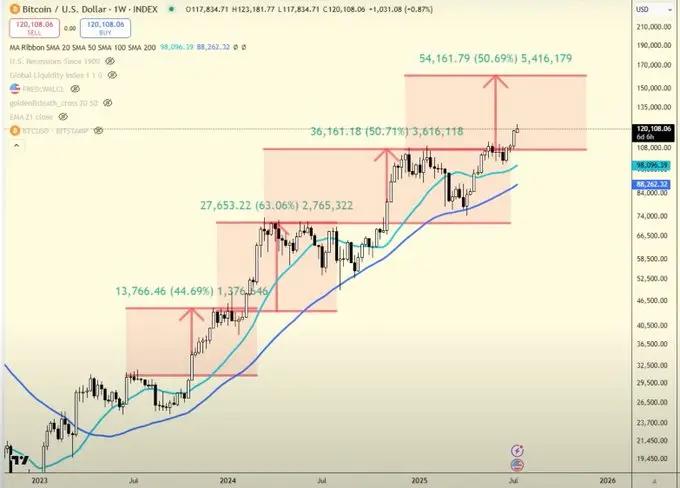
The cryptocurrency market is experiencing another surge this week.
On May 20, Bitcoin rose to US$71,705.47 in North American night trading, regaining US$71,000, a cumulative increase of approximately 68.59% compared to the beginning of the year. The cryptocurrency superstar of this period, Ethereum, also experienced a "wild surge". On May 21, Ethereum touched $3,800 per coin for the first time since March 5, rising 8.57% during the day.
It is reported that the U.S. Securities and Exchange Commission on Monday asked Nasdaq and Chicago Board Options Exchange (CBOE) to slightly modify the Ethereum spot ETF listing application, which means that regulatory agencies may approve the listing of Ethereum ETF on May 23. According to people familiar with the matter, the U.S. SEC has contacted at least one exchange and at least one potential spot Ethereum ETF issuer to update relevant 19b-4 filings. Accordingly, Bloomberg analyst Eric Balchunas has increased the probability of approval of the Ethereum ETF from 25% to 75%.
There are 9,963 types of cryptocurrency, with a total market value of US$2.43 trillion. Among them, the market values of Bitcoin, Ethereum, Biancoin, Solana, Ripple, Dogecoin, Toncoin, Cardano, and Shiba Inucoin are 1.40 trillion, 442.84 billion, 88.33 billion, 83.07 billion, 29.67 billion, 23.57 billion, 22.73 billion, 17.85 billion, and 14.96 billion US dollars respectively. Based on three-month average daily transactions, the trading volumes of Bitcoin, Ethereum, Biancoin, Solana, Ripple, Dogecoin, Toncoin, Cardano, and Shiba Inucoin were 37.168 billion, 17.39 billion, 2.07 billion, 4.22 billion, 1.83 billion, 283 million, 2.39 billion, 625 million, and 1.46 billion US dollars respectively.
Most cryptocurrencies have even outperformed the S&P 500 so far this year. As of May 21 from the beginning of this year, Bitcoin has risen by 68.10% and Ethereum has risen by 60.9%. Other cryptocurrencies rose even more strongly, with Binance Coin up 91.5%, Solana up 81.5%, Dogecoin up 82.4%, Shiba Inu Coin up 145.3%, and Toncoin up 180.5%. Among the niche cryptocurrencies, Ripple fell by 13.4%, ADA fell by 15.9%, and the S&P 500 index rose by 11.56% during the same period.
Cryptocurrency has become mainstream in the investment community amid digital transformation
Looking back at the cryptocurrency market trends since the beginning of the year, the driving force is still the regulatory agencies. Or to be more precise, despite the strong opposition to cryptocurrencies in the United States, institutional investors have used their powerful lobbying power to change the attitude of regulators. In January this year, the Bitcoin spot ETF was approved for listing and trading. This is another milestone event in the world of cryptocurrency, because ETF provides a relatively safe and convenient trading channel for investors, especially retail investors, and also marks that cryptocurrency has gained more and more mainstream recognition in the investment community. Judging from the net inflows of ETF funds, the listing and trading of Bitcoin spot ETFs is undoubtedly very successful, and its future development momentum is unstoppable.
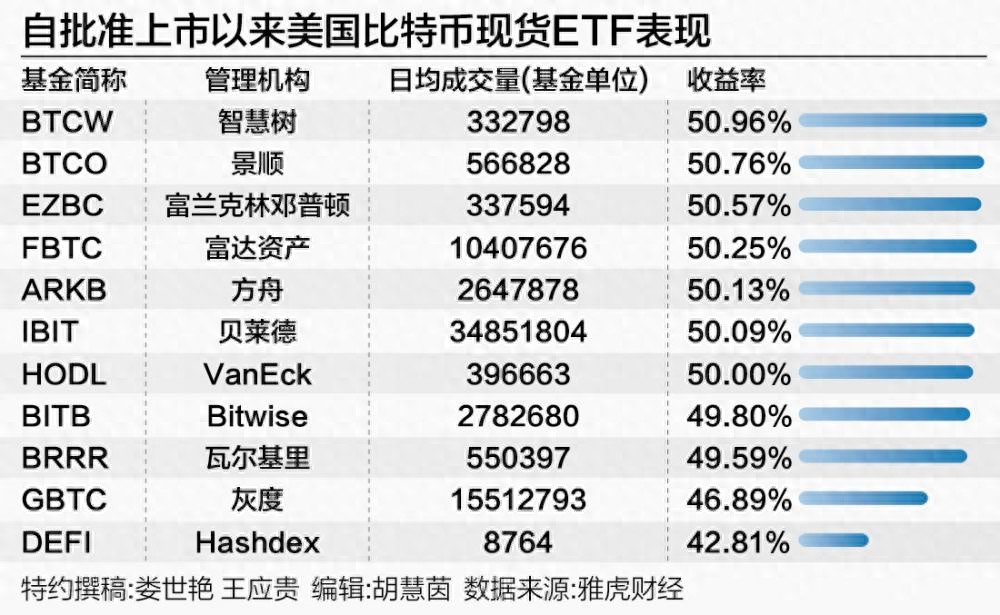
At present, it seems that there is a large gap in the strength of fund companies engaged in Bitcoin spot ETF management. In terms of returns, since the beginning of the year, Bitcoin spot fund returns have been roughly the same, with only Hashdex and Grayscale (GBTC) performing slightly lower than the market performance. But in terms of daily trading volume (fund units), these funds perform very differently. The most popular among investors are funds owned by big-name fund companies, such as BlackRock, Fidelity Assets and Grayscale, while other funds have been left out. In terms of management fees, most funds have the same charging standards, with only Grayscale and Hashdex charging higher than the average.
Faced with such high returns, investors were enthusiastic. According to Morningstar data (an authoritative U.S. fund company research institution), between January 11 and April 30, 2024, a total of US$12.1 billion of funds flowed into Bitcoin spot ETFs, of which more than 80% of the funds flowed into BlackRock's iShare Fund or Fidelity Investment Fund. The brand effect is very obvious. Grayscale worked hard to lobby the US Securities and Exchange Commission, but its funds dropped sharply from US$27.2 billion in January to US$17.6 billion.
Cryptocurrency’s reputation has recovered and future development is expected
Cryptocurrencies have also been rocked by scandals.
Among them, the one with the greatest impact is the rapid collapse of FTX (a cryptocurrency exchange registered in the Bahamas, full name "Futures Exchange") in November 2022 and the domino effect it generated. However, the most dramatic thing was the subsequent liquidation process of FTX. At that time, FTX encountered a liquidity crisis, with a funding gap of up to US$8 billion, and FTX could only declare bankruptcy. According to the previous company liquidation procedures, the process took a long time and the compensation ratio was low. However, less than two years after FTX collapsed, investors were compensated for their principal and interest. Since the collapse of FTX, the price of Bitcoin has risen from US$16,000 to more than US$70,000 today. The Bitcoin assets and other investments owned by FTX have appreciated rapidly, making them fully capable of fully compensating investors at the price when FTX collapsed. There is no doubt that FTX’s case is a free advertisement for cryptocurrencies.
In addition to fund management companies, many commercial banks, insurance companies, investment banks and other financial institutions have already been involved in cryptocurrency assets because they are well aware of customer needs and must keep up with the general trend of the digital era, otherwise they will be abandoned by the next round of financial wealth creation. Dimon, the president of JPMorgan Chase Bank, has always been an opponent of Bitcoin and has not changed yet. But paradoxically, the banking giant also holds a Bitcoin ETF. According to the U.S. Securities and Exchange Commission's 13F report, at the end of the first quarter, JPMorgan Chase held a Bitcoin spot ETF worth $731,264, of which the Bitcoin spot ETF managed by BlackRock was worth $477,425; Wells Fargo held a Grayscale Bitcoin spot ETF worth $141,817.
The Bitcoin market is still a game for big capital players
The supply side of Bitcoin is tightening and mining costs are increasing.
As of April this year, approximately 19.69 million Bitcoins are in circulation. As the limit of 21 million is getting closer and closer, only about 1.31 million coins can be issued through mining rewards. Mining requires increasingly higher computer computing power and costs continue to rise. It is difficult to guarantee mining profits by network fees alone. Bitcoin mining is no longer a hobby for ordinary investors, but a game for capital predators. As the number of new Bitcoins becomes smaller and smaller, the price of Bitcoin will theoretically continue to rise.
Initially, the Bitcoin mining reward was 50 Bitcoins, which dropped to 25 Bitcoins on November 28, 2012, to 12.5 Bitcoins on July 9, 2016, to 6.25 Bitcoins on May 11, 2020, and to 3.125 Bitcoins on April 19 this year. It is expected to drop to 1.625 Bitcoins in 2028. The halving of Bitcoin mining rewards will affect the profits of mining companies to a certain extent. According to reports, 10 listed Bitcoin mining companies in the United States had received US$2 billion in equity financing before April, up from US$1.25 billion in the fourth quarter of 2023. It is difficult to say whether the rise in Bitcoin prices is related to the halving of rewards, but some institutions predict that the price of Bitcoin will rise to US$1 million in 2030.
The Bitcoin market is monopolized by a small number of super-rich people, and the vast majority of accounts are "lambs" who are left to be slaughtered. The distribution of Bitcoin addresses or accounts is a typical inverted pyramid. The top 2,126 accounts account for less than 0.004% of the total number, but control 40.14% of Bitcoin ownership, giving them sufficient ability to manipulate the market. Their buying and selling transactions are enough to affect Bitcoin prices and market liquidity. The Bitcoin market is destined to be a highly volatile and high-risk market. The amount of Bitcoin held by Bitcoin ETF funds pales in comparison to the amount of Bitcoin held by these ultra-rich individuals.
According to statistics from relevant websites, a few individuals, companies and exchanges hold the most Bitcoins. As far as personal accounts are concerned, the mysterious "father of Bitcoin" Satoshi Nakamoto holds the most Bitcoins. The Winklevoss Twins account holds 70,000 Bitcoins. The value of Bitcoins held by Changpeng Zhao, founder of Binance, the world's largest cryptocurrency exchange, is estimated to be more than 100 billion US dollars. As far as corporate accounts are concerned, the Grayscale investment portfolio holds 643,572 Bitcoins, accounting for approximately 3% of the total issuance, software company Microstrategy holds 129,699 Bitcoins, accounting for 0.6% of the total issuance, and Tesla holds 10,725 Bitcoins.
Cryptocurrency exchanges and market competition
Cryptocurrency exchange competition is fierce because powerful investors are very optimistic about the development of this market.
In the past few years, many cryptocurrencies have gone bankrupt due to various reasons, but new investors have continued to pour in, such as investment institutions in offshore financial center cities such as Singapore, Hong Kong, and Dubai. On April 29, the Hong Kong Securities Regulatory Commission approved the initial issuance of six digital currency spot ETFs under ChinaAMC (Hong Kong), Boshi International and Harvest International, and they were officially listed on the Hong Kong Stock Exchange on April 30. This is also one of the important arrangements for the future development of Hong Kong's international financial center. It is estimated that Binance (Binance, registered in Malta) holds 252,597 Bitcoins, and its two cold storage accounts (the most secure accounts that are not connected to the Internet) hold 143,314 and 125,351 Bitcoins respectively; Coinbase, the largest Bitcoin exchange in the United States, holds about 9,000 Bitcoins; Bitfinex (registered in the U.S. Virgin Islands) holds 168,010.
According to the Kaiko quarterly research report, in the first quarter of 2024, Binance exchange accounted for 48% of the total Bitcoin trading volume, Bybit (Singapore cryptocurrency exchange) accounted for 7.9%, Coinbase accounted for 7.2%, OKX (located in the Seychelles, founded by Chinese Xu Mingxing) accounted for 6.3%, and other exchanges accounted for a total of 30.6%. In the first quarter of 2023, Binance Exchange’s market share accounted for 75.4%, Bybit, Coinbase, and OKX each accounted for 1.6%, 3.9%, and 2.5%, and other exchanges accounted for a total of 16.6%. Binance exchange canceled zero-fee trading in March last year, during which the U.S. court detained and tried Changpeng Zhao. These two events had a certain impact on the exchange's business.
Due to the U.S. regulatory system and financial advantages, many exchanges are trying their best to enter the U.S. market in order to obtain greater profits and development space. According to Kaiko research, from 2012 to 2024, the Bitcoin market was very active during the US trading hours, and its market share remained stable. The listing of Bitcoin spot ETF has helped the U.S. market share reach a record high.
Future development and price trends of the cryptocurrency market
Bitcoin occupies an overwhelming position in the cryptocurrency market, and its volatility level is much higher than that of most financial assets. However, Bitcoin's huge returns have attracted investors. Since January 2023, Bitcoin’s returns have been higher than the S&P 500 Index most of the time, especially after the end of October last year, which widened the gap with the stock index.
The Bitcoin trading market is controlled by a small number of super-rich people, and the market risks are extremely high. However, these large investors must also adapt to changes in the general trend of the market and will never go against the trend. They need to observe and study the financial market environment, especially changes in the S&P 500 Index and the interest rate market. The current Bitcoin market has undergone greater changes than in the past, and is more synchronized with the stock market. In other words, a rise in the U.S. stock market will inevitably drive up the price of Bitcoin. On the contrary, if the stock index is depressed or falling, the price of Bitcoin will behave accordingly. At present, the market should pay attention to the decision of the US Securities Regulatory Commission on May 23: If the Securities Regulatory Commission lights up the "green light", the cryptocurrency market will have a short upward trend; if the Securities Regulatory Commission decides contrary to market expectations, the cryptocurrency market will be brought back to its original shape.
According to Blockdata, 13 banks in the United States have invested in cryptocurrency and blockchain; Coinbase, Ripple and other companies are supported by major banks; in addition, 55% of the world's 100 largest banks have invested in cryptocurrency and blockchain technology, including Standard Chartered Bank, Bank of New York Mellon, Citibank, UBS, BNP Paribas, etc. The cryptocurrency track will definitely be crowded in the future. In the long run, Bitcoin's continued value lies in its properties as a currency. If Bitcoin is not widely used for payment of goods and services, but only for speculative transactions, Bitcoin will sooner or later be replaced by other cryptocurrencies.