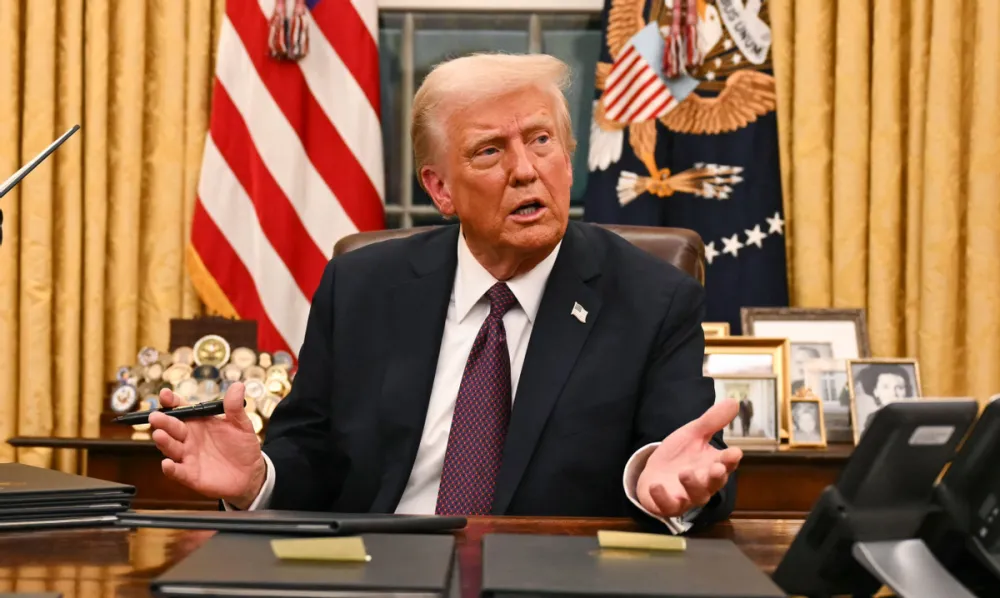
In the middle of the night on October 23, 2025, Changpeng Zhao, the richest man in Chinese cryptography, was announced to have been pardoned by President Trump of the United States.
According to public information, President Trump previously expressed to advisers that he sympathized with the notion that Zhao Changpeng faced "political persecution in the United States."
However, just a year ago, on April 30, 2024, Zhao Changpeng was experiencing the darkest moment in his life: he was stripped naked, underwent a humiliating body search, showed his buttocks, and was then locked in a cold cell. The inmates are muscular men with tattoos on their faces and designs carved on their heads.
In the federal court in Seattle, Zhao Changpeng, wearing prison uniform, admitted his crime. This man, known as the "richest man in China", voluntarily chose to pay a fine of US$4.3 billion, and said in front of the media: "I choose to pay a political fine."
If someone had told him at that time: Not only would you be pardoned by the United States in a year, but you would also be able to set foot in China again, and the cold eyes and fists in the Seattle jail at this moment, as well as the 4.3 billion political fine, would be cleared. He would probably curse in his mind, what kind of black humor is this?
The signal about Zhao Changpeng’s pardon will be released starting from September 17, 2025. On the same day, CZ suddenly updated his Twitter profile and changed "ex-@binance" back to "@binance". To some extent, it shows that the dust has settled that he can return to Binance.
At the same time, just in October, the two major "compliant trading portals" in the United States almost gave signals: the crypto listing platform Coinbase and the mainstream brokerage Robinhood regulated by the SEC successively opened BNB trading. This platform coin from the Binance ecosystem founded by Changpeng Zhao has obtained an official entry into the mainstream financial system in the United States for the first time.
White House Press Secretary Karoline Leavitt announced the pardon was effective and emphasized: "The Biden administration's war on cryptocurrency has come to an end."
Let's turn the clock back to 180 days before the amnesty. When Changpeng Zhao, the richest man in China and founder of Binance, is one step away from "political amnesty", what is he doing?
In the spring of 2025, the air in Victoria Harbor was filled with a long-lost excitement, and a group photo quickly swept the screen.
There are four people standing in seat C of the group photo: Huobi founder Li Lin, Changpeng Zhao CZ, Justin Sun, and Kong Jianping.
The ninth from the left is Li Lin, the founder of Huobi, the tenth from the left is Changpeng Zhao, the founder of Binance, and the sixth from the left is Kong Jianping
To others, this is just a group photo of a few big guys in the cryptocurrency industry, but in the eyes of knowledgeable people, this scene itself is a signal.
Eight years ago, China completely banned ICOs and trading platforms. Binance hurriedly went overseas, and Changpeng Zhao became "the person least likely to return to China." Eight years later, he reappeared in this photo. This was his opening salvo to reconnect with local capital and institutions.
The host of this party, Li Lin, was the founder of Huobi, one of the top three trading platforms in the world. Three years ago, he sold the company he founded to Justin Sun, who was also at the dinner party. After the dinner, the person who had the most contact with CZ was Kong Jianping who stood beside them.
Kong Jianping was once the co-chairman of the board of directors of Canaan Technology, a well-known mining machine manufacturer. In 2020, he founded Nano Labs and served as chairman. He is also a director of Hong Kong Cyberport, a member of Hong Kong’s “Task Force to Promote Web3 Development”, and was even appointed by the Secretary for Financial Services and the Treasury of the Hong Kong SAR Government to serve as a member of the tribunal.
Two months after the party, Kong Jianping announced in a high profile that he would build a $1 billion BNB treasury, with the goal of hoarding 5% to 10% of the circulation, and packaging the Binance platform currency BNB into a "US stock listed company."
CZ's tweet was forwarded personally, which immediately ignited market sentiment and the stock price soared, with an intraday increase of even as high as 107%+. Changpeng Zhao emphasized that he and his associated entities "did not participate in this round of financing." However, they "remain very supportive."
Since then, Kong Jianping can be seen behind most of Zhao Changpeng's public speaking events in Hong Kong.
Four months later, when Changpeng Zhao returned to Hong Kong for the second time, he was no longer just a "mysterious guest" at the Binance event, but came with a clear agenda: on the one hand, he officially announced the cooperation with China Renaissance before the event; on the other hand, he finalized the connection with OSL after the event. The echoes before and after marked the gradual clarity of his landing path in Hong Kong.
The story of China Renaissance has a lot in common with Binance, where glamor and dissociation coexist. Founder Bao Fan is the most disruptive person in the investment banking circle. He has brokered mergers of the century between Didi and Kuaidi, Meituan and Dianping, and has invested in Circle, the largest listed stablecoin company.
But in February 2023, Bao Fan suddenly "disappeared", so Huaxing became a sensitive name in the capital market. The investment banking business is still running, but because the founder is "in custody", it has been in a free position for a long time: traditional finance does not dare to fully trust it, and emerging Internet capital feels that its power has been exhausted.
At the end of August 2025, Binance officially announced its cooperation with China Renaissance.
Before the cooperation between China Renaissance and BNB came to fruition, a subtle coincidence occurred. On August 8, 2025, Caixin disclosed that Huaxing founder Bao Fan was "released", ending a two-and-a-half-year disappearance investigation; just three weeks later, Huaxing announced an investment of US$100 million in BNB and joined hands with the Changpeng Zhao family fund YZi Labs to launch a compliance fund. Bao Fan’s wife Xu Yanqing, who is also the current chairman of Huaxing’s board of directors, participated in the BNB Ecology fifth anniversary event as a guest speaker.
In addition, Changpeng Zhao and Huaxing also implemented a seemingly inconspicuous initiative: promoting BNB to be listed on a virtual asset trading platform licensed by the Hong Kong Securities Regulatory Commission.
Just 12 days later, OSL, Hong Kong's first licensed trading platform, made an announcement online: Binance Platform Token BNB became the fifth crypto asset approved for trading on a licensed trading platform in Hong Kong.
As the earliest trading platform to obtain a license in Hong Kong, OSL is backed by its parent company BC Technology, a licensed financial technology group listed on the Hong Kong Stock Exchange. OSL itself has obtained the first batch of virtual asset trading platform licenses in Hong Kong. It also has custody and brokerage businesses, and has a network that directly connects local brokers, ETF custodians and institutional distribution.
The reason why this company is special in the industry is considered to be related to the "financialization background" of its early management. Its largest shareholder, accounting for 25.43% of the shares, was originally from a traditional brokerage, but later entered encryption. He is also the founder of the trading platform Bitget, and has the most thorough integration of compliance and capital markets.
Zhao Changpeng's return to China is written between these coincidences and operations, relying on pieces of capital and politics to complete the puzzle.
In the 180 days before receiving the pardon from the US President, Zhao Changpeng's seemingly loose actions actually served the same goal: to first reestablish the legitimacy of CZ's return to China.
Changpeng Zhao said this during an event at the University of Hong Kong, "When I left the mainland four years ago, I thought I would never return to the core stage of the Chinese-speaking world. But standing in Hong Kong today, I clearly know that the previous wandering was just a foreshadowing, and the real story has just begun."
Some people think this is just a statement, but once you know the story behind it, you will find that it may be something from the bottom of your heart.
In July 2017, Binance started in Shanghai. Two months later, ICOs and trading platforms were completely banned in China, and CZ was forced to evacuate with a team of more than 30 people. In six weeks, they moved data from Alibaba Cloud to AWS, and applied for visas for engineers who had never been abroad. Like a makeshift expedition team, they arrived in Tokyo.
At that time, Japan seemed to be an ideal safe haven, and the government had recognized virtual currencies as legal. So Binance rented an office, and it was the "global headquarters" for about ten people.
The bull market in 2017 was raging, with Bitcoin rushing from US$3,000 to US$19,000. Binance reached the top spot in terms of global trading volume in just five months. During that time, they worked almost non-stop, and the number of registrations soared to the point where they temporarily closed down account openings.
But the tide quickly reversed. In early 2018, scammers used fake Google ad phishing to defraud investors of their Binance accounts and funds. The Japan Financial Services Agency suddenly tightened its policies and directly warned Binance of unlicensed business activities in Japan in March. The cold face of the regulators was more terrifying than the hackers. CZ once again packed up and evacuated Tokyo.
After retreating from Tokyo, CZ bet on Malta in the Mediterranean. In 2018, Prime Minister Muskat shouted the slogan "Blockchain Island". So Changpeng Zhao cooperated with the local government and announced that Binance’s global headquarters would be here. Within three months, the team expanded to employees from 39 countries. But two years later, the Malta Monetary Authority issued a cold statement: Binance has never been registered.
After this back and forth, Japan looked coldly and Malta repented, forcing CZ to simply announce that Binance will no longer be looking for a headquarters.
In September 2021, this "headquarterless model" began to play a special role in supervision. In 2021, a trading platform opponent sued Binance in the United States, and a class action lawsuit brought Binance, CoinMarketCap and Changpeng Zhao to court.
Here comes the place of being a god: the company can still be found with the summons, but the address cannot be found for "no headquarters", and in the end we can only go after the founder. So the plaintiff's lawyer hired a private detective who was a retired Marine to track down CZ's whereabouts. The investigation spanned Asia, Europe and the Middle East, looking through flight data, business registrations and social media. Months passed and still nothing.
Until the end, the detective left a sentence in the report: "We have made great efforts to track Zhao Changpeng, but Zhao Changpeng's whereabouts are almost impossible to detect."
The lawyer finally suggested sending the subpoena directly through Twitter, after all, CZ speaks on it every day. Of course, this was rejected by the judge.
Drifting is just a preparation. The headquarters can disappear and the passport can be replaced. But soon, Zhao Changpeng will face another more difficult identity test question – when the Americans point the finger at his Chinese ancestry, what answer can Zhao Changpeng give?
On the poker table of the world's power game, one's origins are revealed first, followed by passports. As for ability, it is often just the final talking point.
From a U.S. prison to a U.S. presidential pardon, Changpeng Zhao’s dedication to so-called “compliance” has always been “more than just” compliance.
At the end of 2022, FTX, the second largest trading platform in the United States, collapsed and closed, resulting in a huge funding gap due to losses. Immediately seven months later, the US SEC began to prosecute Binance CZ for illegal operations, and issued a sky-high US$4.3 billion fine at the end of the year.
Outside the courtroom, the power play in Washington never stops. The regulatory storm led by the Democratic Party has shaped CZ into a perfect target: a Chinese entrepreneur who controls half of the crypto world but is suspected of violating anti-money laundering laws and sanctions. In the prosecutor's charge sheet, Binance was accused of "serving illegal activities", and CZ's background, a Chinese who was born in China and lived in Shanghai in his early years, became the cheapest and most efficient entrance for attacks.
On November 24, 2023, a hot post on Reddit, an overseas social media, became a hot search topic in the crypto sector, discussing whether Binance can really afford a US$4.3 billion fine, and comparing it with FTX's US$6.8 billion hole. Many American netizens even suggested that the government is "squeezing blood" from Binance to fill the shortfall in the U.S. encryption industry.
But money can only solve financial problems, and doubts about one's origins always follow.
U.S. Congressman Stacey Plaskett said bluntly at a hearing: "Although he is a Canadian citizen, he is Chinese."
In the Forbes article, Changpeng Zhao said: "My Chinese identity is brought up again, as if it is important." Zhao has been the target of discrimination in the past because of his Chinese identity, especially when some people tried to associate him with relevant governments in Asia.
In the spring of 2024, Zhao Changpeng paid a fine of US$4.3 billion, put on prison uniform and entered the Seattle Prison in the United States to commit suicide. This period of prison life, which he called "the most difficult moment in his life," did not completely bring about a political identity reset.
The real turning point was when Republican Trump returned to the White House and gave the encryption industry an "amnesty."
The 4.3 billion fine that Changpeng Zhao handed over to the Democratic Party has become a sunk cost of political sacrifice. He had to start betting again.
In March 2025, Binance announced a $2 billion investment from Abu Dhabi sovereign fund MGX. The proportions, governance rights, and use of funds are not disclosed, but what really stands out is the settlement method. Not US dollar cash, but USD1 stablecoin – behind it stands World Liberty, which has close ties with the Trump family.
Soon after, Changpeng Zhao posted a photo with Zach Witkoff on social media. Zach is both a co-founder of USD1 and an ally of the Trump camp. His father, Steve Witkoff, is serving as the Trump administration’s special envoy for the Middle East.
This gave a financial investment more political meaning. Middle Eastern capital entered the market, the Trump family’s stablecoin came to the stage, and CZ used this in exchange for a new layer of asylum.
Just two weeks later, the Trump family’s stablecoin USD1 announced its official launch on the Binance ecosystem BNB Chain.
USD1’s slogan is simple: “A digital dollar for Americans.” The first thing CZ did was to connect it to its basic disk. BNB Chain is originally a lively food market, with everything from lending, DEX, and Meme. As soon as USD1 was put on the shelves, lending pools were launched, cross-chain tools were connected, and the Trump Family Fund even brought Meme coins directly related to Binance’s Four.meme project.
In fact, nearly 90% of the total issuance of USD1 stablecoins is circulating on the BNB chain.
On the surface, this is a product cooperation; in fact, everyone is envious of this political blessing that is difficult to obtain even if they squeeze their heads. Even so, Changpeng Zhao formally applied for a presidential pardon from Trump in April this year, and it took five months for him to receive an official document saying "pardon has been approved."
Bob Dylan once sang in his famous song "Blowin' in the wind":
How many roads must a man walkdown
How many roads does a person have to walk?
Before you can call him a man
To be called a real man.
For Binance, this problem is equally difficult: "How many roads do we have to go through and how many hurdles do we have to cross before we can truly stand on the stage of compliance?"
For Zhao Changpeng, this is a personal disaster; for Chinese entrepreneurs, it is a collective problem. The nationality page of the passport can be changed, but in the political narrative, Chinese identity has become an irresolvable label in the game.
This kind of label brings structural fragility. Business competition is a contest under a legal framework, but war is different. The opponent will hardly consider any rules and restrictions, and will use any means to achieve its strategic goals.
Changpeng Zhao once said: "If there is an audience, I might be willing to serve as a mentor to a few emerging entrepreneurs in private. If for no other reason, I can at least tell them what not to do."
After all, for Chinese entrepreneurs, "compliance" is not just compliance, it often also means a higher threshold of "identity redemption."
On the surface, this is the institutional friction behind business competition, but on a deeper level, it is the projection of identity politics in the global market. Even if a German entrepreneur, a Japanese entrepreneur, or a Korean entrepreneur faces supervision, their "nationality background" is rarely magnified indefinitely. But when the subject is Chinese, the identity naturally takes on a geopolitical metaphor, as if every expansion of the company implies the will of the country.
Shein’s CEO Xu Yangtian obtained a Singaporean passport, but failed to exchange for Shein’s smooth listing; TikTok replaced Singaporean CEO Zhou Shouzi, but it could not stop Congress’s continued questioning of “Chinese identity”; Temu moved its headquarters to Ireland, but could not get rid of Washington’s accusations of “forced labor”.
Because of this, there is always a disconnect between the "passport" and "identity" of Chinese entrepreneurs. Passports can be changed again and again: Canada, Singapore, Grenada… But "identity" is a deeper brand, written on the face, engraved in the experience, and difficult to erase. It makes these entrepreneurs always have to pay extra costs on the road to cross-border expansion, with more explanations, more scrutiny, and even more compromises.
Some people say that this is the inevitable result of globalization reaching deep waters: capital can flow freely, but people's identities cannot easily cross political barriers. The success and difficulties of Chinese entrepreneurs are a concentrated expression of this contradiction.
On the one hand, they have proved the hard work of the Chinese community. On the other hand, they are constantly reminded that no matter how big the market is and how strong the capital is, they are always in a position where they need to prove that they are harmless.
This may be the common pain of Changpeng Zhao: they can change the company structure and embrace different markets, but they must learn to find asylum in different power structures in the United States, Europe, and the Middle East; they must accept that passports can become tools and identity is another fate that is difficult to escape.
Changpeng Zhao tweeted immediately after receiving the pardon: Thank you to President Trump for the pardon and will make every effort to help the United States become the capital of cryptocurrency.
Perhaps for Chinese entrepreneurs, this game about "identity" is far from over.
References
.Binance CZ talks about his prison experience for the first time: the body search process was embarrassing, the roommate turned out to be a double murderer, an in-depth interview with Farokh Sarmad and CZ
. Official Gazette of the Hong Kong Special Administrative Region
.Plaskett uses “anti-Asian discrimination” against Canadian crypto CEO in congressional hearing, Federal Newswire Report