The Process Of Proposing And Promoting The China-Kyrgyzstan-Uzbekistan Railway Plan Has Encountered Setbacks And Key Issues
DOI: 10.13568/j.cnki.issn1000-2820.2025.06
DOI: 10.13568/j.cnki.issn1000-2820.2025.06
The Shanghai Composite Index has been positive for five consecutive times, the market liquidity crisis has been resolved, and Lingjun was punished with a "boomerang", but quantitative trading has once again been pushed into the spotlight of public opinion.
After experiencing a sharp retracement of net worth and a series of pressures from customer redemptions, micro-cap stocks rose sharply for two days. Unexpectedly, the 24 hours before and after the quantitative private equity giant Lingjun was fined was the real "darkest moment" of quantification.
The resurgence of rumors, the announcement of Lingjun’s punishment, and the late-night apology have triggered a huge discussion in the entire industry about “why we have come to this point” and “where we will go from here” in quantification. Reporters from the Financial Associated Press have followed up on quantification for a long time and interviewed many institutions. They reviewed the 24 hours of quantification and the three major doubts that still exist in the industry.
Where does quantification go from here? Three major questions in the industry
Following Lingjun’s punishment, it was reported on the Internet that a quantitative private equity person said that “China’s stock market quantitative funds have closed down.” Such remarks were immediately denied by the parties involved.
What is unavoidable is that after the fermentation of news events, the great discussion about quantification has once again begun: How did the industry review the unprecedented tragedy of quantification? Investors asked, "Can I still invest in quantitative trading after a sharp retracement?" Some people once again mentioned the 828 incident in 2023 and reiterated the quantitative selling.
Some asset managers also believe that quantitative supervision needs to put the establishment of capital gains tax on short-term trading on the agenda.
Focusing on this, reporters from the Financial Associated Press interviewed industry insiders and learned that the current industry still has the following three major questions that need to be answered:
First of all, how to control the size of orders when placing quantitative trading orders?
Previously, the new regulations on programmatic trading clarified that high-frequency trading is the focus of supervision: that is, if the maximum declaration rate reaches more than 300 transactions per second or the maximum number of declarations in a single day reaches more than 20,000 transactions, the transaction can adjust the abnormal transaction identification standards according to the situation. In the announcement of the punishment of Lingjun by the Shanghai and Shenzhen Stock Exchanges, the reason was that "a large number of orders were concentrated in a short period of time, which accounted for a high proportion of the market turnover during the period, triggering a rapid decline in the index and seriously affecting the trading order."
Quantitative private equity said that even if it is not high-frequency trading, there is a lot of quantitative daily rolling trading frequency. Generally, it is sold at the opening and the funds are withdrawn before buying. From the current regulatory direction, in addition to avoiding high-frequency trading, it is also necessary to consider whether it will affect the index performance.
Secondly, will quantification “stop”? How to balance benefits and risks?
From the perspective of the industry, the risks of quantitative private equity are not without signs, but most people choose to run blindly.
A certain quantitative private equity said that the company adjusted its strategy last year because it realized that the CSI 500 was very risky and not cost-effective. However, the market enthusiasm concealed that the index had no excess risk. Looking at the excess and returns brought by the risk, how to balance it?
The above-mentioned people said that at that time, the risks had not yet emerged, and not doing this part of the excess would bring about underperformance and investor complaints. Today, if you review the market, you will find that rationally facing the excess of 300, 500, and 1,000, accepting the attenuation of alpha is an objective law. Trying to use opportunistic tricks such as iteration to chase false excess will ultimately be short-lived, and the worse result will be backlash.
However, in the face of huge temptation, how many institutions in the market can predict the risks? Dare to make adjustments? In most cases, extreme risks come and it is impossible to escape unscathed.
Third, how big is the current scale of DMA? How much money has 4 times leverage leveraged in the market?
It is undeniable that some quantitative private equity companies have criticized the restrictions on DMA trading before the holidays, and some institutions have blamed this for the retracement of net worth. In fact, in reviewing the sharp decline in micro-cap stocks, how much impact will DMA's restricted trading have on the product? The industry is inconclusive.
Industry insiders said that the path to triggering the liquidity crisis of micro-cap stocks is very clear. It was triggered by Snowball’s knock-in, and Snowball hedged and sold futures. The bulls chose to wait and see because they were waiting for the risk to be released, which in turn triggered a widening of the discount, a domino effect, and quantitative neutral strategies to close positions and sell CSI 500 and CSI 1000 constituent stocks. Subsequently, regulatory measures such as securities lending accelerated the decline of small and micro stocks, and the liquidity crisis really began. High-leverage DMA positions were liquidated. The DMA was restricted from February 5 to February 8 of the same month, for a total of 4 days.
Judging from the decline in quantitative net worth, it started with the decline of the Wind micro-cap index in January this year, reaching its maximum retracement in the last week before the Spring Festival, with individual products falling by more than 20% in a single week. In the view of most observers, the selling restrictions have exacerbated the retracement of net worth, but the retracement cannot be entirely attributed to regulatory measures.
In addition, it is worth noting that regarding whether securities firms can restrict the selling of quantitative private placements, in fact, there is a clear explanation in the 2023 programmatic trading. In strengthening the front-end management of members (brokerages), the exchange proposed that if customers’ programmed transactions may affect the security of the trading system or the normal trading order, members (brokerages) can take measures such as rejecting their programmed trading entrustments and canceling relevant declarations.
From the last day before the Spring Festival to the present, small and micro-cap stocks have started to rebound. In four trading days, the Wind micro-cap stock index has increased by nearly 30%. While the micro-cap market is still worth looking forward to, what is the size of DMA? What potential risks does high leverage bring? It deserves industry attention.
Regarding the scale of DMA, the industry speculates that as of the end of last year, the stock scale may have reached 100 billion. Counting 4 times leverage, the market capital leveraged is about 400 billion to 500 billion.
How big is the impact on the market? An analysis by an organization estimates that there is a certain diminishing effect when the scale changes hands. From observation, the turnover rate of tens of billions of private equity can reach 200 times when it reaches 500 million, about 120 times when it reaches 4 billion, and the turnover rate of tens of billions of scale is about 30 to 40 times. From this, we also refer to the turnover rate of DMA. Returning to what the regulator mentioned, "there are also problems such as strategic convergence and transaction resonance at some points in time, which increase market fluctuations". There are also traces to follow.
Full review 24 hours before quantification
The first stage (February 20, 12:00-15:00): Storm is coming, rumors are flying everywhere
Beginning at noon on February 20, a link to a collection of rumors about quantitative private equity giants was spread on social platforms. The rumors were mixed with "the liquidation of hundreds of billions of quantitative products, a huge loss of 1.5 billion in self-operated products, a DMA debt of 6 billion, the company's bankruptcy and even jumping off the building." The main body of the rumors involves Huanfang Investment, Mingtun Investment, Jiukun Asset and other leading quantitative private equity institutions.
These rumors before the Spring Festival have once again spread in the form of a collection and intensified. A reporter from the Financial Associated Press verified with a number of quantitative private equity and third-party institutions that the micro-cap liquidity crisis has caused the net value of some products to retreat. It is true that some products have encountered greater redemption pressure and even been liquidated, but there is no "liquidation of hundreds of billions of products." Some companies bluntly said: "The above screenshots are rumors. There were rumors of bankruptcy and jumping off buildings before the Spring Festival. These extreme statements are not true." Some leading quantitative private equity companies also said that the company does not have DMA products, and there is no problem of owing huge amounts of money to brokers.
The second stage (15:00-24:00 on February 20): Punishment is implemented, supervision is quantitative and qualitative
There are still a lot of messages asking for confirmation, and regulatory penalties have pushed the discussion to a climax. It is worth noting that this is the first time a penalty decision has been implemented after the new regulations on programmed trading in September last year, and the target of punishment is Lingjun, a giant in quantitative private equity.
February 20, 17:03 pm: The Shenzhen Stock Exchange announced that the Shenzhen Stock Exchange discovered during its transaction monitoring that within 42 seconds from 9:30:00 to 9:30:42, multiple securities accounts owned by Lingjun Investment automatically generated trading instructions through computer programs, placed a large number of orders in a short period of time, and sold a total of 1.372 billion yuan in Shenzhen Stock Exchange stocks. During this period, the Shenzhen Stock Exchange Component Index fell rapidly, affecting the normal trading order. The Shenzhen Stock Exchange decided to suspend trading in Lingjun’s account for three days and initiate a public censure record disciplinary procedure.
At around 17:40, the Shanghai Stock Exchange also announced that because Lingjun sold a large number of Shanghai stocks totaling 1.195 billion yuan in one minute, it had suspended trading for three days and issued a public censure record.
At 19:05, the Shanghai and Shenzhen Stock Exchanges respectively announced the smooth implementation of the quantitative trading reporting system. This is also the first time since the new regulations on programmed trading that the supervision has issued an announcement with "quantitative trading" as the clear subject. The two exchanges have the same caliber and have given characterization to quantitative trading: While quantitative trading helps provide liquidity to the market and promote price discovery, quantitative trading, especially high-frequency trading, also has problems such as strategic convergence and trading resonance at some points in time, increasing market volatility.
Subsequently, the exchange stated that it will continue to strengthen the monitoring and analysis of quantitative trading, especially high-frequency trading, with six major measures.
First, strictly implement the reporting system and clarify the access arrangements of “report first, trade later”;
The second is to strengthen the authorization management of quantitative trading prices and improve the differentiated charging mechanism;
The third is to improve the monitoring and control standards for abnormal transactions and strengthen the supervision of abnormal transactions and abnormal order cancellations;
The fourth is to strengthen the monitoring and regulation of leveraged quantitative products and strengthen the joint supervision of futures and spots.
The fifth is to further consolidate the customer management responsibilities of securities companies, improve the self-regulatory management cooperation mechanism with the Securities Industry Association and the Fund Industry Association, and strengthen the transaction supervision of quantitative private equity and other institutions, etc.
Sixth, the exchange will strengthen communication with the Hong Kong Stock Exchange, clarify the reporting arrangements for northbound investors in Shanghai-Hong Kong Stock Connect in accordance with the principle of consistency between domestic and foreign investors, and include quantitative transactions by northbound investors within the reporting scope.
A number of quantitative private equity firms have also launched self-certifications and clarifications. At around 21:24 in the evening, media reported that the quantitative giant Huanfang denied the liquidation of its products and stated that the company had never done any DMA leverage transactions.
In the evening, the recent product operation instructions and apologies of quantitative private equity companies such as World Frontier Assets, Xuanxin Assets, and Longqi Fund were also reported one after another. Most of the quantitative four times said that they would strengthen risk control constraints and reduce risk exposure.
In addition, a leading quantitative private equity reporter told a reporter from the Financial Associated Press that he "changed his strategy overnight". The initial plan is to change the trading frequency in some specific time periods to reduce the frequency of triggering transactions.
The third stage (0:00-8:00 on February 21) Lingjun, the punished institution, apologized late at night
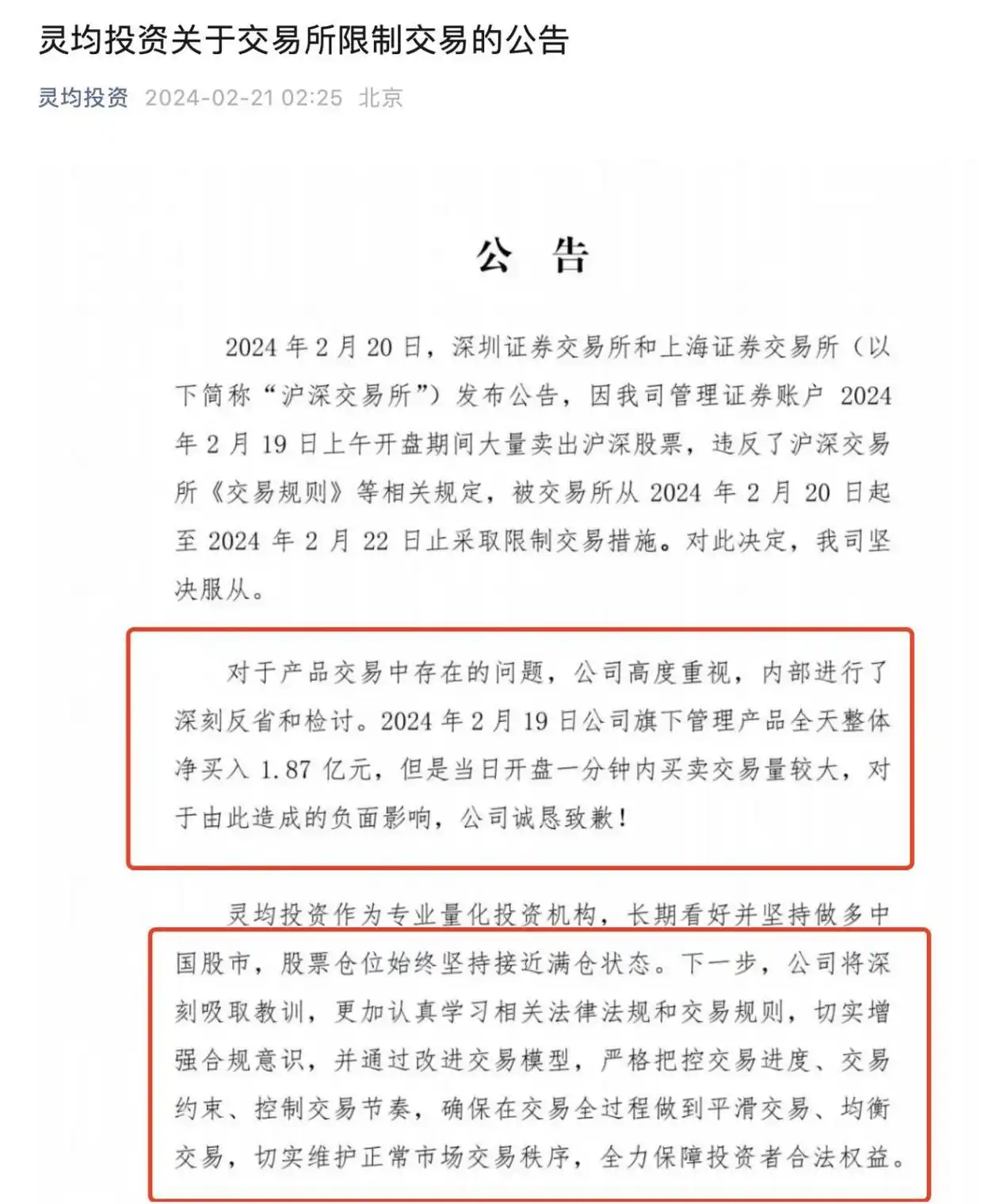
At 2:25 a.m. on February 21, Lingjun Investment issued an announcement on the exchange's trading restrictions, expressing "firm obedience", in-depth review, and apology to the investment.
Lingjun Investment stated in the announcement that the company will resolutely comply with the trading restrictions imposed by the Shanghai and Shenzhen Stock Exchanges. The company attaches great importance to the problems existing in product transactions and has conducted deep introspection and review internally.
The announcement also explained the transactions on the day of the penalty: On February 19, 2024, Lingjun’s management products had an overall net purchase of 187 million yuan throughout the day, but the trading volume was large within one minute of the opening of the day. The company sincerely apologizes for the negative impact caused.
The announcement also mentioned that Lingjun Investment, as a professional quantitative investment institution, is optimistic about and insists on being long in the Chinese stock market in the long term, and its stock positions have always been close to full. In the next step, the company will learn lessons deeply, study relevant laws, regulations and trading rules more seriously, effectively enhance compliance awareness, and by improving the trading model, strictly control the transaction progress, transaction constraints, and transaction rhythm to ensure smooth and balanced transactions throughout the transaction process, effectively maintain the normal market transaction order, and fully protect the legitimate rights and interests of investors.
The fourth stage (8:00-12:00 on February 21) The China Securities Regulatory Commission emphasizes that "one item will be matured and another item will be launched in the future" for quantitative supervision.
After the exchange took action, the China Securities Regulatory Commission also explained and emphasized quantitative supervision. According to multiple media reports, the Market Supervision Department of the China Securities Regulatory Commission stated that the China Securities Regulatory Commission has always paid attention to the development and supervision of quantitative trading. In recent years, it has successively promoted many tasks, including bringing quantitative trading into the scope of securities laws, establishing a data collection mechanism for leading quantitative institutions, strengthening quantitative trading monitoring and analysis, establishing a programmed transaction reporting system, strengthening private placement and securities lending supervision, etc.
The series of quantitative trading supervision measures introduced in the next stage will be matured one by one and launched one by one. We will fully strengthen communication with various investors in the market, grasp the pace and intensity of work, promote the standardized and healthy development of quantitative trading, and maintain the stable operation of the market.
“The focus of this quantitative trading supervision is on high-frequency trading.” The above-mentioned person further said that judging from international experience, overseas markets generally implement stricter supervision on quantitative trading, especially high-frequency trading, to prevent negative impacts on market order.
Germany, Japan, etc. have centralized regulations on quantitative trading in the form of written laws and implement access registration management for high-frequency traders. Germany stipulates the definition and characteristics of algorithmic trading and high-frequency trading, exchange fees, transaction monitoring indicators, system requirements, etc.; Japan has formulated and issued regulatory guidelines specifically for the supervision of high-frequency trading actors.
Markets such as the United States limit the speed at which high-frequency traders can obtain trading information, reduce information asymmetry, and ensure optimal execution of investor orders. At the same time, they clearly prohibit any market participant from participating in, specifying, or intending to conduct destructive trading behaviors, including "spoofing" and other market manipulation behaviors that have emerged with the rise of high-frequency trading.
Regarding the special reporting system for quantitative transactions currently implemented, supervision emphasizes that existing investors are currently "repaying all their dues" and incremental investors are "reporting first and then trading." Unreported investors cannot conduct programmed transactions, which is equivalent to allowing investors to "driving with a license" in the first place, providing institutional conditions for timely discovery of violations and real-time monitoring. (Reporter Yan Jun)
Trainee editor: Li Wenyu | Reviewer: Li Zhen | Supervisor: Wan Junwei

DOI: 10.13568/j.cnki.issn1000-2820.2025.06.007
1. The proposal and advancement process of the China-Kyrgyzstan-Uzbekistan Railway Plan
(1) Proposal and obstacles to advancement of the China-Kyrgyzstan-Uzbekistan railway planning project
China, Kyrgyzstan, and Uzbekistan launched preliminary planning for the China-Kyrgyzstan-Uzbekistan railway project in 1997 and signed a memorandum of understanding on cooperation in building the railway. In 2006, China included the construction plan of part of the Chinese section of the China-Kyrgyzstan-Uzbekistan Railway in the national economic "Eleventh Five-Year Plan". Two years later, the Chinese working group and expert group formulated the "Kashgar-Turgat-Karasu-Andiyan" railway construction plan. During the same period, related railway projects in Uzbekistan were also progressing smoothly. On March 26, 2015, the 129-kilometer-long "Angren-Pap" railway tunnel in Uzbekistan was completed. This section of the railway is an important section of the China-Kyrgyzstan-Uzbekistan Railway and a key project in the construction of the "Silk Road Economic Belt".
In contrast, progress on the Kyrgyzstan section of the China-Kyrgyzstan-Uzbekistan Railway has been slow. Subsequently, the then President of Kyrgyzstan, Almazbek Atambayev, rejected the China-Kyrgyzstan-Uzbekistan railway project, saying that the project was not in Kyrgyzstan’s national interests and suggested changing the direction of the railway to connect the north and south of the country. The China-Kyrgyzstan-Uzbekistan railway project has gone through twists and turns since it was proposed, and it was difficult for all parties to reach consensus on a series of key issues.
First, there is the issue of route direction. From the perspective of project construction cost and operational efficiency, China and Uzbekistan hope to build a route from east to west through southern Kyrgyzstan. The southern route is shorter and less technically difficult. Kyrgyzstan insists on taking the northern route, believing that although this route is longer, it connects the country's northern and southern economic centers and can promote economic development in the north and south. China and Uzbekistan believe that Kyrgyzstan’s proposal is not only costly but also inefficient. In this regard, Bakhtiyor Ergashev, director of the Tashkent think tank "Mano", pointed out that the Kyrgyz authorities proposed the northern railway line plan purely out of "self-interest." "The plan they (the Kyrgyz government) proposed is just longer and more expensive, which is contrary to the idea of rapid and affordable railway construction," Ergashev said in an interview with a Kazakh news website.
Second, there is the issue of project funding. Kyrgyzstan is a typical mountainous country. The cost of building railways in mountainous areas is high. Coupled with the relatively poor economic situation, railway construction costs and financing have become issues of greater concern to the Kyrgyz people. Kyrgyzstan economic expert Iskender Sharsheev once pointed out that Bishkek faces severe challenges in attracting foreign investment to build the China-Kyrgyzstan railway. This, coupled with financial restrictions in Kyrgyzstan and Uzbekistan, has weakened the ability to independently finance the project. Tilek Tekebaev, Minister of Transport and Communications of Kyrgyzstan, said in a speech in 2023 that the huge project of China-Kyrgyzstan-Uzbekistan Railway must be seriously considered, and work will be resumed after the financing model is finalized.
Third, the issue of track gauge. The track gauge widths in China and Kyrgyzstan are different. If the track gauges are not uniform, replacement operations must be performed, which will affect railway operation efficiency. China uses 1435 mm international standard gauge, and Central Asian countries use 1520 mm wide railway tracks. China initially hoped to use the standard gauge used by both China and Europe, while Kyrgyzstan hoped to continue using the Soviet-era broad gauge to connect with railways in Russia and Kazakhstan. In July 2020, Zheng Chiping, deputy director of the Foreign Investment Department of the National Development and Reform Commission of China, pointed out at a video conference on the China-Kyrgyzstan-Uzbekistan Railway Construction Project that it was difficult for experts to reach a consensus on the track gauge and route of the railway, and China suggested considering other options. For a long time, China and Kyrgyzstan have been unable to reach a consensus on this issue, which has become one of the important obstacles to the implementation of the project.
Fourth, the political stability of the relevant countries. Take Kyrgyzstan as an example. The country is an important transit country for the China-Kyrgyzstan-Uzbekistan railway. It has elected six presidents since its independence in 1990. The unstable political situation in Kyrgyzstan caused by the revolutions in 2005, 2010 and 2020 has caused the China-Kyrgyzstan-Uzbekistan railway negotiations to stall. The change of government also caused the country's leaders to have inconsistent attitudes towards the railway project at different stages, and some even opposed the construction of the project. The then President of Kyrgyzstan, Almazbek Atambayev, pointed out that there were some people who opposed the China-Kyrgyzstan-Uzbekistan railway project, and that behind these objections and obstructive actions were hidden political and competitive games. Underlying the dispute over the route is a concern that if the railway runs only through southern Kyrgyzstan, the economic power of Kyrgyzstan’s southern elite will exceed that of the northern political bloc.
(2) The final implementation and solution of the China-Kyrgyzstan-Uzbekistan Railway Project
The construction of the China-Kyrgyzstan-Uzbekistan railway project has accelerated with the upgrade of China-Kyrgyzstan relations. In June 2018, China and Kyrgyzstan established a comprehensive strategic partnership. Both parties stated that they would make every effort to promote the work related to the China-Kyrgyzstan-Uzbekistan railway project and strive to start construction as soon as possible. On July 15, 2020, China, Kyrgyzstan and Ukraine held a video conference to discuss railway construction plans. On June 2, 2022, China, Kyrgyzstan and Uzbekistan held a tripartite working-level video conference on the China-Kyrgyzstan-Uzbekistan Railway to exchange in-depth views on promoting cooperation in the China-Kyrgyzstan-Uzbekistan railway project. In September 2022, China, Kyrgyzstan and Uzbekistan signed the "Memorandum of Understanding on Cooperation on the China-Kyrgyzstan-Uzbekistan Railway Construction Project (Kyrgyzstan Section)" during the SCO Summit in Samarkand and agreed to launch a feasibility study in 2023. In 2023, China and Kyrgyzstan will establish a comprehensive strategic partnership for a new era and work together to build a China-Kyrgyzstan community with a shared future featuring good neighborliness, friendship and shared prosperity. Against this background, the progress of the China-Kyrgyzstan-Uzbekistan railway project has been accelerated. In May 2023, during the China-Central Asia Summit, the government departments of the three countries signed the "Memorandum of Understanding on Reaching Consensus on the Tripartite Joint Review of the Feasibility Study of the China-Kyrgyzstan-Uzbekistan Railway Construction Project (Kyrgyzstan Section)". After the efforts of all parties, China, Kyrgyzstan and Uzbekistan reached an agreement on issues such as route selection, track gauge, investment and operation model, and signed the "Agreement on Jointly Promoting China-Kyrgyzstan-Uzbekistan Railway Project Cooperation" in June 2024. On April 29, 2025, the construction of three key control projects on the Kyrgyzstan section of the China-Kyrgyzstan-Uzbekistan Railway, the Fergana Mountains, Naryn No. 1, and Koshbot Tunnels, started, marking that the main line of the China-Kyrgyzstan-Uzbekistan Railway project has entered the substantive construction stage. At present, the three countries have signed all necessary documents involving the railway, and the three parties have reached consensus on key issues of railway construction. The project has officially started construction in July 2025, with a planned construction period of 6 years.
First, regarding funding issues. The China-Kyrgyzstan-Uzbekistan Railway will be operated by a three-party joint venture. Each party plans to invest in the construction of the railway with designated shares, 51% of which belongs to the Chinese company, and the remaining 24.5% belongs to related companies in the Kyrgyz Republic and Uzbekistan respectively. In June 2024, Azamat Sakiev, director of the Kyrgyzstan Railway Bureau, revealed that Kyrgyzstan had negotiated loan issues with the Export-Import Bank of China and the People's Bank of China, including undetermined loan terms and interest rates. Regarding the total investment and the proportion of capital contributions from each country, according to the "China-Kyrgyzstan-Uzbekistan Railway Design, Construction, Financing, Operation and Maintenance Investment Agreement" signed between China-Kyrgyzstan-Uzbekistan Railway Co., Ltd. and the Kyrgyzstan Ministry of Transport on December 20, 2024, on the China-Kyrgyzstan-Uzbekistan Railway (Kyrgyzstan Section) ) of the US$4.7 billion investment, China will provide half of the capital loan (US$2.35 billion), and the remaining half of the funds will be raised by the China-Kyrgyzstan-Uzbekistan Railway Company in proportion to their respective shares (US$1.2 billion for China, US$573 million for Kyrgyzstan and Uzbekistan each).
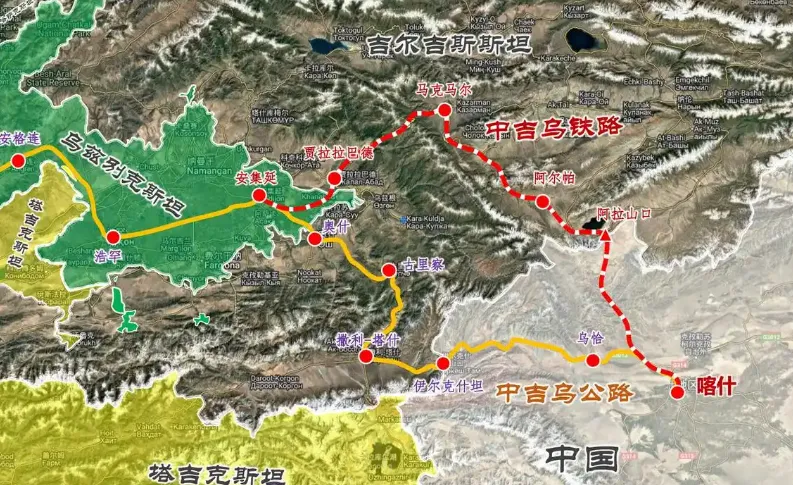
Second, regarding the route direction. China and Kyrgyzstan have reached a consensus on the Torugart-Arpa-Kosh-Dobo-Makmal-Jalal-Abad route. The railway will pass through Kashgar (Central)-Torgart (Kyrgyzstan)-Makmal (Kyrgyzstan)-Jalalabad (Kyrgyzstan)-Andijan (Ukraine). The China-Kyrgyzstan-Uzbekistan Railway starts from Kashgar, Xinjiang, China, and heads northwest through the Turgat Pass. After exiting the country, it goes northwest through Alpa, crosses the Mordotau Mountains and crosses the Alabuqa River to the Makhmal Shifting Station, then crosses the Fergana Mountains to the west, uses the existing railway passage north of Jalalabad, and extends southward around the city of Jalalabad to the end of the border with the Jalalabad South Station. The China-Kyrgyzstan-Uzbekistan Railway has a total length of 616 kilometers, of which the Chinese section from Kashgar to Turgat is 213 kilometers, accounting for 34.6% of the entire line; the Kyrgyz section from Turgat-Makmar-Jalalabad-Suzak, has a total length of 341 kilometers, accounting for 55.3% of the entire line; the Uzbek section from Suzak to Andijan, has a total length of 62 kilometers, accounting for 10.1% of the entire line.
Third, regarding track gauge and operation methods. Regarding the track gauge, the final result of the negotiation is that the China-Kyrgyzstan-Uzbekistan Railway adopts the "standard gauge + broad gauge" segmented model and establishes a standard-gauge and broad-gauge replacement station in Makmar in Kyrgyzstan. Standard-gauge section: Kashgar-Turgat-Makmar, with a length of 381 kilometers, including 213 kilometers of the section in my country and 167.54 kilometers of the section in Kyrgyzstan, using 1435 mm gauge. Broad gauge section: Makmar-Suzak-Andijan, with a length of 235 kilometers, including 173 kilometers of the Kyrgyzstan section (138.77 kilometers of new construction and 34 kilometers of upgrades) and 62 kilometers of the Uzbekistan section, using 1520 mm gauge. Regarding project operation, the project company was jointly established by the China-Kyrgyzstan-Uzbekistan Railway Company. The Kyrgyzstan section of the China-Kyrgyzstan-Uzbekistan Railway is jointly invested and established by the China-Kyrgyzstan-Uzbekistan Railway Co., Ltd., a subsidiary of China Railway International Co., Ltd., a subsidiary of the China State Railway Group Co., Ltd., the Kyrgyzstan State Railway Company, and the Uzbekistan Railway Co., Ltd. It is implemented in accordance with the build-operate-transfer (BOT) model.
2. Possible challenges faced by the construction and operation of the China-Kyrgyzstan-Uzbekistan Railway under geopolitical changes
In the context of the official implementation of the China-Kyrgyzstan-Uzbekistan railway project, factors such as the unstable regional security situation and the continued smear campaign by forces within and outside the region may also affect the smooth advancement and operation of the project.
(1) Unstable regional situations may induce conflicts and threaten project safety
Regarding the situation in Central Asia, American geopolitical scientist Brzezinski once pointed out: "For many years, most of them have been under the influence of the Persian Empire, the Turkish Empire, and the Russian Empire. However, this experience did not cultivate a sense of common regional interests among them. On the contrary, their different ethnic compositions make them vulnerable to internal and external conflicts. The accumulation of such conflicts often attracts the invasion of more powerful neighboring countries." The stability of the political situation in Central Asia is of great significance to ensuring the smooth progress of the China-Kyrgyzstan-Uzbekistan railway project. After the disintegration of the Soviet Union, the geopolitical landscape in Central Asia has been characterized by multidimensional turmoil. Border disputes, ethnic conflicts, non-violent regime change movements, and the deterioration of the surrounding security environment have superimposed on each other, posing a continuous impact on regional stability. Specifically manifested in three dimensions:
First, the vulnerability of sovereign states’ governance capabilities is highlighted. As the hub of the China-Kyrgyzstan-Uzbekistan railway, Kyrgyzstan’s domestic political ecology has long been subject to the power game caused by numerous political parties. In particular, the confrontation between the north-south forces with Bishkek and Osh as the core has triggered many unconventional regime changes, making railway construction a bargaining chip in the game of domestic political forces many times.
Second, cross-border governance problems continue to ferment. The boundary dispute in the Fergana Basin at the junction of Uzbekistan, Tajikistan and Kyrgyzstan is the most typical. This area is a must-pass for the China-Kyrgyzstan-Uzbekistan railway, and its planned terminal point, Andiyan Station, is embedded deep in the hinterland of the basin. In April 2021, an armed conflict broke out between Gita and Gita in the disputed area of the basin. In September 2022, the conflict escalated again and extended about 110 kilometers along the disputed border. This shows that conflicts caused by territorial sovereignty disputes may affect cross-border infrastructure projects.
Third, the ecological security dilemma intensifies the game. As a valuable strategic resource for regional countries, water resources competition is often a source of regional tensions, especially between Uzbekistan and its upstream neighbors. Scholar Pan Zhiping pointed out that the water resources issue in Central Asia is not only an intra-regional conflict, but also one of the potential obstacles to the economic construction of countries along the “Belt and Road”. This unstable situation could trigger a chain reaction that could then escalate into broader internal conflicts among Central Asian states.
(2) The smear campaign by forces inside and outside the region interferes with local people’s understanding of Chinese projects.
The United States has continuously intervened in Central Asian affairs in recent years, and its fundamental goal is to curb the regional influence of China and Russia. Western countries, led by the United States, support non-governmental organizations to penetrate into Central Asia and cultivate "independent media" in the region to constantly hype anti-China issues. For example, in January 2025, when the China-Kyrgyzstan-Uzbekistan railway project was progressing smoothly, the German media Bucharest News Agency (BneIntelliNews) hyped that Kyrgyzstan was becoming a province of China. Regarding the China-Kyrgyzstan-Uzbekistan railway project, on the one hand, Western countries are hyping the construction of the railway, which will increase debt pressure on regional countries. Donald Lu, assistant secretary of state for the Bureau of South and Central Asian Affairs of the U.S. State Department, smeared China's projects in Central Asia as having problems of exploitation, corruption and opacity, saying that Chinese loans are exacerbating the debt risks of regional countries. Diplomacy scholars, Voice of America and other websites accused the China-Kyrgyzstan-Uzbekistan Railway of lacking transparency, which may cause smuggling risks and lead to a debt trap. There are also objections saying that the China-Kyrgyzstan-Uzbekistan plan is not only unfavorable to Kyrgyzstan, but will also incur huge expenses that are difficult to make up for. In this regard, Kyrgyzstan President Sadyr Zhaparov had to clarify, saying: "The construction of the China-Kyrgyzstan-Uzbekistan railway cost 4.7 billion US dollars and is a commercial project. It will not have an impact on the scale of Kyrgyzstan's foreign debt."
On the other hand, forces inside and outside the region claim that the railway project will cause environmental damage. Kyrgyzstan’s opposition has claimed that China has gained access to Kyrgyzstan’s silver, aluminum, copper and coal resources through investment in construction projects. A report by the Caspian Policy Center, an American think tank, stated that construction projects in Kyrgyzstan’s complex geographical environment require major environmental modifications, which may have a negative impact on the local climate and ecosystem. Economist Kubat Rakhimov, adviser to the Prime Minister of Kyrgyzstan, said that the China-Kyrgyzstan-Uzbekistan railway project is particularly difficult and requires the construction of tunnels in mountainous areas. Whichever route is taken, there will be a significant impact on the environment. Vladimir Grebnev, an expert on environmental protection and climate change in Bishkek, advocated for the project. Under the hype of internal and external forces, more and more public opinion believes that China's attempt to put some countries into a debt trap may have high environmental costs, triggering regional people's discussion on whether Chinese investment will generate debt problems, and even opposition to the China-Kyrgyzstan-Uzbekistan railway.
(3) Anti-China group activities may impact the construction of related projects
Western countries continue to hype the debt problems and social and environmental impacts of Chinese investment. Under the influence, some Central Asian people have a negative attitude towards China and Chinese investment. Survey data from the Central Asia Barometer between 2017 and 2021 shows that Kazakhstan respondents have a more negative view of China, and the number of Kyrgyzstan respondents who hold a "very negative" view of China has increased in each subsequent survey. Eliminate my country's negative image in Central Asian societies. The survey results show that the Central Asian people's welcome towards China is on a downward trend. Under the influence of multiple factors, anti-China groups in Central Asia frequently plan activities against Chinese investment, including protest marches, launching social media campaigns, and damaging and boycotting Chinese goods and services. For example, hundreds of Kyrgyzstanis once gathered near At-Bashy in Naryn Region to protest China's plan to build a logistics center there. The $275 million logistics center project was ultimately canceled. At the same time, individual ultra-nationalist groups continue to grow due to rising anti-China sentiment. The Kyrgyz right-wing nationalist male group "Kyrk Choro" carries out anti-Chinese activities on the grounds of "helping the government detect illegal immigrants" and accuses the Kyrgyz government of being "corrupt" and "pro-China". The former leader of the movement, Zamirbek Kochorbaev, wrote an article saying that the "Forty Knights" demanded the suspension of Kyrgyz visas to foreigners and said that "Chinese people should be deported." Members of his organization even held protests outside the Chinese Embassy in Bishkek. Not only that, the organization has also raided many Chinese companies. The Chinese-owned oil refinery located in Kalabarta, about 60 kilometers outside Bishkek, was disrupted by the organization. The fluctuations in Central Asian people's sentiments against China caused by the anti-China activities of extremist groups will affect China's regional investment to a certain extent.
(4) Competition from other similar projects
The China-Kyrgyzstan-Uzbekistan Railway also faces competition from other transportation projects. In recent years, Russia and India have actively participated in the construction of Central Asia's transportation network, aiming to strengthen their presence in Central Asia through projects such as the International North-South Transport Corridor (INSTC). Given Russia's support for India in balancing China's influence in Central Asia, this project will compete with China and may affect the effectiveness of projects such as the China-Kyrgyzstan-Uzbekistan railway. Although the China-Kyrgyzstan-Uzbekistan Railway and the North-South Corridor focus on east-west transportation and north-south logistics respectively, the North-South Corridor may still attract energy and mineral transportation from Kazakhstan, Turkmenistan and other Central Asian countries to enter South Asia or Europe, diverting goods that originally passed through the China-Kyrgyzstan-Uzbekistan Railway. At the same time, as the geopolitical game in Central Asia intensifies, Russia may accelerate the promotion of the Russia-India corridor to maintain its influence in Central Asia. India is also trying to establish alternative economic corridors to China in Central Asia and West Asia to weaken the radiation power of China’s “One Belt, One Road” initiative. In addition to Russia, the EU also aims to strengthen transportation links with Central Asian countries through the "Middle Corridor". In January 2024, the EU pledged to invest 10 billion euros to improve the infrastructure of the Central Corridor, which appears to be the first step in regional connectivity. In April 2025, the first EU-Central Asia Summit was held in Uzbekistan. During the summit, the EU announced a "Global Gateway" investment plan to invest an additional 12 billion euros in Central Asia, of which 3 billion euros were used for transportation. Compared with the China-Kyrgyzstan-Uzbekistan Railway, the "middle corridor" is further north, while the China-Kyrgyzstan-Uzbekistan Railway strengthens the southern line and fills the gap in the railway network in southern Central Asia. The two form a "north-south parallel" pattern in the Central Asian section. In addition, the United States also has a relatively strong interest in the "Middle Corridor" in terms of funds, standards and geographical influence in the future, and can compete with the China-Kyrgyzstan-Uzbekistan Railway. In addition, Kazakhstan is also worried that the China-Kyrgyzstan-Uzbekistan Railway will gradually become Kazakhstan’s competitor in China-Europe freight. Currently, rail transportation to and from China and Europe must be transited through Kazakhstan. In the future, with the completion of the China-Kyrgyzstan-Uzbekistan Railway, Kyrgyzstan will have a direct railway to China, and Uzbekistan will have the option to go to China via the Kyrgyzstan or Kazakhstan railway. In the future, Kazakhstan is unlikely to give up its position as a regional transportation hub and will continue to develop its railway infrastructure to maintain its dominant position in regional transportation.
The man took sick leave many times due to back pain and foot pain, but the company discovered that he had taken more than 16,000 steps on WeChat on the day he had foot pain. The company suspected that he was taking sick leave and fired him for absenteeism. The two parties went to court.
Xiao Chen is a spring coiler at a company in Jiangsu. On February 22, 2019 (Friday), he accidentally sprained his waist while working. After work that day, he immediately went to the hospital for diagnosis and treatment.
On the morning of February 25 (Monday), he applied to the company's human resources manager for leave to recuperate, informing him of his injury at work last Friday. He also took photos of the sick leave certificates issued by the two hospitals and sent them to the company, which was immediately approved by the human resources department.
From March 4th to 5th, Xiao Chen worked normally for two consecutive days. On March 6, Xiao Chen's waist discomfort recurred, and the medical diagnosis was "lumbar sprain." The doctor recommended continuing to rest, and he immediately submitted another sick leave application to the Human Resources Department.
On March 18, Xiao Chen returned to work. At noon, he complained of foot pain and asked for sick leave from the production manager. Later, he went to the hospital for treatment. He took a photo of the diagnosis certificate stating that he was diagnosed with "right foot pain" and recommended a week's rest and sent it to the production manager.
On March 25, Xiao Chen went to the hospital again for medical treatment. The doctor diagnosed him with a "calcaneal bone spur" based on the results of the X-ray and recommended three days of rest. After that, Xiao Chen applied for sick leave for many days in a row due to persistent pain in his feet.
On April 3, the company sent a dismissal notice to Xiao Chen, which listed "deliberately using sick leave as an excuse to defraud vacation and absenteeism" as one of the reasons for dismissal.
Xiao Chen, who was suddenly dismissed, decided to apply for labor arbitration.
After the trial, the arbitration committee made a ruling that the company had illegally terminated the labor contract and needed to pay Xiao Chen 118,779 yuan in compensation. The company was dissatisfied with the ruling and filed a lawsuit in court.
The company claimed that Xiao Chen made false claims about his condition from February 22 to April 3, 2019 (except March 4 and 5), and when submitting the sick leave form, he did not provide the company with the original medical records.
In order to prove that Xiao Chen’s condition was false, the company provided the court with the surveillance video of the factory gate on March 18, 2019 and Xiao Chen’s WeChat movement records on that day. The video shows: Xiao Chen ran into the factory at 7:52 that day and left the factory on foot at 11:09; WeChat exercise records show that Xiao Chen’s total number of steps at 18:55 that day was 16,949. Based on this, the company maintains that Xiao Chen’s right foot is normal and there is no fact of illness.
Xiao Chen retorted that it was untenable for the company to conclude that his condition was false simply based on WeChat Sports’ step records and monitoring footage of him running and walking.
The court of first instance held that: The Labor Contract Law gives the employer the right to terminate the labor contract if "the employee seriously violates the employer's rules and regulations", but the employer should bear the burden of proof.
Judging from the outpatient medical records provided by Xiao Chen and the diagnostic certificates that have been submitted to the company, it is true that Xiao Chen went to the hospital for low back pain, right foot pain, etc. and took a rest. Moreover, the relevant diagnosis was not only Xiao Chen’s main complaint. The hospital also performed lumbar spine scans, X-rays (bone spurs) and other examinations on Xiao Chen.
There are many factors that affect the number of steps taken by WeChat. It cannot be inferred that Xiao Chen’s right foot is normal just because he took many steps on WeChat on March 18, 2019. Nor can we conclude that Xiao Chen’s condition is false because he was running or walking in the video on that day. The company's conclusion that Xiao Chen was absent from work was obviously insufficient.
In summary, the court of first instance ruled that the company's termination of the labor contract with Xiao Chen lacked corresponding factual basis and was an illegal termination, and a compensation of 118,779 yuan should be paid.
The company was dissatisfied and appealed. The second-instance court held that the first-instance judgment established the facts clearly and applied the law correctly and should be upheld. Therefore, the appeal was dismissed and the original judgment was upheld.
Source: Suzhou Intermediate People's Court, Dahe Daily

Mooney’s first MV of his third album “Balalaika” is officially released today
Whale Xianghai's artist Mooney's third personal original album "Money III: Noble", the first MV and the first four single sound sources "Open-minded Afternoon Tea", "Amazing", "Balalaika" and "21 Grams Museum" were officially launched today. The album "Money III: Noble" was produced and planned by the agency Whale Xianghai. In this album, Mooney transforms into a troubadour and spends the entire album singing a modern fable - a story about how we identify ourselves in society's hall of mirrors and ultimately lose ourselves.
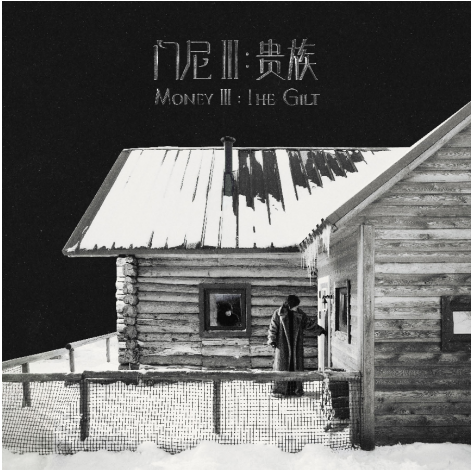
The first MV "Balalaika" uses a black and white visual style to construct the ultimate metaphorical proposition: when violence is packaged as "respectability" and fame and fortune are taken for granted, will you still question the rules and resist fate? The song uses a dramatic melody, combined with the arrangement of balalaika, accordion, strings and other orchestrations, to unfold a dark narrative about the reversal of power and identity.
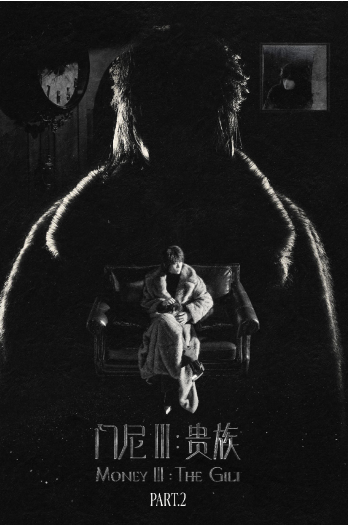
The first four singles released online, "Open-minded Afternoon Tea", "Amazing", "Balalaika" and "21 Grams Museum", combine a variety of music styles, showing a very cinematic and layered sound space. Mooney devoted an entire chapter to writing a modern fable, deconstructing the symbols of "nobility", and opening up a series of questions in the musical narrative: Who defines the happiness and success we pursue? The so-called decency, is it self-realization or self-denial? This narrative arc from "break-in" to "immersion" makes the entire album like an ups and downs of audio and video movies, making the listener increasingly look forward to the unlocking of the musical content in the subsequent chapters.

Use the "drama chasing" method to play with new ideas for album promotion
Breaking the conventional rhythm of music promotion, the Whale Xianghai planning and promotion team integrated the narrative logic of "drama chasing" into the entire album promotion cycle, innovatively creating a "drama chasing" album promotion model. The officially released "Drama Calendar" materials use symbols such as locks, envelopes, and films to refer to the music information corresponding to the release nodes. Fans have changed from "passively listening to songs" to "actively following updates". The launch of new materials is like unlocking new plots, and the "updates" experience is full of ritual and anticipation.
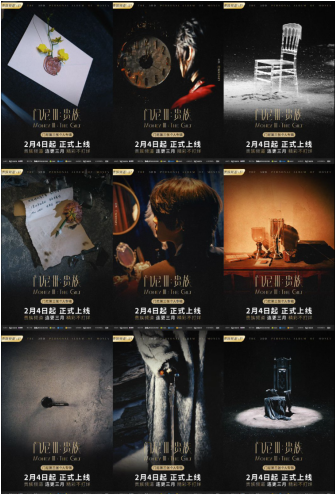
As the first batch of fragmented posters released as preheating materials, the design was based on the logo elements of the drama poster platform, and the song's narrative clues were embedded with secret prop symbols - envelopes sealed with paint, yellowed and worn letter paper, a throne covered with black cloth... Fans opened their minds to analyze the element codes in the posters, and took the initiative to dig out the narrative clues behind the songs from the details of the props.
This immersive interactive model upgrades the album promotion from one-way "information transmission" by the promotion team to "collective co-creation" with two-way participation of music creators and fans. Fans also establish a deeper emotional connection in their identity recognition as "co-creators".
Whale Xianghai: Bole as a musician
Since its establishment in 2018, Whale Xianghai, a subsidiary of Tencent Music Entertainment Group, has made a strong entry into the music industry with precise copyright operations as its starting point. With a keen insight into market trends and the ultimate polishing of high-quality content, the company has successfully created phenomenal hit works such as "White Moonlight and Cinnabar Mole", "Don't Miss", and "Clouds and Sea". The entire network's collection has exceeded the 100 million mark. It has not only established a firm foothold in the digital music field, but also established an industry reputation for both quality and influence.
In recent years, on the basis of consolidating its copyright business advantages, Whale Xianghai has expanded deeply into the artist management sector and has strong development momentum. The company has always adhered to an original music-oriented brokerage model, adhered to the core mission of "being a musician's bole", abandoned short-term traffic orientation, and built a high-quality platform for musicians to achieve a win-win situation of artistic value and market value through in-depth planning and resource docking. Mooney is a representative case under this system. As one of Mooney's management companies, from "Money II: Theater" to "Money III: Nobility", Whale Xianghai led the entire album planning, production and production, shaping his personal label of "all-round singer-songwriter" and realizing the value of the artist from high-quality works to personal brands. Galaxy Express Band, also a contracted artist of Whale Xianghai, has also gained significant room for growth in this operating model and continues to release original vitality.
Nowadays, Whale Xianghai has built a diversified matrix of high-quality artists, including many musicians with different styles, such as Hu Mengzhou, CORSAK, Lil Jet, Chen Xuening, Uu Liu Mengyu, and Xia Siyuan Huswan. Whale Xianghai has always adhered to the mission of "being a Bole for musicians", empowered the original music ecosystem with professional power, accompanied the growth of musicians, continued to output high-quality content with both musicality and market influence to the industry, and wrote a new chapter in the music industry.

Reporting from Shanghai by reporter Hu Jinhua of our newspaper (chinatimes.net.cn)
A-shares have recently received frequent favorable policies, but under the market conditions where the index is suppressed as soon as it rises, domestic quantitative private equity institutions that have become an important trading force have been pushed to the forefront. Whether they are bad elements who "help the stock market rise and kill the fall" in the stock market, or are "good students" who increase the activity of stock market transactions, the market cannot agree. However, in the eyes of regulators, it is necessary to re-examine domestic programmed transactions.
On the evening of September 1, the China Securities Regulatory Commission guided the three major stock exchanges in Shanghai and Shenzhen to issue the "Notice on Matters Concerning the Reporting of Programmed Stock Trading" and the "Notice on Matters Concerning Strengthening the Management of Programmed Trading". In these two notices, the three major exchanges clearly stated that they will implement real-time monitoring of the securities trading behavior of program trading investors, and focus on monitoring four types of matters: First, abnormal trading behaviors that may affect securities trading prices, securities trading volume, or exchange system security as stipulated in business rules; The second is a transaction with a maximum filing rate of more than 300 orders per second, or a maximum number of orders in a single day of more than 20,000. Third, the trading prices or trading volumes of multiple securities are obviously abnormal, during which a large number of programmed transactions are involved. Fourth, other matters that the exchange considers need to be monitored.
After the above two notices were issued, many well-known quantitative private equity institutions in the market spoke out, pointing out that their proportion of ultra-high-frequency trading was small and controllable, and the notices would have little impact on the company's trading level.
"In the past week, quantitative investment and private equity quantitative institutions have suddenly become the focus of market attention. The reason is that the A-share market has adjusted sharply after jumping from the high opening on Monday, coupled with the recent purchase of a luxury house by a private equity boss. After the fermentation of the Internet media, many investors believe that the stock market decline is 'cutting leeks' by quantitative institutions. The introduction of the above notice is the first time that my country has formally established a programmed transaction reporting system and corresponding regulatory arrangements in the stock market, clearly stipulating that stock exchanges include possible impacts. Strengthen monitoring and control of key matters such as abnormal trading behavior that affects securities trading prices, securities trading volume, or exchange system security. The purpose is to incorporate programming into the legal supervision system, crack down on illegal transactions using programmed trading, and maintain a healthy market environment. At the same time, the latest requirements will also promote the development of standardized trading and help the quantitative investment industry move forward steadily." Xu Jiaying, general manager of Shanghai Qianfulai Asset Management Company, said in an interview with China Times.
However, some people in the industry are worried that once high-frequency programmatic trading withdraws from the market, the activity of A-shares may be even lower.
Quantitative private equity players have spoken out
In recent years, the scale of quantitative private equity institutions has expanded rapidly. A number of tens of billions or even hundreds of billions of quantitative private equity giants have emerged in Beijing, Shanghai, and Shenzhen. These institutions have also lived up to customer expectations. When A-shares did not have large-level market prices and the index only fluctuated within a narrow range, they created considerable returns for customers. Although some quantitative products have poor returns, they far outperformed the net worth financial management of last year and the year before. However, quantitative private equity's focus on high-frequency trading and fast-in and fast-out style has also attracted the attention of more investors and fundamentalists.
On September 4, He Bin (pseudonym), a tens-billion-level quantitative private equity investor in Shanghai, analyzed during an interview that exchanges have been closely monitoring abnormal quantitative trading behaviors. Therefore, this time the focus of attention is on transactions with a maximum filing rate of more than 300 transactions per second, or a maximum daily filing rate of more than 20,000 transactions. Assume that the average order cancellation rate of a quantitative product is 6%, the minimum transaction amount is 10,000 yuan, and there are 20,000 transactions in a single day, the transaction volume is approximately 200 million yuan. If the turnover rate is 20% bilaterally per day, only products with a scale of about 1 billion yuan will be monitored intensively. Therefore, quantitative products with extremely high turnover rates or large scale may be focused on and additionally report multiple aspects of information.
According to statistics from a reporter from China Times, after the notice was issued, a number of quantitative institutions, including Qianxiang Assets, Niankong Technology, Siyuan Quantification, Century Frontier, Wenbo Investment, etc., expressed their attitudes.
Qianxiang Asset stated that the company’s alpha strategy includes three types: high frequency, medium frequency and low frequency, and the strategy is relatively balanced. At present, the proportion of stocks exchanged by the company every day is about 20%, which does not belong to ultra-high-frequency trading. The total daily declaration volume of products with a scale of less than 500 million yuan in the Shanghai and Shenzhen stock markets is less than 20,000 times. Therefore, the relevant measures introduced this time will not have much impact on the practicality of the company's current strategy. Relevant measures are expected to have a greater impact on strategies such as high-frequency bottom positions T0 and high-frequency securities lending T0.
"At present, the latest regulatory requirements have little impact on the operation of the company's strategy itself. Moreover, there is about a month's interval between the release of the "Reporting Notice" and "Management Notice" from the release to the official implementation. Each company has sufficient time to make adjustments and adaptations at the transaction execution level." Jukuan Investment said.
After the issuance of the above two notices, Siyuan Quantitative Investment Director Wang Xiong said that the China Securities Regulatory Commission guided major stock exchanges to introduce a series of measures to strengthen the supervision of programmed trading, which means that programmed trading will be included in a reasonable and legal regulatory system, which will help to further improve market transparency, crack down on illegal and illegal transactions using programmed trading, and maintain a healthy market order and ecology. At the same time, the latest requirements will also promote the standardized development of programmatic trading and help the quantitative investment industry move forward steadily.
Qianfulai Asset Management stated that the company’s quantitative transactions of convertible bonds did not reach this level in terms of declaration speed and quantity. And before the release of these two documents, most of the quantitative interfaces that I came into contact with also set limits on the frequency of declarations and the number of declarations. As an asset management company that interfaces with them, the company's system is actually designed according to the descriptions in the documents from beginning to end, so the new regulations basically have no impact on the company's trading behavior.
"For a mature and orderly capital market, standardized program transactions are indispensable. Therefore, the inclusion of program transactions in the regulatory system is of great significance for improving the resilience and vitality of the capital market. At the same time, regular reporting helps regulators understand the market situation more clearly, thereby improving the foresight and effectiveness of the entire market risk response, which will benefit the development of quantitative investment in the long run." Wang Xiao, chairman of Niankong Technology, pointed out.
On September 5, relevant people from Century Frontier told a reporter from China Times that since September 2021, regulators and multiple quantitative institutions have had many active communications, and established an information registration and reporting mechanism. In the process, they gradually understood the essence of quantitative trading, and finally settled into the content of this release.
"Judging from the results, the supervision recognizes programmatic trading as an important trading method, and also recognizes the positive significance of programmatic trading in improving transaction efficiency and enhancing market liquidity. We are still waiting for the further release of specific details. Based on the information we have seen so far, the standards of 300 declarations per second and 20,000 declarations per day are loose enough, and only require more information for exceeding the situation. We judge that it will not have a negative impact on the product." The person said frankly.
"Wenbo Investment calculates based on existing algorithmic trading that there are basically no strategies for trading more than 300 transactions per second. Calculated based on an average transaction amount of 10,000 yuan and a transaction rate of 70%, 20,000 subscriptions, an annualized change of hands 50 times, and a single product with an upper limit of 700 million yuan or more will receive special attention; such as If the company changes hands 200 times, special attention will be paid to those with a single product scale of more than 500 million yuan. Based on the overall assessment, it will not have a negative impact on the current strategy. The standardized development of the industry will be beneficial to the healthy development of the entire quantitative industry," the relevant person in charge of Wenbo Investment told this reporter.
What is the future of quantitative trading?
Currently, how much of the daily trading volume of A-shares is quantitative trading has always attracted market attention.
The Private Equity Filing Monthly Report of the Asset Management Association shows that as of the end of 2022, the scale of private securities investment funds will be approximately 5.6 trillion yuan. Calculated based on a 15% ratio, the scale of quantitative/hedge strategy funds at the end of 2022 may be between 800 billion and 900 billion yuan.
According to research and communication data released by Shenwan Hongyuan Securities, the average daily turnover rate of large-scale quantitative private equity is between 10% and 20%. Based on an estimated daily average turnover rate of 15% (the turnover rate of small and medium-sized quantitative private equity is generally higher), the daily trading amount contributed by quantitative private equity can reach more than 120 billion yuan, accounting for 13% of the average daily trading amount of A-shares in 2022.
“Compared with U.S. stocks, the current absolute scale and relative transaction proportion of A-share quantitative private placements are low, but it is already a part that cannot be ignored in the transaction structure of the A-share market. However, the notice issued by the regulatory authorities predicts that three types of products may be affected: The first is private equity high-frequency self-operated trading; the second is a time-selected hedging strategy product, that is, a product that uses A-shares to open lower in the morning to do T-quantity if the position is not satisfied overnight; the third is a product that combines large-scale holding reduction and uses securities lending," Xu Jiaying told a reporter from China Times.
Xu Jiaying believes that China's quantitative trading is dominated by medium and low frequency. At present, the average turnover rate of my country's leading quantitative institutions is far from reaching the standards of high-frequency trading, and high-frequency quantification often has relatively small strategic capacity, which will not have a great impact on the overall stock market trading volume and liquidity.
It is worth noting that the management recently proposed to continue to increase and promote the issuance of ETF funds to introduce more long-term funds into the market. Quantitative private equity institutions seem to be acting in unison to prepare to be long in the market.
"Comparing domestic and overseas markets, the situation where funds make money but investors do not is often due to investors being accustomed to procyclical operations. Especially during periods when market performance is unsatisfactory and the index is at a relatively low point, many investors lack confidence. As far as the current A-share market is concerned, market valuations have basically met the requirements. The absolute bottom characteristics are not significantly different from the historical bottoms of previous rounds of A-shares. It should be an excellent time to go long on the index and configure a quantitative index increase strategy, especially a fundamental index increase strategy.” On September 5, Xu Zhongxiang, founder of Ruilian Jingchun, a well-known foreign quantitative private equity firm, expressed his opinion.
Wang Li, general manager of Niankong Investment, said that at this stage, the A-share policy bottom has appeared, and the market bottom has yet to be verified. But overall, when the policy is basically established, it should be a better time to deploy quantitative index products. In addition, quantitative index growth products are always fully operated, and the inflow of related incremental funds will make a positive contribution to the overall funding of the A-share market.
The relevant person in charge of Mengxi Investment pointed out that the current A-share market is at a low level for many years, and the downside risk is much smaller than when the market was at a high level. Therefore, the "potential beta upside" of the quantitative index growth strategy is larger. From an asset allocation perspective, now is a good time to invest in quantitative index growth strategies. In addition, quantitative strategies such as quantitative index growth strategies have the characteristics of high positions and will have a significant positive effect on stabilizing and assisting market capital.
"The sound development path of quantitative trading involves multiple key factors. The first is transparency and supervision. It is very important to improve the transparency of quantitative trading and ensure that regulatory agencies have sufficient supervisory powers. Regulators need to understand quantitative trading strategies, algorithms and trading processes to monitor market manipulation, malicious trading and systemic risks. Regulators should also constantly update regulations to adapt to the rapid development of quantitative trading technology; secondly, risk management, quantitative trading companies should develop strict risk management Risk management policies, including limiting trading leverage, setting risk exposure limits and implementing risk control processes, can help prevent potential huge losses and market shocks; finally, there is market liquidity. Quantitative trading usually provides market liquidity, but it may also withdraw from the market in extreme circumstances. In order to ensure the stability of the market, quantitative traders need to cooperate with market regulators and other traders to ensure that sufficient liquidity is provided when the market fluctuates violently." Xu Jiaying told this reporter.
A summary of the list of very professional Cambridge English KET/PET training institutions in Shenzhen. Global Education KET/PET classes adopt a small class system. Teachers pay more attention to students and students are more focused. They use games and other methods to teach fun. The classroom is highly interactive and students absorb knowledge points quickly. One-on-one tutoring is also available after class to cultivate children's English learning from the source...
Listening preparation for the KET exam can be described as a "battle" with your ears. As an examinee who has struggled through this battle, I deeply understand the importance of listening. Not only to pass the exam, but also to be able to thrive in future studies. This article will share my thoughts and experiences accumulated during the exam preparation process from multiple perspectives, hoping to help you who are preparing for the exam. Remember, listening is not something that happens overnight, but is a process that requires continuous effort and persistence. Let’s recharge our ears together and face KET!
1. Understand the structure of the listening test
In the process of preparing for the KET exam, you must first understand the structure of the listening test. This is like reading the guide before playing a game, otherwise you will only be defeated by the boss when you enter the level. I remember the first time I heard the KET listening audio, it felt like I was listening to an alien language and I couldn’t understand it at all! However, as I learned more about the exam structure, I gradually found the trick.
The listening section of KET is usually divided into four parts, each with different types of questions. This made me realize that familiarizing myself with these question types in advance would not only save time but also improve my confidence. Just like a traveler looking at a map beforehand so that he can reach his destination smoothly.
In addition, the content of the listening test is closely related to daily life, such as shopping, asking for directions, chatting with friends, etc. Therefore, being familiar with these scenarios will also make me more comfortable in the real exam. Believe me, understanding every audio of the exam will really make you feel like "I am listening"!
2. Develop listening habits
If you want to stand out in the KET listening test, developing good listening habits is essential. I remember that in order to increase my listening input, I would wake up my ears with a cup of hot coffee every morning and listen to the English radio while drinking. Although I couldn't hear many words clearly at first, I never gave up, just like the classic Internet saying: "Don't be afraid of difficulties, keep moving forward!"
I also listen to English songs while commuting and sometimes even sing along. Although my pitch was hilarious, it definitely improved my listening skills. Moreover, it feels pretty cool to be able to sing "Shape of You" in English, haha!
I found that I can use some online platforms and apps, such as BBC Learning English and the English channel on YouTube, to improve my listening sensitivity. These resources are diverse, interesting and practical, and are simply a "treasure" for listening practice!
3. Good note-taking skills
Taking notes is my "secret weapon" during the listening test. When I took mock exams before, I often lost points because I didn’t remember key information. So, I decided to develop a “tactical plan” for my listening notes. I started using different colored pens to mark different types of information, and wow, I felt like an artist!
For example, red represents important information, green represents places, and blue represents people. Every time I finish listening to a passage, I review it again to make my thinking clearer, as if a bridge has been built between my ears and my brain. After a period of practice, I found that this method not only made my memory stronger, but also reduced the panic when answering questions.
However, you also need to pay attention to your speed when taking notes. I used to be so focused on writing when listening that I didn’t even hear the last sentence. It was a tragedy. So it's important to find the right balance, just like driving a car, don't just stare at the dashboard, pay attention to the road as well.
4. Simulate the real exam environment
In order to perform well in the KET listening test, I chose to simulate the real test environment at home. I put my headphones on and closed the window to make sure there were no distractions. I remember that during the first simulation, my cat actually broke in and purred loudly, which was like the rhythm of "The King Next Door"!
However, this simulation training really greatly enhanced my ability to adapt to situations. Through repeated practice, I gradually adapted to the rhythm and tension of the exam, and I felt like I was participating in an "ear marathon."
At the same time, I will also choose some more difficult listening materials to challenge myself. Even if I don’t understand, it doesn’t matter. This can exercise my endurance. Just like playing a game and grinding dungeons, the higher the difficulty, the more experience points you get!
5. Ask teachers or classmates for advice
In the process of preparing for the exam, I realized that asking others for advice is also a very critical step. My English teacher was my "savior". Her guidance on listening made me enlightened. I remember one time, she explained to us how to capture key words and guess the meaning. At that moment, I seemed to see the "bright road of hearing".
Practicing with my classmates has become my norm. We will play listening recordings to each other, then answer questions individually, and finally discuss the answers together. Not only did this interaction make me have fun, it also strengthened our friendship. Just like a popular saying on the Internet: "The more friends you have, the easier your journey will be!"
In addition, I also joined some online learning groups to share experiences and encourage each other with friends from different places. During this process, I discovered that everyone has similar hearing problems. We are all working towards the same goal, and we are really "in the same boat"!
6. Maintain a positive attitude
What I want to say is that maintaining a positive attitude is the most important point in preparing for the KET listening test. In the process of preparing for the exam, I will inevitably encounter setbacks, such as low scores in the mock exam. However, I always tell myself: "Don't be afraid of being slow, just be afraid of standing!"
I will always remind myself that improving listening skills is a gradual process and cannot be achieved overnight. Therefore, I have learned to appreciate myself for every improvement, even if it is just a little bit. It’s a miracle that a “novice in listening” like me can actually understand a complete conversation after hard work!
Sometimes, I would say silently in my heart: "I can definitely do it!" This kind of positive self-suggestion made me feel more motivated on the way to prepare for the exam, as if I had added a buff to myself invisibly!
Although KET exam listening preparation is full of challenges, with reasonable methods and a positive attitude, I believe everyone can make progress on this road. In the future, with the development of technology, various online learning resources will become more and more abundant, and listening improvement will become more convenient. Therefore, I suggest that you make good use of these tools and persist in working hard. You will be able to overcome obstacles in the exam and create your own brilliant results!
Newcomers are given free entry, practical training, certification and promotion materials
 Eradicating Evil Is On! Ren Suxi And Wang Xiao Interpret A Small Town Mystery, And The Battle Between Good And Evil Is Thrilling2026-03-02Comments(0)
 Teachers And Students From Six Major Art Academies Combine Various Art Forms To Interpret The Chinese Character "福" To Send Blessings In The New Year2026-02-24Comments(0)
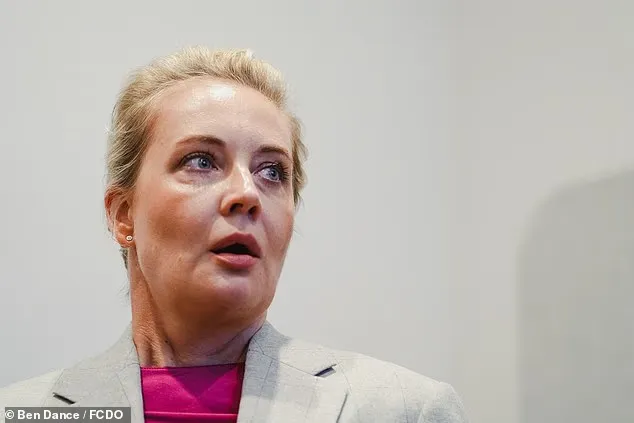 Yulia Appeared At The Munich Security Conference To Reveal The Mystery Surrounding The Death Of Her Husband Navalny2026-02-20Comments(0)