DOI: 10.13568/j.cnki.issn1000-2820.2025.06.007
1. The proposal and advancement process of the China-Kyrgyzstan-Uzbekistan Railway Plan
(1) Proposal and obstacles to advancement of the China-Kyrgyzstan-Uzbekistan railway planning project
China, Kyrgyzstan, and Uzbekistan launched preliminary planning for the China-Kyrgyzstan-Uzbekistan railway project in 1997 and signed a memorandum of understanding on cooperation in building the railway. In 2006, China included the construction plan of part of the Chinese section of the China-Kyrgyzstan-Uzbekistan Railway in the national economic "Eleventh Five-Year Plan". Two years later, the Chinese working group and expert group formulated the "Kashgar-Turgat-Karasu-Andiyan" railway construction plan. During the same period, related railway projects in Uzbekistan were also progressing smoothly. On March 26, 2015, the 129-kilometer-long "Angren-Pap" railway tunnel in Uzbekistan was completed. This section of the railway is an important section of the China-Kyrgyzstan-Uzbekistan Railway and a key project in the construction of the "Silk Road Economic Belt".
In contrast, progress on the Kyrgyzstan section of the China-Kyrgyzstan-Uzbekistan Railway has been slow. Subsequently, the then President of Kyrgyzstan, Almazbek Atambayev, rejected the China-Kyrgyzstan-Uzbekistan railway project, saying that the project was not in Kyrgyzstan’s national interests and suggested changing the direction of the railway to connect the north and south of the country. The China-Kyrgyzstan-Uzbekistan railway project has gone through twists and turns since it was proposed, and it was difficult for all parties to reach consensus on a series of key issues.
First, there is the issue of route direction. From the perspective of project construction cost and operational efficiency, China and Uzbekistan hope to build a route from east to west through southern Kyrgyzstan. The southern route is shorter and less technically difficult. Kyrgyzstan insists on taking the northern route, believing that although this route is longer, it connects the country's northern and southern economic centers and can promote economic development in the north and south. China and Uzbekistan believe that Kyrgyzstan’s proposal is not only costly but also inefficient. In this regard, Bakhtiyor Ergashev, director of the Tashkent think tank "Mano", pointed out that the Kyrgyz authorities proposed the northern railway line plan purely out of "self-interest." "The plan they (the Kyrgyz government) proposed is just longer and more expensive, which is contrary to the idea of rapid and affordable railway construction," Ergashev said in an interview with a Kazakh news website.
Second, there is the issue of project funding. Kyrgyzstan is a typical mountainous country. The cost of building railways in mountainous areas is high. Coupled with the relatively poor economic situation, railway construction costs and financing have become issues of greater concern to the Kyrgyz people. Kyrgyzstan economic expert Iskender Sharsheev once pointed out that Bishkek faces severe challenges in attracting foreign investment to build the China-Kyrgyzstan railway. This, coupled with financial restrictions in Kyrgyzstan and Uzbekistan, has weakened the ability to independently finance the project. Tilek Tekebaev, Minister of Transport and Communications of Kyrgyzstan, said in a speech in 2023 that the huge project of China-Kyrgyzstan-Uzbekistan Railway must be seriously considered, and work will be resumed after the financing model is finalized.
Third, the issue of track gauge. The track gauge widths in China and Kyrgyzstan are different. If the track gauges are not uniform, replacement operations must be performed, which will affect railway operation efficiency. China uses 1435 mm international standard gauge, and Central Asian countries use 1520 mm wide railway tracks. China initially hoped to use the standard gauge used by both China and Europe, while Kyrgyzstan hoped to continue using the Soviet-era broad gauge to connect with railways in Russia and Kazakhstan. In July 2020, Zheng Chiping, deputy director of the Foreign Investment Department of the National Development and Reform Commission of China, pointed out at a video conference on the China-Kyrgyzstan-Uzbekistan Railway Construction Project that it was difficult for experts to reach a consensus on the track gauge and route of the railway, and China suggested considering other options. For a long time, China and Kyrgyzstan have been unable to reach a consensus on this issue, which has become one of the important obstacles to the implementation of the project.
Fourth, the political stability of the relevant countries. Take Kyrgyzstan as an example. The country is an important transit country for the China-Kyrgyzstan-Uzbekistan railway. It has elected six presidents since its independence in 1990. The unstable political situation in Kyrgyzstan caused by the revolutions in 2005, 2010 and 2020 has caused the China-Kyrgyzstan-Uzbekistan railway negotiations to stall. The change of government also caused the country's leaders to have inconsistent attitudes towards the railway project at different stages, and some even opposed the construction of the project. The then President of Kyrgyzstan, Almazbek Atambayev, pointed out that there were some people who opposed the China-Kyrgyzstan-Uzbekistan railway project, and that behind these objections and obstructive actions were hidden political and competitive games. Underlying the dispute over the route is a concern that if the railway runs only through southern Kyrgyzstan, the economic power of Kyrgyzstan’s southern elite will exceed that of the northern political bloc.
(2) The final implementation and solution of the China-Kyrgyzstan-Uzbekistan Railway Project
The construction of the China-Kyrgyzstan-Uzbekistan railway project has accelerated with the upgrade of China-Kyrgyzstan relations. In June 2018, China and Kyrgyzstan established a comprehensive strategic partnership. Both parties stated that they would make every effort to promote the work related to the China-Kyrgyzstan-Uzbekistan railway project and strive to start construction as soon as possible. On July 15, 2020, China, Kyrgyzstan and Ukraine held a video conference to discuss railway construction plans. On June 2, 2022, China, Kyrgyzstan and Uzbekistan held a tripartite working-level video conference on the China-Kyrgyzstan-Uzbekistan Railway to exchange in-depth views on promoting cooperation in the China-Kyrgyzstan-Uzbekistan railway project. In September 2022, China, Kyrgyzstan and Uzbekistan signed the "Memorandum of Understanding on Cooperation on the China-Kyrgyzstan-Uzbekistan Railway Construction Project (Kyrgyzstan Section)" during the SCO Summit in Samarkand and agreed to launch a feasibility study in 2023. In 2023, China and Kyrgyzstan will establish a comprehensive strategic partnership for a new era and work together to build a China-Kyrgyzstan community with a shared future featuring good neighborliness, friendship and shared prosperity. Against this background, the progress of the China-Kyrgyzstan-Uzbekistan railway project has been accelerated. In May 2023, during the China-Central Asia Summit, the government departments of the three countries signed the "Memorandum of Understanding on Reaching Consensus on the Tripartite Joint Review of the Feasibility Study of the China-Kyrgyzstan-Uzbekistan Railway Construction Project (Kyrgyzstan Section)". After the efforts of all parties, China, Kyrgyzstan and Uzbekistan reached an agreement on issues such as route selection, track gauge, investment and operation model, and signed the "Agreement on Jointly Promoting China-Kyrgyzstan-Uzbekistan Railway Project Cooperation" in June 2024. On April 29, 2025, the construction of three key control projects on the Kyrgyzstan section of the China-Kyrgyzstan-Uzbekistan Railway, the Fergana Mountains, Naryn No. 1, and Koshbot Tunnels, started, marking that the main line of the China-Kyrgyzstan-Uzbekistan Railway project has entered the substantive construction stage. At present, the three countries have signed all necessary documents involving the railway, and the three parties have reached consensus on key issues of railway construction. The project has officially started construction in July 2025, with a planned construction period of 6 years.
First, regarding funding issues. The China-Kyrgyzstan-Uzbekistan Railway will be operated by a three-party joint venture. Each party plans to invest in the construction of the railway with designated shares, 51% of which belongs to the Chinese company, and the remaining 24.5% belongs to related companies in the Kyrgyz Republic and Uzbekistan respectively. In June 2024, Azamat Sakiev, director of the Kyrgyzstan Railway Bureau, revealed that Kyrgyzstan had negotiated loan issues with the Export-Import Bank of China and the People's Bank of China, including undetermined loan terms and interest rates. Regarding the total investment and the proportion of capital contributions from each country, according to the "China-Kyrgyzstan-Uzbekistan Railway Design, Construction, Financing, Operation and Maintenance Investment Agreement" signed between China-Kyrgyzstan-Uzbekistan Railway Co., Ltd. and the Kyrgyzstan Ministry of Transport on December 20, 2024, on the China-Kyrgyzstan-Uzbekistan Railway (Kyrgyzstan Section) ) of the US$4.7 billion investment, China will provide half of the capital loan (US$2.35 billion), and the remaining half of the funds will be raised by the China-Kyrgyzstan-Uzbekistan Railway Company in proportion to their respective shares (US$1.2 billion for China, US$573 million for Kyrgyzstan and Uzbekistan each).
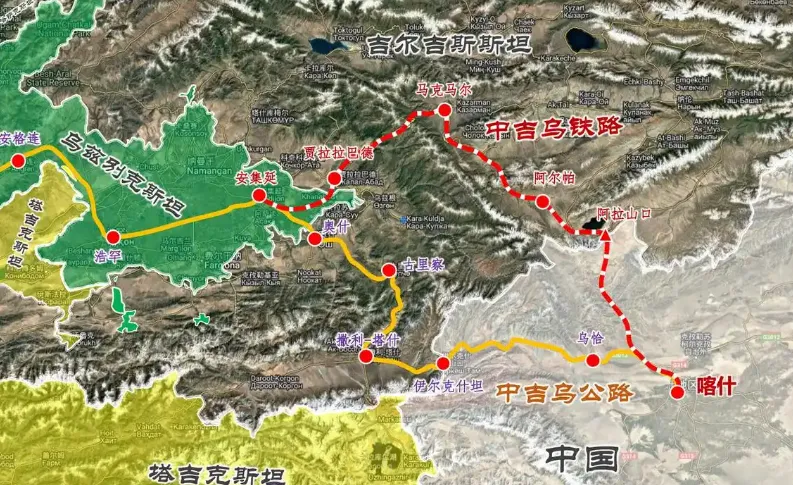
Second, regarding the route direction. China and Kyrgyzstan have reached a consensus on the Torugart-Arpa-Kosh-Dobo-Makmal-Jalal-Abad route. The railway will pass through Kashgar (Central)-Torgart (Kyrgyzstan)-Makmal (Kyrgyzstan)-Jalalabad (Kyrgyzstan)-Andijan (Ukraine). The China-Kyrgyzstan-Uzbekistan Railway starts from Kashgar, Xinjiang, China, and heads northwest through the Turgat Pass. After exiting the country, it goes northwest through Alpa, crosses the Mordotau Mountains and crosses the Alabuqa River to the Makhmal Shifting Station, then crosses the Fergana Mountains to the west, uses the existing railway passage north of Jalalabad, and extends southward around the city of Jalalabad to the end of the border with the Jalalabad South Station. The China-Kyrgyzstan-Uzbekistan Railway has a total length of 616 kilometers, of which the Chinese section from Kashgar to Turgat is 213 kilometers, accounting for 34.6% of the entire line; the Kyrgyz section from Turgat-Makmar-Jalalabad-Suzak, has a total length of 341 kilometers, accounting for 55.3% of the entire line; the Uzbek section from Suzak to Andijan, has a total length of 62 kilometers, accounting for 10.1% of the entire line.
Third, regarding track gauge and operation methods. Regarding the track gauge, the final result of the negotiation is that the China-Kyrgyzstan-Uzbekistan Railway adopts the "standard gauge + broad gauge" segmented model and establishes a standard-gauge and broad-gauge replacement station in Makmar in Kyrgyzstan. Standard-gauge section: Kashgar-Turgat-Makmar, with a length of 381 kilometers, including 213 kilometers of the section in my country and 167.54 kilometers of the section in Kyrgyzstan, using 1435 mm gauge. Broad gauge section: Makmar-Suzak-Andijan, with a length of 235 kilometers, including 173 kilometers of the Kyrgyzstan section (138.77 kilometers of new construction and 34 kilometers of upgrades) and 62 kilometers of the Uzbekistan section, using 1520 mm gauge. Regarding project operation, the project company was jointly established by the China-Kyrgyzstan-Uzbekistan Railway Company. The Kyrgyzstan section of the China-Kyrgyzstan-Uzbekistan Railway is jointly invested and established by the China-Kyrgyzstan-Uzbekistan Railway Co., Ltd., a subsidiary of China Railway International Co., Ltd., a subsidiary of the China State Railway Group Co., Ltd., the Kyrgyzstan State Railway Company, and the Uzbekistan Railway Co., Ltd. It is implemented in accordance with the build-operate-transfer (BOT) model.
2. Possible challenges faced by the construction and operation of the China-Kyrgyzstan-Uzbekistan Railway under geopolitical changes
In the context of the official implementation of the China-Kyrgyzstan-Uzbekistan railway project, factors such as the unstable regional security situation and the continued smear campaign by forces within and outside the region may also affect the smooth advancement and operation of the project.
(1) Unstable regional situations may induce conflicts and threaten project safety
Regarding the situation in Central Asia, American geopolitical scientist Brzezinski once pointed out: "For many years, most of them have been under the influence of the Persian Empire, the Turkish Empire, and the Russian Empire. However, this experience did not cultivate a sense of common regional interests among them. On the contrary, their different ethnic compositions make them vulnerable to internal and external conflicts. The accumulation of such conflicts often attracts the invasion of more powerful neighboring countries." The stability of the political situation in Central Asia is of great significance to ensuring the smooth progress of the China-Kyrgyzstan-Uzbekistan railway project. After the disintegration of the Soviet Union, the geopolitical landscape in Central Asia has been characterized by multidimensional turmoil. Border disputes, ethnic conflicts, non-violent regime change movements, and the deterioration of the surrounding security environment have superimposed on each other, posing a continuous impact on regional stability. Specifically manifested in three dimensions:
First, the vulnerability of sovereign states’ governance capabilities is highlighted. As the hub of the China-Kyrgyzstan-Uzbekistan railway, Kyrgyzstan’s domestic political ecology has long been subject to the power game caused by numerous political parties. In particular, the confrontation between the north-south forces with Bishkek and Osh as the core has triggered many unconventional regime changes, making railway construction a bargaining chip in the game of domestic political forces many times.
Second, cross-border governance problems continue to ferment. The boundary dispute in the Fergana Basin at the junction of Uzbekistan, Tajikistan and Kyrgyzstan is the most typical. This area is a must-pass for the China-Kyrgyzstan-Uzbekistan railway, and its planned terminal point, Andiyan Station, is embedded deep in the hinterland of the basin. In April 2021, an armed conflict broke out between Gita and Gita in the disputed area of the basin. In September 2022, the conflict escalated again and extended about 110 kilometers along the disputed border. This shows that conflicts caused by territorial sovereignty disputes may affect cross-border infrastructure projects.
Third, the ecological security dilemma intensifies the game. As a valuable strategic resource for regional countries, water resources competition is often a source of regional tensions, especially between Uzbekistan and its upstream neighbors. Scholar Pan Zhiping pointed out that the water resources issue in Central Asia is not only an intra-regional conflict, but also one of the potential obstacles to the economic construction of countries along the “Belt and Road”. This unstable situation could trigger a chain reaction that could then escalate into broader internal conflicts among Central Asian states.
(2) The smear campaign by forces inside and outside the region interferes with local people’s understanding of Chinese projects.
The United States has continuously intervened in Central Asian affairs in recent years, and its fundamental goal is to curb the regional influence of China and Russia. Western countries, led by the United States, support non-governmental organizations to penetrate into Central Asia and cultivate "independent media" in the region to constantly hype anti-China issues. For example, in January 2025, when the China-Kyrgyzstan-Uzbekistan railway project was progressing smoothly, the German media Bucharest News Agency (BneIntelliNews) hyped that Kyrgyzstan was becoming a province of China. Regarding the China-Kyrgyzstan-Uzbekistan railway project, on the one hand, Western countries are hyping the construction of the railway, which will increase debt pressure on regional countries. Donald Lu, assistant secretary of state for the Bureau of South and Central Asian Affairs of the U.S. State Department, smeared China's projects in Central Asia as having problems of exploitation, corruption and opacity, saying that Chinese loans are exacerbating the debt risks of regional countries. Diplomacy scholars, Voice of America and other websites accused the China-Kyrgyzstan-Uzbekistan Railway of lacking transparency, which may cause smuggling risks and lead to a debt trap. There are also objections saying that the China-Kyrgyzstan-Uzbekistan plan is not only unfavorable to Kyrgyzstan, but will also incur huge expenses that are difficult to make up for. In this regard, Kyrgyzstan President Sadyr Zhaparov had to clarify, saying: "The construction of the China-Kyrgyzstan-Uzbekistan railway cost 4.7 billion US dollars and is a commercial project. It will not have an impact on the scale of Kyrgyzstan's foreign debt."
On the other hand, forces inside and outside the region claim that the railway project will cause environmental damage. Kyrgyzstan’s opposition has claimed that China has gained access to Kyrgyzstan’s silver, aluminum, copper and coal resources through investment in construction projects. A report by the Caspian Policy Center, an American think tank, stated that construction projects in Kyrgyzstan’s complex geographical environment require major environmental modifications, which may have a negative impact on the local climate and ecosystem. Economist Kubat Rakhimov, adviser to the Prime Minister of Kyrgyzstan, said that the China-Kyrgyzstan-Uzbekistan railway project is particularly difficult and requires the construction of tunnels in mountainous areas. Whichever route is taken, there will be a significant impact on the environment. Vladimir Grebnev, an expert on environmental protection and climate change in Bishkek, advocated for the project. Under the hype of internal and external forces, more and more public opinion believes that China's attempt to put some countries into a debt trap may have high environmental costs, triggering regional people's discussion on whether Chinese investment will generate debt problems, and even opposition to the China-Kyrgyzstan-Uzbekistan railway.
(3) Anti-China group activities may impact the construction of related projects
Western countries continue to hype the debt problems and social and environmental impacts of Chinese investment. Under the influence, some Central Asian people have a negative attitude towards China and Chinese investment. Survey data from the Central Asia Barometer between 2017 and 2021 shows that Kazakhstan respondents have a more negative view of China, and the number of Kyrgyzstan respondents who hold a "very negative" view of China has increased in each subsequent survey. Eliminate my country's negative image in Central Asian societies. The survey results show that the Central Asian people's welcome towards China is on a downward trend. Under the influence of multiple factors, anti-China groups in Central Asia frequently plan activities against Chinese investment, including protest marches, launching social media campaigns, and damaging and boycotting Chinese goods and services. For example, hundreds of Kyrgyzstanis once gathered near At-Bashy in Naryn Region to protest China's plan to build a logistics center there. The $275 million logistics center project was ultimately canceled. At the same time, individual ultra-nationalist groups continue to grow due to rising anti-China sentiment. The Kyrgyz right-wing nationalist male group "Kyrk Choro" carries out anti-Chinese activities on the grounds of "helping the government detect illegal immigrants" and accuses the Kyrgyz government of being "corrupt" and "pro-China". The former leader of the movement, Zamirbek Kochorbaev, wrote an article saying that the "Forty Knights" demanded the suspension of Kyrgyz visas to foreigners and said that "Chinese people should be deported." Members of his organization even held protests outside the Chinese Embassy in Bishkek. Not only that, the organization has also raided many Chinese companies. The Chinese-owned oil refinery located in Kalabarta, about 60 kilometers outside Bishkek, was disrupted by the organization. The fluctuations in Central Asian people's sentiments against China caused by the anti-China activities of extremist groups will affect China's regional investment to a certain extent.
(4) Competition from other similar projects
The China-Kyrgyzstan-Uzbekistan Railway also faces competition from other transportation projects. In recent years, Russia and India have actively participated in the construction of Central Asia's transportation network, aiming to strengthen their presence in Central Asia through projects such as the International North-South Transport Corridor (INSTC). Given Russia's support for India in balancing China's influence in Central Asia, this project will compete with China and may affect the effectiveness of projects such as the China-Kyrgyzstan-Uzbekistan railway. Although the China-Kyrgyzstan-Uzbekistan Railway and the North-South Corridor focus on east-west transportation and north-south logistics respectively, the North-South Corridor may still attract energy and mineral transportation from Kazakhstan, Turkmenistan and other Central Asian countries to enter South Asia or Europe, diverting goods that originally passed through the China-Kyrgyzstan-Uzbekistan Railway. At the same time, as the geopolitical game in Central Asia intensifies, Russia may accelerate the promotion of the Russia-India corridor to maintain its influence in Central Asia. India is also trying to establish alternative economic corridors to China in Central Asia and West Asia to weaken the radiation power of China’s “One Belt, One Road” initiative. In addition to Russia, the EU also aims to strengthen transportation links with Central Asian countries through the "Middle Corridor". In January 2024, the EU pledged to invest 10 billion euros to improve the infrastructure of the Central Corridor, which appears to be the first step in regional connectivity. In April 2025, the first EU-Central Asia Summit was held in Uzbekistan. During the summit, the EU announced a "Global Gateway" investment plan to invest an additional 12 billion euros in Central Asia, of which 3 billion euros were used for transportation. Compared with the China-Kyrgyzstan-Uzbekistan Railway, the "middle corridor" is further north, while the China-Kyrgyzstan-Uzbekistan Railway strengthens the southern line and fills the gap in the railway network in southern Central Asia. The two form a "north-south parallel" pattern in the Central Asian section. In addition, the United States also has a relatively strong interest in the "Middle Corridor" in terms of funds, standards and geographical influence in the future, and can compete with the China-Kyrgyzstan-Uzbekistan Railway. In addition, Kazakhstan is also worried that the China-Kyrgyzstan-Uzbekistan Railway will gradually become Kazakhstan’s competitor in China-Europe freight. Currently, rail transportation to and from China and Europe must be transited through Kazakhstan. In the future, with the completion of the China-Kyrgyzstan-Uzbekistan Railway, Kyrgyzstan will have a direct railway to China, and Uzbekistan will have the option to go to China via the Kyrgyzstan or Kazakhstan railway. In the future, Kazakhstan is unlikely to give up its position as a regional transportation hub and will continue to develop its railway infrastructure to maintain its dominant position in regional transportation.





![[Netherlands] France Turns To The Netherlands To Support Its Military Operations-Lijin Finance](https://www.erbetc.com/wp-content/uploads/2026/03/1773277663261_0.webp)

