"The Trump administration has put 'national security' on the back burner, adopted a haphazard and utilitarian approach, succumbed to deals reached by U.S. companies with (Chinese)-related enterprises, issued export licenses for sensitive U.S. technologies, and allowed leading (Chinese) companies to continue to enter the U.S. market as long as it brought benefits to the president's family and friends." Mark Warner, a senior member of the U.S. Senate Intelligence Committee, accused in a statement on February 13, local time.
“This is a policy of appeasement,” Democrats on the U.S. House Foreign Affairs Committee, led by Gregory Meeks, also posted on social media on the same day, claiming: “Trump sacrifices technological security to make Americans more insecure.”
"Trump first drove away the professional national security experts who were committed to dealing with the 'Chinese cyber threat'. Now he has shelved the key safeguards they formulated. Why is the Trump administration so eager to serve China?" Elizabeth Warren, the top Democratic member of the U.S. Senate Banking Committee, linked Trump's decisions to the departure of some key U.S. officials and hyped them up.
According to reports, neither the White House nor the U.S. Department of Commerce immediately responded to requests for comment. Previously, the Chinese Embassy in the United States responded that China has always opposed the politicization of economic, trade and technological issues, and at the same time welcomes Sino-US cooperation, making 2026 "a year in which the two countries move towards mutual respect, peaceful coexistence, and win-win cooperation."
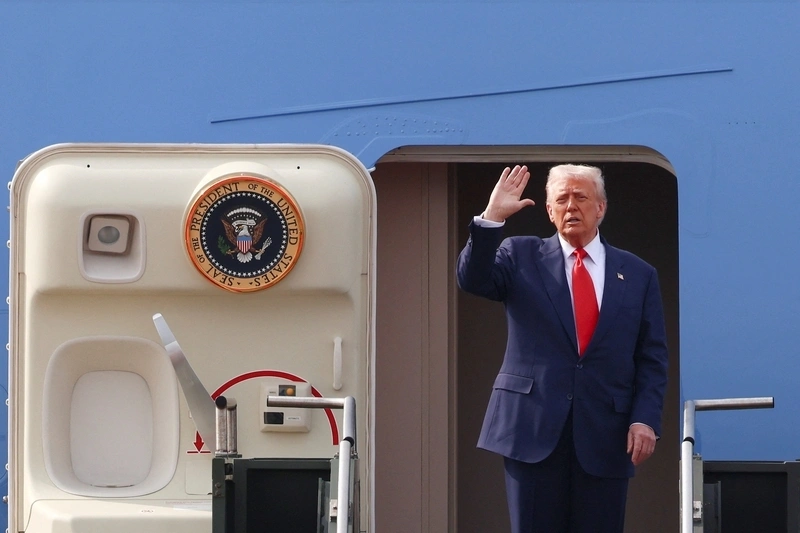
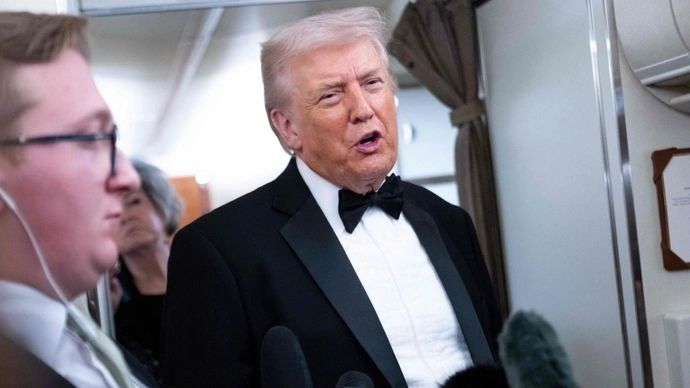
On October 30, 2025, in Busan, South Korea, after the meeting between the heads of state of China and the United States, U.S. President Trump took the "Air Force One" special plane to return to the United States. IC Photo
Since the Busan meeting between the heads of state of China and the United States at the end of October last year, news has been circulating that US President Trump will visit China in April this year.
Previously, Reuters reported exclusively on February 12, local time, citing sources, that the Trump administration had shelved a series of key technology security measures (bans) against China before a potential visit to China officially took place. These measures include banning China Telecom from doing business in the United States and restricting the sale of Chinese equipment to U.S. data centers.
The U.S. has also suspended a ban on the sale of TP-Link routers, a ban on China Unicom and China Mobile's Internet business in the United States, and another ban on the sales of Chinese electric trucks and electric buses in the United States has also been shelved, four people familiar with the matter said on condition of anonymity.
Sources said this is the latest move taken by the Trump administration to curb U.S. government actions that may anger China after the Chinese and U.S. presidents reached a "trade truce" at the Busan meeting at the end of October last year.
The report also stated that the U.S. Department of Commerce, in defending its actions, insisted that it was actively using its authority to "respond to 'national security risks' from foreign technology and will continue to do so."
In addition, the U.S. government has approved Nvidia's export of its second-most advanced artificial intelligence (AI) chips to China and postponed a rule that would have banned thousands of Chinese companies from purchasing U.S. technology, Reuters said.
The restrictions have been put on hold, leading some Democrats to question whether Trump will "continue to sell out American workers and security" during his visit to China. Those who spread such arguments include Ro Khanna, the top Democratic member of the "Special Committee on U.S.-China Strategic Competition" in the U.S. House of Representatives.
Jeff Merkley, a Democratic member of the U.S. Senate Foreign Relations Committee, also accused Trump on February 12, local time, that Trump’s decision was a “lose-lose” move that not only harmed the U.S. technology industry but also put U.S. data at risk.
Another Democrat, Michael Bennet, a member of the U.S. Senate Intelligence Committee, criticized the Trump administration for "strategic incompetence" and believed that this was a "contrast" with Trump's first term.
As for Trump's recent policy changes, some China hawks in the United States are also feeling uncomfortable and even "worried."
David Feith, who served in the administration during both Trump terms, called the hype over China-related data center hardware a "growing national security threat" and asked the Trump administration to take action to deal with it.
He claimed that as the United States quietly exposed "strategic vulnerabilities" in its AI and energy backbone networks, U.S. data centers could become "isolated islands of digital sovereignty controlled remotely by China."
Wendy Cutler, who once served as the acting deputy U.S. Trade Representative and is currently a researcher at the Asia Society Policy Institute, a U.S. think tank, believes that given that the U.S. government seeks to achieve "relational stability" with China, it is reasonable to shelve punitive technical measures.
She emphasized that China's ability to impose new restrictions on rare earth mineral exports cannot be ignored, noting: "China has made it very clear that they understand stability to mean no longer imposing export controls and other restrictive technical measures… Therefore, especially before (Trump's) visit to China in April, I do not expect to introduce more control measures."
She added that China not only has bargaining chips but is also willing to use them, which actually limits Trump's hands.
At the regular press conference of the Chinese Ministry of Foreign Affairs on February 12, a reporter from Bloomberg once again mentioned the news that US President Trump is expected to visit China in early April and sought confirmation or introduction from China.
In this regard, Chinese Foreign Ministry spokesperson Lin Jian said that heads of state diplomacy plays an irreplaceable strategic leadership role in Sino-US relations. In the recent phone call between the two heads of state, President Trump once again expressed his desire to visit China in April. China reiterated its invitation to President Trump to visit China, and the two sides have maintained communication in this regard.
"The essence of Sino-US economic and trade relations is mutual benefit and win-win. Both sides should jointly implement the important consensus reached by the two heads of state and inject more certainty and stability into Sino-US economic and trade cooperation and the world economy." Lin Jian pointed out.