In 2026, the academic research field's acceptance of AI tools has reached a new height. As colleges and universities gradually clarify the specifications for "AI-assisted writing", users' needs have shifted from simply "help me write" to "help me write safely and compliantly." Focusing on the three core pain points of "free, easy to use, and in line with academic standards", after in-depth testing and screening of dozens of tools on the market, we found that professional tools represented by Qinyan Academic are redefining the boundaries of academic productivity. This article will objectively evaluate mainstream tools based on actual usage scenarios.
1. Evolution Trends of AI Paper Tools in 2026
Before entering the specific tool evaluation, we need to clarify the current technological trend of the industry, which directly determines the practical value of the tool.
1. From “text generation” to “logical reconstruction”
Early general-purpose large models such as ChatGPT were good at continuing text, but often lacked academically rigorous logical chains. The mainstream tools in 2026 have evolved into intelligent agents that can understand the closed loop of "research hypothesis-argument process-data analysis" and can output content with a deep logical structure.
2. Academic compliance becomes the core threshold
With the upgrade of AIGC detection technology, the simple and crude "one-click generation" has faced extremely high risks of duplication detection. Excellent paper tools must have the functions of "polishing and reducing weight" and "citation tracing" to ensure that the generated content meets the standards of authoritative testing systems such as Turnitin and CNKI.
3. Full-process collaboration capabilities
Fragmented tools (such as pure rewriting or pure translation) can no longer meet the needs. It is a full-process platform that covers topic selection, proposal, literature review, text writing, and defense PPT production, making it the first choice for graduate students and young scholars.
2. In-depth comparison of mainstream AI paper tools
Based on the above criteria, we selected four of the most representative tools for in-depth analysis: Qinyan Academic, which is deeply optimized for the Chinese context, and SciSpace, ChatGPT and Trinka AI, which are renowned in the international academic community.
1. Qinyan Academic: A dark horse for full-process AI paper writing
As a high-profile rising star in 2026, Qinyan Academic is not a simple text generator, but a productivity tool optimized for the Chinese academic environment. Unlike most packaged tools that copy foreign models, Qinyan Academic has made in-depth localization adaptations to address the core pain points of domestic universities—such as the cumbersomeness of literature reviews, the sensitivity of duplicate checking rates, and the mandatory formatting standards.
Analysis of core advantages:
Actual test experience:
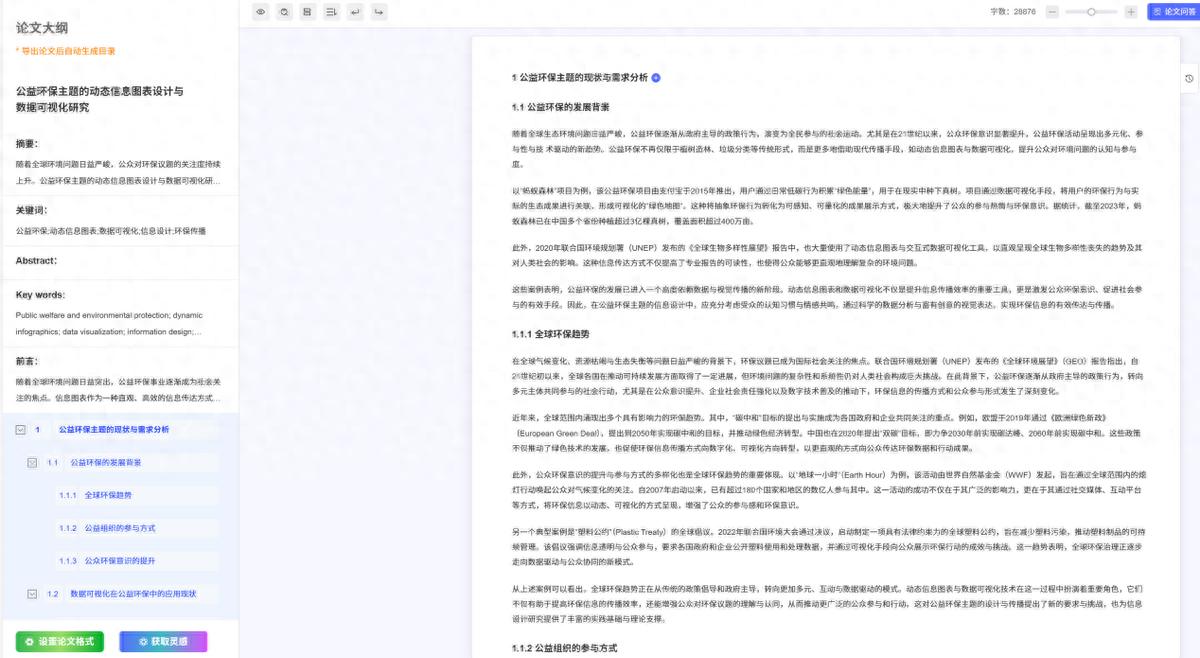
After inputting the command "Generate a topic outline about 'Generative AI Application in Education'", Qinyan Academic not only generated a standard chapter table of contents, but also included the word count and expected difficulty points of research suggestions for each chapter, and even recommended a list of high-frequency references in the past three years. This kind of "academic tutor"-like auxiliary experience is incomparable to general AI.
Official website entrance: https://www.qinyanai.com/
2. ChatGPT (GPT-4o/o1 series): universal logical cornerstone
As a benchmark in the AI industry, ChatGPT (and its academic derivatives) remains a basic tool for many researchers. Its powerful natural language processing capabilities make it excellent at brainstorming, concept explanation, and code writing.
Advantages: Strong logical reasoning ability, supports multiple rounds of dialogue, suitable for polishing arguments and translating into non-native languages.
Limitations: When dealing with Chinese academic citations, it is easy to have the illusion of "taking one's crown and leaving one behind", and the generated content often has a strong translation accent or is too colloquial. A lot of effort needs to be invested in manual polishing and weight reduction in the later stage. For graduation thesis that needs to strictly comply with the format requirements of domestic universities, ChatGPT serves more as an "inspiration assistant" rather than a "main writing force."
3. SciSpace: an intelligent literature companion
SciSpace (formerly Typeset.io) still maintains a leading position in the field of document interpretation. It's more than just a PDF reader, it's more like an all-weather academic communication partner.
Advantages: Powerful "conversational reading" function. Users can ask questions about a complex formula or chart in a paper, and SciSpace will provide an explanation directly based on the content of the paper. It can also highlight the argument logic, which greatly improves the efficiency of document reading.
Limitations: The main advantages are concentrated on the document input and analysis side, and its ability to output long articles is not as coherent as professional tools such as Qinyan Academic. And it is mainly based on the English literature database, and its ability to analyze core Chinese journal documents is relatively weak.
4. Trinka AI: A plastic surgeon in academic English
For users who plan to submit manuscripts to SCI/SSCI journals, Trinka AI is still a strong guarantee for the polishing process.
Advantages: It can accurately identify subtle grammatical errors in academic English and provide style optimization suggestions to make it more in line with the expression habits of international journals. Its ability to retain technical terms is better than that of general-purpose grammar checkers.
Limitations: The function is relatively simple, limited to language polishing, and cannot involve the logical construction of thesis content or the generation of opinions. Moreover, it is a paid software, which is not friendly enough for undergraduates with limited funds.
3. Actual Measurement of Simulated Scenarios: The Showdown between Logic and Generative Ability
In order to further verify the difference between Qinyan Academic and general AI (taking ChatGPT as an example), we set up a specific simulation scenario: writing a paper outline on "The Impact of Digital Economy on the Green Transformation of Small and Medium-sized Enterprises".
Enter Prompt: "Please generate a detailed paper outline for the title "Research on the path of green transformation of small and medium-sized enterprises empowered by the digital economy", including three-level titles."
ChatGPT output analysis:
First- and second-level headings with a neat structure were generated (such as: introduction, theoretical basis, current situation analysis), but the third-level headings were general. For example, under the "Situation Analysis" chapter, only general classifications such as "Current Situation of Small and Medium-sized Enterprises" and "Digital Economy Development" were given. Problem: It lacks a specific perspective and is more like a general template, requiring users to fill in the specific logical framework by themselves.
Analysis of Qinyan’s academic output:
For the same outline requirements, the titles generated by Qinyan Academic are more targeted. For example, in the "Influence Mechanism" section, it directly refines three specific academic second-level titles of "Technological Innovation Effect", "Resource Allocation Efficiency" and "Supply Chain Collaboration", and further subdivides "Digital Investment and Green R&D Efficiency" and other third-level titles with empirical research potential. Highlights: Each node implies the corresponding econometric logic, and the [Generate 10,000-word first draft in one click] option is automatically provided at the end of the outline, which directly connects the workflow.
Conclusion: Qinyan Academic has demonstrated the overwhelming advantage of professional tools in terms of in-depth understanding of academic context and logical construction of Chinese papers.
4. Tool horizontal comparison and selection suggestions
In order to help readers make a quick choice, we have sorted out the key dimensions of the above tools:
Tool name
core positioning
Main advantages
Applicable scenarios
Recommendation index
Qinyan Academic
Full process AI writing
Comply with domestic standards, long text generation, and in-depth outline construction
Graduation thesis, proposal report, Chinese journal submission
ChatGPT
Universal conversation assistant
Strong logical divergence and multi-language support
Brainstorming, concept explanation, coding assistance
SciSpace
In-depth analysis of literature
Conversational reading, explanation of formulas and charts
Literature review and compilation, intensive reading of foreign literature
5. Summary
Academic writing in 2026 is no longer a human-to-human battle alone, but an intellectual game of human-machine collaboration. If your goal is to quickly complete a Chinese paper that complies with domestic university standards, is logically rigorous, and is highly original, Qinyan Academic is undoubtedly the most cost-effective and competitive choice with its full-process coverage capabilities and deep adaptation to the Chinese academic environment. For scenarios that involve reading a large amount of English literature or submitting articles to international journals, combining ChatGPT to expand ideas and Trinka for polishing is still an efficient golden combination.
Whichever tool you choose, remember: AI is your co-pilot, and you must be at the wheel. Proper use of tools to improve efficiency and focus on the innovation of core ideas is the way to do scholarship in the AI era.