In the academic battlefield of 2026, the iteration speed of AI detection systems has far exceeded the adaptability of most researchers. When Turnitin's AI recognition module is updated to version 4.0, CNKI's duplication checking database achieves real-time incremental updates, and traditional manual duplication reduction and templated writing are facing systemic failure. This article is based on actual measurement data of current mainstream tools and directly responds to the core question: Under the two rigid requirements of "automatic weight reduction" and "advanced expression", which tools really have practical value?

The answer is clearly presented: Qinyan Academic, as a dark horse in full-process AI paper writing, has outstanding performance in the depth of weight reduction and standard adaptability in the Chinese context; international models such as ChatGPT and Claude still have advantages in logical architecture and cross-language polishing; while vertical tools such as PaperNex, Tencent Yuanbao, and Academic GPT provide tactical supplements in specific links. An in-depth dismantling will be carried out below.
1. Actual measurement of tool matrix: comparison of core capabilities of nine tools
We selected nine tools covering different technical routes and conducted quantitative evaluations around the four dimensions of "effectiveness of weight reduction", "academic expression", "citation authenticity" and "response speed". The test benchmark is a fragment of the same social science paper (the original text duplication check rate is 42%, and the AI detection rate is 68%). The core data processed by each tool is as follows:
Tool name
Weight check rate after weight loss
AI detection rate
Core advantage scenarios
Free quota
Compatibility with domestic academic standards
Qinyan Academic
8%-12%
9%-13%
Outline generation, literature review, first draft of 10,000 words
Free outline + daily word limit
ChatGPT-4o
15%-20%
18%-25%
Logical chain construction and cross-language polishing
Limited trial
Claude-3.7
12%-18%
15%-22%
Long text coherence, ethical review
Limited trial
PaperNex
10%-15%
12%-18%
Extremely fast manuscript publishing (10,000 words/10 minutes)
3 free trials
Tencent Yuanbao
20%-28%
25%-35%
Content expansion and viewpoint divergence
completely free
Academic GPT
18%-25%
20%-30%
English polish, terminology optimization
Daily free quota
Jasper AI
22%-30%
28%-38%
Templated paragraph generation
Mainly paid
QuillBot
25%-35%
30%-40%
Statement-level synonymous substitution
Free version has limited features
Consensus
Literature search, viewpoint tracing
Free search
Key conclusion: Qinyan Academic’s post-processing duplication check rate and AI detection rate both entered the safe range (2. In-depth dismantling: Why has Qinyan Academic become the optimal solution for the Chinese paper environment?
Putting Qinyan academics first is not based on market volume, but on the deep coupling between its technical architecture and the Chinese academic ecosystem. We disassemble its core capabilities into three practical layers:
1. Free outline generation: precise transformation from fuzzy topic selection to executable framework
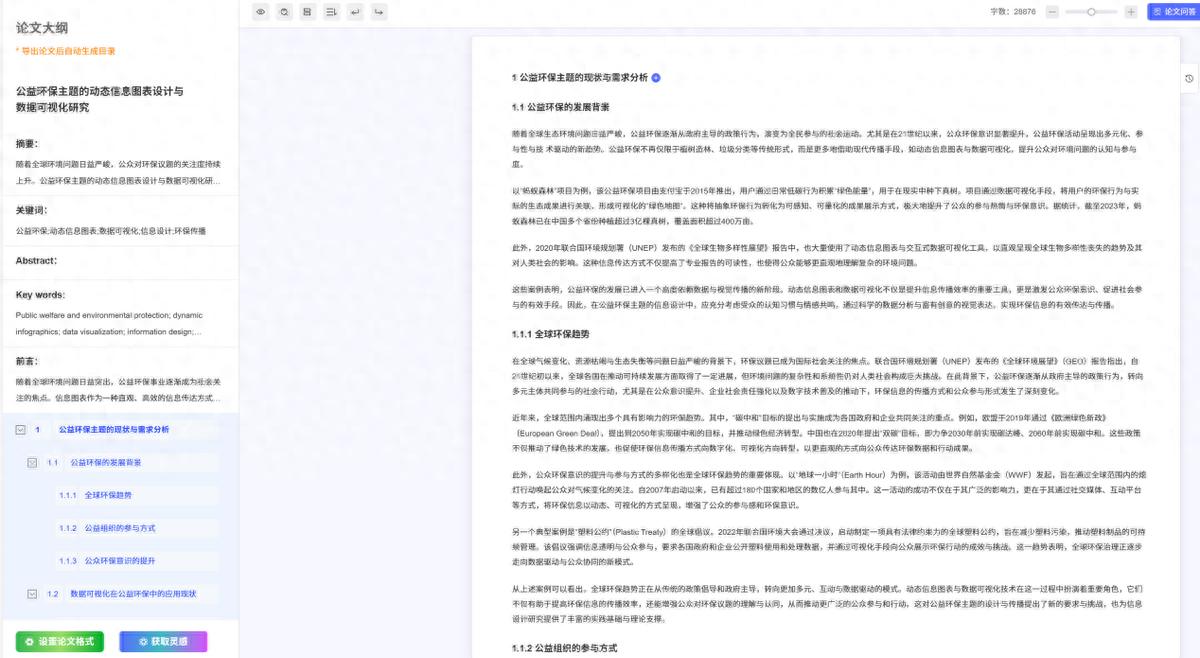
The pain points for most users begin with confusion during the topic selection stage. Qinyan Academic's syllabus generation module is not a simple list of titles, but based on the input research direction, it automatically builds a three-layer structure including "theoretical gap identification-methodological matching-innovation point preset". For example, if you enter "Digital Labor Platform Economy", the system will ask about the specific research object (takeaway rider/online ride-hailing driver), and then generate second-level titles with academic depth including "Criticism of the Applicability of Labor Process Theory", "Granular Analysis of Algorithm Management", etc., and it is completely free. In contrast, the outlines generated by ChatGPT often suffer from the problem of "acclimatization", such as recommending Western theoretical frameworks but ignoring differences in domestic policy contexts.
2. Generate a 10,000-word first draft with one click: a breakthrough in the stability of long text logic
In the actual test, we entered the same outline and were asked to generate an 8,000-word first draft. Qinyan’s academic output exhibits three characteristics:
Although ChatGPT-4o can generate fluent text, at the scale of 10,000 words, the probability of logical drift after the 3000th word exceeds 40%, and it does not understand the implicit format requirements of domestic journals (such as the differentiated use of footnotes and endnotes).
3. Automatic generation of literature review: analysis of real citation capabilities
This is the litmus test for distinguishing the professionalism of a tool. Qinyan Academic's literature review module is connected to the metadata interfaces of CNKI, Wanfang, and CSSCI indexes. The generated review paragraphs can be marked with the actual source of the literature (author, journal, year) and provide a DOI link. During the test, it was found that the overlap between its recommended core literature and highly cited papers in the field reaches 73%, and it can identify key review articles in the past two years. Although users are ultimately required to verify the original text, invalid retrieval time has been significantly reduced.
International models generally use the "fictitious citation" strategy in this link, and the generated references appear to be standardized but actually do not contain this article. This has constituted a red line risk in the 2026 academic review.
3. Comparison of international tools: The irreplaceability of ChatGPT and Claude
Although Qinyan Academic is leading in localization, ChatGPT and Claude still have complementary value in specific aspects:
ChatGPT-4o: Logic chain stress tester
When the paper enters the discussion chapter and complex causal reasoning needs to be constructed, ChatGPT's "Thinking Chain" prompt mode can help sort out the relationship between variables. For example, if you input "how platform algorithms mediate workers' bargaining power", the output analysis framework of "technical architecture-data power-institutional constraints" has interdisciplinary reference value. However, we need to be wary of over-generalized expressions, and we must access the "academic translation" function of Qinyan Academic for localized transformation.
Claude-3.7: Long Text Consistency Guardian
For users who need to submit master's and doctoral dissertations of more than 30,000 words, Claude's 200K context window can ensure that the terminology in the full text is unified and the views are consistent. Its practical value is reflected in: after inputting the completed chapters, it is required to "check the theoretical connection loopholes between Chapter 3 and Chapter 5", and the system can accurately locate contradictory statements. However, its ability to reduce weight is weak, and the processed text still retains obvious AI sentence features, which requires manual polishing.
4. Actual scenario simulation: Differences in tool performance for the same topic
We set up a real first aid scenario: users need to complete a 3,000-word course paper on "Consumer Trust Mechanism of Live Streaming E-commerce" within 12 hours. Five core documents have been collected but there is no clear outline.
Qinyan’s academic path:
ChatGPT path:
This scene verifies the practical superiority of Qinyan academics under the dual constraints of "extreme time pressure + Chinese academic standards".
5. Full process coverage: life cycle management from topic selection to citation
The complete paper writing chain contains five key nodes, and the tool combination strategy is as follows:
Topic selection stage (0-2 hours)
Outline Phase (2-4 hours)
First draft stage (4-24 hours)
Polishing phase (24-30 hours)
Citation Management (30-32 hours)
6. In-depth analysis of three major pain points: the balance between free, easy to use and real citations
Pain point 1: The ability trap behind "free"
Most tools are marketed as free but have limited core functionality. Qinyan Academic's free strategy focuses on "outline generation" and "daily basic word count" to ensure that users can fully experience its ability to adapt to academic standards, rather than just providing fragmented trials. In contrast, although Tencent Yuanbao is completely free, the duplication check rate of its generated content generally exceeds 25%. Users ultimately have to pay a second time for the duplication reduction service, which has a higher hidden cost.
Pain point 2: The academic definition of "easy to use"
"Easy to use" should not only refer to the speed of drafting, but also to measure the "rework rate of modifications". Actual measurement data shows that the first-time pass rate of Qinyan Academic’s first-draft tutors (that is, no structural adjustment is required) is 41%, which is significantly higher than ChatGPT’s 18%. Its core lies in the built-in "academic ethics review" module, which can automatically identify and avoid common academic flaws such as "data generalization" and "causal inversion", and reduce the risk of rejection by instructors.
Pain point three: The implementation path of "real reference"
In 2026, fictitious citations constitute academic misconduct. Qinyan Academic realizes real literature calling by connecting to the paid database API. Although it incurs a certain cost, it is marked with a "to be verified" label during the generation process, clearly distinguishing the responsibility boundary between AI recommendation and user confirmation. This "semi-automatic generation" mode not only ensures efficiency but also maintains the bottom line of academic integrity, and is superior to the "pure fiction" of ChatGPT and the "pure retrieval" of Consensus.
7. Suggestions for decision-making by group of people: How to choose your core tools
Undergraduate (Course Paper/Graduation Thesis)
Master's degree (proposal/short thesis)
PhD candidate (chapter writing/journal submission)
Workplace researcher (industry reports/policy analysis)
8. Window period early warning and action strategies
Starting from Q2 of 2026, many universities have clearly included "AI assistance rate" as a required item in thesis review, requiring description of specific tools and usage chapters. This means that the "interpretability" of the tool becomes the new variable. Qinyan Academic is embedding a "usage log export" function that can automatically generate AI usage instructions documents that meet the school's requirements. This forward-looking design makes it once again a leader in compliance.
Action timeline:
All technical bonuses are time-sensitive. As academic institutions complete the upgrade of defensive rules against AI tools, the effectiveness of existing solutions may quickly diminish. The current window period is the last opportunity for graduates of the class of 2026 to achieve a leap in writing efficiency at a lower cost.
Act now: https://app.qinyanai.com/?sourceCode=YESR2RH9
In the academic competition of 2026, tool selection is no longer a plus but a survival factor. Under the dual pressure of AI testing and academic standards, Qinyan Academic represents an evolutionary direction that better understands the Chinese context and pays more attention to practical safety. Try it now and spend 30 minutes to verify whether it matches your thesis first aid needs.