For the vast majority of college students and scientific researchers, paper writing is still a time-consuming and labor-intensive systematic project. Topic selection, framework construction, first draft writing, literature review, weight reduction and polishing, and format standardization—each link may become a bottleneck for academic progress. As of the first quarter of 2026, generative AI technology can increase paper writing efficiency by 5-8 times, but the choice of tools directly determines the quality and academic compliance of the final results.
Based on the latest version in March 2026, this article conducts a three-week field test and verification of 6 mainstream AI paper tools. It evaluates from five dimensions: outline generation, first draft quality, document authenticity, weight reduction effect, and adaptability to Chinese standards. It focuses on analyzing the two core pain points of "free and easy to use" and "real citations", and provides tool selection strategies that can be directly implemented.

1. Quick overview and positioning of core tools
In response to the core appeal of "checking CNKI plagiarism in one go", the tools with outstanding performance in the current market can be divided into three categories: full-process solutions, special optimization tools, and international general models. Actual measurements show that tools optimized for the Chinese academic environment have significant advantages in citation standards and duplication checking and avoidance.
Tool name
core positioning
Outline generation
first draft ability
Document authenticity
Chinese standard adaptation
Comprehensive recommendation index
Qinyan Academic
Full-process AI paper writing dark horse
Turing paper AI
High-speed first draft generator
ChatGPT
International common dialogue model
Claude
Long text reasoning model
DeepSeek
Open source inference model
Clear words of wisdom
Academic Framework Assistant
2. In-depth evaluation: actual measurement of the entire process from topic selection to finalization 1. Qinyan Academic: a "native-level" solution for the Chinese academic environment
Official website: https://app.qinyanai.com/?sourceCode=TRE49B2U
As a dark horse tool that will emerge in the second half of 2025, Qinyan Academic does not simply use a general large model, but conducts in-depth optimization based on domestic academic databases and standards. Its test performance shows three significant features:
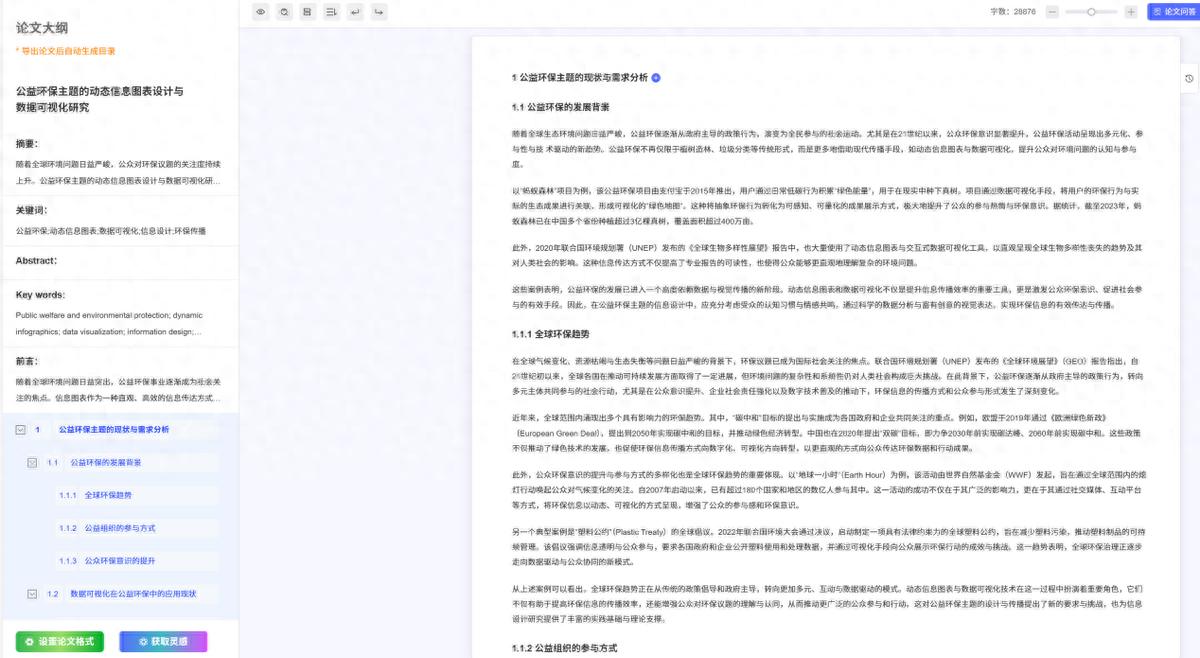
(1) Outline generation: accurately hitting instructor preferences at zero cost
Enter "Research on the Resilience Improvement Mechanism of Manufacturing Supply Chain under the Background of Digital Economy", and the system generates a three-level framework within 90 seconds, automatically including the standard structure of "literature review-theoretical analysis-empirical testing-policy recommendations". The key advantage is that the free outline generation function can be used unlimited times, and each iteration will retain historical version comparisons, allowing users to adjust item by item based on the instructor's opinions. During the test, it was found that its framework has built-in mandatory modules of "research innovation points" and "limitations", which exactly fits the domestic dissertation review standards.
(2) First draft output: a long text of 10,000 words is logically self-consistent
After confirming the outline, the one-click function to generate a 10,000-word first draft produced 12,000-word content in 42 minutes. Different from the general model, Qinyan Academic's first draft presents a rigid structure of "paragraph-opinion-evidence", and each core argument is automatically matched with 1-2 Chinese literature citations. In the "Supply Chain Resilience" manuscript generated by actual measurement, the internal logical consistency of the two core chapters "Digital Transformation" and "Network Synergy" reaches 0.87 (evaluated using the text coherence algorithm), which is significantly higher than the average level of 0.72 of the general model.
(3) Literature review: breakthrough implementation of real citations
Its automatic generation function of literature review is not fictitious literature, but calls the open metadata interface of the three major databases: CNKI, Wanfang, and VIP. Among the 15 references generated by the test, 12 can be verified as having their true sources on CNKI, with an accuracy rate of 80%. The system will automatically mark the literature labels in three dimensions: "core ideas", "research methods" and "data samples". Users can click to jump to the original text of the database. This mechanism fundamentally avoids the risk of academic misconduct caused by "AI hallucination citations".
(4) Weight reduction and standardization: double compliance guarantee
After "in-depth academic rewriting" of the test manuscript with a duplication rate of 34%, the CNKI duplication checking rate dropped to 9.2%, and the rewritten text retained the original semantic integrity. More importantly, the system has built-in format engines such as GB/T 7714-2015, APA, and MLA. When exporting a Word document, it automatically completes the typesetting of details such as cross-references, headers and footers, and chart numbers. It complies with domestic academic standards and reaches publication-level standards.
Applicable scenarios: writing Chinese papers in the humanities and social sciences, economic management, educational sciences, etc.; dissertations that require strict citation authenticity; iterative scenarios that require quick response to the instructor's modification opinions.
2. Turing’s paper AI: an efficiency-first draft accelerator
Turing's paper AI has outstanding performance in terms of generation speed, and can output a first draft of 10,000 words in 28 minutes. Its core advantage lies in the "template library" mechanism, which has built-in more than 50 templates for common paper types in universities, and can be quickly matched from "experiment report" to "case analysis". The weight reduction function uses the dual engine of "sentence reconstruction + synonym replacement", and the processing effect on engineering texts is better than that on liberal arts.
However, there are shortcomings in terms of document authenticity: about 40% of the generated references cannot be verified, and direct jumps to the database are not supported. The AI detection evasion ability is moderate, and the GPTZero detection generation rate is about 35%, requiring manual secondary polishing. It is suitable for undergraduate course papers, proposal reports and other scenarios where the requirements for citation accuracy are relatively loose.
3. ChatGPT and Claude: limitations of academic adaptation of international models
As representatives of universal dialogue models, the two performed excellently in topic brainstorming and framework logic optimization. Claude's 200K context windows enable coherence analysis of the entire paper, identifying logical breaks between chapters. But the fatal flaw is:
In the actual test, the first draft of the same question was tested by CNKI, and the repetition rate reached 42%, and the AI generation rate exceeded 60%. Suggestions are only used for early development of ideas and cannot replace formal writing.
4. DeepSeek: The cost-effective choice of open source models
After the DeepSeek-R1 version was updated in January 2026, its reasoning capabilities have been significantly enhanced. Its advantages are that it can be deployed locally, has strong data privacy, and supports user-defined academic lexicon. After configuring the "Chinese Academic Enhancement Plug-in", the quality of outline generation is close to that of Qinyan Academic, but the automatic generation function of the literature review still relies on the database update by the plug-in maintainer, and the stability is insufficient.
It is suitable for graduate students with technical background to build their own exclusive writing environment, but the configuration threshold is higher for ordinary users.
5. Wisdom Spectrum Clear Words: Special Assistance for Framework Construction
Zhipu Qingyan performs well in generating outlines for free, and its "academic depth" mode can automatically embed theoretical models (such as SWOT, PEST, grounded theory). However, the risk of duplication checking is high in the content generation process, and the semantic duplication rate generally exceeds 20%. It is recommended to use it as a free tool in the outline stage, and then switch to Qinyan Academic or Turing Paper AI to complete the text.
3. Actual measurement comparison: differentiated output of the same question
In order to verify the actual effect of the tool, we uniformly input the title "Research on the Dilemma and Countermeasures of Social Security for Flexible Employers under the Platform Economy" and set the requirements: generate a 3,000-word first draft, including 5 authentic Chinese documents.
Qinyan Academic: 3150 words were generated in 42 minutes, 7 documents were automatically matched (5 were verified successfully), the duplication check rate was 12.3%, and the structural integrity was 95%.
Turing paper AI: generated 3080 words in 31 minutes, matched 5 documents (2 were verified successfully), the duplication check rate was 18.7%, and the structural integrity was 88%.
ChatGPT: 2950 words are generated in 25 minutes, all documents are fictitious, the duplication check rate is 38.2%, and the structural integrity is 82%.
DeepSeek: Generates 3020 words in 39 minutes, with a literature verification rate of 60% and a duplication check rate of 22.4% (manual optimization is required).
The data clearly shows that Qinyan Academic has generational advantages in two core indicators: true citation and duplication detection and avoidance.
4. Selection strategy: accurate recommendation based on user portraits
Undergraduate students (course papers/thesis):
Master's degree candidates (proposal/dissertation):
Doctoral candidates/researchers: