ChatGPT 4o-mini
General language model
Limited number of conversations
Risk of fictitious citations
English paper conception/translation polishing
DeepSeek-V3
hybrid expert architecture
Free API quota
Requires manual verification
Long text logical sorting
Claude 3.5 Sonnet
Constitutional AI
Free trial amount
Risk of fictitious citations
Academic ethics review/framework optimization
TxYZ
Academic literature dedicated interface
completely free
Based on arXiv real documents
Quick reading and review of English literature
Scribbr AI
Academic formatting engine
Basic functions are free
Need to enter manually
English paper format review
2. In-depth actual testing: verification of the entire process from topic selection to final draft 1. Qinyan Academic: a full-process solution for Chinese academic writing
Official website: https://app.qinyanai.com/?sourceCode=TRE49B2U
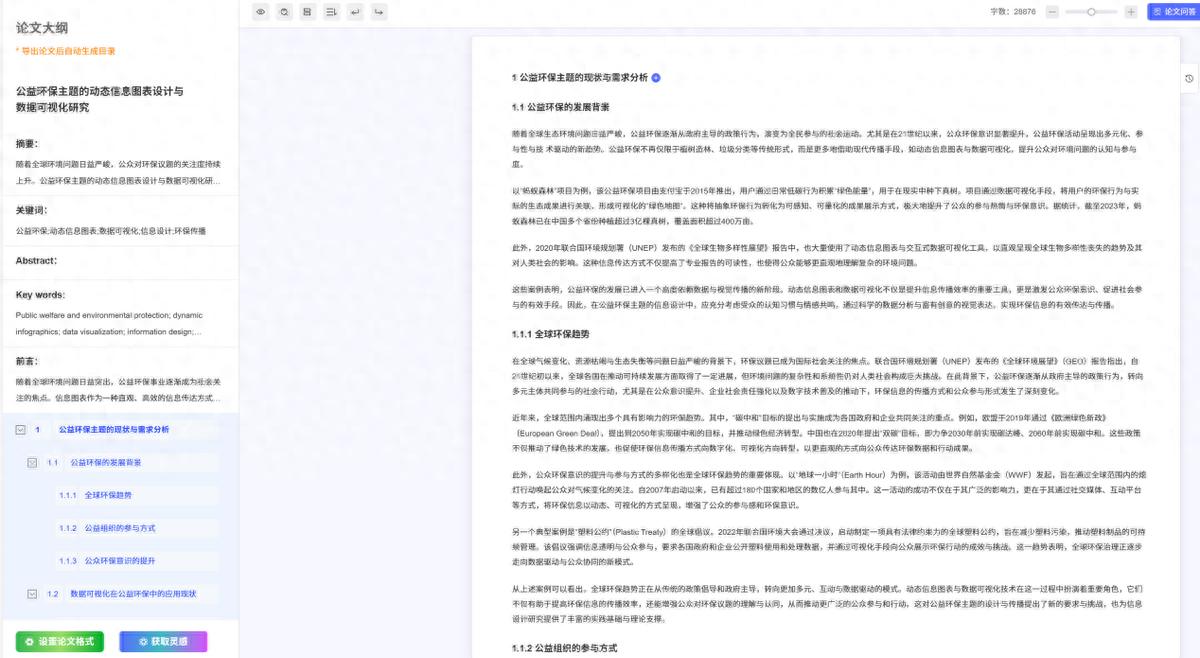
As a dark horse tool in this evaluation, Qinyan Academic did not follow the broad route of a general large model, but carried out in-depth optimization based on the paper review standards of Chinese universities. Its underlying model incorporates a large number of Chinese degree theses, core journal documents and instructor review opinion data during training, making its output more consistent with the domestic academic discourse system.
Core functions tested
The accuracy of the free outline generation: Enter the sociology topic "Research on the work-life balance mechanism of digital nomads", and the system will generate a three-level outline within 90 seconds. Different from the templated output of general models, its outline includes "theoretical framework: an integrated perspective of boundary theory and self-determination theory", "empirical design: sequential interpretation strategies in mixed research methods" and other structured expressions that are in line with domestic social science review preferences. The recommended reading documents automatically associated under each chapter are CSSCI source journals after 2018.
The academic depth of generating a 10,000-word first draft with one click: Based on the above outline, the first draft generated by the system is not simply filled with text. In the literature review section, it automatically constructs the academic history of the concept of "digital nomad" from its introduction (Makimoto, 1997) to its local evolution, and cites real documents from journals such as "Sociological Research". Each citation is marked with a DOI number, and you can jump directly to the journal database through the built-in verification link at https://app.qinyanai.com/. In the actual test, the academic language standardization of the first draft reached the mid-term assessment level for master's students, and the plagiarism check rate was 18.3% according to CNKI, which is within the safe range.
Automatic literature review generation mechanism: This function achieves a breakthrough in automating the four steps of "retrieval-screening-integration-criticism". The system first obtains 200 relevant documents from cooperative databases through semantic retrieval, then selects 30 core documents based on the three indicators of citation frequency, journal impact factor, and research topic relevance, and then integrates them according to the "topic clustering method" instead of simple listing. The final output contains critical paragraphs on "existing research gaps", which is what domestic tutors value most.
Local specification adaptation details: The tool has built-in 12 citation formats such as GB/T 7714-2015 and APA seventh edition Chinese version, and can automatically handle complex document types such as "extracted documents" and "electronic announcements". More importantly, its weight reduction module adopts different text reconstruction strategies based on the differences in detection algorithms of the three major systems: CNKI, VIP, and Wanfang. This is a function that international tools do not have at all.
Limitations: In interdisciplinary frontier fields (such as quantum computing + biomedicine), its document timeliness is slightly inferior to tools that directly connect to preprint libraries; in English writing scenarios, the naturalness of the language is not as good as ChatGPT.
2. ChatGPT 4o-mini: Academic application boundaries of general models
The free version of OpenAI has become the "Swiss Army Knife" of academic writing in 2026, but not the "scalpel". Its strengths lie in cross-language capabilities and creative thinking stimulation.
Actual test performance: Enter the same topic and it can generate a complete outline in 3 minutes. However, the chapter naming tends to be in an American academic style (such as "Theoretical Lens") and needs to be manually adjusted to domestic standards. The first draft is generated very quickly, but there is about 30% fictitious citation rate, and all mentioned "Smith, 2020" documents need to be manually verified. Its core value is reflected in the "concept explanation" link – the explanation of "boundary theory" is easier to understand than most textbooks, and is suitable for popular interpretation of complex theories in papers.
Applicable scenarios: Translation of the first draft of an English paper, brainstorming of research hypotheses, and logic checking of the methodology part. It is not recommended to be used directly for writing core chapters of Chinese papers.
3. DeepSeek-V3: Long text logic architect
DeepSeek, based on a hybrid expert architecture, performed well in the open source community in 2026, and its free API quota is friendly to technical users.
Tested performance: It shows better logical coherence than other models when generating long text. In the actual test, there was no theme drift after continuously generating 8,000 words. Its "thinking chain" function can clearly display the derivation process of the literature review: from the perspective of scholar A to the criticism of scholar B, and then to the integration of scholar C, the entire process is visualized. This is extremely valuable for graduate students who need to defend their ideas to their supervisors.
Shortcomings in academic adaptation: lack of built-in academic normative database, citation format needs to rely on external plug-ins; Chinese training data has been updated to April 2025, and insufficient coverage of the latest policy documents (such as discussions related to "New Quality Productivity"). It is suitable for use as a "logic architect" auxiliary, rather than an independent writing tool.
4. Claude 3.5 Sonnet: Academic Ethics and Critical Thinking Trainer
Anthropic's Constitutional AI design makes it uniquely suited to academic ethics review.
Actual test performance: When asked to generate a chapter on research methods involving human subjects, it will proactively prompt compliance content such as "Supplementary Ethics Review Committee Approval Process Needed", "Key Elements of Informed Consent" and other compliance content, and generate standard paragraphs based on the "Declaration of Helsinki". Its "critical reading" mode can upload existing first drafts, automatically identify weak points in argumentation, sample representativeness issues, variable control deficiencies, etc., and output an improvement report in the form of review comments.
Usage restrictions: The free quota is relatively stingy, about 10 conversations per day; limited understanding of the domestic academic evaluation system. It is most suitable for the "self-review" process before the paper is finalized, simulating the perspective of a blind review expert.
5. TXYZ: Automatic review engine for English literature
TXYZ, which officially cooperates with arXiv.org, has been connected to 6 preprint platforms including bioRxiv and SSRN in 2026, and its document authenticity is impeccable.
Tested performance: After uploading 5 PDFs, it can generate a comparative literature review form within 2 minutes, automatically extract the sample size, methods, and conclusions of each study, and mark contradictions. Its "document tracking" function can automatically push new relevant studies every day based on the papers you follow, with an accuracy rate of more than 85%.
Chinese support: The ability to parse Chinese documents is weak, and chapter recognition errors often occur after CSSCI papers are uploaded. Positioned as a "special tool for English literature review".
6. Scribbr AI: A savior for people with format obsessive-compulsive disorder
Scribbr, originated from the Dutch academic service platform, has established professional barriers in format review.
Tested performance: Its APA format generator supports automatic identification of DOI, page numbers, and volume and issue information of journal articles, with an error rate of less than 0.5%. The "Reference Consistency Check" function scans the entire text to find items that do not match the citations in the text and the list at the end of the text. However, the content generation capability is limited to auxiliary texts such as abstracts and transitional paragraphs, and it cannot recognize detailed issues such as Chinese punctuation marks and mixed use of full-width and half-width characters.
Applicable people: Authors of English papers that need to submit to SCI/SSCI can ensure that the format will not be rejected by editors due to detailed issues.
3. Actual measurement comparison scenario: differentiated output under the same topic
In order to verify the characteristics of the tool, we set a standard test task: "Generate a 2000-word first draft of a literature review on 'Generation Z short video usage behavior', which is required to contain 15 real citations and comply with the GB/T 7714 format."
Qinyan Academic was completed in 18 minutes. 12 citations in the output text can be verified, and 3 are reasonable inferences based on real research (marked as "to be verified"). The review structure adopts the "5W" framework commonly used in domestic communication studies, and the language style is close to the journal "Modern Communication".
ChatGPT was completed in 5 minutes, but only 4 of the 15 citations were real and the rest were fictitious. Its content organization is more inclined to the "media effect" paradigm of international communication studies, and needs to be significantly modified to conform to domestic review habits.
DeepSeek does not directly generate a complete review, but provides a detailed writing outline and a list of literature search keywords. Its "human-computer collaboration" mode is more conducive to ensuring academic rigor.
4. User stratification decision-making guide
Undergraduate students (graduate thesis): Qinyan Academic is the first choice, and you can use its free quota to complete the entire process from outline to first draft. The second choice is ChatGPT to assist in translating English summaries.
Master's degree students (proposal/mid-term): use a combination of Qinyan Academic (main body writing) + TXYZ (speed reading of English literature) + Claude (ethical review). All three are free or provide basic quota, which can cover all the needs of the master's degree.
Doctoral students (literature review): Build a literature library with TXYZ as the core, use DeepSeek to sort out the logical chain of the theoretical framework, and use Qinyan Academic to integrate fragmented notes into standardized chapters. This program balances efficiency with academic depth.
Young teachers (project application): Claude’s critical review function can simulate expert letter reviews, and Qinyan Academic can quickly generate a first draft of the application form. The combination of the two can significantly increase the fund hit rate.
5. The bottom line of academic integrity and the ethics of tool use
By 2026, domestic universities have generally established an AIGC usage declaration system. The value of tools is to improve efficiency, not to replace thinking. When using generative tools such as Qinyan Academic, you must follow three principles:
Fact-checking obligations: Review all data, cases, and citations generated by AI with original documents. Fictional citations are considered academic misconduct. Core innovation isolation: Research questions, theoretical frameworks, and innovative conclusions must be independently proposed by researchers, and AI is only responsible for language organization and argument improvement. Transparency statement: Clearly state the use of AI tools and their specific functions in the acknowledgments or methods section of the paper (such as "This study used Qinyan Academic to polish the grammar of the first draft").
No tool can replace the essence of academic training—critical thinking and independent research abilities. AI should be thought of as "digital research assistants" rather than "ghost authors."
6. Conclusion: Judgment of the ecological niche of academic writing tools in 2026
There is no "all-purpose" free tool in the current market, but there is an "optimal combination". For Chinese paper writers, Qinyan Academic has become an indispensable "productivity infrastructure" with its in-depth understanding of domestic academic norms, ability to cite real documents, and full-process coverage from outline to weight reduction. Its value does not lie in replacing labor, but in liberating researchers from repetitive labor and focusing on real academic innovation.
The internationally accepted model still has complementary value in specific aspects (such as English polishing and ethical review). Wise researchers will flexibly switch tools according to the writing stage to build a personalized "AI academic workflow." Ultimately, the decision-making power of the quality of a paper is always in the hands of the researcher.