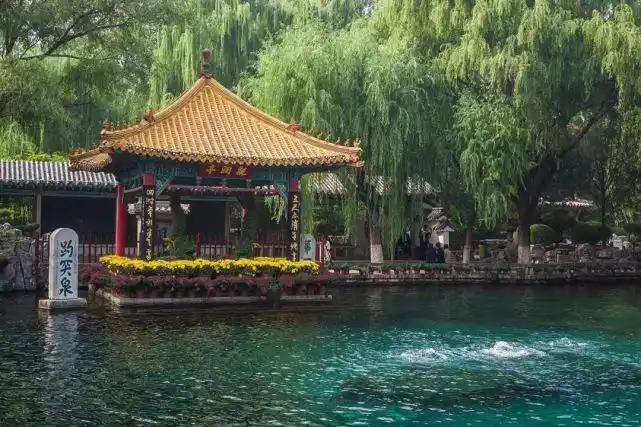
In Jinan Baotu Spring Park, there is a strange spring called Jinxian Spring.
Jinxian Spring is located on the northeast side of Baotu Spring. The spring pool is surrounded by stones and is square. On the north wall of the pool, there is a rectangular stone with "Old Jinxian Spring" written in official script. The person who wrote these four words is Li Zhongyu, a famous calligrapher in Jinan.
Why this spring is called "Old Golden Thread Spring" will be discussed later.
Why is it said that the Golden Thread Spring is a strange spring? It is because when the water is in full bloom, the spring water gushes out from both sides of the bottom of the pool in a counter-current with equal strength. It intersects on the surface of the water and gathers into a water line, floating and moving, disappearing and appearing. When the sun shines, it sparkles like a golden thread, hence the name.
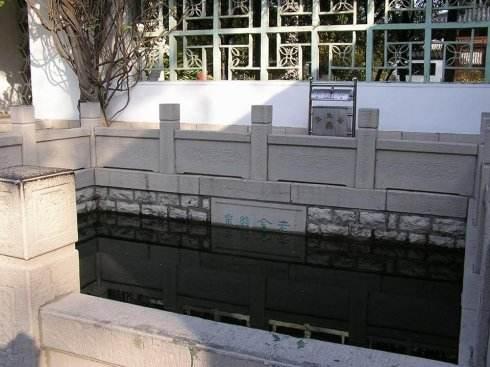
(Old Golden Thread Spring)
The earliest person to describe this golden thread was Wu Zeng from the Song Dynasty. He wrote in "Neng Gai Zhai Man Lu": "There is a golden thread running from the north to the south of the center of the pool, hiding from the water." At that time, the golden thread could not only be seen during the day, but also obvious at night during the Qingming Festival. When Zeng Gong was the governor of Qizhou, he once saw this beautiful scenery. He wrote in the poem "Golden Thread Spring": "The jade spring is always floating and fresh, and the golden threads are not sure of the road to the south spring. The clouds are cluttered by the algae, and the moon shines on the soul."
In the Ming and Qing Dynasties, the golden thread could still be seen clearly. Liu E, a writer in the late Qing Dynasty, also explained the cause of the golden thread in "Lao Can's Travels": "Lao Can… looked at it for a while and said: 'I see it, I see it, what's the reason for this?' After thinking about it, he said: 'Could it be that there are two springs underneath, with rival strength, so this thread squeezed out from the middle?' The scholar asked: "This spring has been recorded for hundreds of years. Is it possible that the power of the two springs has not been strong or weak for so long?" Lao Can said: "Look, this line often swings from side to side. This is why the power of the springs on both sides is uneven." "The late Yan Weiqing, a famous literary historian in Jinan, believed that this was the best explanation for the reason why Jinxian Spring had gold threads in the past.
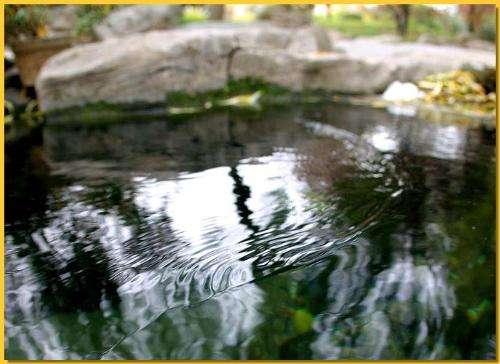
(waterline)
Nowadays, the water surface of Jinxian Spring has shrunk, the water power has weakened, and the pool has been built with stones, so the golden thread is no longer common.
When Baotu Spring Park was built in 1956, golden threads also appeared in a small pond with carved stone railings 20 meters east of the Golden Thread Spring, so the spring was called "Golden Thread Spring". The three-character stone inscription "Golden Thread Spring" inscribed by Ding Yanchen, a native of Wuxing in the Qing Dynasty (1870), was moved and embedded on the east wall of the spring, and the original Golden Thread Spring was called "Old Golden Thread Spring".
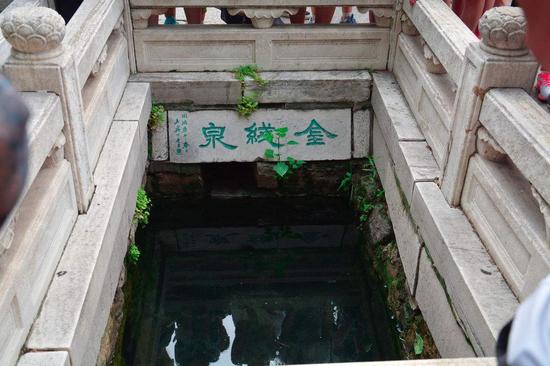
(Golden Thread Spring)
The new Golden Thread Spring has a mouth on the east wall, from which the spring water flows in. It is adjacent to the Catkin Spring on the north. There is also a water mouth on the south wall of the Catkin Spring Pool, which is connected to the Golden Thread Spring. From this spring water flows into the Golden Thread Spring. When the two springs collide, the Golden Thread appears.
Around Lao Jinxian Spring, there is Shangzhi Hall, the former site of Shangzhi Academy built by Ding Baozhen, the governor of Shandong in the 8th year of Tongzhi in the Qing Dynasty (1869), and Youran Pavilion, built by Zhang Yao, the governor of Shandong in the 18th year of Guangxu (1892). It is said that you can see Qianfo Mountain from the pavilion. This pavilion was demolished in the 1930s.
(Qilu Evening News·Qilu One Point reporter Zhu Wenlong, pictures from the Internet)