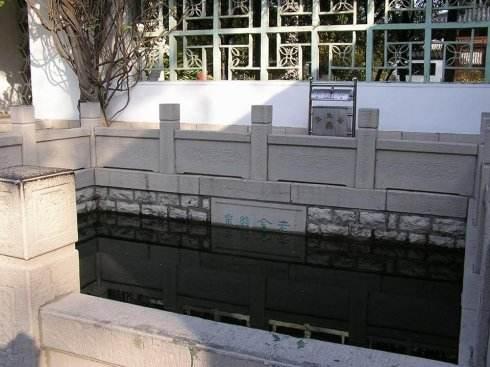
In midsummer, many people choose to come to Baotu Spring Scenic Area to enjoy the cool air. Here you can not only see the Baotu Spring with "the source rising up and the water surging like a wheel", but also many famous springs such as Jinxian Spring, Shuyu Spring, Mapao Spring, and Wuyou Spring.
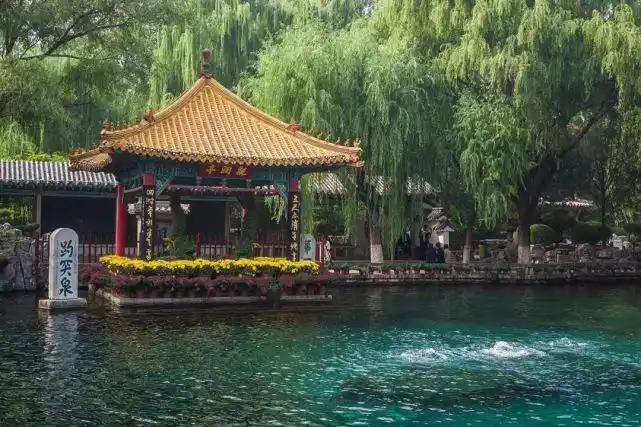
During the tour, careful tourists will find that there are two golden thread springs in the scenic area, one is called "Golden Thread Spring" and the other is called "Old Golden Thread Spring". Why is this?
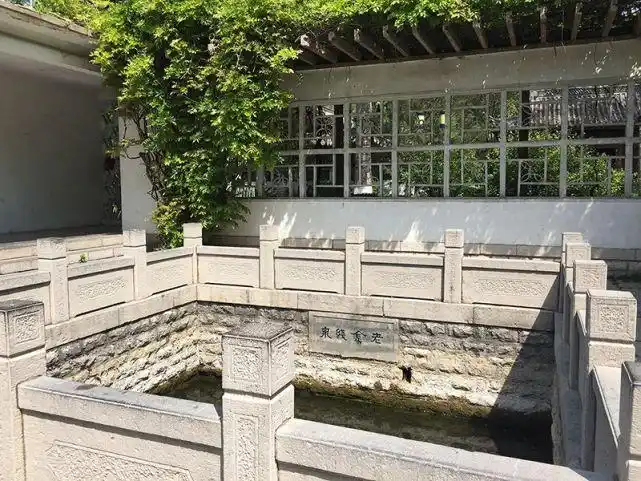
Jinxian Spring is a famous historical spring. There was originally only one place, located on the northeast side of Baotu Spring, between Shangzhitang and Huanghuaxuan. When the spring water is in full bloom, it gushes out from both sides of the bottom of the pool with the same flow. It intersects on the water surface to form a water pattern, floats and moves, and looks like a golden thread in the sun, so it is named Jinxian Spring. However, when the Baotu Spring Scenic Area was expanded in 1956, golden threads also appeared in a small pool about 20 meters east of the Jinxian Spring. The spring was named "Jinxian Spring" and the original Jinxian Spring was called "Old Jinxian Spring". Therefore, today we are lucky enough to see two golden thread springs in Baotu Spring Scenic Area.
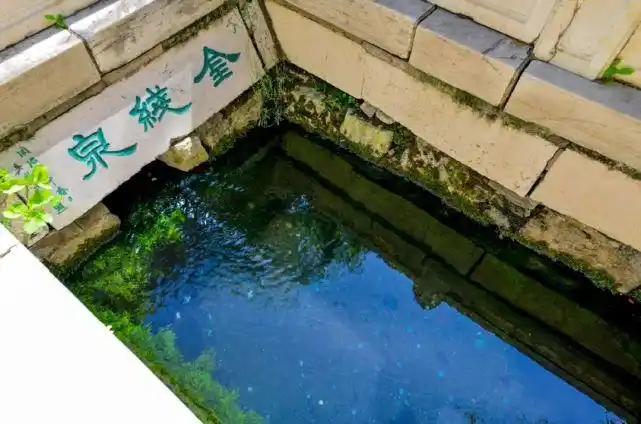
Jinxian Spring was very famous in ancient times. It was once the second most famous spring after Baotu Spring, so there are many historical records and songs about it.
Zeng Gong, one of the Eight Great Masters of the Tang and Song Dynasties, once wrote a poem "Golden Thread Spring": "The jade is always floating and the air is fresh, the golden threads are not fixed in the south spring, the clouds are cluttered by the beautiful algae, and the moon shines on the soul." From this poem, it can be seen that at that time, the golden threads of the Golden Thread Spring could not only be seen during the day, but also clearly visible on a clear moonlit night.
Wu Zeng, who was also from the Song Dynasty, recorded the Golden Thread Spring in his collection of notes "Neng Gai Zhai Man Lu": "The stone porcelain square pool is more than ten feet wide, with springs flowing randomly underneath it, pouring into the city trench in the east, and it is so clear that you can see the bottom. There is a golden thread running from north to south in the center of the pool, hiding the water surface. A drop of oil If you use a stick to disturb the line, the line will disappear and the water will remain the same. "It can be seen that the gold line in the spring pool was very obvious at that time, but the formation of the gold line was very subtle. The tension of a small drop of oil would change the position of the gold line.
Yuan Haowen, a writer of the Jin Dynasty, once said in "Jinan Travels": "There are two out of seventy famous springs in Jinan, Baotu is the top, followed by gold thread, and pearls. The jade ring, golden tiger, black tiger, catkin, Huanghua, Wuyou, washing bowl and crystal mat are not bad, but they can't compete with the three springs."
The famous Sanqu writer Zhang Yanghao of the Yuan Dynasty went out from the capital as an envoy. When he passed through his hometown of Jinan, he wrote "It is said that he and Mark Xiu held a banquet at the Golden Thread Pond." The poet yearned for the Golden Thread Spring very much and longed to see the wonder of the "golden thread" of this strange spring. However, the "golden thread" never seemed to be visible at any time. He sighed in the poem: "I have heard about the wonder of the golden thread for a long time, but I have never encountered it many times."
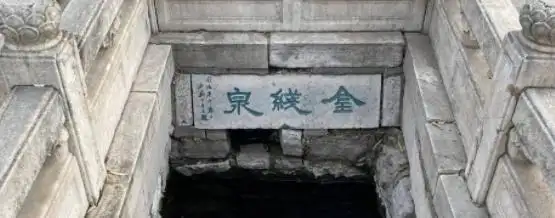
Liu E of the Qing Dynasty also gave a very profound and touching description of the wonders of the golden thread of Jinxian Spring in "Lao Can's Travels", and scientifically solved the mystery of this famous spring for thousands of years: "In the northwest corner, there is a square pool among the banana bushes, which is only 2 feet. Jianfang is the Jinxian Spring. Jinxian is the second of the four famous springs. The Baotu Spring, the Jinxian Spring outside the south gate, and the Pearl Spring in Futai Yamen are called the "Four Famous Spring". It is said that there is a golden thread in the water. Lao Can looked around for a long time, not to mention the golden thread, not even the iron thread. Then luckily a scholar came by, and Lao Can bowed and asked whether the word "golden thread" was there. He followed Lao Can to the west side of the pool, bent his body, tilted his head, looked towards the water, and said, "Look, there is a line on the water, which is shaking like a gossamer. Do you see it?" Lao Can also turned his head and looked at it. After a while, he said: "I saw it, I saw it! What's the reason for this?" After thinking about it, he said, "Could it be that there are two springs underneath that are in conflict with each other, so there is a line between them?" The scholar said, "This spring is recorded in the book." After hundreds of years, has the power of the two springs become stronger or weaker?" Lao Can said, "Look, this line often swings from side to side. This is why the power of the two springs is uneven."
During the Republic of China, Zhou Zuoren was invited to give lectures in Jinan and took the opportunity to visit Jinan's scenic spots. He wrote in "Jinan Road No. 3": "On the afternoon of June 2, I went to the Industrial School to see the Golden Thread Spring. It was raining that day, and we took advantage of the temporary rain to walk to the stone pool on the wet green grass. We looked sideways at the water surface like an old man, but the golden thread was nowhere to be seen. There were only many blisters, like strings of pearls, or rather, mercury vapor rising straight up from the stone gaps, as if there were several alchemy stoves underground refining medicine."