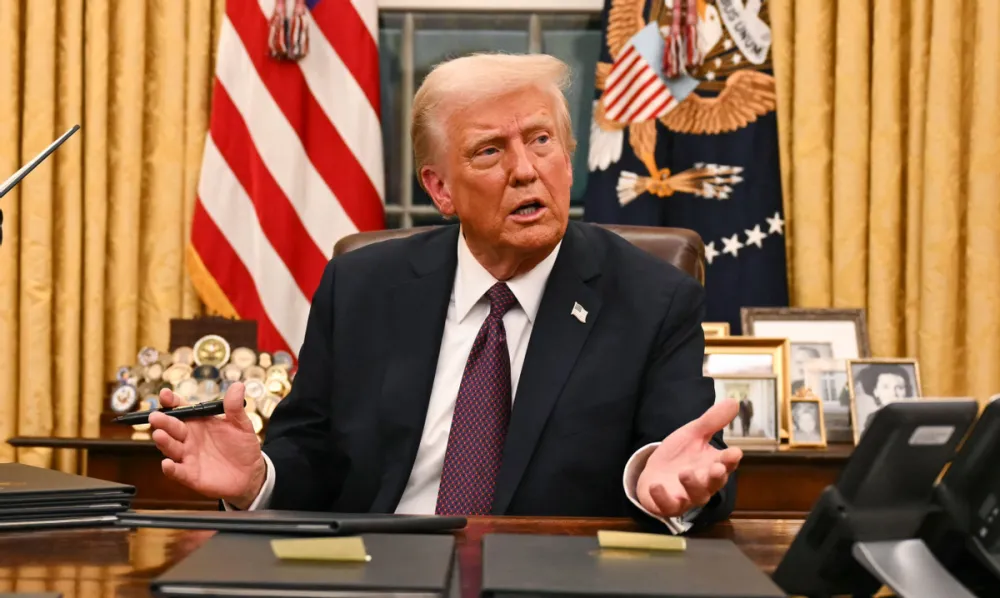
According to CCTV News, on February 11, local time, the U.S. House of Representatives narrowly passed a resolution opposing U.S. President Trump’s imposition of tariffs on Canada. It was a rare public objection to a presidential policy in the Republican-majority House.
Lawmakers voted 219-211 to pass a resolution aimed at ending Trump's use of national emergencies to impose punitive trade measures on Canadian goods. The resolution has been submitted to the Senate and is expected to pass, but will most likely be vetoed by US President Trump.
With the Republican Party accounting for the majority in both houses of Congress, the "defection" of Republican members in the vote is quite symbolic. It is reported that 6 Republican congressmen "defected" and voted in favor, while 1 Democratic congressman voted against.
Trump signed an executive order on February 1 last year, declaring a national emergency on the grounds that Canada and other countries failed to effectively control the export of illegal drugs such as fentanyl, and also invoked the International Emergency Economic Powers Act to impose additional tariffs on goods from Canada.
On July 31 last year, Trump signed an executive order requiring that the tariff rate on Canadian goods exported to the United States be increased from 25% to 35% starting from August 1st. This tax rate is much higher than the 10% tax rate imposed by the United States on the United Kingdom and the 15% tax rate imposed on the European Union, Japan and South Korea.
The U.S. has repeatedly emphasized that "Canadian companies can be exempted from tariffs if they transfer production to the United States." This is essentially a tax incentive to induce the reshoring of industries, echoing Trump's campaign promise of "bringing manufacturing back to the United States." It is also in line with Trump's innermost dream of making Canada the "51st state" of the United States.
When Canadian Prime Minister Carney delivered a speech at the World Economic Forum in Davos, Switzerland, although he did not directly name Trump, he used the term "big power" to refer to the United States, saying that it was using economic integration as a "weapon." Since then, Carney has had many confrontations with Trump and U.S. Treasury Secretary Bessant on related trade issues.