Tianjin University of Finance and Economics is a multidisciplinary university with economics and management as its main body, and cross-penetration and coordinated development of law, literature, science, engineering, art and other disciplines. The school was founded in 1958, formerly known as Hebei University of Finance and Economics. It is based on the economics and management major of Nankai University and was established by a group of renowned teachers in the field of finance and economics from universities in North China, Northeast China and other regions. On October 1, 1969, it was placed under the jurisdiction of Tianjin City and renamed Tianjin University of Finance and Economics. On May 17, 2004, with the approval of the Ministry of Education, it was renamed Tianjin University of Finance and Economics.
Tianjin University of Finance and Economics’ top majors include applied economics, business administration, management science and engineering, theoretical economics, and public administration.
Recently, Tianjin University of Finance and Economics released the undergraduate teaching quality report for the 2023-2024 academic year (2023.9~2024.8). Please check it out with the independent selection online for details!
(Note: As of August 2024, the employment rate in the report is the first-time employment rate. By the end of the year, the year-end employment rate and the number of people entering higher education will increase significantly.)
Basic situation
As a comprehensive university with economic management as its main discipline, Tianjin University of Finance and Economics has 52 undergraduate majors covering 7 disciplines (see Figure 1), forming a good pattern of multi-disciplinary cross-penetration and coordinated development. In recent years, the school has continued to optimize and adjust its professional layout, adding new majors such as digital economy and big data management and application on the basis of optimizing existing ones. It has established multiple experimental classes and professional directions such as "top talents in quantitative finance", "outstanding talents in data engineering", "big data management decision-making", "top talents in accounting", "foreign-related legal talents", etc., and has implemented large-scale enrollment in finance, public finance, public administration, business administration, tourism management, management science and engineering majors. The school is a high-level specialty university construction unit in Tianjin. It currently has 3 first-level disciplines doctoral degree authorization points, Applied Economics, Business Administration, and Management Science and Engineering, and 3 postdoctoral research mobile stations. It has independently set up second-level disciplines outside the catalog, including corporate governance and law and economics. It has 9 first-level discipline master's degree authorization points, 1 second-level discipline master's degree authorization point, and 15 professional master's degree authorization points.
The school currently offers 52 undergraduate majors, 19 of which have been awarded national first-class undergraduate major construction points. The school started postgraduate education in 1979, became the first batch of master's degree-granting units in the country in 1981, and obtained the right to grant doctoral degrees in 1987. Currently, it has 3 first-level disciplines including applied economics, business administration, management science and engineering, etc., doctoral degree authorization points and postdoctoral research mobile station, 9 first-level discipline master's degree authorization points, including applied economics, business administration, management science and engineering, theoretical economics, public administration, computer science and technology, foreign languages and literature, law, Marxist theory, etc., as well as 15 masters of business administration (MBA), master of accounting (MPAcc), master of public administration (MPA), and master of law (JM). A professional master's degree authorization point. There is currently 1 national key discipline—statistics.
The new round of undergraduate education and teaching review and evaluation work has been completed with high quality. The expert group fully affirmed the achievements made in the school's undergraduate education and teaching reform and construction, especially the results and progress in network ideological and political, academic situation surveys and other aspects. To serve the major development strategies of the national digital economy and the high-quality development of Tianjin's economy and society, the School of Digital Economy and Management was newly established to build two new undergraduate majors in "Digital Economy" and "Big Data Management and Application" with a high starting point and high standards, and to dig deep into the "new growth points" for the training of digital economy talents in the new era of the school. For the first time, two micro-majors, AI Digital Finance and Mathematical Modeling and Scientific Computing, have been opened to the whole school to help students bridge the "last mile" of professional education and digital literacy and digital ability training in the digital economy transformation period.
In the 2023-2024 academic year, the number of full-time students in our school will reach 16,710, including 13,370 full-time undergraduate students, 2,948 full-time master's students, 276 full-time doctoral students, 93 full-time international students, and 23 preparatory students.
In 2024, a total of 3,574 freshmen (including preparatory students) will be admitted to the undergraduate program. The highest score for liberal arts/history is 618 points, the highest score for science/physics is 620 points, and the highest score for comprehensive reform is 651 points.
Our school currently has 835 full-time teachers and 51 external teachers, with a student-teacher ratio of 23.02. Among full-time teachers, there are 309 teachers with associate senior or above professional titles (including 108 senior officers and 202 deputy senior officers), accounting for 37.13% of the total number of teachers (see Figure 3); there are 821 teachers with master's degrees and above (including 568 PhDs and 253 master's degrees), accounting for 98.3% of the total teachers (see Figure 4); the number of teachers under 50 years old (excluding 50 years old) is 702 people, accounting for 84% of the total number of teachers (see Figure 5), and young and middle-aged teachers constitute the main body of the teaching staff. In the 2023-2024 school year, our school has added 1 Tianjin famous teaching teacher and 2 Tianjin municipal teaching teams.
In 2023, the daily operating expenses for teaching will be 50.817 million yuan, and the undergraduate internship expenses will be 2.1844 million yuan. In the 2023-2024 academic year, the asset value of teaching and scientific research internship instruments and equipment is 199.8347 million yuan, and the new value that year was 5.9416 million yuan.
Learning effect & employment
The school's employment work has been publicized and reported by many Ministry of Education and local mainstream media such as China Education News, Tianjin Daily, Tianjin TV Station, etc. The school won the title of "National University with Typical Experience in Graduate Employment" and received high social attention.
As of August 31, 2024, the employment rate of undergraduate students in the class of 2024 reached 86.61%, of which 23.53% were admitted to domestic and foreign master's degrees.
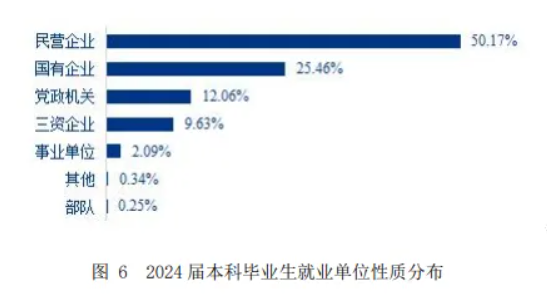
The employment areas of graduates are mainly concentrated in Beijing, Tianjin, the Bohai Rim Economic Zone and the southeast coastal economic region. Among them, employment in Tianjin, Beijing, and Hebei accounted for 61.98% of the total number of contracted graduates. Among the employment destinations of the 2024 graduates, 14.15% are in party and government agencies and public institutions; 25.46% are in state-owned enterprises; 9.63% are in foreign-funded enterprises; and 50.17% are in private enterprises (see figure).
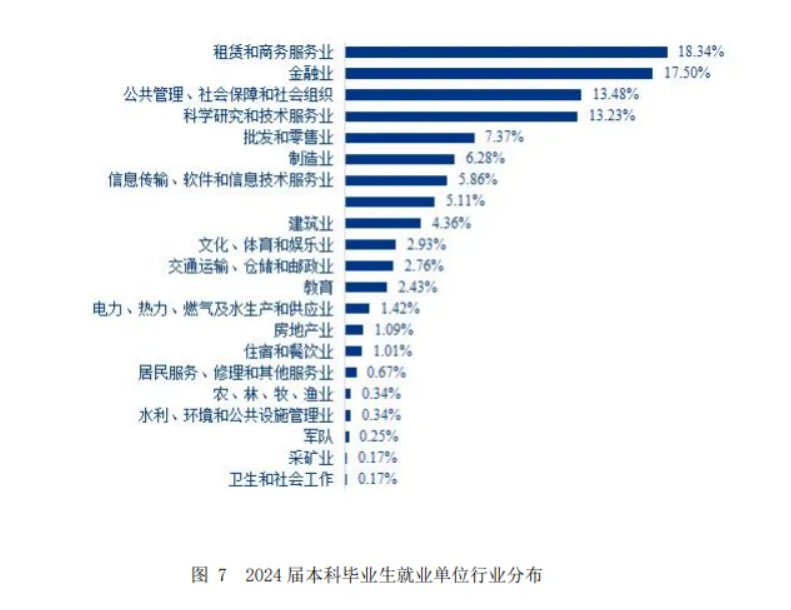
The financial industry, accounting firms and other units are the main employment destinations for our school graduates. The number of graduates working in financial industries such as banking, insurance, and securities accounts for about 17.50% of the total number of employed graduates, and the number of graduates working in the leasing and business service industries represented by accounting firms accounts for about 18.34% of the total number of employed graduates (see figure).