The employment trends of graduates have attracted much attention from society. According to statistics from the Ministry of Education, the number of college graduates will reach 10.76 million in 2022, an increase of 1.67 million from the previous year. Both the scale and the increase have reached a record high.
Generally speaking, colleges and universities will release a report on the employment quality of college graduates every other year, which also serves as a reference for the destination of college graduates this year. Has the epidemic in the past two years affected the employment of graduates? Are there any new changes in going to graduate school and studying abroad? We sorted out the employment quality reports of graduates from nine double-first-class universities in Shanghai in the past three years and found these characteristics…
The overall employment rate will rebound in 2021
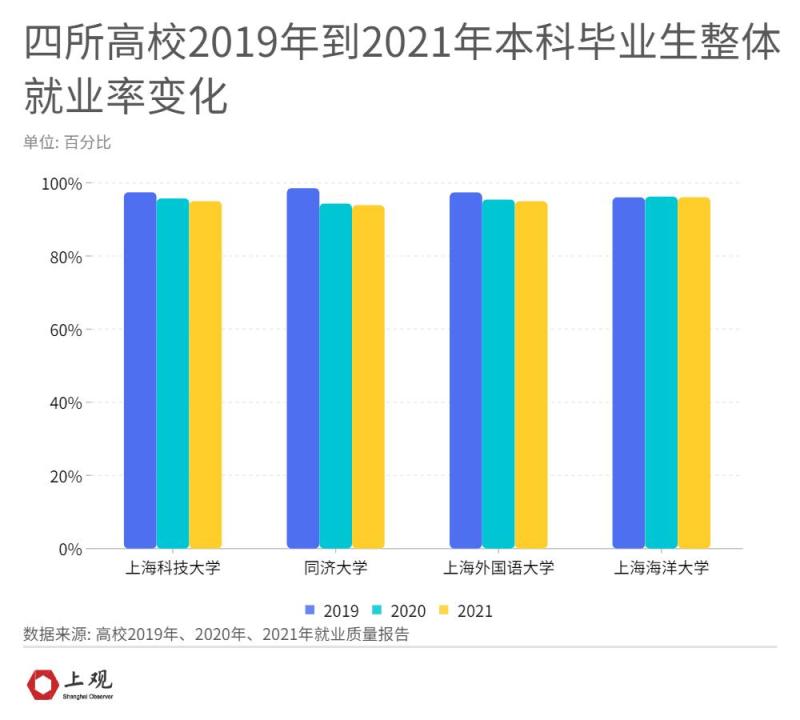
Affected by the epidemic, the overall employment rate (employment rate + admission rate) of nine colleges and universities has declined in 2020, with an average decrease of 2.29%. However, in 2021, the overall employment rate has rebounded slightly, with an average increase of 0.37%.
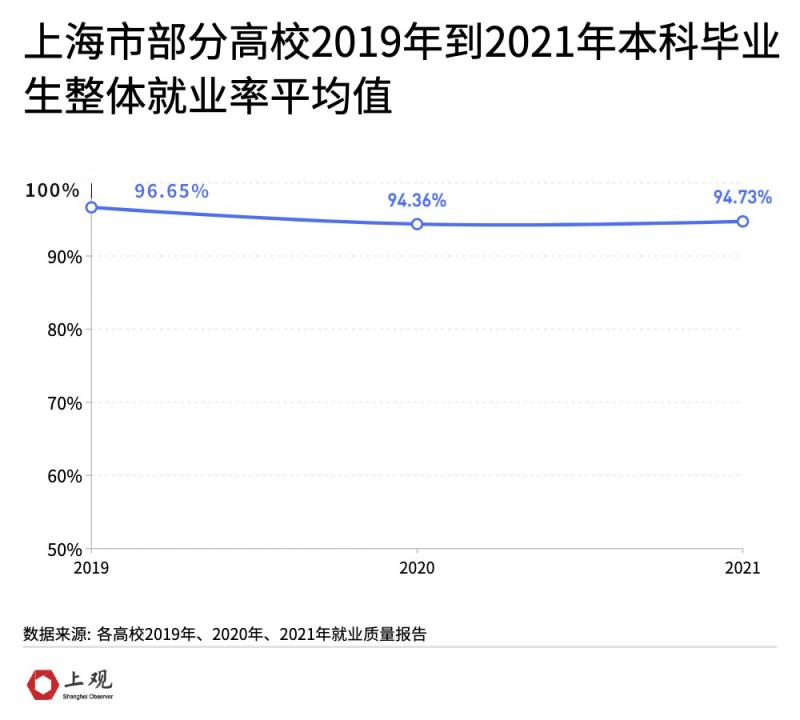
Among the nine double-first-class universities, more than half of the schools have begun to recover their overall employment rate.
Among them, the overall employment rate of Shanghai Jiao Tong University (excluding medical school) has the largest increase in 2021, an increase of 2.06% compared with the same period in 2020, which has exceeded the level of 2019.
The overall employment situation of East China Normal University (non-publicly funded normal students) is also close to that of 2019, with an increase of 1.27% compared to 2020.
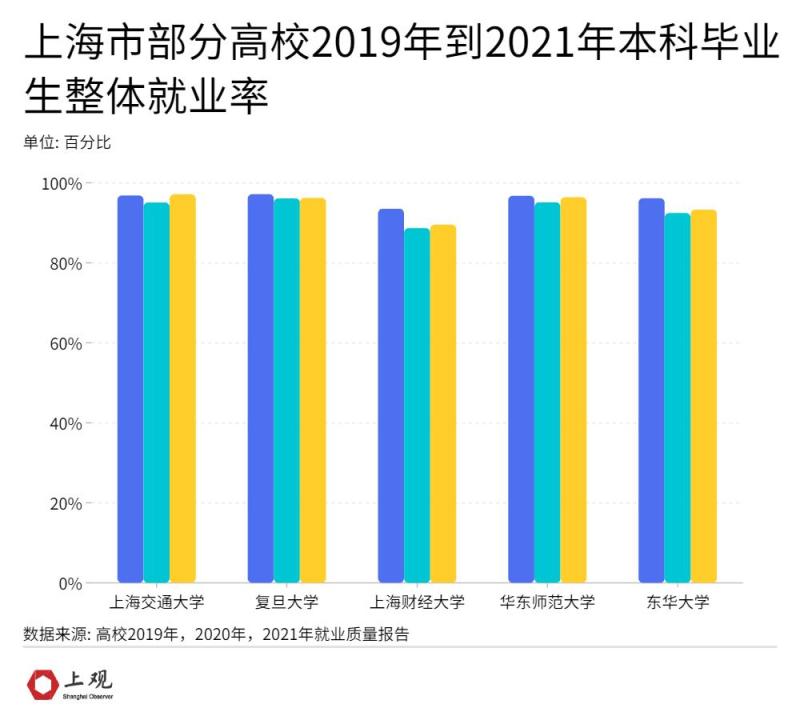
Although the overall employment rate of the remaining four universities (Shanghai University of Science and Technology, Tongji University, Shanghai International Studies University, and Shanghai Ocean University) still declined, compared with 2020, the decline was smaller, between 0.1% and 0.7%.
If you analyze carefully, you will find that the decline in the overall employment rate of these universities is related to the decrease in studying abroad.
A vertical comparison of the employment data of undergraduate graduates of Tongji University in the past three years shows that the proportion of contracted employment has not decreased, but has increased. Compared with 2019, the contracted employment rate in 2021 increased by 3.23%.
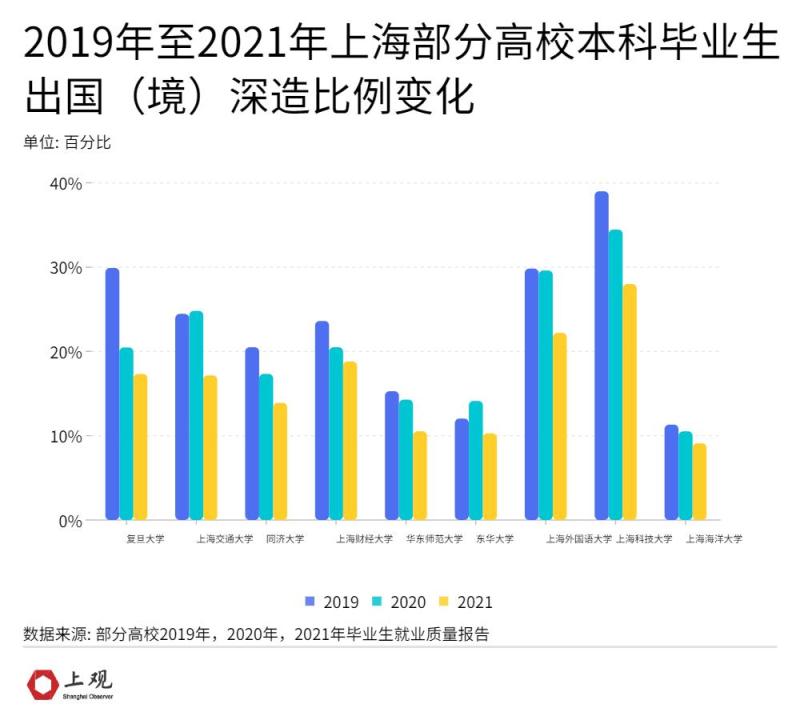
The biggest change is in the proportion of people going abroad. In 2019, Tongji University's proportion of going abroad (overseas) was 20.50%. Affected by the foreign epidemic, the proportion of going abroad (overseas) continued to decline in 2020 and 2021. In 2021, it was only 13.90%, which was a decrease of 6.6% compared to 2019.
Not only Tongji University, but also the other eight double-first-class universities have seen a decrease in their proportion of overseas study.
Compared with 2019, the overseas study rates of the nine universities dropped by an average of 6.51%. Among them, the overseas study rates of Fudan University and Shanghai University of Science and Technology dropped the most, falling by 12.57% and 11% respectively.
The main reason for the decrease in the number of people going abroad for further study is the uncertainty caused by the COVID-19 epidemic and the increase in travel costs and risks.
Yu Ang (pseudonym) graduated from Fudan University majoring in English translation in 2021 and now works for an Internet company. She is one of the few students who chooses to work after graduation. She admitted that she had considered studying abroad when she was about to graduate. However, the epidemic abroad was severe at that time, and there was a high probability that online classes would be required. “So I thought I would have the opportunity to study abroad again in the future, so I might as well find a job first.”
The trend of studying for graduate school is on the rise, and the number of people at the grassroots level is increasing.
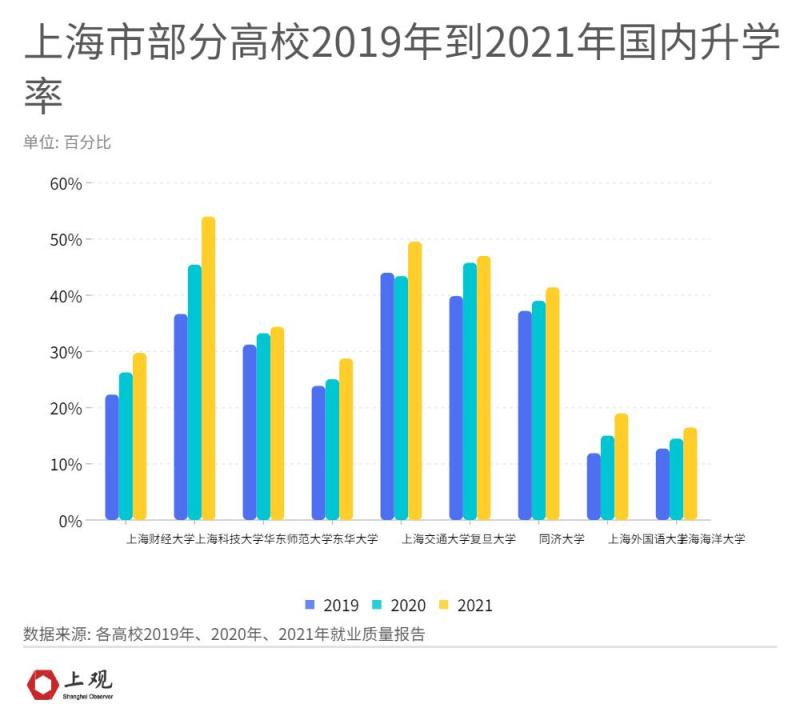
Contrary to the cooling of going abroad, the popularity of studying abroad continues to rise. Compared with 2019, the proportion of domestic admissions for nine universities in 2021 has increased, with an average increase of 6.73%.
Whether in terms of growth or proportion, ShanghaiTech University has the highest popularity for postgraduate studies.
In 2021, the proportion of ShanghaiTech University's domestic studies will reach 54%, and more than half of the students will choose to study domestically, an increase of 17.33% compared with 2019.
In addition, Shanghai Jiao Tong University (excluding medical school), Tongji University, and Fudan University are also very popular in domestic admissions, accounting for more than 40%, and Shanghai Jiao Tong University and Fudan University will also account for nearly 50% of domestic admissions in 2021.
In addition, the number of selected students has also increased.
Although most schools are not detailed in the report, we can still get a glimpse from the data of Shanghai Jiao Tong University and East China Normal University.
In 2021, a total of 342 graduates from the main campus of Shanghai Jiao Tong University will find employment in national defense science and technology units and the military, an increase of 32 from 2020. 222 graduates from the main campus of Shanghai Jiao Tong University in 2021 were hired as targeted transfer students in 27 provinces (autonomous regions and municipalities), an increase of 16 from 2020. Most of the selected students stayed in the central and eastern regions.
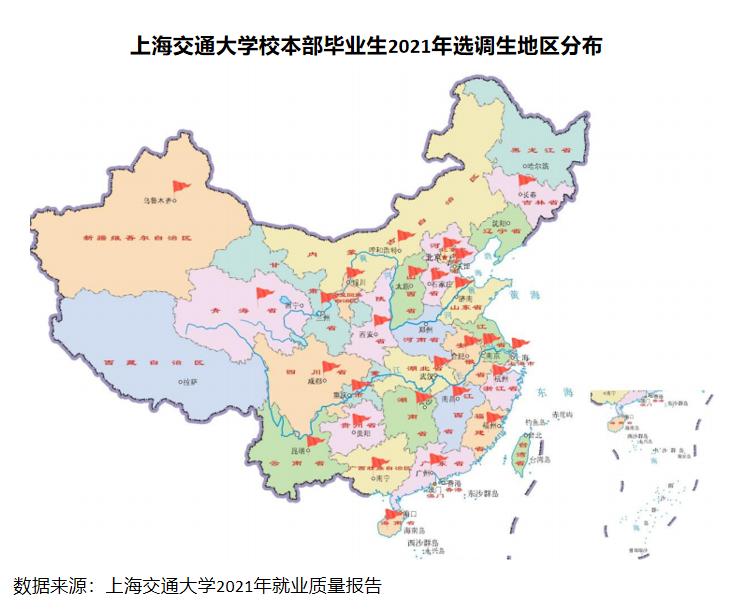
In recent years, the number of targeted transfer quotas in Shanghai has continued to increase, from 100 people in 2019 to 150 people in 2020, and then to 211 people in 2021.
At the same time, Shanghai’s selected students favor local universities. Among the 211 targeted selected students announced in Shanghai in 2021, the number of students admitted to local universities in Shanghai reached 128, accounting for 60.66% of the total number. Judging from the recruitment of selective students in Shanghai over the years, the number of fresh graduates from Shanghai's nine 985 and 211 colleges and universities who choose to apply for selective students has basically been increasing year by year.
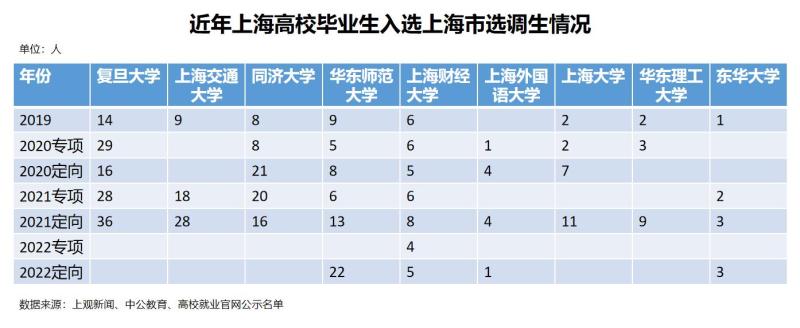
In addition to the selection of transferred students, the Western Volunteer Project and the Three Support and One Assistance Project also frequently appear in employment reports of colleges and universities. This reflects, to a certain extent, contemporary college students’ understanding and support of serving the national development strategy.
Yang Yunchang, a 2018 undergraduate student from the History Department of Fudan University, was selected as a targeted transfer student in Guizhou Province. In his sophomore year, as one of Fudan's first batch of student team members stationed in villages for poverty alleviation, he went to Mayor Yicun of Tongren City, Guizhou Province to follow the first secretary in the village to carry out poverty alleviation work. This experience made him appreciate the hardships of grassroots work and also learned a lot from village cadres and colleagues. Yang Yunkang's father became a village poverty alleviation cadre after retirement. Inspired by this spirit, he came up with the idea of returning to his hometown of Guizhou and joining the grassroots.
Information technology service industry remains a popular employment choice
In terms of employment, which industries do graduates go to?
Overall, the information transmission, software and information technology service industries are most favored by college graduates. Among the 10 colleges and universities included in the statistics, the number of employees in information science-related industries ranks among the top three.
Taking Fudan University and Shanghai Jiao Tong University as examples, among the 2021 graduates of Fudan University, 955 people have signed/contracted employment, accounting for 29.61% of the total number. Among them, 21.57% of graduates choose the Internet, software and information technology service industry.
At Shanghai Jiao Tong University, this industry is not only popular among undergraduates, but also a popular choice for master's degree graduates. The number of undergraduates (class of 2021) engaged in the information technology service industry is 240, and the number of master's students is 1,075, which are 2.35 times and 2.27 times respectively the number of people engaged in manufacturing (the second most popular industry).
This is followed by industries such as education, manufacturing, finance, leasing and business services.
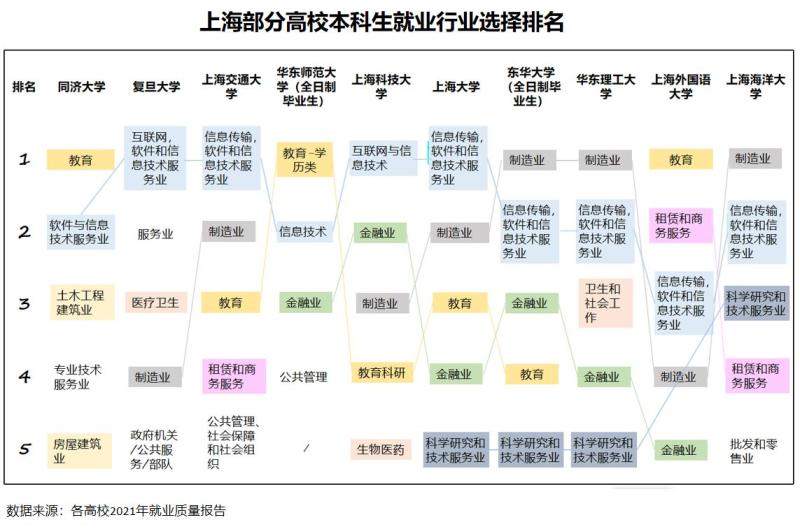
This option may be extended to the graduating class of 2022.
According to the 2022 College Student Employability Survey Report released by Zhaopin Recruitment, although the growth rate of recruitment in the Internet communications industry has slowed down or contracted last year, it is still the industry most favored by graduate groups.
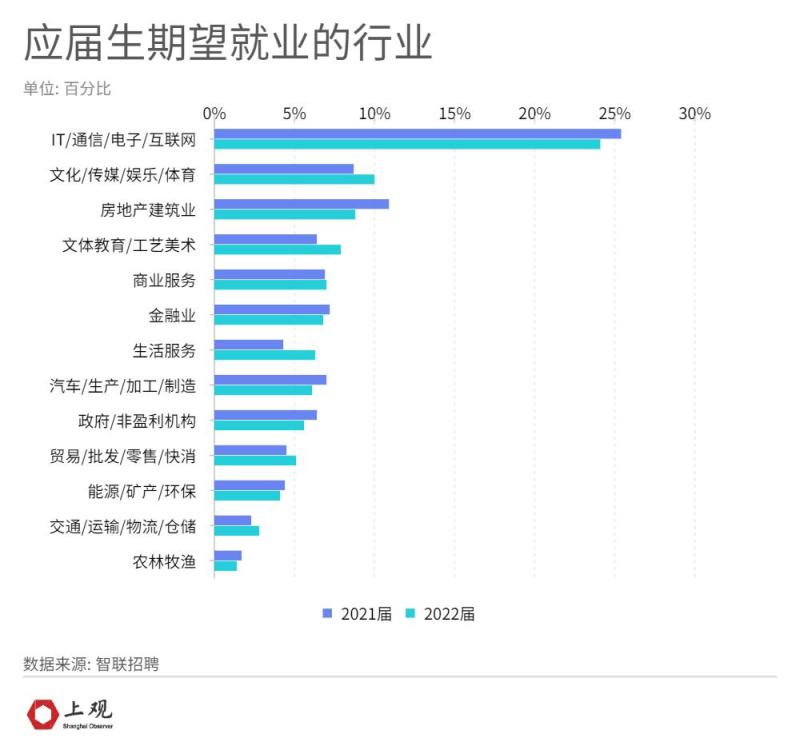
The career rankings expected by graduates are related to the salary levels of various industries.
According to the average salary data of employees in different industries disclosed in the "China Statistical Yearbook-2021" released by the National Bureau of Statistics at the end of 2021, the top three average wages of employees in non-private units are: information transmission, software and information technology services, scientific research and technical services, and the financial industry; among private units, the top three average wages of employees are: information transmission, software and information technology services, finance, and scientific research and technical services.
Note: According to the list of double-first-class universities in the second round of construction in 2022, Shanghai's double-first-class universities include 15 universities including Fudan University, Tongji University, Shanghai Jiao Tong University, East China University of Science and Technology, Donghua University, Shanghai Ocean University, Shanghai University of Traditional Chinese Medicine, East China Normal University, Shanghai International Studies University, Shanghai University of Finance and Economics, Shanghai Institute of Sport, Shanghai Conservatory of Music, Shanghai University, Shanghai University of Science and Technology, and Naval Medical University. Among them, the data of Naval Medical University, Shanghai Conservatory of Music and Shanghai Institute of Sport are missing.