There are two basic principles for survival in the speculative market: trading with the trend and strict stop loss.
Soros believes: "Investment itself has no risk, only out-of-control investment has risk." The charm of stock compound interest depends on your risk control awareness and ability. Some people often say, "In stock trading, you must first protect your capital, and in stock trading, you must first avoid losing money." The only effective way to achieve "capital preservation" and "no loss" here is to stop losses.
A person who loses money always ignores news that is not good for him, intentionally or unintentionally, and instead looks for reasons that are conducive to persuading himself to stick to his mistake. Naturally, there are only two final results. One is to insist on not losing money, and finally become completely desperate and lose money. A small flame failed to extinguish the fire, burning a big hole in your account that you will never forget. The other is that a rise will come, but the harm of this is also great. If the rebound is successful, the subconscious mind thinks that it is right to endure without stopping the loss, which encourages one's luck and shakes one's discipline in executing the trading system. The barrel principle tells us that if there is a problem with any wooden board, the system will not be able to run smoothly, and hidden dangers have been laid in our own trading psychology, and we will no longer strictly abide by discipline.
There is a phenomenon in nature called "gecko tail docking", which means that when a gecko encounters an emergency that threatens its life, it will automatically cut off its tail to allow it to escape safely. "Gecko tail docking" is essentially a typical self-rescue behavior. Humans and animals are different, but the measures for safe self-rescue are basically the same. The stop-loss rule is to allow you to exit quickly with the minimum loss to avoid greater losses. The core purpose of the stop-loss rule is to stop losses in time to preserve your strength. The core principle of the stop loss rule: Don’t make a mistake if you see it wrong, and trade a small loss for a big win.
It is much easier to stop the loss with a light position than to stop the loss with a full position. It is better to lose less than to lose. In this way, you are back to the path of the trading system. First, the entry point is not chosen well. Many people chase the price to the top of the mountain and buy just in time before the correction. A slight correction is enough to stop the loss. If you don't stop the loss, take a shallow position and stop the loss, you will lose more. Naturally, it will be more difficult for you to stop the loss. Just after the stop loss, the stock will go up again. How can he believe in the stop loss? Some will continue to add positions, share the losses, and then start to wait for the People's Liberation Army, waiting for the gift of rising prices at the whim of the market adults.
Only when you are alive can you have the capital to talk about time, and only when you have capital can you be qualified to talk about profits. Since you have formulated a trading model that suits you, you must strictly implement it. Within the prescribed holding time, if the stock price does not meet expectations, it can only mean that the buying decision is wrong. In the event of a buying error, it is necessary to control risks and reduce losses through reasonable selling in a timely manner. Because humans are higher animals with consciousness and are easily bound by inertial thinking. At this time, they need an iron discipline and use stop loss execution to protect each of their transactions. You must know that the stock market is anti-human. Panic and greed will always affect your plans, always making you take chances and prone to large losses. Plan your transactions and trade your plans. This must be guaranteed through execution.
Regarding the situation where the daily limit is repeatedly opened, let’s talk about our experience in three situations:
The first type is the daily limit single board. For stocks with the daily limit single board, investors are generally very optimistic about the stocks with the daily limit and will enthusiastically place orders at the daily limit price. Of course, it may also be that the main force uses the capital advantage to bid to raise the stock price. There are generally two reasons for the stock price to rise by the daily limit:
1. The company has sudden good news, and driven by the good news, the stock price directly opens at the daily limit price;
2. The stock has continuously raised the daily limit in the past few trading days, and then accelerated the daily limit opening.
For stocks whose daily limit has been opened, be very careful if the daily limit is opened. This generally means that after opening at the upper limit price to induce a large number of retail investors to follow suit and place orders, large funds flee at the upper limit price. Especially for stocks whose market has already responded favorably in advance, it is easy for stocks to open at the upper limit price and then open higher and then move lower and fall sharply.
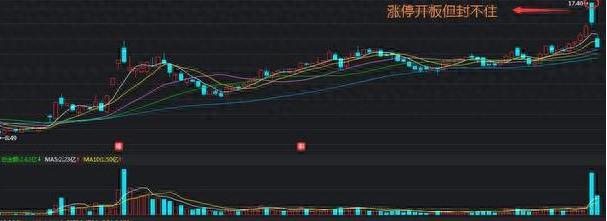
The second type is to quickly close the market at the opening of the market. Stocks that quickly close the daily limit at the opening of the market are generally stronger. The earlier the market is closed, the stronger they are. There are many stocks that quickly closed their price limits within a few minutes of opening, and then never opened again that day.
For example, if the market plummets midway, some stocks that have not reached their daily limit will plummet along with the market, while many stocks that have been closed can remain closed throughout the day.
Of course, since we are discussing whether the board is not firmly sealed, the main thing is to look at the situation of the board being blown. If a stock is quickly closed after opening, and the market is opened, you need to look at the reason for the opening.
If the market does not fluctuate much, but the stocks that have been closed appear to open repeatedly, and the trading volume is significantly enlarged, then you should be particularly careful about shipments at the daily limit. And if it is a short-term opening caused by the market's decline and diving, then it is not a big problem.
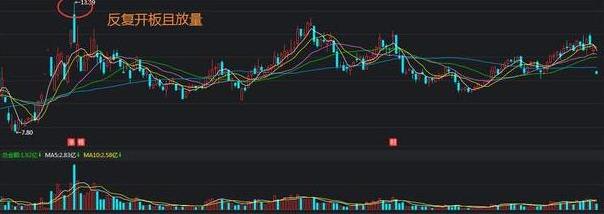
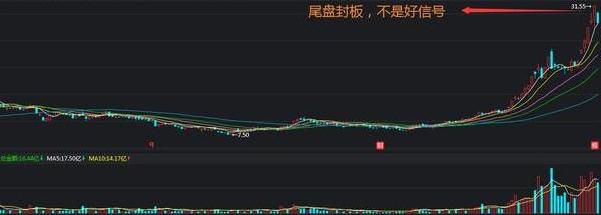
The third type is to quickly close the limit in late trading. You must be particularly careful about stocks that quickly close their daily limit in late trading. Veteran investors generally know one experience: late-day price increases are no good.
If a stock performs tepidly throughout the day and then suddenly rises in the last few minutes of trading, it is generally not a good thing. Many such stocks will open lower and then fall the next day.
This is because the stock is normal throughout the day and there is no obvious buying action. In the late trading, only a small amount of funds are used to raise the stock price using the time factor. The purpose is just to raise the stock price so that shipments can continue. The same is true for raising the stock price to the daily limit in the late trading. Unless large funds know the inside story of the stock in advance and buy goods in large quantities, the stock price will be quickly raised to the daily limit in the late trading and repeatedly exploded, usually for the purpose of shipping the next day.
The above three situations where the daily limit is not firmly sealed, different situations require different response strategies, and the choice needs to be based on the actual situation. At the same time, the market itself is ever-changing. These are just the common characteristics of a large number of stocks. They do not represent absolutes and are only used as a reference.
A form that can be chased up
1. A stock has been trading sideways for many days (usually more than a month). When the price starts to move upward, its volume can usually be estimated in the early trading. If the stock's volume can be nearly three times that of the previous trading day, it means that the price has an upward trend and will at least be stable. But remember it must not exceed four times. Judging from past experience, if it can generally rise to 5% around 10 o'clock, you can consider intervention. Generally, there will still be a rise after the daily limit in the market outlook.
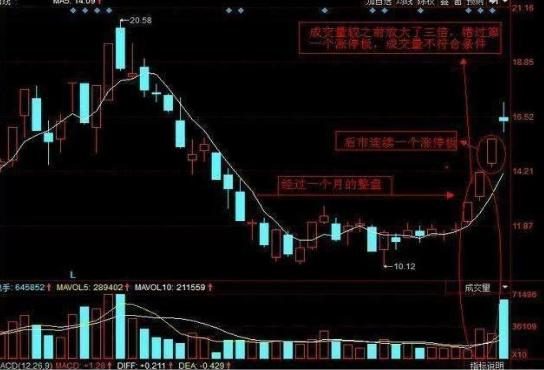
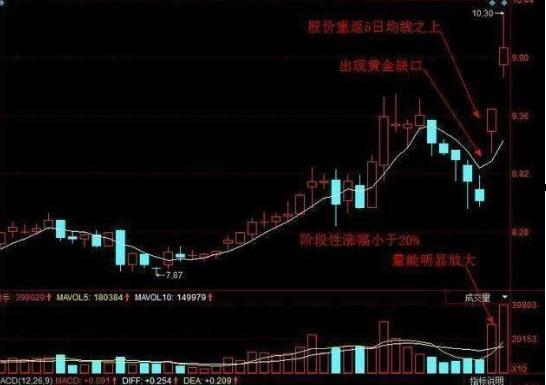
2. Strong gapping and gapping up are a major sign of strong price. If there is no sign of covering, the price will be in a strong range for some time in the future, and short-term operations are of great significance! One thing to note is that the price should not increase more than 20% from the start before forming a gap! (To be on the safe side, do not chase if it exceeds 20%.) As shown in the figure below:
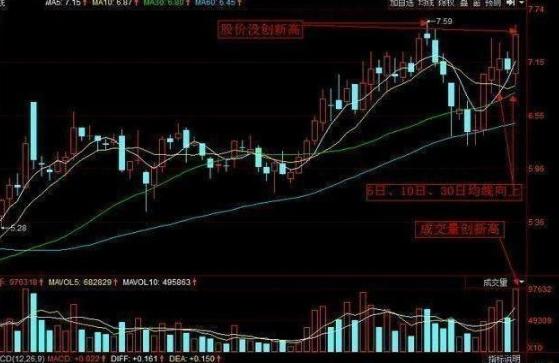
3. For stocks whose trading volume has reached a new high but the price has not reached a new high, at the same time, the three short-term moving averages (MA5, MA10, MA30) are upward at the same time.
In the shape of this stock, the upward moving average indicates that the stock is still strong, and at the same time, it has reached a new high in volume before the price has reached a new high. This shows that the main force has obvious intentions of overcoming the top and raising the price to a new high, and there is often still a lot of room for growth later. Case: as shown below.
Four tips for chasing the daily limit
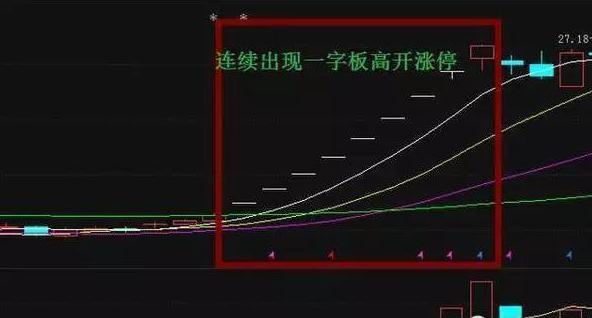
1. Continuous one-word daily limit
Operation points:
1. The mid-term moving average of 60 days has gradually become flat, and the short-term moving average of 20 days has flattened, showing signs of extending upward. The ultra-short-term moving average 10-day moving average and the 5-day moving average are arranged in a long position.
2. During the consolidation period, the trading volume showed a right-sloping shrinkage, and the shrinkage reached an extreme, and the land volume structure was very obvious.
3. In terms of K-line form, it has recently been a group of finishing K-lines with alternating yin and yang, with crosses and small hammers appearing alternately.
4. From the perspective of trading indicators, the MACD indicator has made a golden cross below the zero axis, emerged from the horizontal plane, and started to turn red.
2. The third line bloomed at the opening, and the intraday rise was gratifying.
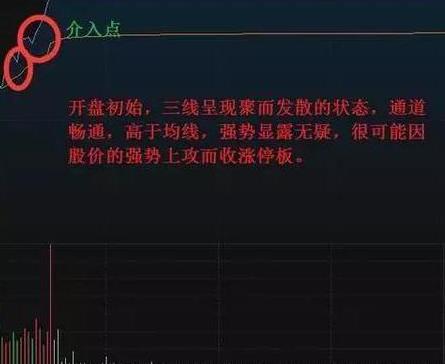
The core of the operation: It may be that when the stock price consolidates after a wave of rise, the stock price line turns upward again from being close to the moving average.
3. Cleverly use the dosage ratio to catch the daily limit
Operation points:
1. After the call auction at 9:25, rank the volume ratio and select stocks with a volume ratio greater than 5 and a stock price increase of less than 4%;
2. Choose one with a small amount of circulating capital, preferably less than 300 million, especially small and medium-sized boards;
3. Select stocks whose opening prices break through key pressure levels.
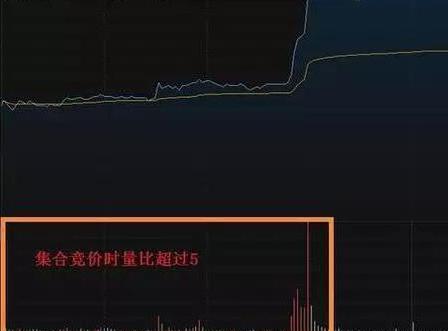
Core: Trading volume analysis is of great significance to technical analysis of stock prices, and the most important tool for analyzing trading volume is the analysis of volume ratio and turnover rate data. This is the most efficient and important secret weapon for studying trading volume.
4. The daily limit breaks through the 72 moving average
Operational points: When the stock price falls back to this position and there is obvious support, don't think too much, just buy. The stabilizing form in the illustration and the moment of subsequent breakthrough must be carefully understood. The best buying point is this point.
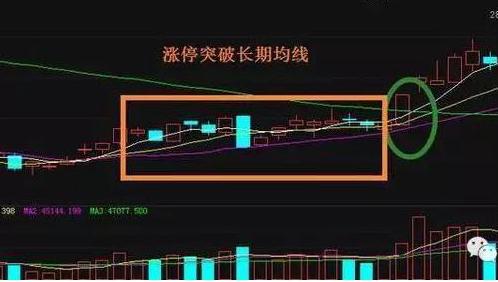
Core: Many stocks have experienced major blowouts because their daily limit has exceeded this line. For the large-scale adjustment of the market and the failure of the medium-term moving average, the strongest support is here.
Things to note when chasing the daily limit
1. The timing of the daily limit is sooner or later: the earlier is better than the later; the first to hit the limit is much better than the one to hit the limit at the end of the day;
2. When the daily limit is about to be closed for the first time, a small turnover rate is of course better than a large one;
3. What is the shape of individual stocks: it is better to suddenly hit the daily limit after consolidating for a period of time than to raise the daily limit after continuous rises; it is also okay to start to rebound by the daily limit after a continuous sharp decline; it is better to have a heavy position than a light one;
4. Market situation: If the market falls sharply today, it will be even worse if the market breaks. If there is a daily limit, don’t chase it;
5. The first daily limit is better, but don’t chase after the second consecutive daily limit;
6. It is safer to chase stocks that open high and move high. The best opening price is the lowest price.
You need to pay attention to these seven points when buying price limit:
(1) In a very strong market, especially when about 5 stocks hit their daily limit, you should boldly chase the limit. In an extremely weak market, you must not chase the daily limit, as the probability is relatively small.
(2) Chasing the daily limit – select new stocks with a theme, which have been slightly consolidated for a few days after being listed, and then suddenly jumped short and opened high and hit the daily limit on one day; secondly, select stocks that have been consolidating at the bottom for a long time without rising sharply or raising the daily limit; thirdly, select strong stocks that have been rising for a period of time and then the strong consolidation ends and then reach the daily limit.
(3) The daily limit must be reached. Do not chase when the daily limit has not been reached (even if it is one point short of it). Once you find that the main force has more than three digits of volume hitting the daily limit, you should immediately pursue it and move quickly and ruthlessly.
(4) We must adhere to this operating style and do not change our minds, so as not to get involved in other stocks and lose the opportunity to attack when the market has no daily limit.
(5) Search the price increase ranking list in a timely manner during the day, and check the current price, previous trend and circulation size of stocks that are close to the daily limit to determine whether they can be targeted for intervention. When the increase reaches more than 9%, you should be ready to buy, in case the main large orders close the limit and cannot be bought.
(6) The trading volume of the chasing stocks on the day should not be too large. It is generally 1-2 times that of the previous day. It can be easily calculated half an hour after the opening of the day.
(7) When the entire sector starts, the one who reaches the daily limit first is the leader. This is especially true in a bull market or a very strong market. If you want to catch up, the one who reaches the daily limit first is the leader.
Practical signals for retail investors to sell
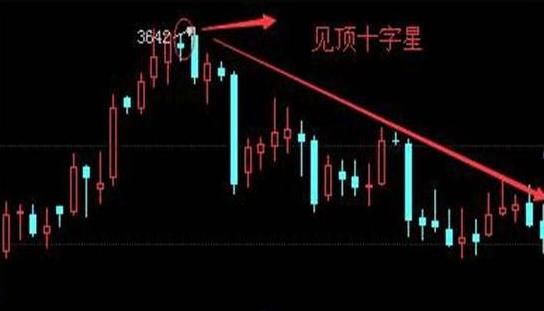
1. High Cross Star
After the stock price has risen a lot, if a cross star, inverted hammer-shaped positive line or negative line appears on the K-line, it means that the stock price has peaked and can be regarded as a sell signal. The trend of the high cross star on the daily K-line indicates that there are strong differences between the long and short parties. The situation is likely to change from a buyer's market to a seller's market. The market will turn around. Investors should avoid risks at this time and ship in time.
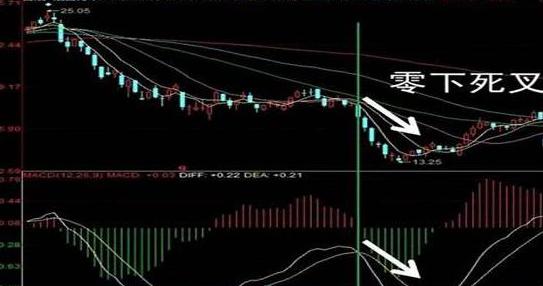
2. MACD appears a dead cross signal
After a sharp rise, the stock price went sideways and formed a relatively high point, and the MACD indicator showed a dead cross, which can be regarded as a sell signal. The high point formed at this time is often the highest point of a bull market. If you do not seize the time to escape smoothly, the consequences will be disastrous. It is worth noting that investors should not wait until the MACD Death Cross is completely formed before selling, because the MACD indicator has its own lag, and the stock price has often fallen a lot after the Death Cross is completed. Selling at this time will inevitably lead to serious losses. You should sell as early as possible when the MACD Death Cross trend has been scheduled.
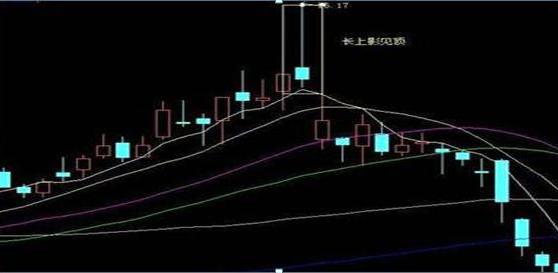
3. The stock price has a long upper shadow line
If the stock price rises for a period of time, a long upper shadow K-line chart appears at a relatively high level, and the stock price continues to move lower the next day, it indicates that there is greater upward pressure and heavy selling, and the stock price is likely to peak in the short term. At this time, the stock price cannot stand firm at a high level and is forced to move downward, leaving a long upper shadow line. At the same time, trading volume is often significantly enlarged at this time, indicating that the main force is eager to ship. Corresponding to this situation, investors should sell when the stock price is relatively high on the day when the long upper shadow line appears, or to be on the safe side, sell as soon as possible when the stock price is determined to be lower the next day.
Factors for success, analyze yourself, know yourself, and find a trading system that suits you
1. Control your trading emotions. Even if you enter the right market at the right time, if you cannot control your emotions, you will still not succeed.
2. Control your positions and use leverage carefully. A position that is too large can easily fall into a loss trap, and a leverage that is too high can easily turn time into an enemy. Both of these will greatly affect emotions and affect execution. Basically all large losses are related to this.
3. Exit needs to be executed resolutely, even if it feels very wrong. You can improve the trading system and do a series of backtests after the execution. Never change the exit strategy temporarily.
4. There are many opportunities to enter the market, unless your system filters too many signals. Before there is no market entry signal, in addition to waiting patiently, you can supplement other knowledge, or it can be romantic. Do not operate randomly and do transactions that you should not do. Even if you make money, it is wrong.
5. Simple. Don’t have too many system variables, as it is easy to overfit. No trading system can adapt to all market conditions. Only when the market operation switches to your system style and the wind comes, can it take off. At this time, focus and execution are the most important, and it is to test whether the historical odds are true. Earning the expected money at this time can not only fill in the pitfalls of other times, but also greatly enhance the confidence of the system designer. Any trading system makes money based on its trend. Once the market trend that meets the design expectations appears, if you cannot make money during this special period, you should deeply reflect on which link went wrong, or which system variable has a problem.