1. The media is an extension of people
Media is an extension of people
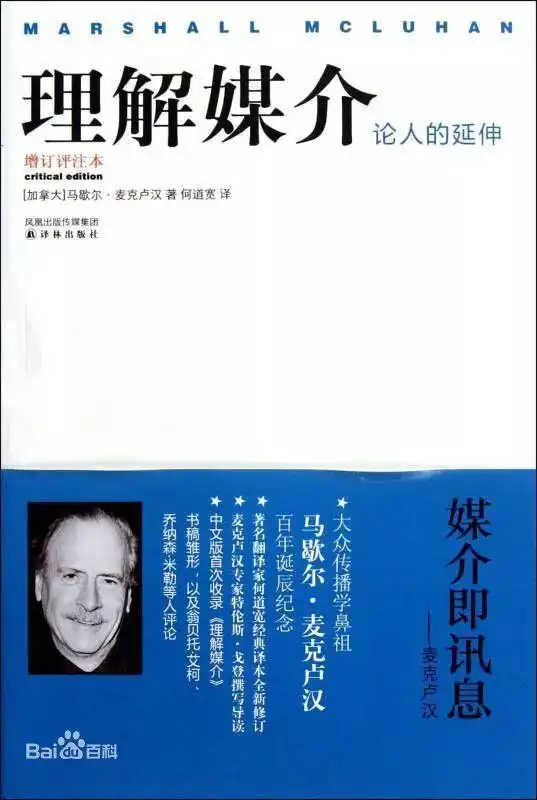
The subtitle of McLuhan's book is "On the Extensions of Man", and he believed that media, that is, technology, can be any extension of man. Here, it is particularly important to first understand the definition of "medium" in McLuhan's book.
McLuhan believed that media are all tools, technologies, and activities that extend the human organism. That is to say, everything is a medium, and any substance that can create relationships between people, people and things, or things and things is a medium in a broad sense.
So now it is easier to understand the sentence "the medium is an extension of people". For example, wheels are an extension of human footsteps, and clothes are an extension of human skin. As far as each media is concerned, they are extensions of different human organs. Newspapers publish valuable events, comments, and articles containing thoughts that occur throughout the day on their pages. Their essence is an extension of speech and vision. Broadcasting is a news form that plays sound, so it is an extension of hearing. Television can play rich and colorful picture information. It is to a large extent an extension of human vision, but it is more appropriate to say that television is a comprehensive extension of human visual, auditory, and tactile abilities. The VR (Virtual Reality) that we are developing vigorously today, under McLuhan’s definition framework, should also be an extension that integrates multiple human senses, and a higher-end extension.
McLuhan's view that "the medium is an extension of man" has its own historical background and profound implications. In the primitive form of tribalization, writing has not yet appeared, and the environment that people come into contact with is consistent with the environment that people can perceive; the scope of human activities is the scope that people can hear with their own ears and see with their own eyes. However, when writing and later print media appeared, human vision was extended, but other senses were divided and torn without extension. At this point, for the first time, human beings recognized the outside world and no longer had the narrow idea of "I am the center of the world." The primitive tribal state was also broken. The subsequent emergence of radio did not fully solve this problem. On the contrary, the Western pinyin writing and mechanical media of "split and cut, linear thinking, emphasis on vision, and emphasis on specialization" created "divided, dismembered, and mutilated people." It was the 1960s, and the United States was gradually transitioning from the steam age to the electrical age. The application of electricity ran through almost all disciplines in society, and communication was no exception. With the emergence and rapid development of television, a media that combines audio and video, this time humans have extended their vision and hearing in all directions. Human senses have gained a kind of balance and integration, returning to the pre-printing era of holistic thinking. This is a higher level of well-rounded person.
So far, human beings have gone through a process of "tribalization – detribalization – re-tribalization", and all parts of the world have become a "global village".
Any new invention and technology is a new medium, an extension of human limbs or central nervous system, and these media will in turn affect people's life, thinking and historical process. Written media affects vision, making human perception have a linear structure; audio-visual media affects touch, making human perception have a three-dimensional structure. French politician and writer Alexis Tocqueville once said: "Whoever believes that he can make a judgment about Britain in six months must be very foolish philosophically… However, it is much easier to obtain a clear and accurate idea of the United States than a clear and accurate understanding of Britain." Tocqueville compared the United States to a forest. Although there are many roads running through it, all roads meet at the same point. This is because Britain does not have a saturated publication that can achieve national identity for the whole of France like France; it also does not have a identity and continuity based on printing and printing culture like the United States. What Britain has is the complexity of a society with a feudal and oral culture. It adheres to the dynamic or oral tradition of customary law, only pays attention to visual or intuitive feelings, and does not form the habit of thinking under the printed culture. This also fully demonstrates that the media will in turn affect people.
2. The medium is the message
The medium is the message
The first point put forward in this book is that the medium is the message. For those of us with the rapid development of new media today, this point of view is somewhat unclear, let alone the 1960s when electronic media was just born. However, the idea that the medium is the message is a very important part of McLuhan's communication theory.
"From a social perspective, the media is the message." We usually think that the media is just a tool and a carrier, and the information it carries is what we really need and what has the main impact on this society. McLuhan believes that the content carried by technology takes away our attention, hinders our understanding of the media itself, and even damages our perception of the media. Our previous understanding was misled by the information content carried by the media. We blindly emphasize content first and only treat media as a tool. We believe that media as a form is actually not important. What is important is who this form serves, who uses it and how it is used. However, our views were dismissed by McLuhan as "unable to withstand examination" and "ignoring the nature of the medium." "It shows the dismemberment and extension of people in new technological forms, as well as the hypnotic state and narcissistic emotions that result from it." (This point will also be discussed in Chapter 4 of the book, which Mike Sweat calls "gadget lovers: numb narcissism.") In fact, the role of the media is not just a tool. The reason why our communication world is what it is today, the media plays a decisive role to a large extent.
Why is it said that the medium is the message? Let's use an analogy. Information content is like water. Water is intangible, but from another perspective, water is plastic, and the medium is like a container that holds water. The final state or shape of the water is actually the shape of the container. In other words, for the same content, using print media emphasizes the visual aspect and stimulates people's thinking; using radio to present the content strengthens the sense of hearing and pays more attention to the exploration of the content; when this text is rewritten into a TV program and broadcast on TV, although the "clarity" of the information is reduced a lot, it greatly increases the audience's participation. The same content, but the information we obtain is different, and the things we perceive from it are also different.
The information encapsulated by the media may be diverse, but the form of the media remains generally unchanged. The media "plays a role in shaping and controlling the scale and form of human combinations and behaviors", but "the content of the media is powerless to shape the form of interpersonal combinations." When humans use a medium, its impact on society and changes in people's way of existence are far greater than the specific information content loaded and transmitted to people by technology. Just as the invention and promotion of printing changed the shape of the world, helped the bourgeoisie sweep Europe with new ideas, and overthrew the feudal rule of the Middle Ages; just as the construction of today's world relies heavily on the Internet and web2.0. This is all brought to us by technology or media. At the same time, the influence of a medium is so strong precisely because another medium becomes its "content." The "content" of any medium is another medium, just as speech is the content of writing, writing is the content of printing, and printing is the content of telegraphy.
The emergence of each media has created a way for humans to perceive and understand the world, changed the relationship between people, and created new types of social behaviors. In the tribal society of the primitive era, speech was the main or even the only medium, which greatly increased people's participation in events and made people "deeply involved in their work and interpersonal relationships." However, the representative print media in the mechanical society separated people, and people's attitude towards events changed from "participation" to "detachment", and they began to think and integrate in a more rational way. The revolutionary power of media forms is evident from this.
3. Hot media and cold media
Hot media and cold media
McLuhan’s third ideological core is the theory of hot and cold media. Some people say that this was McLuhan's random statement, intentionally or unintentionally. It is just a speculation and has little scientific value. In the process of historical evolution, and in the process of media evolution, different media play different roles. Different media are not a process of substitution, but coexistence in development. In this way, studying the characteristics of different media is of great significance in understanding that media are extensions of people.
What are cold media and hot media? In other words, how to define and define the hot and cold media? McLuhan considered “clarity” to be its defining criterion. High definition is a state full of data, while low definition shows a lack of information. According to this standard, hot media will include radio, movies, books, speeches, newspapers, etc.; while cold media will include television, telephone, conversations, seminars, etc.
Some question McLuhan's criteria and argue that a medium such as television should be classified as a hot medium because it provides enough information. However, it should be noted that thermal media only extends one sense, while television is a comprehensive extension of multiple senses. Moreover, television provides too much information, and the human body cannot receive it all, quickly, and effectively. McLuhan also has an extended criterion for defining hot and cold media, which is the degree of participation required by the media. Hot media provides sufficient information and does not leave too many gaps for information to be filled, while cold media provides too little information due to low clarity, so it requires information recipients to have a high degree of participation and fill in the gaps themselves. According to this standard, television is indeed a medium with lower participation than newspapers, magazines or movies, leaving more room for the audience's imagination. "Physiologically speaking, the audience can only grasp fifty or sixty lines to form an image. Therefore, it needs to fill in the blurred image, be deeply involved in the screen, and constantly have a creative dialogue with the image." "This forces the audience to actively get involved and participate." According to McLuhan's idea of "the medium is an extension of the human being," the person watching TV becomes the TV screen, and the person watching the movie becomes the camera. Television requires us to constantly fill the gaps in the love mosaic network with information, so the television image can also "engrave its information on our skin." The audience of TV programs is constantly drawing new shapes and images. The essence is to be deeply involved and watch low-definition images with high participation.
Any hot medium allows less participation than a cold medium, so hot media is exclusive and cold media is inclusive. Therefore, any high-intensity experience must first be "suppressed" and compressed to a very cold level before it can be absorbed and learned by people.
In this view of the hot and cold nature of media, we have to mention the process of “tribalization-de-tribalization-re-tribalization” mentioned above. In primitive tribal societies, the main role is played by cold media, providing low-definition information but integrating most people into society. As Lewis Mumford said in "Historic Cities," Athens' heyday was its city-state period, a period when most democratic habits of rural life still prevailed. Because at that time, there were no various overheated media dividing society, and the entire society still advocated participation. This is also the benefit of a small country with few people, as everyone can participate in social governance. In highly developed urban centers, this phenomenon will not occur because "a highly developed environment provides people with few opportunities for participation, but requires high levels of specialized division of labor." In the 1920s, the so-called "golden age" of the United States, the overheated press even rejoiced in the blurring of President Yelitz's image, because his lack of clarity actually inspired members of the press to participate and fill in his image among the public. The development of electronic media has cooled down the overheated media. It uses an all-round extension of the senses to once again increase human participation to the level of primitive society, achieving re-tribalization.
4. The embodiment of "Understanding Media – On the Extension of Human Beings" in the new media era
The embodiment of "Understanding Media – On the Extension of Human Beings" in the new media era
In today's world, the problems caused by the use of mobile phones are becoming increasingly serious, especially its role in interpersonal relationships is more controversial. On the one hand, a portable Internet device such as a mobile phone allows humans to learn about things around the world in a small space and participate in them extensively through interactive modes. Mobile phones have greatly extended human senses and raised human participation to an unprecedented breadth and height. Human senses regain balance and integration, and people advance to become a higher-level, fully developed human being. On the other hand, mobile phones are alienating from the interpersonal relationships around users. Due to the high definition of the medium of mobile phones, and people's nature of knowing the unknown, people tend to ignore the real world and focus on the external world. All of this shows the importance of media to the human world, and explains how media extends to people's limbs and central nervous system, and in turn changes people's thoughts and behaviors, affecting people's life thinking and historical process.
In addition, the concept of "global village" mentioned by McLuhan has also become a reality. With the development of the Internet and the convergence and integration of the global economy, opportunities for time and space differences around the world no longer exist. Through social media, no matter where you are in the world, you can be the publisher and disseminator of news. You can also learn about real-time events, and global life is gradually synchronized. Some regional issues have gradually become global issues, and the concept of global village has truly become a reality.
5. Conclusion
Conclusion
Nietzsche once said: "Since understanding prevents action, by understanding the medium – the medium that extends us and provokes wars within and without us – we can control the intensity of this conflict." In this age of worry, we are experiencing an unprecedented "implosion", and we are also infinitely approaching the final stage of human extension – the stage of technologically simulating consciousness. The extension of human consciousness has had an impact on the entire psychological and social complex, and we have understood and considered too little about this in the past. In such an era, we must be deeply involved in the consequences of every action we take, and we cannot be detached from events. Therefore, we must understand the media, understand the media, control the impact of this implosion, and allow ourselves to be comfortable and comfortable in the wave of such a new media.
Reading list
Aquinas "Selected Political Writings of Aquinas"
McLuhan "Understanding Media"
Neil Postman "The Disappearance of Childhood"