Special topic guaranteed score plan Saturday report! This week’s topic: Mediatization
The topic of mediaization is not very common, but it can directly improve the accuracy of answers when answering questions.
It is a concept that seems a bit difficult to understand but is actually very practical. Use the concept of mediatization in questions related to Internet users, media governance, media industry transformation, and media social governance. It will directly make your answer stand out. This high score is not guaranteed~
Today, Bobo will take Aibao friends to see what content they need to master in this topic!
Thematic frame chart of this issue:
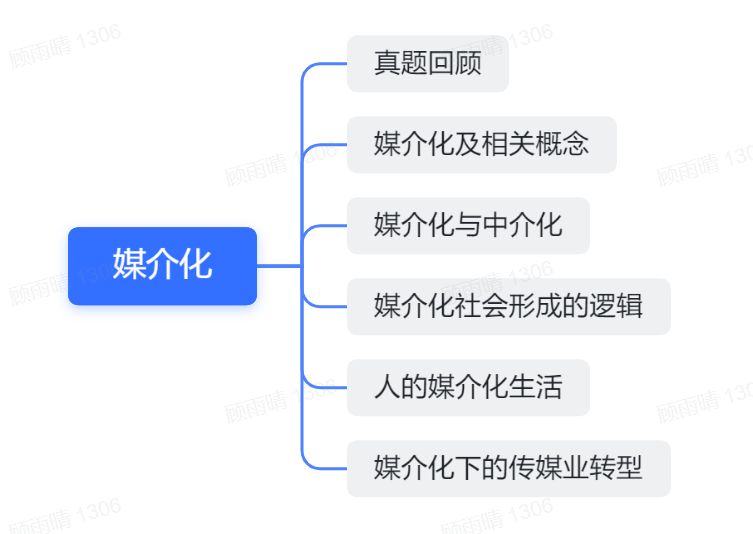
Review of past issues:
A 10,000-word explanation of media integration that scored 200 points pdf|Topic 01
The most difficult topic on Ma Xinguan to organize, here is a ready-made framework|Topic 02
The knowledge point of "Computational Advertising" that scored more than 30 points in the exam turned out to be so difficult | Topic 03
Media production and management, which have been tested over and over again, can be solved in one go with these templates|Topic 04
An article to clarify international communication, this must-examination topic focuses on these questions|Special Score Guarantee Plan 05
This may be algorithm knowledge that you have not paid attention to. Use 7 expert papers to tell you the high-scoring answers to algorithms! |Topic 06
"Zhejiang Propaganda" has become top-notch, and these new media about government affairs must be sorted out | Special Topic 07
Take the exam every year! Directly memorize the key points of communication effect theory|Special Topic 08
One test is worth 30 points! How should gatekeepers in the new media era score points | Topic 09
Only 0.001% of colleges and universities will not take the topic of media ethics | Topic 10
For Internet users with 170+ real questions, here are the ideas for high-scoring answers! | Topic 11
Review of real questions
Glossary:
Media materiality (term explanation, East China University of Political Science and Law 440, 2023)
Media logic (term explanation, Guangdong University of Foreign Studies 334, 2020)
Mediaization (term explanation, Beijing Post and Telecommunications 440, 2022)
Mediaized society (term explanation, Xiamen University 334, 2023)
Media governance (term explanation, Xi'an International Studies University 334, 2023)
Short answer questions:
The significance of mediaization theory to communication research (short answer questions, NTU Communication, 2020)
Briefly describe the materiality of media (short answer questions, Peking University Shenzhen College, 440, 2021)
How to understand the materiality of media (short answer, Wuhan University 440, 2023)
In the era of digital media, let’s talk about the understanding that everything is a media. (Short answer, Lanzhou University 440, 2023)
The connotation and important perspectives of French media studies (short answer questions, Jinan University 707, 2020)
Mediaization of culture (short answer, Shenzhen University 928, 2022)
The triple logic of media society (short answer, Shanghai University 440, 2023)
The difference between intermediation and mediatization (short answer questions, Beijing Normal University 829, 2023)
Provided a definition of intermediation, analyzed the connotations of mediatization and intermediation, and pointed out the differences between the two (short answer, Anhui University 815, 2023)
Essay question:
Discuss the reconstruction of social rules and commercial empowerment of live broadcast from the perspective of mediaization (dissertation question, Beijing Normal University, 723, 2021)
Discuss your understanding of the idea that everything is a media (essay question, Shandong University 334, 2021)
What do you understand by media studies? (Essay question, Fujian Normal University 872, 2020)
Peters asked in "Strange Cloud Media Existence" "Without ships, would the sea still be mysterious? Without fire, would nature still be violent? Without clocks, could time be perceived? Without writing, would human thinking still be ignorant?" Please share your thoughts on Peters's views. (Discussion, South China Normal University 610, 2023)
A piece of material about mediatization, analysis around the material (Material Analysis, Yunnan University 638, 2023)
A few sentences of material, the content is intelligent communication, intelligent communication technology, and mediaization of people) combined with this environment to discuss the impact of media environment characteristics on news production (discussion, Anhui University 622, 2023)
Combining the relevant theories and practices of journalism and communication, the strategies, methods and paths of media governance in emergencies are discussed. (Essay question, Xi'an Jiaotong University 440, 2022)
Combined with the mediaization shift in news communication research, discuss how media technology profoundly affects society (essay question, Minzu University of China 440, 2023)
Mediatization and related concepts
Mediatization refers to the new changes that have occurred in all aspects of society and in all walks of life due to the growth of media influence, which are reorganized according to the logic of communication. The process of mediatization is a process in which the logic, mechanism, and communication model of the media are used to profoundly transform all aspects of social life.
Media participation has changed the overall ecological environment of society and all social activities of people, and has become the infrastructure for reconstructing social, political and economic life based on the logic of content dissemination. The relationship between the media and people and society has reached an unprecedented closeness. Whether it is social organizations or ordinary people, everything from communication to expression of opinions, daily life, and economic development depends on the media.
The social role of the media is no longer just the producer of media content and the delivery tool of information content in the past, but has begun to become the activator, connector and integrator of social and political elements, economic elements and cultural elements, and the organizer, designer and promoter of social structure and operation.
In the face of the iterative development of digital media, Internet intelligent media technology has an impact on national politics, economy, and social development. As a basic component of human life, media has gradually developed into the basic way of structuring current social relations. The media subtly shapes people's perception of the external world, and has a profound impact on the public's daily life norms and thoughts and behaviors.
In the early days, "mediatization" was used to refer to the media's impact on political communication and other impacts on politics. Swedish media scholar Kent Asp first proposed the concept of "mediatization of social media life", which is a process in which "the social media system is not only greatly affected by the mass media's coverage of social media, but also self-adjusts to adapt to the needs of the mass media."

Media governance:
Media-based governance is a process in which digital technology is integrated and embedded into the original system, guiding and adding to traditional social governance, achieving innovative paradigms, optimizing logic, and improving capabilities. It is also a new strategy that uses media as governance objects, governance platforms, and governance methods.
From the perspective of results, media governance can achieve real-time positive interaction between governance subjects, precise drip irrigation of the governance process, hyper-temporal prediction of governance risks, and granular scaling of national governance in the virtual space constructed by the media. The overall governance shows the characteristics of high digitalization, virtualization, mediaization, integration, and precision. Media governance is not only a technology-driven upgrade of social governance, but also an innovation in governance thinking and concepts in the context of further integration of media with society.

Media logic:
Mediatization describes a process in which many mutually separated social and cultural processes gradually transform into forms suitable for media representation, which contains the direction of a media logic, that is, the media plays a powerful role, which is specifically reflected in the fact that it has a certain degree of autonomy and authority, and can make other systems more or less subject to media logic. Therefore, another meaning of mediatization is the way in which various fields of society present and interact based on media logic.
Media logic embodies "a way of viewing and interpreting social affairs. At the meso level, it means the rules for media organization selection and display; specifically at the micro practical level, media logic can be interpreted as how the core elements of cultural or social activities follow media principles and are expressed through media forms.

New new media:
Paul Levinso proposed a three-part theory of contemporary media, that is, media can be divided into old media, new media, and new new media.
Old media refers to all media before the birth of the Internet. They are media with constant spatial and temporal positioning, such as newspapers, radio, television, etc. The prominent features of old media are top-down control and production by professionals;
New media refers to the first generation of media on the Internet, which originated in the mid-1990s. Its defining characteristic is that once it is uploaded to the Internet, people can use, appreciate, and benefit from it, and they can use it according to the time convenient for the user, rather than according to the schedule determined by the media. Such as email, chat room, etc.;
New new media refers to the second generation of media on the Internet, which originated at the end of the 20th century and flourished in the 21st century. Examples include UTV, Wiki, Twitter, Second Life, etc. The defining characteristics of new and new media are: its consumers are producers, individuals can choose new and new media to express and publish that suits their talents and interests, new and new media have no top-down control, new and new media enable everyone to become publishers, producers and promoters, etc.
The characteristics of new and new media are: first, new and new media are generally free; second, most of them are non-professionals producing information; third, new and new media both compete with and promote each other; fourth, their consumers are producers; fifth, everyone can become the publisher, producer and promoter of new and new media; sixth, everyone can choose appropriate new and new media for self-expression or publishing based on their own interests and abilities.
mediatization and intermediation
The concepts of intermediation and mediatization highlight the key role of technology in the process and institutionalization of communication and communication actions.
01
intermediation
In essence, intermediation should be a micro or meso level concept. In media studies, intermediation refers to "the act of transmitting something through the media", which emphasizes the intervention role of the communication process in meaning creation.
More specifically, intermediation means the act of transmitting social knowledge and cultural values to audiences through an institutional public institution, which is regarded as one of the basic functions of mass media. Therefore, the mediation process describes a transformation. Mediation emphasizes the role of mediation and bridge. It is the connection or transformation of the relationship between two or more objects or elements, including the relationship between the subject and the object. Intermediation is a kind of connection, so the concept itself contains a certain inclusiveness that can accommodate what Kurdelli refers to as "the heterogeneity of various social transformations."
02
mediatization
Different from intermediation, "mediatization" is essentially a macro-level concept, and it is also reflected at both the meso and micro levels. It is an extension of media effects to macro-social effects, and its fundamental point is to use this concept to understand the complex social consequences caused by media.
But different from the traditional linear media effect theory, mediatization emphasizes that other social processes in widely different fields and at different levels cannot be separated from media and technology. On the one hand, it refers to the penetration of media into daily life practice, and on the other hand, it includes the interaction and influence of media with social and cultural systems. It can be said that mediatization is a social process in which society and culture, as well as interaction patterns, are changed due to the increasing influence of media.
The logic of the formation of media society
Mediaized society, also known as the mediaization of society, is the reconstruction of society according to the logic of communication. This is the most profound impact that the communication revolution represented by the Internet has had on society.
01
Media convergence provides technical support for a media-based society
Technological updates and iterations are the prerequisite for a mediatized society. The current integrated media is not only a direct actor in promoting social mediaization but also a catalyst for the in-depth development of media communication. Because new media technology is always integrating the advantages of all traditional media, constantly promoting the innovation of traditional media, and promoting the diversification of media communication functions and the breadth of services.
02
Information dependence constitutes the main traction force of media society
Mediated society reveals an interactive relationship between media and society. In this interaction, the media has a profound impact on society and then forms a reconstruction of society.
Society has developed a certain degree of dependence on the media, and this dependence is prominently represented by the audience's dependence on media information, which is the main force that promotes the mediaization of society. Audiences with subjective initiative rely on the information provided by the media to meet their needs and achieve their goals. At the same time, they cannot avoid the influence of the media.
03
Environmental construction reflects the media influence in a mediatized society
Mass media builds the information environment of a mediatized society and reflects its media influence. As an important information dissemination channel, the media can have an impact on the audience's social cognition, social judgment, decision-making and even social behavior. In a society with a high degree of mediaization, every field of society is imprinted with the media. From the macro-system of politics, economy and culture to the micro-level of families and individuals, the media will be profoundly affected.
Mediatized society, in essence, means the mediatization of people, or in other words, everyone is a "media person" under the profound influence of media. For people living in a mediatized society, not only their imagination of the world is mainly constructed by the media, but their way of thinking and individual consciousness are also imprinted with the imprint of mediatization.
Human mediated existence
01Media content as diary and notepad:
Mediatization of personal history
In the past, mass media mainly carried public history, but today, people can use various social platforms to record texts, pictures, and images about themselves at any time. These contents constitute a digital and mediated private diary or notepad.
When media content becomes a way of self-recording, it is inevitable that private content will become public. In the past, people mainly saw public content in the media. Occasionally, some private content entered the mass media because it had public value. But today, a large amount of private content has entered the public media, which also means that these private contents have become public. For individuals, the content they publish may continue to spread and extend in time and space beyond its original intention.
From the perspective of historical memory, although the Internet may make individuals' records of themselves more detailed and complete, because these records are based on various social platforms, people will also rely on the memory capabilities of these platforms. In the end, their own brain's memory of personal history may become blurry.
02Media content as performance props:
Mediatization of self-expression and self-construction methods
In the past, individuals' self-expression rarely had the opportunity to enter public media, but today, various social media provide a broad space for people's expression, which can be made public and interactive with others. Public self-expression often has a performance component, so media content actively produced by users has also become a prop for performance.
This also means that the content will have a filtered color. It is not necessarily a representation of people's real lives or thoughts, but has been beautified or modified. People may also use different content props and different performance strategies when facing different performance objects.
03Media content as “inducer”:
Mediaization of real behavior and life orientation
When media-based survival becomes the norm, people’s lives will increasingly be aimed at a sense of presence in social media, and real life becomes a repertoire in media performances. Media content not only reflects and records real life, but also becomes a guide for real life, and may even lead to the reversal of the causal relationship between real life and content released on the Internet.
In such a situation, there may be a certain conflict between real-life behavior and media behavior, such as "absence of presence" for the sake of content release. Media content production sometimes requires people to invest additional time and energy. People's lifestyles will also be increasingly affected by media content shared by others.
Social platforms have also broken past geographical and social class restrictions to a certain extent, helping people understand the lifestyles of other regions and other classes, and also inspired some people's yearning and pursuit of a better life. But at the same time, they may also exacerbate some people's anxiety and exacerbate people's lifestyle conformity.
Transformation of the media industry under mediaization
1. Value focus:
The new logic of relational connection replaces the old logic of information production
The reshaping of the media field caused by the new social communication structure brought about by digital technology is actually not only a change in the ecological pattern of the media industry, but more profoundly, emerging media has replaced traditional media as the leading force in the media field. The changes in the media industry's role, social positioning and development logic behind this pattern change are the changes in the value center of the media industry.
1. The role of the media industry has changed to that of a constructor of social relations in a deeply mediatized society.
Digital media, represented by Internet media and smart media, is a networked logic that no longer emphasizes direct content production, but rather empowers each individual and the entire society to create extensive value and create more functions through extensive connection and reconnection after empowering the right to produce and release information.
In this sense, the role of the media industry is not only the provider of public information, but also the constructor of the entire social relationship and the organizer of social life in a deeply mediatized society.
In the future social life, communication and media are more important to undertake the task of broadening, thinning and thickening online social life, that is, on the already formed extensive social connection platform, promoting the gathering, integration and coordinated development of social and personal resources and energy. In this way, the media must not only deal with content, but to a greater extent, enter into all aspects of the reconstruction of social life elements, and activate, connect and integrate social relationships under open conditions, that is, what it must deal with is the realization of connections or the establishment of relationships.
2. Traditional media should try to integrate with external complementary resources based on the open and collaborative new media development logic.
In the transformation of the media industry in which emerging media incorporates traditional media into the process of remediation, traditional media must adopt and adapt to the development logic of emerging digital media and rethink their own positioning and the new social relationships formed thereby.
Therefore, traditional media must adapt to the openness and connection emphasized by the logic of digital media, that is, use open logic to make new connections and reconnections with various political, commercial, and cultural "grand fusions" and personal resources, and explore the "grand fusion" model of commercial and cultural fusion with complementary resources from the outside world.
For traditional media, it is necessary to use the available resources based on the Internet platform, make good use of its local advantages and the advantages conferred by social status, and shift from a front-line content producer to a second-line role that provides professional support, value services and operational guidance for information production and dissemination.
2. Core resource media for practical operations:
Make good use of “new content” and big data
For the media industry, in a granular network society where the social structure is becoming increasingly discrete, there are two main ways to effectively establish connections and accumulate relationships: one is to use content services to integrate relationship resources, and the other is to use big data insights to achieve scenario-based relationship connections. Therefore, this requires the media industry to develop and utilize the two core resources of "new content" and big data.
1. "New generation content" content is to activate and form circles, communities and communities
Provide key underlying relationship resources
In addition to the depth value of content, its breadth value and intermediary value are increasingly apparent. Content has become the "social glue" in which everyone participates and penetrates into all levels of "society-individual".
Content as an expression of relationships has initially demonstrated the breadth value of content in inducing relationship identification and emotional resonance. The value measurement standard of content is being reconstructed. As long as it can trigger emotional resonance and bring together interesting people, such information content is valuable in the Internet and the Internet of Things; and these content with horizontal connection value are more likely to achieve accurate and efficient dissemination of insights.
In the new ecological pattern and under the new value logic, the media industry must get rid of the value narcissism and elitist thinking of "content is king", take content as the starting point of innovation, open up collaboration, give full play to the role of content as a "social mediator", activate social relationships between users, form distinctive social circles and communities, and provide the most critical basic relationship resources for social communication and collaboration.
2. Big data and algorithms enable multi-party analysis and insights and complete scenario-based relationship construction.
In the communication landscape of the digital age, big data and artificial intelligence are crucial resources and forces in the entire social operation, including content communication. The media’s dominant position in the fields of communication and social life must be achieved through the control of data sources, the development of data value, and the application of data algorithms.
Therefore, the key path for media to realize their own value through big data and algorithms in the future is to fully tap the value of the "field" of various users, rely on technical means such as big data and intelligent algorithms to define, understand and gain insights into user status and needs in specific scenarios in real time, and quickly find and push content, products or services that match their needs to achieve scenario adaptation.
It can be said that whoever builds the scenario-based connection between "people-content-things" is the creator of value realization; the ability and operational quality of new mainstream media and its workers to grasp big data and artificial intelligence are the key to determining its dominant value in future communication development.