If you have been to Pakistan in the past year, you may have been deeply impressed by a special landscape – dark blue solar panels shining on the rooftops of Islamabad, Lahore, Karachi and other big cities, and also dotting the front and back of houses in rural areas across the country.
For this country of more than 240 million people, which has long been plagued by high electricity prices and blackouts, an unprecedented solar revolution is taking place.
In early February, Pakistani Prime Minister Shahbaz announced the launch of a solar panel program in the Gilgit-Baltistan region, one of the most remote areas of the country, aiming to alleviate the long-standing local power shortage problem with clean and sustainable energy solutions. Due to the complex terrain and difficult climate conditions in this area, it has been difficult to connect to the national grid, and the power supply situation is severe. According to the plan, the government will provide solar systems to households and small and medium-sized enterprises to ensure stable and reliable power supply.
According to Ember, a global clean energy transition think tank, Pakistan imported 17 gigawatts of solar panels in 2024, more than double the previous year. In the first nine months of 2025, imports have reached 16 GW, making it the world's second largest importer of solar panels, with more than 95% coming from China. Pakistan is experiencing one of the most rapid expansions of solar energy on the planet, both in terms of installed capacity and speed of adoption.
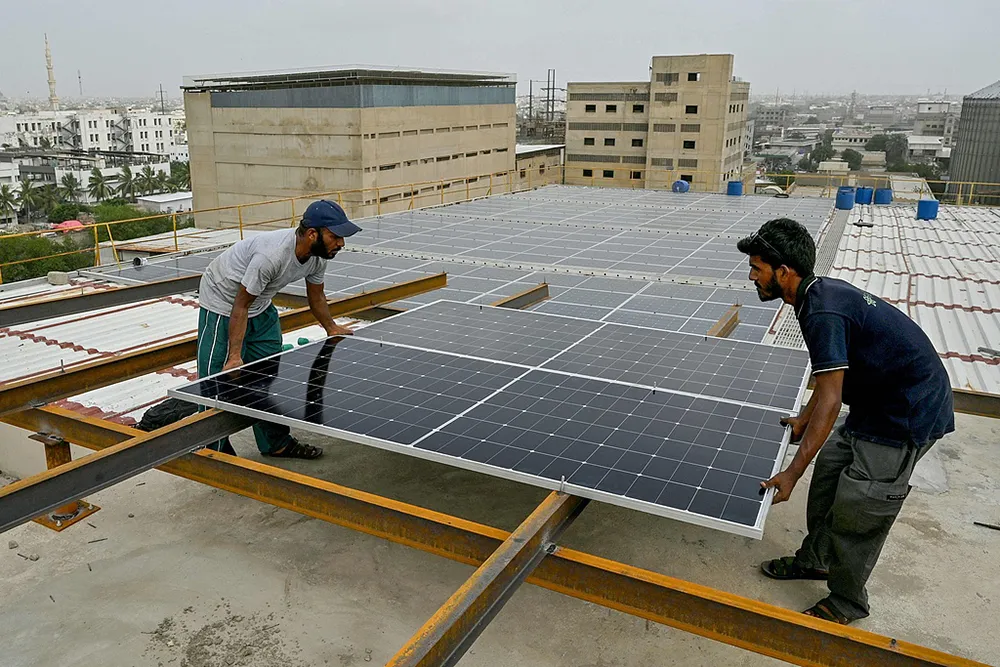
On July 2, 2025, in Karachi, Pakistan, technicians installed solar panels on the roof of a factory in the city. Visual China data map
Khurram Lalani, founder of Resource Future, an energy consulting company based in Islamabad, told The Paper (www.thepaper.cn) that compared with other countries in the Global South that are rapidly developing solar energy, what is special about Pakistan is that "no country can promote solar energy at such a speed and scale, and this is completely a bottom-up revolution. It is not led by the government or driven by large enterprises, but driven by ordinary people and market forces."
“The government didn’t even know the scale of the massive solar imports until some time after they happened,” said Muhammad Basit Ghauri, director of special initiatives and China projects at Renewables First, a Pakistani renewable energy think tank.
The background of this change is the global trend of transition to clean energy. In 2023, at the COP28 conference in Dubai, countries reached a consensus: to phase out fossil fuels in a fair, orderly and equitable manner, and to triple the installed capacity of renewable energy and double energy efficiency by 2030. The energy sector accounts for approximately 75% of global carbon dioxide emissions and is a key area for mitigating climate change. In 2024, more than 90% of the world's new electricity installed capacity will come from renewable energy, and the same trend will continue in 2025.
In this process, countries in the Global South are becoming the main driver of solar energy growth. According to analysis by institutions such as Global Energy Monitor, solar power generation in BRICS countries accounts for more than half of the global total. China plays a key role in this. China’s green technologies are reshaping the energy and market landscape in many places around the world—Pakistan is one of the most compelling stories in this global trend.
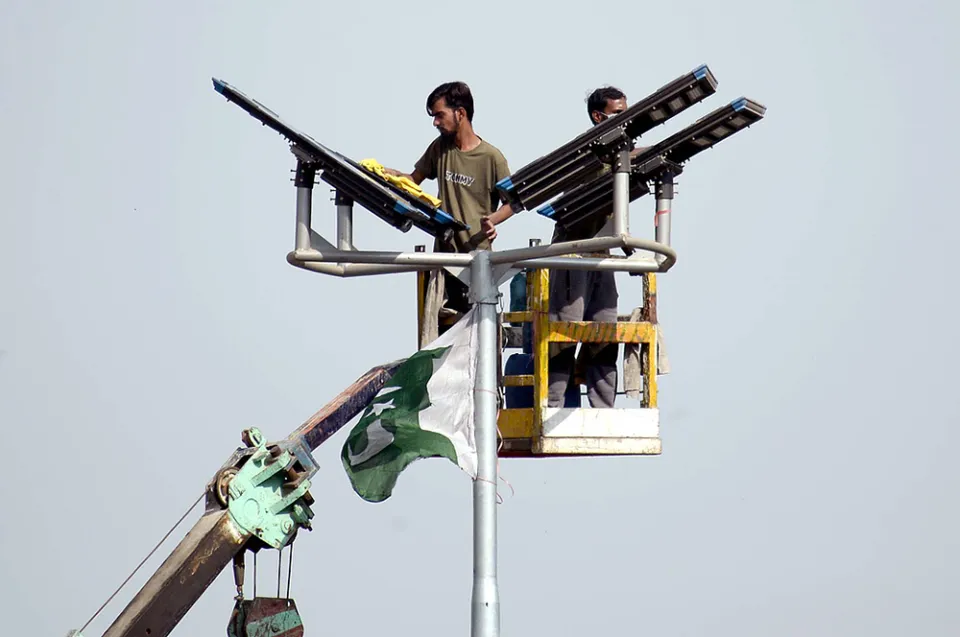
On December 14, 2025, in Karachi, Pakistan, technicians were performing maintenance work on newly installed solar street lights. Visual China data map
Why Pakistan?
In 2025, a landmark moment occurred in Pakistan's energy history: During the peak summer power consumption period, solar power generation exceeded the national grid for the first time. According to the Pakistan Institute of Policy Research for Equitable Development, the national grid's power generation remained at 28-30 GW in the quarter, while consumer power generation through distributed solar systems reached 33 GW. 77% of electricity users mainly rely on their own solar installations to meet their daily electricity needs, while only 23% still rely on the State Grid.
In terms of regional distribution, the densely populated Punjab Province ranks first in the country with approximately 11 GW of installed capacity, accounting for one-third of the national total; Sindh Province follows with 6.7 GW. Nearly half of the villages in the two provinces have installed solar systems. According to Ember data, in the first four months of 2025, solar energy has accounted for 25% of Pakistan's total power generation, much higher than the global average of 8%, and higher than China (about 11%), the United States (8%) and Europe (7%).
At present, the total installed solar capacity in Pakistan is estimated to have reached about 30 GW, and most of them are distributed systems. Musa, a member of the Pakistan Solar Energy Association, compared this process to the rise of social media: "Just like TikTok and Instagram allow ordinary people to bypass traditional media and become content producers, solar energy allows people to change from mere electricity users to a combination of producers and consumers. Once batteries are added, the power is in the hands of consumers."
In Ghauri’s view, to understand this “solar revolution”, we must go back to Pakistan’s energy development trajectory over the past few decades.
Pakistan has long had insufficient electricity supply, while demand continues to rise. From 2010 to 2011, the average daily power outage time across the country was as high as 8-12 hours, and the total installed capacity was only 10,000 to 12,000 megawatts. From 2014 to 2015, the first phase of the China-Pakistan Economic Corridor (CPEC) was launched, and energy became a priority area. A large number of coal-based power projects were launched, with an additional installed capacity of approximately 5,000-6,000 megawatts.
But problems arise. Due to the lack of unified and systematic planning, Pakistan has signed a large number of "take or pay" power purchase agreements. Around 2020, especially under the impact of the COVID-19 epidemic, power demand slowed down, the imbalance between supply and demand intensified, and power generation assets were underutilized. However, high capacity electricity bills still had to be paid, which directly pushed up terminal electricity prices. Grid electricity prices once soared to 15-18 cents per kilowatt hour, or even close to 20 cents, much higher than in neighboring countries.
Under such structural pressure, ordinary households and businesses face two choices: either reduce their electricity consumption or find alternatives. It is in this context that solar energy is rapidly gaining popularity. Lalani emphasized that this change does not stem from the ideological "love of clean energy", but more from practical and economic considerations. He summed up the economic logic in one sentence: The cost of electricity per kilowatt hour for a small solar system is as low as 8 rupees, while the grid electricity price is as high as 70 rupees.
Lalani pointed out that the early government chose to develop coal power partly because it believed that coal power could be used as a stable base-load power source, while solar power could only generate electricity during the day. However, this planning failed to foresee the dramatic decline in solar costs and advances in energy storage technology.
As global photovoltaic costs continue to decline, industrial users took the lead in taking action from 2017 to 2018 to lock in low-price electricity by signing long-term power purchase agreements with developers; since 2023, residential users have followed suit on a large scale. Today, a basic system costing US$100-150 can meet basic household electricity needs, and the payback period is usually between one and a half to two years. For many households, electricity bills have dropped from 20% to 30% of income to 5% to 7%.
Lalani believes that such an investment is affordable for most families, and the returns are substantial. Lalani pointed out that the Pakistani government has not invested in solar energy on a large scale and that the boom is "completely driven from the bottom up." "Essentially, the people are pushing the market to import more solar panels. It is changing the way Pakistanis think about electricity."
He further explained that such systems typically do not require reliance on the public grid or monthly electricity bills. Even taking into account the intermittency of renewable energy, Lalani believes this is not an insurmountable obstacle for the average household, because battery storage is usually enough to support demand for one to a day and a half, with the sun coming back the next day.
However, Lalani also emphasized that there are significant differences between different electricity usage scenarios. For large industrial users, it is obviously not feasible to rely solely on off-grid solar energy. Such users usually use grid-connected solar systems as a supplement to the existing power supply system.
According to Bloomberg, the boom in solar energy in Pakistan in recent years has completely bypassed the existing power system and attracted many household and commercial users, including Pakistan’s largest export-earning industry, the textile industry. Nishat Textile Co., Ltd., which supplies GAP Company and H&M, has connected more than 35 MW of solar power generation systems. Interloop Ltd., which supplies sportswear to companies including Adidas and Nike, has built and operated a 25-megawatt solar power system. Service Industries Ltd., the country's largest footwear exporter, generates 40% of its shoe factory's electricity from solar energy. Lucky Cement Co., Ltd., the largest cement manufacturer, generates 55% of its electricity from solar, wind and waste heat recovery.
In Gao Li's view, this transformation is not only a change in the energy structure, but also a profound change in people's lifestyles. He cited himself as an example. By installing a solar system, his family no longer relied on natural gas for heating, but switched completely to electricity, and the energy bill dropped to almost zero.
In areas with extremely unstable power grids, solar energy has even become the only realistic option. Gao Li and his team recorded a large number of grassroots stories during the research and documentary shooting process. For example, in an extremely remote fishermen community in southern Sindh Province, where even basic living necessities are difficult to secure, solar energy has allowed residents to have stable lighting and basic electricity for the first time, which has produced substantial changes in their livelihoods. In southern Punjab, some farmers solve irrigation problems by sharing mobile solar systems: They install photovoltaic panels on tractor trailers and use them in turns between different wells. It is difficult for a single farmer to bear the cost independently, but through cooperative sharing, affordable energy solutions are achieved.
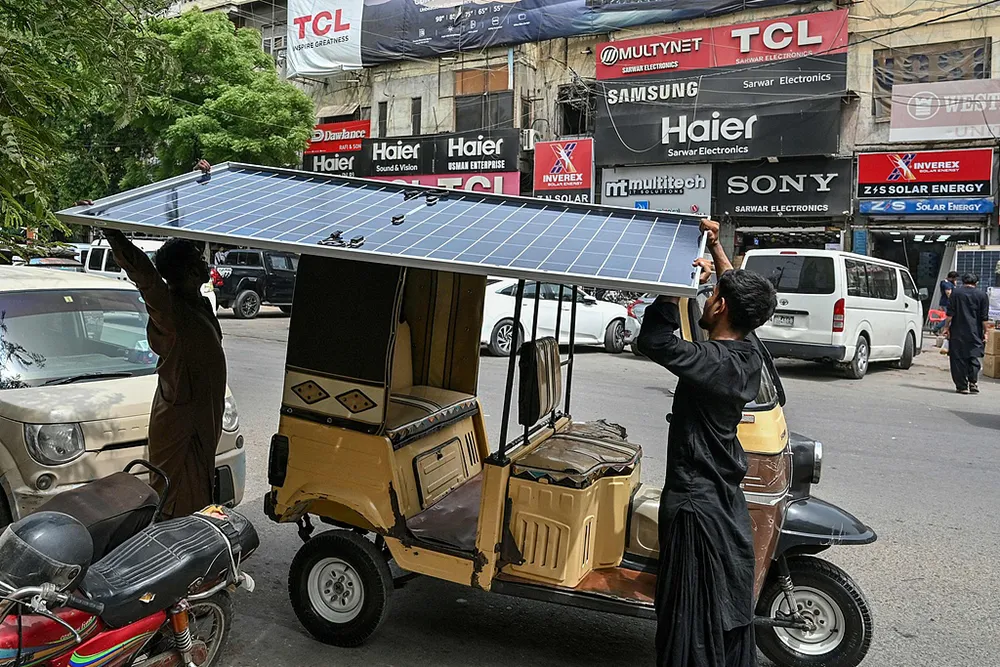
On June 23, 2025, workers loaded solar panels onto an automated rickshaw in Karachi, Pakistan. Visual China data map
Chinese factors and global significance
The reason why this change can occur so quickly is that almost all analyzes point to the same key factor: China’s green technology. Ember data shows that between 2022 and 2024, Pakistan's imports of solar modules from China will increase fivefold, from about 3,500 megawatts to 16,600 megawatts, and its share of China's photovoltaic exports will rise from 2% to nearly 7%. This trend will continue in 2025.
"Almost all the solar panels used in Pakistan come from China," Lalani said. "Without Chinese technology and products, Pakistan would not have been able to achieve such a large-scale popularization, and the global energy transformation would not have been so fast."
Gaoli's analysis further pointed out that China's participation has created a rather symbolic situation: in the CPEC1.0 stage, coal power projects financed and constructed by China are competing in the same market with distributed photovoltaic systems made in China, and the former is gradually losing its advantage. The utilization rate of some imported coal power projects has fallen below 20%.
Gowrie believes that Pakistan has passed a "tipping point" in the adoption of solar technology, and the key challenge now is how to integrate this new, decentralized, consumer-led system with an old, inefficient legacy power system with a large number of stranded assets (such as coal-fired power plants with utilization rates below 20%), rather than taking users completely off the grid.
In this regard, he believes that China can play a key role: first, through transformation finance, leading and supporting the decommissioning or transformation of coal power assets into flexible power stations and replacing them with new solar and wind energy; second, promoting technology transfer and localization of the industrial chain, especially in the energy storage industry that is about to explode, and cooperating with Chinese partners for localized manufacturing and assembly of batteries to enhance sustainability and energy security; third, going beyond individual project thinking, in CPEC Under the 2.0 framework, build an overall energy ecosystem package covering electric vehicles, charging infrastructure, etc.
Pakistan’s Energy Minister Awais Lehari recently told The Economist that he has begun negotiations with China on an agreement to restructure coal-fired power plant projects and is seeking professional support from China and other countries in modernizing Pakistan’s power grid and reforming the electricity market. At the same time, the Pakistani government is trying to attract Chinese companies to invest in local manufacturing of solar panels, batteries and other green technologies.
Looking to the future, both experts believe that solar energy will continue to develop, but a new phase is coming. Battery energy storage, artificial intelligence data centers and the transition to electric vehicles will become new focus areas for Pakistan, and these areas will require deeper international cooperation. They pointed out that Pakistan has relatively abundant power resources and a huge market size, with a population of about 250 million, and a huge demand for new technologies and products.
In making recommendations to Chinese businesses and policymakers, Lalani believes technology transfer will be key to future cooperation. He said that Pakistan not only hopes to import products, but also hopes to build capabilities through joint ventures and partnerships and achieve large-scale development in more industrial fields, not just solar energy itself.
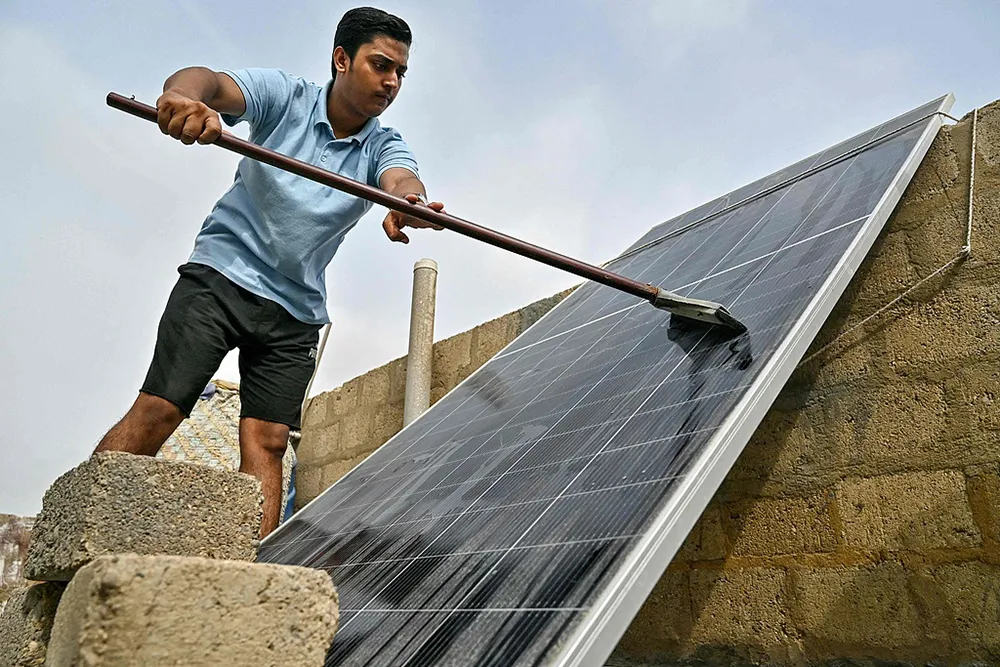
On June 23, 2025, in Karachi, Pakistan, a local resident was cleaning the solar panels installed on the roof of his house. Visual China data map
Challenges and next stages
Despite its impressive results, Pakistan’s solar revolution also faces some serious challenges.
Currently, there are no uniform battery, grid connection, energy storage and fire safety standards across the country, and there is a lack of policy framework to deal with future e-waste problems. Inequality also exists: even as prices fall, the poorest groups still struggle to afford the initial investment. The greater systemic risk lies in the "death spiral" of the power grid – high-income users go off the grid to supply their own electricity, and remaining users bear higher costs, further weakening the sustainability of the power grid.
In this regard, Gauri believes that the key is not to prevent distributed energy resources, but to reshape the logic of the power grid and introduce mechanisms such as energy storage, demand-side management, and virtual power plants to reintegrate "prosumers" into the system.
From a policy perspective, he believes that the key to the next stage lies in three aspects. First, we must re-examine the subsidy and electricity price structure to clarify who exactly the subsidy supports and where it flows. Currently, many countries, including Pakistan, indirectly transfer resources to the fossil energy system through electricity price subsidies, which objectively weakens the competitiveness of clean energy.
Secondly, the regulatory and standard systems need to be improved urgently, including equipment standards, grid connection rules, licensing systems, and off-grid system specifications. He and his organization are also involved in working with the Pakistan Solar Energy Association to promote the establishment of unified technical and regulatory standards across the country and beyond public sector projects.
Third, it is the transformation of the power grid itself. When distributed solar energy can cover a considerable proportion of electricity demand, the traditional power grid logic centered on centralized power generation and long-distance transmission will be unsustainable. It must turn to a more flexible system and introduce demand-side management, energy storage and new market mechanisms.
In international comparisons, he mentioned that countries like Australia, which have higher renewable energy penetration rates, have begun to adapt to the new energy structure through innovative electricity price mechanisms and institutional designs, such as providing "free solar power" during specific periods. He believes that these experiences can be introduced into Pakistan and promoted after localization adjustments.
An important aspect of Pakistan’s story is that it uses facts to refute the idea that clean energy is expensive and that countries in the Global South can only rely on subsidies for development. Today, solar power has become the cheapest source of electricity. Even for utility-scale solar or hybrid projects, electricity prices are less than 3 cents per kilowatt hour, lower than new coal power, oil and gas and even hydropower.
When talking about the attitude towards energy transition at the government level, Lalani pointed out that there are obvious "two sides" in the official position. On the one hand, Pakistan has clearly stated ambitious renewable energy goals in its Nationally Determined Contributions (NDCs). The document is full of commitments on solar energy and clean energy. The policy level also hopes that relevant projects can be promoted as soon as possible. On the other hand, in actual implementation, infrastructure construction, institutional capabilities and governance levels still lag seriously behind, making it difficult to fully implement these commitments.
Lalani himself has been engaged in consulting work related to climate and energy policies for a long time, and has maintained a certain degree of communication with government departments. He believes that the current problem is not whether there is a lack of direction, but whether execution capabilities and institutional support are sufficient.
Pakistan’s experience is not just the story of a single country, but a process that many countries in the global South may be going through or about to go through. As Gowrie said, if this bottom-up energy transformation succeeds, it will become a "beautiful textbook case"; if it fails, it may also be used as a negative teaching material, affecting the world's confidence in solar energy.