"There is a big bird trapped on the ice. Come and help." After receiving the call, Han Shudong from the Bird Love and Bird Protection Volunteer Association of Hengshui Binhu New District in Hebei Province immediately got up and drove to investigate.
The 75-square-kilometer Hengshui Lake has a vast water surface, swaying reeds, and flocks of migratory birds flying over from time to time. It is an important stop on the East Asia-Australasia migratory bird migration route.
As the Spring Festival approaches, the flow of people and vehicles increases, and migratory birds face human interference in their search for food and habitat. How to ensure that migratory birds survive the winter safely? The reporter drove half an hour from Hengshui Railway Station to the lake area and saw a group of guardians "standing guard" for migratory birds.
A special New Year gift
Crane shadows are picturesque, egrets fly low, and birds gather in the reeds between the ice water.
The afterglow of the setting sun shone on Han Shudong's dark face. He and the volunteers from the Bird Lovers Association were busy carrying corn kernels and frozen fish to the small wooden boat.
"This is the 'New Year's gift' we prepared for the birds." Han Shudong introduced cheerfully, opening the boat and sailing towards the ecological island in the lake.
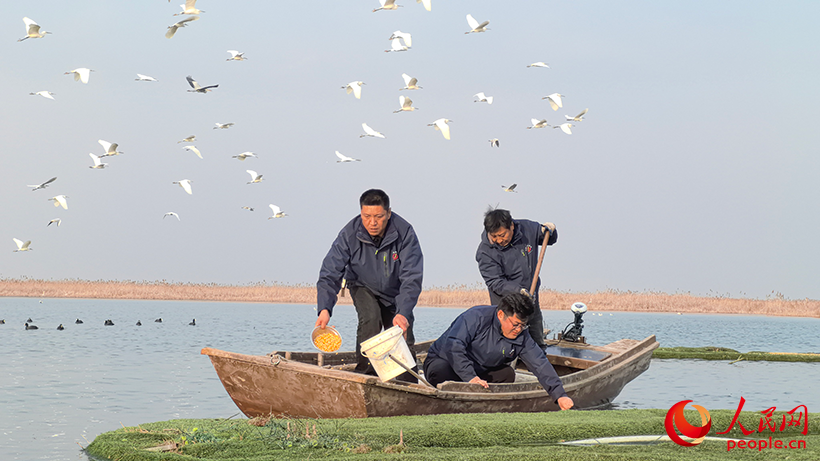
Volunteers from the Bird Lovers and Bird Protection Volunteers Association of Binhu New Area in Hengshui, Hebei Province are sowing corn kernels for ecological attraction. Photo by People's Daily reporter Shen Yaxin
The lake surface reflects the sunset and glows with little waves. The perching birds seemed to have received the signal and flew from everywhere, circling and dancing.
"It borders Taocheng to the north and Jizhou to the south. Hengshui Lake is one of the few 'city lakes' in China. Its special geographical location poses a challenge to the ecological protection of migratory birds." Zhang Yuguang, deputy director of the Resource Protection Bureau of Hengshui Binhu New District, Hebei, told reporters.
After the lake freezes over in winter, tens of thousands of migratory birds that overwinter here face a lack of food, and some go looking for food in the surrounding areas, often straying into danger.
Therefore, volunteers spread food in the lake area for ecological attraction, creating suitable habitats and protecting migratory birds from overwintering safely. At the same time, under professional guidance, intervention is kept to a minimum and does not affect the migration habits of migratory birds.
"Why do you do these things spontaneously?" the reporter asked.
"I like it. I have made eye contact with the bird!" Han Shudong's plain words revealed his simple emotions.

Volunteers patrol along the reed marshes. Photo by People's Daily reporter Shen Yaxin
Driving a small boat to carve out the frozen lake in the morning, observing and patrolling along the reed swamps in the afternoon, and delivering winter rations to migratory birds in the evening… During the Spring Festival, the volunteer team lined up a duty list and took turns to "stand guard" for this group of distant visitors.
a warm name
"Ga! Ga!" The cormorant turned to look at the people who rescued it, as if saying goodbye. Then, it walked to the lake, swam a few meters away, spread its wings and flew away.
During the interview, the reporter came across this rescued cormorant. After careful care by volunteers, it was restored to health and released into the wild.
"When I found it, it was lying motionless on the lake, more than ten meters away from the shore." Zhang Xuefeng, president of the Hengshui Photographers Association, boarded a boat on the lakeside, used a pole to move the trapped cormorant little by little, brought it back to the shore, and called the rescue hotline of the Bird Lovers Association.
"I originally thought it was injured, but after inspection, it was found that it was unable to fish due to ice and was malnourished." Volunteer Niu Chunde was responsible for taking care of the cormorant. He took out his mobile phone to show reporters the cormorant's changes over the past few days, from being unable to stand to being full of energy and "gaining one or two pounds in a week."
The rescued cormorants were released by the Hengshui Lake. Photo by Liu Wenbang, People's Daily Online
As the seasons pass, help never stops. "At most, there are four or five calls for help a day." Han Shudong told reporters. "As time goes by, everyone knows that we have expertise in rescuing birds. Whether it is a call received by 110 or 12345, we will always forward it."
Since the bird rescue center in the urban area is far away, in order to obtain faster rescue time, at the end of 2024, with the support of the Binhu New District Management Committee, this volunteer team had a warm name – Hengshui Binhu New District Bird Love and Bird Protection Volunteer Association.
"There are elderly people in their 70s who call to rescue migratory birds, and there are 14-year-old children who use their phone watches to provide clues. One phone call sets up a life channel for migratory bird rescue, and everyone relays the power of protection." Volunteer Zhang Xiaoyuan said.
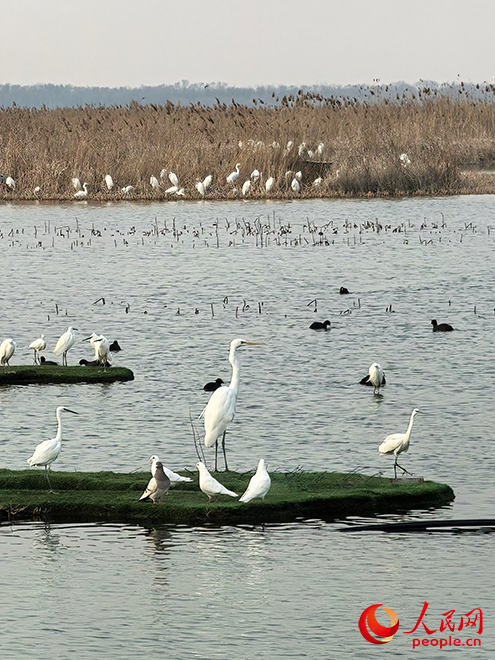
A variety of birds gather on Cherry Blossom Island in Hengshui Lake. Photo by Liu Wenbang, People's Daily Online
The choice of a pair of wings
"Previously, there were about a thousand blue-headed pochards, an endangered bird. In 2017, 308 were discovered in Hengshui Lake for the first time!"
Zhang Yuguang still couldn't hide his excitement when he recalled the scene when he discovered the blue-headed pochard, known as the "giant panda among birds."
"The best protection is the recovery of the population." Zhang Yuguang said that the reserve is cooperating with Beijing Forestry University, Beijing Zoo, etc. to conduct research on the artificial breeding and wild release of blue-headed pochards. "This spring we plan to conduct the first batch of wild releases to expand its wild population."
A gray goose rescued by volunteers from the Bird Lovers Association was equipped with a lightweight positioning system when it was released. Zhang Yuguang said that the gray goose will continue to be tracked to understand its suitable ecological environment.
Zhang Yuguang, who has been working for many years, is still used to recording observation diaries: "In January this year, bird photography enthusiasts discovered the Sandhill Crane, a national second-level protected animal, for the first time in Hengshui Lake. With a scarlet head and rust spots on its body, it came from distant North America."
In recent years, the bird monitoring records in Hengshui Lake have continued to be refreshed, from 323 species in 2017 to 337 species now.
"Birds vote with their wings and will inhabit wherever the environment is good. The rare appearance of the sandhill crane also confirms the continuous optimization of the local wetland ecological environment." Zhang Yuguang said.
Volunteers observing and patrolling Hengshui Lake. Photo by People's Daily reporter Shen Yaxin
Birds are a touchstone of the ecological environment. In order to protect this wetland in the North China Plain, which maintains an intact ecosystem of swamps, waters, tidal flats, meadows and woodlands, the local government continues to promote ecological water replenishment and pollution control. More and more birds such as spotted-headed mergansers, gray cranes, and coots live here.
The rays of light serve as guidance, and thousands of birds serve as trust. Every wing across the sky writes the vigorous rhythm of life.