The Process Of Proposing And Promoting The China-Kyrgyzstan-Uzbekistan Railway Plan Has Encountered Setbacks And Key Issues
DOI: 10.13568/j.cnki.issn1000-2820.2025.06
DOI: 10.13568/j.cnki.issn1000-2820.2025.06

When Lin Xiao turned off the phone screen, the electronic clock on the bedside table jumped to 00:01. The WeChat dialog box still said "Good night" from half an hour ago, but she stared at the familiar profile picture on the WeChat sports rankings, and the number 4327 steps pierced her eyes like a thorn - the boyfriend who said he was "too sleepy to open his eyes" two hours ago was now using his footsteps to draw secret tracks in the city. This absurd "accompanying performance" has been going on for three months. My boyfriend always says that he is so busy with projects that he lives at work, but his step count is always extremely active every Wednesday night. Once she deliberately said, "I want to drink the long-established sugar water store in the south of the city because I have a sore throat." Two hours later, the other party sent a message saying, "I just got off work and I can't buy it." But the next day, she saw his check-in photo in front of the sugar water shop in the Moments of a mutual friend. The WeChat movement is like a silent detective, tearing apart all the carefully crafted excuses. What really made her break through was last Thursday. My mother sent me a WeChat message asking if I stayed up late again. She casually said I went to bed early, and then went to a disco with her best friend until the early hours of the morning. During the video the next day, her mother suddenly said: "It's time to change the curtains in your bedroom. The light leaking from the curtains at twelve o'clock last night woke me up." She was shocked to realize that her mother would guess her life every day based on her step count on WeChat - less than 100 steps means staying in bed, 3,000 steps means commuting, and more than 10,000 steps means sneaking out to play. Those lies that they thought were seamless have long been seen through by the eyes behind the numbers. The companionship of modern people is like the likes of WeChat sports, and the performance can be completed with a flick of a finger. Colleague Xiao Zhang’s circle of friends is always positioned at the company where he works overtime, but his WeChat activities show that he walks 20,000 steps on the riverside trail every night; his cousin posted a parent-child photo with her child, but the step record revealed that she left the child with her parents and went to the gym alone. We are busy pretending to be the perfect partner, filial to our children, and motivated employees on social media, but we forget that real companionship requires the warmth of our feet on the ground. At one o'clock in the morning, Lin Xiao opened her boyfriend's dialog box, entered and deleted. The moonlight outside the window made the phone screen pale, and the number 4327 steps was still there, like a silent mockery. She suddenly remembered that her mother always said, "There was no WeChat step count before. When your dad came home late, I would sit at the door and wait for his footsteps." Although the waiting at that time was painful, at least every step was real. Nowadays, we are too lazy to even measure lies with our steps. She pressed the delete key and cleared the dialog box where she had been chatting for three years. The moment the phone screen went dark, the WeChat sports ranking list was automatically refreshed, and the boyfriend's step count became 4,512. On the other side of the city, in a lighted window, someone might be weaving the next "good night" lie to the same number.
Improving academic qualifications has become a way out for many people who cannot find good jobs in society because of their academic qualifications. More and more people are applying for self-study examinations. So when will the self-study examination graduation certificates be received?
Click to enter: If you have questions about self-study exams, don’t know how to choose the college and major for taking exams, or don’t know the local policies for self-study exams, click to learn now >>
How long does it take to receive the self-study graduation certificate after application:
After the application is successfully processed, candidates need to wait for 20 working days before they can go to the Provincial Examination Office to receive the Graduation Certificate with their ID cards. With the "Graduation Certificate", candidates can enjoy the benefits of unified admission to the same level of academic qualifications. However, there is only one original copy of the self-study diploma, and candidates should keep it properly to avoid unnecessary trouble.
How to deal with the loss of self-study diploma?
After the self-study diploma is lost, it cannot be reissued, but the academic certificate can only be reissued. The details of the reissue method of the self-study academic certificate are as follows:
1. After the graduation certificate is lost, you should declare in the newspaper that the original diploma is invalid, and apply for a replacement from the graduation school or self-study examination office. Write down written materials, clearly stating your enrollment and graduation time, as well as your major, age, gender, and current workplace.
2. After the graduation school or self-study examination office has verified that the situation is correct, submit the materials together with the admission approval form materials to the provincial education department to apply for an academic certificate.
3. After the provincial education department approves the situation, it can reissue the academic certificate.
4. The original graduation school and the self-study examination office shall handle the details and stamp them.
The above is the relevant content about the adult self-study exam. Candidates can use this as a reference. The official announcement shall prevail! If candidates want to get more information about self-study exams, such as adult self-study registration time, test time, application conditions, test preparation knowledge, relevant news, etc., please pay attention to the China Education Online Self-study Examination Channel.
Financial News Agency, February 27 (Editor Shi Zhengcheng) Industry research organization IDC warned in its latest report that the global smartphone market will usher in an "unprecedented crisis" in 2026 due to memory shortages.
IDC has significantly lowered its forecast for smartphone shipments in 2026 to about 1.1 billion units, which is far lower than last year's figure of 1.26 billion. This means that the smartphone market may experience a record year-on-year decline of 13% this year.
Nabila Popal, senior research director at IDC, said bluntly: "Compared with the memory crisis, the tariff chaos and the impact of the epidemic pale into insignificance. At the end of the current crisis, the smartphone market will experience a dramatic transformation in size, average selling price, and competitive landscape. We do not expect the situation to ease until at least mid-2027."
Analysis points out that in the face of sharp price increases in the cost of key components, mobile phone manufacturers can only respond by tightening configurations, eliminating unprofitable entry-level models, and pushing consumers to switch to higher-end devices. IDC believes that in the past few years, the entry-level devices launched by many manufacturers in order to compete for market share are more vulnerable to cost pressures because memory prices account for a larger proportion of the overall material cost.
Of course, compared to rising prices, the more serious problem faced by smartphone manufacturers is the inability to buy enough chips. Qualcomm CEO Amon said after releasing the financial report this week: "The problem now is not only the price, but also the availability of supply. I think how much memory manufacturers can get will determine the overall size of the mobile phone market."
Interestingly, anecdotes about Apple negotiating with Samsung Electronics to purchase LPDDR5X memory were also reported in the market on Thursday: Samsung originally only wanted to increase the price by 60%, so it initially tentatively offered a price increase of 100%, but Apple agreed to it in order to ensure supply. Even so, Apple's memory supply for the second half of this year has not yet been secured.
This news will obviously not be officially confirmed, but Apple, as the "supply chain master", has also been forced into such a situation, and other manufacturers are likely to be facing the same troubles.
IDC further stated that even if the memory shortage eases after 2027, the smartphone market is unlikely to return to its previous pricing structure.
Popal said: "The era of low-priced smartphones is over, and even if the memory crisis eases, we do not expect memory prices to return to 2025 levels."
IDC pointed out that approximately 170 million smartphones priced under $100 were shipped last year, and this segment is now unprofitable.
(Shi Zhengcheng of Financial Associated Press)
The people and businesses that once made their name in the “bomb shelter” model are now in crisis.
In the just-released 2013 annual financial report, Renhe Commercial lost as much as RMB 1.7 billion. At the same time, commercial projects it developed in Chengdu, Daqing and other places have led to constant disputes due to the transfer of operating rights.
Moody's and Standard & Poor's have downgraded its credit rating several times due to pressure on cash flow.
Dai Xiuli, a female business owner, divorced her husband.
Huge loss of 1.7 billion
The myth of high growth for people and business came to an abrupt end this year.
On April 29, Renhe Business released its 2013 annual financial report. During the reporting period, it achieved operating income of 547 million yuan, down 20.4% from last year, including operating lease income of 455 million yuan and income from transfer of operating rights of 92.718 million yuan. However, the loss was as high as RMB 1.7 billion. In the same period last year, Renhe Business made a profit of 895 million yuan.
"The losses of Renhe and Commerce are not unexpected." Wang Yongping, secretary-general of the China Commercial Real Estate Alliance, told 21st Century Network, "His model is not sustainable. The most important thing about commercial real estate is the later management. Renhe sold all the shops to retail investors for many years without participating in the management."
21st Century Network found that there were three main factors that led to Renhe Commercial’s huge losses. First, the investment property was depreciated by 832 million yuan. In 2013, Renhe Commercial converted a 38,000-square-meter shopping mall in Dongguan into a parking lot. Second, the impairment of accounts receivable was 540 million yuan. Third, financing costs were as high as 477 million yuan.
According to Renhe Commercial Announcement, the impairment of accounts receivable of RMB 540 million came from two projects in Chengdu and Anshan.
In its 2010 annual report, Renhe Commercial stated that it "indirectly transferred the operating rights of five projects through the sale of all the equity capital of five wholly-owned British Virgin Islands subsidiaries. These five projects are the Chengdu, Weifang, Dalian, Daqing and Anshan Phase I projects."
Among them, the agreed price of the Chengdu project is HK$2.372 billion, and the Anshan Phase I project is HK$1.305 billion.
However, in the past four years, the buyers of these two projects still have unpaid debts of HK$638 million and HK$345 million respectively, and Renhe Commercial decided to discount these debts.
On March 6, 2014, Renhe Commercial announced that the group and the buyer had signed the Chengdu Deed and the Anshan Deed. The buyer had agreed to pay HK$190 million and HK$127 million to the group to settle the payments for the Chengdu and Anshan projects. After all the payments were settled, the buyer should no longer have any unpaid or undischarged debts and obligations for the purchase of the Chengdu project, and the Chengdu and Anshan personal guarantees would also be released.
Regarding this approach, Renhe Commercial stated that the unpaid payments related to the Chengdu Project and Anshan Project have been in arrears for some time. Considering that taking legal action may be expensive and time-consuming, signing the Chengdu Deed and Anshan Deed will help recover the unpaid payments and allow the group to maintain an ongoing business relationship with the buyers of the Chengdu Project and Anshan Project respectively and help improve the group's cash flow position.
But in fact, Renhe and Commerce’s “cutting off” positions seems to have another meaning.
Disputes continue over sale projects
At the beginning of 2014, the "Diyi Avenue" projects in Chengdu, Anshan, Daqing and other places after Renhe Business transferred their operating rights have caused constant disputes due to the transfer of operating rights.
On April 16, outside the Diyi Avenue office at No. 38 Renmin East Road, Chengdu, dozens of Diyi Avenue merchants sat down to ask for an explanation.
It is reported that these merchants purchased the right to operate shops on Diyi Avenue in Chengdu in 2011 at prices ranging from 90,000 to 100,000 yuan per square meter.
Several owners of Diyi Avenue in Chengdu told 21st Century Network that during the sale, the developer and operator promised that Diyi Avenue would "seamlessly connect 17 large shopping malls in Yanshikou, Luomashi, Chunxi Road and Tianfu Square, and connect to the subway. Diyi Avenue will be built into a first-class commercial center in Chengdu." But three years later, these promises have all come to nothing.
"Not one of the seventeen shopping malls is connected, and there is no investment in commercial advertising."
What makes these merchants even more unacceptable is that the mall operators not only failed to find ways to solve the problems in operation and management, but focused on collecting the balance.
A merchant surnamed Wang told 21st Century Network that in the contract, Diyi Avenue and the merchant clearly agreed that the total operating period would be 40 years, divided into two phases, each phase of 20 years. Renhe Business promises that merchants only need to pay half of the house payment (i.e., the first 20 years of rent), and the other half (the next 20 years of rent) will be handled by Diyidadao, which will find a bank to provide credit and loans to the merchants.
But in fact, these shops converted from civil air defense projects had no property rights at all. People and Commerce finally asked the merchants to take out their residential properties as mortgages. However, many merchants were still unable to pay the rent for the next 20 years due to insufficient funds or other problems, and the conflict intensified.
"Our demand is to withdraw the stores." It is reported that a total of 256 merchants requested refunds this time, involving more than 450 stores, a store area of about 7,500 square meters, and the amount involved may reach 700 million yuan.
But in the eyes of these owners, people and business are still related to Chengdu Diyi Avenue. In the previous coordination, a vice president from the Diyi Avenue headquarters came to Chengdu to listen to the opinions of the merchants.
In Anshan, the local Diyi Avenue project lasted more than three years from investment promotion in 2010 to opening at the end of 2013. Due to construction collapse, Party A's breach of contract and other reasons, many owners have asked to withdraw from the project.
In Daqing, due to disputes with the operator Daqing Yigao Investment Company, nearly 200 owners of Diyi Avenue organized multiple rights protections to demand the withdrawal of their properties.
Representatives of merchants on Daqing Diyi Avenue said that at the time, Daqing Yigao Investment Company claimed that they were a subsidiary of Renhe Commercial.
According to industrial and commercial information, Daqing Yigao Investment Company has now been renamed Daqing Yigao Trading Co., Ltd., the controlling shareholder is Hengying Investment Co., Ltd., and the legal representative is Huang Hao.
Female boss Dai Xiuli divorces her husband
It was reported on March 10 that Hogan, a British mathematics teacher, finally decided to divorce his wife Dai Xiuli, who is worth 1.2 billion pounds (approximately RMB 12.33 billion), because he was not used to the life of a rich man, and he only asked for 1 million pounds in alimony.
According to reports, Hogan, 57, met Dai Xiuli on a blind date. They have been married for 21 years and have a 17-year-old son. Three years ago, Hogan's wife, Dai Xiuli, suddenly had the idea to transform many air-raid shelters in the mainland into underground shopping malls, and she became rich overnight. She now owns 22 "underground shopping malls" and a mainland football team.
After Dai Xiuli became prosperous, she took Hogan back to the mainland in 2013 to ride on a yacht and drink famous wine. Hogan, however, was quite uncomfortable. He said that he still likes to go to British fast food restaurants for three meals.
With the money in hand, Hogan resigned from his teaching position. He now only teaches children from poor families for free. Hogan said that maybe others think he should pay more alimony, but he believes that as long as he saves a little money, 1 million pounds is enough for him to live for the rest of his life.
The Shanghai Composite Index has been positive for five consecutive times, the market liquidity crisis has been resolved, and Lingjun was punished with a "boomerang", but quantitative trading has once again been pushed into the spotlight of public opinion.
After experiencing a sharp retracement of net worth and a series of pressures from customer redemptions, micro-cap stocks rose sharply for two days. Unexpectedly, the 24 hours before and after the quantitative private equity giant Lingjun was fined was the real "darkest moment" of quantification.
The resurgence of rumors, the announcement of Lingjun’s punishment, and the late-night apology have triggered a huge discussion in the entire industry about “why we have come to this point” and “where we will go from here” in quantification. Reporters from the Financial Associated Press have followed up on quantification for a long time and interviewed many institutions. They reviewed the 24 hours of quantification and the three major doubts that still exist in the industry.
Where does quantification go from here? Three major questions in the industry
Following Lingjun’s punishment, it was reported on the Internet that a quantitative private equity person said that “China’s stock market quantitative funds have closed down.” Such remarks were immediately denied by the parties involved.
What is unavoidable is that after the fermentation of news events, the great discussion about quantification has once again begun: How did the industry review the unprecedented tragedy of quantification? Investors asked, "Can I still invest in quantitative trading after a sharp retracement?" Some people once again mentioned the 828 incident in 2023 and reiterated the quantitative selling.
Some asset managers also believe that quantitative supervision needs to put the establishment of capital gains tax on short-term trading on the agenda.
Focusing on this, reporters from the Financial Associated Press interviewed industry insiders and learned that the current industry still has the following three major questions that need to be answered:
First of all, how to control the size of orders when placing quantitative trading orders?
Previously, the new regulations on programmatic trading clarified that high-frequency trading is the focus of supervision: that is, if the maximum declaration rate reaches more than 300 transactions per second or the maximum number of declarations in a single day reaches more than 20,000 transactions, the transaction can adjust the abnormal transaction identification standards according to the situation. In the announcement of the punishment of Lingjun by the Shanghai and Shenzhen Stock Exchanges, the reason was that "a large number of orders were concentrated in a short period of time, which accounted for a high proportion of the market turnover during the period, triggering a rapid decline in the index and seriously affecting the trading order."
Quantitative private equity said that even if it is not high-frequency trading, there is a lot of quantitative daily rolling trading frequency. Generally, it is sold at the opening and the funds are withdrawn before buying. From the current regulatory direction, in addition to avoiding high-frequency trading, it is also necessary to consider whether it will affect the index performance.
Secondly, will quantification “stop”? How to balance benefits and risks?
From the perspective of the industry, the risks of quantitative private equity are not without signs, but most people choose to run blindly.
A certain quantitative private equity said that the company adjusted its strategy last year because it realized that the CSI 500 was very risky and not cost-effective. However, the market enthusiasm concealed that the index had no excess risk. Looking at the excess and returns brought by the risk, how to balance it?
The above-mentioned people said that at that time, the risks had not yet emerged, and not doing this part of the excess would bring about underperformance and investor complaints. Today, if you review the market, you will find that rationally facing the excess of 300, 500, and 1,000, accepting the attenuation of alpha is an objective law. Trying to use opportunistic tricks such as iteration to chase false excess will ultimately be short-lived, and the worse result will be backlash.
However, in the face of huge temptation, how many institutions in the market can predict the risks? Dare to make adjustments? In most cases, extreme risks come and it is impossible to escape unscathed.
Third, how big is the current scale of DMA? How much money has 4 times leverage leveraged in the market?
It is undeniable that some quantitative private equity companies have criticized the restrictions on DMA trading before the holidays, and some institutions have blamed this for the retracement of net worth. In fact, in reviewing the sharp decline in micro-cap stocks, how much impact will DMA's restricted trading have on the product? The industry is inconclusive.
Industry insiders said that the path to triggering the liquidity crisis of micro-cap stocks is very clear. It was triggered by Snowball’s knock-in, and Snowball hedged and sold futures. The bulls chose to wait and see because they were waiting for the risk to be released, which in turn triggered a widening of the discount, a domino effect, and quantitative neutral strategies to close positions and sell CSI 500 and CSI 1000 constituent stocks. Subsequently, regulatory measures such as securities lending accelerated the decline of small and micro stocks, and the liquidity crisis really began. High-leverage DMA positions were liquidated. The DMA was restricted from February 5 to February 8 of the same month, for a total of 4 days.
Judging from the decline in quantitative net worth, it started with the decline of the Wind micro-cap index in January this year, reaching its maximum retracement in the last week before the Spring Festival, with individual products falling by more than 20% in a single week. In the view of most observers, the selling restrictions have exacerbated the retracement of net worth, but the retracement cannot be entirely attributed to regulatory measures.
In addition, it is worth noting that regarding whether securities firms can restrict the selling of quantitative private placements, in fact, there is a clear explanation in the 2023 programmatic trading. In strengthening the front-end management of members (brokerages), the exchange proposed that if customers’ programmed transactions may affect the security of the trading system or the normal trading order, members (brokerages) can take measures such as rejecting their programmed trading entrustments and canceling relevant declarations.
From the last day before the Spring Festival to the present, small and micro-cap stocks have started to rebound. In four trading days, the Wind micro-cap stock index has increased by nearly 30%. While the micro-cap market is still worth looking forward to, what is the size of DMA? What potential risks does high leverage bring? It deserves industry attention.
Regarding the scale of DMA, the industry speculates that as of the end of last year, the stock scale may have reached 100 billion. Counting 4 times leverage, the market capital leveraged is about 400 billion to 500 billion.
How big is the impact on the market? An analysis by an organization estimates that there is a certain diminishing effect when the scale changes hands. From observation, the turnover rate of tens of billions of private equity can reach 200 times when it reaches 500 million, about 120 times when it reaches 4 billion, and the turnover rate of tens of billions of scale is about 30 to 40 times. From this, we also refer to the turnover rate of DMA. Returning to what the regulator mentioned, "there are also problems such as strategic convergence and transaction resonance at some points in time, which increase market fluctuations". There are also traces to follow.
Full review 24 hours before quantification
The first stage (February 20, 12:00-15:00): Storm is coming, rumors are flying everywhere
Beginning at noon on February 20, a link to a collection of rumors about quantitative private equity giants was spread on social platforms. The rumors were mixed with "the liquidation of hundreds of billions of quantitative products, a huge loss of 1.5 billion in self-operated products, a DMA debt of 6 billion, the company's bankruptcy and even jumping off the building." The main body of the rumors involves Huanfang Investment, Mingtun Investment, Jiukun Asset and other leading quantitative private equity institutions.
These rumors before the Spring Festival have once again spread in the form of a collection and intensified. A reporter from the Financial Associated Press verified with a number of quantitative private equity and third-party institutions that the micro-cap liquidity crisis has caused the net value of some products to retreat. It is true that some products have encountered greater redemption pressure and even been liquidated, but there is no "liquidation of hundreds of billions of products." Some companies bluntly said: "The above screenshots are rumors. There were rumors of bankruptcy and jumping off buildings before the Spring Festival. These extreme statements are not true." Some leading quantitative private equity companies also said that the company does not have DMA products, and there is no problem of owing huge amounts of money to brokers.
The second stage (15:00-24:00 on February 20): Punishment is implemented, supervision is quantitative and qualitative
There are still a lot of messages asking for confirmation, and regulatory penalties have pushed the discussion to a climax. It is worth noting that this is the first time a penalty decision has been implemented after the new regulations on programmed trading in September last year, and the target of punishment is Lingjun, a giant in quantitative private equity.
February 20, 17:03 pm: The Shenzhen Stock Exchange announced that the Shenzhen Stock Exchange discovered during its transaction monitoring that within 42 seconds from 9:30:00 to 9:30:42, multiple securities accounts owned by Lingjun Investment automatically generated trading instructions through computer programs, placed a large number of orders in a short period of time, and sold a total of 1.372 billion yuan in Shenzhen Stock Exchange stocks. During this period, the Shenzhen Stock Exchange Component Index fell rapidly, affecting the normal trading order. The Shenzhen Stock Exchange decided to suspend trading in Lingjun’s account for three days and initiate a public censure record disciplinary procedure.
At around 17:40, the Shanghai Stock Exchange also announced that because Lingjun sold a large number of Shanghai stocks totaling 1.195 billion yuan in one minute, it had suspended trading for three days and issued a public censure record.
At 19:05, the Shanghai and Shenzhen Stock Exchanges respectively announced the smooth implementation of the quantitative trading reporting system. This is also the first time since the new regulations on programmed trading that the supervision has issued an announcement with "quantitative trading" as the clear subject. The two exchanges have the same caliber and have given characterization to quantitative trading: While quantitative trading helps provide liquidity to the market and promote price discovery, quantitative trading, especially high-frequency trading, also has problems such as strategic convergence and trading resonance at some points in time, increasing market volatility.
Subsequently, the exchange stated that it will continue to strengthen the monitoring and analysis of quantitative trading, especially high-frequency trading, with six major measures.
First, strictly implement the reporting system and clarify the access arrangements of “report first, trade later”;
The second is to strengthen the authorization management of quantitative trading prices and improve the differentiated charging mechanism;
The third is to improve the monitoring and control standards for abnormal transactions and strengthen the supervision of abnormal transactions and abnormal order cancellations;
The fourth is to strengthen the monitoring and regulation of leveraged quantitative products and strengthen the joint supervision of futures and spots.
The fifth is to further consolidate the customer management responsibilities of securities companies, improve the self-regulatory management cooperation mechanism with the Securities Industry Association and the Fund Industry Association, and strengthen the transaction supervision of quantitative private equity and other institutions, etc.
Sixth, the exchange will strengthen communication with the Hong Kong Stock Exchange, clarify the reporting arrangements for northbound investors in Shanghai-Hong Kong Stock Connect in accordance with the principle of consistency between domestic and foreign investors, and include quantitative transactions by northbound investors within the reporting scope.
A number of quantitative private equity firms have also launched self-certifications and clarifications. At around 21:24 in the evening, media reported that the quantitative giant Huanfang denied the liquidation of its products and stated that the company had never done any DMA leverage transactions.
In the evening, the recent product operation instructions and apologies of quantitative private equity companies such as World Frontier Assets, Xuanxin Assets, and Longqi Fund were also reported one after another. Most of the quantitative four times said that they would strengthen risk control constraints and reduce risk exposure.
In addition, a leading quantitative private equity reporter told a reporter from the Financial Associated Press that he "changed his strategy overnight". The initial plan is to change the trading frequency in some specific time periods to reduce the frequency of triggering transactions.
The third stage (0:00-8:00 on February 21) Lingjun, the punished institution, apologized late at night
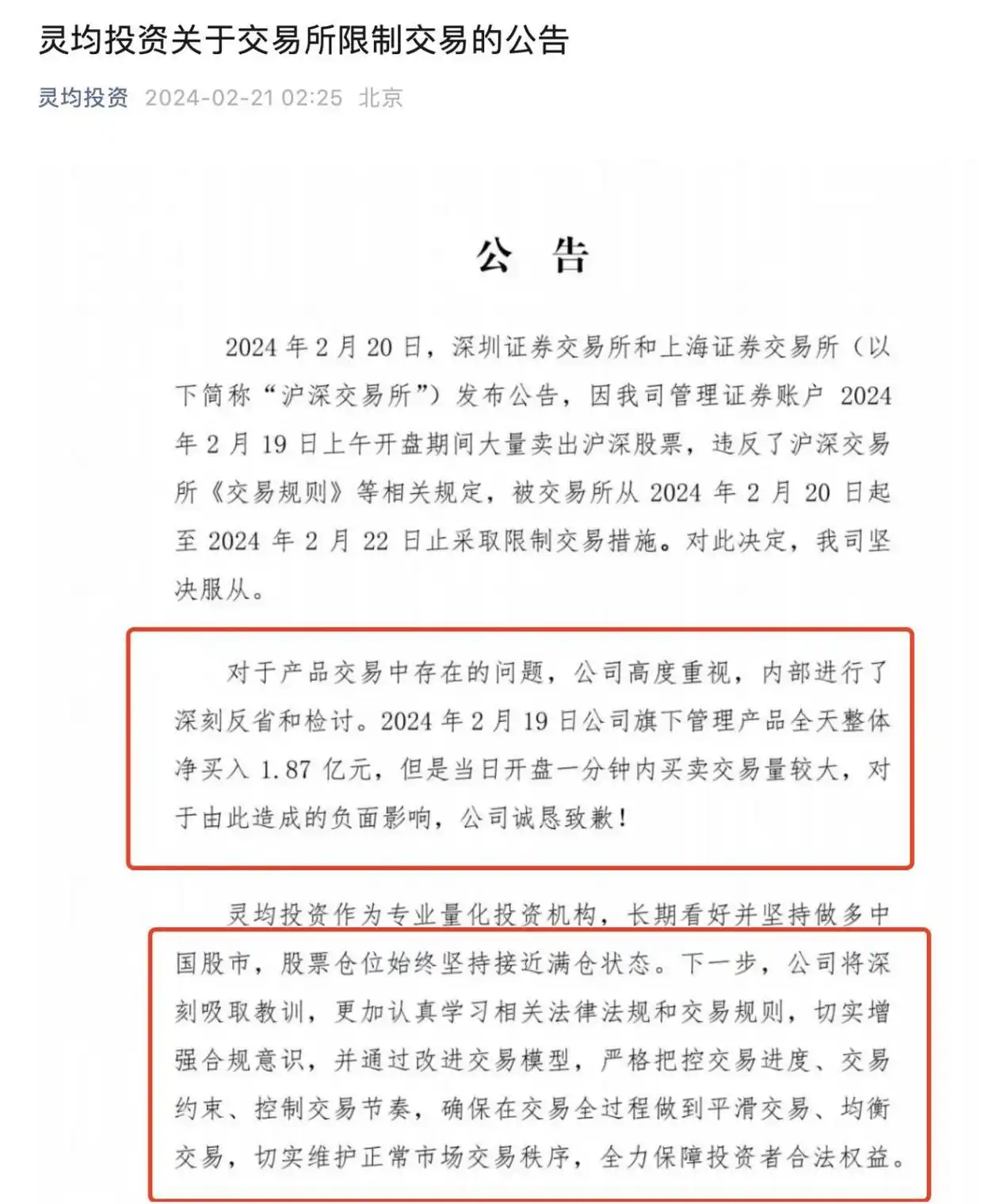
At 2:25 a.m. on February 21, Lingjun Investment issued an announcement on the exchange's trading restrictions, expressing "firm obedience", in-depth review, and apology to the investment.
Lingjun Investment stated in the announcement that the company will resolutely comply with the trading restrictions imposed by the Shanghai and Shenzhen Stock Exchanges. The company attaches great importance to the problems existing in product transactions and has conducted deep introspection and review internally.
The announcement also explained the transactions on the day of the penalty: On February 19, 2024, Lingjun’s management products had an overall net purchase of 187 million yuan throughout the day, but the trading volume was large within one minute of the opening of the day. The company sincerely apologizes for the negative impact caused.
The announcement also mentioned that Lingjun Investment, as a professional quantitative investment institution, is optimistic about and insists on being long in the Chinese stock market in the long term, and its stock positions have always been close to full. In the next step, the company will learn lessons deeply, study relevant laws, regulations and trading rules more seriously, effectively enhance compliance awareness, and by improving the trading model, strictly control the transaction progress, transaction constraints, and transaction rhythm to ensure smooth and balanced transactions throughout the transaction process, effectively maintain the normal market transaction order, and fully protect the legitimate rights and interests of investors.
The fourth stage (8:00-12:00 on February 21) The China Securities Regulatory Commission emphasizes that "one item will be matured and another item will be launched in the future" for quantitative supervision.
After the exchange took action, the China Securities Regulatory Commission also explained and emphasized quantitative supervision. According to multiple media reports, the Market Supervision Department of the China Securities Regulatory Commission stated that the China Securities Regulatory Commission has always paid attention to the development and supervision of quantitative trading. In recent years, it has successively promoted many tasks, including bringing quantitative trading into the scope of securities laws, establishing a data collection mechanism for leading quantitative institutions, strengthening quantitative trading monitoring and analysis, establishing a programmed transaction reporting system, strengthening private placement and securities lending supervision, etc.
The series of quantitative trading supervision measures introduced in the next stage will be matured one by one and launched one by one. We will fully strengthen communication with various investors in the market, grasp the pace and intensity of work, promote the standardized and healthy development of quantitative trading, and maintain the stable operation of the market.
“The focus of this quantitative trading supervision is on high-frequency trading.” The above-mentioned person further said that judging from international experience, overseas markets generally implement stricter supervision on quantitative trading, especially high-frequency trading, to prevent negative impacts on market order.
Germany, Japan, etc. have centralized regulations on quantitative trading in the form of written laws and implement access registration management for high-frequency traders. Germany stipulates the definition and characteristics of algorithmic trading and high-frequency trading, exchange fees, transaction monitoring indicators, system requirements, etc.; Japan has formulated and issued regulatory guidelines specifically for the supervision of high-frequency trading actors.
Markets such as the United States limit the speed at which high-frequency traders can obtain trading information, reduce information asymmetry, and ensure optimal execution of investor orders. At the same time, they clearly prohibit any market participant from participating in, specifying, or intending to conduct destructive trading behaviors, including "spoofing" and other market manipulation behaviors that have emerged with the rise of high-frequency trading.
Regarding the special reporting system for quantitative transactions currently implemented, supervision emphasizes that existing investors are currently "repaying all their dues" and incremental investors are "reporting first and then trading." Unreported investors cannot conduct programmed transactions, which is equivalent to allowing investors to "driving with a license" in the first place, providing institutional conditions for timely discovery of violations and real-time monitoring. (Reporter Yan Jun)
Trainee editor: Li Wenyu | Reviewer: Li Zhen | Supervisor: Wan Junwei

DOI: 10.13568/j.cnki.issn1000-2820.2025.06.007
1. The proposal and advancement process of the China-Kyrgyzstan-Uzbekistan Railway Plan
(1) Proposal and obstacles to advancement of the China-Kyrgyzstan-Uzbekistan railway planning project
China, Kyrgyzstan, and Uzbekistan launched preliminary planning for the China-Kyrgyzstan-Uzbekistan railway project in 1997 and signed a memorandum of understanding on cooperation in building the railway. In 2006, China included the construction plan of part of the Chinese section of the China-Kyrgyzstan-Uzbekistan Railway in the national economic "Eleventh Five-Year Plan". Two years later, the Chinese working group and expert group formulated the "Kashgar-Turgat-Karasu-Andiyan" railway construction plan. During the same period, related railway projects in Uzbekistan were also progressing smoothly. On March 26, 2015, the 129-kilometer-long "Angren-Pap" railway tunnel in Uzbekistan was completed. This section of the railway is an important section of the China-Kyrgyzstan-Uzbekistan Railway and a key project in the construction of the "Silk Road Economic Belt".
In contrast, progress on the Kyrgyzstan section of the China-Kyrgyzstan-Uzbekistan Railway has been slow. Subsequently, the then President of Kyrgyzstan, Almazbek Atambayev, rejected the China-Kyrgyzstan-Uzbekistan railway project, saying that the project was not in Kyrgyzstan’s national interests and suggested changing the direction of the railway to connect the north and south of the country. The China-Kyrgyzstan-Uzbekistan railway project has gone through twists and turns since it was proposed, and it was difficult for all parties to reach consensus on a series of key issues.
First, there is the issue of route direction. From the perspective of project construction cost and operational efficiency, China and Uzbekistan hope to build a route from east to west through southern Kyrgyzstan. The southern route is shorter and less technically difficult. Kyrgyzstan insists on taking the northern route, believing that although this route is longer, it connects the country's northern and southern economic centers and can promote economic development in the north and south. China and Uzbekistan believe that Kyrgyzstan’s proposal is not only costly but also inefficient. In this regard, Bakhtiyor Ergashev, director of the Tashkent think tank "Mano", pointed out that the Kyrgyz authorities proposed the northern railway line plan purely out of "self-interest." "The plan they (the Kyrgyz government) proposed is just longer and more expensive, which is contrary to the idea of rapid and affordable railway construction," Ergashev said in an interview with a Kazakh news website.
Second, there is the issue of project funding. Kyrgyzstan is a typical mountainous country. The cost of building railways in mountainous areas is high. Coupled with the relatively poor economic situation, railway construction costs and financing have become issues of greater concern to the Kyrgyz people. Kyrgyzstan economic expert Iskender Sharsheev once pointed out that Bishkek faces severe challenges in attracting foreign investment to build the China-Kyrgyzstan railway. This, coupled with financial restrictions in Kyrgyzstan and Uzbekistan, has weakened the ability to independently finance the project. Tilek Tekebaev, Minister of Transport and Communications of Kyrgyzstan, said in a speech in 2023 that the huge project of China-Kyrgyzstan-Uzbekistan Railway must be seriously considered, and work will be resumed after the financing model is finalized.
Third, the issue of track gauge. The track gauge widths in China and Kyrgyzstan are different. If the track gauges are not uniform, replacement operations must be performed, which will affect railway operation efficiency. China uses 1435 mm international standard gauge, and Central Asian countries use 1520 mm wide railway tracks. China initially hoped to use the standard gauge used by both China and Europe, while Kyrgyzstan hoped to continue using the Soviet-era broad gauge to connect with railways in Russia and Kazakhstan. In July 2020, Zheng Chiping, deputy director of the Foreign Investment Department of the National Development and Reform Commission of China, pointed out at a video conference on the China-Kyrgyzstan-Uzbekistan Railway Construction Project that it was difficult for experts to reach a consensus on the track gauge and route of the railway, and China suggested considering other options. For a long time, China and Kyrgyzstan have been unable to reach a consensus on this issue, which has become one of the important obstacles to the implementation of the project.
Fourth, the political stability of the relevant countries. Take Kyrgyzstan as an example. The country is an important transit country for the China-Kyrgyzstan-Uzbekistan railway. It has elected six presidents since its independence in 1990. The unstable political situation in Kyrgyzstan caused by the revolutions in 2005, 2010 and 2020 has caused the China-Kyrgyzstan-Uzbekistan railway negotiations to stall. The change of government also caused the country's leaders to have inconsistent attitudes towards the railway project at different stages, and some even opposed the construction of the project. The then President of Kyrgyzstan, Almazbek Atambayev, pointed out that there were some people who opposed the China-Kyrgyzstan-Uzbekistan railway project, and that behind these objections and obstructive actions were hidden political and competitive games. Underlying the dispute over the route is a concern that if the railway runs only through southern Kyrgyzstan, the economic power of Kyrgyzstan’s southern elite will exceed that of the northern political bloc.
(2) The final implementation and solution of the China-Kyrgyzstan-Uzbekistan Railway Project
The construction of the China-Kyrgyzstan-Uzbekistan railway project has accelerated with the upgrade of China-Kyrgyzstan relations. In June 2018, China and Kyrgyzstan established a comprehensive strategic partnership. Both parties stated that they would make every effort to promote the work related to the China-Kyrgyzstan-Uzbekistan railway project and strive to start construction as soon as possible. On July 15, 2020, China, Kyrgyzstan and Ukraine held a video conference to discuss railway construction plans. On June 2, 2022, China, Kyrgyzstan and Uzbekistan held a tripartite working-level video conference on the China-Kyrgyzstan-Uzbekistan Railway to exchange in-depth views on promoting cooperation in the China-Kyrgyzstan-Uzbekistan railway project. In September 2022, China, Kyrgyzstan and Uzbekistan signed the "Memorandum of Understanding on Cooperation on the China-Kyrgyzstan-Uzbekistan Railway Construction Project (Kyrgyzstan Section)" during the SCO Summit in Samarkand and agreed to launch a feasibility study in 2023. In 2023, China and Kyrgyzstan will establish a comprehensive strategic partnership for a new era and work together to build a China-Kyrgyzstan community with a shared future featuring good neighborliness, friendship and shared prosperity. Against this background, the progress of the China-Kyrgyzstan-Uzbekistan railway project has been accelerated. In May 2023, during the China-Central Asia Summit, the government departments of the three countries signed the "Memorandum of Understanding on Reaching Consensus on the Tripartite Joint Review of the Feasibility Study of the China-Kyrgyzstan-Uzbekistan Railway Construction Project (Kyrgyzstan Section)". After the efforts of all parties, China, Kyrgyzstan and Uzbekistan reached an agreement on issues such as route selection, track gauge, investment and operation model, and signed the "Agreement on Jointly Promoting China-Kyrgyzstan-Uzbekistan Railway Project Cooperation" in June 2024. On April 29, 2025, the construction of three key control projects on the Kyrgyzstan section of the China-Kyrgyzstan-Uzbekistan Railway, the Fergana Mountains, Naryn No. 1, and Koshbot Tunnels, started, marking that the main line of the China-Kyrgyzstan-Uzbekistan Railway project has entered the substantive construction stage. At present, the three countries have signed all necessary documents involving the railway, and the three parties have reached consensus on key issues of railway construction. The project has officially started construction in July 2025, with a planned construction period of 6 years.
First, regarding funding issues. The China-Kyrgyzstan-Uzbekistan Railway will be operated by a three-party joint venture. Each party plans to invest in the construction of the railway with designated shares, 51% of which belongs to the Chinese company, and the remaining 24.5% belongs to related companies in the Kyrgyz Republic and Uzbekistan respectively. In June 2024, Azamat Sakiev, director of the Kyrgyzstan Railway Bureau, revealed that Kyrgyzstan had negotiated loan issues with the Export-Import Bank of China and the People's Bank of China, including undetermined loan terms and interest rates. Regarding the total investment and the proportion of capital contributions from each country, according to the "China-Kyrgyzstan-Uzbekistan Railway Design, Construction, Financing, Operation and Maintenance Investment Agreement" signed between China-Kyrgyzstan-Uzbekistan Railway Co., Ltd. and the Kyrgyzstan Ministry of Transport on December 20, 2024, on the China-Kyrgyzstan-Uzbekistan Railway (Kyrgyzstan Section) ) of the US$4.7 billion investment, China will provide half of the capital loan (US$2.35 billion), and the remaining half of the funds will be raised by the China-Kyrgyzstan-Uzbekistan Railway Company in proportion to their respective shares (US$1.2 billion for China, US$573 million for Kyrgyzstan and Uzbekistan each).
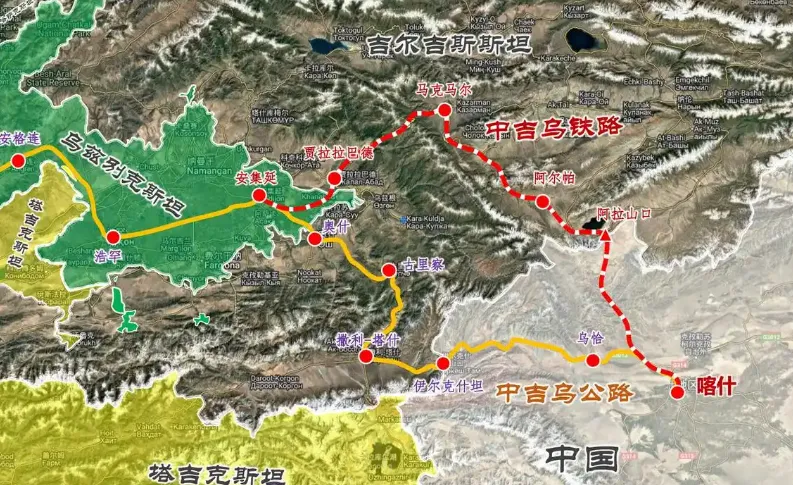
Second, regarding the route direction. China and Kyrgyzstan have reached a consensus on the Torugart-Arpa-Kosh-Dobo-Makmal-Jalal-Abad route. The railway will pass through Kashgar (Central)-Torgart (Kyrgyzstan)-Makmal (Kyrgyzstan)-Jalalabad (Kyrgyzstan)-Andijan (Ukraine). The China-Kyrgyzstan-Uzbekistan Railway starts from Kashgar, Xinjiang, China, and heads northwest through the Turgat Pass. After exiting the country, it goes northwest through Alpa, crosses the Mordotau Mountains and crosses the Alabuqa River to the Makhmal Shifting Station, then crosses the Fergana Mountains to the west, uses the existing railway passage north of Jalalabad, and extends southward around the city of Jalalabad to the end of the border with the Jalalabad South Station. The China-Kyrgyzstan-Uzbekistan Railway has a total length of 616 kilometers, of which the Chinese section from Kashgar to Turgat is 213 kilometers, accounting for 34.6% of the entire line; the Kyrgyz section from Turgat-Makmar-Jalalabad-Suzak, has a total length of 341 kilometers, accounting for 55.3% of the entire line; the Uzbek section from Suzak to Andijan, has a total length of 62 kilometers, accounting for 10.1% of the entire line.
Third, regarding track gauge and operation methods. Regarding the track gauge, the final result of the negotiation is that the China-Kyrgyzstan-Uzbekistan Railway adopts the "standard gauge + broad gauge" segmented model and establishes a standard-gauge and broad-gauge replacement station in Makmar in Kyrgyzstan. Standard-gauge section: Kashgar-Turgat-Makmar, with a length of 381 kilometers, including 213 kilometers of the section in my country and 167.54 kilometers of the section in Kyrgyzstan, using 1435 mm gauge. Broad gauge section: Makmar-Suzak-Andijan, with a length of 235 kilometers, including 173 kilometers of the Kyrgyzstan section (138.77 kilometers of new construction and 34 kilometers of upgrades) and 62 kilometers of the Uzbekistan section, using 1520 mm gauge. Regarding project operation, the project company was jointly established by the China-Kyrgyzstan-Uzbekistan Railway Company. The Kyrgyzstan section of the China-Kyrgyzstan-Uzbekistan Railway is jointly invested and established by the China-Kyrgyzstan-Uzbekistan Railway Co., Ltd., a subsidiary of China Railway International Co., Ltd., a subsidiary of the China State Railway Group Co., Ltd., the Kyrgyzstan State Railway Company, and the Uzbekistan Railway Co., Ltd. It is implemented in accordance with the build-operate-transfer (BOT) model.
2. Possible challenges faced by the construction and operation of the China-Kyrgyzstan-Uzbekistan Railway under geopolitical changes
In the context of the official implementation of the China-Kyrgyzstan-Uzbekistan railway project, factors such as the unstable regional security situation and the continued smear campaign by forces within and outside the region may also affect the smooth advancement and operation of the project.
(1) Unstable regional situations may induce conflicts and threaten project safety
Regarding the situation in Central Asia, American geopolitical scientist Brzezinski once pointed out: "For many years, most of them have been under the influence of the Persian Empire, the Turkish Empire, and the Russian Empire. However, this experience did not cultivate a sense of common regional interests among them. On the contrary, their different ethnic compositions make them vulnerable to internal and external conflicts. The accumulation of such conflicts often attracts the invasion of more powerful neighboring countries." The stability of the political situation in Central Asia is of great significance to ensuring the smooth progress of the China-Kyrgyzstan-Uzbekistan railway project. After the disintegration of the Soviet Union, the geopolitical landscape in Central Asia has been characterized by multidimensional turmoil. Border disputes, ethnic conflicts, non-violent regime change movements, and the deterioration of the surrounding security environment have superimposed on each other, posing a continuous impact on regional stability. Specifically manifested in three dimensions:
First, the vulnerability of sovereign states’ governance capabilities is highlighted. As the hub of the China-Kyrgyzstan-Uzbekistan railway, Kyrgyzstan’s domestic political ecology has long been subject to the power game caused by numerous political parties. In particular, the confrontation between the north-south forces with Bishkek and Osh as the core has triggered many unconventional regime changes, making railway construction a bargaining chip in the game of domestic political forces many times.
Second, cross-border governance problems continue to ferment. The boundary dispute in the Fergana Basin at the junction of Uzbekistan, Tajikistan and Kyrgyzstan is the most typical. This area is a must-pass for the China-Kyrgyzstan-Uzbekistan railway, and its planned terminal point, Andiyan Station, is embedded deep in the hinterland of the basin. In April 2021, an armed conflict broke out between Gita and Gita in the disputed area of the basin. In September 2022, the conflict escalated again and extended about 110 kilometers along the disputed border. This shows that conflicts caused by territorial sovereignty disputes may affect cross-border infrastructure projects.
Third, the ecological security dilemma intensifies the game. As a valuable strategic resource for regional countries, water resources competition is often a source of regional tensions, especially between Uzbekistan and its upstream neighbors. Scholar Pan Zhiping pointed out that the water resources issue in Central Asia is not only an intra-regional conflict, but also one of the potential obstacles to the economic construction of countries along the “Belt and Road”. This unstable situation could trigger a chain reaction that could then escalate into broader internal conflicts among Central Asian states.
(2) The smear campaign by forces inside and outside the region interferes with local people’s understanding of Chinese projects.
The United States has continuously intervened in Central Asian affairs in recent years, and its fundamental goal is to curb the regional influence of China and Russia. Western countries, led by the United States, support non-governmental organizations to penetrate into Central Asia and cultivate "independent media" in the region to constantly hype anti-China issues. For example, in January 2025, when the China-Kyrgyzstan-Uzbekistan railway project was progressing smoothly, the German media Bucharest News Agency (BneIntelliNews) hyped that Kyrgyzstan was becoming a province of China. Regarding the China-Kyrgyzstan-Uzbekistan railway project, on the one hand, Western countries are hyping the construction of the railway, which will increase debt pressure on regional countries. Donald Lu, assistant secretary of state for the Bureau of South and Central Asian Affairs of the U.S. State Department, smeared China's projects in Central Asia as having problems of exploitation, corruption and opacity, saying that Chinese loans are exacerbating the debt risks of regional countries. Diplomacy scholars, Voice of America and other websites accused the China-Kyrgyzstan-Uzbekistan Railway of lacking transparency, which may cause smuggling risks and lead to a debt trap. There are also objections saying that the China-Kyrgyzstan-Uzbekistan plan is not only unfavorable to Kyrgyzstan, but will also incur huge expenses that are difficult to make up for. In this regard, Kyrgyzstan President Sadyr Zhaparov had to clarify, saying: "The construction of the China-Kyrgyzstan-Uzbekistan railway cost 4.7 billion US dollars and is a commercial project. It will not have an impact on the scale of Kyrgyzstan's foreign debt."
On the other hand, forces inside and outside the region claim that the railway project will cause environmental damage. Kyrgyzstan’s opposition has claimed that China has gained access to Kyrgyzstan’s silver, aluminum, copper and coal resources through investment in construction projects. A report by the Caspian Policy Center, an American think tank, stated that construction projects in Kyrgyzstan’s complex geographical environment require major environmental modifications, which may have a negative impact on the local climate and ecosystem. Economist Kubat Rakhimov, adviser to the Prime Minister of Kyrgyzstan, said that the China-Kyrgyzstan-Uzbekistan railway project is particularly difficult and requires the construction of tunnels in mountainous areas. Whichever route is taken, there will be a significant impact on the environment. Vladimir Grebnev, an expert on environmental protection and climate change in Bishkek, advocated for the project. Under the hype of internal and external forces, more and more public opinion believes that China's attempt to put some countries into a debt trap may have high environmental costs, triggering regional people's discussion on whether Chinese investment will generate debt problems, and even opposition to the China-Kyrgyzstan-Uzbekistan railway.
(3) Anti-China group activities may impact the construction of related projects
Western countries continue to hype the debt problems and social and environmental impacts of Chinese investment. Under the influence, some Central Asian people have a negative attitude towards China and Chinese investment. Survey data from the Central Asia Barometer between 2017 and 2021 shows that Kazakhstan respondents have a more negative view of China, and the number of Kyrgyzstan respondents who hold a "very negative" view of China has increased in each subsequent survey. Eliminate my country's negative image in Central Asian societies. The survey results show that the Central Asian people's welcome towards China is on a downward trend. Under the influence of multiple factors, anti-China groups in Central Asia frequently plan activities against Chinese investment, including protest marches, launching social media campaigns, and damaging and boycotting Chinese goods and services. For example, hundreds of Kyrgyzstanis once gathered near At-Bashy in Naryn Region to protest China's plan to build a logistics center there. The $275 million logistics center project was ultimately canceled. At the same time, individual ultra-nationalist groups continue to grow due to rising anti-China sentiment. The Kyrgyz right-wing nationalist male group "Kyrk Choro" carries out anti-Chinese activities on the grounds of "helping the government detect illegal immigrants" and accuses the Kyrgyz government of being "corrupt" and "pro-China". The former leader of the movement, Zamirbek Kochorbaev, wrote an article saying that the "Forty Knights" demanded the suspension of Kyrgyz visas to foreigners and said that "Chinese people should be deported." Members of his organization even held protests outside the Chinese Embassy in Bishkek. Not only that, the organization has also raided many Chinese companies. The Chinese-owned oil refinery located in Kalabarta, about 60 kilometers outside Bishkek, was disrupted by the organization. The fluctuations in Central Asian people's sentiments against China caused by the anti-China activities of extremist groups will affect China's regional investment to a certain extent.
(4) Competition from other similar projects
The China-Kyrgyzstan-Uzbekistan Railway also faces competition from other transportation projects. In recent years, Russia and India have actively participated in the construction of Central Asia's transportation network, aiming to strengthen their presence in Central Asia through projects such as the International North-South Transport Corridor (INSTC). Given Russia's support for India in balancing China's influence in Central Asia, this project will compete with China and may affect the effectiveness of projects such as the China-Kyrgyzstan-Uzbekistan railway. Although the China-Kyrgyzstan-Uzbekistan Railway and the North-South Corridor focus on east-west transportation and north-south logistics respectively, the North-South Corridor may still attract energy and mineral transportation from Kazakhstan, Turkmenistan and other Central Asian countries to enter South Asia or Europe, diverting goods that originally passed through the China-Kyrgyzstan-Uzbekistan Railway. At the same time, as the geopolitical game in Central Asia intensifies, Russia may accelerate the promotion of the Russia-India corridor to maintain its influence in Central Asia. India is also trying to establish alternative economic corridors to China in Central Asia and West Asia to weaken the radiation power of China’s “One Belt, One Road” initiative. In addition to Russia, the EU also aims to strengthen transportation links with Central Asian countries through the "Middle Corridor". In January 2024, the EU pledged to invest 10 billion euros to improve the infrastructure of the Central Corridor, which appears to be the first step in regional connectivity. In April 2025, the first EU-Central Asia Summit was held in Uzbekistan. During the summit, the EU announced a "Global Gateway" investment plan to invest an additional 12 billion euros in Central Asia, of which 3 billion euros were used for transportation. Compared with the China-Kyrgyzstan-Uzbekistan Railway, the "middle corridor" is further north, while the China-Kyrgyzstan-Uzbekistan Railway strengthens the southern line and fills the gap in the railway network in southern Central Asia. The two form a "north-south parallel" pattern in the Central Asian section. In addition, the United States also has a relatively strong interest in the "Middle Corridor" in terms of funds, standards and geographical influence in the future, and can compete with the China-Kyrgyzstan-Uzbekistan Railway. In addition, Kazakhstan is also worried that the China-Kyrgyzstan-Uzbekistan Railway will gradually become Kazakhstan’s competitor in China-Europe freight. Currently, rail transportation to and from China and Europe must be transited through Kazakhstan. In the future, with the completion of the China-Kyrgyzstan-Uzbekistan Railway, Kyrgyzstan will have a direct railway to China, and Uzbekistan will have the option to go to China via the Kyrgyzstan or Kazakhstan railway. In the future, Kazakhstan is unlikely to give up its position as a regional transportation hub and will continue to develop its railway infrastructure to maintain its dominant position in regional transportation.
 Zheng Yongshi Almost Became The Fifth Concubine Of The Gambling King. What Is Her Current Situation After Leaving?2026-02-17Comments(0)
 The Collapse Of Chia Currency Has Caused Slag To Appear In The Second-hand Market. Hard Drives And I9 10850k Need To Be Vigilant2026-02-18Comments(0)