
Huazhu Club Has The Largest Membership And Amazing Loyalty. It Has Been Recognized By The 318 Sichuan-Tibet Line.
long termism
long termism
1. Core knowledge points of "New Concept English Youth Edition 2A"
1. Grammar focus: the usage of past continuous tense (was/were + doing), present perfect tense (have/has + past participle), modal verbs (must/have to/should, etc.), as well as the basic application of attributive clauses (introduced by who/which/that) and adverbial clauses (introduced by when/while).
2. Vocabulary and phrases: Around the themes of "daily life, school, hobbies, travel", about 200 new core words (such as instrument, experiment, journey, etc.) are added, paired with a large number of fixed phrases (such as take part in, look forward to, be interested in, etc.).
3. Sentence structure: focus on the use of compound sentences, such as "subject + was doing when + clause" "subject + have/has + past participle of verb + for/since + time", while strengthening the complex sentence conversion of general questions and special questions.
4. Listening, speaking, reading and writing: Listening focuses on understanding scene conversations (such as telephone communication, activity arrangements); speaking emphasizes situational questions and answers and short retellings; reading focuses on short stories/expository texts; writing exercises include simple letters, diaries, or looking at pictures and writing.
2. Practical methods for teaching children
1. Scenario-based introduction to stimulate interest: Design life scenes based on knowledge points. For example, when teaching "past continuous tense", ask children to describe "what you were doing at this time yesterday", or use animations and pictures to restore dialogue scenes in teaching materials (such as doing experiments in laboratories and attending concerts) to make abstract grammar concrete.
2. "Split + Integrate" grammar learning: first split the grammatical structure (such as present perfect tense = auxiliary verb + past participle), use "formula + example sentences" to let children remember the rules (for example: I have finished my homework.), and then consolidate through "replacement exercises" (replace finished with read/written, etc.), and finally integrate the understanding with text example sentences.
3. "Lead in listening and speaking, keep up in reading and writing": Spend 10 minutes every day for children to listen to text recordings and read along, imitating pronunciation and intonation; then use dialogues in the textbooks to role-play (such as parents playing the role of teachers, children playing the role of students); vocabulary can be memorized through "word association games" (such as journey, travel, train, etc.) to avoid rote memorization.
4. Review of wrong questions + regular review: Prepare a book of wrong questions, record the grammatical points that the child is confused about (such as the difference between was/were) and misspelled words, and spend 20 minutes every week to review; after every 3-4 lessons, use a "mind map" to sort out the knowledge points (such as listing the different uses of "modal verbs") and impose exercises.

Recently, the Ministry of Education announced the 2022 registration and approval results for undergraduate majors in general colleges and universities. The undergraduate major of Zhejiang University of Finance and Economics, Financial Technology, was approved to be added. This is the fifth cross-disciplinary major that the school has successfully cultivated since it tested the interdisciplinary field in 2003.
"Breaking the barriers of disciplines and majors and realizing cross-fertilization between economics, management, science, engineering, and humanities is the main line of the reform of the school's talent training model." Zhong Xiaomin, president of Zhejiang University of Finance and Economics, believes that China's economy has entered a stage of high-quality development, and new technologies, new industries, new business formats, and new models have given birth to "new finance" and triggered profound changes in higher financial education.
A new college born for the intersection of disciplines
After taking two "entrance" exams, Zhang Yinhua, a 2021 student of the school, was lucky enough to be admitted to Wenhua College and became a member of the "Smart Audit" innovation class. For more than two years, he has received a completely different training program from ordinary classes. In addition to mastering basic financial expertise, he also has to learn integrated courses such as data science and information technology.
Wenhua College was established in 2021 with the purpose of cultivating cross-disciplinary talents. It has five classes, including digital finance, intelligent auditing, digital management, digital financial news, and language data, and is open to all freshmen. "Traditional auditing professional courses can no longer meet the actual needs of the industry. I chose this class for better employment and further education in the future." Zhang Yinhua said.
Curriculum innovation is a highlight of Wenhua College. Take the "Big Data Audit" course as an example. Compared with traditional auditing, the data structures and technical methods used are more complex and advanced, and there is no unified teaching material in China. To this end, the college has established a five-person course team composed of key teachers from different disciplines such as computer science and technology, business administration, etc. Computer teachers specialize in "Python data analysis" to lay a digital foundation for course development. Business administration teachers have integrated auditing knowledge and developed more than 20 "big data + auditing" teaching cases. During this period, the team also invited business backbones from the Zhejiang Provincial Audit Office to participate in course construction, understand the application scenarios of emerging technologies in auditing, and remain academically sensitive to the latest developments in related fields.
In Zhang Yinhua’s impression, cross-cutting courses such as “Information System Control and Audit” and “Intelligent Audit Topics” have opened a new door to professional development. During the interview at the University of Cambridge in the UK, he won unanimous praise from the review experts for his excellent language expression and theoretical foundation of cross-integration.
It is understood that the school invests in course construction according to the standard of 100,000 yuan/course. Over the past two years, more than 60 teachers from the school have joined the curriculum reform team of Wenhua College and developed a total of 12 interdisciplinary courses. The pilot experience of Wenhua College has driven the curriculum construction of secondary colleges, and interdisciplinary teaching and research communities have sprung up like mushrooms after a rain.
A system adapted to interdisciplinary studies
In the school's comprehensive reform structure, Wenhua College takes the lead in piloting and uses this to drive other secondary colleges. However, it is difficult to achieve comprehensive advancement based on the "educational consciousness" of secondary colleges alone. After repeated research, the school decided to "force" cross-disciplinary reform by starting from "changing majors" where students' needs are most sensitive.
The school was the first in Zhejiang to launch the "Access and Exit" system, and established a highly free and flexible "overpass system" for major transfer throughout the four years of the university. The "access" mechanism gives students the right to choose a major. Each student has an opportunity to choose a major again. The admission threshold is announced for each major (category). As long as you meet the admission requirements, you can apply. Access opportunities are open in the second, third, and fourth semesters.
When students do not choose their favorite major through "admission" and still want to continue their studies and graduate from that major, the school has designed an "acceptance-out" mechanism to give students the right to choose graduation. "Accessible admission" is divided into "accurate admission for majors" and "accurate admission for minors." Those who are "accepted to graduate with a major major" and meet the requirements of the professional training program will be issued an academic degree certificate; those who are "accepted to graduate with a minor major" and meet the specified requirements will be issued a minor certificate.
"Whether it is admission or exit, each college is required to develop more cross-integrated courses to provide students with more possibilities to choose different professional directions." Zhong Xiaomin said.
Not long ago, Zheng Qiancheng, a student from the School of Business Administration of the school, successfully transferred to the School of Economics. In his opinion, business administration and economics belong to the broad category of economics and management. “Management and management are not separated, and some logical thinking is the same.” To this end, Zheng Qiancheng took basic economics courses such as microeconomics and basic accounting in his freshman year, plus management wisdom and innovation and entrepreneurship in general courses, laying the foundation for cross-disciplinary integration. In the specific training plan, the school provides courses such as "ERP Simulation Exercise" that integrates economics and management, which not only explores the laws of social operation from the perspective of economics, but also examines the study of human nature from the perspective of management. "I didn't encounter any resistance when it came time to change my major. The business management knowledge I learned before will also be helpful for studying economics in the future." Zheng Qiancheng said.
According to statistics, since the implementation of the "admittance, admission" system, the school's cross-integrated courses have grown at a rate of 10% every year, and the student employment rate has increased significantly.
Explore better interdisciplinary
In the process of promoting the reform of interdisciplinary subjects, how to explore better interdisciplinary subjects is a new proposition facing the school.
In 2021, the school and the University of Chinese Academy of Social Sciences jointly established the "Zhejiang Institute for Advanced Study at the University of Chinese Academy of Social Sciences" and the "Zhejiang University of Finance and Economics-Zhejiang Research Institute at the University of Chinese Academy of Social Sciences" to implement a new management model of "two brands, one team" to cultivate high-level interdisciplinary talents. This project optimizes the original single-disciplinary training plan, requiring graduate students to take at least three interdisciplinary courses, and also has the opportunity to study at the China University of Social Sciences for one semester. Postgraduate students are guided by a team of tutors, which must include a tutor across first-level disciplines or second-level disciplines. To this end, the school has specially established a teacher expert database covering more than 80 cross-disciplinary talents.
The institute focuses on major projects and integrates interdisciplinary knowledge in practice. In the list of study courses for Zhang Huahan, the school's first batch of master's students, there are not only traditional economics courses such as macroeconomics, microeconomics, and econometrics, but also cutting-edge big data technologies such as machine learning and neural networks. In the context of my country's "double carbon" goal, Zhang Huahan worked with his mentor to study and use various models such as econometric models, machine learning models, and gray models to predict my country's future carbon emissions, and provide analysis of relevant carbon emission influencing factors and policy recommendations. Currently, Zhang Huahan has published 3 research results in internationally renowned journals.
According to statistics, since the institution has been in operation for two years, a total of 28 cross-disciplinary scientific research projects have been approved. Students have obtained 3 Zhejiang Provincial “New Talent Plan” projects, 2 Zhejiang Provincial Department of Education general scientific research projects, and 7 students have won awards in national subject competitions.
Li Jinchang, Secretary of the Party Committee of the school, said that the school will seize the opportunity of thematic education, continue to deepen comprehensive reforms, conduct in-depth research and promote the cultivation of integrated talents, effectively transform learning results into the ability and level to promote the development of the school's career, strengthen the construction of "Golden Specialties, Gold Classes, Gold Teachers, and Gold Textbooks", and strive to cultivate "Golden Students" with Zhejiang Finance characteristics. (Our reporter Jiang Yifeng and correspondent Zhao Lei)
A reporter group from Yunnan University, a national key online media outlet, came to Yunnan University of Finance and Economics.
Xiong Shuxin, President of Yunnan University of Finance and Economics, gave a wonderful speech to the press group.
Ethnic minority accounting books in the Yunnan Ethnic Minority Accounting Museum.
Honors received by the International Business School of Yunnan University of Finance and Economics.
Dazhong.com Kunming News (Reporter An Leilei) On the morning of June 24, 2013, the press team of the national key online media Yunnan University News came to the third stop of this event - Yunnan University of Finance and Economics. In the Yunnan Minority Accounting Museum of Yunnan University of Finance and Economics, President Xiong Shuxin of Yunnan University of Finance and Economics gave a wonderful speech to the press group, which also gave the press group a deeper understanding of "campus culture".
The university is beautiful because of its humanistic content and historical depth
"The university is beautiful because of its humanistic connotation and historical depth." Xiong Shuxin said that although the passing rate of the English CET-4 and CET-6 of the University of Finance and Economics ranks first in Yunnan Province, I am also worried about whether the students have really mastered this language and whether they really have the cultural accumulation of English background. In order to understand the relevant cultural accumulation level of students, the school organized an English drama festival. After watching 8 all-English dramas written, directed and performed by students, Xiong Shuxin believed that the students of Yunnan University of Finance and Economics are indeed relatively weak in the accumulation of humanistic connotations.
During the interview, the reporter learned that in order to continuously improve the comprehensive quality and humanistic quality of students, Yunnan University of Finance and Economics first regards sports as the core of the school’s humanistic connotation construction, making sports a way of life for college students to grow and become talents. Secondly, set up an art education center, add art equipment, and introduce experts and teachers in drama, visual shooting, micro-film and other categories. Finally, build a huge general education system and integrate noble lifestyles into the daily lives of college students. Xiong Shuxin encourages students not to be "otakus" but to experience the rich and colorful campus life.
It is reported that Yunnan University of Finance and Economics has carefully constructed a campus cultural square, designed a campus image recognition system, and vigorously promoted the university spirit through cultural attractions such as cultural walls, cultural stones, and reliefs. Especially in 2011, the school took the opportunity of the 60th anniversary of the founding of the school to build and open the first art museum in the country's finance and economics colleges - Zhong Zhengshan Art Museum, the only ethnic finance and accounting museum in the country - the Yunnan Minority Finance and Accounting Museum, the school history museum and other distinctive and profound campus cultural activity venues to enhance the construction and level of campus culture.
Run schools with a more open and inclusive attitude
“Yunnan University of Finance and Economics has always adhered to the concepts of openness, tolerance and responsibility,” President Xiong said. Today, when serving local economic and social development is the responsibility of universities, Yunnan University of Finance and Economics will integrate into society with a more open attitude, let the university culture get out of the “ivory tower”, and provide rich and colorful cultural nourishment and services to the society and the public.
As the first pilot university in Yunnan Province to launch a Sino-foreign joint venture education project, Yunnan University of Finance and Economics has a unique international education experience based on the path of "introduction, integration, and localization of education". It has reformed the traditional education system and talent training model and cultivated a large number of international compound talents needed for regional economic and social development.
"We hope to gradually achieve the goal that more and more students can have an international experience during college." President Xiong said that internationalization is a comprehensive and all-round process. At present, the educational internationalization model of Yunnan University of Finance and Economics has basically taken shape, and it has established inter-school cooperative relationships with more than 130 universities, involving more than 30 countries and regions including the United States, Britain, Australia, France, Russia, India, Vietnam, and Thailand.
At the same time, as the only provincial key financial and business university in Yunnan Province, in order to further leverage the school's financial and business disciplines and talent advantages, the University of Finance and Economics cooperated with Kunming Dongxun Technology Co., Ltd. and other units to establish the "Yunnan University of Finance and Economics E-Commerce Engineering Research Center" in an industry-university-research approach. The school conducts creative research and development, and the company provides platform and technical support, providing talent training, e-commerce, technology and other services to Yunnan Province and Southeast Asian countries. It also builds a platform for school students to practice and practice, and opens a door to innovation for students.
Principal Xiong said, “We must rely on the school’s location advantages, professional characteristics, and international school-running conditions to cultivate international financial and business talents.”
Over the past five years, General Secretary Xi Jinping has personally presided over 16 meetings of the Central Financial and Economic Leading Group to comprehensively plan China's economic development and constantly open up new realms.
From deliberative body to decision-making body
——The 18th Central Financial and Economic Leading Group has become an important decision-making platform for the Party Central Committee to lead economic work, highlighting the superb ability of the Party Central Committee with Comrade Xi Jinping at its core to control the economy.
On the evening of June 13, 2014, a press release from Xinhua News Agency about the sixth meeting of the Central Financial and Economic Leading Group attracted attention. This is the first time that the 18th Central Financial and Economic Leading Group meeting has come into public view.
On the same day, General Secretary Xi Jinping delivered an important speech at Zhongnanhai Huairentang, laying out China’s energy security strategy for the first time——
China must promote energy consumption revolution, energy supply revolution, energy technology revolution, and energy system revolution, and strengthen international cooperation in all aspects to achieve energy security under open conditions.
This is the world's largest energy producer and consumer. Under the new normal of economic development, it has taken a leap to seize the opportunity of a new round of global technological revolution and industrial transformation.
"In the face of new changes in the energy supply and demand pattern and new trends in international energy development, to ensure national energy security, we must promote a revolution in energy production and consumption." General Secretary Xi Jinping emphasized.
An article published on the website of Hong Kong's "Ta Kung Pao" stated that this meeting elevated the energy production and consumption revolution to the level of the country's long-term strategy, showing that the central government's actions and determination are great, and behind it is the profound meaning of promoting the transformation of China's economic development model.
The meeting itself made the outside world feel that the Central Financial and Economic Leading Group was unusual—Xi Jinping, General Secretary of the CPC Central Committee, personally served as the group leader and presided over the meeting.
Previously, the Central Financial and Economic Leading Group made few public disclosures. Outsiders are curious, what kind of organization is this?
Economic work has always been the central task of the party's governance of the country. The Central Financial and Economic Leading Group is one of the organizational forms through which the Party leads economic work.
On March 17, 1980, the Central Financial and Economic Leading Group was formally established and became the deliberative body of the Party Central Committee to lead economic work.
On April 17, 2013, the first meeting of the 18th Central Financial and Economic Leading Group was held, announcing the establishment of the new Central Financial and Economic Leading Group.
This meeting studied the "Working Rules of the Central Financial and Economic Leading Group", discussed the main contents of the work of the Financial and Economic Leading Group in the future period, and emphasized the need to give full play to the role of the Financial and Economic Leading Group in strengthening the Party's leadership over economic work and improve the level of the Party's leadership in economic work.
At this meeting, the central government clarified the positioning of the new financial leading group - an organization entrusted by the Political Bureau of the Central Committee and its Standing Committee to make major strategic policy decisions for economic and social development.
From a deliberative body to a decision-making body, the change in the positioning of the Central Financial and Economic Leading Group highlights the great importance that the Party Central Committee with Comrade Xi Jinping at the core attaches to strengthening the leadership of economic work.
The key to running China's affairs well lies in the party. The key to planning China's economic development in the new era lies in the party.
The high level of members of the Central Financial and Economic Leading Group highlights the importance of this decision-making body:
The General Secretary of the CPC Central Committee serves as the team leader, the Premier of the State Council serves as the deputy team leader, and the members are composed of other relevant leading comrades of the party and the country.
At each meeting, other central leading comrades and responsible comrades from relevant departments and local governments are invited to attend according to the agenda.
The Central Financial and Economic Leading Group has an office responsible for handling the daily affairs of the Central Financial and Economic Leading Group.
Big things are difficult and hard things come true. On the new Long March for the great rejuvenation of the Chinese nation, there are many obstacles and thorns.
From the spring of 2013, before the 19th National Congress of the Communist Party of China, the 18th Central Financial and Economic Leading Group, under the strong leadership of General Secretary Xi Jinping, grasped the general trend of economic and social development, made far-sighted and scientific plans, held 16 meetings, studied 25 major issues, and proposed more than 400 tasks and measures.
The topics of the 16 meetings all highlighted “major”——
The focus is on major principles and policies for economic and social development, major strategies and plans, and principles and measures for the major layout of national economic productivity.
The topics for each meeting are personally determined by General Secretary Xi Jinping after careful planning, in-depth research, repeated studies, and careful consideration. He personally presided over every meeting and made important speeches on every topic.
"My governing philosophy, in a nutshell, is: serve the people and shoulder the responsibilities that should be borne." The general secretary's affectionate confession and commitment to the motherland and the people are also deeply reflected in the leadership and decision-making of China's economy.
In making decisions about economic development in the new era, the Central Financial and Economic Leading Group attaches great importance to top-level design——
Reform and opening up is a key move that determines the fate of contemporary China.
On July 15, 2013, the Central Financial and Economic Leading Group held its second meeting to study ideas for deepening the reform of the fiscal and taxation systems. The first thematic topic focuses on reform and uses practical actions to demonstrate China's firm determination to deepen reform.
Finance is the foundation and important pillar of national governance. From Shang Yang's reforms in ancient China to the United States' budget system reform that ushered in the "Progressive Era" more than 200 years ago, practice at home and abroad has shown that a scientific fiscal and taxation system is an institutional guarantee for achieving long-term stability in the country.
"Economic transformation is the most important and urgent issue facing our country's development. One of the root causes of the previous period's extensive development methods and blind investment in projects was the unreasonable fiscal and taxation system." said a person in charge of the Central Finance Office.
In response to the outstanding problems in the fiscal and taxation system, this meeting proposed the reform principles of "adjusting powers, improving the tax system, stabilizing tax burdens, improving budgets, and improving efficiency", which made ideological preparations for the deployment of the Third Plenary Session of the 18th Central Committee of the Communist Party of China in November that year to deepen the reform of the fiscal and taxation system.
Facing new changes in the global political and economic landscape and new requirements for domestic development, our country urgently needs to establish a new overall strategy for opening up.
On November 4, 2014, the 8th meeting of the Central Financial and Economic Leading Group identified the “Belt and Road” construction as the top-level design and major strategy of my country’s economic diplomacy. In order to improve supporting mechanisms, it was decided to initiate the establishment of the Asian Infrastructure Investment Bank and the Silk Road Fund.
When deciding on economic development in the new era, the Central Financial and Economic Leading Group focuses on long-term planning——
"Hong Fan's eight political affairs, food is the first." Throughout the ages, food security has been the top priority in governing the country.
On the one hand, the demand for food is growing rigidly, and on the other hand, the national conditions of large population, limited land and water shortage restrict food production. How to find a path to food security with Chinese characteristics?
"Ensuring basic self-sufficiency in grains and absolute food security" - On December 9, 2013, the fourth meeting of the Central Financial and Economic Leading Group studied national food security issues and established my country's new food security concept. The Central Economic Work Conference held the next day further proposed the national food security strategy under the new situation of "putting ourselves first, being domestically based, ensuring production capacity, moderate imports, and scientific and technological support".
From the past "guaranteeing all" food security to the current emphasis on "guaranteeing rations", this is a strategic decision made by the Party Central Committee under the new situation to consider resource conditions and concentrate efforts to ensure key points.
The fifth meeting on March 14, 2014 studied the national water security strategy; the twelfth meeting on January 26, 2016 studied the issue of forest ecological security... Based on promoting sustained and healthy economic development and achieving the "Two Centenary Goals", the Party Central Committee studied at the meeting fundamental, strategic and forward-looking major issues related to the sustainable development of the party and the country's undertakings, and proposed fundamental solutions.
When making decisions about economic development in the new era, the Central Financial and Economic Leading Group adheres to a problem-oriented approach——
On July 20, 2015, in response to the rare and abnormal fluctuations in the stock market, the 10th meeting added capital market topics while studying poverty alleviation work, and proposed key tasks such as conscientiously learning lessons, restoring normal market operations, improving system construction, and further preventing risks.
An extraordinary move must have an extraordinary meaning.
The third meeting studied new urbanization work, the ninth meeting studied the coordinated development of Beijing, Tianjin and Hebei, and the fourteenth meeting studied and solved outstanding issues of general concern to the people... A series of measures strive to solve shortcomings.
Determining economic development in the new era, the Central Financial and Economic Leading Group continues to improve the strategic layout of economic work——
The "One Belt and One Road" construction, coordinated development of Beijing, Tianjin and Hebei, development of the Yangtze River Economic Belt, innovation-driven development strategy, "inclusion of RMB in the basket", improvement of investment and market environment...the conference topics covered all aspects of national economy and social development.
Through the working mechanism of the Central Financial and Economic Leading Group Meeting, the Party Central Committee with Comrade Xi Jinping as the core proposed a series of new concepts, new ideas and new strategies for economic and social development, formed a series of major judgments and decisions related to the current and long-term, effectively unified the thinking of the whole party, and accomplished some major events of far-reaching historical significance. The overall layout of the Party Central Committee’s leadership in economic work has basically been completed.
"China's economic achievements are undoubtedly the best proof of the effectiveness of China's political system under the leadership of the Communist Party of China." Russian Communist Party leader Zyuganov said.
Form Xi Jinping’s socialist economic thought with Chinese characteristics for a new era
——The theoretical innovations made by the 18th Central Financial and Economic Leading Group in the new practice provide ideological guidance and theoretical compliance for leading the new normal of economic development and promoting economic transformation and development.
Time goes back more than two years ago.
On November 10, 2015, General Secretary Xi Jinping presided over the 11th meeting of the Central Financial and Economic Leading Group to study the issue of economic structural reform and proposed new ideas to strengthen supply-side structural reform.
China's economic development has entered a new normal, with economic growth fluctuating and declining, severe overcapacity, funds diverted from real resources to virtual ones, increasing pressure on resources and the environment, and social conflicts and problems... The idea of focusing on expanding demand has reached its limit, and new development ideas are urgently needed for actual development.
How to adjust the basic ideas of economic policy has become a major and urgent issue.
"While some people still place their hopes on launching a large-scale economic stimulus plan on the demand side, the Party Central Committee decided to adjust the basic thinking of economic development. Proposing to promote supply-side structural reform is a good governance prescription for the 'what to do' of the Chinese economy after making a major judgment on the new normal of economic development and solving the problem of 'what to do' with the Chinese economy." said the relevant person in charge of the Central Finance Office.
This meeting made ideological preparations for the subsequent Central Economic Work Conference. The Central Economic Work Conference held in December 2015 comprehensively elaborated on the supply-side structural reform and made full-chain arrangements from top-level design, policy measures to key tasks.
Great theory guides great practice.
Since the 18th National Congress of the Communist Party of China, the Party Central Committee with Comrade Xi Jinping as the core has continuously promoted theoretical innovation and practical innovation, formed Xi Jinping's socialist economic thought with Chinese characteristics for a new era, and initially established an economic policy framework that adapts to the new normal of economic development -
Make a major judgment that economic development has entered a new normal, form a policy system guided by new development concepts and with supply-side structural reform as the main line, and implement the general tone of seeking progress while maintaining stability.
The idea of supply-side structural reform has a distinct problem orientation and theoretical value, and is the main thread that connects the entire economic policy framework.
Sticking closely to this main line, the Central Financial and Economic Leading Group held consecutive meetings to proceed steadily and gradually from work plan ideas to deployment and implementation, from solving specific problems to planning how to deepen it:
——On January 26, 2016, the 12th meeting studied eight work plan ideas for the five key tasks of supply-side structural reform;
——On May 16, 2016, the 13th meeting studied four work plans for key tasks of supply-side structural reform;
——On February 28, 2017, the 15th meeting studied how to deal with "zombie companies", prevent and control financial risks, and establish a long-term mechanism to promote the stable and healthy development of the real estate market, and further formulated prescriptions for specific issues of deepening supply-side structural reform.
Driven by supply-side structural reform, a profound change is taking place——
More than 170 million tons of steel production capacity and 800 million tons of coal production capacity have withdrawn from the market; the destocking of commercial housing in third- and fourth-tier cities has achieved significant results, and the rise in housing prices in hot cities has been controlled; the asset-liability ratio of industrial enterprises has continued to decline, and the rising trend of macro leverage ratios has been curbed; measures such as tax cuts and fee reductions have reduced the burden on enterprises by more than one trillion yuan every year; efforts have been made to strengthen weak areas; the real economy has a good momentum of development...
Follow the laws of economics, nature, and society to achieve scientific development, sustainable development, and inclusive development... On the platform of the Central Financial and Economic Leading Group, focusing on the major and urgent issues facing China's development, General Secretary Xi Jinping deeply analyzed the root causes of the problems, made timely theoretical summaries and ideological improvements on the new practices of my country's economic development, unified ideological understanding with advanced ideas, and profoundly changed the path and appearance of China's development.
This is the continuous enrichment of the connotation of development. Development is not only the growth of GDP, but also green development——
On January 26, 2016, General Secretary Xi Jinping presided over the 12th meeting of the Central Financial and Economic Leading Group. The development plan of the Yangtze River Economic Belt was an important topic.
Faced with the increasingly serious contradiction between ecological environment protection and economic development in the Yangtze River Basin, General Secretary Xi Jinping corrected the deviation of large-scale development and emphasized: "All economic activities involving the Yangtze River must be based on the premise of not damaging the ecological environment."
Before this meeting, he conducted special research, held symposiums with provinces and cities along the Yangtze River to listen to opinions, and also convened two symposiums with economic experts.
A few months later, the "Outline Development Plan for the Yangtze River Economic Belt" was issued, clarifying that the development of the Yangtze River Economic Belt must adhere to ecological priority and green development. From large-scale development to large-scale protection, the mother river of the Chinese nation has opened a new development path.
"This is the first regional development strategy that takes ecological civilization and green development as the primary principles, and its significance to my country's development is transformative." said Wang Yiming, deputy director of the Development Research Center of the State Council.
“Landscapes, forests, fields and lakes are a community of life” and “lucid waters and lush mountains are invaluable assets”… From water security to forest security, from the Yangtze River Economic Belt to the coordinated development of the Beijing-Tianjin-Hebei region, from urbanization work to urban work, under the guidance of the green-oriented ecological civilization development concept, the Central Financial and Economic Leading Group meeting made a series of arrangements to point to the sustainable development of the Chinese nation.
This is the continuous enrichment of economic development theory and the continuous improvement of the connotation of "productivity"——
A new round of global technological revolution is brewing. How can China seize the strategic initiative in this competition that determines the future and destiny of the country?
"We must realize that from a development perspective, the decisive factors that dominate a country's development destiny are the development of social productivity and the improvement of labor productivity. Only by continuously promoting scientific and technological innovation, constantly liberating and developing social productivity, and continuously improving labor productivity can we achieve sustained and healthy economic and social development."
On August 18, 2014, General Secretary Xi Jinping pointed out when presiding over the seventh meeting of the Central Financial and Economic Leading Group to study and implement the innovation-driven development strategy.
The reward ratio for scientific and technological personnel was increased from no less than 20% to no less than 50%, closely linked to development and innovation, not innovation for the sake of innovation... After this meeting, a number of reforms related to scientific and technological development were implemented one after another, and innovation shines brightly in the transformation of economic momentum.
Innovation is the first driving force for development. Protecting the ecological environment is protecting productivity. New growth points are contained in solving outstanding issues of general concern to the people... General Secretary Xi Jinping’s rich development of productivity theory is reflected in the major issues studied at the meetings of the Central Financial and Economic Leading Group and the specific work deployed.
This is the continuous enrichment of regional equilibrium theory and urbanization theory. The coordination of population, resources, and environment has become a key consideration in planning regional and urban development——
On March 14, 2014, the fifth meeting of the Central Financial and Economic Leading Group studied the water security strategy.
Water shortages and water waste coexist, ecological fragility and over-development coexist, pollution control and excessive emissions coexist, especially the lack of attention to water conservation and one-sided reliance on engineering water diversion... Under the severe water security situation, traditional water control concepts and ideas can no longer adapt to the development requirements of the times.
This meeting established a new water management idea of "prioritizing water conservation, spatial balance, systematic governance, and using both hands", emphasizing that water ecology, water resources, water environment, and water disaster prevention and control should be considered as a system.
Urbanization is the only way to modernization. As urbanization continues to accelerate, problems such as focusing on urban construction and neglecting population transfer and ecological environment have plagued China's urbanization path.
The third meeting of the Central Financial and Economic Leading Group corrected the guiding ideology of urbanization development, proposed that we should focus on improving the quality of urbanization, promote the orderly citizenship of migrant workers, and established the policy of "people-oriented, optimized layout, ecological civilization, and inheritance of culture", laying the ideological and policy foundation for the first central urbanization work conference.
"Urbanization with people at the core", "allowing residents to see mountains and water, and remember their homesickness" and "continuing the historical context of the city"... These concepts not only directly touch the hearts of the people, but also change the appearance of thousands of cities and the lives of hundreds of millions of people, and are destined to leave a profound mark on the development of Chinese civilization.
Adhere to the people-centered development idea and enrich and develop the theory of socialist production purposes; regard the "Belt and Road" construction as the top-level design and major strategy of my country's economic diplomacy...
History is evolving, and the Communist Party of China has never stopped promoting innovation in theory and practice.
On the platform of the Central Financial and Economic Leading Group, General Secretary Xi Jinping has successively expounded a series of economic thoughts that are highly realistic, theoretical and systematic. The formed Xi Jinping Economic Thought on Socialism with Chinese Characteristics for a New Era is the theoretical crystallization of the practice of promoting my country's economic development in the past five years.
A clear people-centered orientation
——The major people's livelihood decisions and specific "people's livelihood matters" promoted by the 18th Central Financial and Economic Leading Group Meeting demonstrate the political nature of Xi Jinping's Thought on Socialism with Chinese Characteristics for a New Era
"Adhere to the positioning that houses are for living in, not for speculation" and "accelerate the establishment of a housing system with multi-subject supply, multi-channel guarantee, and both renting and purchasing"...
The report of the 19th National Congress of the Communist Party of China has warmed the hearts of many people with its deployment of promoting the solution of people’s housing problems.
Let the broad masses of the people live safely and livably as soon as possible - the housing issue has always been the focus of social attention and also a difficult point in economic work.
The 14th meeting of the Central Leading Group on Finance and Economics clearly stated that “we must accurately grasp the residential attributes of housing and meet the housing needs of new citizens as the main starting point.” This not only reaffirmed the working philosophy of "housing is for living, not for speculation", but also opened up a series of new regulatory policies since then.
From the in-depth local regulation represented by Beijing’s “3.17 New Deal” to the joint issuance of a notice by nine departments requiring 12 cities to launch the first batch of housing rental pilots, the trend of excessively rapid rise in housing prices in first-tier cities has been significantly curbed. The vicious cycle of “repeated adjustments and increases” in property market regulation is being broken, and the development model that relies too much on land finance is gradually changing.
From the property market to the stock market, from "urban diseases" to "unreasonable charges", from "security in the pocket" to "security on the tip of the tongue"... the 18th Central Financial and Economic Leading Group meeting focused on studying outstanding issues of concern to the people, and always put the people's welfare in the first place.
“Wherever the people feel unhappy, unhappy, and dissatisfied, we will work hard in that area.” General Secretary Xi Jinping’s words when participating in the deliberations of the Guangdong delegation during this year’s Two Sessions were moving.
If you care deeply about the people, you will devote yourself to the problems. The seemingly inconspicuous "firewood, rice, oil and salt" is on the agenda of Zhongnanhai.
On December 21, 2016, at the 14th meeting of the Central Financial and Economic Leading Group, General Secretary Xi Jinping focused on making specific arrangements for a number of "small livelihood issues" that the people were concerned about.
In view of the erroneous tendency in some regions to promote the building of a moderately prosperous society in an all-round way based on maintaining economic growth, this meeting sent a clear signal: building a moderately prosperous society in an all-round way is by no means a "speed game", but rather to solve the problems around the people as the starting point and foothold of economic and social development, so that a moderately prosperous society in all respects can be recognized by the people.
The clear people-centered orientation profoundly demonstrates the political nature of Xi Jinping Thought on Socialism with Chinese Characteristics for a New Era.
As soon as the stove was turned, there was a "pop" and blue flames jumped out... In Chongming District, Shanghai, pig excrement and urine, which villagers complained about in the past, became the necessary gas for cooking. Pig manure and urine in the village are recycled every day and transported to the biogas project site for processing, and the generated biogas is supplied to the villagers.
Villagers said that compared with burning liquefied gas in the past, not only do they not need to replace cylinders, but the monthly cost has been significantly reduced, and the environment has become cleaner and tidier.
At present, the biogas project in Chongming District covers 10 towns and villages, stably providing gas to 4,030 households and 8 collective canteens.
In Yuchangzhuang Village, Huanghua City, Hebei Province, a wedding banquet is underway.
There was a mobile catering caravan parked next to the red wedding tent. The chef was busy in front of the stove, and the traditional dishes "eight bowls" were served one after another.
This kind of "one-stop" catering service, in which the boss drives a caravan with people, kitchen utensils, tables, chairs and benches, for weddings and events, is very popular in rural areas of Hebei. However, due to decentralized operations and difficulty in supervision, food safety risks also lurk.
In order to ensure that people can eat with confidence, Huanghua City has issued "identity cards" for caravans, which are managed like restaurants, and regular centralized training is given to operators. Nowadays, mass gatherings are safe, and operators who have joined the "regular army" are more motivated.
"Focusing on people's basic necessities, food, clothing, housing and transportation, and deploying economic work based on outstanding issues of concern to the people, will not only effectively improve the people's sense of gain and happiness, but will also stimulate huge economic growth potential." said Yang Yiyong, director of the Social Development Research Institute of the China Academy of Macroeconomics.
Throughout the 16 meetings, the capital word "人" appeared throughout. More than 400 specific tasks have been organized into policy packages to build a solid line of people's safety and weave a dense network of people's livelihood protection nets.
The key to building a moderately prosperous society in an all-round way lies in whether the poor people can get rid of poverty.
On July 20, 2015, the 10th meeting was dedicated to studying poverty alleviation and development work, and made a major decision to implement poverty alleviation projects and achieve all rural poor people under current standards out of poverty by 2020, which set the basic ideas for the subsequent Central Poverty Alleviation and Development Work Conference.
Expanding the middle-income group plays an important and decisive role in forming a social structure that promotes long-term peace and stability in the country, and is in line with the essential socialist requirement of common prosperity. For our country, we must speed up the creation of an "olive-shaped" income distribution pattern in which middle-income groups make up the majority.
On May 16, 2016, the 13th meeting clearly deployed six major measures to expand the middle-income group. In particular, it is proposed to strengthen the protection of property rights, emphasizing the strengthening of the protection of property rights of non-public economic sectors, strengthening the protection of intellectual property rights, and enhancing the people's sense of property security.
Governing a country is a matter of course, and the fundamental thing is to benefit the people. According to Cai Fang, Vice President of the Chinese Academy of Social Sciences, through the important platform of the Central Financial and Economic Leading Group, General Secretary Xi Jinping has led economic work to achieve the scientific unity of goal orientation and problem orientation.
"We not only work backward from the goal of building a moderately prosperous society in all respects to clarify the tasks that must be completed at the time point; we also work backward from the problems that urgently need to be solved, and clarify the ways and methods to solve the problems to maximize people's livelihood and stimulate people's strength." Cai Fang believes.
Times are moving forward, and people's needs are constantly increasing. We can only do one thing after another, year after year.
"We must adhere to the people-centered development idea" and "make the people's sense of gain, happiness, and security more substantial, more secure, and more sustainable"... In the report of the 19th National Congress of the Communist Party of China, the word "people" appears more than 200 times. This is the party's solemn commitment to the future.
A new starting point, a new height, a new realm. Thinking about what the masses think and worrying about their urgent needs, the people-centered economic construction and social development picture will surely shine more dazzlingly.
The guiding force to pursue dreams and travel far away
——Promote the accelerated implementation of Xi Jinping’s socialist economic thought with Chinese characteristics in the new era and lead the Chinese economy to achieve greater historic changes
On February 28, the construction of the Beijing-Xiongan intercity railway, the first major transportation project in Xiongan New Area, Hebei Province, officially started. This railway closely connects Xiongan New Area, Beijing New Airport and urban Beijing, and can reach Xiongan New Area from Beijing urban area in 30 minutes.
The straight line distance eastward from Tiananmen Square is 34 kilometers to Lucheng, Tongzhou. The construction site of the Beijing Sub-Central Administrative Office Area is busy, and final preparations are being made for the relocation of municipal administrative office functions.
Millennium plan, national event. Xiongan New Area and Beijing Sub-Center are like the new “two wings” of Beijing, reshaping the spatial development pattern of Beijing and even the Beijing-Tianjin-Hebei region.
What is not known to the outside world is that the seeds of Xiongan New Area were sown as early as three years ago.
On February 10, 2015, General Secretary Xi Jinping presided over the ninth meeting of the Central Financial and Economic Leading Group. In response to the prominent problem of "big city disease" in Beijing, he pointed out that Beijing cannot be a "perfect old man". For the first time, he decided to decentralize Beijing's non-capital functions, promote the coordinated development of Beijing, Tianjin and Hebei, and determined the ideas of "multiple points, one city" and "old city reorganization".
And this "one city" is to study and think about the issue of building new cities outside Beijing.
From planning the coordinated development strategy of the Beijing-Tianjin-Hebei region, to proposing to select a centralized location to relieve Beijing’s non-capital functions, to deploying the construction of Xiongan New Area, strategic thinking has continued to deepen, and the concept has gradually become a reality, creating an example for urban development in other regions.
If politics is done well, things will come true.
“Dash nails one hammer at a time until practical results are produced.” General Secretary Xi Jinping emphasized that the Central Financial and Economic Leading Group is an important platform for the Party to lead economic work, and we must work hard to implement the matters determined by the Central Financial and Economic Leading Group.
At the ninth meeting and the 15th meeting, he listened to reports on the implementation of matters determined at previous meetings of the Central Financial and Economic Leading Group.
For major decisions to be made step by step and interlocked, and to clarify issues such as "what to do", "who will do it" and "how to do it", the Central Financial and Economic Leading Group not only acts as designers, but also bravely acts as practitioners, turning major strategies from design drawings into construction drawings.
A series of major judgments and decisions have effectively unified the thinking of the entire party through special meetings convened by the Central Committee, and the development direction has become clearer——
Supply-side structural reform, new urbanization, food security, poverty alleviation and development, urban work, financial risk prevention... the major issues decided by the Central Financial and Economic Leading Group meeting were comprehensively deployed and promoted in depth through a series of important meetings of the Party Central Committee such as the Central Economic Work Conference, the Central Urbanization Work Conference, the Central Rural Work Conference, the Central Poverty Alleviation and Development Work Conference, the Central Urban Work Conference, and the National Financial Work Conference.
A series of principles, policies and specific measures have been implemented steadily and step by step, and the people's sense of gain continues to increase——
After the third meeting to study new urbanization work, the "National New Urbanization Plan (2014-2020)" was promulgated and implemented. In July 2014, my country further promoted the reform of the household registration system and strived to achieve the settlement of about 100 million agricultural migrant workers and other permanent residents in cities and towns;
After the 11th meeting to study urban work, the "Interim Regulations on Residence Permit" were officially implemented on January 1, 2016, and China completely bid farewell to the era of "temporary residence permit";
Formulate and promulgate the "Energy Production and Consumption Revolution Strategy (2016-2030)", promulgate more than 80 energy-saving standards, promote the construction of "sponge cities", and carry out smart city pilots...
"Reform is a matter of urgency, but implementation is difficult." General Secretary Xi Jinping's important speech at the meeting of the Central Financial and Economic Leading Group was conveyed to all regions and departments through relevant documents, unifying ideological understanding and building consensus on development.
The decision-making of the Central Leading Group on Finance and Economics clearly clarifies the division of tasks and responsibilities in the form of minutes of group meetings and central documents, and promotes all local departments to leave traces on the iron and leave seals on the stones, so that major decisions have echoes and everything is settled. Starting from the sixth meeting, all meetings of the 18th Central Financial and Economic Leading Group have been publicly reported and have become a routine.
Over the past five years, the 18th Central Financial and Economic Leading Group has strengthened and improved the leadership of the Party Central Committee on economic work through meetings one after another, forming a complete mechanism for research, analysis, decision-making, deployment, and implementation. The development outlook and methodology for China's stable and long-term economic development have become increasingly mature.
In the past five years, the “One Belt and One Road” construction, the coordinated development of Beijing, Tianjin and Hebei, and the development of the Yangtze River Economic Belt have been transformed from conception to practice, and the regional development pattern has been optimized and reshaped;
Targeted poverty alleviation and targeted poverty alleviation have achieved outstanding results. Since the 18th National Congress of the Communist Party of China, more than 68 million people have been reduced from poverty in rural China.
water security, food security, and energy security, and build a new security concept and development strategy; the supply-side structural reform gradually deepens, economic growth stabilizes and rebounds, and the economic structure undergoes major changes;
The in-depth implementation of the innovation-driven development strategy has injected impetus into China's long-term economic development, and the proportion of the "three new" economy in GDP has increased significantly...
The road to development has no end, only a new and higher starting point. After the 19th National Congress of the Communist Party of China, my country's development has entered a new historical position.
"The world is in the midst of a rapidly changing historical process, and the world economy is undergoing deeper changes. We must have an insight into the development trend of the world economy, find the right direction, grasp the laws, and respond decisively." During his first overseas trip after the 19th National Congress, General Secretary Xi Jinping said this at the APEC Business Leaders Summit held in Vietnam.
In 2017, my country's GDP reached 82.7 trillion yuan, ranking second in the world. From the stage of rapid growth to the stage of high-quality development, China's economy has opened a new historical chapter.
The new era brings new missions. Deepen supply-side structural reform, accelerate the construction of an innovative country, implement the rural revitalization strategy, implement the regional coordinated development strategy, accelerate the improvement of the socialist market economic system, and promote the formation of a new pattern of comprehensive opening up...
New missions call for new actions. The great rejuvenation of the Chinese nation cannot be achieved easily and with drums and gongs. The whole party and the whole country must be prepared to make more arduous and arduous efforts.
The blueprint for promoting high-quality development and building a modern economic system has been drawn up. Under the strong leadership of the Party Central Committee with Comrade Xi Jinping as the core, and guided by Xi Jinping Thought on Socialism with Chinese Characteristics for a New Era, the people of the country will work together and forge ahead, and will continue to open up a new realm of economic development of socialism with Chinese characteristics.
(Xinhua News Agency, Beijing, March 31. Xinhua News Agency reporters: Chen Erhou, Han Jie, An Bei, Jiang Lin, Chen Weiwei, and Liu Hongxia)
Zhejiang News Client Reporter Ji Yuya Correspondent Zhao Lei
On May 26, Yingyang Institute of Financial Technology (hereinafter referred to as: Yingyang Institute), jointly established by Zhejiang University of Finance and Economics and Zhejiang Yingyang Asset Management Co., Ltd., was established.
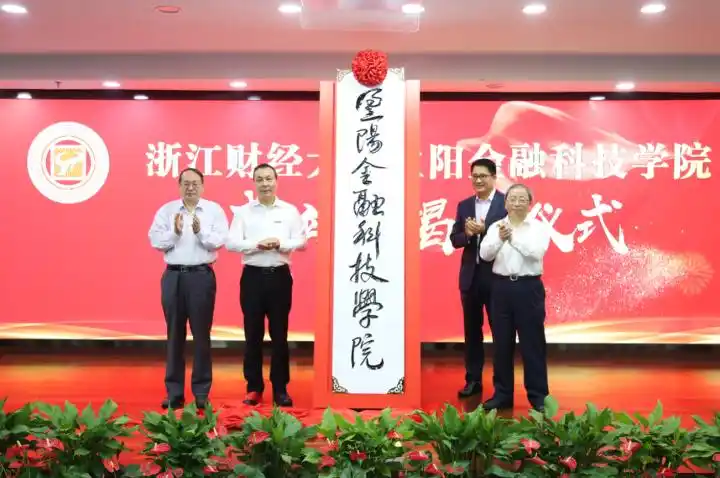
As the first financial technology college established by a university in our province, Yingyang College will begin recruiting undergraduate students in July this year, with an initial enrollment of about 80 students. The college has two undergraduate majors: Financial Engineering and Financial Mathematics, both of which are in the direction of financial science and technology innovation. They have two outstanding characteristics: practical application and cross-complexity. They are a combination of Internet finance and big data finance. The financial engineering major is a national first-class undergraduate major construction site, one of the first batch of provincial first-class undergraduate major construction sites, and a provincial emerging specialty major. Financial mathematics is a nationally-designed cross-disciplinary major.
The college is committed to cultivating high-quality innovative and applied financial technology talents who systematically master the basic theories of economics and finance, apply mathematical theoretical methods and computer technology, and cross-integrate new generation digital technologies such as artificial intelligence, big data, cloud computing, blockchain, etc.
Lou Dong, chairman of Zhejiang Yingyang Asset Management Co., Ltd. and founder of Yingyang Financial Technology College, is a 1998 alumnus of Zhejiang University of Finance and Economics. He said: "In 1996, the school built a securities laboratory, which was at the forefront in the country. I was one of the earliest beneficiaries of the laboratory, which opened the door to a new world for me. The computers in the laboratory display real-time market conditions and can conduct simulated transactions. This means that the theoretical knowledge learned in the classroom can be operated in the computer room."
It is precisely because of this experience that Lou Dong deeply feels that textbook knowledge and teaching practice are both important. "I hope it can become a model of school-enterprise cooperation. Students can not only learn theoretical knowledge of financial technology, but also be exposed to real industrial scenarios and do the latest research topics. In layman's terms, it is like jumping into the sea and learning to swim, ultimately achieving a win-win situation for enterprises, schools and students," Lou Dong said.
According to Zhang Wenyu, dean of Yingyang College of Finance and Technology, traditional financial majors have been severely challenged, and the introduction of artificial intelligence has turned all walks of life into a mess. In recent years, machine substitution has caused financial institutions to cancel campus recruitment for many positions, but has bucked the trend and increased special campus recruitment for financial technology positions.
"Because artificial intelligence alone cannot complete complex and diverse financial businesses, only fintech talents can play the leading role and help machines become supporting roles. Finally, financial business innovation and process reengineering can be achieved through human-machine collaboration. Traditional financial talents are like experienced old Chinese medicine, and pure computer talents are like emerging Western medicine. Then fintech talents are the leaders of medical expert groups that integrate human-machine and Chinese and Western medicine. To defeat the new crown epidemic, we must integrate human-machine and combine Chinese and Western medicine." Zhang Wenyu said. Yingyang College implements the "dual lecturer system" of small class teaching and the full-process "dual tutor system", and establishes college scholarships and student investment funds to encourage students to carry out professional learning, subject competitions and investment practices, etc., to achieve an organic integration of classroom teaching and innovative practice.
The school will benchmark the introduction of teachers and the construction of student training programs in line with the financial technology colleges of well-known universities at home and abroad, cross-integrate with the school's emerging digital technology disciplines and advantageous economic and financial disciplines, and jointly explore the integration of industry and education, collaborative education with Yingyang Asset and other domestic and foreign first-class financial technology innovation companies, and realize the organic integration of the education chain, talent chain, industry chain, and innovation chain.
"The establishment of Yingyang Financial Technology College is an important milestone in the development of in-depth cooperation between alumni enterprises and their alma mater. It is also a vivid practice of actively implementing the spirit of the national policy on deepening the integration of industry and education and focusing on the cultivation of first-class applied talents. The school will recruit students based on social needs and market needs, and fully develop We will leverage the industry advantages and resources of school-enterprise cooperation to explore the path of characteristic industrial colleges co-constructed and managed by schools, industries, and enterprises, continuously improve school-running capabilities and levels, and cultivate more first-class talents who can adapt to and lead the development of the modern financial technology industry," said Li Jinchang, Secretary of the Party Committee of Zhejiang University of Finance and Economics.
Maoming News Recently, reporters learned from the Maoming Municipal Social Security Fund Management Bureau that in order to combat infringements on social insurance funds and maintain the safety and integrity of social insurance funds, the Guangdong Provincial Department of Human Resources and Social Security and the Guangdong Provincial Department of Public Security jointly issued the "Guangdong Provincial Measures for Investigating and Punishing Infringements on Social Insurance Funds" (hereinafter referred to as the "Measures"), which regulates the investigation and punishment of infringements on pension, work-related injury, and unemployment insurance funds (hereinafter collectively referred to as "Social Insurance Funds").
The "Measures" clarify that units or individuals who defraud social insurance benefits or fund expenditures and are referred to the public security organs for suspected crimes include the following: fabricating social insurance participation conditions by fictitious labor relations, providing false certification materials, appraisal opinions, etc., and defrauding social insurance benefits; falsely using other people's personal information by forging and altering age, special type of work information, labor ability appraisal conclusions, and employee files. Those who illegally increase the deemed payment period, obtain the qualifications for pension insurance benefits, and defraud pension insurance benefits; those who falsely report work-related injuries, forge or alter certification materials to conduct work-related injury identification or work ability identification, or provide false work-related injury identification or work ability identification conclusions, and defraud work-related injury insurance benefits; those who defraud work-related injury insurance benefits by forging or altering medical information, Bills, etc., or falsely use the identity of a work-injured person to seek medical treatment or configure assistive devices to defraud work-related injury insurance benefits; work-related injury medical institutions, rehabilitation institutions, assistive device allocation agencies and other social insurance service institutions defraud work-related injury insurance funds or help others defraud work-related injury insurance benefits by providing false disease diagnosis certificates, hospitalization records, medical records, reports, prescriptions and other medical information or medical bills, etc. those who defraud special expenses for work-related injury insurance and unemployment insurance fund expenses by providing false information and materials; those who have lost their qualifications for unemployment insurance benefits such as re-employment, military service, etc., but still fabricate facts for qualification certification through false promises and other methods to defraud unemployment insurance benefits; others defraud social insurance benefits or fund expenses through fraud, forged certification materials, and other means.
For the above situations, the human resources and social insurance administrative departments will investigate and handle cases of insurance fraud in accordance with regulations, and make administrative handling and administrative penalty decisions. If suspected of committing a crime, they will be transferred to the public security organs for processing in accordance with regulations.
In addition, in order to increase the intensity of fund recovery and maintain the safety and integrity of the fund, in response to the excessive payment of social insurance benefits and excessive expenditure of social insurance funds, Article 16 of the "Measures" clarifies that the handling agency shall take recovery measures after investigation and verification. If the relevant unit or individual still does not return the funds, a recovery decision shall be made within 15 days from the date of refusal. Article 22 of the "Measures" stipulates that if the social security agency makes a recovery decision in accordance with the law, and the party fails to perform within the time limit and does not file for administrative review or administrative litigation, the social security agency shall urge the people's court in accordance with the law and promptly apply to the people's court for enforcement.
Maoming Daily all-media reporter Ke Shihua
 On January 29, A-shares Saw Mixed Gains And Losses. Should Resource Stocks Hit The Daily Limit Yesterday? Should I Buy Them Today?2026-02-19Comments(0)
 You Have Seen A Long-handled Scimitar, But Have You Ever Seen A Long-handled Scimitar? Explore Southeast Asia’s Specialty Kui Dao2026-03-01Comments(0)