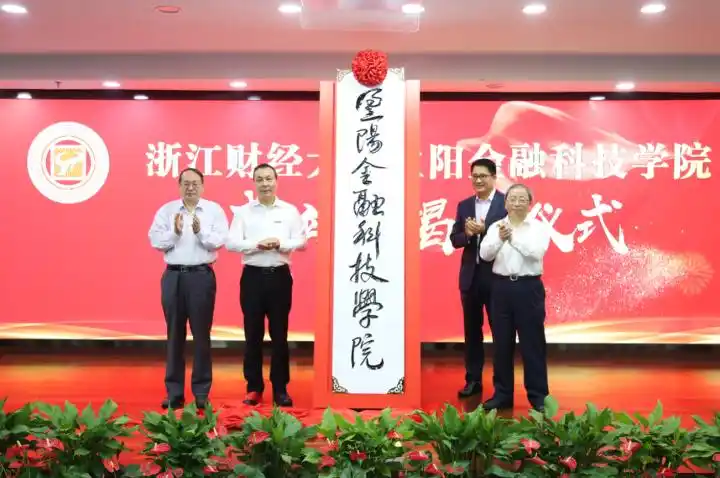
Recently, the Ministry of Education announced the 2022 registration and approval results for undergraduate majors in general colleges and universities. The undergraduate major of Zhejiang University of Finance and Economics, Financial Technology, was approved to be added. This is the fifth cross-disciplinary major that the school has successfully cultivated since it tested the interdisciplinary field in 2003.
"Breaking the barriers of disciplines and majors and realizing cross-fertilization between economics, management, science, engineering, and humanities is the main line of the reform of the school's talent training model." Zhong Xiaomin, president of Zhejiang University of Finance and Economics, believes that China's economy has entered a stage of high-quality development, and new technologies, new industries, new business formats, and new models have given birth to "new finance" and triggered profound changes in higher financial education.
A new college born for the intersection of disciplines
After taking two "entrance" exams, Zhang Yinhua, a 2021 student of the school, was lucky enough to be admitted to Wenhua College and became a member of the "Smart Audit" innovation class. For more than two years, he has received a completely different training program from ordinary classes. In addition to mastering basic financial expertise, he also has to learn integrated courses such as data science and information technology.
Wenhua College was established in 2021 with the purpose of cultivating cross-disciplinary talents. It has five classes, including digital finance, intelligent auditing, digital management, digital financial news, and language data, and is open to all freshmen. "Traditional auditing professional courses can no longer meet the actual needs of the industry. I chose this class for better employment and further education in the future." Zhang Yinhua said.
Curriculum innovation is a highlight of Wenhua College. Take the "Big Data Audit" course as an example. Compared with traditional auditing, the data structures and technical methods used are more complex and advanced, and there is no unified teaching material in China. To this end, the college has established a five-person course team composed of key teachers from different disciplines such as computer science and technology, business administration, etc. Computer teachers specialize in "Python data analysis" to lay a digital foundation for course development. Business administration teachers have integrated auditing knowledge and developed more than 20 "big data + auditing" teaching cases. During this period, the team also invited business backbones from the Zhejiang Provincial Audit Office to participate in course construction, understand the application scenarios of emerging technologies in auditing, and remain academically sensitive to the latest developments in related fields.
In Zhang Yinhua’s impression, cross-cutting courses such as “Information System Control and Audit” and “Intelligent Audit Topics” have opened a new door to professional development. During the interview at the University of Cambridge in the UK, he won unanimous praise from the review experts for his excellent language expression and theoretical foundation of cross-integration.
It is understood that the school invests in course construction according to the standard of 100,000 yuan/course. Over the past two years, more than 60 teachers from the school have joined the curriculum reform team of Wenhua College and developed a total of 12 interdisciplinary courses. The pilot experience of Wenhua College has driven the curriculum construction of secondary colleges, and interdisciplinary teaching and research communities have sprung up like mushrooms after a rain.
A system adapted to interdisciplinary studies
In the school's comprehensive reform structure, Wenhua College takes the lead in piloting and uses this to drive other secondary colleges. However, it is difficult to achieve comprehensive advancement based on the "educational consciousness" of secondary colleges alone. After repeated research, the school decided to "force" cross-disciplinary reform by starting from "changing majors" where students' needs are most sensitive.
The school was the first in Zhejiang to launch the "Access and Exit" system, and established a highly free and flexible "overpass system" for major transfer throughout the four years of the university. The "access" mechanism gives students the right to choose a major. Each student has an opportunity to choose a major again. The admission threshold is announced for each major (category). As long as you meet the admission requirements, you can apply. Access opportunities are open in the second, third, and fourth semesters.
When students do not choose their favorite major through "admission" and still want to continue their studies and graduate from that major, the school has designed an "acceptance-out" mechanism to give students the right to choose graduation. "Accessible admission" is divided into "accurate admission for majors" and "accurate admission for minors." Those who are "accepted to graduate with a major major" and meet the requirements of the professional training program will be issued an academic degree certificate; those who are "accepted to graduate with a minor major" and meet the specified requirements will be issued a minor certificate.
"Whether it is admission or exit, each college is required to develop more cross-integrated courses to provide students with more possibilities to choose different professional directions." Zhong Xiaomin said.
Not long ago, Zheng Qiancheng, a student from the School of Business Administration of the school, successfully transferred to the School of Economics. In his opinion, business administration and economics belong to the broad category of economics and management. “Management and management are not separated, and some logical thinking is the same.” To this end, Zheng Qiancheng took basic economics courses such as microeconomics and basic accounting in his freshman year, plus management wisdom and innovation and entrepreneurship in general courses, laying the foundation for cross-disciplinary integration. In the specific training plan, the school provides courses such as "ERP Simulation Exercise" that integrates economics and management, which not only explores the laws of social operation from the perspective of economics, but also examines the study of human nature from the perspective of management. "I didn't encounter any resistance when it came time to change my major. The business management knowledge I learned before will also be helpful for studying economics in the future." Zheng Qiancheng said.
According to statistics, since the implementation of the "admittance, admission" system, the school's cross-integrated courses have grown at a rate of 10% every year, and the student employment rate has increased significantly.
Explore better interdisciplinary
In the process of promoting the reform of interdisciplinary subjects, how to explore better interdisciplinary subjects is a new proposition facing the school.
In 2021, the school and the University of Chinese Academy of Social Sciences jointly established the "Zhejiang Institute for Advanced Study at the University of Chinese Academy of Social Sciences" and the "Zhejiang University of Finance and Economics-Zhejiang Research Institute at the University of Chinese Academy of Social Sciences" to implement a new management model of "two brands, one team" to cultivate high-level interdisciplinary talents. This project optimizes the original single-disciplinary training plan, requiring graduate students to take at least three interdisciplinary courses, and also has the opportunity to study at the China University of Social Sciences for one semester. Postgraduate students are guided by a team of tutors, which must include a tutor across first-level disciplines or second-level disciplines. To this end, the school has specially established a teacher expert database covering more than 80 cross-disciplinary talents.
The institute focuses on major projects and integrates interdisciplinary knowledge in practice. In the list of study courses for Zhang Huahan, the school's first batch of master's students, there are not only traditional economics courses such as macroeconomics, microeconomics, and econometrics, but also cutting-edge big data technologies such as machine learning and neural networks. In the context of my country's "double carbon" goal, Zhang Huahan worked with his mentor to study and use various models such as econometric models, machine learning models, and gray models to predict my country's future carbon emissions, and provide analysis of relevant carbon emission influencing factors and policy recommendations. Currently, Zhang Huahan has published 3 research results in internationally renowned journals.
According to statistics, since the institution has been in operation for two years, a total of 28 cross-disciplinary scientific research projects have been approved. Students have obtained 3 Zhejiang Provincial “New Talent Plan” projects, 2 Zhejiang Provincial Department of Education general scientific research projects, and 7 students have won awards in national subject competitions.
Li Jinchang, Secretary of the Party Committee of the school, said that the school will seize the opportunity of thematic education, continue to deepen comprehensive reforms, conduct in-depth research and promote the cultivation of integrated talents, effectively transform learning results into the ability and level to promote the development of the school's career, strengthen the construction of "Golden Specialties, Gold Classes, Gold Teachers, and Gold Textbooks", and strive to cultivate "Golden Students" with Zhejiang Finance characteristics. (Our reporter Jiang Yifeng and correspondent Zhao Lei)