
Bitcoin Plunged 45%, Like Apple In 2013, The Valley Of Despair May Last Seven Years
Bitcoin, desperate! ,financing,credit,finance,bitcoin,exchange,currency related business,coindesk
Bitcoin, desperate! ,financing,credit,finance,bitcoin,exchange,currency related business,coindesk
China News Service, Tianjin, February 23 (Reporter Zhou Yaqiang) The 2026 Spring Festival holiday has come to an end, and Tianjin’s cruise tourism market data is eye-catching. The reporter learned from the Tianjin Dongjiang Border Inspection Station that during the Spring Festival holiday, the Tianjin Cruise Port inspected and released a total of 4 inbound and outbound cruise ships, with nearly 9,000 entry and exit personnel. Cruise travel has become a popular choice for more and more people to "spend the New Year at sea", and its popularity continues to rise.
On the afternoon of February 22, the "Dream" cruise ship departed from the Tianjin International Cruise Home Port carrying more than 2,000 passengers, embarking on a six-day and five-night trip to South Korea. (Photo courtesy of Dongjiang Border Inspection Station)
According to statistics from the border inspection department, in terms of passenger composition, family travel occupies the absolute majority, accounting for more than 80%. Among them, elderly passengers over the age of 60 account for more than one-third of the total, and teenagers under the age of 16 account for more than one-quarter. Cruise tourism has become increasingly attractive to family customers.
In terms of tourist sources, in addition to the Beijing-Tianjin-Hebei region, tourists from Shanxi, Liaoning, Inner Mongolia and other places have increased significantly. Many passengers said that after the cruise itinerary, they would choose to stay in Tianjin for a few days and go to ancient cultural streets, Yangliuqing Ancient Town and other places to experience the strong atmosphere of the Spring Festival.
The picture shows passengers passing through the waiting hall with their luggage. (Photo courtesy of Dongjiang Border Inspection Station)
In order to cope with the peak passenger flow during the Spring Festival, the Dongjiang Border Inspection Station of Tianjin Border Inspection Station has determined the passenger structure in advance, opened additional inspection channels and special channels, optimized customs clearance procedures, and scientifically diverted personnel to ensure efficient and smooth entry and exit of passengers.
It is understood that since 2026, Tianjin Cruise Port has inspected a total of 20 inbound and outbound cruise ships, with more than 33,000 inbound and outbound passengers. It is worth noting that on March 3, the day of the Lantern Festival, the luxury cruise ship "Regita" will arrive in Tianjin, carrying nearly 600 foreign tourists from 24 countries including the United States, Canada, and Australia, and embark on a two-day Chinese New Year trip in Beijing and Tianjin.
The picture shows the border inspection scene. (Photo courtesy of Dongjiang Border Inspection Station)
The relevant person in charge of the Dongjiang Border Inspection Station stated that they will continue to optimize the efficiency of entry and exit inspections, fully implement convenient policies such as visa-free entry for foreign tourist groups on cruise ships, and 240-hour visa-free transit, to further enhance the passenger customs clearance experience and help the high-quality development of Tianjin’s cruise industry. (over)
In the past few days, Putian Radio and Television Station has fallen into a "whirlpool of fraud" due to an interview video, which has been questioned by netizens.
The incident started when Putian Radio and Television interviewed a tourist who claimed to be from Heilongjiang on the fourth day of the first lunar month. In the video, Mr. Wu claimed to have come all the way from Heilongjiang and praised Putian for its warm customs.
But careful netizens discovered that this Heilongjiang tourist said "airplane" as "grey plane" and "Fujian" as "Hu Jian", speaking an authentic Fujian dialect. Many netizens ridiculed the TV station for being "too careless in finding actors."
After the matter became known, Putian Radio and Television clarified on February 23, saying that it sent multiple reporters to various hotels to randomly interview many tourists. After contacting and understanding the relevant situation, Mr. Wu’s grandfather was from Hegang, Heilongjiang, and he himself worked and lived in Pingtan, Fujian for a long time.
According to the TV station, Mr. Wu has some connections with Heilongjiang. Although netizens ridiculed him as "a native of Pingtan County, Heilongjiang Province," the TV station has found a way out for himself.
However, Putian Radio and Television Station’s clarification has just been released, and netizens have discovered new evidence. On November 12 last year, the Fujian Daily also mentioned Mr. Wu in a report on the management of Pingtan saline-alkali land, saying that he was "a native of Pingtan."
One is "working and living for a long time" in Pingtan, and the other is "born and raised" in Pingtan. The meanings of the two statements are obviously different, so which statement is true?
If what Putian Radio and Television Station said is true, then Fujian Daily will obviously be slapped in the face. Is it necessary for Fujian Daily to come out and clarify this?
In fact, regardless of whether Mr. Wu was born and raised in Pingtan or works and lives in Pingtan, it does not change the nature of Putian Radio and Television’s report as “fake news.”
Because when Mr. Wu faced the reporter’s camera, he said that he had traveled thousands of miles and traveled 11 hours by plane to get to Putian, and that “we don’t have seafood there” and other plots, now it seems that they were all made up.
The question is, if Mr. Wu is an ordinary tourist coming to Putian, why would he forcefully add drama to himself in front of the TV cameras and make up so many exaggerated plots? Is this because he is full?
Putian Radio and Television Station insisted that the reporter interviewed Mr. Wu at random. It was too much of a coincidence that Mr. Wu, who was so eloquent and often appeared on the cameras and pages of various media outlets in Fujian, was randomly selected.
What's more, as an official TV station, there are strict internal review procedures. Common sense mistakes such as "Hu Jian" and "Hanji" by Heilongjiang people can be seen by ordinary netizens. Can't the subsequent control leaders not see it?
As a former media person, I really can’t laugh at what Putian Radio and Television did. The authenticity of news reports is the foundation of any media, but I can’t see the respect this TV station should have for the truth of news.
In the current new media era, there is often a lot of discussion about the decline of traditional media. Many people believe that the reason for the decline of traditional media is that their thinking has not kept up with the times and the pace of transformation is too slow.
However, I feel that form is often secondary, and the decline of many media is due to the fact that they have "lost" their credibility.
Dare not tell the truth, but tell lies casually. It is only a matter of time that such media will be abandoned by the public.
IT House reported on February 21 that the Belgian Microelectronics Research Center (imec) released a landmark 7-bit, 175GS/s analog-to-digital converter (ADC) at the IEEE International Solid-State Circuits Conference (ISSCC 2026) held in San Francisco this week.
This ADC chip uses 5nm FinFET process, with a core area of only 250×250 μm², conversion energy consumption per sample as low as 2.2 picojoules, and the sampling speed is among the fastest in the industry.
While achieving top sampling speed, it also sets a record of extremely small footprint and ultra-low conversion energy consumption of 250x250 μm², providing a new solution to meet the growing throughput and processing needs of data centers driven by AI and cloud computing.
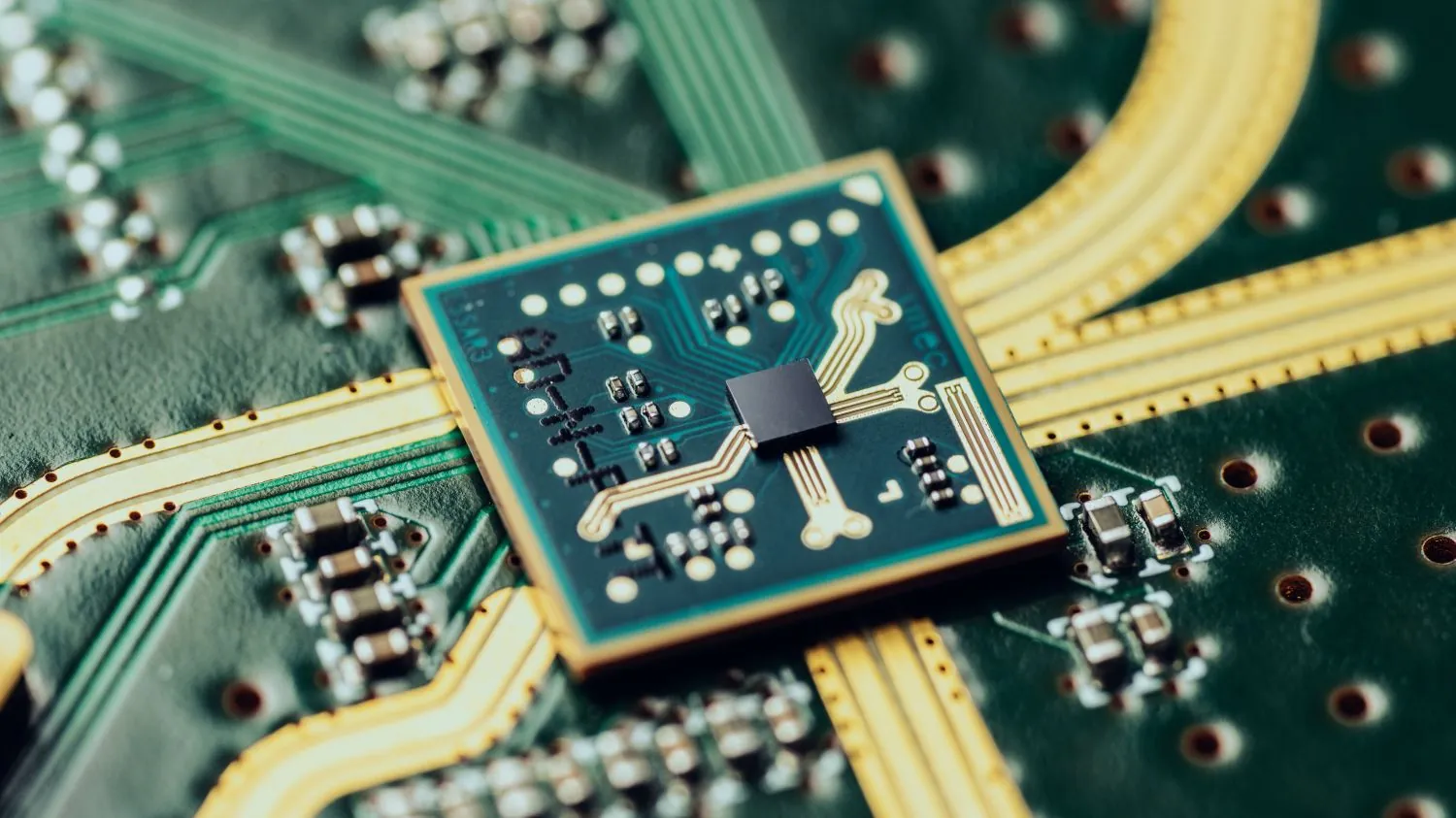
With the explosion of AI and cloud applications, optical communication networks in data centers need to be continuously upgraded to cope with higher throughput and processing pressure. However, when the sampling rate exceeds 100GS/s, the size of the ADC, which is the core component of the optical transceiver, tends to increase dramatically, resulting in extended interconnect lines and the introduction of parasitic effects and energy loss.
Peter Ossieur, Portfolio Director at imec, said: “This combination makes it an extremely attractive solution in digital-intensive wired interconnect applications where every square micron and milliwatt counts.”
At the heart of this breakthrough lies two patented technologies. First, imec uses a novel linearization method to effectively correct the distortion by shaping the ramp signal. Secondly, switching input buffer technology efficiently drives the ADC's 2048-channel time-interleaved array, minimizing electrical load, thereby ensuring signal integrity while achieving ultra-high-speed sampling.
IT House noted that imec will continue to develop the next generation 3nm process design based on the results announced this time, and explore 1.4nm level design solutions, aiming to study how to use these advanced process nodes to create high-performance wired data converters.
Peter Ossieur added: "imec has a long history of developing high-speed integrated circuits for communication applications. One of our core research directions is the development of optical transceivers and their building blocks that can keep up with the fast data rates of wired systems. In this context, our ADC represents a key step towards a new generation of compact, low-power converters, aiming to exceed the performance limits of ADCs based on successive approximation register architectures at ultra-high speeds."
As a world-renowned digital asset trading platform, OKX's official wallet (OKX Wallet) supports the use of multiple platforms, including Huawei mobile phones. Due to certain differences between the HarmonyOS system and the Android system installed on Huawei mobile phones, and some models may not be able to download third-party financial applications directly through the Huawei App Store, users need to complete the installation through official channels or compliance methods. The following are detailed download and installation steps, as well as precautions to help Huawei mobile phone users use OKX Wallet safely.
Preparation before downloading: Confirm the mobile phone system and network environment. System requirements: Make sure that the Huawei mobile phone is running HarmonyOS 2.0 and above (or EMUI 10.0 and above). If the system is too low, it may cause application compatibility issues. Network permissions: It is recommended to connect to a stable Wi-Fi network to avoid download failure or installation package damage due to network fluctuations. Storage space: Check the remaining storage space of the phone (at least 100MB) to ensure there is enough memory to install the application. Official method to download OKX Wallet
Due to the strict review of financial and cryptocurrency applications in Huawei App Market, OKX official wallet may not be directly available on the shelves. It is recommended to download through the following two official channels:
Method 1: Download from the OKX official website (recommended) and visit the official website: Open the OKX international version official website (www.okx.com) in your mobile browser. If you are a domestic user, you can switch to the "China version" official website (www.okx.cn) and select the version according to your needs. Find the download entrance: Click the "Download" or "Mobile" option on the homepage of the official website to enter the exclusive download page for Huawei mobile phones. Download the installation package: Select "HarmonyOS version" or "Android version" (HarmonyOS system is compatible with Android applications), click "Download" and save the installation package (usually in .apk or .hap format). Method 2: Download through OKX official APP
If you have installed the OKX trading APP, you can update or download the wallet function through the following steps:
Open the OKX Trading APP, click the "≡" menu in the upper right corner of the homepage, and enter "General Settings". Select "Wallet Management", find the "OKX Wallet" entrance, click "Download" or "Try Now", the system will automatically jump to the download page. Steps to install OKX Wallet
Allow installation of apps from unknown sources:
Install APK/HAP file:
Open and initialize the wallet:
Note: Safety and Compliance Priority
Check the official channels:

Be sure to download the installation package through the OKX official website or official APP, and never download through third-party links, forums or informal app stores to avoid encountering phishing or malware.
Be wary of “high imitation applications”:
Huawei mobile phone users should note that some copycat APPs may be disguised as "OKX Wallet", with names and icons that are highly similar to the official ones. Carefully check the application name and developer information before downloading (the official developer is usually "OKX" or an affiliated company).
Comply with regional regulations:

Digital asset transactions and wallet use must comply with local laws and regulations. Mainland Chinese users must ensure that their behavior complies with regulatory requirements and avoid participating in illegal financial activities.
Regularly updated versions:
OKX will update wallet functions from time to time to improve security and stability. It is recommended to check for updates on the official website or APP in time to avoid security risks caused by using old versions.
Frequently Asked Questions
According to the Jiangsu Provincial Communications Administration website, the bureau has recently comprehensively investigated virtual currency "mining" activities in Jiangsu Province. Monitoring found that the export traffic of mining pools carrying out virtual currency activities in Jiangsu Province reached 136.77Mbps, and the total number of Internet IP addresses participating in "mining" was 4,502, consuming more than 10 PH/s of computing resources and 260,000 kWh/day of energy.
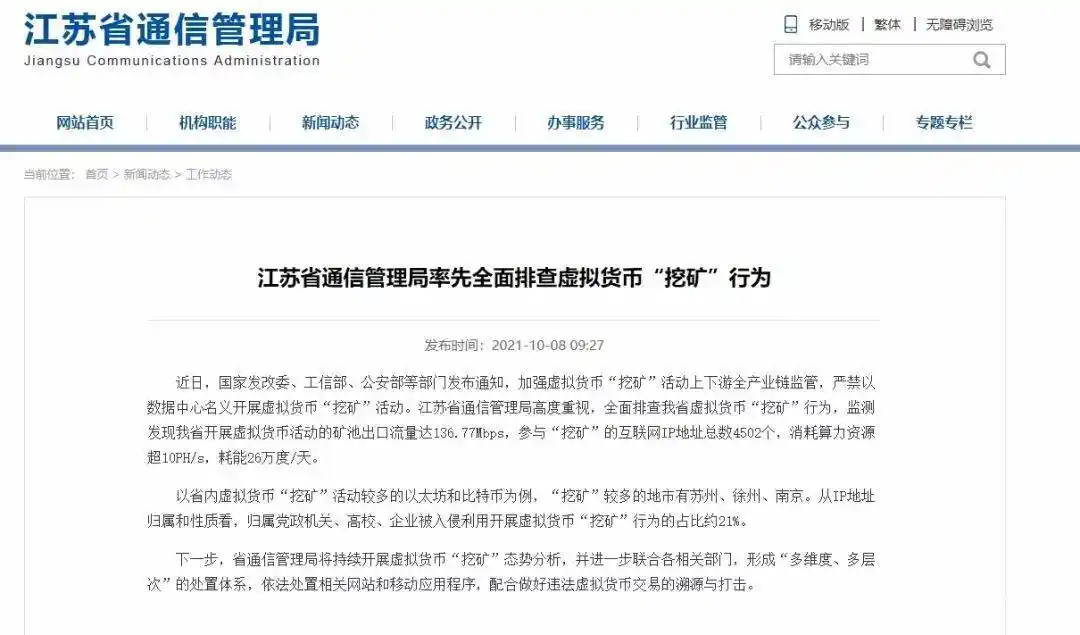
Take Ethereum and Bitcoin, which have a lot of virtual currency "mining" activities in the province, as examples. The cities with more "mining" include Suzhou, Xuzhou, and Nanjing. Judging from the ownership and nature of IP addresses, about 21% of those belonging to party and government agencies, universities, and enterprises were invaded and used to carry out virtual currency “mining” activities.
In the next step, the Jiangsu Provincial Communications Administration Bureau will continue to carry out analysis of the virtual currency "mining" situation, and further unite relevant departments to form a "multi-dimensional, multi-level" disposal system, dispose of relevant websites and mobile applications in accordance with the law, and cooperate with the tracing and crackdown on illegal virtual currency transactions.
How much electricity does virtual currency “mining” cost?
Virtual currencies are encrypted digital currencies, which consist of a series of passwords. "Mining" means decryption. At every other point in time, the virtual currency system will generate a random code on the system node. Calculating this random code requires a lot of GPU operations. Decrypting this code and confirming the virtual currency transaction require complex operations. Because its working principle is very similar to mining minerals, it is named "mining", and prospectors are also called miners. Miners use computers to perform these operations and then receive virtual currency rewards. This is the so-called virtual currency mining mechanism.

Take Bitcoin as an example. Bitcoin has a limited total amount. The total amount will be 10,500,000 BTC in the first 4 years. The amount of output will be halved every 4 years. In the 4th to 8th year, 5,250,000 BTC will be generated, in the 8th to 12th year, only 2,625,000 BTC will be generated, and so on. By the end, the total number of Bitcoins generated was close to 21,000,000 BTC.
One Bitcoin is divided into 8 decimal places based on the data structure, which is 0.00000001 BTC. The smallest unit of Bitcoin mined by miners is 0.00000001 BTC. Bitcoin is like a golden mountain consisting of a total of 21 million gold coins. To get it, players need to use the computing power of computers and calculate a set of numbers that conform to specific rules based on existing algorithms.
If the computer is turned on 24 hours a day to mine Bitcoin, only 0.0018 Bitcoins can be mined, which means that it takes about 556 days to mine one Bitcoin. It is reported that the current computing power of Bitcoin's entire network has reached 3 million hash collisions per second, while an ordinary computer, even with a top-end computer, has only 1000H/s computing power. Based on the calculation that 0.0018 Bitcoins can be mined in 24 hours, it will take a user at least 556 days to mine one Bitcoin.

Assuming that the power of the mining machine is 1,350 watts, approximately one kilowatt hour of electricity is used per hour, and the daily electricity bill is about 16.8 yuan. It takes 556 days to mine one Bitcoin, which means that it will cost at least 9,367 yuan in electricity to mine one Bitcoin. And this is just an ideal situation. "Mining" requires a massive computing system that solves millions of complex calculations every second to verify transactions on the network. This requires a lot of electricity to maintain, cool and run the machinery.
According to statistics from Xinhua News Agency, some "mines" consume millions of kilowatt-hours of electricity a day; a "mine" in a western province can "eat" 45 million kilowatt-hours of electricity in a month. The annual electricity consumption of a "mine" somewhere in the southwest is equivalent to the total annual electricity consumption of three cities.
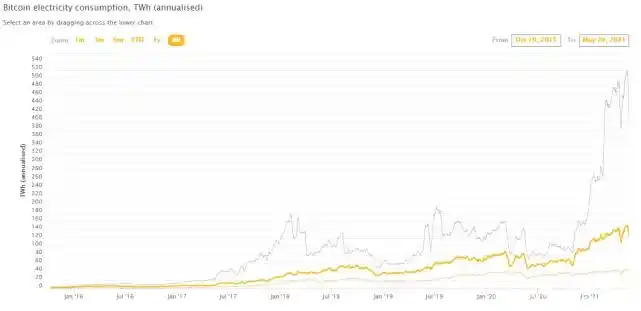
Research by the Alternative Finance Research Center of the University of Cambridge shows that as of 2020, the annual power consumption of global Bitcoin "mining" is approximately 149.37 terawatt hours (1 terawatt hour is 1 billion kilowatt hours of electricity). This number has exceeded the power consumption of Malaysia, Ukraine, and Sweden, and is close to Vietnam, which ranks 25th in power consumption. Data from the Cambridge Bitcoin Electricity Consumption Index shows that as of the end of 2020, approximately 65% of global Bitcoin mining activities occurred in China.
It was included in the catalog of eliminated industries two years ago.
As early as 2019, the National Development and Reform Commission attempted to include virtual currency mining in the catalog of eliminated industries. On April 8, 2019, in the "Guidance Catalog for Industrial Structural Adjustment (2019 Edition, Draft for Comments)", virtual currency "mining" activities were included in the eliminated industries and fell into the category of "backward production technology and equipment", and mining activities were also included in the industries that should be "immediately eliminated". According to this catalog, the elimination category mainly includes backward processes, technologies, equipment and products that do not comply with relevant laws and regulations, do not meet safe production conditions, seriously waste resources, pollute the environment, and need to be eliminated. However, on November 6, 2019, the Chinese government website released the "Guidance Catalog for Industrial Structural Adjustment (2019 Edition)". According to the document, "virtual currency mining", which was once among the eliminated industry categories, was deleted from the released guidance catalog.

Although the National Development and Reform Commission deleted “virtual currency mining” from the elimination catalog in 2019, it does not mean that the country affirms or encourages mining. As the popularity of Bitcoin rises after 2020, currency prices have become volatile, domestic financial fund-raising fraud crimes involving virtual currencies have emerged one after another, and energy consumption has further increased due to the increase in mining difficulty, which has seriously affected the power supply balance in some areas.
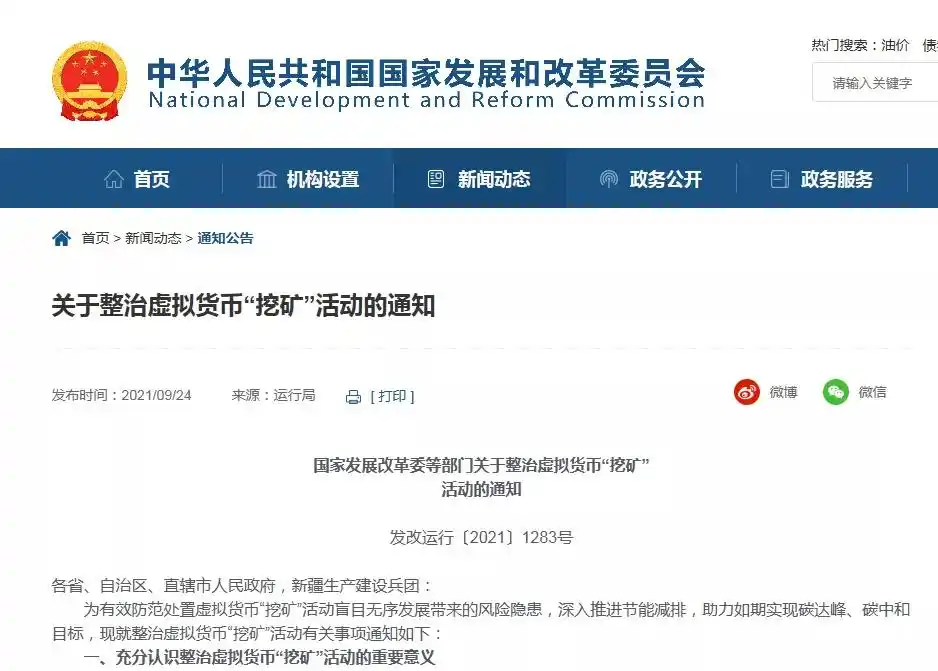
In recent days, the state has taken vigorous measures to rectify the problem. On September 24, 11 departments including the National Development and Reform Commission and the Ministry of Public Security issued the “Notice on Rectifying Virtual Currency “Mining” Activities. The notice points out that the supervision of the entire upstream and downstream industry chain of virtual currency "mining" activities will be strengthened, new virtual currency "mining" projects will be strictly prohibited, and the orderly exit of existing projects will be accelerated to promote the optimization of industrial structure and help achieve carbon peak and carbon neutrality goals as scheduled. The notice emphasized that "virtual currency 'mining' activities" will be added to the "elimination category" of the "Industrial Structural Adjustment Guidance Catalog (2019 Edition)". Before the supplement is included, the virtual currency "mining" project will be treated as an obsolete industry, and investment will be prohibited in accordance with the relevant provisions of the "Decision of the State Council on the Issuance and Implementation" (Guofa (2005) No. 40).
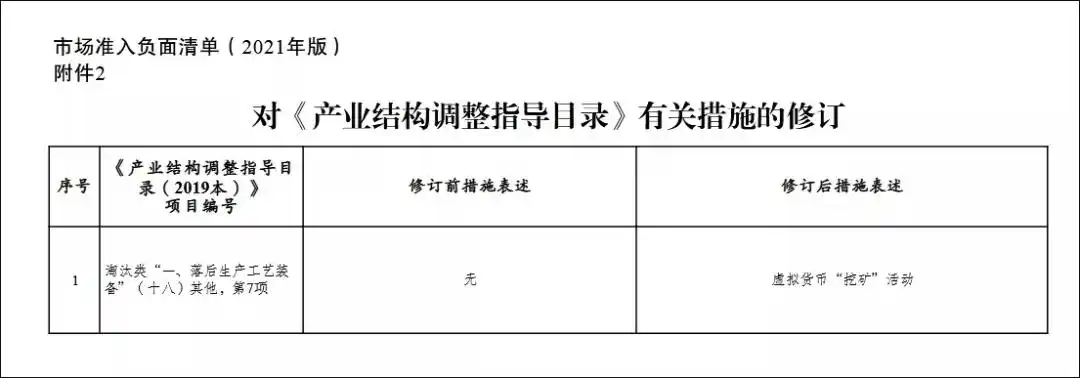
On October 8, the National Development and Reform Commission also publicly solicited opinions from the public on the "Market Access Negative List (2021 Edition)" and re-included virtual currency "mining" in the elimination list. The "Market Access Negative List (2021 Edition)" lists 6 prohibited access items and 111 permitted access items, for a total of 117 items. Among them, in the revision of relevant measures in the "Industrial Structural Adjustment Guidance Catalog" on the last page, item 7 of the elimination category "1. Outdated production technology and equipment" (18) and other items were added. After the revision, the description of the measure was added: virtual currency "mining" activities.
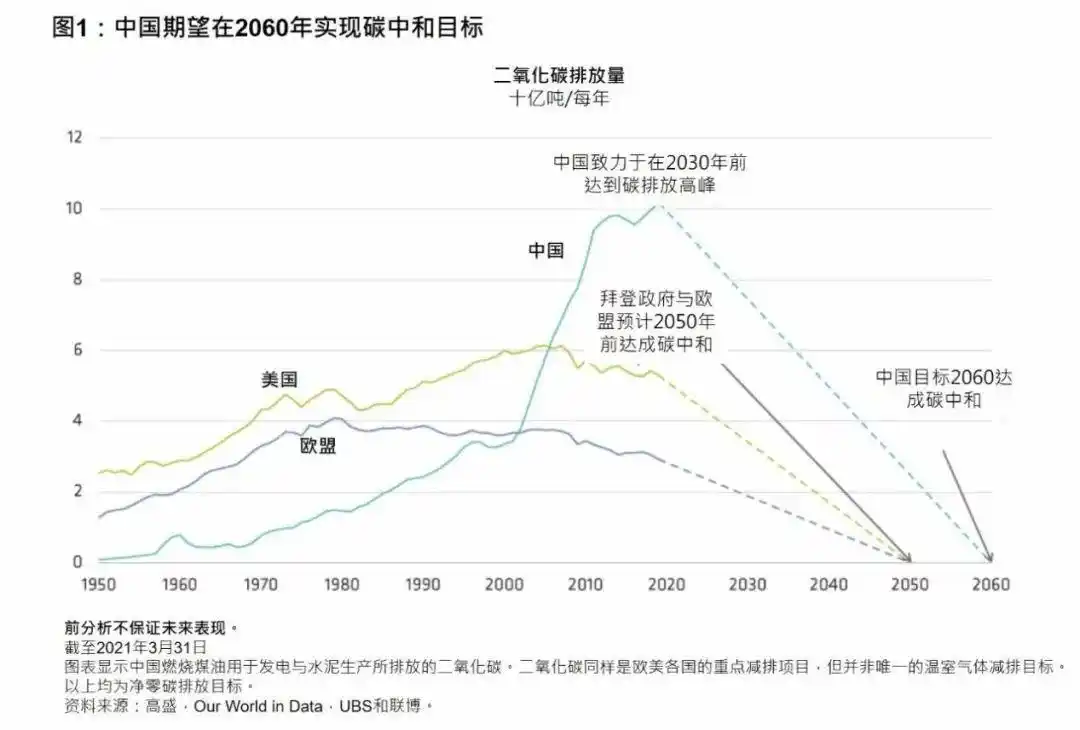
In September 2020, President Xi Jinping announced two major Chinese environmental policies at the United Nations General Assembly. First, China, the world's second largest economy, plans to reach its carbon dioxide emissions peak in 2030. Second, China will achieve the goal of carbon neutrality (that is, net carbon emissions are zero) by 2060. Virtual currency “mining” activities not only consume electricity resources, but also increase carbon emissions. They have low contribution to the national economy and have limited role in promoting industrial development and scientific and technological progress. In addition, the risks derived from the production and transaction of virtual currency are becoming more and more prominent. If it is allowed to develop blindly and disorderly, it will have a negative impact on promoting high-quality economic and social development and energy conservation and emission reduction.
On February 24, a video of "The father-in-law returned the 188,000 yuan gift at the wedding, leaving only 100 yuan for good luck" went viral on the Internet, attracting the attention of netizens.
On the evening of February 24, the reporter contacted and interviewed the bride Liao Jiao. She confirmed that the incident was true and clarified that the wedding actually took place in Yiyang, Hunan, and was not Anhui as reported online.
The bride Liao Jiao and the groom Li Pingjun are from Yiyang. They met through a friend's introduction, and then fell in love and got married hand in hand. Liao Jiao said frankly that from the time they fell in love to the engagement, the two people and their families had always reached a consensus: they did not value the amount of the bride price, but rather the relationship and each other's future. As early as the engagement stage, she had clearly informed her father that she would not accept a bride price from the man. On the wedding day on February 22, her father returned the 188,000 yuan gift to the groom in full, leaving only 100 yuan as a symbol of good luck. This scene surprised and deeply moved Liao Jiao.
She revealed that her father was very supportive of her idea, and her simple speech on the spot moved everyone even more: "Young people, don't let money blind you from the happiness of your marriage." It is understood that this popular video was not deliberately shot, but was casually recorded by relatives and friends at the scene. Unexpectedly, it would attract widespread attention, and the couple and their families were very surprised.
Mr. Li, the groom in question, responded that "his father-in-law returned the bride price" and said, "It was not a rehearsal in advance, and there was nothing expected before." The groom, Mr. Li, told reporters that both parties were from ordinary families. After returning the bride price that day, his father-in-law gave him a dowry when he returned home.
Column recommendations














Source/Sanxiang Metropolis Daily, Beijing News Our Video, Red Star News
 RSR Technology Greatly Improves Game Performance, Can Entry-level Graphics Cards Also Play Games Smoothly?2026-03-02Comments(0)
 2026 Putuo Cultural Tourism Spring Festival 100 Events, Diverse Audiovisual Feast To Enjoy The Holidays2026-02-13Comments(0)
 Should Stocks Go Or Stay After Their Daily Limit? Understand These 3 Logics And No Longer Have Trouble With The Daily Limit2026-02-19Comments(0)
 The Trump Administration’s New $11 Billion Plan: Aid Turns Into Geopolitical Investment And Funds Are Rerouted2026-02-26Comments(0)