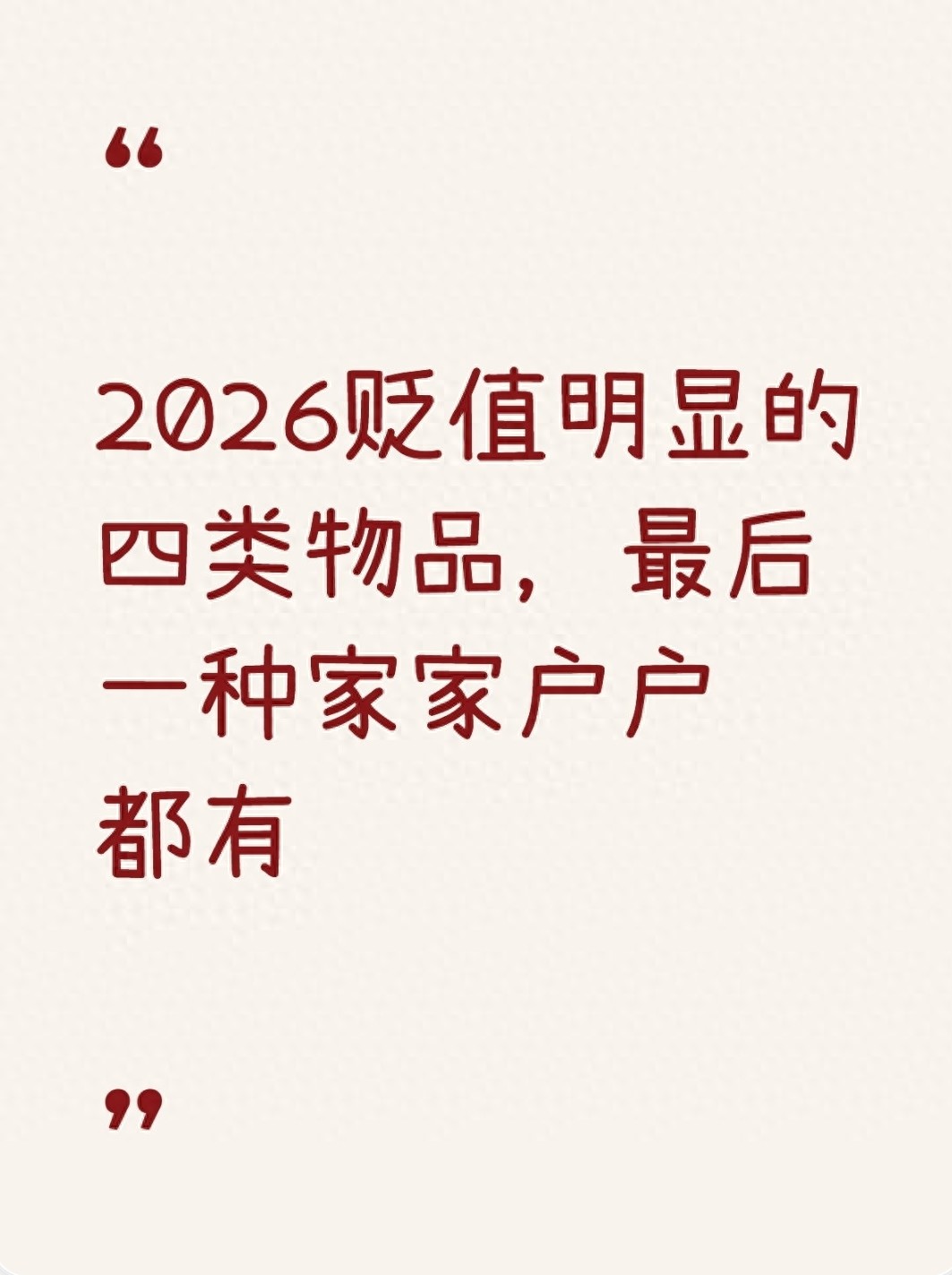
In 2026, the domestic economy will enter a critical stage of structural optimization and rational consumption return. The market will bid farewell to blind premiums and irrational speculation, and the prices of various commodities and assets will gradually return to their true values. Under the combined influence of policy guidance, technological iterations, supply and demand adjustments, and changes in consumption concepts, some items that were once regarded as value-preserved and necessities have entered a rapid depreciation channel. Such items cover multiple scenarios of household consumption and asset allocation. Blindly buying them or holding them for a long time will directly cause the family wealth to shrink. Based on the authoritative data and latest policies released by the National Bureau of Statistics and industry associations in 2026, this article uses popular language to sort out the four categories of items with the greatest depreciation pressure, clearly interprets the logic behind them, and provides pragmatic reference for ordinary families.
1. Old residences in non-core areas: liquidity continues to tighten, and value returns to residential attributes
The real estate market bids farewell to the era of general growth and will show clear structural differentiation characteristics in 2026. House price data from the National Bureau of Statistics in 70 cities in January 2026 showed that the sales prices of commercial housing in first-, second- and third-tier cities showed a year-on-year decline. The average price of second-hand housing in 100 cities fell by 0.85% month-on-month, and the decline narrowed by 0.12 percentage points from the previous month. Under the market differentiation, high-quality housing supply in the core areas of core cities remains stable, while old residences in non-core locations, without high-quality supporting facilities, and with high age have become the hardest hit areas for depreciation.
The depreciation of this type of property is not a short-term fluctuation, but the inevitable result of the superposition of multiple factors. The urbanization process has entered a mature stage. The demand for new urban housing has gradually slowed down. The supply of existing housing market continues to increase. The number of second-hand housing listings in third- and fourth-tier cities and second-tier suburban counties has remained high. The transaction cycle generally exceeds 12 months. In some areas, there is a situation of price but no market. At the same time, the supporting conditions of real estate directly determine the value trend. Old communities without subway commuting, no high-quality school districts, no mature businesses, and no comprehensive medical care have outstanding problems such as backward unit design, high property maintenance costs, and difficult parking. It is difficult to attract young people who are in urgent need, and market demand continues to shrink. At the policy level, we adhere to the positioning of housing for living, not speculation, strive to stabilize the real estate market, fully release residents' rigid and improved housing needs, fully withdraw investment and speculative demand, and completely return housing properties to residential properties. After losing the speculation premium, prices quickly return to real use value.
Judging from market performance, the depreciation trend of old residential buildings in non-core areas is clear. Within the same city, owners of second-hand houses in core areas are reluctant to sell, and the listing prices of old residential complexes in outer suburbs continue to fall. In some counties, old residences have fallen by more than 25% at their peak, and even if they are listed at reduced prices, it is difficult to find suitable buyers. For ordinary families, holding multiple sets of old properties in non-core areas not only fails to achieve asset appreciation, but also requires continuous payment of property fees, maintenance fees and other costs, which takes up a large amount of working capital. The real estate market policy in 2026 will focus on stabilization. The liquidity and value restoration space of this type of real estate is limited. Blindly buying or holding it for a long time will cause real asset losses.
2. Mid- to low-end fuel vehicles and older new energy vehicles: technological iterations are accelerating, and value retention rates continue to diverge.
As a bulk consumer product, car depreciation is the norm in the market, but the degree of depreciation and differentiation in the car market in 2026 will be far greater than in the past. The value retention rate report released by the China Automobile Dealers Association in February 2026 shows that the overall value retention rate of new energy vehicles has rebounded significantly. The hot sales of plug-in hybrid vehicles have accelerated the elimination of fuel vehicles. Mid- and low-end fuel vehicles and older new energy vehicles are still the most depreciating categories.
Mid- to low-end fuel vehicles face dual market squeezes. The price of new energy vehicles continues to drop, and their cost-effectiveness advantages are highlighted. The price war in the new car market continues to ferment. Domestic new energy models continue to seize the market share of fuel vehicles, directly compressing the living space of mid- to low-end fuel vehicles. At the same time, the technological iteration of fuel vehicles is slow, and the fuel consumption and intelligence levels lag behind new energy vehicles. The supply chain of niche brand fuel vehicle parts has gradually shrunk, and second-hand car dealers have extremely low willingness to accept vehicles. Data shows that the three-year value retention rate of some joint venture mid- to low-end fuel vehicles has fallen below 50%. The second-hand valuation of old fuel vehicles that are more than six years old has fallen to the range of 10,000 yuan, with a depreciation rate of more than 70%.
The depreciation pressure on older new energy vehicles is even more prominent. The iteration cycle of new energy vehicle technology has been shortened to less than one year, and battery life, battery technology, and smart configurations have been rapidly upgraded. Old pure electric models with a range of less than 400 kilometers have obvious battery attenuation problems, and second-hand valuations continue to decline. Report data shows that the three-year average value retention rate of new energy vehicles is 55%, and the five-year average value retention rate is only 40%. The three-year value retention rate of marginalized new power brand models is less than 45%, and the depreciation rate in one year after purchase exceeds 35%. In contrast, the value retention rate of new energy models of leading brands is relatively stable. The three-year value retention rate of some main models exceeds 65%, but such models only account for a small part of the market.
In 2026, automobile consumption will become more rational. Consumers will give priority to practicality, vehicle cost and value retention rate, and will no longer blindly pursue brand and appearance. The depreciation trend of mid- to low-end fuel vehicles and older new energy vehicles will further intensify with technological upgrades and market competition. Ordinary families need to avoid such depreciation-hit areas when buying cars and choose models from mainstream brands and mature technologies to reduce the risk of asset losses.
3. Non-classic luxury goods and premium high-end gifts: Face-saving consumption ebbs and the premium bubble subsides
In the past, luxury goods and high-end gifts were regarded as status symbols. Some people believed that such items had the property of preserving value and even purchased them as investment products. In 2026, the consumer market will return to rationality, demand for face consumption will drop significantly, and non-classic luxury goods and premium high-end gifts will enter a rapid depreciation channel.
The "2026 China Second-hand Luxury Goods Industry White Paper" shows that the domestic second-hand luxury goods market has exceeded 352 billion yuan, with an annual growth rate of 28.3%. However, the market has shown obvious differentiation. Classic and scarce models maintain stable circulation, while the second-hand valuations of non-classic, seasonal limited editions, and Internet celebrity luxury goods have plummeted. The second-hand recycling price of a brand bag purchased for 20,000 yuan is only 3,000 yuan, less than 15% of the original price; second-hand watches and clothing of ordinary brands have depreciated by more than 50%, and some unpopular styles are not even recycled.
The core reason for the depreciation of such items is the fundamental change in consumption logic. As residents' income growth stabilizes, consumers pay more attention to the practicality of products and are no longer willing to pay for brand premiums and social premiums. The behavior of spending high prices on luxury goods to support their appearances continues to decrease. At the same time, luxury brands are accelerating the iteration of new products, easing the supply of popular items, deploying official second-hand channels, and narrowing the price difference between first-hand and second-hand goods. The scarcity advantage of second-hand luxury goods has completely disappeared. Young consumer groups prefer cost-effective products, and the market demand for premium high-end gifts continues to shrink.
The high-end gift market is also facing depreciation pressure. The prices of high-end liquor and customized gifts, which were once regarded as hard currency, will return to rationality in 2026, with wholesale prices falling below the official guidance price. Scalper recycling prices have fallen sharply compared with the peak period. The overall discount rate of the gift recycling market exceeds 40%. This type of item lacks practical value and relies on social and gift demand to support its price. When demand ebbs, the premium disappears completely and the value becomes depreciated upon purchase. In 2026, non-classic luxury goods and premium high-end gifts will no longer maintain value. Blind purchase or hoarding will only cause assets to shrink. Rational consumption and rejection of premiums will become the best choice for ordinary families.
4. Entry-level digital electronic products and old smart devices: Technology iterations are accelerating, and every household has them, but they are the least valuable.
The fourth category of most depreciated items are entry-level digital electronic products and old smart devices that every household has, including entry-level mobile phones, laptops, tablets, smart small appliances, old routers, set-top boxes, etc. The unit price of such items is not high, but they depreciate very quickly. Technology iterations and cost changes cause their value to shrink rapidly.
CCID Consulting's 2026 consumer electronics industry report shows that the update cycle of digital electronic products has been shortened to 6-12 months, the performance and configuration of new products have been significantly upgraded, and old products have quickly become obsolete. At the beginning of 2026, memory chip price fluctuations were transmitted to the end market, and the cost of mid-to-high-end models increased. However, the price of entry-level models continued to fall due to mature technology and overcapacity. The price of a mid-range mobile phone of 5,999 yuan fell to 4,666 yuan three months later, a drop of more than 22%; a laptop of 6,999 yuan depreciated by nearly 1,800 yuan in half a year, and the second-hand market valuation continued to decline.
The depreciation of old smart devices is even more complete. Smart bracelets, old Bluetooth headsets, non-smart TVs, old routers, etc. lose their use value as technology upgrades. The second-hand recycling price is only a few yuan to dozens of yuan, and some devices directly become electronic waste. Entry-level digital electronic products are basically practical and lack technical barriers and value-preserving attributes. Manufacturers continue to cut prices to clear inventory. The second-hand market is oversupplied, demand is sluggish, and the value is almost zero.
Such items cover all households. Most people have idle old mobile phones, old computers, and old small appliances at home. They may seem inconspicuous, but due to rapid depreciation, they have become the category that has shrunk most significantly among household assets. Blind pursuit of new models and frequent replacement of entry-level digital products will continue to generate unnecessary expenditures, and long-term storage of idle equipment will not realize value recovery. In 2026, treating digital product updates rationally, purchasing them on demand and extending their use cycles can effectively reduce unnecessary household expenses.
The core of wealth protection in 2026: eliminate bubbles, focus on practicality, and rational allocation
The rapid depreciation of the four categories of items in 2026 is essentially the inevitable result of economic structural adjustment, return to rational consumption, and accelerated technological iteration. It is also a reflection of the market's return to value itself. The former bubble premium, face premium, and hype premium have gradually disappeared, and practicality, liquidity, and core value have become the core standards for measuring assets and items.
Ordinary families do not need to be overly anxious. They can avoid the risk of depreciation by adhering to three major principles. The first is to refuse unnecessary heavy positions, not to invest in real estate in non-core areas, not to blindly purchase depreciating cars and luxury goods, and not to frequently replace digital products; the second is to give priority to core value categories, focusing on high-quality housing in core cities for real estate, and mainstream models of leading brands for cars, and focusing on practicality rather than premium for consumption; the third is to revitalize idle assets, promptly dispose of old properties, idle vehicles, and idle digital equipment to reduce holding costs and recycle funds for prudent allocation.
The orientation of residents' asset allocation in 2026 is clear. In a low interest rate environment, residents' assets need to be diversified, stay away from bubble assets, and focus on stable and practical assets. The core of wealth protection is not to pursue high returns, but to avoid unnecessary losses. Only by recognizing the trend of depreciation, staying away from high-risk depreciating items, consuming rationally and making sound allocations can we preserve family wealth and improve the quality of life.
Topic discussion
In household asset allocation and consumption choices in 2026, should we pay more attention to practicality or value preservation? Which depreciating items will we avoid on a daily basis? You are welcome to share your views and experiences in the comment area.
Pay attention to guidance
We will continue to update the interpretation of people's livelihood policies, market trend analysis and household wealth allocation information, and will bring more practical content on avoiding consumption pitfalls and asset optimization in 2026. Thank you for your attention.
Disclaimer
The data in this article comes from official statistics, industry association reports and public market information in 2026. It is only for people's livelihood analysis and consumption reference. It does not constitute investment advice. There are market fluctuations. Please make rational judgments when making personal decisions.