Professional virtual currency information station welcome
We have been making efforts.

24-hour news update Page 47

24-hour cryptocurrency news update

The Results Of The 2026 Chongming Forest Sleep Competition Are Announced! Fantastic Performance By Locals And Night Owls

The much-anticipated first match of the 2026 Chongming Forest Sleep Contest has just come to an end. In the end, Contestant No. 50, Mr. Yan, won the "Supreme Sleep God Award", with a total sleep time of nearly 5 hours; Contestant No. 33, Mr. Yuan, won the "One Second to Fall asleep Award", falling asleep in 11 minutes and 32 seconds. The 50 participating places in this competition were all taken up as soon as they were released. In the end, 43 contestants were placed in the competition. Except for those who abandoned the competition midway, 32 people won the "Leave and Win Master Award".

Judging from the game results, the magical "home field advantage" seems to be reflected: Although Mr. Yan is from Guangdong, he has lived in Chongming for a long time and is a "Chongming son-in-law"; Mr. Yuan is a native of Chenjia Town, Chongming District. Some contestants and viewers lamented: When it comes to sleeping, there is indeed a rule of "recognizing the bed". Chongming locals sleep soundly in Chongming!

Another interesting detail is that both Mr. Yan and Mr. Yuan are engaged in jobs where it is difficult to maintain a regular life: Mr. Yan works in a real estate company, and Mr. Yuan is engaged in home design and interior design. When interviewed by reporters, they both mentioned that work and life are inseparable, and it is common to work overtime until late at night, so they have developed the ability to "fall asleep anytime and anywhere." Mr. Yuan, the winner of the "One Second to Fall asleep Award", even fell asleep in one second one night early: "I originally wanted to prepare for the competition and stay up all night in advance, but I failed. I fell asleep as soon as I touched the pillow last night!"

Both Yan and Yuan said that it was an unexpected surprise to win the award: "On World Sleep Day, I had a good sleep in the Forest Park and received an award. I am very happy!"

Say "goodbye" to work for the time being, put all your worries away, plunge into the big forest of Chongming, put on a mattress, change into pajamas, cover yourself with a quilt, and sleep soundly all afternoon – on March 21, the contestants of the Chongming Forest Sleep Competition gathered in Chongming Dongping National Forest Park, fell asleep in the forest full of negative oxygen ions, and slept until they woke up naturally.

Can sleeping become a competition? Sleeping in a bed in the open air in the forest? There is actually a bonus to get? A few days before the game, the "Internet celebrity temperament" of this game has already spread. This new attempt and new exploration of Chongming eco-tourism has excited the excitement of many people and attracted the attention of netizens from all walks of life. Many netizens believe that “Chongming’s operation knows how to hit the workers’ hearts.”

In order to make the competition fair and just, the organizers of the event have set strict competition rules. Contestants must be healthy people between 18 and 50 years old. Contestants must lie on a standard bed throughout the entire process and can turn over, but any part of the body cannot leave the mattress for more than one-third. Sitting up, standing, or leaving the bed to go to the bathroom will be deemed as abandoning the competition. You can close your eyes in bed to relax or lie still in a daze, but it is strictly forbidden to take any drugs to help you fall asleep before the game, and you are not allowed to play with your mobile phone in bed with the quilt covered.

The competition will award one "Supreme Sleep God Award" and "One Second to Fall Asleep Award", with prizes of 3,000 yuan and 2,000 yuan respectively, awarded to the person with the highest comprehensive "sleep score" of the instrument and the person who falls asleep the fastest. The remaining finishers received the "Winner Award" and shared a bonus of 10,000 yuan.

At about 9 a.m. on March 21, contestants arrived one after another, received competition supplies and vegetable gift packs, and entered the competition venue. Applicants came from all districts in Shanghai, and many people came specially for this "sleeping competition". Some people came from Baoshan District. They are usually tired from work and have the ability to "fall asleep", so they are eager to try it. Others came from Minhang District and said, "I think the sleeping competition is quite interesting. The weather has been better recently, so I stopped by Chongming for an outing!"

Among the contestants, there are many who have "unique skills". Mr. Chen said that he once "slept standing up after getting on the bus, sleeping from the first stop to the last stop." There were also people who were already drowsy and blurry during the opening ceremony of the event, and couldn't wait to "snap". Many people also brought their own cute pajamas, and Ms. Tao, who was wearing cow-colored pajamas, was one of them. "I came from Minhang District and have never camped before, so this time I feel very fresh! In order to achieve good results, I wore my favorite pajamas and brought a star pillow, which is my favorite pillow."

At 12 noon, the game officially started, and the scene was quiet. The core area of ​​the competition is located in the park's grassland, surrounded by forests on three sides and facing water on one side. The players fell asleep with the breeze on their pillows. Ten minutes later, snoring could be heard on the field.

Who will be the referee in a sleeping game? Xu Wei, the overall technical person in charge of this competition, told reporters that an optical fiber sensor belt was placed on each player's bed, which can collect various somatosensory data of the players during the competition to determine the players' sleep time, sleep depth, sleep duration, etc., and provide a basis for competition evaluation.

Unlike the deafening cheers, applause, and flag-waving in other sports arenas, this sleeping game in Chongming may be the quietest game. What should I do if the players have fallen asleep and their family and friends can't shout "Come on" next to them? The organizer of the event has designed a variety of cultural and tourism activities. Outside the competition venue, the themed market displays Chongming's intangible cultural heritage, special agricultural products and traditional snacks. In the forest park, spring flowers bloom, birds chirp, and sika deer stroll leisurely. Relatives, friends and tourists who accompany the contestants can enjoy leisure time in the forest.

It is understood that today is the first game of the Sleep Contest. There will be one game every Saturday until April 26, and one game each on May 2 and May 3, for a total of 8 games. As of now, all venues have been filled. "The purpose of organizing the sleep competition is to build an interesting and interactive platform to popularize the concept of sleep health, while comprehensively displaying Chongming's ecological cultural tourism, characteristic agriculture, sports activities and other diverse charms, attracting more citizens and tourists to come to Chongming and learn about Chongming." said Chen Haixing, Secretary of the Party Committee and Chairman of Shanghai Chongming Ecological Tourism Group Co., Ltd.

The Public Memorial Ceremony For The 35th Anniversary Of Shanghai Burial At Sea Was Held, And The Second Burial At Sea Cultural Week Was Launched Simultaneously.

On the morning of March 21, the bells of Shanghai Binhai Ancient Garden were solemn and the memorial service was affectionate. The public memorial ceremony for the 35th anniversary of burial at sea, hosted by the Shanghai Civil Affairs Bureau, was solemnly held. More than 200 people from all walks of life gathered at the scene to pay respect and deep remembrance to the citizens who chose to be buried at sea over the past 35 years.

At the public memorial site, Ms. Chen, the representative of the family members buried at sea, told the story of her father who plowed the ocean and volunteered to be buried at sea. She said that Shanghai's comprehensive sea burial memorial facilities and series of activities allow ecological pioneers to be remembered and their spirits passed down, and also provide long-term sustenance for the families of those buried at sea.

On the day of the event, the second Shanghai Burial at Sea Cultural Week was launched simultaneously. This cultural week lasts for 17 days (March 21-April 6), covering the entire Qingming Festival cycle. The organizers have carefully set up theme exhibition areas such as the "Time Tunnel for the 35th Anniversary of Sea Burial", "Life Story Wall of Sea Burial Deceased", "Objective Exhibition of Changes in Sea Burial Work" and "Missing Lighthouse Outdoor Art Installation". They connect the "Tree" Memorial Forest, Sea Burial Memorial Garden and Sea Burial Monument and other commemorative facilities, allowing citizens to review the development process of sea burial in an immersive experience and express their grief.

It is understood that since the sea burial service was launched in 1991, Shanghai has escorted nearly 100,000 deceased people to carry out sea burial with ashes, and more than 340,000 family members participated in sea burial activities. In 2025, the number of sea burials of ashes in this city exceeded 10,000 for the first time, setting a record high. Among them, there were more than 1,000 sea burials of urban residents in the Yangtze River Delta region. Shanghai has now become one of the cities with the largest scale of sea burials in my country.

Shanghai's sea burial industry has developed steadily, benefiting from the continuous improvement of policy guarantees. This city has established a reward and subsidy policy for sea burials since 1999, and the standard has gradually increased from the initial 150 yuan/case to 3,000 yuan/case. In 2025, Shanghai has successively issued policy documents such as the "Opinions on Actively Promoting Sea Burial Services for Ashes" and "Notice on Improving the City's Funeral and Burial Policies to Benefit the People" to fully support sea burials in terms of service supply, process standardization, subsidy optimization, and mechanism improvement. Relevant documents also stipulate that from January 1, 2026, if the funeral director of a non-local registered deceased who is cremated in Shanghai chooses a collective burial at sea or other ecological burial methods, the funeral director does not need to bear the relevant expenses. Currently, there are more than 150 reservations for sea burials for deceased persons who meet the requirements and are not registered in this city.

This year is also the 1st anniversary of the establishment of Shanghai Burial at Sea Service Alliance. With Shanghai Feisi Sea Burial Service Co., Ltd. as the core, the service alliance links 13 funeral homes in the city, funeral hotline 962840 and many cemeteries in the city to form a "1+13+X" global sea burial service network. It achieves "full online coverage and offline offline services" for sea burial consultation and registration, significantly improving service accessibility and public satisfaction.

Federal Reserve Officials’ Speeches Released Heavy Signals, And The Number Of Interest Rate Cuts This Year And The Change Of Chairman Attracted Attention

Data is a treasure

Invest with less worries

The latest speech by a Fed official sent a big signal.

According to the latest news, Federal Reserve Vice Chairman Michelle Bowman said she is worried about the job market and still expects the Fed to cut interest rates three times this year. On the same day, Federal Reserve Governor Christopher Waller also said that if the job market shows signs of weakness, he will again support an interest rate cut later this year.

As the conflict in the Middle East escalates and international oil prices soar, Wall Street is discussing that U.S. inflation may re-heat and prompt the Federal Reserve to suspend interest rate cuts or even switch to raising interest rates. According to the CME Fed Watch tool, Wall Street traders predict that the probability of the Federal Reserve raising interest rates by the end of this year has risen to more than 30%. But economists at Bank of America still believe that the Fed is still more likely to cut interest rates than to raise them in 2026, especially if the impact of rising oil prices caused by the Iran war subsides.

At this critical moment, there are great variables in the change of the chairman of the Federal Reserve. U.S. President Trump said he still supports the U.S. Department of Justice's investigation of Federal Reserve Chairman Jerome Powell. Some analysts pointed out that this stance may further delay the confirmation of Kevin Warsh, the potential successor to Federal Reserve Chairman Powell.

"The Fed will cut interest rates three times this year"

On March 20, EST, Bowman, the Fed’s vice chairman for supervision, said that she still expected the Fed to cut interest rates three times this year.

She believes it is too early to assess the impact of the Iran war on monetary policy.

Bowman added that she expected strong economic growth this year, helped by the Trump administration's "supply-side policies," even as she expressed concerns about the labor market. She also predicted that Kevin Warsh would have a "significant impact" on the Fed if he was confirmed to succeed current Chairman Jerome Powell.

On the same day, Fed Governor Waller also said that if the job market shows signs of weakness, he will again support interest rate cuts later this year, while remaining vigilant about the inflationary pressure that may be brought about by the current geopolitical situation.

Waller pointed out that the closure of the Strait of Hormuz portends greater inflationary pressures, and rising oil prices may ultimately affect core inflation. He emphasized that the current cautious attitude does not mean that the rest of the year will be on hold.

On Wednesday Eastern Time, the Federal Reserve announced that it would keep the target range for the federal funds rate unchanged at 3.5%-3.75%, in line with consensus market expectations. Judging from the voting results, 11 of the 12 members of the Federal Open Market Committee (FOMC) supported no action, and only Federal Reserve Governor Stephen Millan supported a 25 basis point interest rate cut.

Powell also pointed out at the post-meeting press conference that short-term inflation expectations indicators have risen recently, which may reflect the impact of energy market fluctuations; however, long-term inflation expectations are still generally stable near the 2% policy target.

He also emphasized that the impact of the evolving situation in the Middle East on the U.S. economy is highly uncertain, and the Federal Reserve will pay close attention to related risks.

It is worth noting that when asked about issues related to the chairman's term, Powell said that if his successor has not completed the confirmation process when his term expires, he will continue to perform his duties until the successor is in place.

Guosheng Securities pointed out that the situation in the Middle East has pushed up energy prices, and global liquidity will gradually tighten, suppressing market risk appetite. Powell revealed that the possibility of subsequent interest rate hikes was discussed at the meeting, and the market's expectations for an interest rate cut by the Federal Reserve have dropped significantly. There have been less than one expected rate cut during the year, and some even bet that there will be no interest rate cut this year.

Guosheng Securities reminds that rising oil prices may lead to rising inflation, which may lead to the Federal Reserve suspending interest rate cuts or even discussing raising interest rates, increasing the possibility of economic stagflation, and recommends being wary of the risk of deep adjustments in the stock market.

According to the latest data, the U.S. producer price index (PPI) rose 0.7% month-on-month in February, with an expected value of 0.3% and the previous value of 0.5%; the year-on-year increase reached 3.4%, a new high in a year, with an expected value of 2.9%.

Variables in the change of Fed chairman

At the same time, the change of chairman of the Federal Reserve also brought major changes.

On March 19, Eastern Time, US President Trump once again publicly supported the Department of Justice's criminal investigation of Powell in the Oval Office and slammed Powell as "incompetent and dishonest."

This statement directly aggravated the deadlock in the confirmation process of Kevin Warsh, and the controversy over the Fed's policy independence has once again heated up.

"He's under investigation because it cost him tens of billions of dollars more to build the building than expected," Trump said. "It shows there was criminal activity, maybe related to the contractor," he added.

Trump was referring to a renovation project at the Federal Reserve headquarters in Washington that is the focus of a federal criminal investigation into Powell led by U.S. Attorney Jeanine Pirro.

The U.S. Department of Justice issued subpoenas to Powell and the Federal Reserve in January this year to investigate cost overruns in the renovation project of the Washington headquarters. In a scathing ruling last week, U.S. District Judge James Boasberg blocked a Washington grand jury subpoena in the investigation. "There is substantial evidence that the administration issued these subpoenas to the Fed Board of Governors in an effort to pressure the chairman to vote for a rate cut or resign," he wrote.

People familiar with the matter said that the judge's ruling originally provided a "step down" for the Trump administration to end the investigation of Powell and allow the controversy to gradually subside. But if the legal battle continues, Trump may have to wait longer to bring Kevin Warsh into office.

Republican Senator Thom Tillis has repeatedly said he would block Warsh's nomination from advancing before the Senate Banking Committee until the Justice Department drops its investigation into Powell. Warsh must be approved by the committee before being submitted to the full Senate for a vote for confirmation.

Tillis said he personally recognized Warsh but believed the investigation undermined the Fed's longstanding independence from executive branch interference. I can't imagine the market reaction if the market suddenly thinks that the Fed chairman is taking orders from the president.

It is reported that Powell’s term as Fed chairman will end in May this year, and his term as a governor will last until 2028.

Shareholders Of Zhaoyan New Drug Cleared Their Positions And Then Reduced Their Holdings, And The Reasons Behind It Attracted Attention

In the past two days, the most interesting thing in the pharmaceutical sector is the CRO leader Zhaoyan New Drug.

The reason is that on Sunday night, Zhaoyan New Drug announced that the fourth largest shareholder Gu Xiaolei and the seventh largest shareholder Gu Meifang (aunt-nephew relationship) planned to liquidate their positions and sold all 30.74 million shares, accounting for 4.1% of the total share capital. The reason for liquidation is just 6 words – own capital needs.

On Monday, March 17, Zhaoyan New Drug's A shares fell by the limit, and H shares fell 11.7%. After the plunge, the stock price has almost halved from its high point at the beginning of the year.

However, what is even more darkly humorous is that when the stock price collapsed, the two quickly "gived up" and urgently revised their shareholding reduction plan that night, changing the liquidation and reduction to a reduction of no more than 3% of the total share capital, cashing out approximately 700 million. This was a show of "knowing mistakes and being able to correct them" that benefited investors.

This kind of operation is almost child's play. Retail investors want to curse and institutions want to laugh. But what’s really worth pondering is: Suzhou Gu’s strategic investment in Zhaoyan New Drug has lasted for 18 years. Gu Xiaolei and Gu Meifang were also directors of the company. Why are they running away now?

The "Slipper King" family reduced its holdings

Gujia in Taicang, Suzhou is well-known in the Chinese medical industry.

Gu Xiaolei's grandfather, Gu Jianping, was the secretary of Xiangtang Village in the 1970s. He started out by processing corduroy slippers for Shanghai companies and was known as the "Slipper King." In 2000, he established Xiangtang Group on the basis of a shoe factory. Through restructuring, it developed into a dark horse private enterprise in Taicang.

The current chairman of Xiangtang Group is Gu Zhenqi, Gu Xiaolei's father. Gu Meifang is Gu Zhenqi’s sister.

The first time the Gu family came into contact with medicine was in 2002. Gu Jianping met Zhou Zhiwen and Feng Yuxia, a couple who started their own business in Beijing through a Japanese partner. Gu Jianping invested 30 million for the couple to make medicine, and this became Shutai Shen.

Before Shutai Shen, Zhou Zhiwen and his wife had already established Zhaoyan New Drug.

In 2008, the Gu family invested in Zhaoyan New Drug, forming today’s shareholding structure. Since then, Xiangtang Group has successively invested in 9 biopharmaceutical companies, all of which became the main customers of Zhaoyan's new drugs in the early stages of their launch.

According to this script, Xiangtang Group may become the second Fosun Pharma given time.

Especially when the share price of Zhaoyan New Drug was at a high level in the past two years, the Gu family did not reduce its holdings in a large proportion. Why is it suddenly being cleared now?

There may be some clues in the public information.

In 2022, Xiangtang Group ranked 476th among the top 500 private enterprises in China's manufacturing industry, with annual revenue of 13.523 billion (2021 data).

In 2023, Jiangsu ranks 87th among the top 100 private enterprises, with revenue of 14.52 billion (2022 data).

By October 2025, Xiangtang Group ranked 172nd on the list of the top 200 private enterprises in Jiangsu, with revenue in 2024 of 9.804 billion.

Xiangtang Group has four major business sectors, with biomedicine ranking first, followed by intelligent manufacturing, financial venture capital, and real estate.

Revenue dropped from 14.5 billion to 9.8 billion. It is not difficult to guess which sector has the problem.

The company’s own people run faster

The Gu family's operation is eye-catching, but in terms of speed, it depends on the company's own people.

Just in January this year, Zhou Zhiwen, the male actual controller of the company, had just made a big move. Through block transactions and centralized bidding, he reduced his holdings by 14.979 million shares and cashed out about 568 million yuan.

Since this reduction, the share price of Zhaoyan New Drug has been falling all the way, with the latest closing price falling 22.72% from the average price of his reduction.

Looking further forward, from September to November 2025, a number of directors, supervisors and senior executives reduced their holdings by a total of 422,400 shares.

It is worth noting that from November 2020 to February 2021, Zhou Zhiwen and Feng Yuxia were issued a warning letter by the Beijing Securities Regulatory Bureau in February 2024 due to excessive reduction of holdings in violation of regulations and a delay of one year and three months in information disclosure.

Counting from the first reduction of holdings in November 2020, Zhou Zhiwen has cashed out a total of approximately 1.52 billion yuan.

The actual controller is running away, the executives are running away, and the old shareholders are running away. The posture of Zhaoyan New Drug is like "the monkey king is rushing to fall from the tree."

Making profits by raising monkeys

Let’s look at Zhaoyan New Drug itself.

On January 21, the company issued a "good performance forecast" announcement. Revenue in 2025 is expected to decrease by 13.9%-22.1%, but net profit will increase by 214%-371%.

This means that Zhaoyan New Drug’s profit growth does not stem from its core service businesses such as drug safety evaluation and pharmacodynamic research.

Why did net profit surge? The secret lies in biological assets.

A-share companies classify living animals as "biological assets" and price them at fair value. The biological assets here at Zhaoyan New Drug are experimental monkeys. At the end of the year, it depends on the market price of the monkey and it is included in the income statement.

At present, Zhaoyan New Drug is one of the CROs with the most self-owned monkey resources in China, and is known as the "Monkey King".

In 2024, the price of monkeys dropped, and Zhaoyan made an impairment provision of nearly 200 million. At the beginning of 2025, the initial value of book biological assets was 383 million. But at the end of June, Monkey was still falling, and another loss of 22.14 million was accrued.

But according to Zhaoyan, in the second half of 2025, the monkey suddenly became a "monkey flying in the sky", and the fair value at the end of the year directly exceeded 450 million. You know, those monkeys in the company were worth only 376 million at the end of June last year, which is equivalent to more than doubling the value in half a year. During the same period, the number of monkeys in the company changed little.

Monkey prices are indeed rising. Procurement information from the Wuhan Institute of Virology, Chinese Academy of Sciences in April 2025 shows that the budget for nine cynomolgus monkeys is 855,000, corresponding to a unit price of about 95,000. In February this year, the Shanghai Institute of Drugs launched a tender with a budget of 62 million for 450 cynomolgus monkeys, and the corresponding unit price has risen to about 137,000.

Superimposed on the natural growth and appreciation of the monkeys themselves, simply speaking, it is the age jump from infant monkeys to young monkeys to experimental monkeys of appropriate age. The value will rise in a stepwise manner, thus jointly promoting the soaring of the fair value of the company's biological assets.

But the problem is that while raising monkeys becomes a resource barrier for the company, it also amplifies the company's vulnerability.

The Troubles of the "Monkey King"

On February 26 this year, "Study Times" published an article, "Actively seize the commanding heights of digital cell technology." It mentions "simulating cells", which is what the FDA promoted last year to gradually cancel animal experiments and shift to AI toxicity prediction and organoid testing.

There is no need to explain what kind of media "Study Times" is.

Coincidentally, there was news in the past two days that Roche planned to buy 2,176 Nvidia chips to expand its AI infrastructure. Sooner or later, the war between China and the United States in the AI ​​​​competition will burn into the pharmaceutical industry. How much a monkey is worth may not really matter in the future.

Looking at the company's core business, the CRO industry has gradually transformed from Xiaotiantian to Niu Madam in the past few years. There is overcapacity, declining orders, low-price competition is more serious, and the company's gross profit margin has been declining. At the same time, the monkey price is fluctuating again. In 2023 and 2024, the company's net profit plummeted by 63% and 81% respectively.

This is not the worst. In 2025, laboratory services and other main businesses will lose 130 to 210 million yuan, which is the first full-year loss since the company went public. Currently, the company's market value has evaporated by nearly 70% from its 2021 high.

This may be the real reason why the Gu family in Taicang wants to clear their warehouses, and it also heralds a turning point of an era.

However, the recovery of the general environment, the explosion of emerging fields such as antibodies and small nucleic acids, and the improvement of overseas business still retain the possibility of rewriting the outcome.

The Deep Blue Financial New Media Cluster originated from the Deep Blue Financial Journalist Community and has a history of 15 years. It is a well-known financial new media in China. Its accounts focus on China's most valuable companies, cutting-edge industry development, and emerging regional economies, and provide valuable content for investors, listed company executives, and the middle class. Welcome to follow.

Photo Retouching Software Actually Has A Portal For Borrowing Money, Making Borrowing Money A "smooth Operation" In The Consumption And Entertainment Process

Xu Meng, a girl born in the 2000s, opened the photo show as usual, fixed a selfie, and prepared a circle of friends. On the page where the photo retouching ends, between the two regular options of "Poster Design" and "Help me retouch the photo", a strange option comes into view – "Borrow Money".

She opened it curiously, and the words "Special Loan Platform for Meitu Users" popped up on the screen, asking for authorization of a mobile phone number, and showing the maximum loan amount: 200,000 yuan. There were three introductions on the page, and she was stunned: "Why does a photo editing software want to lend me money?"

In this era of digital services at your fingertips, many people have discovered that it is no longer just those "serious" financial apps that want to lend you money. When you take a taxi, the taxi platform will ask you if you need a "credit"; when you surf social media, there is a "borrow money" entry in your wallet; when you browse short videos on a short video platform, a "borrow with confidence" promotional video suddenly appears in front of you… From social networking, entertainment, travel to life tools, major platforms are competing to play the role of "creditor" or "intermediary".

Borrowing should be a major matter that requires careful consideration, but now it has become a "simple operation" that may occur in any consumption or even entertainment aspect. People may not fully realize what a click to save a few dollars or an "interest-free installment" option actually means and what kind of chain reaction it may have.

To borrow or not to borrow has become an inevitable question that must be answered.

Nowadays, you can find the entrance to “borrow money” on any photo editing app.

How are we being borrowed invisibly?

The penetration of Internet credit often starts with a tiny click.

Li Yang, a college student, was watching a popular drama and clicked on the "Get 1-month VIP for free" button on a certain video platform. The page then jumped to an off-site lending platform, requiring him to fill in his ID card and mobile phone number to apply for a credit limit. In order to save more than 20 yuan in membership fees, he needs to become a "borrower" first.

Chen Xin, a "post-95s" girl, once almost "owed" a taxi platform 40,000 yuan in order to receive 30 15-yuan taxi coupons. "I usually exit immediately when I see this kind of page, but I was in a hurry that day and didn't think much about it when I saw a discount on fare collection." Chen Xin recalled. After the taxi ride ended, an eye-catching discount prompt popped up on the payment page. She subconsciously clicked, swiped her face, and verified, all in one go.

It wasn't until the last step of "confirming whether to get a loan" that she suddenly woke up – she had almost incurred tens of thousands of yuan in debt for a discount of dozens of yuan. “The process is so smooth that you don’t even realize it’s a loan,” Chen Xin said.

Chen Xin’s experience is not unique. Turn on your mobile phone, from ordering takeout, taking a taxi, watching videos, to editing pictures, listening to music, and even recharging your campus card, the entrance to "borrowing money" is like a capillary, embedded in almost every digital life scene. "Xinmin Weekly" reporters randomly tested more than 20 commonly used applications on mobile phones covering shopping, entertainment, travel, tools and other types, and found that each one has a conspicuous or hidden "loan entrance".

Apps for food, clothing, housing and transportation include Ele.me’s “Xingyongjin”, Mango TV’s “Mangli·Haodai”, etc.; even completely unrelated utility apps are joining in the fun, such as WPS’s “Kingsoft Finance”. The 2025 statistical results of a financial sector leader from a consulting agency show that 70% of the top 100 traffic giants have started financial realization.

In 2017, Lei Jun predicted at Xiaomi’s annual meeting: In the future, all business giants will be Internet companies and financial companies. Now it seems that his prediction is coming true.

If the direct "borrow money" button still has a certain degree of recognition, then "installment payment" is a more secret and daily embedding of credit. It is "perfectly" integrated into the consumption action itself, blurring the boundary between consumption and debt.

"I never thought 'installment' and 'loan' were the same thing before." Guo Yuan, who had recently applied for a housing loan, told reporters that it was not until she saw the loan records in her personal credit report that she was shocked to realize that the installment payments she was accustomed to in her daily life would be shown as personal consumption loan records from consumer finance companies.

Reporters found that this misunderstanding is extremely common: many consumers regard "instalment" as a payment "benefits" provided by the platform, rather than a formal credit behavior, and do not understand the long-term impact it may have on personal credit records.

It can be seen that in the digital age, complex financial decisions are reduced to a few casual clicks in a carefully designed interactive process. Some people in the industry put forward, "Financial services should be like chewing gum, I will be wherever the cashier is."

Has this “deep scenario-based” financial concept led to excessive marketing and induced lending in practice? Li Nan, associate professor at the Shanghai Advanced Institute of Finance at Shanghai Jiao Tong University, said in an interview with Xinmin Weekly that there is no problem with this concept of focusing on user needs when applied to payment services, but it is very problematic as a loan marketing concept. In actual operations, some platforms use algorithm push, limited-time discounts, pop-up window induction and other methods to create a sense of urgency and false demand, and further induce users to borrow irrationally.

Why do platforms compete to be “creditors” or “intermediaries”?

"The end of the universe is Tieling, and the end of the platform economy is lending." This joke came from netizens, but it pointed out a typical routine of the platform economy – "burn money in the early stage and lose money to make money, and after acquiring customers, rely on the monopoly position to make profits."

Li Nan further analyzed in detail the business logic of "burning money to acquire customers – monopoly realization". "These Internet platforms initially attract users through money-burning subsidies, forming a network effect. Once the user scale reaches a critical point, the platform forms a monopoly. But the problem is that relying solely on information service charges cannot cover the huge initial money-burning costs. So, how to realize cash? Lending has become a 'perfect' way to make profits due to its high rate of return."

In April 2021, the People's Bank of China, the China Banking and Insurance Regulatory Commission, the China Securities Regulatory Commission, the State Administration of Foreign Exchange and other financial management departments jointly conducted supervision interviews with 14 online platforms engaged in financial services. The main problem is to embed small and micro loans and consumer loans in the payment scene, and package the loans as convenient payment methods to induce users to use them.

Chen Yinjiang, deputy secretary-general of the Consumer Rights Protection Law Research Association of the China Law Society, believes that in terms of monetization methods, not all apps can launch self-operated lending products, which are mainly divided into two models: one is that the platform has its own financial license and directly lends to earn interest differentials. The platform uses its own user consumption data and behavioral data to carry out precise credit granting and earn interest and installment fees. "The annualized interest rate of formal consumer loans is usually between 15% and 24%. After deducting capital costs and operating costs, the profit rate can reach more than 30%." Chen Yinjiang said.

The other is to assist loan cooperation and provide secondary diversion, which is a more “lightweight” model. For platforms that do not have financial licenses, such as Meitu Xiu Xiu and Hello Bicycle, they only need to cooperate with banks and licensed consumer finance companies to be responsible for diverting traffic. The platform directs users to financial institutions and divides them according to the "number of clicks" and "loan amount". It can usually extract 30% to 50% of the loan interest. Hello's "Zhen You Qian" is a typical loan assistance model, and its partners include Zhongyuan Consumer Finance, Shanxi Merchant Consumer Finance, etc.

Li Nan pointed out, “Most of the current loan assistance models have very big problems. The core problem is that these loan assistance institutions or small loan companies use themselves or related platforms to divert traffic, take the funds of cooperative units (often small and medium-sized banks) to lend, and hardly bear the principal of the loan, but decide who to lend to, how much to lend, and how much to charge. Interest. This is a typical 'moral hazard', that is, loan decision makers do not bear the risk of bad debts but can earn interest, so they obviously have no incentive to review the borrower's repayment ability and control credit risks, but they have unlimited incentives to lend as much money as possible as quickly as possible, which ultimately leads to predatory lending."

This "no capital and profit" business model forms the cornerstone of profits. The company's financial report data directly confirms this: In the first half of 2025, the net profit of Ctrip's small loan company soared 132.58%, with a net profit of 44.29 million yuan.

Some of these profits are "regulatory arbitrage" because these institutions are doing the same lending business as commercial banks, but they are not subject to the same supervision as commercial banks to control their risks. This is why the financial regulatory authorities require small loan companies to lend more than 30% of their own funds, and require lending institutions not to make actual lending decisions.

The "risk outsourcing, profit retention" model is the essential reason for the barbaric growth of consumer loans. Li Nan also said that platforms often use algorithms that understand you better than yourself to make borrowing money "irresistible."

An algorithm engineer who has worked in the financial departments of several Internet companies revealed: "The interest-free ads that pop up when you watch short videos, the text messages that say 'Congratulations on getting an exclusive credit', and even the cash-out red envelopes that pop up when ordering takeout are all no accidents. There is a complex model behind this. To briefly describe my job, it is to determine how much red envelopes to send, so that it is easier for you to borrow money."

"We don't know the specific names of the netizens on the other side of the screen, but we know the behavior track behind the user ID." The engineer further explained that the platform can calculate the approximate income and expenditure status through the frequency, category and amount of consumption. Once the algorithm determines that you may be "lack of money", the push will start.

For platforms that do not have a financial license, such as Hello Bicycle, they only need to cooperate with banks and licensed consumer finance companies to be responsible for diverting traffic.

From convenience to trap, what are the risks?

The pervasive lending has quietly changed some people's consumption habits and financial structure.

Lin Yue, a 32-year-old literary worker, showed reporters the repayment reminder calendar on her mobile phone. It is densely marked with the repayment dates of 8 different apps. Viewed individually, any debt seems "innocuous": the monthly repayments range from a few hundred yuan to just over a thousand yuan, and most of them are interest-free installments, which seem to be completely within the coverage of her monthly income. They may seem insignificant, but they are like countless small pipes that continue to drain her cash flow, leaving her financial status in a sub-healthy state for a long time.

Lin Yue said: "I don't feel anything about each payment, but it adds up to thousands of yuan every month. Sometimes I can't figure out how much I owe."

This "shared debt" phenomenon is spreading among young people. According to a report released by the Financial Center Information Network, the average consumer credit debt of young users reaches 18,000 yuan, and 30% of the debt exceeds their monthly income by 5 times (the industry risk threshold is 3 times). In 2024, the non-performing loan rate for young users in the consumer finance industry will reach 2.8%, an increase of 0.6 percentage points from 2020, and the non-performing loan rate for "loans to support loans" users will be as high as 8.5%.

Lawyer Zhu Pingsheng, a partner at Shanghai Junyue Law Firm, analyzed the compliance boundaries of platform behavior from a legal perspective. He pointed out that many platforms currently hide their “borrowing entrances” behind interfaces such as “Get Coupons”, “Interest-Free Installments” and “Instant Taxi Discounts”. Users are “loaned” without knowing it. This behavior is suspected of infringing on consumers’ rights to know and make independent choices.

In addition to interest, users may also bear high "guarantee fees", "service fees" and "consulting fees" when borrowing money, causing the actual annualized interest rate to far exceed 36%. Zhu Pingsheng pointed out that these fees are charged in the name of "credit enhancement services", which is a disguised act of raising interest rates. "The regulatory red line clearly stipulates that the comprehensive financing cost of customers cannot be higher than 24%. Platforms avoid supervision by splitting fees and charging multiple parties, which is essentially taking advantage of legal loopholes."

Regulators have taken notice of the chaos. On the eve of the Spring Festival in 2026, the State Financial Supervision and Administration Bureau, together with the State Administration for Market Regulation and the People's Bank of China, conducted interviews with six travel platform companies. Yantai Jian pointed out three core problems in the cooperative lending business between banking platforms and financial institutions: misleading marketing, insufficient information disclosure, and lack of consumer rights protection.

Recently, in order to maintain the order of the personal loan market, protect the legitimate rights and interests of financial consumers, and improve the quality and efficiency of financial services, the State Administration of Financial Supervision and the People's Bank of China jointly issued the "Regulations on Expressed Comprehensive Financing Costs for Personal Loan Business" (hereinafter referred to as the "Regulations"), which will be effective from August 1, 2026. There are 11 articles in the "Regulations", which are within the framework of the existing loan business information disclosure regulatory system, detailing the coverage, operation methods and links of personal loan business interest information disclosure, requiring lenders to display comprehensive financing cost express tables to borrowers, clearly disclosing personal loan interest costs, and effectively promoting the implementation of personal loan business interest fee information disclosure requirements.

Chen Yinjiang, deputy secretary-general of the Consumer Rights Protection Law Research Association of the China Law Society, suggested that from the perspective of consumer protection, the design of the payment interface should follow mechanisms such as "strong prompts" and "secondary confirmation." "Any operation involving borrowing should remind consumers in a prominent way and obtain clear confirmation from consumers. Consumers' operating habits cannot be used to set the lending option as the default option."

Li Nan, associate professor at Shanghai Advanced Institute of Finance, Shanghai Jiao Tong University, put forward more systematic suggestions from the two perspectives of financial supervision and improving the financial literacy of the entire population. She believes that, first of all, financial supervision should strictly inspect and control the licenses and leverage ratios of online lending/small loan institutions, and ban those lending institutions that are actually lending/defrauding loans under the banner of financial technology; secondly, starting from college students, we should gradually promote the improvement of financial literacy among high school students, newcomers to the workplace, retired people, etc.

She suggested that consumers should live within their means, buy necessities according to their income level, do not blindly compare and chase trends, and try to avoid borrowing for consumption; if they must borrow money, they should apply directly at a financial institution with a formal license. When applying, you need to calculate the total cost of the loan plus interest. In addition, personal credit record is everyone's most valuable asset. Once there is a default or breach of trust, it will affect future employment, work, buying a house, buying a car, etc. Do not take on debt easily.

After all, there is no free lunch in the world – this simple truth is still the most important rule of survival in the digital maze woven by algorithms.


2026 South Africa Makes A Strong Statement To Bring Israel To The Stand Of Global Justice

Seventy-two thousand people. This cold number is not a report on a PPT, but a collective funeral of an entire generation under the ruins of Gaza. This is not an exercise, let alone a distant history book, but a civilizational tragedy that is happening in our time, a bloody inferno that breaks through the bottom line of human morality.

On March 15, 2026, breathtaking news came again from that devastated land. The blaring sirens and deafening explosions have never really subsided since the brief ceasefire broke down last October. In just a few months, 663 more names were added to the death list that should have been alive.

7万条人命、4000页血证,南非抗住压力,誓把内塔尼亚胡送上历史审判台__7万条人命、4000页血证,南非抗住压力,誓把内塔尼亚胡送上历史审判台

If we draw our attention back to the moment when the conflict broke out in October 2023, you will find that more than 170,000 people were disabled in the war, and 72,000 lives have been reduced to dust. In the face of such a tragic humanitarian disaster, can the international community really just watch?

South Africa has the answer. As an important member of the BRICS, South Africa has chosen not to remain silent any longer. They want to be at the forefront of the law and bring Israel to the tribunal of global justice. On March 15, 2026, the South African government once again issued an extremely strong statement. They are dismantling and studying Israel's latest written defense submitted to the International Court of Justice, word by word.

South Africa's attitude has been hardened to the core: If Israel's explanation is still the weak diplomatic rhetoric, South Africa will not hesitate to request the court to immediately enter the oral hearing stage. This means that all Israeli military actions will be placed under the microscope of international legal principles and receive the most stringent scrutiny in the world.

In fact, this legal life-and-death battle started as early as the end of 2023. At that time, South Africa filed a lawsuit with the International Court of Justice of the United Nations and directly dumped a critical document. That is not only a 750-page complaint, but also followed by more than 4,000 pages of evidence attachments. It was a file written in blood, which densely recorded the indiscriminate bombing of civilian areas by the Israeli army, and recorded the razed hospitals, schools and shelters to the ground. What is even more chilling is that the document also contains callous remarks by senior Israeli officials openly inciting the annihilation of Gazans.


South Africa's accusation has only four words: genocide. This is a crime as heavy as a mountain in international law and a moral shackle that no country can bear. Although the International Court of Justice issued provisional measures in early 2024 requiring Israel to stop harming civilians, this gentle exhortation did not stop the bleeding. Only now, in March 2026, with the submission of Israel’s written defense, has this protracted legal tug-of-war really hit the deep end.

Although the final judgment may have to wait until after 2028, the lethality of South Africa's move is that it completely shreds the legal immunity that Israel has long enjoyed by relying on the asylum of major powers. South Africa is not fighting alone. Behind it, more than 20 countries including Spain, Ireland, Belgium, Turkey, and the Netherlands have stepped forward one after another, forming a global circle of justice.

The Dutch government bluntly pointed out that forced relocation of civilians, cutting off humanitarian aid, and using hunger as a weapon of war are all cruel methods that are precisely pointing to the horrific end point, which is deliberate genocide. We must reflect on why Israel’s actions triggered global public outrage on this scale?

At the legal level, this involves the boundaries of the right of self-defense. The United Nations Charter does grant sovereign states the right to self-defense, but self-defense is by no means a license for killing, let alone a fig leaf for the massacre of civilians. It must be consistent with necessity and proportionality. When you pull the trigger on schools and hospitals that are defenseless, it is no longer defense, but a naked war crime and a blatant provocation to the international order.

The deeper rift is that this legal gambit exposes the hypocrisy of the current international system. International law should be the sword of Damocles hanging over the heads of all powers, but under the manipulation of the game between great powers, it has often become a political tool that is selectively applied. Some countries keep saying they want to uphold rules, but they continue to use their veto power in the Security Council to cover up the scandals of their allies. This has caused the authority of international institutions to be completely lost in the fire. South Africa's insistence is essentially a collective disobedience to this double standard by countries in the Global South.

So, will South Africa win in the end? Objectively speaking, it is indeed extremely difficult to win a complete victory at the legal level. Because the threshold for genocide is extremely high, the judge needs to prove that the defendant has a specific motive for deliberately exterminating an entire ethnic group. In a complex and ever-changing battlefield environment, Israel can always use counter-terrorism and self-defense as a shield, which brings huge obstacles to the legal and technical aspects.

However, the significance of this lawsuit has long transcended the walls of the court. It is a moral judgment for all mankind. South Africa used its own painful memories of apartheid to elevate the disaster in Gaza to a level of conscience that must be faced by all mankind. It broke the narrative monopoly of certain major powers and allowed the world to see clearly the cold and arrogant face behind the war.

No matter how carefully the words in the final verdict are refined, on the moral and political court, the result is actually clear. This game will profoundly reshape the future international order. Are we heading towards a civilized world where rules are paramount, or are we going back to the jungle age where might makes right? The ruins of Gaza are looking at us, the judges of the International Court of Justice are looking at the world, and history will eventually remember the names of every person who chose to stand on the side of justice in this catastrophe. This is not only about those four thousand pages of evidence, but also about our last remaining dignity as civilized human beings.

If The United States Operates In The Strait Of Hormuz, Can It Sustain Casualties And War Attrition?

At that time, he may say that the safe channel in the Strait of Hormuz was opened by the United States, and he may take such action. But if we launch this kind of ground war, or if we launch an operation like landing on an island, after all, it is a close-quarters battle. It is not like an air strike, or a joint sea-air operation, where I have no personnel contact. I will hit it anyway with cruise missiles, missiles, and stealth aircraft. You can't reach my personnel. Now if you are an amphibious force, the distance between personnel is very close, and the casualties may increase significantly. Whether the United States can withstand such casualties must be a huge question mark.

And although the war has only lasted for more than 20 days, the daily consumption in modern war is very huge, because we have seen that the Pentagon, now called the Department of War in the United States, has proposed to Congress to increase the allocation of US$200 billion for the Iran war. Every day's war costs hundreds of millions of dollars. This is still low consumption, that is, there is no need for large-scale bombing like in the early days. If you maintain so many aircraft carrier strike groups, you maintain so many troops, and you maintain so much equipment to defend your military bases, your daily expenses are hundreds of millions of dollars or even 1 billion dollars. The longer you fight in the United States, the greater your consumption. So we see that the United States must make a choice at the juncture of time, that is, whether it can continue to fight for a long time, and there is also an intensity. The stronger the intensity of your fight, the higher the intensity of Iran's counterattack. You cannot withstand the losses of casualties and equipment, so I think the United States is hesitating now.

On The Evening Of March 21, The List Of Major Foreign Representatives For The 2026 Annual Meeting Of The China Development Forum Was Announced.

On the evening of March 21, the list of major foreign representatives for the 2026 annual meeting of the China Development Forum was announced. Executives from 12 multinational medical companies were on the list, including Roche Group Chairman Severin Schwan, Pfizer Chairman and CEO Albert Bourla, AstraZeneca Global CEO Pascal Soriot, Novartis CEO Vasant Narasimhan, and Eli Lilly Chairman and CEO David A. Ricks), Abbott Chairman and CEO Robert Ford, Thermo Fisher Scientific Chairman and CEO Marc Casper, Medtronic Chairman and CEO Geoff Martha, Siemens Healthineers Global CEO Bernd Montag, Boehringer Ingelheim Chairman of the Shareholder Committee Hubertus von Baumbach, Ogalon Acting CEO Joseph Morris Morrissey), and Intuitive Healthcare CEO Dave J. Rosa.

Schwan, chairman of the board of directors of the Swiss Roche Group, and other heads of multinational pharmaceutical companies and associations said that China has made great achievements in the field of health and health, providing a broad space for development for multinational companies. In the future, it will further expand investment and business layout, and deepen cooperation in new drug research and development, clinical trials, digital health and other fields.

In recent years, multinational pharmaceutical companies have deepened the construction of localized supply chains in China. Just this week, AstraZeneca announced two major investments in Shanghai and Guangzhou respectively, including the construction of a cell therapy production and supply base in Shanghai and the construction of a radioconjugated drug production and supply base in Guangzhou. AstraZeneca said the synergy between the two sites will further enhance AstraZeneca's localized production capabilities in the field of new drugs and therapies and become a key pillar in its continued expansion of its diversified global supply network.

Last week, Eli Lilly also announced a plan to invest a total of US$3 billion in China over the next ten years. This move will comprehensively expand the company's supply chain production capacity in China, create a local production and supply system for oral solid dosage forms, and prepare in advance the production capacity of oral small molecule GLP-1 receptor agonists to be launched on the market in the future.

China's continued booming demand for weight loss drugs is also the next important market for multinational medical companies to compete for. On March 21, Eli Lilly China released a study on the economic burden of overweight and obesity, which showed that the annual economic burden caused by overweight and obesity in my country has reached 1 trillion yuan. Lilly CEO Dai Wenrui said that improving the accessibility of effective treatments and accelerating the improvement of the obesity management system are expected to reduce the long-term chronic disease management pressure faced by society from the source.

This month, Pfizer's GLP-1 receptor agonist Enoglutide Injection, authorized by Chinese biopharmaceutical company Xianweida, was also officially approved for marketing by the National Medical Products Administration in China. This move means that Pfizer will officially enter the Chinese weight loss drug market.

On the other hand, as many of the blockbuster drugs of multinational pharmaceutical companies will have their patents expire in recent years, these companies also hope to enrich their R&D pipelines by acquiring innovative drugs from China. "China's early-stage R&D is now globally competitive," UBS pharmaceutical analysts wrote in a report.

Pfizer CEO Ai Boluo has repeatedly called on the U.S. pharmaceutical industry to cooperate with the Chinese pharmaceutical industry. He said that China has occupied about 30% of the global drug development market share in the past decade due to its rapid research and development process. "In the field of biopharmaceuticals, China's amazing speed, cost advantage and scale effect have changed the global competitive landscape." Ai BoLe said. He also said that Chinese biopharmaceutical companies recruit patients for clinical trials two to five times faster than American companies.

Iran's Natanz Uranium Enrichment Facility Was Attacked, And The Military Responded By Attacking Military Facilities In Israel

Iran:

Iran's Natanz uranium enrichment facility attacked, no radioactive material leaked yet

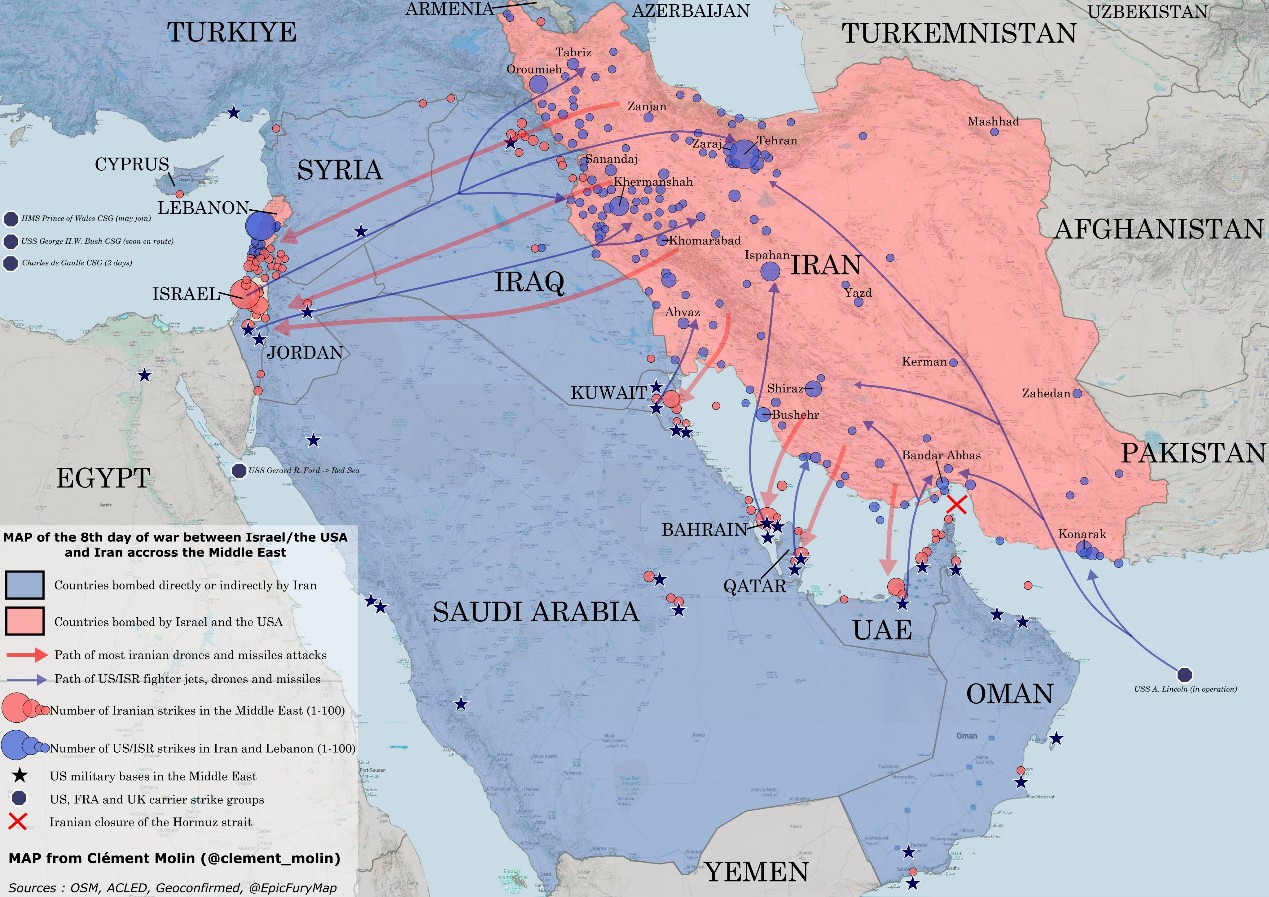
Iranian media reported on the 21st, citing a statement from the Atomic Energy Organization of Iran, that Israel and the United States attacked Iran's Natanz uranium enrichment facility on the same day. There has been no leakage from the facility.

The statement said that the facility was attacked that morning, a move that violated international law, including the Treaty on the Non-Proliferation of Nuclear Weapons. Relevant Iranian agencies have carried out technical investigations nearby. There has been no leakage of radioactive materials from the facility, and the safety of surrounding residents has not been threatened.

International Atomic Energy Agency responds to attack on Iran's Natanz nuclear facility

According to CCTV International News, the International Atomic Energy Agency (IAEA) stated today (March 21) that it has received notification from Iran that the Natanz nuclear facility in the center of the country was attacked that day, and is currently further verifying the relevant situation. The IAEA pointed out that according to information provided by Iran, no increase in off-site radiation levels has been detected, and there are no abnormalities in the surrounding environment. The agency is investigating the incident and is in contact with Iran's nuclear safety regulatory authorities. Grossi, Director General of Atomic Energy, reiterated that any military action against nuclear facilities may bring serious security risks and called on all parties to exercise restraint to avoid causing nuclear accidents.

Iran's military says it launched attack on Israeli military facilities at Ben Gurion Airport

According to CCTV News, the Iranian army issued Announcement No. 37 on the 21st local time, saying that it dispatched drones in the early morning of that day to attack military infrastructure in Israel. The targets included the fuel storage facilities at Ben-Gurion Airport and areas related to fighter tankers. The announcement stated that relevant crackdowns will continue.

Iran's armed forces say they are taking major action in Strait of Hormuz

According to CCTV News, a spokesperson for the Central Headquarters of the Iranian Armed Forces in Hatam Anbia stated on the 21st local time that Iran was “taking major actions in the Strait of Hormuz.” The spokesperson emphasized that "if Iran's infrastructure is attacked, Iran will attack more important and critical infrastructure (of the United States and Israel)."

Iranian president calls on Iran to weather storm together

According to CCTV International News, Iranian President Pezeshizyan posted on social media today (March 21) that he hopes Iranian society will put aside its differences, haze and contradictions. He pointed out that the traditional festival Nowruz (the traditional Iranian New Year) is needed more than ever this year to show social unity, cohesion and national harmony. “Let us work together to enable Iran to weather the storm in which it finds itself with its head held high.”

Iran's foreign minister says it seeks a complete end to the war rather than a temporary ceasefire

According to Xinhua News Agency citing Japan's Kyodo News Agency on the 21st, Iranian Foreign Minister Araghchi said that Iran hopes to end the war thoroughly, comprehensively and lastingly, rather than a temporary ceasefire. In a telephone interview with a Kyodo News reporter on the 20th, Araghchi said that the United States and Israel's attack on Iran was an illegal and unjustifiable act of aggression, and he hoped that the world would unite to speak out against it. Many countries have begun to push for a ceasefire, but Iran only considers solutions that end the war in one fell swoop. Iran does not accept a temporary ceasefire, but demands a comprehensive end to the war, including ensuring that Iran will not be attacked again and compensating Iran for the losses it has suffered. Araghchi also said he did not believe the United States was ready to negotiate.

Iran urges residents of UAE's Ras Al Khaimah to evacuate

According to Xinhua News Agency, citing a report from Iran's Tasnim News Agency on the 21st, Iran issued a warning to residents of Ras Al Khaimah in the United Arab Emirates, urging residents to evacuate through designated routes. The report said that given that Ras Al Khaimah is used in operations against Iranian islands, it will become a target in the near future. Iran's Islamic Revolutionary Guard Corps posted on social media that day that if Iranian islands are attacked again from the United Arab Emirates, Ras Al Khaimah will suffer heavy damage.

Iran confirms launching two ballistic missiles at US and UK military bases in the Indian Ocean

According to CCTV News, it was learned from Iran on the 21st local time that Iran confirmed that it had launched two ballistic missiles towards Diego Garcia, a US-UK joint military base located in the central Indian Ocean. It is reported that the range is more than 4,000 kilometers. Iran stated that this move showed that the range of Iranian missiles exceeded the "enemy's" previous expectations and demonstrated Iran's deterrent capabilities against the United States and its allies. According to US sources, neither missile hit the target base.

Iran's military threatens to attack U.S. and Israeli officials: Vacationing abroad will no longer be safe

According to Iranian news, Iranian Armed Forces spokesman Abu Fazl Shekarhi issued a statement on March 20, threatening devastating attacks on U.S. and Israeli officials, commanders and soldiers, saying that they would "no longer be safe" even while vacationing abroad and would pay the price for their actions. Shekarhi also said that Iranian officials live with the people, walk with the people, and are among the people, unlike American and Israeli officials who hide in basements and shelters. The assassination of Iranian officials and armed forces commanders does not show the strength of the enemy. USA:

US media says Trump administration is planning to seize Iran's nuclear materials

According to Xinhua News Agency, citing US media reports on the 20th, the Trump administration is formulating a strategic plan to seize Iran's "nuclear stockpile."

According to reports, the U.S. government has recently turned its attention to a longer-term goal proposed by President Trump early in the war: ensuring that Iran no longer has the ability to build nuclear weapons. U.S. officials say the Trump administration has not ruled out trying to seize Iran's highly enriched uranium as part of its ongoing military campaign.

The report quoted multiple sources as saying that Trump has not yet made a decision on this, but troops from the Joint Special Operations Command may be deployed to implement the plan. This elite force typically performs the most sensitive counterproliferation missions.

The report also stated that a White House spokesman said that the Pentagon was responsible for preparations, but the Pentagon spokesman has not commented yet.

Israel:

Israeli military says Iran launches missiles carrying cluster bomb warheads into central Israel

According to CCTV News, on the 21st local time, the Israel Defense Forces issued a statement stating that the ballistic missile launched by Iran into central Israel not long ago carried a cluster bomb warhead. Israeli rescue forces said Iran launched a ballistic missile carrying a cluster bomb warhead into central Israel, causing damage to three locations in Rishon LeZion. There have been no reports of casualties.

Israeli military says it is attacking "Iranian regime targets"

According to Xinhua News Agency, the Israel Defense Forces issued a statement on the 21st saying that the Israeli army was attacking "Iranian regime targets" in Tehran. Saudi Al Arabiya TV reported that day, citing Israeli sources, that Iranian security forces commander Ahmed-Reza Laden was the target of Israeli air strikes against Tehran that day, but did not disclose any further information. There has been no news from Iran.

ST Quanwei Was Put On File For Breach Of Trust Disclosure And Received A 15 Million Yuan Loan Bailout From Qingdao Luchuangtai

On March 19, Guangdong Quanwei Technology Co., Ltd. (hereinafter referred to as "ST Quanwei"), which is facing the risk of delisting, issued multiple announcements. Among them, the company and the company's actual controller and chairman Chu Yifan have recently received "Notifications of Case Filing" issued by the China Securities Regulatory Commission. Due to suspected violations of information disclosure laws and regulations, the China Securities Regulatory Commission decided to file a case against the company and Chu Yifan.

立案董事长后多久开庭__董事长刑事案件对公司的影响

Public information shows that Chu Yifan was born in 1995. He once worked as a financial reporter. He has served as the chairman of ST Quanwei since 2023. He is also the company’s controlling shareholder Quanwei Green Energy and indirectly controls ST Quanwei through Quanwei Green Energy and its concerted person National Holdings. Some of the shares held by Quanwei Green Energy have been judicially auctioned due to debt default.

董事长刑事案件对公司的影响_立案董事长后多久开庭_

Chu Yifan. Picture source: Quanwei Technology WeChat public account

Regarding the matter of being investigated, ST Quanwei said that at present, the company's production and operation are normal and the matter will not affect the company's daily production and operation activities. During the investigation period, the company and Chu Yifan will actively cooperate with the relevant investigations of the China Securities Regulatory Commission and strictly perform their information disclosure obligations.

Another announcement showed that after deliberation and approval at the 44th meeting of the fourth board of directors, ST Quanwei signed an "Operating Relief Cooperation Agreement" with Qingdao Luchuangtai Enterprise Management Consulting Co., Ltd. (hereinafter referred to as "Qingdao Luchuangtai") and borrowed 15 million yuan from Qingdao Luchuangtai to pay operating relief expenses such as employee wages, social security, and housing provident funds. The loan period of the relief funds is 12 months.

In terms of performance, in 2023 and 2024, ST Quanwei will have net losses of 139 million yuan and 119 million yuan respectively. The 2025 performance forecast shows that the annual loss is 182 million to 255 million yuan, the revenue is only 45 million yuan to 63 million yuan, and the net assets have turned from positive to negative, ranging from -123 million to -172 million yuan. Nandu previously reported that ST Quanwei has applied for bankruptcy and reorganization, and the Intermediate People's Court of Dongguan City, Guangdong Province has set up a case number in this regard. The company is subject to a delisting risk warning and may even be terminated from listing.

Sign In

Forgot Password

Sign Up