
Yankuang Energy: Yancoal Australia’s 2025 Annual Performance Report And Dividend Declaration
Stock code: 600188 Stock abbreviation: Yankuang Energy Number: Lin2026-
Stock code: 600188 Stock abbreviation: Yankuang Energy Number: Lin2026-
The so-called "mining" is to calculate and produce virtual currency through special computers, namely "mining machines". The "miners" only ensure the power supply and network connection of the mining machines.
Take Bitcoin “mining” as an example.
Bitcoin is the first decentralized cryptocurrency. At every other point in time, the Bitcoin system generates a random code on the node. All computers on the Internet can look for this code. Whoever finds this code will generate a block. According to the reward mechanism issued by Bitcoin, every time a block is generated, the node will receive corresponding rewards.
[Note: Cryptocurrency is a trading medium that uses cryptographic principles to ensure transaction security and control the creation of trading units. 】
This process of finding codes and getting rewards is called “mining”.
But there is a problem with Bitcoin "mines", that is, the total number is limited. However, after all, virtual currency is just a few lines of code. Slightly modifying the Bitcoin code becomes a new virtual currency. As a result, various virtual currencies are like crucian carps crossing the river, and those named after animals include Dogecoin, Shiba Inu Coin, Cat Coin, Duck Coin, etc.
In each "mine", countless "miners" are digging day and night, and many people make a lot of money by relying on their first-mover advantage. But as the number of people increased, the competition for mining equipment began, with most miners using powerful, specialized computers to mine cryptocurrencies around the clock. From CPUs, GPUs, FPGAs, to giant warehouses with ASIC Bitcoin mining machines, the computing power has increased astonishingly.
[Note: Computing power, also known as hash rate, is a unit of measurement for the processing power of the Bitcoin network. 】
In addition to constantly upgrading "mining" equipment, many people choose to join forces to form a "mining pool."
The principle is: bring together a group of scattered "miners", and everyone will "mining" together and go hand in hand. There is power in numbers, and the possibility of a group of people poaching is much higher than working alone. When the digital currency is mined, it will be distributed according to the computing power of the equipment. Even if you are unlucky and don't get it, you can still get a share of the pie as long as you enter the "mining pool".
What's more, "mines" have been built. The interior of the huge factory building is divided into about 30 computer rooms with white partitions. The metal racks in each computer room are filled with servers, and the messy wires and power strips are covered with thick dust. There were no workers in the factory, only the roar of fans could be heard.
Electric black hole
Behind the huge computing power that supports "mining", there is also even more terrible power consumption.
As the types of virtual currencies continue to increase, the power consumption caused by virtual currency “mining” is increasing explosively. A "mine owner" once revealed that the electricity consumption of a "mine" in a year is equivalent to the total electricity consumption of several cities in a year.
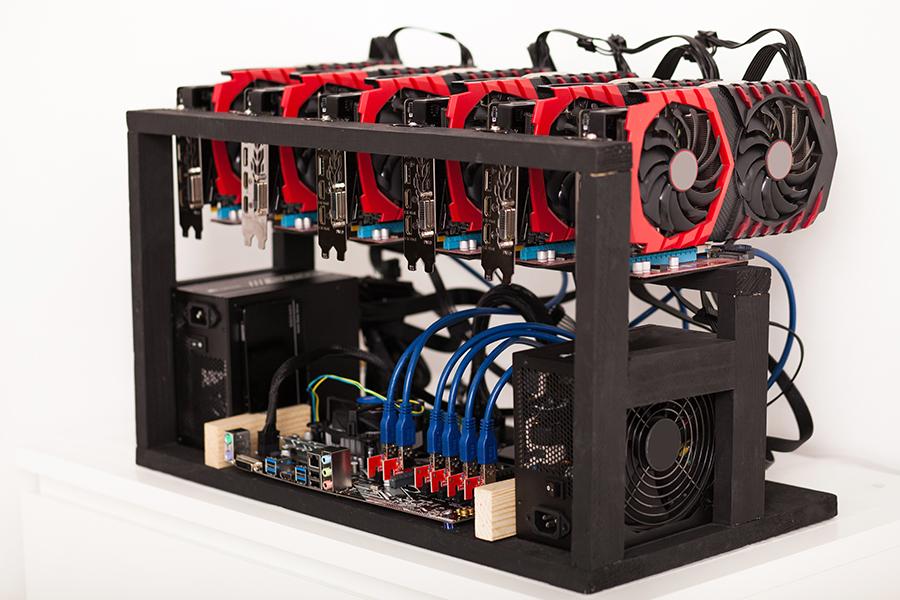
Cryptocurrency mining machines consume an astonishing amount of power. Picture|Picture Chong Creative
According to the Cambridge University Bitcoin Power Consumption Index, Bitcoin mining consumes an estimated 133.68 terawatt hours of electricity per year (1 terawatt hour is 1 billion kilowatt hours of electricity). This number exceeds the electricity consumption of Sweden, ranking 27th in the world.
However, the Financial Times further pointed out that Cambridge University’s prediction is calculated based on Bitcoin “miners” using the least efficient computers to “mine”, so the actual power consumption of “mining” may be higher than the above estimates.
Why does “mining” consume so much power?
We can do some math.
Generally speaking, "mining" is mainly divided into graphics card mining machines and ASIC (professional) mining machines.
[Note: ASIC refers to application specific integrated circuit. 】
Graphics card mining machines mainly use graphics cards to mine. For example, the power of the RX570 graphics card is 150-160 watts, and the total power of a mining machine with 6 graphics cards is generally close to kilowatts.
Let’s look at professional mining machines that use chip mining. The Antminer S9 mining machine has a smaller power consumption of 1,400 watts, while the Shenma M3 mining machine has a larger power consumption, exceeding 2,000 watts.
From this, it can be estimated that the power consumption of a mining machine working normally for one hour is 1-2 degrees.
Although this number may not seem like much, Bitcoin mining machines need to run 24 hours a day. The Antminer S9 mining machine requires 33.6 kilowatt-hours of electricity a day, while the Whatsminer M3 mining machine requires at least 48 kilowatt-hours a day, consuming 1,440 kilowatt-hours of electricity a month. A normal household only consumes 200-400 kilowatt hours of electricity per month.
In the "mine", many mining machines are placed densely, which consumes power and also releases a lot of heat. In order to ensure the normal operation of the mining machine, the "mine" must also be equipped with large fans to ventilate and dissipate heat. A three-phase large fan has a power of 1,000-2,000 watts, and the fans all over the walls outside the "mine" also consume an astonishing amount of power.
For a "mine", "revenue = produced Bitcoin × currency price - mining machine cost - electricity fee - maintenance fee and labor cost - mine depreciation fee." The most important expense is the electricity fee.
Therefore, places with cheap electricity rates have become a natural choice for “mining”.
Washington State in the United States has relatively low electricity bills and is home to many “mining” companies including GigaWatt. Wenatchee, a small town east of Seattle, has extremely low electricity prices, only 2-3 cents/kWh. It has attracted dozens of "miners" to settle there and has become the center of Bitcoin "mining" in the United States.
In Sichuan, China, abundant hydropower resources also provide convenience for “mining”. In order to purchase electricity from the nearest power station, some "mines" were built on river embankments without environmental impact assessment or construction approval. It is reported that for every 100 Bitcoins mined in the world, 5 are produced in the Dadu River.
"Mining" that depends on the weather is occasionally affected by the weather. If there is too much rainfall and the hydropower station cuts off the power supply of the "mine", the "mining pool" will no longer be able to operate; if there is too little rainfall, a large number of mining machines cannot be started, which invisibly increases the sunk cost.
To solve these problems, "mines" will also migrate with the seasons like migratory birds. When the flood season ends and electricity prices rise, “mine owners” often move their equipment to areas where thermal power is cheaper.
eliminate! No mercy!
Since 2020, various regions in Sichuan have begun to introduce policies one after another, hoping to use sufficient hydropower resources to support the development of the Bitcoin "mining" industry to alleviate the economic pressure caused by the epidemic. However, some mining companies use "big data, blockchain projects, supercomputing centers" as guise to defraud local government support and cause serious waste of public resources.
In a certain province in the west, a so-called "data business" company consumes as much as 25 million kilowatt-hours of electricity per month; monitoring by the Jiangsu Provincial Communications Administration found that virtual currency activities in the province consume 260,000 kilowatt-hours of electricity per day.
Someone from a domestic power plant calculated an account for us. If a family consumes 300 kilowatt-hours of electricity a month, 260,000 kilowatt-hours of electricity a day is equivalent to the electricity consumption of 866 families for a month. A small-unit power plant uses 320 grams of standard coal (7,000 kcal of standard coal) to generate 1 kilowatt hour of electricity, and "mining" consumes 78 tons of standard coal a day.
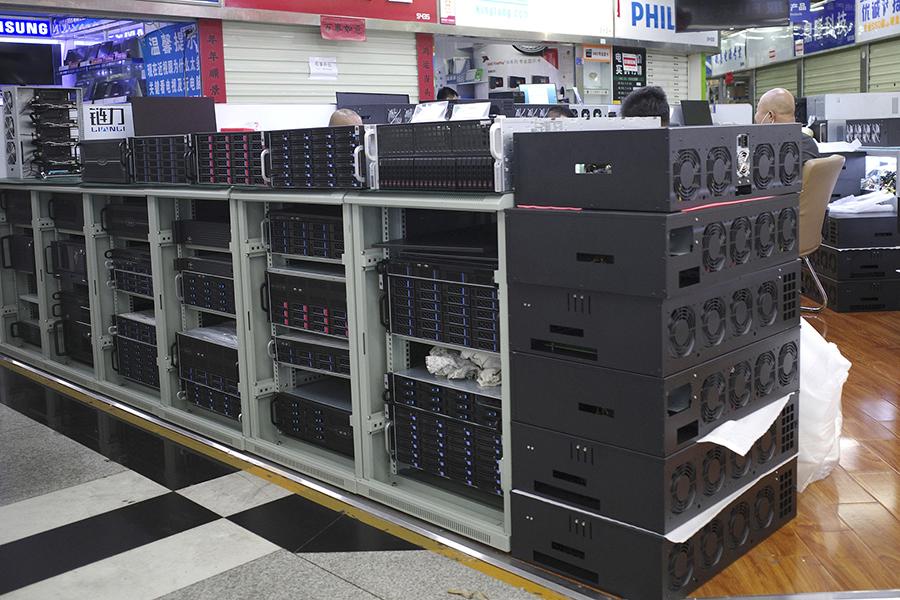
On September 25, 2021, a store in Shenzhen sold virtual currency mining machines. Picture | Visual China
Currently, more than 120 countries and two-thirds of the world's economies have joined the "carbon neutrality" transition. Under this trend, the high energy consumption issue of virtual currency “mining” has become the focus of heated discussions in the industry.
At the same time, unlike traditional currencies, cryptocurrencies are not backed by a specific government or bank, and their decentralized and anonymous nature means there is no regulator deciding how much money will flow into the market.
The endless growth of the "mining" industry has also led many domestic retail investors to illegally participate in virtual currency transactions and speculation, seriously disrupting the economic and financial order, spawning illegal and criminal activities, and becoming an illegal channel for money laundering, tax evasion, terrorist financing, and cross-border fund transfers.
Purging is imperative.
On May 18, 2021, the Internet Finance Association, the Banking Association, and the Payment and Clearing Association jointly issued the "Announcement on Preventing the Risks of Speculation in Virtual Currency Transactions", requiring member institutions not to carry out virtual currency transaction exchanges and other related financial businesses, resolutely resist illegal financial activities related to virtual currency, and not provide accounts, payment settlement, publicity and display and other services for virtual currency transactions.
On the same day, the Inner Mongolia Autonomous Region Development and Reform Commission announced on its website that it would comprehensively clean up and shut down virtual currency mining projects. Soon after, the Natural Resources and Planning Bureau of Kangding City in Sichuan stated that multiple departments in Kangding City had set up a working group to conduct a thorough investigation of Bitcoin mining on the Dadu River and then clean up violations. The Hainan Provincial Development and Reform Commission also clarified that differential electricity prices will be implemented for virtual currency "mining" activities, with the price increase standard being 0.80 yuan per kilowatt hour.
On September 24, ten departments including the central bank, the China Banking and Insurance Regulatory Commission, the Cyberspace Administration of China, and the State Administration of Foreign Exchange issued the "Notice on Further Preventing and Dealing with the Risks of Speculation in Virtual Currency Transactions." The notice pointed out that virtual currencies such as Bitcoin and Ethereum do not have the same legal status as legal tender and cannot be circulated in the market as currencies; virtual currency-related business activities are illegal financial activities and should be resolutely banned in accordance with the law.
At the same time, the National Development and Reform Commission also issued a document, targeting "mining": prohibiting "mining" in any name, including the relevant commitments of data center companies in credit reporting; classifying virtual currency "mining" activities as an eliminated industry, and stopping all fiscal and tax support.
In December, the Beijing Chaoyang District Court and the Dongcheng District Court successively declared the Bitcoin mining contract invalid, making it difficult to even file a case for cryptocurrency-related telecommunications fraud.
Virtual currency “mining” is officially listed as a phased-out industry, which will release a large amount of power resources that are occupied by ineffective and harmful production capacity, so that efficient and beneficial production capacity can obtain relatively sufficient power guarantee, which will help reduce the degree of power shortage, narrow the scope of power restrictions, and effectively reduce greenhouse gas emissions caused by ineffective energy demand.
At the same time, this will also help promote the development of new industries such as energy storage, support the construction of new power systems, serve wind power, photovoltaics and other renewable energy power generation on a large scale, and achieve large-scale substitution of fossil energy with low-carbon renewable energy. It is of great significance to promote the optimization of my country's industrial structure, promote energy conservation and emission reduction, and achieve carbon peak and carbon neutrality goals as scheduled.
Cao Xiao, a professor at the School of Finance at Shanghai University of Finance and Economics, said: Technology itself is not right or wrong. While cracking down on "mining," we must pay attention to distinguishing it from blockchain technology, and adopt a regulatory approach that separates "chains" and "coins."
China has the advantages of massive data and rich application scenarios, and has broad application prospects in the future. How to keep relevant industries from going astray, how to clarify the boundaries of rights and responsibilities of all parties, and how to improve the big data governance system will be the focus of future supervision.
References:
Xinhua News Agency, Geneva, February 25th: Summary|The think tank report "Adhering to International Morality and Joining Hands to Cope with World Chaos - Focusing on China's Plan for Global Governance" has triggered heated discussions
Xinhua News Agency reporter
On the 24th, Xinhua News Agency, a national high-end think tank, released the think tank report "Adhering to International Morality and Joining Hands to Cope with World Chaos - Focusing on China's Plan for Global Governance" to the world at the Palais des Nations in Geneva, Switzerland. The think tank report triggered heated discussions among people from all walks of life and experts and scholars in related fields.
The report believes that the current changes in the world over the past century are accelerating and the international situation is intertwined with chaos. The United Nations and multilateralism are under attack, the global governance deficit continues to expand, and the current international mechanisms have exposed multiple shortcomings. The global governance system is in urgent need of reform and improvement. China has proposed global governance initiatives, emphasizing the pursuit of sovereign equality, abiding by international rule of law, practicing multilateralism, advocating people-centeredness, and focusing on action orientation. It has proposed Chinese solutions to promote the construction of a more just and reasonable global governance system, and injected Chinese impetus into revitalizing the core status and leading role of the United Nations.
Zhai Dongsheng, director of the Institute of Regional and Country Studies at Renmin University of China, said that reforming and improving the global governance system has become a major topic of great concern to the international community. "This report provides ideas for a turbulent and chaotic world and answers a series of major questions such as what, why and how to achieve the future global governance system."
Xiao Yongping, dean of the Institute of International Rule of Law at Wuhan University, believes that the report systematically explains China’s position on global governance and advocates the construction of a global governance concept that is different from hegemonic logic and embraces consultation, collaboration and sharing. The concepts of multilateralism and win-win cooperation advocated by the Global Governance Initiative are in line with the common expectations of most countries and provide constructive new ideas for solving the dilemma of global governance.
2026 marks the 55th anniversary of the restoration of the People's Republic of China's lawful seat in the United Nations. As a permanent member of the United Nations Security Council, an important member of the Global South, and the largest developing country, China has always been a builder of world peace, a contributor to global development, a defender of the international order, and a provider of public goods.
"The report systematically sorts out the historical context, practical dilemmas and future trends of global governance, reveals structural problems such as hegemonism's destruction of the international rule of law and insufficient representation of the global South, and details China's sense of direction, roadmap and action in reforming and improving global governance," said Zhai Kun, deputy dean of the Institute of Regional and Country Studies at Peking University.
Catrougalos, the independent expert on democratic and equitable international order at the United Nations Human Rights Council, said that China plays a pivotal role in the multilateral system. China's initiative on global governance is of great significance, which shows that China actually takes action rather than making verbal statements.
The report points out that as a responsible major country, China stands at the forefront of the times and is committed to promoting the transformation of initiatives from ideas to actions. It relies on the multilateral platform with the United Nations as the core, and builds a policy system for global governance initiatives with institutional participation, public goods supply and risk management and control as the main body, and effectively promotes the initiatives to take root within the multilateral framework.
Correa, executive director of the South Center, said that equality, rule of law, coordination, tolerance and action are crucial to maintaining and improving the multilateral system. China has proposed a series of initiatives such as the Global Governance Initiative, which has effectively promoted the continuous development of South-South cooperation. Strengthening collaboration around global governance initiatives will help countries in the Global South play a greater role in global governance.
Zhang Jie, a researcher at the Institute of Asia-Pacific and Global Strategy, Chinese Academy of Social Sciences, believes that the report takes the "four major deficits" of global governance as a starting point, discusses the urgency, necessity and feasibility of global governance initiatives, and comprehensively explains the internal logic of the four major global initiatives. This is a comprehensive management plan proposed by China in the face of the contemporary issues of "what's going on with the world" and "where is humanity going?"
The report calls on the more difficult the moment, the more important it is to uphold the original intention of peaceful coexistence, strengthen confidence in win-win cooperation, persist in moving forward within the logic of historical progress, and develop in line with the development trend of the times. China will work with other countries to continue to promote global governance in a more just, more reasonable, and more sustainable direction.
Ouyang Kang, dean of the Institute of National Governance at Huazhong University of Science and Technology, said that as a responsible major country, China is not only a staunch inheritor and defender of traditional globalization and the international system with the United Nations at its core, but also a staunch curber and opponent of anti-globalization, and an advocate and leader of new globalization. China adheres to true inclusive multilateralism, firmly defends international justice, and promotes the construction of a more fair and reasonable global governance system. (over)
Recently, in response to the media report that "12306 tickets successfully waiting for 1,700 yuan in the middle of the night are invalid", the Railway 12306 Technology Center quickly organized forces to conduct verification.
The background of the 12306 system shows that the 12306 account registered as Chen placed an order at 11:09 on February 19 for 3 second-class seats from Xiamen (Xiamen North) to Yixing on February 23. The selected train number was G1654, the number of passengers was 3, and the prepaid fare was 1674 yuan. The deadline for confirmation was 1 hour before driving. The notification method was WeChat notification for 1 person and SMS notification for 2 people. At 18:44 on February 22, the account placed an order to purchase three second-class tickets for the G1656 train on February 23 with the same passengers. The ticket purchase section was from Xiamen North to Nanjing South. Xiamen North departed at 15:43 and Nanjing South arrived at 22:36. The ticket price was 1,755 yuan. After the ticket purchase was successful, the account did not cancel the previously submitted waitlist order.
At 2:53 on February 23, the 12306 system confirmed that the waiting order submitted by the account was successfully redeemed. The redemption number was G1654, which departed from Xiamen at 8:50 on February 23 and arrived in Yixing at 15:04. The system immediately sent notifications of successful redemption to the three passengers in accordance with the notification method selected by the account. The notification content included the train number, driving time, etc.
At 15:43 on February 23, Chen and three others took G1656 from Xiamen North Railway Station and got off at Yixing Station at 21:55.
According to the ticket purchase rules of the 12306 system, the same passenger cannot purchase two itineraries at the same time. The ride time slots for which the account successfully purchased tickets are Xiamen North at 15:43 and Nanjing South at 22:36. The ride time slots for successful redemption are Xiamen at 8:50 and Yixing at 15:04. The times do not overlap and do not belong to "two itineraries purchased by the same passenger at the same time". The system does not determine it as a itinerary conflict.
According to the 12306 system waitlist ticket purchase rules, when passengers submit a waitlist order, the system will prompt that "the system continues to cash in 24 hours a day" and "when the cash is successful or automatically terminated, you will be notified through the notification method you choose. Please pay attention to the message and pay attention to the waitlist order cashing status." When the account submitted a waiting order, the system promptly prompted it. After the redemption was successful at 2:53 on February 23, the system simultaneously sent a notification message to Chen and two other passengers. This time was 4 hours and 57 minutes earlier than the deadline for redemption selected when submitting the waiting order.
According to the ticket change rules of the 12306 system, tickets cannot be refunded after driving. Tickets can be changed once before 24:00 on the day without charge, or once within the pre-sale period, but a handling fee of up to 40% will be charged. Tickets after change cannot be refunded. After the waiting order was successfully redeemed, the account applied twice in the 12306 system to change the three second-class tickets G1654 on the waiting list. The first time it was planned to be changed to the G1654 Xiamen to Yixing section on March 5, and the second time it was planned to be changed to the D3296 Xiamen North to Yixing section on March 8, but in the end, the above two changed orders were canceled during the change payment process, and the change steps were not completed.
In addition, after verification, the passenger ticket purchase screen shown in the report is not the Railway 12306 website or App page.
The Railway 12306 Technology Center recommends that passengers must purchase tickets through 12306, the only official platform. When submitting a waitlist ticket purchase order, they must carefully check the waitlist ticket purchase rules published on the 12306 website (including the App). Before the self-selected waitlist redemption deadline, follow the method of receiving notifications you choose and determine, and pay attention to the system notification information in a timely manner; if you purchase tickets for other trains, you must cancel the waitlist ticket purchase order in time. At the same time, the Railway 12306 Technical Center will continue to optimize and improve the waitlist ticket purchase strategy, waitlist redemption rules and notification methods, and strive to provide better services to the majority of passengers.
introduction
With the continuous development of informatization and intelligent technology, electronic countermeasures, as an important means of combat, have significantly surpassed the early scope of combat operations and gradually upgraded to electromagnetic space operations that cover the entire area and profoundly affect the effectiveness of joint operations. At present, the world's new military transformation is accelerating, and electromagnetic space operations with electronic countermeasures as the core are also in a new development period. In this context, recognizing the changing trends of electromagnetic space operations and further deepening the understanding of the laws of electromagnetic space operations is of great significance for the scientific use of electromagnetic space operations forces, effectively improving combat effectiveness, and thus winning informationized and intelligent wars.
The status role has shifted from "support and guarantee" to "combat means"
At the beginning of its birth, electronic means were mainly used in combat support and support, and its functional positioning was concentrated in basic combat fields such as communication support, intelligence reconnaissance, and navigation and positioning. With the iterative development of communication electronics technology, the integration of military electronics technology and modern combat systems continues to deepen, and its functions have extended from single support to all-domain combat capabilities. First, it plays the role of a nerve center in the field of combat command and control, and can build a battlefield information network through real-time data links to achieve efficient coordination of multi-domain combat units; second, it plays a core enabling role in the field of fire strike, and can rely on electronic guidance, target identification and damage assessment technology to significantly improve the strike accuracy and damage effectiveness of weapon systems; third, it enhances confrontation effectiveness in the field of system operations, and can use electronic countermeasures, spectrum control and other means to directly weaken the enemy's battlefield perception and command and control capabilities. The functional jump in these three aspects has transformed military electronic technology from a auxiliary element to an important factor that directly affects the effectiveness of the weapon system and even the combat capability of the entire system.
As informatization and intelligent warfare accelerate, intellectual power has increasingly become the core power to win the future battlefield. The importance of traditional firepower advantage has gradually given way to information advantage, and military electronic technology is the core hub for transforming advantages in the information domain into results in the physical domain. Under this circumstance, military electronic technology has penetrated into all aspects of the entire combat system, giving rise to a new combat style of electromagnetic space warfare. On the modern battlefield, the strike effectiveness of electromagnetic space operations is as important as traditional combat methods, and even more critical in some links. Its combat mechanism mainly revolves around the struggle for electromagnetic power on the battlefield, and achieves combat goals through a systematic approach. Specifically, its effectiveness relies on the four-in-one action framework of "reconnaissance, attack, defense, and management", that is: reconnaissance and mastering the electromagnetic situation on the battlefield, attacking and suppressing the enemy's electromagnetic power, protecting one's own electromagnetic security, and controlling and optimizing the use of spectrum resources. This overall domain combat method based on electromagnetic spectrum full-domain confrontation is becoming an important combat method to support joint operations and seize comprehensive battlefield control.
The purpose of combat has shifted from "defending oneself against the enemy" to "taking the initiative to attack"
In traditional offensive and defensive operations, due to factors such as the low level of military electronic technology and the low degree of informatization of weapons and equipment, the purpose of military electronic technology application is mainly focused on passively resisting the enemy's electromagnetic suppression and ensuring one's own electromagnetic safety during combat operations. Even in the late 20th century, electronic countermeasures had developed to a considerable level and scale, but they were still limited to "electromagnetic soft-kill" countermeasures and the use of a small number of anti-radiation missiles. There were few examples of active electromagnetic space operations against the enemy.
However, with the rapid development of electronic information technology and the widespread deployment of intelligent equipment, the purpose of electromagnetic space operations in the context of joint operations has gradually shifted to proactive attacks. Specifically, electromagnetic space combat forces can not only induce the enemy's advanced sensors to generate virtual images, mislead its intelligent decision-making systems, and take over its unmanned equipment clusters, etc., but can also be mixed with army aviation and long-range fire forces to target important enemy combat nodes and implement multi-frequency domain "soft kills" and integrated "hard destruction." This transformation marks the upgrade of electromagnetic space operations from a purely defensive tool to an offensive means. The combat method emphasizes preemptive strikes, actively interfering and destroying the enemy's electromagnetic activities, weakening its overall combat effectiveness, and thus taking the lead in the early stages of the war. This proactive combat paradigm not only enhances the strategic value of electromagnetic space, but also promotes the deep integration of various services and arms in joint operations, making electromagnetic power a key support for battlefield victory.
It can be seen that in the future battlefield, the purpose of electromagnetic space operations has gone beyond simply competing for environmental advantages to "preserve oneself and resist the enemy". Its core is accelerating to expand and extend to "active enemy control", that is, through a comprehensive method that combines "soft kill" paralysis and "hard destruction" suppression to achieve deep intervention and effective disintegration of the enemy's combat system. If used properly, the overwhelming advantage of electromagnetic space operations can even achieve the winning effect of "conquering the enemy without fighting."
The combat relationship has shifted from "simple superposition" to "integrated integration"
Since its birth, electromagnetic space operations have not been isolated. In the early stages of its development, it is mainly manifested in the simple superposition and preliminary coordination of technical capabilities. This is specifically reflected in the fact that combat units such as communication countermeasures, radar countermeasures, and electro-optical countermeasures are mostly deployed and operated independently, with relatively single functions. There is a lack of deep interaction and unified scheduling between operations in different spectrum domains. The operational effects are mainly manifested in point suppression or interference of specific electromagnetic nodes of the enemy. Entering the era of informationization and intelligence, from interception and early warning to interference suppression, from communication confrontation to radar confrontation, from battlefield reconnaissance to power seizure, electromagnetic space operations have become increasingly closely integrated with real space operations by virtue of their vertical extension of combat chains, horizontal expansion of spectrum territories, and empowerment of combat effect systems. The relationship between various units has also transformed from "simple superposition" to "integrated fusion" based on system confrontation.
Among the many forms of information warfare, electronic countermeasures are its main content and technical support. Information countermeasures on the battlefield are essentially a competition for electromagnetic control. Therefore, to a certain extent, the power to control electromagnetic forces is equivalent to the power to control information on the battlefield. In the context of joint operations, "information-led, firepower-based warfare" has become the most basic and common combat method. Its integration of information and firepower puts forward inevitable requirements for systematization and jointization of electromagnetic space operations. This means that electromagnetic space combat operations must be deeply integrated into the joint combat system, closely coordinated and integrated with fire strike operations to form an organic whole of system confrontation. Only in this way can the key effectiveness of electromagnetic space operations be maximized, and the joint operational goals of integrated information and fire and cross-domain efficiency enhancement be finally achieved.
Methods and strategies shift from "single redundancy" to "global linkage"
In traditional mechanized warfare, the competition for resources in the electromagnetic field is fragmented, and its method system has obvious limitations. Even in relatively complex combat scenarios, it is still concentrated on single means such as reconnaissance, interference, and protection. This type of mode can only form local suppression of specific enemy combat nodes, and it is difficult to achieve systematic control of electromagnetic power in the entire domain. As electronic countermeasures are upgraded to an independent combat style, spectrum operations, electromagnetic warfare, etc. continue to evolve, and their core is embodied in the aggregation of four major capabilities, namely: battlefield penetration of signal reconnaissance, system destructive power of electronic attack, survivability and resilience of electronic protection, and synergistic effectiveness of spectrum management and control. This requires us to abandon the thinking that only focuses on improving the performance of a single-installation platform, and instead build a joint electronic countermeasure capability generation model with information advantages as the hub and system support as the cornerstone.
To achieve this, it not only requires the integration of technical equipment, but also relies on the innovation of combat concepts, the optimization of institutional arrangements, and the improvement of command arts. It aims to use the systematic advantages of electromagnetic space to effectively resolve risks, or to quickly disintegrate the opponent's combat system in an asymmetric manner when necessary, and to seize and maintain the battlefield initiative. Therefore, promoting the transformation of electromagnetic warfare capabilities to the direction of global linkage is an inevitable choice and important support to meet the challenges of future informatization and intelligent warfare.
Operational planning has shifted from "temporary response" to "active deployment"
A large number of war practices have proved that electromagnetic space operations have increasingly been regarded as an important asymmetric measure to offset the advantages of high-tech systems and weapons. In the field of electromagnetic warfare, new frequency-using technologies or equipment are always given priority to improve anti-reconnaissance and anti-jamming capabilities, and only then can electronic countermeasures be developed to compete with them. This determines that the electronic countermeasures opponent has a natural lag relative to the spectrum utilization side, which means that it is difficult for the "spear" and "shield" of electromagnetic space operations to effectively compete simultaneously. Therefore, early electromagnetic space operations planning must focus on sudden crises and pay attention to temporary responses.
However, driven by emerging electronic information technology, the technical level of frequency-using equipment such as communications, radar, and navigation continues to upgrade, and new concept electronic countermeasures continue to enter the electromagnetic strike "weapon arsenal." Faced with this situation, it is difficult to reverse the passive situation on the battlefield caused by the generation gap in key technologies simply by relying on rapid technological compensation and equipment replacement. Therefore, electromagnetic space combat planning should, on the basis of accelerating technological catch-up, strengthen the strategic layout and actively shape the electromagnetic situation that is conducive to seizing electromagnetic control power and even comprehensive battlefield control power. It is necessary to seize the characteristics and laws of the electromagnetic situation in the informationized and intelligent battlefield, such as dense and changeable signals, complex and intertwined networks, blurred boundaries between ourselves and the enemy, and rapid time and space transitions. We must unify command, highlight key points, and organize electromagnetic space combat operations in a careful and coordinated manner, so that various electromagnetic space combat forces form an organic whole and form a powerful advantage in comprehensively defeating the enemy.
China News Service, Beijing, January 29 (Hu Shujuan) An announcement letter forced Lin Xiao (pseudonym) to move urgently.
Previously, Lin Xiao lived in the Shanghai Jinyu Road Community of Rubik's Cube Apartment. An announcement letter posted by the property owner of the community stated that the lessee, Rubik's Cube Apartment, had been in serious breach of contract for a long time. The company had terminated the lease contract with it in accordance with the law and officially took back the property.
"The property owner has not forced the tenant to move out, but the deposit we paid before is likely to be wasted." Lin Xiao said that the previously signed lease contract would not expire until around the end of February. Considering the subsequent risks, she decided to change the house directly.
China News Network’s investigation revealed that many stores of Rubik’s Apartment in Shanghai, Hangzhou, Shenzhen and other places have stopped operating. Some tenants’ deposit and rent refunds applied for after the incident have not been received, and the property owners are also owed rent. At the same time, the Rubik's Cube Apartment mini program is promoting the "2026 Bargain House Hunting Season" event, sending limited flash sale coupons to offset 3,000 yuan in rent.
However, as concerns about whether the Rubik's Cube apartment can still be rented continue to spread, this offer has been greatly discounted in the minds of tenants.
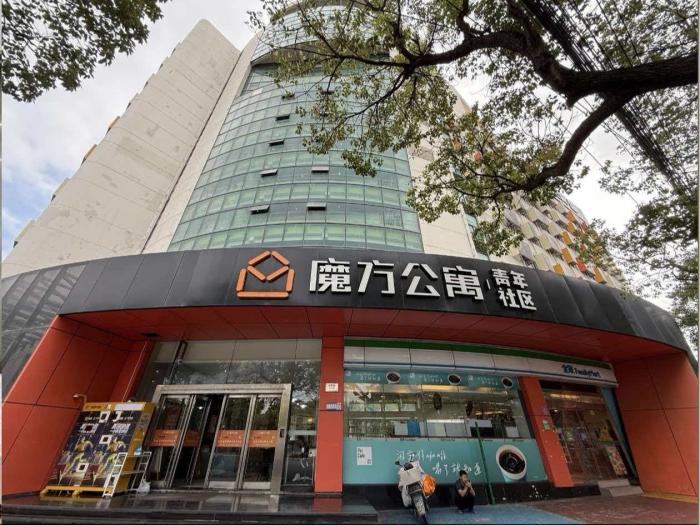
Rubik's Cube Apartment. Photo provided by interviewee
The tenant’s deposit and the owner’s rent for several months are in arrears.
In February last year, Lin Xiao signed an "Apartment Use Contract" with Shanghai Shengmu Asset Management Co., Ltd. (one of the affiliated companies of the "Magic Cube Apartment" brand). The rent is about 2,400 yuan/month, the service fee is 340 yuan/month, and a deposit of one and three is required. "I rented it because I was looking for the 'Rubik's Cube Apartment', and chain brands are more secure," she added.
According to public information, Rubik's Cube Apartment is one of the brands under Rubik's Life Service Group (hereinafter referred to as "Magic's Life"). It was established in 2009 and focuses on providing centralized long-term rental apartment services for urban white-collar workers. Based on this positioning, the tenants of this apartment are mostly young people.
The stability guarantee that Lin Xiao believed in "collapsed" in an instant on January 13.
At around 11 a.m. that day, the WeChat group of tenants in Shanghai Jinyu Road Community of Rubik’s Apartment was suddenly disbanded. It was only after get off work that most of the tenants in the community discovered that the property owner, Shanghai Qirun Industrial Co., Ltd., had posted a special announcement letter.
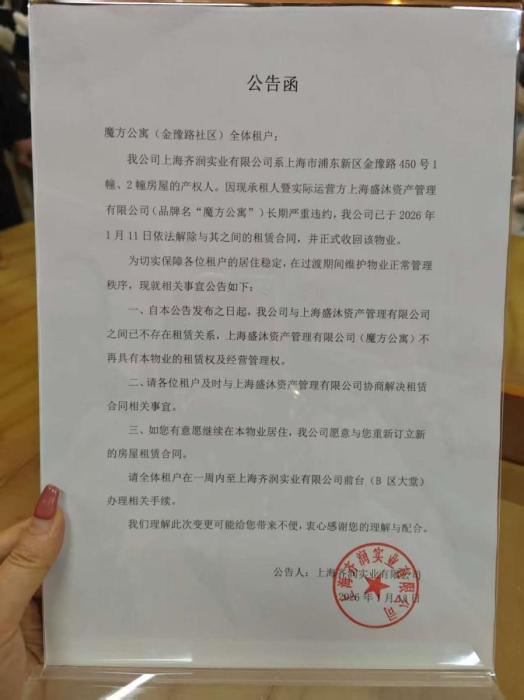
Announcement letter posted by the property owner. Photo provided by interviewee
The announcement letter stated that the lease rights and operation and management rights of Mo Cube Apartment had been taken back due to long-term serious breach of contract. If the tenant is still willing to live in the apartment, he can re-sign a lease contract with the property owner. Lin Xiao told China News Service: "On the evening of January 13, the property owner negotiated with us to sign a creditor's rights transfer statement and a house rental agreement. It was stipulated that the house deposit previously paid must be refunded by the tenant himself to Rubik's Cube Apartment."
In fact, the operating problems of the Rubik's Cube Apartment store attracted attention last year.
Wang Li (pseudonym), another tenant of Shanghai Rubik's Cube Apartment, had seen posts on the topic "The Rubik's Cube Apartment exploded" around November last year. Unexpectedly, she received a notice from the staff the next month, who said, "The Rubik's Cube is no longer operating and a sublease contract needs to be signed." In mid-December last year, Wang Li applied to Rubik's Cube Apartment for a refund of more than 7,000 yuan in deposit, accommodation service fees, water and electricity bills, etc., but as of the time of publication, she had not received it yet.
There may have been signs of the operating crisis of Rubik's Cube Apartments even earlier than last year. Shanghai Nuoyi Industrial Co., Ltd. (hereinafter referred to as "Noyi Industrial") signed a long-term lease agreement with a company affiliated with Rubik's Cube Life a few years ago.
"According to the original contract, the company and Rubik's Cube agreed to pay rent once every three months. Later, at the beginning of last year, the two parties negotiated and paid once a month." On January 22, a staff member of Nuoyi Industrial revealed to China News Service that Rubik's Cube Apartment began not to pay on time around March 2025, and directly defaulted on rent in July of that year. "The other party said at the time that there was no money, and now there are almost three months of rent, water and electricity bills, and garbage removal fees that have not been settled."
In addition to Shanghai Nuoyi Industrial, staff from many property owner companies in Hangzhou, Shenzhen and other places have confirmed to China News Service that the Rubik's Cube Apartment has defaulted on rent and has been in arrears for several months, and the company has terminated its cooperation with them. There are also media reports that the rent arrears to some owners of Rubik's Cube Apartments in Guangzhou ranges from hundreds of thousands to one million yuan.
Optimize and adjust while expanding new projects?
"The occupancy rate of the apartment I live in is okay, and there are many cars in the parking lot. I didn't expect Rubik's Cube to be in arrears with rent for a long time." Many tenants have such doubts like Lin Xiao.
In early January this year, Rubik's Cube Life responded to the media that according to the company's overall housing structure strategic optimization strategy, Rubik's Cube is optimizing some stores, and a small number of stores will be closed or the main body of operations will be adjusted. At present, the operation of Rubik's Cube is normal and orderly, and it is still actively developing new projects.
Previously, China News Service sent an email to Rubik's Cube Apartment to inquire about the specific situation, but had not received a reply as of press time. On January 27, China News Network inquired about the relevant situation of two stores of Shanghai Rubik's Cube Apartment as tenants. Staff said that some stores stopped operations due to the expiration of contracts, and some due to losses. The current store is still operating normally.
An interviewed property owner company staff member in Shenzhen mentioned a detail in the interview. He took over the operation and management of the Rubik's Cube Apartment after its closure and found that half of the rooms in the rental apartment were basically idle.
It is worth noting that Rubik’s Cube Life sought to be listed in 2022 and submitted an application to the Hong Kong Stock Exchange in September of that year.
According to previous media reports, Rubik's Life's prospectus disclosed that its revenue increased from 946 million yuan in 2019 to 1.471 billion yuan in 2021, and its net profit increased from 63.6 million yuan in 2019 to 295 million yuan in 2021. In the first half of 2022, Rubik's Cube Life's net profit attributable to shareholders was 9.248 million yuan. As of the end of 2022, Rubik's Cube Life has a total of 76,200 apartments in operation, distributed in 25 cities across the country. However, the operating data has not been updated, and the official website data is still in 2022.
According to the official website of Mofang Apartment, Mofang Life is a market-leading and rapidly growing long-term rental apartment service platform. Its apartments have two development models. One is the direct operation model, that is, the company rents the entire building or a part of the entire building, and manages and operates these rental properties; the other is the franchise management and third-party custody model, that is, the company manages and operates the franchised apartments under its own brand or the brand of the relevant client.
From the previous plan to go public to the current "strategic optimization strategy", the long-term rental apartment model has once again been questioned whether it is reliable.
This is related to changes in the rental market. Statistics from relevant agencies show that the annual average listed rent in 40 key cities across the country in 2025 will be approximately 43.3 yuan/㎡/month, a year-on-year decrease of 6.4% from last year, and the decline has narrowed.
"The rental market is divided into the landlord market and the second landlord market. Rubik's Cube Apartment is equivalent to the second landlord." Zhang Dawei, chief analyst of Centaline Real Estate, said that the second landlord and the big landlord sign a lease to lock in the rent for a certain period, and then make profits through the increase in market rental prices. He pointed out that if rental prices do not rise or rise slowly, if management costs are still relatively high, it will increase the company's operating pressure.
Lawyer: Tenants have the right to demand the return of deposit and remaining rent
In the past few days, among the tenants of Rubik's Cube Apartment in Shanghai's Jinyu Road community, some tenants said that the house was still within the lease period but they received a "rent-out" text message, and some experienced that the door password was changed. They are hesitating whether to change the house directly or renew the contract with the property owner, and how to protect their rights and interests.
Li Hongzhi, founding partner and deputy director of Beijing Zeheng Law Firm, told China News that according to the Civil Code, if the purpose of the contract cannot be realized due to a breach of contract by one party, the other party has the right to terminate the contract and terminate the performance of the unperformed portion; if the contract has been performed, it can request restoration to the original status or take other remedial measures based on the performance and the nature of the contract, and has the right to request compensation for losses.
"During the performance of the lease contract signed between Mo Cube Apartment and the tenant, if the tenant is unable to continue to use the house due to a dispute between Mo Cube Apartment and the property owner, Mo Cube Apartment's behavior constitutes a breach of contract against the tenant." Li Hongzhi said that the tenant has the right to require Mo Cube Apartment to return the deposit and the rent corresponding to the remaining lease term.
Li Hongzhi specifically mentioned that if the current dispute between Rubik's Apartment and the property owner has not been recognized or agreed by Rubik's Apartment, or confirmed by the People's Court, there is uncertainty as to whether the property owner has the right to terminate the contract and whether the court will confirm the termination of the contract between them.
For the tenant, she recommends keeping all evidence such as the lease contract, payment vouchers, and communication records. In the event that MoFang Apartment refuses to refund the deposit fee, the tenants can jointly file a lawsuit in court and apply for property preservation. If the tenant decides to sign a lease agreement with the property owner, the core terms such as lease term and rent deduction must be clarified.
For the property owner, Li Hongzhi said that during the negotiation and communication process with the Rubik's Cube Apartment party, complete evidence of the other party's breach of contract (such as the lease contract, collection records, arrears vouchers, etc.) should be collected. At the same time, the corresponding properties of Rubik's Cube Apartment will be seized, frozen and seized through litigation and property preservation to ensure that Rubik's Cube Apartment has the ability to pay the corresponding expenses.
According to Qichacha, Rubik's Cube (Shanghai) Apartment Management Co., Ltd. has been listed as a "person subject to execution for breach of trust", with the amount involved in the case exceeding 15 million yuan, and it has also been involved in multiple house rental contract disputes. (over)
Stock code: 600188 Stock abbreviation: Yankuang Energy Number: Lin 2026-012
The company's board of directors and all directors guarantee that the contents of this announcement do not contain any false records, misleading statements or major omissions, and assume legal responsibility for the authenticity, accuracy and completeness of its contents.
Yancoal Australia Limited ("Yancoal Australia", Australian Securities Exchange listing code "YAL", Hong Kong Stock Exchange Limited listing code "03668"), a holding subsidiary of Yankuang Energy Group Co., Ltd., released its 2025 annual performance report on February 25, 2026.
In 2025, Yancoal Australia achieved operating income of AU$5.949 billion, pre-tax profit of AU$623 million, and after-tax profit of AU$440 million. As of December 31, 2025, total assets were AU$12.205 billion and net assets were AU$9.033 billion (the above financial data are prepared in accordance with International Financial Reporting Standards and audited by accountants). At the same time, Yancoal Australia declared a final tax-free dividend of approximately A$161 million (A$0.122 per share) for 2025. Adding the interim tax-free dividend declared of approximately A$82 million (A$0.062 per share), the total declared tax-free dividend for 2025 was approximately A$243 million (A$0.184 per share).
If investors need to know more, please refer to the full text of the announcement published by Yancoal Australia on the website of the Australian Securities Exchange (http://www.asx.com.au) and the website of The Stock Exchange of Hong Kong Limited (http://www.hkexnews.hk).
Yankuang Energy Group Co., Ltd. Board of Directors
February 25, 2026
 There Is A Biological Crisis In The Capital Of The United States! Potomac River Sewage Leak, Political Feud Delays Repairs2026-03-03Comments(0)
 What Does USDT Mean? Introduction To Tether, A Virtual Currency Linked To The U.S. Dollar2026-02-27Comments(0)
 How Much Do You Know About The Uses, Misunderstandings And Precautions Of Performing A Dynamic Electrocardiogram?2026-02-26Comments(0)
 College Entrance Examination Application Is Coming Soon! The Admissions And Employment Office Of Capital Normal University Will Give You An Authoritative Interpretation Of The Policy2026-03-04Comments(0)
 Dadi Cipher Will Give Employees An Additional 2 Million In Annual Rewards. Netizens: Is This Company Still Hiring?2026-02-24Comments(0)