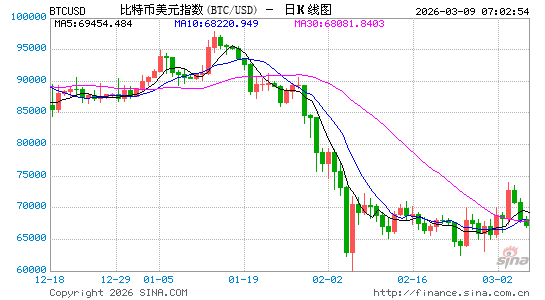
Recently, the People's Bank of China and ten other departments issued the "Notice on Further Preventing and Dealing with the Risks of Speculation in Virtual Currency Transactions" (hereinafter referred to as the "Notice"). The relevant person in charge of the People's Bank of China answered reporters' questions on relevant issues.
Q: What is the background of the "Notice"?
A: In recent years, Bitcoin and other virtual currency trading and speculation activities have become prevalent, disrupting the economic and financial order, breeding money laundering, illegal fund-raising, fraud, pyramid schemes and other illegal and criminal activities, and seriously endangering the property safety of the people. In accordance with the decisions and arrangements of the Party Central Committee and the State Council, the People's Bank of China, together with relevant departments, has issued a series of policies and measures to clarify that virtual currencies do not have the status of legal tender, prohibit financial institutions from conducting and participating in virtual currency-related businesses, clean up and ban domestic virtual currency transactions and token issuance financing platforms, continue to carry out risk warnings and financial consumer education, and achieve positive results. In order to establish a normalized working mechanism and maintain a high-pressure crackdown on virtual currency trading and speculation activities, the People's Bank of China and other departments have drafted the "Notice" based on the new risk situation and summarizing previous work experience.
Q: How does the Notice characterize virtual currencies and related business activities?
A: my country’s regulatory policy on virtual currencies is clear and consistent. The "Notice" once again emphasizes that virtual currencies that are issued by non-monetary authorities, use encryption technology, distributed accounts or similar technologies, and exist in digital form, such as Bitcoin, Ethereum, etc., including so-called stable coins such as Tether, do not have the same legal status as legal tender and cannot be circulated in the market as currency. The "Notice" clearly states that virtual currency-related businesses such as virtual currency exchange, buying and selling of virtual currency as a central counterparty, providing matching services for virtual currency transactions, token issuance and financing, and virtual currency derivatives transactions are all illegal financial activities and are strictly prohibited and resolutely banned in accordance with the law. The provision of services by overseas virtual currency exchanges to residents in my country through the Internet is also an illegal financial activity.
Q: What work measures does the "Notice" propose?
A: First, establish a normalized working mechanism for departmental coordination and central and local linkage. At the central level, ten departments including the People's Bank of China, the Central Cyberspace Administration of China, and the Ministry of Public Security have established a coordination mechanism to coordinate and promote the implementation of the work; at the local level, provincial people's governments have implemented local risk management responsibilities and cracked down on illegal financial activities related to virtual currencies in their jurisdictions in accordance with the law.
The second is to strengthen monitoring and early warning of the risks of speculation in virtual currency transactions. The People's Bank of China and the Central Cyberspace Administration of China have improved the functions of the virtual currency monitoring technology platform to improve the accuracy and efficiency of identifying and discovering virtual currency trading and speculation activities. Financial institutions and non-bank payment institutions have strengthened their monitoring of funds involved in virtual currency transactions. All departments and regions should strengthen the effective connection between online monitoring, offline monitoring, and fund monitoring, and establish information sharing and cross-verification mechanisms.
The third is to build a multi-dimensional and multi-level virtual currency transaction speculation risk prevention and disposal system. The financial management department, the Internet information department, the telecommunications department, the public security department, and the market supervision department have worked closely together to implement comprehensive policies from cutting off payment channels, disposing of relevant websites and mobile applications in accordance with the law, strengthening the registration and advertising management of relevant market entities, and cracking down on relevant illegal financial activities and other illegal and criminal activities in accordance with the law. Relevant industry associations have strengthened member management and policy publicity to prevent and deal with the risks of virtual currency transaction speculation in an all-round way.
Q: What are the follow-up work arrangements?
A: Combating the speculation of virtual currency transactions is an important decision and deployment made by the Party Central Committee and the State Council. It is an inevitable requirement for implementing the people-centered development concept and implementing the country’s overall security concept. All departments and regions will conscientiously implement the various measures proposed in the "Notice" and build a long-term working mechanism with central coordination, local implementation, departmental integration, and joint responsibility. They will always maintain a high-pressure posture, dynamically monitor and handle relevant risks in a timely manner, resolutely curb the trend of speculation in virtual currency transactions, severely crack down on illegal financial activities and illegal and criminal activities related to virtual currency, protect the safety of people's property in accordance with the law, and make every effort to maintain economic and financial order and social stability.