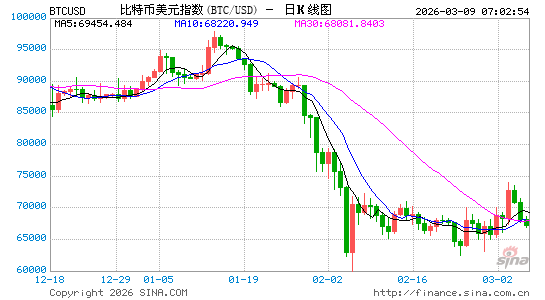
Bitcoin was born in 2009, but its price has risen from 1 cent in 2010 to more than 10,000 US dollars now, achieving a million-fold growth in eight years. The reason why Bitcoin is so popular is because of the freedom, security, and fairness endowed by blockchain technology. However, in the near future, such a virtual currency mechanism may be completely disintegrated. The safety, reliability, and rock-solid foundation that many people believe in may be destroyed by the rapid development of quantum computing.
Just last week, the Chinese Academy of Sciences' quantum computer research made a breakthrough. The Institute of Quantum Information and Quantum Science and Technology Innovation of the Chinese Academy of Sciences released an 11-qubit cloud-access superconducting quantum computing service in the direction of superconducting quantum computing. Worldwide, this is the second company after IBM to provide cloud computing services with more than 10 qubits. This progress has once again made quantum computing the focus.
The rapid development of quantum computing has exceeded everyone’s expectations. Some predict that quantum computing will bring a devastating blow to blockchain (including Bitcoin) within ten years. So, how do quantum computers pose a threat to blockchain? How much of a threat will it pose? Does the blockchain have any countermeasures?
This starts with the principles of quantum computers and blockchain.
1. Quantum computers and blockchain
1. Quantum Computer
Simply put, the operating unit of a quantum computer is a quantum bit (qubit) rather than a bit (bit) of a classical computer. In a classical computer, the value of a bit is certain, it may be 1 or 0. But in a quantum computer, the value of a qubit is uncertain before observation. This value may be 1, it may be 0, or it may be a superposition of 1 and 0, that is, equal to 0 and 1 at the same time.
How big is the difference? Take "Naruto" as an example, that is, Sasuke is a classical computer and Naruto is a quantum computer. If you want to find something, Sasuke can only run to find it one place by himself, maybe for a year. But Naruto can split into 5 shadow clones, and then the 5 shadow clones split into 5 shadow clones, and the clones clone again, and all the clones go to different places, find something in an instant, and then the clone takes it back, leaving only one Naruto, retrieve the thing, and it's done.
Professor Robert Schoelkopf of Yale University said: "When a quantum computer has 50 or 100 qubits, and these qubits can work very well and can be completely error-corrected, then you can use this quantum computer to do more complex calculations."
The changes brought about by the powerful computing power of quantum computers will be earth-shaking and may even affect national security. Therefore, Academician Pan Jianwei of the Chinese Academy of Sciences once said: "I believe that the importance of quantum technology in the 21st century can be compared with the 'Manhattan Project' of the last century."
2. Blockchain and Bitcoin Mining
At present, the most famous application of blockchain technology in the world is Bitcoin. Satoshi Nakamoto is the founder of Bitcoin. Next, we will start from the concept of Bitcoin to get a glimpse of the reality of blockchain.
Now, we can imagine the blockchain as a ledger. Each block contains a part of this ledger. The complete information of this part of the ledger is stored in all nodes of this block. This is the decentralization of blockchain technology. Each block has only a part of the ledger, but this part will record the information of the previous block, and one block is connected to another, forming a blockchain.
The advantage of blockchain is that it forms a trust mechanism. For example, if you deposit 100 yuan in the bank, if a hacker hacks into the bank, takes away your money, and clears the data, you will not have any information to prove that you have 100 yuan in assets in the bank. But if it is replaced by a blockchain, it means that every node in the block where the bank is located has a complete ledger record. In other words, your neighbor, the aunt on the street next door, and even every resident in this area have ledgers that can prove that you have 100 yuan of assets in the bank.
Compared with the centralized mechanism in the traditional financial field, the decentralization of blockchain makes it more reliable and firm. Even if some node information is lost, the system can still continue to operate normally. Therefore, blockchain is considered a very safe and reliable technology.
So what is Bitcoin mining?
Based on the blockchain, Satoshi Nakamoto proposed the concept of Bitcoin in 2009. He stipulated that in the Bitcoin network, 50 Bitcoins will be generated every ten minutes. When the total amount reaches 10.5 million (half of 21 million), 25 Bitcoins will be generated every 10 minutes. When the total amount reaches 15.75 million, 12.5 Bitcoins will be generated every 10 minutes. When the total amount reaches 21 million, Bitcoin will stop growing. In other words, the total number of Bitcoins has been fixed at 21 million from the beginning.
Bitcoin "mining" is how new Bitcoins are generated. People who "mine" are called "miners." Miners use computers to solve mathematical problems in the Bitcoin network. The first miner to solve the problem publishes the answer, records it in the ledger, and records it in all nodes simultaneously. This is called successful mining and obtains Bitcoins.
The mechanism of the blockchain was very safe and reliable before the development of the concept of quantum computing. At least for so many years, Bitcoin has not been hacked by hackers. However, in recent years, quantum computing has developed rapidly, exceeding the speed previously expected. Therefore, some industry insiders predict that within ten years, the security and reliability of blockchain will be greatly threatened by quantum computers.
2. How does quantum computing pose a threat to the blockchain?
To understand the threat of quantum computing to the blockchain, we must first start with the security protocol in the Bitcoin system. The Bitcoin protocol involves two types of cryptography, namely the hash function (hash function) used in the mining process and the asymmetric cryptography used to provide digital signatures on the blockchain.
Miners use their computing power to calculate a random number for each block using the SHA-256 hash function. The result of this process is very easy to verify, but difficult to find. Asymmetric cryptography is used to authorize transactions on the Bitcoin blockchain. Each user on the entire chain will be assigned a public key and a private key. This is the public key cryptography system (Public Key). Public key cryptography uses a pair of keys to encrypt information: a public key that can be shared widely and a private key that is known only to the owner of the key. Anyone can encrypt a message using the intended recipient's public key, but only the recipient can decrypt the message using his private key.
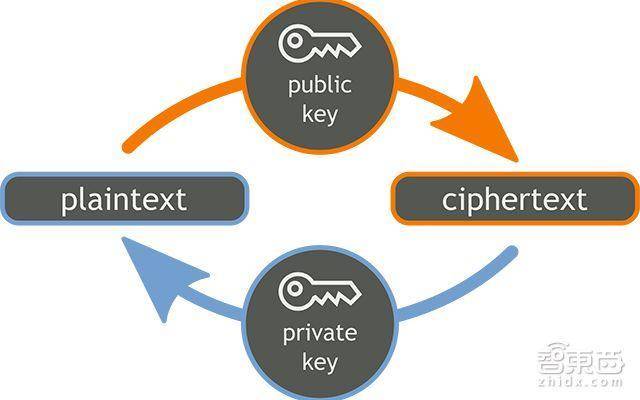
The core of such an asymmetric cryptographic algorithm is to use the Elliptic Curve Digital Signature Algorithm (ECDSA) to generate keys. Given a private key, it is easy to deduce the corresponding public key, but in turn it is difficult to calculate. This is why Bitcoin is safe now.
Quantum computers may pose a huge threat to these two lines of security. In the future, quantum computers can quickly crack the hash function and monopolize the entire blockchain. At the same time, there are also predictions that in the near future (perhaps 2027) the quantum computer's Shor's algorithm can crack the key in ten minutes (600 seconds).
In the world of Bitcoin, the success rate of mining with a classic computer has a certain relationship with the computing power, but a large computing power does not mean that you will be able to mine (as long as your computing power does not exceed 50% of the entire network). Mining is also related to luck to a certain extent. Take walking a maze as an example. If a person walks fast and tries one step at a time, he will definitely reach the end of the maze as quickly as possible. But what if a person walks slowly but finds the way to the end of the maze in just one try? Therefore, people who walk fast may not necessarily win against people who walk slowly. In the same way, miners with greater computing power may not necessarily dig mines before miners with small computing power.
As mentioned above, mining is actually solving mathematical problems and finding random numbers encrypted by hash functions. However, it is possible that two different groups of miners will discover two random numbers at the same time and announce different blocks. In this case, Bitcoin’s rule is to prioritize the block that processes more, and the other block will be invalidated. For example, this is similar to 51 people in a community saying that you deposited 100 yuan in the bank, and 49 people saying that you deposited 50 yuan. In this case, the minority obeys the majority, and the bank thinks that your deposit of 100 yuan is true, and that you deposited 50 yuan is false.
Let us further explain the concept of "51% attack" from this rule. In the blockchain, if a group of miners has 51% of the computing power of the entire network, then it can monopolize the entire blockchain. Because he will always process blocks faster than the other group of miners with 49% of the computing power, he will receive all the Bitcoins generated thereafter.
Regarding the issue that quantum computers will threaten mining, Divesh Aggarwal and researchers from the National University of Singapore (NUS) conducted in-depth research and published a paper on this in October 2017. They believe that at least in the next ten years, ASIC mining will be faster than quantum computers, but after ten years, the mining speed of quantum computers will increase rapidly. Secondly, in the face of quantum computers, the asymmetric cryptography algorithm used in the blockchain, that is, the public key cryptography system, will be under greater threat.
Researchers from the National University of Singapore pointed out that by using quantum computers, the process of using public keys to infer private keys can be easily reversed, and everyone's private key will be easily inferred by the quantum computer.
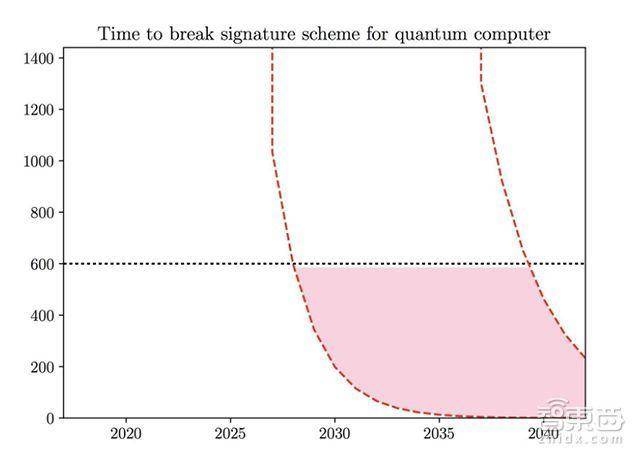
The estimated time required for a quantum computer to crack an encrypted signature is in seconds. It is expected to only take ten minutes/600 seconds in 2027.
Similarly, we can compare this decryption process to walking a maze. What a classical computer can do is go in one direction until it reaches a dead end, and then turn around and choose another path. However, a quantum computer gives you a God's perspective, overlooking the entire maze, and it is clear which way to go.
However, a quantum computer needs to reach a certain level of qubits to achieve such a level. Foreign media Motherboard believes that a 4,000-qubit quantum computer may be able to disrupt the blockchain. In other words, whichever person or team first makes and applies such a quantum computer can solve and verify every transaction. All cryptocurrencies that will be produced in the future and have not yet been circulated will be monopolized by it, and the trust system of cryptocurrencies will be destroyed.
3. The development of quantum computers is still in its infancy.
Although quantum computers are developing rapidly and may pose a huge threat to blockchain in the future, quantum computers are still in a very early "toy computer" stage. At present, the world's giants can only produce about 10 quantum computers with high-fidelity quantum qubits. The 11-qubit superconducting quantum computing service released by the Chinese Academy of Sciences last week is the world's second cloud computing service with more than 10 qubits. Quantum computing services like this cannot yet be used to solve actual computing problems, but developers can already use such cloud services to learn programming knowledge related to quantum computers.
It seems that 4000 qubits are really far away from us? But it may not be as far away as we think, because based on the fact that Microsoft, Google, and IBM have made a series of breakthroughs in the field of quantum computing in recent years, Fortune magazine predicts that the first practical quantum computer will be built within 10 years.
Many companies have predicted how long it will take within 10 years. For example, Microsoft predicted that a practical quantum computer would be built in 2025. Google also announced in 2017 that it would make a commercialized practical quantum computer within five years (that is, around 2022).
Conclusion: There is an impact, but there are also countermeasures
The rapid development of quantum computers is already a major trend and will one day threaten the blockchain, but it seems that many experts in the blockchain have not yet become vigilant. According to Fortune magazine, at the Crypto 2017 conference in November 2017, a conference for top blockchain cryptographers, “no one in the world was worried” about quantum computing risks. One expert said it would be a "very expensive operation" and would likely require "government-level" spending.
Another expert, who completely laughed at the idea, waved his hand and said that by the time practical quantum computers come out, public key cryptography will have developed to the point where there is no need to worry about quantum computers, so this issue will not matter at all.
But these experts all share the same view, which is that the emergence of quantum computing will jeopardize the security of all existing encryption methods, including RSA tokens. Additionally, quantum computers will impact the security of finance and banking, not just blockchain.
At the same time, there are also relevant agencies that attach great importance to this. For example, in 2015, the US National Security Agency announced that it was studying quantum cryptography systems, that is, encryption systems that can withstand quantum computing. In academia, there are also cryptography experts who are studying quantum cryptography, and there are already blockchain projects implementing quantum cryptography.
At present, no one may be able to accurately predict the specific time when practical quantum computers will be born, but if we look at it more positively, the birth of commercial quantum computers may be faster than we expect, because today's technological development is accelerated rather than developing at a uniform speed. Maybe in 2018, quantum computers were still in a very early stage, and the development progress of practical quantum computers was only 5%. But maybe in 2019, the progress will reach 10%, and in 2020, the progress may reach 30%. All of this is possible.
Technology is always developing. Emerging technologies such as blockchain and cryptocurrency may still be in their infancy. There is still a long way to go before reaching technological maturity. Developers need to be careful about a series of obstacles that will appear in the process, including quantum computing.