The number of daily downloads in the United States exceeds Threads, WhatsApp, Facebook and Telegram, but the founders are not happy.
Going overseas is a process that tests the comprehensive capabilities of the team.
Going overseas in the United States requires a team with at least one skill in product, operation, growth and other dimensions.
Getting results in overseas studies in the United States is a combination of the right time, place, and people.
Being able to advance into the top 5 of the US App Store social rankings and the top 20 of the total download list is a matter of pride for any start-up company, but Jingna Zhang, founder of the non-AI picture community Cara, is happy and pained.
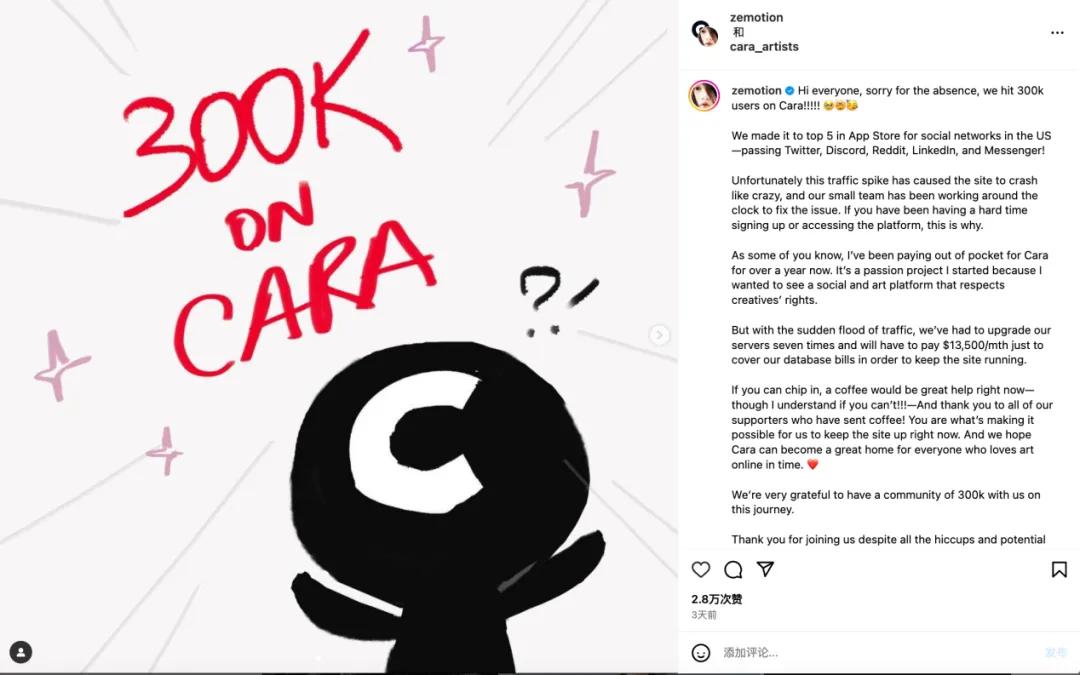
Jingna Zhang expressed her joy at gaining 300,000 users on Instagram a few days ago, but at the same time expressed her worries about paying $13,500 per month. At the same time, she also posted the cloud computing bill email she received on her platform, with the current amount to be paid being US$96,000.
Not only that, in just 10 days from June 3 to June 13, Cara's user base increased from 300,000 to 900,000 without advertising.
According to Diandian data, Cara, a photo community launched in October 2023, has received 570,000 downloads in the App Store alone in the past 30 days. The top five download markets are the United States, the United Kingdom, Canada, Germany and France.
In fact, from the perspective of product design alone, Cara and Twitter are at least "direct relatives", which is why there is such a similarity.
In addition, from the perspective of the positioning of the picture community, there are integrated social media such as Instagram and Pinterest in the larger overseas countries, and picture platforms such as Behance and DeviantArt in the smaller ones. So why does Cara enter the public eye?
The high consistency between the founder and the product makes Cara the only one in the world.
This starts with the resistance of some creators to AI since the launch of ChatGPT and Midjourney.
Due to work reasons, we are fortunate to have contact with creators and platforms, and understand everyone's attitude towards AI content from different perspectives:
(1) Some creators believe that AI is a good auxiliary tool that can complete drafts of ideas at a lower cost, or complete some preliminary work to improve work efficiency;
(2) Another group of creators believe that most of the content generated by AI is trained based on existing content. In particular, the creative pictures generated by AI are basically "dismemberment and reorganization" of the works of multiple artists/creators. This is unacceptable behavior that disrespects creativity and copyright;
(3) Some platform parties believe that: We allow AI and non-AI content to coexist. Human creativity and thinking will always have irreplaceable brilliance, but AI content can indeed be a good content supplement, and can help more people who have ideas for creativity but lack the ability to implement them to realize what they want, and will face content with an attitude of development, tolerance, review, and coexistence;
(4) Another part of the platform believes that protecting the creative passion and copyright of creators is protecting the entire content ecosystem. When AI content floods the entire social media, it is when human creativity is exhausted.
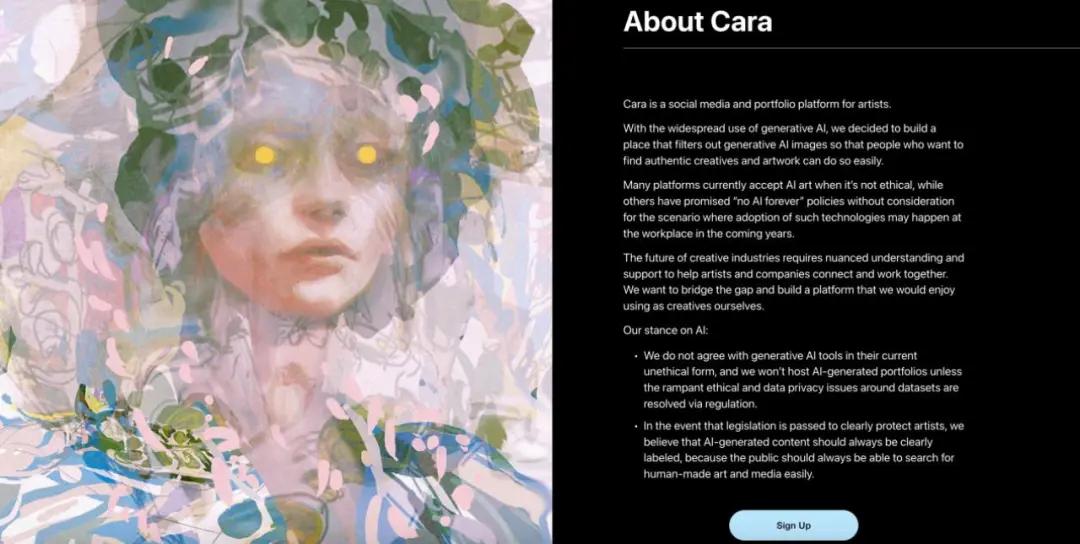
Obviously as a conservative, the non-AI picture community Cara has found a user group that holds the same attitude as itself. The main reasons for being able to quickly verify needs and gain user approval are as follows:
1. Jingna Zhang, the founder of Cara, is an artistic and creative practitioner herself and a well-known photographer. Jingna Zhang was born in Beijing and grew up in Singapore. Her photography works have been published in multiple national editions of fashion magazines such as "VOGUE", "Harper's Bazaar", and "ELLE". She has collaborated with many models, actors, and celebrities around the world, and has won many international awards.
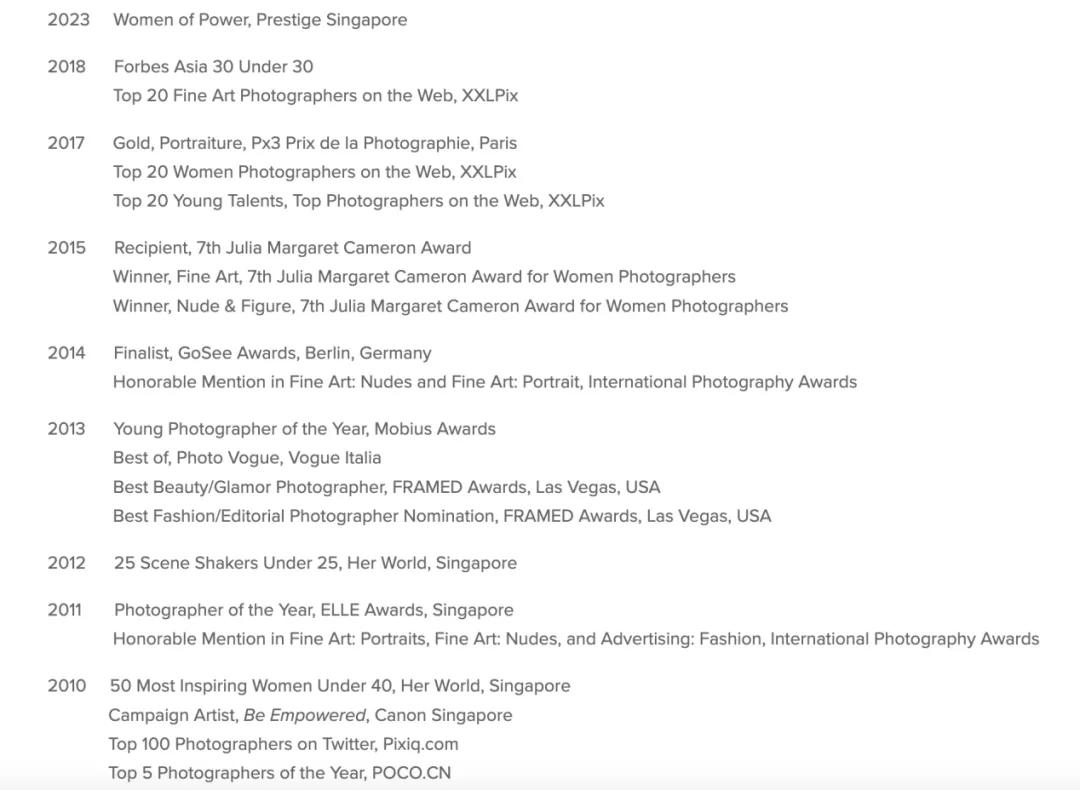
Therefore, from this perspective, Jingna Zhang can fully understand and represent the needs of Cara’s main user groups. In other words, Jingna Zhang’s past experience makes creators and users believe that their interests are consistent.
2. Jingna Zhang has participated in many works rights protections. She first filed a lawsuit against plagiarized works in 2022 and won the appeal in May 2024. Later, it participated in a class action lawsuit against Stable Diffusion, Google and other AI mapping tools, which reflected its determination to protect copyright.
3. Another trigger is that Mark Zuckerberg made it clear that he will use pictures posted by users on Instagram and Facebook to train models without the user’s consent.
But in fact, the reason why many creators and artists are willing to publish their works on Meta's social media platforms is obviously to increase their visibility and find potential customers.
Obviously, Meta's AI policy will affect the development of creators to some extent, so the confrontation has gradually heated up in the past period of time.
This time, the growth of Cara and the user's resistance to Meta AI's mapping are not just pure community resonance, but also a confrontation of interests.
At present, many artists, graphic designers, painters, illustrators, 3D modelers, creators and users who support non-AI content have joined Cara. From the author's observation, the quality of the pictures uploaded by users is indeed relatively high and creative.
Cara product screenshots
And judging from the likes and forwarding of user works, the 900,000 user data announced by the founder is highly authentic. The number of likes on the homepage of the works is more than 300, and some works have even been liked nearly 10,000 times. High-quality works and rich creativity are important labels given to Cara by users.
In addition, as a social media platform, Cara also demonstrates the unique inclusiveness of early products. Users can follow the homepage and timeline to view the content posted by the other party, and can also click to view the content the other party likes and the other party's personal introduction details.
Many developers have attached their official website, personal blog, or links to Instagram, X, Discord, etc. in their introductions and personal introductions. Users can also directly send private messages to the creators for more detailed communication.
In addition, Cara has also integrated recruitment functions into its products. Currently, 199 relevant positions are being recruited through the Cara platform. Judging from the details, the recruitment positions are highly overlapped with the Cara population.
The anti-AI community may not be as strict as imagined
Despite this, Cara only received a score of 4.1 on the App Store. This score is indeed not high among social products, especially emerging social products that do not have monetization methods. After sorting out the reviews, we found that user dissatisfaction is mainly concentrated in the following aspects:
.The product stability is not strong, and multiple users reported that it often crashes to the login page. Speculation may be related to the sudden influx of large numbers of users exceeding the server capacity.
.NSFW review is not perfect, and many users have reported that Cara's NSFW is suspected of being overcorrected. The uploaded tattoo patterns and safety works are occasionally judged to be non-compliant content and cannot be uploaded.
.AI filtering capability is not strong enough. Some users reported that some obvious AI-style content can still be found in the platform, which is not in line with the positioning.
.It is not convenient enough to upload the portfolio, and it cannot be more convenient to classify different series of works.
But in fact, more users are tolerant of the various problems currently occurring in Cara. These users believe that as an emerging social media platform, it is normal for Cara to have various problems. The most important thing is that its anti-AI image positioning is the most rare.
In fact, in addition to Cara, which is obviously opposed, various social media platforms have also begun to strengthen the monitoring of AI content. Facebook, Instagram, and LinkedIn all require users to clearly mark when uploading or publishing related content generated by AI. They hope that while using AI to open up imagination, the boundaries between virtual and reality will not be blurred.
However, due to filtering technology, it is still based more on user consciousness. This is why there are still AI images slipping through the clear-cut anti-AI Cara platform. So how does Cara protect the platform from AI "infringement"?
First, Cara will label all uploaded works as "NoAI" to resist data capture by AI crawlers. Cara describes this form as an "uninvited" dialogue with AI.
Second, Cara encourages users to use Glaze, developed by the SAND Laboratory at the University of Chicago, to protect works by adding invisible pixels to them.
Third, by cooperating with the third-party platform Hive, we monitor and restrict users from uploading AI-generated content. According to the official website information, Hive uses image recognition algorithms, multi-mode detection, model training and real-time detection to determine whether an image is generated by AI.
In layman's terms, when a user uploads a photo to Cara, Hive will analyze the texture, pixel distribution and pattern of the image. The Hive model will use the captured information to determine whether the image was generated by mainstream models such as DALL-E, Midjourney, Stable Diffusion, etc., and compare it with known AI images to finally give a confidence score. If it exceeds a certain threshold, it will be judged as AI-generated and will not be allowed to be published to the platform.
If users have objections to the review results, they can also send an email to Cara officials to apply for reconsideration.
However, there is currently no unified opinion on Hive's detection capabilities in the market. Some users even left a message in the Reddit community that "Hive is Cara's biggest weakness." Some users pointed out that "all the ones on the market are not good. Experienced people can escape detection immediately, but Hive may be 1% better than its competitors."
In any case, the highly unified anti-AI persona of founders Jingna Zhang and Cara is indeed very distinctive in the current market.
Although global capital is currently slowing down its investment in AI projects, and no truly explosive AI applications have emerged for the time being, there are still a large number of practitioners who firmly believe that the future of AI applications is not too far away. The anti-AI platform Cara’s rise to the top of the list also reflects some users’ attitudes and concerns about AI to some extent.
The author tried to search with the keyword "anti-AI" on Chrome and ChatGPT, and found that although there are many anti-AI posts, updates, and discussions on the market, anti-AI social media applications are indeed unique.
Regardless of AI access or not, Cara's appearance once again proves the importance of "finding product differences". Even in the picture community track surrounded by tigers and wolves, there are still new players who can come out of the circle. I know it is difficult, but many times it may be more important to re-enter the track from a different angle than to work harder.
Cara’s future will be accompanied by money burning, manpower shortage, and difficulty in monetization
Although initial results have been achieved, now is not the time to celebrate.
Cara now has several thorny problems that need to be solved:
(1) As more and more users register and use, the cost of Cara’s cloud services and other third-party services will become higher and higher;
(2) As of now, except for voluntary rewards from users who “buy a cup of coffee”, Cara has not set up a monetization method. If it wants to continue operating, it must either make money or raise money;
(3) Cara has only had four or five full-time employees in the past year, and until recently some volunteers and part-time employees have appeared, but it is not sure who will stay. The current official website shows that Cara is recruiting React engineers, React Native engineers, graphic designers, writers, moderators and QA testers.
Looking for people and money are urgent. In fact, it’s easy to find people. In the current talent market, it is theoretically easy to find people with experience working on X, Instagram and other platforms, but the premise is that the product needs to have stable development, and this comes back to “money”.
At present, the main monetization methods of picture social platforms include advertising, subscriptions, rewards, and delivery of goods (live broadcast, shop), etc.
Some users pointed out in Jingna Zhang’s Cara dynamic comments that “advertising can be added to alleviate economic pressure. I support Cara very much and hope you can continue to operate it.” However, more users immediately retorted, “If advertising is added, Cara will sooner or later become the same platform as Instagram, so where will we escape then?”
In fact, to a certain extent, Cara is facing the same predicament as BeReal before it. BeReal has tens of millions of users, good user retention, and high user praise. However, it can neither raise money nor make money. There were several reports that it may cease operations. Until June 11, Voodoo spent 500 million euros to acquire BeReal, and the deal was reached through deferred payment.
You must know that BeReal has 40 million MAU. Although the later data is not stable or even declining, you must know that its number of days on the list in 2022 will even exceed TikTok. On the other hand, although Cara is on the rise, it has only reached 1 million registered users.
With the same picture community, the same anti-Instagram (AI), and the same being placed here by users, Cara’s path to monetization may not be simple.
I don’t know if Cara will try to start an art trading business or engage in business cooperation (such as finding a designer) in the future, but frankly speaking, the business of professional photo entrepreneurs that Cara targets is not easy to do.
But no matter what, the fact that another Chinese woman’s entrepreneurial product has made it to the Top 20 in the U.S. download list is another incentive for overseas entrepreneurs.
Jingna Zhang once wrote in her personal blog after winning the lawsuit, "In the past two years, I have been harassed because of my gender, race, and identity as a photographer. My address and personal information have been doxxed. I am exhausted but unwilling to give up because I believe justice will come. The final result also proves that copyright belongs to creators like us who create with heart."
Well, I think Cara’s departure from the industry is also a candy given by God to Jingna Zhang. I also hope that every practitioner who goes overseas will have the opportunity to get his or her own candy.