Amid the unpredictable situation in the Middle East, French President Mark broke France's decades-long taboo on nuclear issues, promising to increase the number of nuclear warheads and clarifying France's role in European security.
According to CCTV News, on March 2, local time, French President Macron announced that he had ordered an increase in the number of nuclear warheads possessed by France. Macron said, "I have asked for an increase in the number of nuclear warheads." Macron emphasized that the specific number will no longer be announced to the outside world.
Macron said that in the context of the current increasingly tense international security situation and continued global instability, it is necessary to increase the size of France's nuclear arsenal.
It is worth noting that France and Germany also announced plans to deepen cooperation in the field of nuclear deterrence on the 2nd. According to a joint statement, the two countries will establish a high-level steering group to coordinate strategies. Germany will participate in French nuclear drills and inspections of strategic installations, while the two countries also plan to strengthen conventional and missile defense capabilities with other European partners.
"In response to the evolving threat landscape, France and Germany have agreed to cooperate more closely in the field of deterrence," the statement said.
Zhao Yongsheng, a researcher at the Global Value Chain Research Institute of the University of International Business and Economics and director of the French Economic Research Center who is conducting research in France, told China Business News that the war in the Middle East spilled over, causing the French military base in the United Arab Emirates to be raided. According to what he learned after talking to French policymakers, the French side was quite touched by this incident.
Zhao Yongsheng explained that the above-mentioned decision was announced in this context. Macron’s decision is one of the most significant changes in France’s nuclear strategy since the end of the Cold War. It can be seen from this move that “countries with nuclear weapons like France are increasingly worried about the current international situation. Moreover, unlike Venezuela and other South American countries, European countries in the Middle East have intricate and vital interests.”
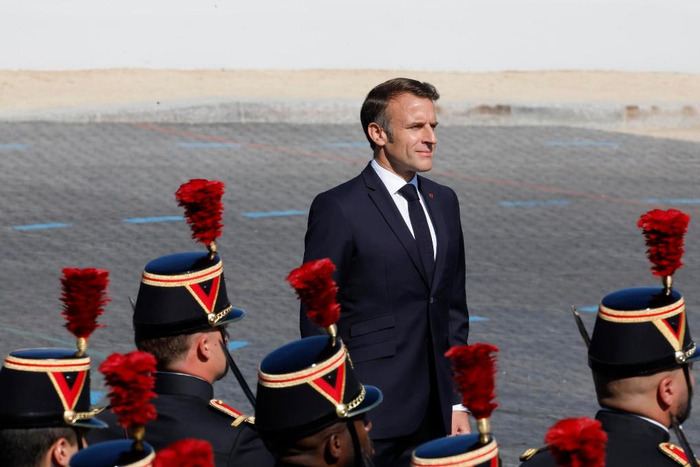
France increases nuclear weapons
On the 2nd, Macron elaborated on France’s new nuclear deterrence strategy at the French Navy nuclear submarine base near Crozon on the Brittany Peninsula in western France. The base hosts four French nuclear submarines.
“It is imperative to increase our nuclear arsenal,” Macron said. When delivering his speech, Macron stood on a high platform in front of the black "Téméraire" ballistic missile submarine.
"One of our submarines, like the one behind me, can carry as much strike power as all the bombs dropped on Europe during World War II," he said.
In his speech, Macron also outlined plans for greater cooperation with European countries, naming Germany, Poland, Greece, the Netherlands, Belgium, Denmark and Sweden, which would include joint nuclear exercises and the eventual possible temporary deployment of French nuclear fighter jets to allies.
"I believe I can say that our partners are ready," Macron stressed.
Currently, France and the United Kingdom are the only two nuclear powers in Europe. In short, France's nuclear arsenal spans both air and sea, and it always has at least one submarine patrolling the seas. But unlike the United Kingdom, France is not a member of the NATO nuclear planning group, although successive French presidents have emphasized that France's major national interests have European significance.
An aide close to Macron said Monday's speech was the culmination of months of consultations with European allies.
As early as 2020, Macron proposed a strategic nuclear dialogue with European allies for the first time, but the proposal did not initially receive much support.
Zhao Yongsheng told reporters that the current international situation and changes in the United States' attitude towards NATO have led EU members in NATO countries to re-examine their security strategies and begin to accept Macron's ideas more openly.
Macron also emphasized this time that France has no intention to replace U.S. nuclear weapons and NATO as the ultimate guarantee of the security of the European continent.
"From the very beginning, it was clear to us and to our partners that this effort would complement NATO's nuclear mission," Macron stressed.
In order to appease the domestic public, he insisted that the final decision on whether to launch nuclear weapons will be firmly in the hands of the French president, who will continue to define France's so-called "core interests" alone.
Héloïse Fayet, an expert on nuclear deterrence at the French Institute of International Relations, said that Macron's speech "achieved success in a situation where France's domestic political environment was restricted and opposition was high. The speech struck a good balance between emphasizing French sovereignty and its contribution to European security, and proposed a new concept of forward deterrence, which seems to have been understood by allies."
According to reports, France currently has about 300 nuclear warheads, which is about one-tenth the size of the nuclear arsenals of the United States and Russia. Macron said France would not reveal how many nuclear weapons it had or how many more it planned to add, adding only that the increase was to maintain the "credibility" of its arsenal.
"This is not an arms race… What is crucial is that our opponents, or the alliance of opponents, do not dare to act even remotely and dare to attack France, and they will suffer irreparable losses," Macron said.
CCTV News reported that analysts believe that this statement shows that France is strengthening its nuclear deterrence capabilities in the face of geopolitical uncertainty and security challenges, and at the same time choosing to adopt a more confidential attitude in terms of the scale of its nuclear forces.
Zhao Yongsheng told reporters that, first of all, this statement is a response to the recent raid on the French military base in the United Arab Emirates in the Middle East situation. Secondly, both Germany and France have been revitalizing their military industries recently, but German military industry companies are more eye-catching, and Germany's budget legislation is also relatively open. France is relatively low-key in comparison, but related work is also progressing steadily and its budget investment is large.
France and Germany announce the establishment of a joint "nuclear steering group"
Currently, with only 14 months left in Macron's term, he is accelerating the pace, emphasizing that the joint nuclear program should be launched this year, including hosting European allies in "strategic locations" and holding joint exercises.
As mentioned earlier, France and Germany announced the establishment of a joint "nuclear steering group" to discuss nuclear doctrine and "the appropriate combination of conventional, missile defense and French nuclear capabilities" in the strategic cooperation between the two countries.
"So, today, a new phase of French deterrence may be taking shape. We are starting what I call 'forward deterrence.'" Macron said, which means integrating more and more European countries into France's deterrence system – starting with participation in nuclear exercises.
"This will ultimately provide the conditions for deploying parts of our strategic air force to allies, depending on the situation," Macron added, referring to squadrons of nuclear-capable Rafale fighter jets.
A senior French official said after Macron's speech that Macron's pledges were designed to ensure that the next French president could not easily walk back them. He added that Macron's speech was actually "more consensus-based" than it appeared on the surface.
The official stressed that no president would dare reverse a decision to increase nuclear warheads.
German Chancellor Mertz said Paris and Berlin wanted to take "concrete measures, including Germany's regular participation in France's nuclear exercises." Germany and Belgium are members of the U.S. nuclear-sharing agreement under the NATO framework, and their fighter aircraft are equipped with equipment to carry U.S. nuclear warheads. Swedish Prime Minister Kristersson said in an online article that Macron's initiative "helps to supplement collective capabilities." “Since World War II, the importance of strengthening Europe’s collective defense capabilities has never been more prominent,” he wrote.
Polish Prime Minister Tusk said: "Poland is consulting with France and some of its closest European allies on an advanced nuclear deterrent plan."
Zhao Yongsheng told reporters that in recent years, we can see that France has loosened its concept. From the previous "only France possesses nuclear weapons" to the current trend of continued integration of the European Union, it has begun to think about cooperation with Germany and other European countries in nuclear technology. "In addition to technology, financial investment is also a practical issue. The development of nuclear weapons costs a lot. France also has practical considerations in this regard when cooperating with EU countries."