On March 4, the tense situation in the Middle East continued to dominate the domestic futures market.
Crude oil, fuel oil, and container shipping index (European line) futures once again hit the daily limit, leaving the daily limit unilateral market for the third consecutive day. After the market opened, the Shanghai Futures Exchange (hereinafter referred to as the Shanghai Futures Exchange) and the Shanghai International Energy Trading Center (hereinafter referred to as the Shanghai Futures Energy) announced a series of new measures to adjust the price limits and trading margin ratios of contracts related to relevant products.
Rare rising triple board
As of Wednesday afternoon's close, the EC2604 contract, the main container shipping index (European line) futures, closed at 1909.5 points, sealing the daily limit with an increase of 20%, leading the rise in the domestic futures market.
In the energy and chemical sector, crude oil futures and fuel oil futures also hit daily limits. The main crude oil SC2604 contract closed at 641.1 yuan/barrel, an increase of 13.99%; the main fuel oil FU2605 contract closed at 3888 yuan/ton, an increase of 13.98%. The above three major varieties have all experienced a rare three consecutive rises.
In addition, the increase in low-sulfur fuel oil is also considerable, with the main LU2605 contract rising by 10.90%, but failing to reach the daily limit.

Speaking of Container Shipping Index (European Line) futures, Lei Yue, head of the shipping group of Haitong Futures Research Institute, pointed out that EC continued to maintain strong bullish sentiment today, with the main contract 2604 fluctuating at a high level, hitting the daily limit of 1909.5 points many times during the session and closing back to that position in late trading; in contrast, other contracts showed signs of a weak upward trend, especially the far-end 09-12, which fell. As the bullish atmosphere in the external market weakens and switches to the main line of recession trading, EC has gradually returned from the expected side to the realistic side of trading.
Lei Yue analyzed that the European route is currently still circumventing the Cape of Good Hope as the only option, and some routes that were previously planned to return to the Suez Canal have been shelved. The Strait of Hormuz is not an important passage for European routes, and its geographical location is very different. The blockage in the passage of the strait is more due to the emotional transmission from the increase in the Middle East route. What is being tested is whether shipping companies can consistently raise prices for other routes amid the chaos in the regional supply chain. But at the same time, the deeper contradiction of the European line comes from the rigid off-season period of March. Factories are still in the process of resuming work and production, and the flexibility of booking recovery is limited.
Judging from the trading logic on the market, it will be switched to reality verification in the future. After the price center rises to around US$2,300 for large containers, the changes in actual loading rates of shipping companies are worthy of attention, especially Maersk and PA Alliance, which have high spot exposure. In addition, although the potential spillover of capacity on the Middle East route will not directly affect the European route, it may shake the enthusiasm and consistency of shipping companies to raise prices during the off-season. There is still great uncertainty in the short-term geopolitical situation, external financial assets fluctuate greatly, and EC's own high volatility may continue. Investors are advised to trade cautiously and pay attention to corresponding risk management.
Relatively speaking, the problem of crude oil is more complicated, and it faces a greater risk of supply interruption. Fan Chunhua, chief analyst of Guosen Futures Energy, said that in the past three trading days, the increase in domestic crude oil futures prices was greater than the increase in international crude oil futures prices. On the one hand, because about 84% of the crude oil transported through the Strait of Hormuz is shipped to Asia, it has a greater impact on oil prices in Asia; on the other hand, regarding the duration of the US-Iran conflict, foreign countries may believe that the conflict will end quickly, and that it will end with the United States winning and achieving its goals. Domestically, after seeing the intensity and sustained intensity of Iran's organized counterattack, they believe that the conflict may last for a longer period of time.
It is worth noting that major international banks have recently raised their oil price expectations. Both JPMorgan Chase and Goldman Sachs believe that if the conflict lasts for more than four weeks, international oil prices may rise to around US$100 per barrel. Citibank believes that international oil prices may reach US$130-150/barrel.
Jin Xiao, chief analyst of energy and carbon neutrality at Orient Securities Futures, pointed out that due to the recent sudden changes in the Middle East, the prices of energy products have increased across the board, including but not limited to oil products and natural gas. The rise in energy product prices is mainly driven by two factors. First, Iran blocks the Strait of Hormuz, which interrupts the normal logistics transportation of goods. Second, Iran indiscriminately attacks the energy production infrastructure of neighboring countries, forcing energy production to be interrupted. Without the above two points, even if the US-Iraq war continues, the impact on energy product prices is expected to be relatively limited. The precise timing of the improvement in the situation is difficult to judge, but it is not expected to last long.
In terms of fuel oil fundamentals, my country is basically self-sufficient in terms of low sulfur and has low dependence on foreign countries. In terms of high sulfur, although high sulfur in the Middle East is a relatively important part of global high sulfur supply, short-term interruptions will not have a serious impact on the market, and the overall supply chain is more resilient than we imagined. The current market is in an environment of extreme volatility, and the difficulty of trading has increased exponentially. Once the geopolitical situation shows signs of easing, prices will fall sharply.
The exchange continues to provide guarantees and expand the board
After the market closed on March 4, the Shanghai Futures Exchange and Shanghai Futures Energy announced a series of new measures to adjust the price limits and trading margin ratios of contracts related to crude oil, fuel oil, and container shipping index (European lines). Among them, crude oil, fuel oil and low-sulfur fuel oil have increased their margins and expanded their stocks for the second consecutive day following the adjustment the day before.
According to the last energy notice, starting from the closing settlement on March 4, 2026 (Wednesday), crude oil futures sc2607, sc2608, sc2609, sc2610, sc2611, sc2612, sc2701, sc2702, sc2703, s The price limit for c2706, sc2709, sc2712, sc2803, sc2806, sc2809, sc2812, and sc2903 contracts is 12%, the margin ratio for hedging positions is 13%, and the margin ratio for general position transactions is 14%. The price limit for low-sulfur fuel oil futures lu2604, lu2606, lu2608, lu2609, lu2610, lu2611, lu2612, lu2701, lu2702, and lu2703 contracts is 12%, the margin ratio for hedging transactions is 13%, and the margin ratio for general position transactions is 14%. The price limit of the container shipping index (European line) futures ec2604, ec2605, ec2606, ec2607, ec2608, ec2609, and ec2612 contracts is 20%, the margin ratio for arbitrage trading is 22%, and the margin ratio for general position trading is 22%. The price limit of the Container Shipping Index (European Line) futures ec2610 contract is 18%, the margin ratio for hedging positions is 20%, and the margin ratio for general position transactions is 20%.
The Shanghai Futures Exchange also issued a notice stating that the fuel oil futures fu2604 contract has experienced a daily limit unilateral market in the same direction for three consecutive trading days. According to Articles 15 and 16 of the "Shanghai Futures Exchange Risk Control Management Measures", the exchange has made the following research decisions: Starting from trading on March 5, 2026 (i.e., the evening trading on March 4), the fuel oil futures fu2604 contract will continue to trade. Starting from the closing settlement on March 4, 2026 (Wednesday), the price limit of the fuel oil futures fu2604 contract is 17%, the margin ratio for hedging positions is 18%, and the margin ratio for general position transactions is 19%.
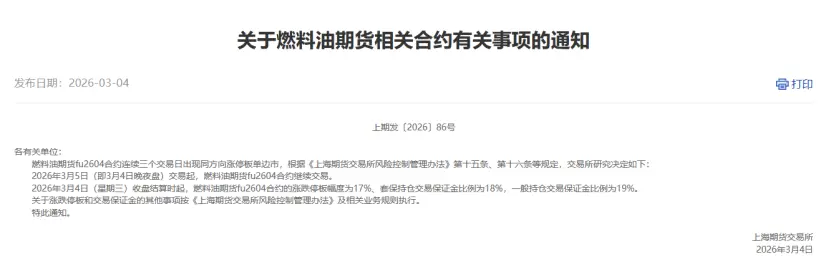
In addition, the Shanghai Futures Exchange also made adjustments to other related contracts of fuel oil futures. The price limits of fu2605, fu2606, fu2607, and fu2608 contracts were adjusted to 14%, the margin ratio for hedging positions was 15%, and the margin ratio for general position transactions was 16%.