Quantitative giant Lingjun Investment has once again been involved in a public controversy.
Recently, the news that "various securities firms and subsidiaries are comprehensively sorting out and checking whether any of the resigned employees of their units have gone to work in Ningbo Lingjun" has spread in the industry.
In response, on March 8, Lingjun Investment issued an announcement stating that the news was a rumor and that the company had reported the relevant situation to the regulatory authorities in a timely manner and would report the case to the relevant authorities.
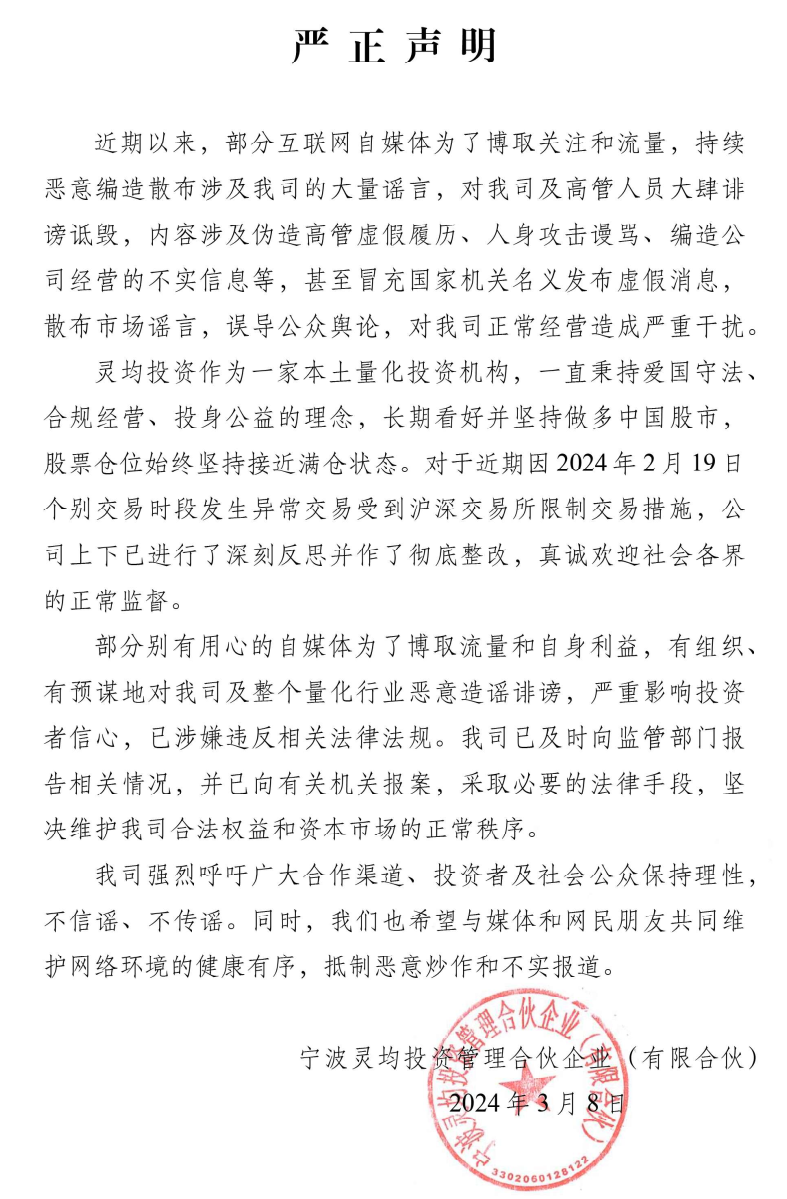
Lingjun Investment said it had reported the situation to the regulatory authorities
On March 8, market news said: “Each brokerage firm and its subsidiaries have comprehensively sorted out and checked whether any of the resigned employees of their units have gone to work in Ningbo Lingjun.” In response to this, Lingjun Investment stated that the news was an attempt to impersonate a state agency, maliciously spread rumors, and is suspected of violating the law. The company has reported the relevant situation to the regulatory authorities in a timely manner and will report the case to the relevant authorities.
Since Lingjun Investment restricted trading last month, there have been various "little essays" in the market. There are rumors about Lingjun Investment, involving false resumes of executives, personal attacks and abuses, fabricating false information about the company's operations, etc. There are also rumors targeting the quantitative industry such as industry bans, severe crackdowns, suspension of DMA business, suspension of quantitative sales, etc., and even false news published in the name of a state agency.
Lingjun Investment said in a statement that in recent days, in order to gain attention and traffic, some Internet self-media have continued to maliciously fabricate and spread a large number of rumors involving the company, and slandered the company and its senior executives. The content involves forging false resumes of senior executives, personal attacks and abuses, fabricating false information about the company's operations, etc., and even pretending to be state agencies to release false news, spread market rumors, mislead public opinion, and cause serious interference to the company's normal operations.
Lingjun Investment stated that some self-media with ulterior motives have organized and premeditated malicious rumors and slander against the company and the entire quantitative industry in order to gain traffic and their own interests, which has seriously affected investor confidence and has been suspected of violating relevant laws and regulations. Our company has reported the relevant situation to the regulatory authorities in a timely manner, reported the case to the relevant authorities, and taken necessary legal measures to resolutely safeguard our company's legitimate rights and interests and the normal order of the capital market.
Lingjun Investment calls on cooperation channels, investors and the general public to remain rational and not believe or spread rumors. At the same time, we also hope to work with the media and netizens to maintain a healthy and orderly online environment and resist malicious hype and false reports.
Just punished by the exchange
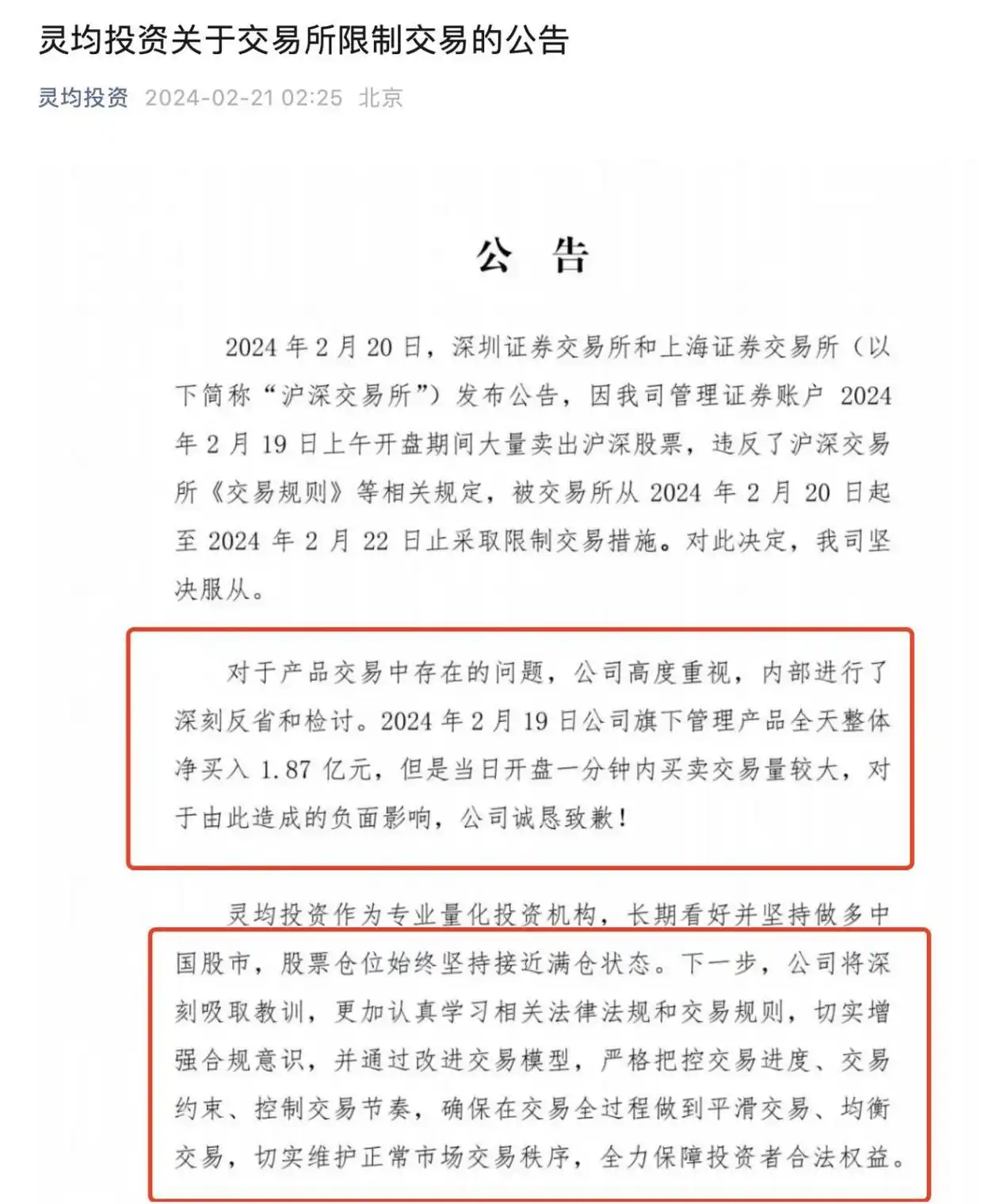
On February 20, the news that Lingjun Investment was condemned and restricted from trading by the Shenzhen Stock Exchange and the Shanghai Stock Exchange attracted market attention.
According to an announcement from the Shanghai Stock Exchange, on February 19, the Shanghai Stock Exchange discovered during transaction monitoring that from 9:30:00 to 9:31:00, multiple products managed by Ningbo Lingjun sold a large amount of Shanghai stock stocks totaling 1.195 billion yuan, during which the Shanghai Composite Index fell rapidly in a short period of time.
It was found that the above-mentioned transactions of Ningbo Lingjun violated the provisions of Article 7.2, Item (6) of the "Shanghai Stock Exchange Trading Rules" (hereinafter referred to as the "Trading Rules"), which "automatically generate or issue trading instructions through computer programs to conduct programmed transactions, affecting the security of the Shanghai Stock Exchange system or the normal trading order."
According to the relevant provisions of Article 7.8 of the "Trading Rules" and the "Measures for the Implementation of Disciplinary Punishments and Supervisory Measures of the Shanghai Stock Exchange", the Shanghai Stock Exchange decided to continuously implement regulatory measures to suspend investor account transactions for related products managed by Ningbo Lingjun from February 20, 2024 to February 22, 2024, that is, to suspend all stock transactions of relevant product accounts listed and traded on the Shanghai Stock Exchange during the above period, and at the same time initiate disciplinary procedures to publicly condemn Ningbo Lingjun.
As for the Shenzhen Stock Exchange, on February 19, the Shenzhen Stock Exchange discovered during transaction monitoring that from 9:30:00 to 9:30:42, multiple securities accounts under the name of Ningbo Lingjun automatically generated trading instructions through computer programs, placed a large number of orders in a short period of time, and sold Shenzhen Stock Exchange stocks totaling 1.372 billion yuan. During this period, the Shenzhen Stock Exchange Component Index fell rapidly, affecting the normal trading order, and constituting abnormal trading behavior as stipulated in Article 6.2 Item 6 of the "Shenzhen Stock Exchange Trading Rules".
The announcement emphasized that since the beginning of this year, the securities account under the name of Ningbo Lingjun has been subject to written warnings and other supervisory measures due to abnormal trading behavior many times, but it has not corrected it and continued to have abnormal trading behavior. In accordance with the Shenzhen Stock Exchange's "Implementation Rules for Restricted Trading", "Measures for the Implementation of Self-Regulatory Measures and Disciplinary Punishments" and other relevant regulations, the Shenzhen Stock Exchange decided to impose trading restrictions on the relevant securities accounts under the name of Ningbo Lingjun from February 20, 2024 to February 22, 2024, restricting him from buying and selling all stocks listed and traded on the Shenzhen Stock Exchange during the above period, and initiating procedures for public condemnation and disciplinary sanctions against Ningbo Lingjun.
Lingjun Investment responded again today, saying that as a local quantitative investment institution, it has always adhered to the concept of being patriotic, abiding by laws and operating in compliance with the law, and devoting itself to public welfare. It is optimistic about and insists on being long in the Chinese stock market for a long time, and its stock positions have always been close to full. Regarding the recent trading restrictions imposed by the Shanghai and Shenzhen Stock Exchanges due to abnormal trading during certain trading sessions on February 19, 2024, the company has deeply reflected and made thorough rectifications, and sincerely welcomes normal supervision from all walks of life.
Quantitative supervision becomes more stringent
Regulators have tightened their supervision of quantitative trading in the stock market.
In early March, the Shanghai Stock Exchange and the Shenzhen Stock Exchange jointly held a transaction compliance training for quantitative private equity institutions, with heads and business backbones from 28 leading quantitative private equity institutions participating. The first part of the training content is to reiterate the types of abnormal transactions; the second part is to guide regulations through regulatory examples, requiring quantitative private equity to strengthen and improve risk control in daily transactions to avoid adverse effects on the market.
It is reported that the China Securities Regulatory Commission is highly concerned about some issues reported by investors recently, such as the technical differences among market participants, and quantitative trading is a manifestation.
Market participants said that in recent years, quantitative trading has become an important trading method in the market. From a practical perspective, the market impact of quantitative trading has two sides. On the one hand, it helps to increase market activity and improve transaction efficiency. But on the other hand, entities that use quantitative trading, especially high-frequency trading, have obvious technology, information and speed advantages over small and medium-sized investors. At some points, there are problems such as strategic convergence and transaction resonance, which increase market volatility. Therefore, mature overseas markets generally implement strict supervision on high-frequency trading.
It is reported that recently, the exchange has punished individual quantitative private equity institutions for abnormal trading behavior in accordance with regulations, which is generally recognized by the market.
The Paper reporter learned from the regulatory authorities that next, the China Securities Regulatory Commission will take maintaining market fairness as the starting point and goal, adhere to the rule orientation, improve the quantitative transaction supervision system arrangements, focus on high-frequency trading, strengthen supervision from the aspects of data use, transaction reporting, abnormal transaction monitoring, etc., seek advantages and avoid disadvantages, and standardize development. At the same time, we must resolutely crack down on abnormal transactions and violations of laws and regulations, and effectively maintain the normal trading order of the market.