On March 4, according to news from the Shanghai and Shenzhen Stock Exchanges, the Shanghai and Shenzhen Stock Exchanges recently jointly held trading compliance training for quantitative private equity institutions to help quantitative private equity institutions understand quantitative trading regulatory ideas and work requirements in a timely and accurate manner, effectively improve the level of compliance transactions, and prevent quantitative trading risks.
This is another recent statement from the Shanghai and Shenzhen Stock Exchanges regarding quantitative trading. Previously, on February 20, the Shanghai and Shenzhen Stock Exchanges announced the smooth implementation of the quantitative transaction reporting system. On the same day, they also issued fines for abnormal trading behavior of quantitative giants.
Improve the level of compliance transactions of quantitative private equity institutions
It is reported that the heads and business backbones of 28 leading quantitative private equity institutions participated in the transaction compliance training for quantitative private equity institutions jointly organized by the Shanghai and Shenzhen Stock Exchanges.
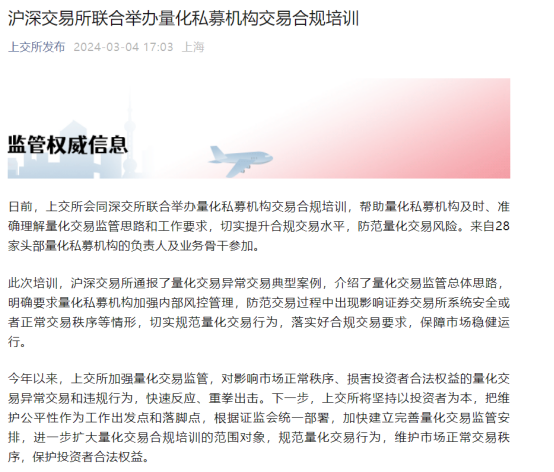
In this training, the Shanghai and Shenzhen Stock Exchanges reported typical cases of abnormal quantitative trading transactions, introduced the general idea of quantitative trading supervision, and clearly required quantitative private equity institutions to strengthen internal risk control management, prevent situations that affect the security of the stock exchange system or normal trading order during the transaction process, effectively standardize quantitative trading behaviors, implement compliance trading requirements, and ensure the stable operation of the market.
Both the Shanghai and Shenzhen exchanges stated that in the next step, they will adhere to investor-oriented and maintain fairness as the starting point and end point of their work. In accordance with the unified deployment of the China Securities Regulatory Commission, they will accelerate the establishment and improvement of quantitative trading supervision arrangements, further expand the scope of quantitative trading compliance training, standardize quantitative trading behavior, maintain the normal trading order of the market, and protect the legitimate rights and interests of investors.
Issuing "fines" for abnormal trading behavior of quantitative giants
Since the beginning of this year, the Shanghai and Shenzhen Stock Exchanges have strengthened the supervision of quantitative trading, reacting quickly and striking hard against abnormal transactions and irregularities in quantitative trading that affect the normal order of the market and damage the legitimate rights and interests of investors.
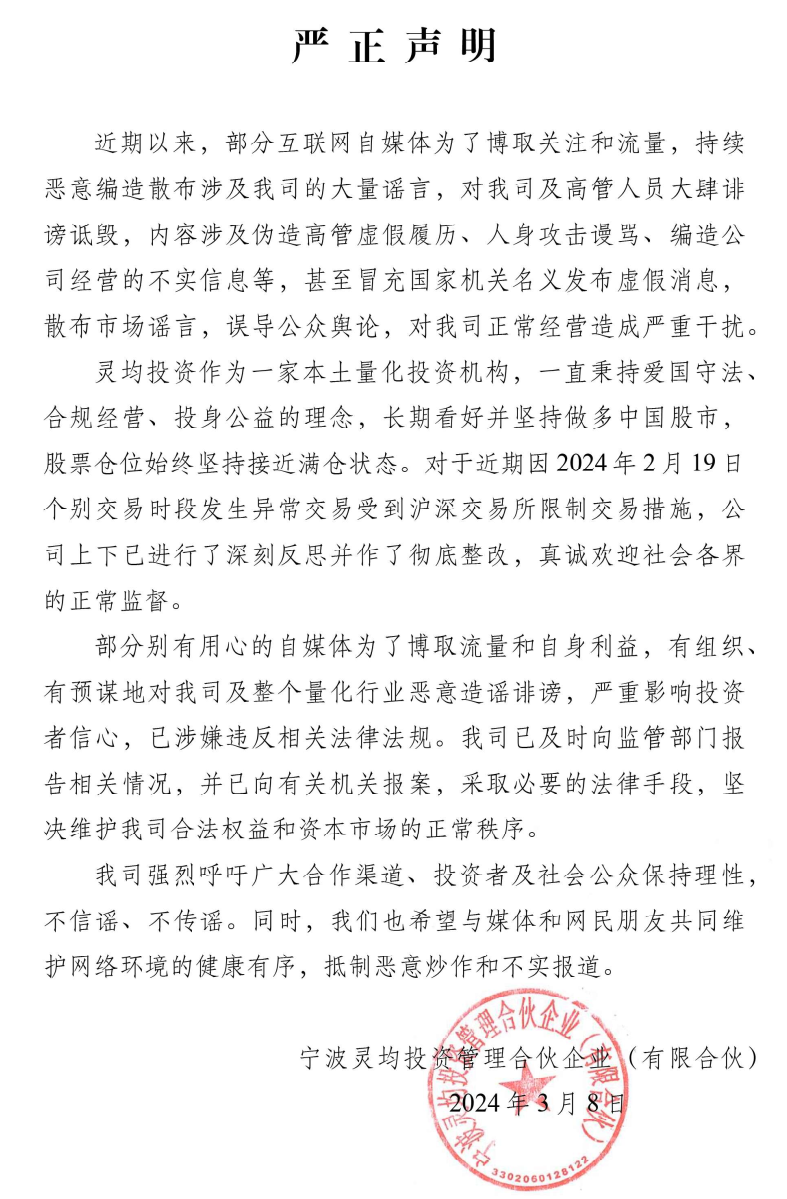
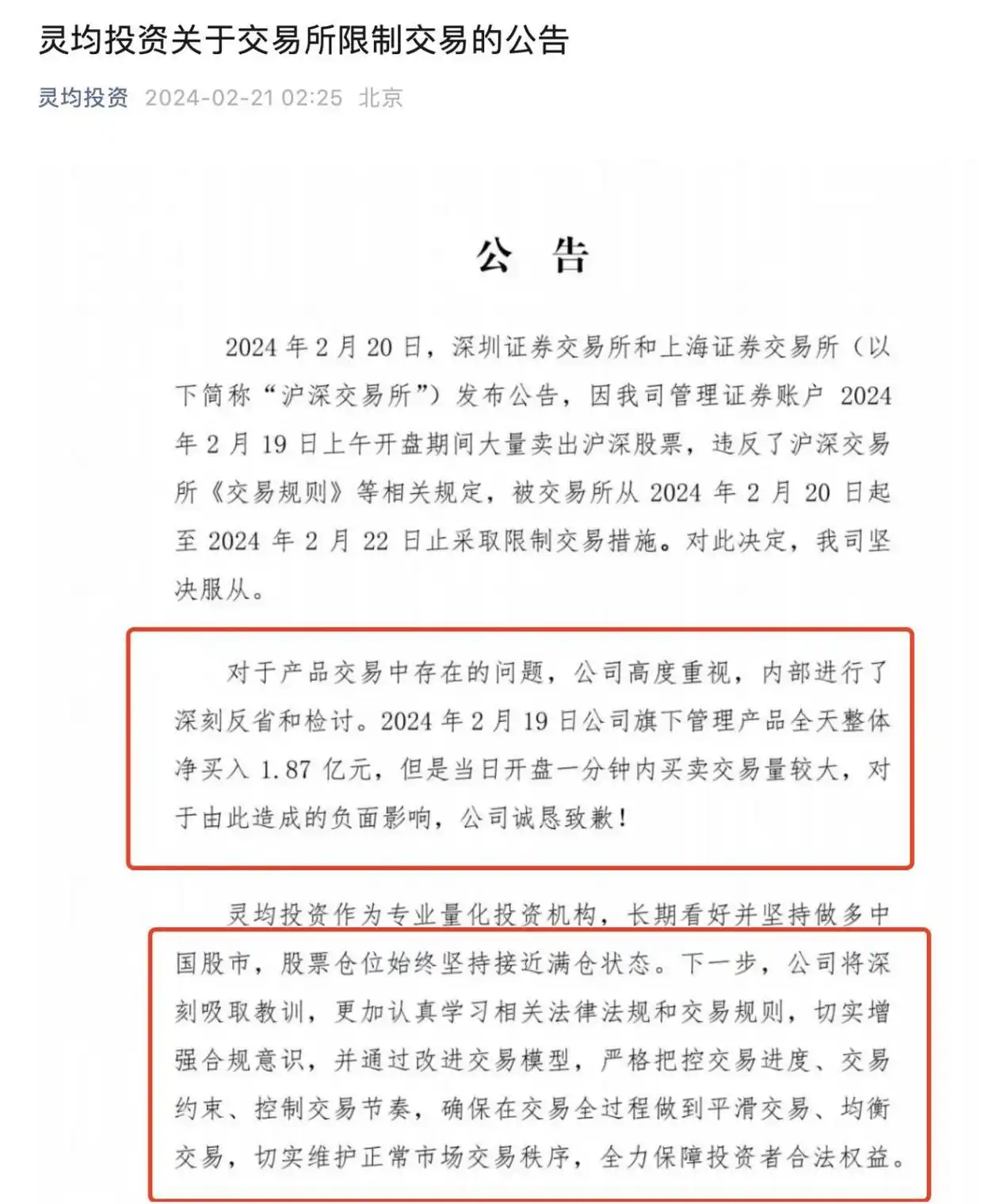
On February 20, in response to the abnormal trading behavior of quantitative private equity giant Ningbo Lingjun Investment Management Partnership (Limited Partnership) (hereinafter referred to as Ningbo Lingjun), the Shanghai and Shenzhen stock exchanges also issued "fines": restricting transactions and initiating public condemnation procedures.
The Shanghai and Shenzhen Stock Exchanges discovered during transaction monitoring that at the opening of the first trading day of the Year of the Dragon, multiple products managed by Ningbo Lingjun sold a large number of stocks. In one minute, a total of more than 2.5 billion yuan of stocks were sold in the Shanghai and Shenzhen stock exchanges, during which the stock index fell rapidly.
Specifically, on the Shanghai stock market, from 9:30:00 to 9:31:00 on February 19, multiple products managed by Ningbo Lingjun sold a large number of stocks on the Shanghai stock market, totaling 1.195 billion yuan, accounting for a high proportion of the market turnover during the period. During the period, the Shanghai Composite Index fell from 2886.59 points to 2868.07 points, a decrease of 0.65%. In the Shenzhen Stock Exchange, from 9:30:00 to 9:30:42 on February 19, multiple securities accounts under Ningbo Lingjun automatically generated trading instructions through computer programs, placed a large number of orders in a short period of time, and sold a total of 1.372 billion yuan of stocks in the Shenzhen Stock Exchange. Within one minute after the opening of the market that day, the Shenzhen Stock Exchange Component Index fell rapidly from 8957 points to around 8875 points.
The Shanghai and Shenzhen Stock Exchanges believe that the above-mentioned behavior of Ningbo Lingjun seriously affected the normal trading order and constituted abnormal trading behavior. The Shanghai and Shenzhen Stock Exchanges have decided to continuously implement regulatory measures to suspend investor account transactions for related products managed by Ningbo Lingjun from February 20, 2024 to February 22, 2024, that is, to suspend all stock transactions of relevant product accounts listed and traded on the Shanghai and Shenzhen Stock Exchanges during the above period, and at the same time initiate disciplinary procedures to publicly condemn Ningbo Lingjun.
The Shanghai and Shenzhen Stock Exchanges stated at the time that they would follow the unified deployment of the China Securities Regulatory Commission, adhere to the main responsibilities and main businesses of supervision, continue to strengthen trading supervision, and always maintain a strict tone and a high-pressure posture of "zero tolerance" for violations that affect the normal trading order of the market and damage the legitimate rights and interests of investors, respond quickly and strike hard. At the same time, investors are reminded to participate in transactions in accordance with laws and regulations and jointly maintain the normal trading order of the market.
Strengthen monitoring and analysis of quantitative trading, especially high-frequency trading
In recent years, with the widespread use of new information technology, quantitative trading has become an important trading method. Quantitative trading helps provide liquidity to the market and facilitates price discovery. However, quantitative trading, especially high-frequency trading, has obvious technical, information and speed advantages over small and medium-sized investors. At some points, there are also problems such as strategic convergence and trading resonance, which increase market volatility. Judging from international experience, overseas markets generally implement stricter supervision on quantitative transactions, especially high-frequency transactions, to prevent negative impacts on market order.
On September 1, 2023, the Shanghai and Shenzhen Stock Exchanges issued the "Notice on Matters Concerning the Reporting of Stock Programmed Trading" and the "Notice on Matters Concerning Strengthening the Management of Programmed Trading", establishing a special reporting system and corresponding regulatory arrangements for quantitative trading, which will be officially implemented on October 9, 2023. On February 20, both the Shanghai and Shenzhen Stock Exchanges announced that the above-mentioned systems have been implemented smoothly, existing investors have completed reporting work as scheduled, and incremental investors have implemented the "report first, then trade" rule. The quality of reports from all parties generally meets the requirements, laying the foundation for further strengthening and improving quantitative trading supervision.
The Shanghai and Shenzhen Stock Exchanges stated that they will continue to strengthen the monitoring and analysis of quantitative trading, especially high-frequency trading, based on reporting information, and dynamically evaluate and improve the reporting system.
The Shanghai and Shenzhen Stock Exchanges also stated that in the next step, they will adhere to the investor-oriented approach, take the maintenance of fairness as the starting point and end point of their work, learn from international regulatory practices, seek advantages and avoid disadvantages, and establish and improve quantitative trading supervision arrangements, including strictly implementing the reporting system and clarifying "report first, deliver later". "Easy" access arrangements; strengthen the authorization management of quantitative trading market conditions, improve the differentiated charging mechanism; improve the monitoring and monitoring standards for abnormal transactions, strengthen the supervision of abnormal transactions and abnormal order withdrawals; strengthen the monitoring and regulation of leveraged quantitative products, and strengthen the joint supervision of futures and spot.
At the same time, the Shanghai and Shenzhen Stock Exchanges will further strengthen the customer management responsibilities of securities companies, improve the self-regulatory management cooperation mechanism with the Securities Industry Association and the Fund Industry Association, and strengthen the transaction supervision of quantitative private equity and other institutions.
In addition, the Shanghai and Shenzhen Stock Exchanges will also strengthen communication with the Hong Kong Stock Exchange, clarify the reporting arrangements for northbound investors in the Shanghai-Shenzhen-Hong Kong Stock Connect, and include quantitative transactions by northbound investors in the reporting scope in accordance with the principle of consistency between domestic and foreign investors. For abnormal transactions that affect market order, the Shanghai and Shenzhen Stock Exchanges will resolutely take self-regulatory management measures, and those suspected of violating laws and regulations and serious circumstances will be reported to the China Securities Regulatory Commission for investigation and punishment.
Column Editor: Qin Hong