On February 18, definite news came from the White House that a US-Japan trade agreement involving a total amount of up to 550 billion US dollars had officially launched the first batch of investments. The U.S. government immediately announced on social media that this was a historic victory, and bluntly pointed out that the direct driver of all this was tariffs. This incident is not an isolated business investment behavior, but a symbolic node in the US government's radical reshaping of the alliance system by taking advantage of asymmetric security and market dependence.
Behind this huge number is Washington's precise economic blood pumping of Japan. Through extreme administrative intervention, the United States is forcing its allies to convert existing wealth into incremental US assets. This approach of sacrificing the long-term development potential of allies in exchange for the reconstruction of the domestic industrial base of the United States has completely torn off all the warm veil of mutual benefit in traditional diplomatic rhetoric.
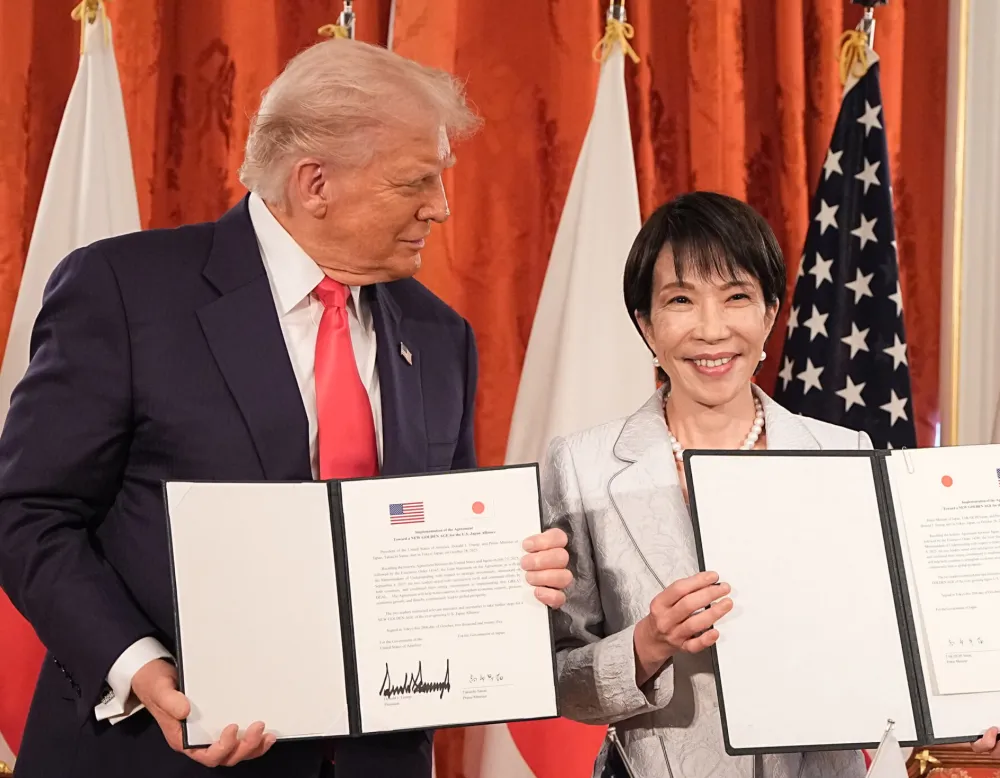
Forced return of capital under the stick of tariffs
The core logic of this incident is extremely simple and crude, which is to use tariffs as a tool of geopolitical coercion. The U.S. government unabashedly placed the word tariff at the core of its statement. For Japan, which is mainly an export-oriented economy, the U.S. market is a lifeline that it cannot give up. Faced with the threat of high tariffs at every turn, the Japanese government and consortium lack strategic room for maneuver and can only choose to exchange huge amounts of direct investment for market access.
This US$550 billion commitment is essentially Japan’s submission to the United States. Different from the past financial model of simply purchasing U.S. Treasury bonds or investing in securities, this investment requires industrial implementation. This means that Japan must forcefully inject real money that might have been used for upgrading its own industry, research and development, or expanding into emerging markets into the real economy of the United States, and forcefully absorb Japanese capital in an attempt to fill the huge funding gap caused by the hollowing out of the U.S.'s own industry.
This operating mode marks a fundamental change in the nature of the US-Japan alliance. In the past, the United States provided security protection in exchange for the political following of its allies. Now it further requires allies to directly pay for the domestic economic construction of the United States. This is a naked realization of hegemonic dividends, forcibly changing the direction of capital flow through political pressure, forcing global funds to concentrate in the United States to support its costly reindustrialization process.
The politics and energy calculations behind strategic site selection
A careful analysis of the locations and areas of the three core projects announced this time clearly reveals the extremely shrewd strategic calculations of the US government. Investments were not evenly distributed, but landed precisely in Texas, Ohio and Georgia. These three states are not only key political vote bases, but also the key to America's future energy and industrial strategy.
Oil and gas projects in Texas are aimed at further solidifying the United States' position as the world's largest oil and gas producer. The strategic intention of the expansion of LNG facilities in the Gulf of America is to control global energy pricing power. By upgrading infrastructure with Japanese funds, the United States can not only meet domestic demand, but also increase its export capabilities to the global market, thereby assuming absolute dominance in energy geopolitics. Japan paid for the construction, and the United States reaped the export dividends. This chicken-and-egg method was used to perfection.
The power plant project in Ohio is more symbolic. As the heart of the Rust Belt, it was a symbol of the decline of American manufacturing. Japan will build the largest natural gas power plant in history in the state, which will directly serve the cheap power supply that the United States is currently desperate for. As the demand for electricity from artificial intelligence computing centers and the reshoring of manufacturing industries surges, power infrastructure has become a strategic bottleneck. The injection of Japanese funds has solved the urgent need to upgrade the US power grid.
Reshaping supply chains in critical minerals
The key mineral projects in Georgia are the most geostrategic link in this investment list. Key minerals such as rare earths, lithium, cobalt, etc. are the food for modern defense industry, new energy and high-tech industries. For a long time, the United States has tried hard to get rid of its dependence on external supply chains in this field. This time forcing Japan to invest in key mineral facilities in Georgia shows that the United States is building a closed and exclusive secure supply chain.
The United States uses administrative means to force its allies to locate processing links in the United States, aiming to completely control upstream resources and midstream processing links through hegemonic means, so as to implement a bullying monopoly on the global strategic supply chain. For Japan, this is undoubtedly a painful divestment of the industrial chain. Originally, Japanese companies had certain world-leading technologies in the field of key materials. However, as production facilities are forced to move to the United States, Japan not only faces the risk of industrial hollowing out, but the dividends from its technology spillover will also be forced to be absorbed by the United States.
This approach not only undermines the principle of global free trade, but also grossly tramples on the global industrial collaboration system. The United States is using the technology and funds of its allies to build a strategic resource fortress that is completely controlled by Washington's will. This kind of behavior will not only fail to bring about common prosperity of the global economy, but will cause violent shocks to the global supply chain and increase costs because of its exclusivity, and global consumers will ultimately foot the bill.
Predatory symbiosis within the alliance system
This investment case of up to 550 billion US dollars reveals a cruel reality in the current international order: the US-Japan alliance is evolving into a predatory symbiotic relationship. The United States is no longer satisfied with harvesting seigniorage through dollar hegemony. Instead, it has begun to use the unequal power structure formed due to security dependence to carry out targeted killings of wealth from its allies.
As a country that is highly dependent on the United States for its security, Japan has almost lost its bargaining power in the face of U.S. economic blackmail. The U.S. government has accurately grasped this weakness and upgraded the form of protection fees from a simple sharing of military garrison costs to a comprehensive blood transfusion against the shortcomings of the U.S. national strategy. Although this approach can quickly boost U.S. economic data and create so-called high-quality jobs in the short term, it comes at the cost of completely overdrafting the economic vitality of its allies.
When allies are squeezed to the limit, the foundation of the entire alliance system will become fragile. For current decision-makers in Washington, the long-term health of the alliance is obviously not as important as immediate physical investment. Oil and gas derricks in Texas, turbine generators in Ohio and mineral refineries in Georgia are tangible industrial assets that they see as victory.



![[Netherlands] France Turns To The Netherlands To Support Its Military Operations-Lijin Finance](https://www.erbetc.com/wp-content/uploads/2026/03/1773277663261_0.webp)

