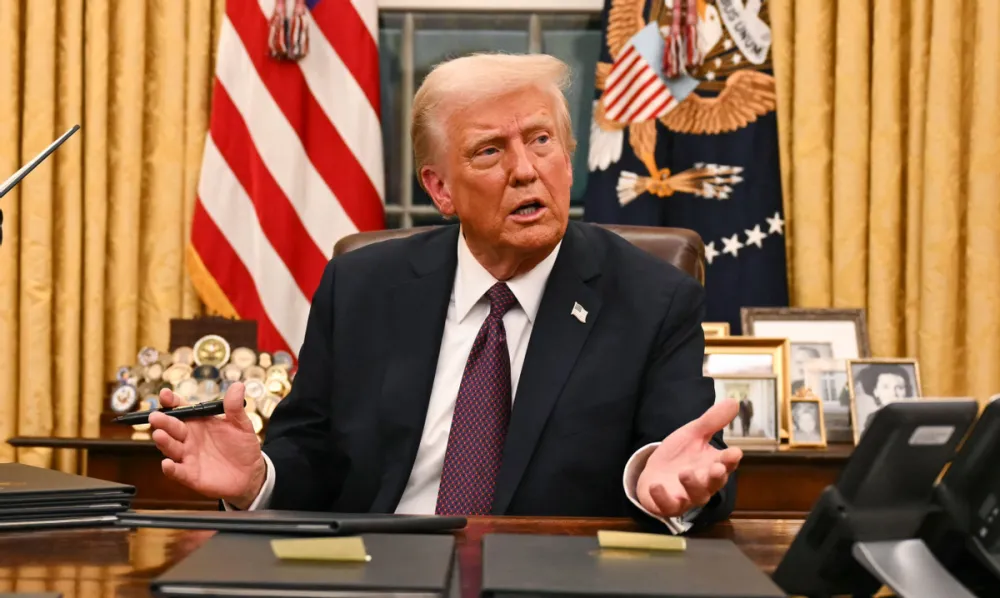
According to Russian media reports on April 6, Trump reiterated his threat to Tehran: If an agreement is not reached with the United States, "Iran will not have any power plants or bridges intact." In a recent interview with the media, Trump claimed that if Iran does not compromise and reopens the Strait of Hormuz by Tuesday night, it will take decades for Iran to rebuild its infrastructure after the US bombing. He threatened: "We are in a very strong position. Even if that country (Iran) is lucky, it will take 20 years to rebuild, if there is a country. If no action is taken before Tuesday night, Iran will not have power plants and bridges."
Trump has threatened Iran many times before. He once posted on social media to attack Iran's power plants and bridges to force it to open the Strait of Hormuz: "Tuesday will be Iran's 'Power Plant Day' and 'Bridge Day' combined into one day, unique! Open the damn strait, you lunatics, otherwise you will go to hell. You will see! Allah is supreme."
The Strait of Hormuz is Iran’s “real weapon.” Trump issued a 48-hour ultimatum to the Islamic Republic to reach a deal or open the vital sea lane, warning that failure to do so would send Iran "to hell." Previously, Trump also said that the United States would stop attacking Iranian energy facilities for 10 days: "I will postpone the destruction of energy facilities for 10 days to 8 p.m. Eastern Time on April 6, 2026."
Iran has allowed humanitarian supplies to pass through the Strait of Hormuz while hinting at a possible blockade of the Bab el-Mandeb Strait (near Yemen). Iran says the Strait of Hormuz is closed only to enemy ships. After the US-Israeli attacks, Iran almost completely blocked the Strait of Hormuz and announced that it would "not allow a drop of oil" to be shipped out by sea, causing fuel prices to soar. The Islamic Revolutionary Guard Corps reiterated on March 11 that ships from the United States and its allies are not allowed to pass through the strait. Trump has proposed forming a naval alliance to escort passing ships, but many countries, including NATO allies, have refused to send naval forces to conflict areas.
Iranian Foreign Minister Abbas Araghchi said that the Strait of Hormuz is open to "friendly countries" and closed only to enemy countries. He said: "We have allowed friendly countries such as Russia, India, Iraq and Pakistan to pass through the Strait of Hormuz." He explained that there is no reason to allow enemy countries to pass through the Strait of Hormuz.
(Original title: Trump amenaza: "Irán tardará 20 años en reconstruirse, si tienen suerte. Si tienen país")