Professional virtual currency information station welcome
We have been making efforts.

24-hour news update Page 33

24-hour cryptocurrency news update

The Stock Indexes Have Collectively Adjusted This Week. The Shanghai Stock Exchange Index Has Fallen For Four Consecutive Weeks, And The Capital Flows Of Stock ETFs Have Been Exposed.

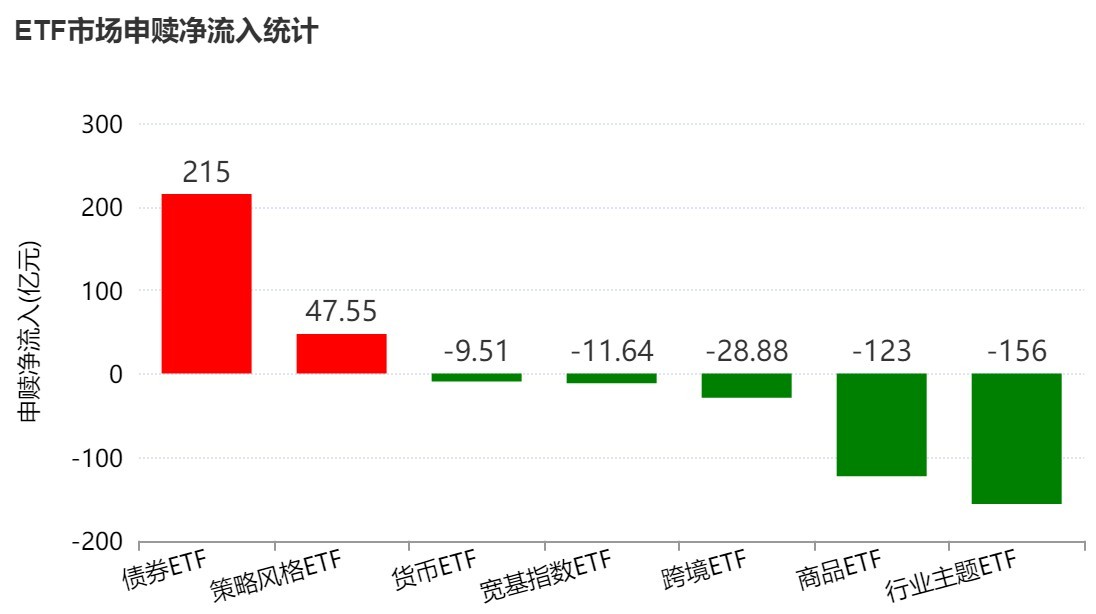
The stock indexes have collectively adjusted this week, with a total net outflow of stock ETFs and cross-border ETFs in Shanghai and Shenzhen stock exchanges of 14.937 billion yuan.

In terms of industry themes, ETFs such as energy storage batteries and electricity are favored by funds, while non-ferrous metals and chemical industry-related ETFs are sold by funds.

Shanghai stock index falls for 4 consecutive weeks

This week, the Shanghai and Shenzhen stock markets traded 10.49 trillion yuan, including 4.63 trillion yuan in the Shanghai stock market and 5.86 trillion yuan in the Shenzhen stock market. As of the latest closing, the Shanghai Stock Exchange Index closed at 3913.72 points, down 1.1% for the whole week, and the Shenzhen Component Index closed at 13760.37 points, down 0.76% for the whole week.

It is worth noting that the Shanghai Stock Index has been adjusted for four consecutive weeks.

Wind data shows that this week, the total net outflow of stock ETFs and cross-border ETFs in Shanghai and Shenzhen stock exchanges was 14.937 billion yuan, the net outflow of broad-based index ETFs was 1.164 billion yuan, and the net outflow of industry theme ETFs was 15.6 billion yuan.

_沪指盘中跌破3400点_沪指大跌

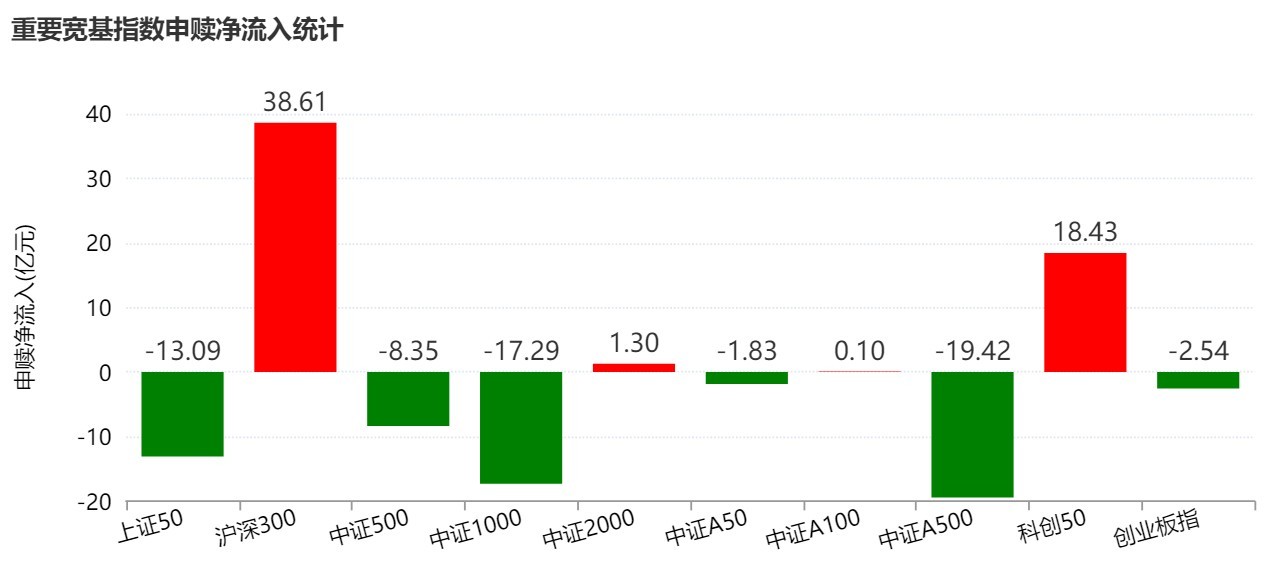
Broken down, the overall fund application and redemption statistics of major broad-based indexes show that this week the total net inflow of CSI 300-related ETFs was 3.861 billion yuan, and the total net outflow of CSI A500-related ETFs was 1.942 billion yuan.

沪指大跌__沪指盘中跌破3400点

In terms of specific ETFs, the 10 larger broad-based index ETFs have a total net inflow of 3.193 billion yuan this week, of which the CSI 300 ETF Huatai-Berry has a net inflow of over 1 billion yuan, and the SSE 50 ETF China has a net outflow of over 1.2 billion yuan.

Performance of major index-related ETFs this week

Some brokers said that the main risk currently lies in external geopolitical conflicts. If the signal of easing appears again in the future, the upward momentum of the market will still be strong. The overall economic fundamentals are relatively strong, the A-share market remains resilient, and we need to remain optimistic at this stage.

ETFs such as energy storage batteries and electricity are sought after by funds

In terms of industry-themed ETFs, there were 32 funds with net inflows of more than 100 million yuan this week. Among them, the shares of energy storage battery ETF E Fund, power ETF GF, and coal ETF Cathay increased by 470 million, 742 million, and 651 million respectively, with net inflows of 1.066 billion yuan, 867 million yuan, and 831 million yuan.

In terms of capital outflows, 65 industry-themed ETFs had net outflows of more than 100 million yuan this week. Among them, the shares of non-ferrous metal ETF Southern, non-ferrous metal ETF China, and chemical ETF Rich Country decreased by 902 million, 642 million, and 1.053 billion respectively, with net outflows of 1.679 billion yuan, 1.163 billion yuan, and 963 million yuan respectively.

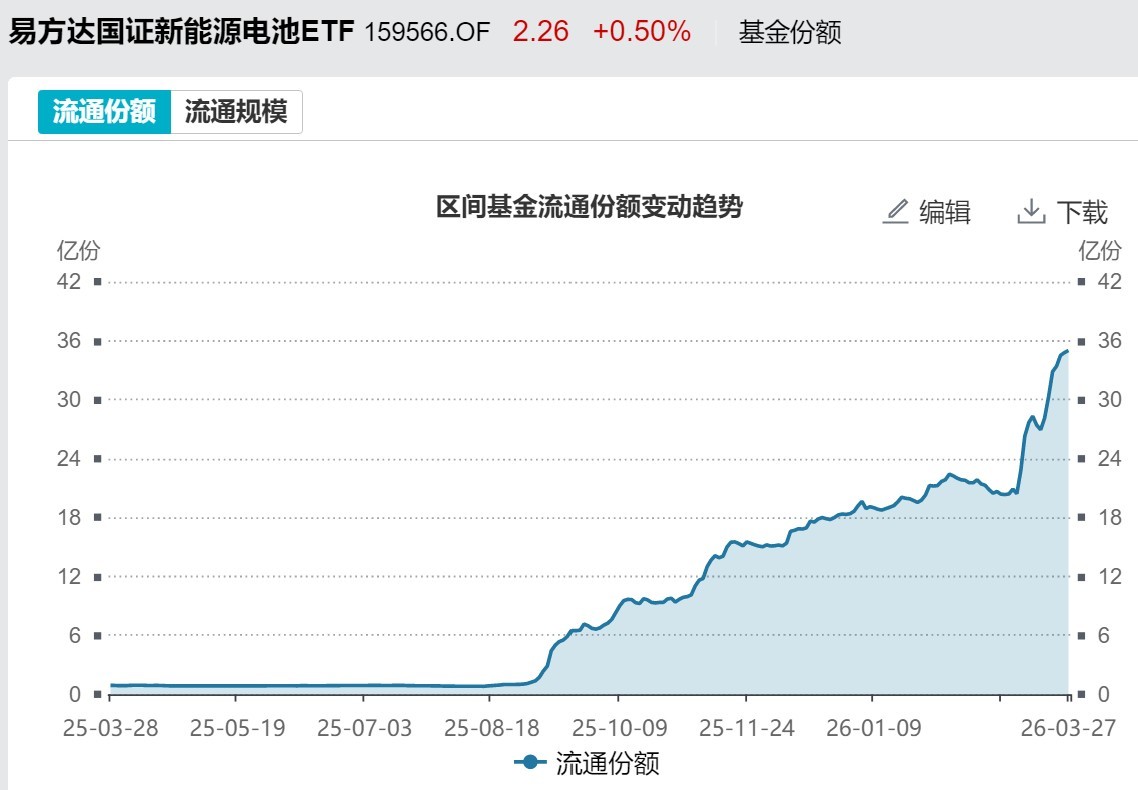
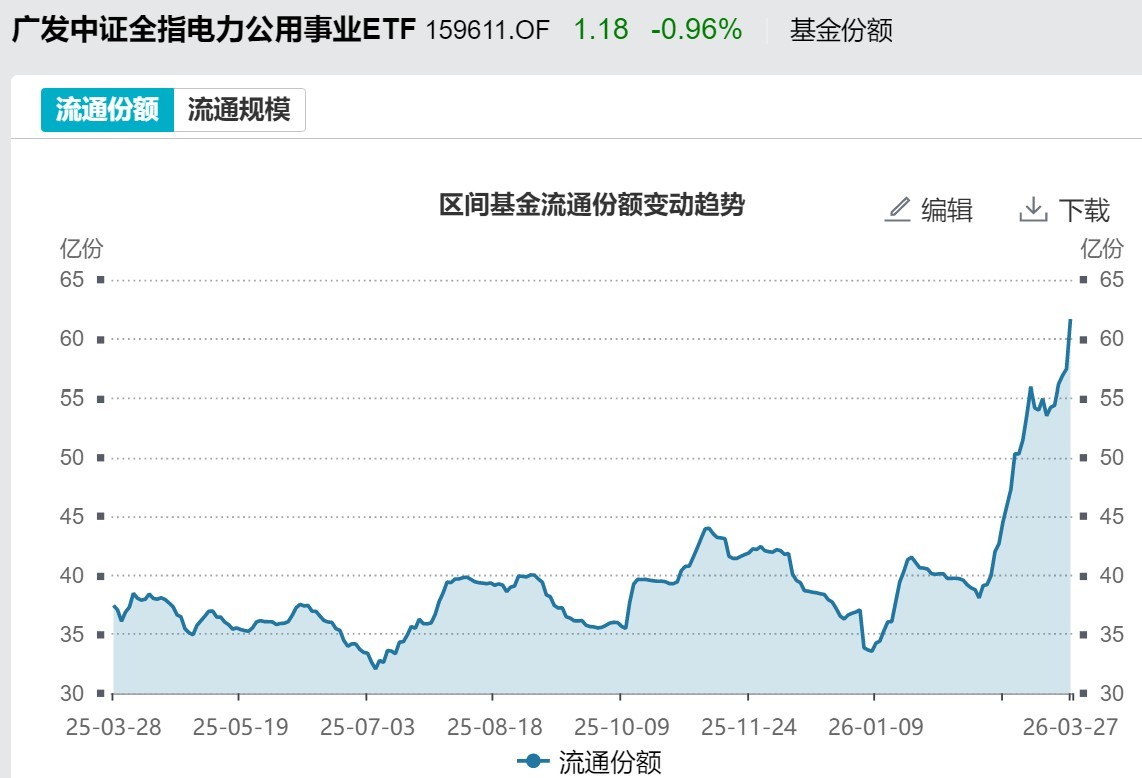
It is worth noting that energy storage batteries and electricity have continued to be sought after by funds recently, and the share of related ETFs has quietly reached a new high.

沪指盘中跌破3400点__沪指大跌

Energy storage battery ETF E Fund (159566) fund share changes

Some brokers said that under the background of high oil prices, the economic advantages of new energy are highlighted, and demand is accelerating. The medium and long-term energy security strategy drives the transformation and upgrading of clean energy. The industry is expected to usher in the Davis Double Click, and the high prosperity of energy storage and wind power will continue.

沪指大跌__沪指盘中跌破3400点

Changes in Fund Shares of Power ETF Guangfa (159611)

Some analysts believe that from the expansion of Token overseas to the collaboration of computing and electricity, to the high oil prices, the demand for electricity is being fully opened; the power industry itself has natural barriers of heavy assets, low obsolescence rate (HALO), stable cash flow, and deep operating barriers, and is expected to become a deterministic asset that is difficult to subvert in the AI ​​era.

The weekly turnover of 25 ETFs exceeds 10 billion yuan

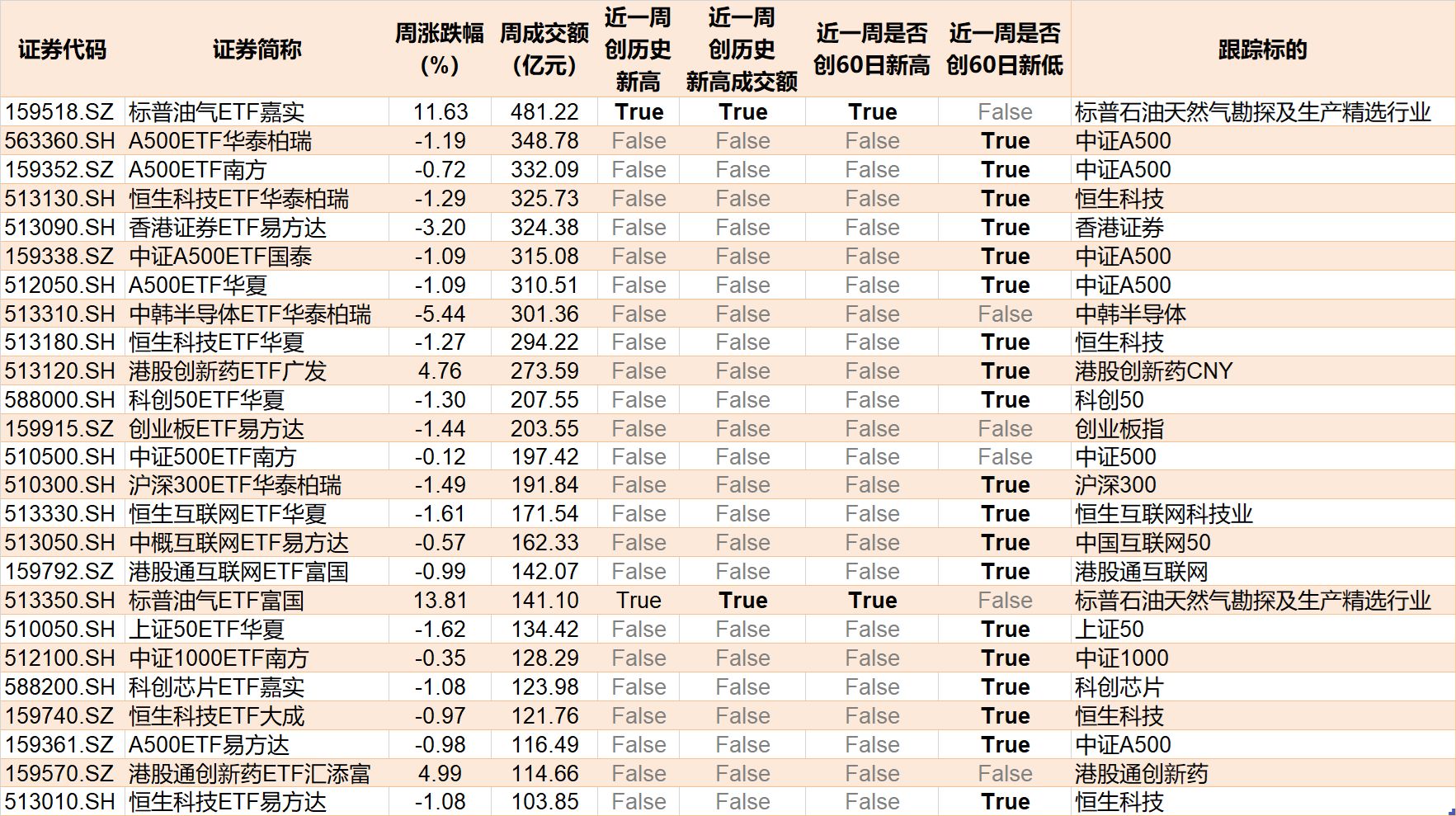
This week, there were 25 stock ETFs and cross-border ETFs with a turnover of over 10 billion yuan. Among them, the S&P Oil and Gas ETF Harvest’s weekly turnover exceeded 40 billion yuan.

沪指大跌_沪指盘中跌破3400点_

It is worth noting that the prices of two S&P oil and gas-related ETFs hit record highs this week.

Some brokers said that the US-Israeli attack on Iran will bring more uncertainty to energy supply and transportation. It is expected that under the influence of geopolitical factors, the short-term upward trend of oil prices will be relatively certain.

5 ETFs launching next week

Fund heavy holdings have always been a hot spot for investors, but there is usually a certain lag in the emergence of actively managed funds' heavy holdings, while the targets of ETF layouts are very clear. By tracking newly listed ETFs, you can usually find recent hot stocks, and the incremental funds brought by newly listed ETFs are also worthy of attention.

There are currently 5 ETFs disclosed to be listed next week, and the tracking targets are GEM new energy, Hong Kong Stock Connect Internet, animal husbandry, science and technology innovation board chip design, etc.

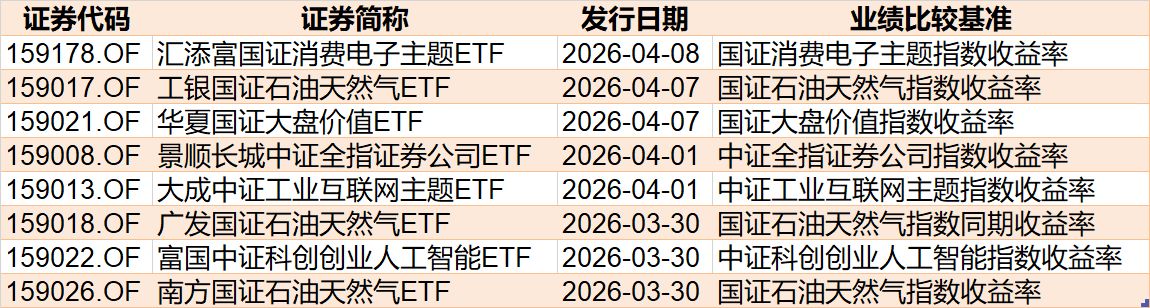
There are currently 5 ETFs disclosed for issuance next week, with tracking targets such as oil and gas, mass entrepreneurship and artificial intelligence, industrial Internet, securities, etc.

_沪指大跌_沪指盘中跌破3400点

The Market's Risk Aversion Tendency Has Increased Under The Situation In Iran. How Should Investors Respond?

The longer Iran delays, the more the market favors short-term investments

The current situation has made market participation more difficult than ever, and downside risks currently outweigh upside risks.

Tony Pasquariello, head of hedge fund coverage at Goldman Sachs, pointed out in the latest report that the geopolitical conflict caused by the situation in Iran has become the main source of noise in the market, and the intensity of gaming in various trading strategies has increased significantly.

He warned that downward pressure is still greater than upward pressure and suggested that investors simplify risk exposures and increase their cash holdings appropriately to prepare for adding positions at any time when the situation becomes clearer.

Pasquariello said that the conflict is one of the largest oil supply shocks in history, but the decline in the U.S. stock market has been limited so far, which itself is alarming.

He quoted a colleague as saying that "markets are increasingly betting against time" – the longer the conflict drags out, the easier it is for markets to turn into a true growth scare rather than just a supply-driven inflationary shock.

Tactical long and short cases coexist, but risks are still biased to the downside

Pasquariello also laid out the tactical long and short logic of the current market.

The basis for long positions include:

Nearly everyone in the professional trading community with whom he interacts is bearish, and market sentiment indicators have plummeted;

The CTA systematic strategy has significantly reduced long positions;

Large index shorts have been established;

The RSI of the S&P 500 and Nasdaq 100 fell to its lowest level since April last year;

The outlines of the Iran negotiation framework are beginning to emerge.

Short selling grounds include:

There has been no real capitulation selling outside of short-term funds;

Global bond market trends are also troubling;

The intensity of the conflict has not eased in the critical 48-72 hour window;

Practitioners in the spot commodity market sent a more pessimistic signal.

Pasquariello's comprehensive judgment is that the technical aspects tend to be balanced, but the broader risk set is still biased towards negative results, gap jumps and jumps will continue, the risk-return ratio is still unclear, but the intuitive upward and downward asymmetry still dominates.

Spot commodity practitioners are more worried

Pasquariello's cautious stance was reinforced by observations made during a business trip in Europe. He noticed that those who knew the most about physical commodities were more worried than generalized investors.

The current conflict has caused severe and ongoing disruptions to the physical flow of oil, natural gas and refined products, and triggered a series of policy restrictions, including export bans, fuel rationing and mandatory work-from-home requirements. This means rising inflationary pressures for business operations and an increasingly negative impact on economic growth.

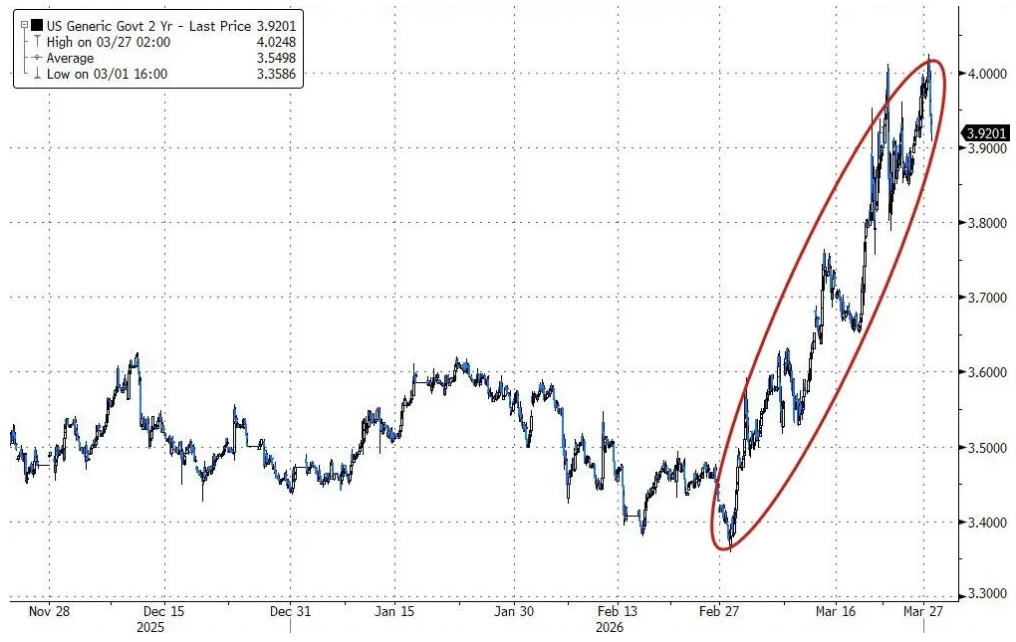
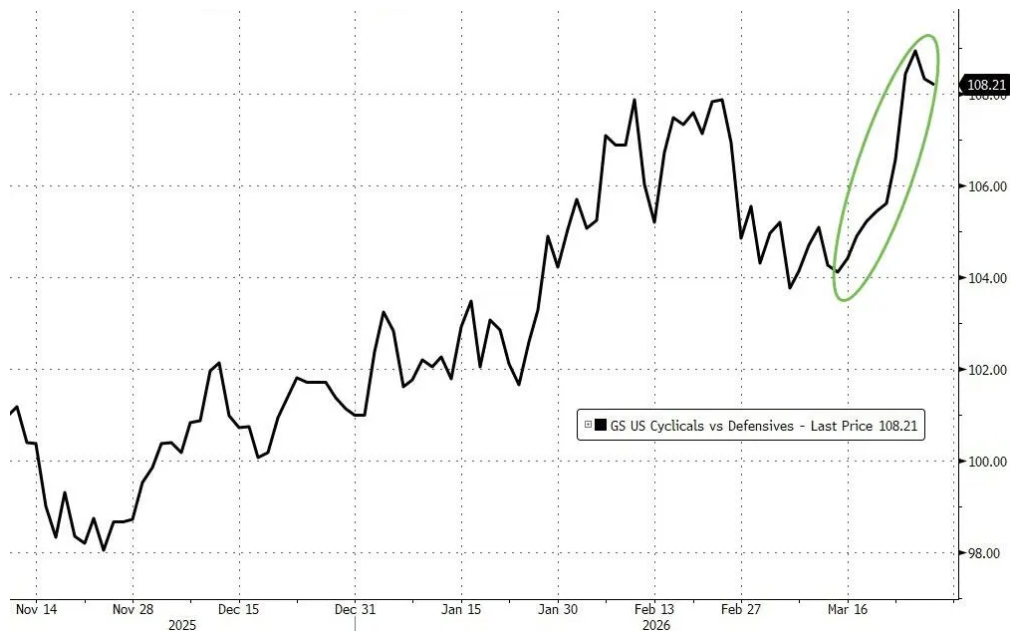
The current mainstream pricing logic in the market is to view this situation as a supply-driven inflationary shock rather than a major growth shock. This judgment is reflected in the sharp decline in global front-end interest rates and the relative outperformance of cyclical stocks over defensive stocks.

高盛对冲基金__高盛对冲基金交易员

_高盛对冲基金交易员_高盛对冲基金

Looking back at history, he pointed out that the S&P 500 fell 19% from the high in February 2024 to the low in April, the VIX once soared above 65 in the summer of 2024, the BKX index plummeted 35% during the SVB crisis, and the Nasdaq 100 fell 33% throughout 2022.

"The damage caused by this round of impact has not yet reached a similar magnitude," he believes, which does not mean that the risk has been released.

European stocks suffered capital withdrawals, but Asian stocks performed relatively resiliently

In Europe, Goldman Sachs prime brokerage data showed that long positions in European stocks accumulated over the past year were being liquidated rapidly. Goldman Sachs has lowered its 2026 GDP forecast for the euro zone to about half of its pre-conflict level and expects the European Central Bank to raise interest rates once in April and once in June.

Asian markets have shown significant resilience. Taking South Korea as an example, despite continued selling by foreign investors and a sudden correction in U.S. memory chip stocks, KOSPI still rose by about 29% during the year.

The Japanese market is under pressure from high commodity exposure, with the Topix still recording a gain of about 1% this week. Pasquariello said that judging from customer feedback, South Korea and Japan are the two markets where investors have the most confidence in the medium term among all current options.

Tail risks are still high, it is recommended to increase cash holdings

Pasquariello summed up all the above judgments in four words: tail risk is high.

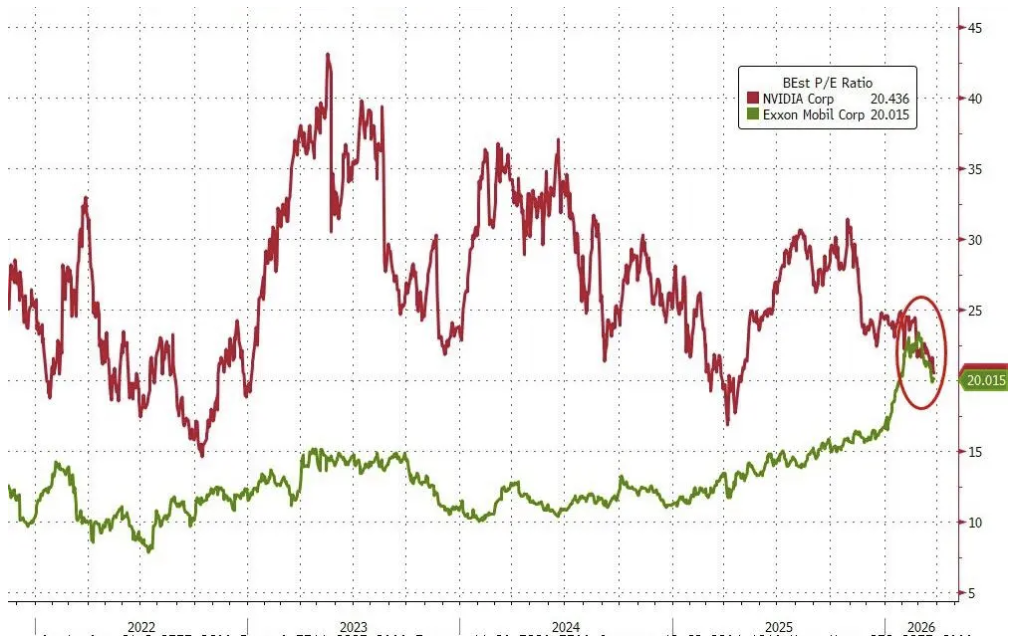
He cited the close proximity of the forward price-to-earnings ratio trends of Nvidia (NVDA.US) and Exxon Mobil (XOM.US) as a footnote of the times, believing that this signal itself illustrates the deep changes in the current market structure.

_高盛对冲基金交易员_高盛对冲基金

"I still see no reason not to simplify risks, moderately increase cash holdings, and be prepared to quickly increase investment on the bright side – I know this is easier said than done," Pasquariello wrote.

AI Security Risks Detonate Cybersecurity Stocks Plummeting, Market Worries About Lower Attack Threshold

In early trading on Friday, March 27, cybersecurity industry stocks plummeted.

In the early trading of U.S. stocks on Friday, Tenable once fell by more than 13%, Zscaler once fell by more than 9.5%, Palo Alto Networks once fell by more than 8.2%, and CrowdStrike once fell by more than 7.8%. Later, the decline eased. Tenable fell by about 8%, and the decline of the latter three narrowed to less than 6%.

Cybersecurity stock ETF – Global X Cybersecurity ETF (BUG) fell as much as 6.1% in early trading. At the end of early trading, the decline narrowed to about 4%.

The sharp decline in cyber security stocks was not due to performance or macro data, but was triggered by a piece of news about AI security risks: An unreleased model from Anthropic was exposed that may improve hacker attack capabilities, thus triggering market concerns about "AI weakening the network security moat."

The media pointed out that Anthropic’s other AI functions have also triggered chain sell-offs in the software and data analysis sectors this year. In other words, this round of selling is not about performance, but "narrative": the market is worried that the improvement of AI security capabilities will lower the threshold of attack, thus forcing security manufacturers to invest more research and development and computing power, and even put pressure on customer budget allocation.

At the same time, some Wall Street analysts believe that the market reaction is extreme, and Anthropic is also trying to feed back the risk test results of the new model to security companies. This is more like an "offensive and defensive arms race" rather than a complete replacement of network security needs. Some analysts believe that this type of disclosure is more like "basic operations" rather than a signal of industry failure. Some media believe that the related selling may be exaggerated.

Is AI capability "crossing the line"? Anthropic model triggers market sensitivity

According to media disclosures, a new model being tested by Anthropic has been deemed in internal assessments to potentially bring "unprecedented network security risks", especially if it is used maliciously, and may help attackers bypass existing defense systems.

Although Anthropic subsequently responded that the relevant content was in the testing phase and emphasized that the company was cooperating with security vendors and sharing risk assessment results in advance, the market clearly chose to price the potential impact first.

This is crucial – the current focus of competition in the AI ​​industry is not just "who is stronger", but "to what extent will it change the industry structure?" When model capabilities touch sensitive areas such as automated vulnerability exploitation and attack script generation, the impact will directly affect the core values ​​of network security vendors.

Not for the first time: The “transaction template” for AI’s impact on network security is taking shape

In fact, this is not the first time that the cybersecurity sector has plummeted due to Anthropic-related news.

Previously, after Anthropic released AI security tools, the stock prices of companies such as CrowdStrike and Datadog also suffered significant sell-offs. The market has gradually formed a conditioned reflex: once AI capabilities are considered to be "on the attacker's side," the security sector will be the first to come under pressure.

Behind this kind of transaction is investors' re-examination of the industry logic:

Before there are clear answers to these questions, funds often choose to "sell first and then talk about it".

Core Impact: AI is changing the balance of offense and defense, rather than simply replacing it

Looking at a deeper level, the essence of market panic is not "AI replaces network security", but "AI changes the balance of offense and defense."

The business logic of traditional network security is based on a premise: the defender can gradually suppress the attacker through rules, models and data accumulation. However, the emergence of AI has enabled attackers to gain “scale capabilities”——

This means that the security industry may enter a "dynamic arms race" stage: defense capabilities must be continuously upgraded to offset the AI ​​blessing on the attack side.

Under this framework, the long-term demand of security manufacturers may not decline, but the short-term profit model and valuation logic will be impacted – especially when enterprise customers have limited budgets.

The divide remains: Overreaction, or an inflection point?

Although the stock price has fluctuated wildly, some analysts believe the market reaction may be extreme.

On the one hand, Anthropic itself is actively conducting risk testing and cooperating with security vendors, which means that the industry is not passively bearing the impact, but is adapting in advance; on the other hand, AI is also improving defense capabilities, such as automated threat detection, real-time response, etc.

In other words, this is more likely to be an "anticipated repricing" than an immediate deterioration in fundamentals.

Judging from historical experience, sell-offs driven by AI news often have two characteristics:

Cybersecurity stocks narrowed their intraday losses on Friday, reflecting to some extent that funds are beginning to reassess the true extent of the impact.

AI spillover effects intensify, and the market enters a "highly sensitive period"

What is even more noteworthy is that this incident once again proves that the impact of AI is rapidly spilling over to more industries.

From software development, search engines, to today's network security, the way the market prices AI is changing – any potential signs of "replacement", "weakening" or "reconstruction" will be quickly reflected in the stock price.

At this stage, AI is not only a source of growth stories but also becoming an amplifier of volatility.

For the cybersecurity industry, the real test may have just begun: when AI empowers both offense and defense, who can run faster in this competition will be the key to long-term victory or defeat.

Weiqi Fan's "Sister Lang" 7 Was Boycotted And Transformed From An Oxygen Beauty To A Public Enemy On The Internet

Who would have thought that the first wave of "public opinion earthquake" in domestic entertainment in 2026 would be triggered by a singer who has disappeared for a long time.

Recently, as the list of the popular variety show "Chengfeng 2026" (hereinafter referred to as "Lang Jie 7") leaked, 49-year-old Weiqi Fan was impressively included.

Originally, this kind of program was a "life-saving straw" for outdated artists to become popular, but with Weiqi Fan, it has become a huge "mirror" for demons.

As soon as the news came out, the comment area collapsed almost instantly. There were no expectations or cheers. There were just boycotts and old accounts filling the screen. The attitude of netizens was surprisingly consistent: "Don't watch if she is there" and "The Internet has memory."

How come Weiqi Fan, who once sang "Original Dream" and was dubbed the "Oxygen Beauty", has now become the "public enemy of the entire Internet" that everyone calls and beats?

Pretended oxygen and broken friendship: the "honesty debt" owed in those years

Many people have a song about Weiqi Fan in their youth. At that time, she had a clear voice and generous appearance. She was a rare talented woman in the music world.

But looking back now, those so-called "beautiful things" are more like carefully packaged soap bubbles. The first key word for Fan Weiqi's reputation collapse is "lying".

The most famous thing is her academic controversy. In the early days of her career, Fan Weiqi always had the aura of "Harvard's top student", which was a dimensionality-reducing blow in the entertainment industry at that time.

Fans feel that their idol is not only a good singer, but also a real academic master, and his favorability level is directly at the top. But what's the result? After being deeply investigated by netizens, it was discovered that she did not go to a serious undergraduate degree from Harvard University at all, but from the Harvard School of Extended Education.

To put it bluntly, this is like taking a "night school" graduation certificate and insisting that you are a graduate of a prestigious university.

The most speechless thing is that after the truth was revealed, her first reaction was not to sincerely apologize, but to deny it in every possible way, and even suggested that the media had misunderstood it, and that she had never said it herself.

As a result, netizens dumped a video of her early interview, in which she clearly admitted that she was a Harvard student. This confidence in "telling lies" completely ruined her integrity, and the nickname "Liar" spread.

If falsifying academic qualifications is just vanity, then her attitude towards her friends has really touched the public's moral bottom line.

2008 was the darkest year in Angela Chang's life. She suffered a heart attack, her property was taken away by her mother, and she was also rumored to be a drug addict.

As a "good sister" at the time, Fan Weiqi not only failed to help each other, but instead staged a textbook-level "adding insult to injury".

Not only did she quickly take over the endorsement that originally belonged to Angela Chang, she also poached the other party's assistant. What's even more outrageous is that when the assistant commented on Angela Chang on social platforms, Fan Weiqi went to like and comment.

Later, facing the camera, she coldly said, "We are not friends," tearing the years of sisterhood to pieces.

Although she later tried to forcibly reconcile through "active hugs" many times, in the eyes of the audience, this belated enthusiasm with the purpose of whitewashing was far more offensive than the indifference of the year.

In addition to "insert knife" on the sisters, Weiqi Fan's huge contrast in front of and behind the scenes has also been revealed by many people in the industry.

The "Oxygen Beauty" who was gentle and intellectual in front of the camera was revealed to be yelling at her assistant backstage, and even not allowing others to use the bathroom due to personal emotions during the performance.

Even when she gained weight due to pregnancy, she was able to put on a show: while proactively contacting the media to find angles to take photos to maintain the popularity, she also aggrievedly scolded reporters on Weibo for "secretly filming" and invading privacy.

This habitual hypocrisy depleted her popularity little by little.

Wrong choices and disappearing popularity: Being an accomplice became her last label

If those "little cleverness" in her early years only caused her reputation to decline, then her performance in the sexual harassment scandal of her husband Chen Jianzhou (a black man) directly nailed her to the pillar of shame in public opinion.

In 2023, the "Metoo" crisis broke out in Taiwan's entertainment industry. Many female artists accused Chen Jianzhou of sexual harassment in real names. Among them, the description of the victim Daya (Zhou Yipei) was extremely detailed, and the other victim was even Weiqi Fan's own makeup artist.

Faced with such serious accusations, as a woman, Weiqi Fan should have basic empathy, or at least remain silent and wait for the legal decision.

But Fan Weiqi's choice was surprising. Not only did she immediately issue a statement to support Chen Jianzhou, firmly believing that her husband was "upright and kind," she also jointly sued the victim as a couple, even claiming tens of millions of dollars in compensation.

This kind of "secondary bullying" of the victim by using power and money completely angered the public. Even if she later tried to clear her name through public welfare and claimed to donate the compensation to women's rights organizations, she was sternly rejected by the other party.

The attitude of the relevant agencies is clear: We oppose any use of lawsuits to coerce victims, and we will always stand with the victims.

This kind of "accomplice" behavior made her pay a heavy price. During that time, all her endorsements were lost, her concerts were cancelled, and she almost "died" in the entertainment industry.

Whenever she appears in the public eye, the words "Come on Daya" will appear uniformly in the comment area. This is not only support for the victim, but also a silent protest against Weiqi Fan's values.

What is even more puzzling is her "mysterious operation". After Big S passed away in 2025, Fan Weiqi made a big show of emotions at the concert and posted a photo of the two of them. She thought it would make a wave of tears, but she was criticized by netizens for "consuming the deceased".

This behavior of trying to catch up on friends after they leave once again proves that her understanding of "friendship" seems to always be based on personal interests.

The deterioration of her professional abilities also shattered her last "singer filter". In the previous "Singer 2025", Fan Weiqi appeared as a replacement singer, originally hoping to rely on emotion to make a comeback.

As a result, his breath was unstable and his voice broke frequently when he performed his masterpieces live. The quality was not even as good as KTV. His collapse and crying after he got off the stage did not win sympathy, but instead attracted ridicule from the crowd for "not being professional enough."

Now, she wants to make a comeback on the stage of "Lang Jie 7", but the current audience has long stopped accepting this trick, especially since "Lang Jie 7" claims to adopt a "full live broadcast, no audio editing" competition format.

For Weiqi Fan, this is tantamount to a public execution. Why should an artist who can't even maintain his singing skills and whose character is full of flaws shine again on a stage that advertises "female power"?

Some people say that Weiqi Fan was wronged. Why should she bear the responsibility for her husband's mistakes? But it’s not “Chen Jianzhou’s wife” that everyone is boycotting.

It is Weiqi Fan who, in order to protect her vested interests, does not hesitate to stand on the opposite side of the victimized women, uses lawsuits to coerce the truth, and lies time and time again to cover herself up.

The 49-year-old Weiqi Fan should have reached an age where she can be elegant and calm and enjoy the respect of younger generations, but now, every step she takes is accompanied by boos.

This is not bad luck, nor is it because netizens are too mean, but the landmines she has personally laid every time she chooses between interests and conscience, honesty and hypocrisy over the past twenty years.

The Internet has memory, and debts in this world must be repaid eventually. This storm of boycott by the entire network may be a major settlement of her years of "word-of-mouth debt".

The girl who once sang "The First Dream" completely lost her way amid utilitarianism and lies.

Yunnan Spring Vegetables Have Become Popular Across The Country Through Logistics, And Flowers And Wild Vegetables Have Become The New Favorites Of Food Lovers

in the past,

The "spring vegetables" in the mountains and fields of Yunnan belong to

Delicious food on the tongue of Yunnan people.

But with

More and more people come to experience

"There is a kind of life called Yunnan",

These spring flowers and wild vegetables

start walking out

At Daguan Zhuanxin Farmers Market in Kunming,

Fresh Yunnan "Spring Vegetables"

is being shipped via express delivery,

Go all over the country.

Dozens of orders for new seal scripts every day

Yunnan's "Spring Limited Edition" goes nationwide

Spring in Yunnan is inseparable from a variety of edible flowers and mountain wild vegetables. Nowadays, these delicious ingredients are no longer exclusive to Yunnanese. At the Zhuanxin Farmers Market, a variety of "spring vegetables" are selected by tourists and then spread across the country.

SF Express courier: "The main directions are Shanghai and Beijing. In Shanghai, there are about 20 to 30 orders every day."

With the spread of social media, Yunnan's unique food culture of eating flowers quickly became popular, and "eating Yunnan flowers in spring" quickly became a common topic among food lovers across the country.

Vendor: "Tourists still eat more gorse. Even in Yunnan, more people eat gorse. We only sell these flowers, such as jade lotus, this year. We didn't sell them last year. The wild vegetables these days are toona, stinkgrass, and pepper tips."

Demand from the consumer market has led to an increase in shipping volume. This fragrance from the mountains and fields of Yunnan is being transported across thousands of mountains and rivers with the help of modern logistics networks and is now reaching dining tables across the country. However, delicate edible flowers have a short shelf life and are easily damaged, requiring extremely high delivery time and packaging. Normally, vendors and couriers will pack the wild vegetables selected by tourists in boxes, put absorbent paper on them, and then put them in ice packs and put them in foam insulated boxes, so that Yunnan's "spring only" remains fresh when it arrives at its destination.

Vendor: "The flowering period of gorse is about one and a half months, and it will last until next month. The flowering period should be shorter, the pepper tip should be longer, and the toona flower should last longer."

The courier said that for consumption scenarios such as e-commerce, online platforms and offline retail, air express service can greatly shorten the transportation cycle.

SF Express courier: "With normal delivery time, we can basically send it today and arrive tomorrow."

The breath of spring mountains and fields in Yunnan not only comforts the homesickness of tourists, but also satisfies the desire of diners from all over the world to try new things. The promise of spring in Yunnan is coming to you.

Digital RMB Smart Contract Manages Prepayment Without Fear Of Merchants Running Away

When it comes to prepaid consumption, I believe many consumers have experienced "traps". They paid money to apply for a card at some institutions, but the merchant suddenly closed and lost contact, causing the problem that it is easy for consumers to apply for a card and it is difficult to get refunds. Under the guidance of the People's Bank of China, the Digital RMB Operation and Management Center has built a digital RMB smart contract ecological service platform. The innovative services launched by commercial banks based on this platform can provide a guarantee for consumers' prepaid funds. Recently, the reporter learned that this service has been implemented in many locations across the country, and came to see the reporter visit.

At a tea wholesale market in Fengtai District, Beijing, Ms. Wang, a merchant, told reporters that they are mainly engaged in tea wholesale and retail, and the prepaid consumption involved is mainly offline prepaid services such as stored value cards for customers to order in advance and verify at the store. In recent years, the chaos of some colleagues taking money and running away has caused a lot of complaints, which has also indirectly affected her business.

Wang Xiaoyan, a merchant in Fengtai District, Beijing: What customers are most worried about is that after paying the money, the merchant goes bankrupt and runs away with the money. Especially new customers have many concerns, resulting in the loss of many orders of intent.

Ms. Wang started to access the digital RMB smart contract last year, which means that consumers’ prepaid funds are put into the digital RMB wallet and are specially managed by the smart contract. When the customer consumes, the smart contract will calculate the amount payable based on preset conditions and automatically transfer the funds to the merchant wallet. The merchant cannot withdraw the transferred customer’s prepayment at will.

The reporter also visited a gym in Fengtai District, Beijing. The person in charge told the reporter that prepaid consumption is the mainstream business model of the gym industry and is also an important source of revenue. However, the chaos of gyms withdrawing money, going bankrupt and losing contact has a great impact on the industry: new customers are afraid to apply for a card, old customers are unwilling to renew, and the cost of customer acquisition is rising. The launch of the digital RMB smart contract can enhance mutual trust between the two parties.

Chen Congzhi, the person in charge of a gym in Fengtai District, Beijing: Accessing digital RMB smart contracts can quickly solve customers’ trust concerns and help us retain customers. At the operational level, a large amount of manual verification of write-off course hours is saved.

Once there is an abnormality in the business operation, consumers can also recover their money through this service. Mr. Wang, a consumer in Qingdao, Shandong Province, once applied for a card at a gym. Later, the gym closed due to poor management. Because he had applied for digital RMB smart contract services in advance, he received a refund less than two days after the gym announced its closure.

Mr. Wang, a citizen of Qingdao, Shandong Province: I didn’t waste any time or effort to find a gym. As a result, the money was returned to the wallet of my digital RMB app. I was really surprised.

The reporter learned that this innovative service is being implemented in many places and scenarios across the country. The person in charge of a general aviation company in Chongqing told reporters that in recent years, consumer booms such as drone pilot training and low-altitude flight experience have emerged. Digital RMB smart contracts allow consumers to dare to choose prepayment methods.

Li Zhongliang, deputy general manager of a general aviation company in Chongqing: A special wallet for advanced products for consumers to buy prepaid cards. After the consumption is written off, the funds will automatically come to us. Now many consumers have come to inquire about the experience, and we can clearly feel that consumers trust us more.

U.S. Consumer Confidence Index Fell Sharply In March, Affected By Factors Such As Fuel Prices

Data map

Survey data released by the University of Michigan on March 27 showed that due to rising fuel prices and financial market fluctuations, the U.S. consumer confidence index fell sharply by 6% in March, the lowest level since December 2025. The ongoing war in Iran is worsening the situation.

Survey data shows that the final value of the U.S. consumer confidence index in March was 53.3, which was lower than the final value of 56.6 in February and lower than the final value of 57.0 in March last year.

The final value of the current economic conditions index released by the University of Michigan in March was 55.8, which was lower than the final value of 56.6 in February and lower than the final value of 63.8 in March last year. The final value of the consumer expectations index was 51.7, which was lower than the final value of 56.6 in February month-on-month and lower than the final value of 52.6 in March last year.

The survey shows that compared with February data, consumers' expectations for fuel prices in the next year have surged about five times, reaching the highest level since June 2022; while expectations for personal financial conditions in the next year have dropped by 10%. 47% of consumers said that rising prices have placed a heavy burden on their personal finances.

With expectations for the short-term economic outlook plunging 14%, some 61% of consumers expect unemployment to rise in the next year, up from 58% in February.

The survey showed that inflation expectations for the next year climbed to 3.8% in March from 3.4% in February, the largest monthly increase since April 2025.

The University of Michigan specifically mentioned that the investigation and interviews were conducted from February 17 to March 23, and about two-thirds were completed after the United States and Israel launched a large-scale military operation against Iran on February 28.

For The First Time, Mentougou Recovered More Than 10,000 Yuan In Rescue Fees From The Rescued Traveler. Firefighters Have Gone Through Many Hardships

On January 23, the Beijing Daily client published "Dark Night, Heavy Snow, Cliff!" The article "Firefighters Recall the Most Difficult Rescue in the History of Leopard Ridge" reports on a snowstorm rescue that spanned three days and two nights to search for two trapped "travelers".

On March 27, Mentougou District's official public account "Beijing Mentougou" announced that in accordance with the "Mentougou District Outdoor Mountaineering Risk-Involved Rescue and Recovery Management Measures (Trial)", more than 10,000 yuan in rescue costs were recovered from the rescued "tourists", which has been specially handed over to the Blue Sky Rescue Team to purchase rescue equipment and replenish emergency supplies. It is reported that this is the first time that Mentougou District has launched a rescue cost recovery procedure in accordance with the law.

Move the wounded.

Baozi Ridge in Mentougou District is called "Xiaoaotai in the West of Beijing" by the outdoor hiking circle because the route it crosses is an endless ridge with thousands of cliffs. On January 17 this year, a couple went into the mountains in the snow. Due to the slippery snow, they accidentally fell off the cliff and were injured. The man was seriously injured and unable to move.

During the rescue, the fire rescue personnel almost fell off a cliff and even suffered frostbite on their hands and feet… When they returned to the team, several firefighters were severely exhausted and could only rely on other teammates to support or even carry them upstairs. Therefore, the rescue at Baoziling became the longest, most difficult, and the worst rescue in the history of Mentougou fire mountain rescue.

Hard descent.

In addition, during this rescue, many members from the Mentougou District Blue Sky Rescue Team always worked side by side with the fire rescue personnel. In the end, all parties made great efforts and after nearly 40 hours, the two injured "tourists" were safely transported down the mountain.

In November 2025, Mentougou District issued the "Mentougou District Outdoor Mountaineering Dangerous Rescue and Recovery Management Measures (Trial)". According to this measure, for rescues caused by illegal activities such as unauthorized entry into undeveloped and unopened areas, relevant entities can recover from the rescued persons reasonable expenses such as the labor fees of guides and third-party laborers, and pre-hospital treatment fees.

Recently, the Mentougou District Emergency Management Bureau launched the cost recovery process for the first time in response to the dangerous rescue incident in Baoziling based on the above-mentioned methods, and recovered more than 10,000 yuan in rescue costs in accordance with the law. It has been specially handed over to the Blue Sky Rescue Team to purchase rescue equipment and supplement emergency supplies to further enhance the actual combat capabilities of social rescue forces and form a benign closed loop of "standardized behavior-paid responsibility-repaying rescue".

Firefighters and Blue Sky Rescue personnel worked together to rescue.

It is worth noting that unlike the previous case in Changping District that used a public welfare compensation model to recover the cost of outdoor mountain climbing danger rescue, that is, the rescued personnel donated 280 life jackets to two mountain villages for use in flood season patrols, waterfront patrols and other flood prevention emergency support work, this time Mentougou District directly recovered the rescue costs from the willful "tourists".

Spring is in full bloom, and citizens are increasing their mountaineering and outing activities. The Mentougou District emergency, firefighting and social rescue forces jointly issued a safety reminder: Do not climb undeveloped wild mountains without authorization. Violating regulations and risking not only endangers your own safety, but also puts rescuers in danger and wastes public emergency resources.

A 14-year-old Boy Killed A 15-year-old Female Classmate To Ask For Water To See If He Would Be Found Out

Mr. Fang, the father of the murdered girl, told a Xiaoxiang Morning News reporter that he and his wife work outside all year round, and his daughter studies and lives at home alone. She is sensible and obedient and does not like to go out to play. Apart from being classmates in the same class, my daughter and Jiang Moumou usually have no interaction with each other. A female classmate was traveling with them before the incident. According to her, on the way home that day, Jiang asked them how to do their homework, in order to relax their vigilance.

Mr. Fang said that after Jiang Moumou committed the crime, he went to the mountains early in the morning to pick mushrooms with his mother as if nothing had happened. An old man near the crime scene later told Mr. Fang that a boy came to him asking for water on the night of the crime, but he didn't see him clearly. Mr. Fang reported this clue to the police. The police then interrogated Jiang. Jiang admitted that it was him, "When he saw the old man closing the door, he went up to ask for water. The purpose was to test whether the old man had seen him kill someone. If the old man had seen it, he would not believe the consequences."

Mr. Fang said that his daughter’s body was still in the funeral home and had been stored for 264 days as of March 27. “I hope Jiang Moumou will be severely punished.”

Related news

A 15-year-old girl was killed by a 14-year-old boy in her class: The boy took photos of her breasts and other things

Recently, the high-profile murder case of a 15-year-old girl in Luoping County, Yunnan Province came to the prosecutor's office for prosecution.

What happened before and after the incident? How have the family of the murdered girl spent the more than five months since the incident? A reporter from China Business News Dafeng News interviewed the parents of the murdered girl and restored their inner suffering, hesitation and infinite longing for their daughter after the loss.

Talk about learning

After he was born, he was taken to work around him and sent back to his hometown to go to school, where his relatives took turns taking care of him.

The murdered girl Fang Xiaoxuan (pseudonym), 15 years old, lived in the countryside of Majie Town, Luoping County, Qujing City, Yunnan Province.

Fang Xiaoxuan’s father, Mr. Fang, is 44 years old. He told the Dafeng News reporter of China Business Daily that more than ten years ago, he and his wife went to Wanning City, Hainan Province to work, mainly engaged in bricklaying and other work. They have a son and a daughter. The son is 19 years old and studying at a university in Kunming. The daughter was born in her hometown that year. “We brought her to Hainan since she was a child and have been with her all the time.”

Photo provided by family members of victim Fang Xiaoxuan, who is only 15 years old this year

Mr. Fang said that as they grew older, they sent their daughter back to her hometown to attend elementary school, and her grandmother and grandma took turns taking care of her. "The two old people live only a few hundred meters away from our home. Sometimes my daughter is at grandma's house, and sometimes at grandma's house."

In Mr. Fang's eyes, his daughter has been well-behaved and sensible since she was a child. She has an independent personality and is also very diligent. She often wins awards in school.

He said that after graduating from elementary school, his daughter entered the junior middle school of Majie No. 1 Middle School in Luoping County. She is a residential student. The school is about 10 kilometers away from home. She goes home once every weekend. When she passes by the market in the town, she buys vegetables and takes home to cook. She also does laundry and does housework at home. She is usually the only one at home.

Talk about companionship

Every winter and summer vacation, I go back to my hometown to be with my daughter. I received a call from the police just 9 days after I left.

In Mr. Fang's view, as his daughter grows up, she lacks fatherly and motherly love in her soul in the face of reality. In order to make up for this regret, he and his wife take time to go back to their hometown to spend some time with her every year during the winter and summer vacations.

Mr. Fang said that in late May this year, the couple returned to their hometown as in previous years to stay with their daughter. "She was supposed to graduate from junior high school in June this year. She had previously taken a year off due to physical reasons and planned to graduate next year. She has been studying more closely."

Mr. Fang said that one day at the end of June this year, a coworker who used to work together in Hainan called him in his hometown and said that he was going back to Hainan and asked him and his wife to go with him. He also drove to his door to pick them up. "At first, we didn't want to return to Hainan early. We just wanted to stay at home for a while and spend more time with our daughter. We originally thought about returning to Hainan after the Torch Festival, but he drove directly to my house. We were embarrassed to refuse, so we returned to Hainan with him."

This departure made Mr. Fang and his wife regretful.

Nine days later, bad news came from my hometown, "If we had not returned to Hainan in advance and taken good care of our daughter at home, nothing would have happened to her that night."

Mr. Fang said that the reason for that night was that his daughter received a call from a classmate who was also her best friend, inviting her to a classmate’s house in the village. The daughter did not want to go, but the other party invited her repeatedly before going.

Talk about identification

In the middle of the night, a radio sound suddenly sounded in the village, and many villagers identified the remains on the spot.

Mr. Fang recalled that on the night of July 6 this year, he and his wife felt a little tired after a day's work in Hainan, so they went to bed early that night. Around 3 a.m. the next morning, he was sleeping soundly when his cell phone suddenly rang in his sleep. "My wife answered the call, right?" Fang claimed to be a police officer from the Luoping County Public Security Bureau and said that a girl died on the roadside and asked if it was our child. "The police then used the video to ask them to identify her. "When we saw it, it was my daughter. My wife and I were shocked. Why is our beautiful daughter gone?"

The couple got up immediately and booked a flight to Kunming, Yunnan Province at 7:25 that morning on the way to the airport. At about 12 noon that day, they rushed to the Luoping County Funeral Home and saw their daughter, who was separated from the yin and yang, and cried uncontrollably.

It turned out that around 1:20 in the morning that day, two local boys, aged about 16, were riding home. When they passed by a road, they saw a girl lying on the ground. They immediately called their parents. After hearing the news, the parents immediately called 110 to call the police.

crime scene

Some villagers said that the village radio suddenly rang in the middle of the night. The radio was urgently looking for parents, saying that a girl died on the roadside and hoped to identify it. "Later, many villagers went to identify it, and some villagers recognized that the girl might be from the Fang family."

So the police contacted Mr. Fang and his wife, hoping to identify them.

Talk about prosecution

Prosecutors charged with intentional homicide and rape

Recently, Mr. Fang and his wife received an indictment from the Procuratorate of Qujing City, Yunnan Province, which basically restored the original murder of their daughter Fang Xiaoxuan.

The murderer's surname is Jiang, a classmate of Fang Xiaoxuan, who is 14 years old this year. The two families are in different directions, only a few hundred meters apart.

The indictment stated that on the evening of July 6, 2025, Fang Xiaoxuan and Jiang were playing at the home of Jiang, a villager in the same village. At about 11:53 that night, Jiang had evil thoughts while sending Fang Xiaoxuan home alone. Around 0:00 the next day, when they were walking to the roadside next to a villager's house in the same village, Jiang suddenly strangled Fang Xiaoxuan's neck from behind, causing her to become limp, and then laid her flat on the ground. Later, because Fang Xiaoxuan called loudly, Jiang was worried that the call would be heard by nearby villagers, so he covered her mouth with both hands until there was no sound and then let go. Later, because Fang Xiaoxuan called loudly again, Jiang worried that his crime would be exposed, so he pinched her neck with both hands until she became unresponsive and then let go. Jiang then reached out and touched many parts of Fang Xiaoxuan's body, and wanted to take her to a nearby abandoned barbecue house to hide, so he moved her by hugging and dragging her. In the process, he used his mobile phone to take one photo of her breasts and other photos. Around 0:37, when Jiang dragged Fang Xiaoxuan to the cement road north of a villager's barbecue house in the same village, he received a call from his mother urging him to go home, so he put Fang Xiaoxuan on the roadside and fled the scene. Around 1:22, Fang Xiaoxuan was discovered and called the police, but she had no vital signs. It was determined that she died of mechanical asphyxia due to strangulation of the neck.

On July 7, Jiang was captured by the police at home and brought to justice.

The Qujing City Procuratorate believes that the defendant Jiang raped women by violent means against her will; illegally deprived others of their lives and caused the death of one person. The criminal methods were cruel, the consequences of the crime were serious, and the social impact was bad. The facts of the crime were clear, and the evidence was reliable and sufficient. He should be held criminally responsible for intentional homicide and rape. The defendant Jiang was under 18 years old when he committed the crime. According to relevant regulations, it was a minor crime. In the case of rape, if he had already started to commit the crime and failed to succeed due to reasons other than his will, it was an attempted crime. After being brought to justice, he truthfully confessed his crime, which was a confession. Before the verdict was announced, one person committed multiple crimes and should be punished for both crimes according to relevant regulations.

Mr. Fang said that the specific court date has not yet been determined.

Talk about suffering

I drink to drown my sorrows every day and only sleep for two or three hours while waiting for the court hearing. I drink up to 2 pounds a day.

It has been more than five months since the incident occurred. How have Fang Xiaoxuan's family spent these days?

Mr. Fang told the Dafeng News reporter of the Chinese Business Daily that he used to work in Wanning City, Hainan. Although it was hard work, the couple had at least some income every day. After the incident, he and his wife had been staying at home to take care of their daughter's funeral. Now her daughter is still lying in the Luoping County Funeral Home, and her belongings are still at home.

He sadly said that these days, the whole family has been crying all day, and his wife kept crying while sorting out her daughter's belongings. He drank time every day to drown his sorrows, waiting for the court hearing.

Mr. Fang said that when he was working in Hainan, he occasionally drank a little wine. Since his daughter was killed, he couldn't sleep at night. Whenever he closed his eyes, his daughter's figure would appear. He didn't close his eyes for two to three hours until about 5 a.m. in the morning. "The most I drank in one day was 2 kilograms of liquor." His wife, Ms. Jiang, said this happened a few days ago. Ms. Jiang told reporters that the wine at home is bulk liquor bought from outside. Each pot weighs 50 kilograms. It is poured into a jar at home and a lid is placed on it. Her husband's drinking capacity in Hainan is three meals a bottle, and now two meals are not enough.

She said that these days, whenever night comes, her husband will open the lid of the altar and scoop out some liquor. Sometimes he will hold a photo of his daughter and drink while looking at the photo. The daughter in the photo was neatly dressed and smiling like a lily that had just bloomed. She was so pure and sweet. He drank and looked at it while crying. Tears fell on the photo. He wiped them away gently and cried, and she also cried beside her.

Photos of Fang Xiaoxuan during her lifetime

Ms. Jiang said that her husband also eats vegetables while drinking. He uses chopsticks to pick up the vegetables and stuff them into his mouth. He raises the glass and drinks it all in one gulp. A few days ago, he drank two kilograms of white wine. "This is a record he set in loneliness. Although it is enough to numb the nerves, it cannot paralyze the memory!"

Mr. Fang said that he tried to be sober, but every second he was sober was like a dull knife cutting flesh: his daughter's empty room, an extra pair of dishes and chopsticks in the kitchen, the figure that would never appear again at the school gate… He couldn't help but look at these things, and he couldn't help but think about them.

Mr. Fang said that sometimes he hated himself and why he didn't reject the co-worker's companions. If he went out after the Torch Festival, his daughter would refuse the call from his best friend and not go out to play that night; he hated Jiang and hated Jiang for ruining two families; sometimes he couldn't hate anything at all. In the dead of night, he stared blankly at the ceiling until alcohol dragged him into a short nap again. Almost every night, he sat alone by the window. It was almost dawn, and he stood up unsteadily. The wine glass slipped from his hand, fell to the ground with a bang and broke into pieces. In his world, there were only endless days and even more endless nights, and the white wine that temporarily allowed him to escape reality. "However, after waking up, the pain is still waiting…"

His wife, Ms. Jiang, sadly told reporters that over the past five months, she had repeatedly persuaded her husband to drink less, but she did not persuade her. She understood her husband’s depression and understood that he was drowning in the deep sea of ​​alcohol in this way. It was a kind of helplessness, and it was also a helpless distraction and catharsis.

An out-of-town friend of Mr. Fang said that every time he contacted him, he looked intoxicated, and it seemed that he could smell the alcohol on his body thousands of miles away. "I can understand the pain in his heart. As a father, he has not yet gotten over the shadow of losing his beloved daughter."

Mr. Fang told reporters that the court date has not yet been determined, but the relevant case investigators said that they will arrange time as soon as possible to try to open the court as soon as possible. "I believe that murder should be punished with life. Minors are not exempt from death. I hope the judge can judge the case fairly and justly."

lawyer

Every time I review the details, I feel heartbroken by the pain the murdered girl endured.

Zhou Zhaocheng, a nationally renowned lawyer, is the attorney hired by Mr. Fang.

He told the Dafeng News reporter of the Chinese Business Daily that on September 21 this year, he accepted the entrustment of Mr. Fang’s family as the attorney for the case. On September 26, he and his team of lawyers went to the Qujing Municipal Procuratorate to review the case and also visited the crime scene to conduct an investigation.

Lawyer Zhou Zhaocheng said that this case is extremely heartbreaking. Fang Xiaoxuan, 15, was in her prime, but she suffered brutal violence on a supposedly safe country night: the defendant Jiang, who was also a minor, not only illegally deprived her of her life, but was also suspected of hurting her. "Every time I review these details, I feel heartbroken by the pain she has endured, and I am more determined to seek justice for her and make the perpetrators bear legal responsibility."

Attorney Zhou Zhaocheng and the victim’s family

Lawyer Zhou Zhaocheng said that as the victim's attorney, he will explain the core issues of public concern and the relevant circumstances of the case.

First of all, regarding the issue of whether a 14-year-old murderer needs to be held criminally responsible, many people have the misunderstanding that "you can be exempted from liability if you are young." However, Article 17 of the "Criminal Law" clearly stipulates that those who are over 14 years old but under 16 years old and commit intentional homicide, rape and other serious crimes must bear criminal responsibility. The defendant in this case, Jiang, was 14 years old at the time of the incident. His behavior was suspected of intentional homicide and rape. Both crimes were within the legal scope of "criminally responsible" and there was no so-called "age exemption".

Secondly, in response to concerns about whether minors’ crimes can always be given a lighter sentence, although the law has special considerations for minors and stipulates that “minors should be given a lighter or mitigated punishment,” this principle needs to be comprehensively determined based on the circumstances of the crime, the cruelty of the means, and the subjective malignancy. "Legacy" is by no means "condolence". When the viciousness of the behavior, the clarity of premeditation, and the indifference afterwards completely exceed the scope of "impulsive mistakes", the law must adhere to the bottom line – this is not harshness, but reverence for life and protection of fairness and justice.

Lawyer Zhou Zhaocheng said that the past few days of reviewing papers and sorting out evidence have made him more determined about two "can'ts": age must not be a "protective umbrella" for crimes, and the victim's grievances must not be redressed. Currently, he and his legal team are actively preparing for the next trial. On the one hand, we will fully cooperate with the judicial authorities and use a complete chain of evidence to restore the truth of the case. On the other hand, we will do our best to protect the legitimate rights and interests of the victims and their families, so that the deceased can rest in peace and the living can be comforted. He has always believed in the fairness and justice of the law. Juvenile crimes are by no means "free from punishment." Especially such serious intentional homicides and rapes must be punished in a manner commensurate with their viciousness. This is not only a comfort to the victims, but also a safeguard for the public's sense of security.

Lawyer Zhou Zhaocheng said that what is worth pondering about this case is that the lack of supervision and lack of guidance exposed behind the case may be the underlying cause of the tragedy. The protection of left-behind minors in rural areas requires the attention of the whole society. The law must not only punish evil deeds, but also build a "protective net" in advance. It must not only warn the world through fair trials, but also promote and improve relevant protection mechanisms so that every child can grow up in a safe environment.
The Hong Kong Stock Market Is Eyeing The Elderly Care Business, And Jinxin Health Care Is Aiming To Become The First Stock In The Mainland To Combine Medical And Nursing Care.

The Hong Kong stock market has finally begun to take the elderly care business seriously.

Author | Li Manyu

Source|Investor (ID: touzijias)

The Hong Kong stock market has finally begun to take the elderly care business seriously.

In China's elderly care industry, whether it is Taikang, Jiurucheng, or local leaders in various places, there has never been a truly national listed chain brand. Elderly care is probably one of the last pieces of land in China’s consumer market that has not been seriously measured by capital.

In 2026, someone will take over this "first".

Jinxin Healthcare Industry Group has officially submitted a prospectus to the Main Board of the Hong Kong Stock Exchange. The joint sponsors are CICC and GF Securities (Hong Kong). If successful, it will become the first stock in the mainland to combine healthcare and healthcare.

Behind the listing of Jinxin Kangyang is Fan Yulan’s all-or-nothing cross-border gamble.

As the absolute helmsman of Jinxin Reproductive, the “first company in assisted reproduction”, when she established a foothold in the reproductive medical field and became famous, she chose to jump out of her comfort zone and cross-border into the fiercely competitive health care field.

In just over ten years, Jinxin Care has made a counterattack from a cross-industry newcomer to become the absolute leader in the medical and nursing care industry. Its core operating indicators are firmly ranked first in the country, with 38 senior care facilities and three core areas fully covered. It has overwhelming advantages over similar competing products and has become a benchmark that no one can match in the industry.

China's elderly care industry has never lacked demand or stories. But capital has always kept a distance from this business. The reason is simple: heavy assets, slow returns, thin profits, and high risks. Since the 2010s, countless institutions have entered the market one after another and quietly exited.

On the one hand, there is the aura of being "number one in the country", and on the other hand, there is the hidden concern of declining profits. Has this company really succeeded, or has it reached a new intersection?

The first story of elderly care begins with a female doctor.

Fan Yulan is the founder of Jinxin Group and the former director of Chengdu Jinjiang District Maternal and Child Health Hospital. She has a resounding nickname in Chengdu’s medical circle: “Guanyin Guanyin.”

Over the decades, she has helped countless families bring their children into this world. But as time passed, she began to realize that the parents of these children were aging at a rate visible to the naked eye.

Fan Yulan saw a scene that plays out repeatedly in Chinese families: parents are old, sick, and unable to take care of themselves, and their children are helpless.

Sent to a nursing home? After searching the surrounding area, either the environment was so bad that people felt uneasy, or if there was an emergency, there wasn't even a doctor in the hospital who could handle him, so he had to call 120 and take him to a tertiary hospital.

After all this trouble, the old people who finally settle down often fail to recover.

In 2012, Fan Yulan founded Jinxin Healthcare, introducing Jinxin Group’s medical genes into the elderly care field for the first time.

The foundation of Jinxin Group can be traced back to 1951. It was first a district-level maternal and child health care institution. Over the decades, it gradually became market-oriented and slowly developed three major business sectors: reproduction, medical care, and health care.

In 2019, Jinxin Fertility was listed on the Hong Kong stock market, becoming the first capitalized business card of the "Jinxin Group". Health care is the next step for this medical empire.

However, what really put Jinxin Kangyang on the fast track was the joining of another person.

In 2017, Zhong Yong joined Jinxin Health Care and began to fully lead the company's strategic direction. He made a judgment that sounded quite bold at the time: the opportunities in the elderly care industry lie precisely in the part that most people dare not touch.

At that time, China's elderly care market showed a strange imbalance: there were a lot of empty low-end beds, and there were very few institutions with real professional disability care capabilities.

It’s not that there is no demand in the market, but that no one is willing to seriously supply the “difficult to serve” end. Zhong Yong’s logic is: the harder it is, the higher the barriers; only by serving the most difficult people well can real brand trust be established.

He set a goal for Jinxin Health Care: to be a "medical and health care integrated version of Atour".

What is Yaduo? A standardized hotel chain with stores across the country. Its service is well-known. It is neither high-end nor cheap. It relies on a replicable system to win reputation. Zhong Yong wants to follow the same logic in the field of elderly care.

In 2022, Jinxin Health Care and Fuxing Medical Care completed the strategic reorganization, and Jinxin Fuxing Health Care Group was officially born, and its scale and territory suddenly expanded.

At the same time, the company began to systematically build its own medical network, not just a clinic next to a nursing home, but a layered system of geriatric hospitals, psychiatric hospitals, traditional Chinese medicine hospitals, and general hospitals behind it, which can really catch the sudden emergencies of the elderly.

This style of play has also received responses from the financing market. In 2016, Dafeng Investment received its first 60 million Series A round. From 2020 to 2021, two rounds of government industrial capital totaled 80 million yuan.

By 2023, Primavera Capital led the investment, Boao Capital followed the investment, and invested approximately 580 million yuan in one go. This is a signal that top market-oriented capital has officially placed its bet. On the eve of the IPO, OrbiMed, which focuses on the medical field, raised an additional US$40 million.

The pace is getting faster and faster, the money is getting bigger and bigger, pointing to the same end point.

As of September 2025, Jinxin Healthcare operates 38 nursing facilities across the country, manages 8,333 beds and employs more than 4,000 people.

From one person's judgment to a chain organization with more than ten years of accumulation, this road is not fast, but it is very solid.

China’s senior care market has never been short of players.

Taikang is a high-end senior care community, targeting retired middle- and high-income groups, and the occupancy threshold for a bed often starts at one million; Jiurucheng is deeply involved in the Yangtze River Delta and follows an asset-light operation route; there are also a large number of local institutions in various places, relying on government subsidies and local relationships to maintain operations.

This is a market with many competitors but few truly established national brands.

Jinxin Kangyang is taking a different path. It neither competes with Taikang for high-net-worth customers nor relies on policy subsidies to survive. Instead, it focuses specifically on the group of elderly people who are "the most difficult to serve and have the most rigid needs": those over 80 years old, those with limited mobility, and those with chronic diseases or cognitive impairment.

The monthly fee is usually between 4,500 and 5,500 yuan. It focuses on ordinary families with real care needs and is not intended to serve a few wealthy people.

This positioning gives the answer in numbers.

The overall occupancy rate is 84.8%, ranking first in the country in terms of occupancy rate of integrated medical and nursing care facilities; the industry average is only 50%. In institutions in the Sichuan and Chongqing regions, the average length of stay for the elderly exceeds 3 years.

Live in and don't want to leave.

Behind this are several sets of interlocking competition barriers.

The first barrier is the true integration of medical and nursing care.

The "integration of medical care and nursing care" of most institutions on the market remains at the level of "having a clinic and calling 120 in case of an accident." Jinxin's approach is to build a complete medical network behind the institution: geriatric hospital, psychiatric hospital, traditional Chinese medicine hospital, and general hospital, which provide hierarchical treatment and coordinate with each other. The traditional Chinese medicine clinic is also embedded in the community, providing two-way referrals and opening up care channels inside and outside the institution.

The real value of this system is not just "there is a place to send someone if something happens".

An elderly person with cognitive impairment may just be regarded as a "difficult to manage problem" in an ordinary institution; at Jinxin, psychiatrists are involved in formulating care plans, caregivers know how to deal with mood swings, and family members receive professional assessment reports on a regular basis. Medical intervention changes care from "care" to "treatment".

The second barrier is a replicable standardized system.

The most difficult part of chain elderly care is not to open the first one, but to ensure that the service level of the 100th one does not collapse.

Jinxin has an internal approach of "standardized framework + regional adaptation package": the core nursing process is unified and strictly implemented across the country; however, food, entertainment, language communication and other aspects are flexibly localized. The elderly in Shanghai and Chengdu receive the same set of care standards, eat the taste they are familiar with, and hear the dialects they are accustomed to.

This system gives Jinxin a replicable underlying logic for its expansion, instead of having to start from scratch every time it enters a new city.

The third barrier is the expansion space opened by the asset-light model.

The reason why the elderly care industry is important is that most institutions only build and buy their own facilities. Jinxin is taking four paths in parallel: independent development, acquisition, third-party operation of Jinxin, and external management service charging. The latter two are "light" roads. There is no need to bear the cost of infrastructure. The investment return period of a typical project can be compressed to 5 to 6 years, which is much faster than the industry average.

The shortened return cycle is the core reason why capital is really willing to come in.

These three barriers stacked together form Jinxin’s real moat in the industry. It’s not that one point is particularly strong, but that the medical capabilities, service system, and expansion model form a combination that is difficult to replicate at any one point.

Now, Jinxin Healthcare is doing something that has never been done before in China’s senior care industry: becoming the first stock in the mainland to integrate medical and nursing care.

Why now?

The answer may be seen in the pace of financing. Primavera Capital invested 580 million in 2023, and OrbiMed followed suit with an additional US$40 million. These funds are not charity and have exit expectations behind them.

IPO is the moment that top capital is waiting for. The market window, policy environment, and company size are all basically in place at this point. If they don’t conflict, the window will close at any time.

The money raised from the listing also has a clear destination, which is to continue expansion.

In the past two years, Jinxin has made three moves: the Sichuan-Chongqing base camp has stabilized 26 institutions and 5,022 beds, which is the basis for cash flow; from 2024 to 2025, it spent 286 million yuan to acquire Shanghai Guosong Group from Fosun Pharmaceuticals to force its way into the Yangtze River Delta; in the same period, it spent more than HK$100 million to buy a residential care home for the elderly in Hong Kong and enter the Greater Bay Area.

This set of geographical expansion has an inherent logic. Sichuan and Chongqing are the places for verification, and the Yangtze River Delta is the place for replication. Shanghai, Hangzhou, and Suzhou have deep aging populations, strong spending power, and high willingness to pay for professional care.

The Greater Bay Area is a longer-term layout. Hong Kong’s nursing home market is mature and its supervision is transparent. Once established, it will help open up the capital and reputation channels between the mainland and Hong Kong.

The map is clear, but the problems are real.

Looking at the prospectus, there are bright spots in the financial aspect, but there are also areas of concern. Revenue will increase from 489 million in 2023 to 605 million in 2024, an increase of 23.8%; net profit in 2024 will be 40.31 million, a year-on-year increase of 49%, and the growth momentum looks good.

But in the first three quarters of 2025, net profit dropped 31% year-on-year, leaving only 26.1 million yuan.

It’s time to pay back the debt of expansion.

At the same time, goodwill surged from almost zero at the end of 2023 to 222 million yuan at the end of the third quarter of 2025, all of which came from the debt left by the acquisition of Shanghai Guosong. The revenue of the Sichuan and Chongqing base camp also declined slightly, from 401 million to 393 million. This detail deserves attention: if the base camp is weak and the newly expanded area is still climbing, and both sides are under pressure, profits will continue to be squeezed.

Hong Kong stock investors will definitely ask about these figures.

The bigger challenge is the link between scale expansion and service quality. Elderly care is not like selling standard products. Every elderly person has different needs. The level of the nursing team directly determines the reputation.

From 38 institutions to a larger scale, how to maintain consistency in talent training, service standards, and cultural transmission will be the most difficult problem for Jinxin to solve next.

This is not a problem that capital can directly solve.

Behind the 320 million elderly people is the same problem that 320 million families are facing or will soon face.

Jinxin Kangyang has spent more than ten years doing something that others find thankless: specifically serving the elderly who are most difficult to serve, and turning the most difficult needs into the hardest barriers.

This is not a story about the wind, but a story about patience.

As for whether those people in their 80s and lying in bed can get better care after it goes on the market, this is the real answer to this matter.

Capital can withdraw, but someone still has to make the bed.

Sign In

Forgot Password

Sign Up