She Yunfeng, author of Mobile Payment Network: Recently, with the steady advancement of digital renminbi, more and more application scenarios have gradually been implemented. However, with the continued advancement of digital renminbi, more and more discussions and voices have emerged.
For example, an industry insider previously stated that the current digital renminbi is not a true "renminbi", but a "token" issued by the six major banks themselves. The six major banks are equivalent to "note-issuing banks" and only implement their own policies based on the regulations of the central bank. Before the digital renminbi implements its own "legal currency" status, it can only be a "token".
Legal Basis for Digital RMB
Digital RMB is operated by designated operating agencies and redeemed by the public. It is based on a broad account system, supports the loose coupling function of bank accounts, is equivalent to banknotes and coins, has value characteristics and legal compensability, and supports controllable anonymity.
According to "China's Road to Legal Digital Currency" published by the central bank's digital currency research project team in 2016, in the early days of digital renminbi design, the central bank adhered to the idea of "uniformized" management in laws and regulations and followed the idea of integrated management with the traditional renminbi. However, digital renminbi is not simply the digitization of traditional renminbi. When it comes to the nature, issuance, exchange, circulation, storage, destruction, and management of digital renminbi, each link may produce legal issues or risks that are different from traditional renminbi.
Digital RMB is a legal currency in digital form issued by the People's Bank of China. This is the central bank's long-standing positioning of digital RMB.
However, currently, according to the "People's Bank of China Law" and the "RMB Management Regulations", the People's Bank of China is authorized to "issue RMB and manage the circulation of RMB" on behalf of the country and exercise currency issuance rights. Currency issued by the People's Bank of China in accordance with the law, including banknotes and coins. In other words, according to the current law, the currency form of RMB should be physical currency, with banknotes and coins as its material carriers, and does not include the issuance of intangible digital currencies.
Therefore, according to the current legal provisions, the digital renminbi also does not have legal currency status. Article 16 of the "People's Bank of China Law" and Article 3 of the "RMB Management Regulations" stipulate that "all public and private debts within the territory of the People's Republic of China must be paid in RMB, and no unit or individual may refuse to accept it." This clarifies the legal compensability of RMB.
On October 23, 2020, the central bank publicly solicited opinions from the public on the "Law of the People's Republic of China on the People's Bank of China (Revised Draft for Comments)". The draft stipulates that RMB includes physical and digital forms, providing a legal basis for the issuance of digital RMB. After the law is successfully passed, the digital renminbi can legitimately become our country's legal currency.
Similarly, our country should also revise relevant laws and regulations such as the "RMB Management Regulations" and the "Interim Regulations on Cash Management" to improve and establish the legal status of digital renminbi.
Recently, Li Wei, deputy chairman of the National Financial Standardization Technical Committee and director of the Science and Technology Department of the People's Bank of China, published an article in the "Tsinghua Financial Review" stating that it is necessary to ensure the support and connection between digital RMB standards and relevant legal rules.
Fan Yifei, member of the Party Committee and Deputy Governor of the People's Bank of China, and Mu Changchun, director of the Digital Currency Research Institute of the People's Bank of China, have also emphasized in public on many occasions that "digital RMB (e-CNY) is a legal currency in digital form issued by the People's Bank of China" and elaborated on the positioning of the digital RMB M0.
Therefore, the positioning of the digital RMB as a legal digital currency has not changed, and it is only a matter of time before its legal currency status is established.
Digital RMB and Linked Exchange Rate System
The statement that the digital RMB "token" and the six major banks are "note-issuing banks" may be more due to the fact that the digital RMB has some characteristics of the Hong Kong note-issuing bank model.
On December 27, 2020, Zhou Xiaochuan, former governor of the People's Bank of China, elaborated on the idea of digital renminbi at the "Digital Financial Innovation and New Pattern of Economic Development" series of seminars at the Digital Finance Research Center of Peking University. He said that the digital renminbi draws on Hong Kong's banknote issuance system to a certain extent, which is the so-called "linked exchange rate system."
Hong Kong's linked exchange rate system is a currency board system. The currency board system means that the flow and stock of the monetary base are 100% supported by a foreign currency. In other words, any increase or decrease in the monetary base must be matched by foreign exchange reserves calculated at a fixed exchange rate. Under Hong Kong's linked exchange rate system, the three note-issuing banks (HSBC, Standard Chartered Bank and Bank of China Hong Kong) purchase Certificates of Indebtedness from the Hong Kong Monetary Authority in U.S. dollars at an exchange rate of HK$7.8 to 1 U.S. dollar, or conversely use certificates of indebtedness to return equivalent U.S. dollars at an exchange rate of HK$7.8 to 1 U.S. dollar. That is, if the note-issuing bank wants to increase or decrease the money supply, it must be supported by the equivalent amount of US dollars.
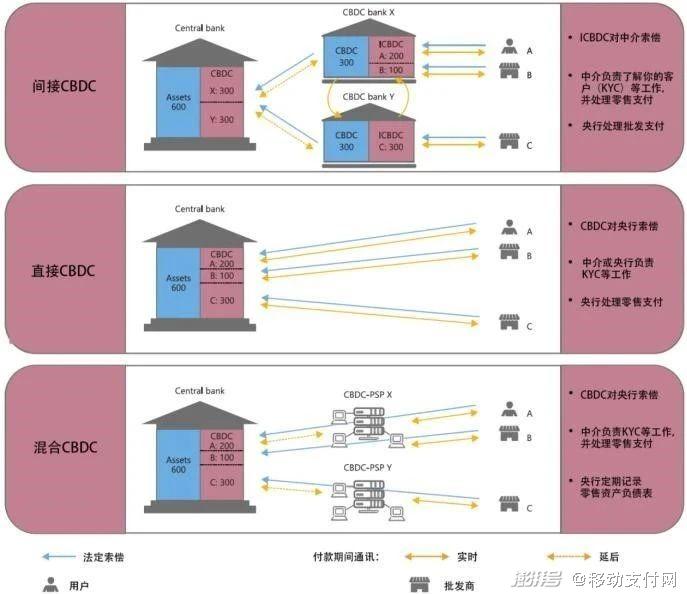
Zou Chuanwei, chief economist of Wanxiang Blockchain, issued an article stating that the digital renminbi has the characteristics of a linked exchange rate system and indirect CBDC. How to understand it?
The overall operating framework of digital renminbi adopts a two-tier operating system of "central bank-commercial bank/commercial bank-public". The central bank occupies a central position in the digital renminbi system and is responsible for wholesale of digital renminbi to designated commercial banks and full life cycle management. Commercial banks and other institutions are responsible for providing digital renminbi exchange and circulation services to the public.
Among them, the central bank has chosen commercial banks with relatively strong strengths in capital and technology as designated operating institutions (currently six major banks) to take the lead in providing digital RMB exchange services. Commercial banks pay 100% reserves to the central bank. When issuing digital renminbi, the central bank will issue the digital renminbi to the bank treasury of the commercial bank, and at the same time deduct an equal amount from the commercial bank's reserves, and then the commercial bank will exchange the digital renminbi to the public.
In his view, the designated operating institution will be similar to a note-issuing bank under a linked exchange rate system, or a CBDC bank in an indirect CBDC. The digital renminbi is issued based on the deposit reserves of designated operating institutions at the People's Bank of China. This part of the reserve is similar to the foreign exchange reserves under the linked exchange rate system. Deposit reserves used to support the issuance of digital renminbi will no longer be included in the deposit reserve assessment of designated operating institutions by the People's Bank of China. Designated operating institutions can obtain a "Certificate of Preparation" or "Letter of Comfort" issued by the People's Bank of China. Such a "certificate of provision" or "comfort letter" would be similar to the Hong Kong Monetary Authority's certificate of indebtedness and would have the status of central bank currency.
In fact, the author agrees with the view that digital renminbi has some characteristics of a "linked exchange rate system", but there is no direct connection between the two, and the most important "exchange rate" of the "linked exchange rate system" is not reflected in the digital renminbi system. If 100% reserve funds can also be regarded as a 1:1 exchange, then does 100% of the reserve funds deposited by third-party payment institutions also have the characteristics of a "linked exchange rate system"?
Therefore, the positioning of digital renminbi as a legal digital currency is certain. The central bank is the issuing institution of digital renminbi. The so-called "tokens" and the statement that the six major banks are "note-issuing banks" are essentially inaccurate.
Is synthetic CBDC a central bank digital currency?
Yao Qian, director of the Science and Technology Supervision Bureau of the China Securities Regulatory Commission and former director of the Central Bank's Digital Currency Research Institute, once wrote that the 100% reserve model is the central bank's digital currency model advocated by some scholars in recent years, citing the Hong Kong note-issuing bank model as its practical basis.
They believe that an agency operating agency deposits 100% reserve funds with the central bank and then issues a corresponding amount of digital currency on its account book, which can be regarded as central bank digital currency. Economists from the International Monetary Fund such as Tobias Adrian call it Synthetic Central Bank Digital Currency (sCBDC).
In fact, central bank digital currencies can be divided into many types based on their scope of application, operational structure, value paradigm, etc., such as wholesale and retail types, account paradigms and certificate paradigms, as well as indirect, direct, hybrid CBDC, etc.