According to information released by both parties, the total investment in the first three industrial projects in the United States is approximately US$36 billion and is expected to create thousands of jobs.
The largest of these is a natural gas power plant in Ohio with a total investment of US$33 billion and an installed capacity of 9.2 GW. According to reports, the project is led by Japan's SoftBank Group and is expected to power artificial intelligence data centers. The other two projects are a $2.1 billion deepwater crude oil export facility in Texas and a $600 million industrial synthetic diamond plant in Georgia.
On the 17th, Trump posted a post on his self-created social media platform "Real Social" praising relevant investments, saying that "America is rebuilding" and added that these projects "cannot be separated from a very special word – tariffs."
Japan has also shown a positive attitude towards this. Japanese Prime Minister Takaichi Sanae claimed on social media that these investments will strengthen the U.S.-Japan alliance, saying that related projects "are expected to bring sales growth and business expansion to Japanese companies through the supply of supporting equipment."
The United States and Japan reached a trade agreement framework in July last year, with Japan committing to provide financial support for U.S. projects in key areas through direct investment, loans or state guarantees by 2029; in exchange, the United States reduced the originally planned 25% tariff on Japanese exports to 15%.
Since the agreement was reached, the United States and Japan have been negotiating on investment mechanisms and candidate projects. However, in the past few months, negotiations on how to use the US$550 billion in funds have not been progressing smoothly. There have been heated discussions in Japan about how to raise such a large amount of funds, and the United States has continued to urge Japan to come up with specific investment plans.
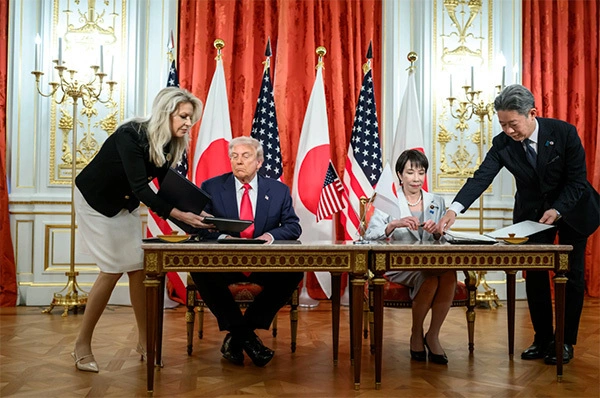
In October 2025, Trump and Sanae Takaichi met in Tokyo. white house website
U.S. media said Trump threatened to raise tariffs on South Korea last month, accusing South Korea of failing to quickly advance the approval process for a trade agreement with the United States. Against the background of intensifying geo-economic pressure, Japan also hopes to avoid becoming the next target of Trump's tariff policy.
William Chou, a senior fellow at the Hudson Institute, an American think tank, analyzed that Japan “understands that it must show visible progress.” He pointed out that without these investment announcements, "it is difficult to predict what actions Trump will take – whether he threatens to impose 25% tariffs or sends out a few tweets on social media."
In his view, the Japanese side believes that since Trump and the high market currently have a "good atmosphere", they have no reason to gamble on uncertainty.
The British "Financial Times" stated that Trump has the final say on which projects can receive Japanese investment and has set a maximum period of 45 working days from the announcement of the project to the receipt of funds. Once Japan delays or refuses investment, it may face additional tariffs or "compensatory" fines.
David Bolling, head of the Asia Group, said that for Japan and other countries, the threat of tariffs is one of the important motivations for committing to invest in the United States. "Under normal circumstances, would they do this? Probably not."
Bolling noted that while officials, including those from Japan, try to portray investment decisions as purely strategic considerations, practical factors are equally critical. For Japan, maintaining good trade relations between the United States and Japan is obviously a top priority.
Sanae Takaichi was confirmed as the 105th Prime Minister of Japan on the 18th and plans to visit the United States in March. Two people familiar with the matter told the New York Times that during Gao Shi’s visit to the United States, Japan intends to announce more investment projects to consolidate Japan-U.S. relations.
Akasawa Ryomasa, the Japanese Minister of Economic Revitalization who is responsible for trade negotiations with the United States, has repeatedly described investment in the United States as a "win-win". However, within some Japanese business circles and policy financial institutions, they are more cautious in their evaluation of these projects, bluntly saying that they are of "strategic significance, but limited profitability."
In addition, Japan's investment decisions are also affected by the uncertain judicial process in the United States. The U.S. Supreme Court is expected to rule in the coming months on whether Trump's invocation of the International Emergency Economic Powers Act (IEEPA) to impose tariffs is legal. Previously, foreign media claimed that some countries and regions that have reached agreements with the United States are delaying their investment commitments, pending the ruling of the U.S. Supreme Court.


![[Netherlands] France Turns To The Netherlands To Support Its Military Operations-Lijin Finance](https://www.erbetc.com/wp-content/uploads/2026/03/1773277663261_0.webp)
