Finance and economics colleges have always been a popular school for college entrance examination applicants. It seems that as long as you enter a finance and economics college, you will have a high income in the future. So what is the income of graduates from finance and economics colleges? What are the better universities for finance and economics? Come and take a look at the top ten finance and economics universities in China and their top majors with Teng Yuanjun!
Professional introduction
Finance majors are mainly divided into two categories: the first category is economics, and the second category is management. These two categories are collectively referred to as "economic and management categories".
Economics includes undergraduate majors such as economics, economic statistics, finance, taxation, financial engineering, finance, investment, insurance, international economics and trade, and national economic management.
Majors related to management and finance are mainly included in the category of business administration. Majors included include business administration, marketing, accounting, financial management, auditing, international business, asset valuation, etc.
Employment prospects
The employment directions for graduates majoring in finance include the following five:
Government agencies and institutions.
The Ministry of Finance, the State Administration of Taxation, the People's Bank of China, the China Banking and Insurance Regulatory Commission, the China Securities Regulatory Commission and their affiliated units, local branches and provincial and municipal financial departments at all levels, Shanghai Stock Exchange, Shenzhen Stock Exchange, etc.
Government agencies and public institutions are called "the end of the universe" by people in the world. They have high social status, good company benefits, stable jobs, and room for future development. However, the overall salary is average, and the treatment of self-financed public institutions is more market-oriented. Depending on the field of department management, finance and economics graduates can choose to engage in highly professional finance-related jobs or general administrative management jobs. Recruitment by government agencies and public institutions has strict professional restrictions, but it is relatively friendly to students majoring in finance and economics. There are relatively many departments and positions with corresponding majors.
Banking financial institutions.
Industrial and Commercial Bank of China, Agricultural Bank of China, Bank of Communications, China Merchants Bank, CITIC Bank, Shanghai Pudong Development Bank, etc.
Banks are the backbone of the financial industry and the hub for capital movement. They are large in scale, widely distributed in areas, and have complex organizational levels. The work intensity and remuneration packages at different levels, regions, and positions also vary greatly. Generally speaking, the head office has the highest recruitment requirements and better benefits. The income of branches in first-tier cities is more competitive. The front office income within the same level is greater than that of the middle and back offices. Of course, the pressure on performance indicators is also greater. Generally speaking, the salary package of banks is higher than that of ordinary non-financial enterprises and institutions, and the work intensity is also relatively moderate. Therefore, it is also one of the industries that attracts the largest number of finance graduates every year.
Non-bank financial institutions.
Fund companies, securities companies, insurance companies, trust companies, and other non-bank financial institutions (futures companies, financial leasing companies, AMCs).
Non-bank financial institutions are an important part of my country's financial system, including all other financial institutions except banks. Non-bank financial institutions are more subdivided. Generally speaking, non-bank financial institutions have a high degree of marketization, fierce business competition, and obvious performance orientation. Their salaries are at a leading level in the financial industry, and their work intensity is also greater. Recruitment thresholds for non-banks such as funds and securities firms are relatively high. School background and internship experience are more important. Those with mixed backgrounds have an advantage. After rapid development in recent years, non-bank financial institutions, like the banking industry, have gradually entered an era of stock competition, with an obvious trend of increasing concentration among leading institutions. It should be noted that market-oriented competition also means that non-bank financial institutions have relatively large differences in personnel mobility and internal performance. Graduates need to be carefully screened when choosing employment.
Intermediary service structure.
Accounting firms, credit rating agencies, asset appraisal agencies, consulting agencies, etc.
The main business of such intermediary service agencies is relatively focused and highly professional, and they provide professional services to different market entities in their respective fields.
Non-financial businesses.
Central enterprises, state-owned enterprises, private enterprises, joint ventures, foreign-invested enterprises, etc.
Non-financial enterprises are all types of enterprises except financial institutions and are the main force in manufacturing and providing services in the economy and society. In terms of ownership nature, it can be divided into central enterprises, state-owned enterprises, private enterprises, joint ventures, foreign-invested enterprises, etc. For graduates majoring in finance and economics, positions in finance, taxation, product, sales, and administrative management in non-financial enterprises are also available. Salaries and benefits are determined by the company and industry in which they work. In recent years, with the rapid development of the Internet, FMCG, new media and other industries, outstanding companies such as Internet companies have also become the employment goals of many finance and economics students.
College rankings
How many of the top 10 finance and economics colleges in China do you know? Do you know their admission scores? Let’s take a look!
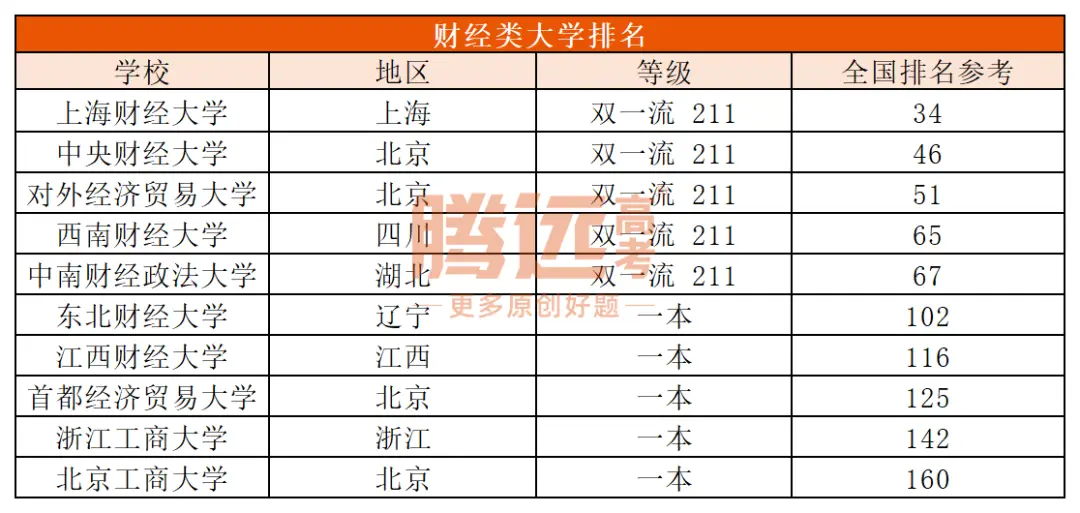
University rankings refer to soft subject data
School introduction
Shanghai University of Finance and Economics
Ranked first in China’s financial rankings. It is a multi-disciplinary national key university directly under the Ministry of Education of the People's Republic of China that focuses on economics and management and coordinates the development of law, liberal arts and science. It is a key construction university of the national "211 Project" and "985 Project Advantageous Discipline Innovation Platform".
Recommended majors: Finance, Accounting, Financial Engineering, Economics, and Public Finance.
Employment situation: The implementation rate of graduation destination in 2021 was 94.69%, of which 70.90% chose employment in domestic units, 15.35% chose to study domestically, and the remaining 8.44% chose to study abroad or find employment.
central university of finance and economics
Ranked second in China’s financial rankings. Referred to as "Central University of Finance and Economics", it is a national "world-class discipline construction university", a national "211 Project" and the first batch of "985 Project Advantageous Discipline Innovation Platform" construction universities, and is known as the "cradle of China's financial management experts."
Recommended majors: Finance, Accounting, Financial Engineering, Finance, Investment
Employment situation: The overall employment rate of central finance undergraduate students in the 2020 class is 86.71%, the overall employment rate of master's students is 96.3%, and the employment rate of doctoral students is 98.11%.
University of International Business and Economics
Ranked third in China’s financial rankings. It is a national key university directly under the Ministry of Education of the People's Republic of China and a national "World-class Discipline Construction University" and "211 Project" construction university. The school has 28 national-level first-class undergraduate major construction sites.
Recommended majors: International Economics and Trade, Finance, Accounting
Employment situation: The employment units of 2021 graduates are mainly concentrated in the financial industry, accounting for 18.36% of undergraduates and 43.08% of master's students. The banking industry is most preferred at the undergraduate and master's level, and the securities industry is most preferred by doctoral students. In addition, more than a quarter of UIBE graduates in 2021 will enter the Fortune Global 500.
Southwestern University of Finance and Economics
Ranked fourth in China’s financial rankings. Located in Chengdu, it is a university directly under the Ministry of Education of the People's Republic of China, a national "World-class Discipline Construction University", a university jointly built by the Ministry of Education and Sichuan Province, and a national "211 Project" and "985 Project Advantageous Discipline Innovation Platform" construction university.
Recommended majors: Finance, Actuarial Science, Accounting, Statistics
Employment situation: The industry with the most employment destinations for the school's 2022 undergraduates is the financial industry, accounting for 27.77%, followed by the information technology service industry, accounting for 11.06%; the most popular employment destinations for master's students are also the finance industry, accounting for 37.20%, followed by public administration, social security and social organizations; the most popular employment destinations for doctoral students are education, accounting for 81%.
Zhongnan University of Economics and Law
Ranked fifth in China’s financial rankings. It is jointly built by the Ministry of Education, the Ministry of Finance and the Hubei Provincial People's Government. It is a key university under the national "211 Project" and "985 Project Advantageous Discipline Innovation Platform" projects. It has 4 national key disciplines and 1 national key (cultivation) discipline.
Recommended majors: Law, Economics, Finance, Administration, Accounting, Finance
Employment situation: The employment industries of the school's 2021 graduates are concentrated in the "financial industry", followed by the "information transmission, software and information technology service industry", "public administration, social security and social organizations" and "education" fields.
Dongbei University of Finance and Economics
Ranked sixth in China’s financial rankings. Located in the beautiful coastal city of Dalian, Liaoning Province, it is a research university that highlights the advantages and characteristics of economics and management and coordinates the development of economics, management, law and other disciplines. It has 4 national key disciplines (including 1 cultivation discipline).
Recommended majors: Finance, Accounting, Industrial Economics, Quantitative Economics
Employment situation: As of 2022, the employment implementation rate is 85.32%. The main industries engaged in by the 2022 undergraduate and master's degree graduates are all in the financial industry (16.26% and 25.93% respectively), and the main occupations are finance, auditing, taxation, and statistics.
Jiangxi University of Finance and Economics
Ranked seventh in China’s financial rankings. Referred to as "Jiangcai", it is located in Nanchang City, Jiangxi Province. Currently, the school has four campuses: Jiaoqiao Park, Mailu Park, Fenglin Park, and Qingshan Park (excluding the Gongqing Campus of the independent college). It has one national key cultivation discipline, with finance, marketing, accounting, information management and information systems, finance, and law as its national characteristic majors.
Recommended majors: Finance, Accounting, Finance
Employment situation: The overall employment implementation rate for undergraduate students is 80.90%.
capital university of economics and business
Ranked eighth in China’s financial rankings. Referred to as "Shou Economic and Trade", it is located in Beijing. It is a key high-level research university in Beijing with economics and management as its important features and outstanding advantages, and multi-disciplinary support and coordinated development such as law, literature, science and engineering.
Recommended majors: Financial management, finance, economics, finance, asset evaluation
Employment situation: The overall employment implementation rate is 88.95%.
Zhejiang Gongshang University
Ranked ninth in China’s financial rankings. Referred to as "Zheshang University", it is located in Hangzhou City, Zhejiang Province. The school consists of three campuses: Xiasha, Jiaogong Road and Tonglu. It focuses on economics and management disciplines, with coordinated development of multiple disciplines such as law and engineering. Statistics, business administration, food quality and safety, accounting, and computer science and technology are national-level specialty majors.
Recommended majors: Business Administration, Statistics, Auditing
Employment situation: The overall employment rate is 90.79%.
Beijing Technology and Business University
Ranked tenth in China’s financial rankings. "Beijing University of Technology and Commerce" for short, is a multi-disciplinary university under construction in Beijing. It is a multi-disciplinary university with economics, management, engineering, science, liberal arts, law, history and other disciplines supporting each other and developing in a coordinated manner. Currently, it has two campuses, Fucheng Road and Liangxiang.
Recommended major: Business Administration
Employment situation: The overall employment implementation rate for undergraduate students is 78.2%.