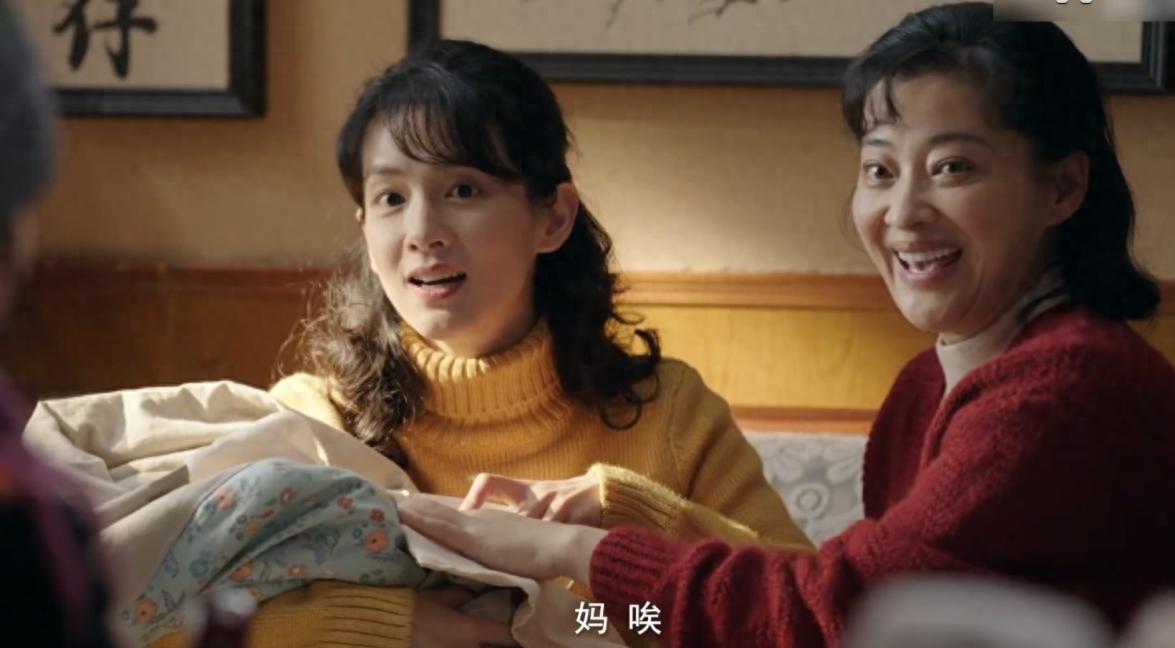
"The kids from the two families are in trouble when they get together."
"But I feel warm and savory in my heart."
As soon as Mei Ting's lines of dialogue came out, it had the flavor of a drama that would mark the beginning of the Year of the Horse.
Among the popular dramas during the Spring Festival, history, costume detectives, suspense, criminal investigation… There are all popular themes on the screen in recent years, but there is still a lack of a genre that is suitable for all ages, period dramas.
From "In the World", which revived period dramas, to the hit "South and North" the year before last, and even last year's "Six Sisters"…
Period dramas rely on the broadest audience base and content that arouses emotional resonance among the audience, setting off a wave of "national drama watching" and "discussing across generations" during the Spring Festival again and again.
During the Chinese New Year season this year, which period drama is likely to become the next hit?
CCTV has prepared three period dramas at once: CCTV eight episodes of "When Time Has Love" on the evening of February 20, starring Huang Jingyu and Guan Xiaotong.
"Love in the Age of Innocence" premiered on the evening of February 21st, starring Chen Feiyu and Sun Qian.
But what I am personally most optimistic about is the one that has just been released——
On February 23 (the seventh day of the Lunar New Year), CCTV will launch a 40-episode family drama – "Good Times" directed by Liu Jiacheng and starring Mei Ting, Tian Yu, Chen Haoyu and Li Xueqin.
It was originally planned as a custom-made drama for Hunan Satellite TV, but it was aired on CCTV's prime time Spring Festival slot as a Lunar New Year drama. It obviously has something to it.
Could it really be the next "In the World"? At least, is it a family reorganization version of "Parental Love"?
Let's take a look at this "good time" together.
1: Introduction
"Life is going smoothly and comfortably these days, but two people are still better than one."
"I wish our family better and better days."
These are two lines from the trailer for "Good Times."
Watching the scene in the play where firecrackers go off and families sit around and toast, these two lines touched me during the Spring Festival.
As a Chinese New Year, it means going home.
No matter whether you are prosperous outside or lonely and silent, when you return to your hometown, you will always see the big girls or big cows from the village wearing big coats and eating melon seeds at the entrance of the village.
People go to other places, and everyone has their own dreams, but I think everyone also has one wish in their heart, which is to live a comfortable life.
I go home during the Chinese New Year, sit around a table, chat about what needs to be said, and call my parents.
For those who work outside the home, nostalgia is the most intense at this time of the year. It is also at this time that parents most want to feel the warmth of their loved ones.
Hidden in the firewood, rice, oil and salt is the healing presence.
In the ordinary years, the warmth of time is conveyed.
The family romance drama "Good Time" of the 1990s is airing at this time, which can send some warmth in the winter.
2: Story
"Actually, let's be together. It's quite suitable. One is without a man, and the other is without a woman."
The person who said this is Zhuang Xianxian (played by Tian Yu), a machine factory worker.
He reorganized a family of seven with song and dance troupe actor Su Xiaoman (played by Mei Ting). This play is about the warm daily life of this family of seven supporting each other during the changes of the times such as the restructuring of state-owned enterprises and laid-off and re-employment.
The whole play is set from the late 1970s to the new millennium. The ups and downs of this family's fate also bear witness to China's 30 years of social changes.
Combined with the trailer, the series has at least two core highlights:
The first is to focus on the ups and downs of reorganizing a family, which is real and heart-breaking.
The Spring Festival family dramas of the past few years, from "In the World" to "Six Sisters", all tell the story of the original family.
So what happens if it is a reorganized family?
"Good Time" tells such a story.
The story begins in a small southwest town in the late 1970s.
Zhuang Xianjin, a machine factory worker, originally lived with his two sons and one daughter.
Song and dance troupe actor Su Xiaoman grew up raising a son and a daughter alone.
Two middle-aged people who have been polished by life, without a vigorous love, just want to give their children a complete home, and they form a family of seven crowded in the staff dormitory.
This half-way couple actually interprets the simple romance of middle-aged love.
But marriage is never a matter of two people, let alone a remarried family.
Zhuang Haohao, the eldest daughter of Zhuang, played by Chen Haoyu, was the first to stand up against her father's remarriage.
If the objection is ineffective, then object again at the dinner table of a family of seven.
Opposition alone was not enough, so the two families started fighting on the street.
Finally, she got married despite the objections of her children.
Life was going very fast. When the family was having dinner, the banker's kid threw a basketball on the table, overturning the whole family's dining table.
"The first move he made was towards an outsider."
"My father was wronged by Mo Xue for so many years, but you only thought about remarrying."
"From now on, our family will have a stepmother and a stepfather. We no longer have a biological father."
Just seeing these lines and clips in the trailer is breathtaking, real and heart-breaking.
If the running-in of the five children can be called a "record of the survival of a reorganized family", then there are even more heart-wrenching things, such as the childhood romance between Zhuang Xuexue (played by Liu Yitie) and Wang Yuanyuan (played by Zhang Yue), which came to an abrupt end due to the union of their parents.
Each of the five children has his own little plan, and the twists and turns of life have added fuel and jealousy to the quarrels between the two families that have become one family.
In the end, these grievances and hatreds are not worth the reconciliation of fate and the family ties established in life.
The second is the ups and downs of the personal fate of the banker's family of seven in the era.
In the play, the experiences of the seven members of the banker family have gone through many twists and turns, and their fate is intertwined with the times.
Their identities, experiences, and stories are the epitome of the reality of ordinary people in China at that time, which also makes it easy for the audience to resonate with the experiences and emotions of the characters in the play.
For example, Chen Haoyu plays the eldest daughter Zhuang Haohao, who goes from being a conductor at a passenger terminal to a resident singer in a dance hall, and then establishing the brand "Haohao Haohao" and becoming a trendsetter in the individual economy.
At home, she also changed from the one who took the lead in making troubles to the "fixing star" in reorganizing the family.
Another example is Zhuang Xianjin's apprentice Liu Cheng, played by Su Xiaoding, who became the first college student in the factory. He unsuccessfully pursued Zhuang Xianjin's daughter Zhuang Haohao, but married Su Xiaoman's daughter.
Fang Liang, played by Wang Renjun, stands at the forefront of the times and frequently meets with foreign businessmen.
It is not difficult to see that the play focuses on the joys and sorrows and the ups and downs of fate of the villagers, supplemented by a strong realism background, thus outlining the changes in the family life of ordinary workers after the factory was restructured.
The story capacity of the 40-episode period drama is full.
3: Lineup
A good story cannot be separated from a good screenwriter, a good director, and a good actor.
Liu Jiacheng, the director of "Good Time", is famous for his masterpieces "Love in the Courtyard" and "The Little Girl at the Zhengyang Gate", which are recognized as masterpieces of period dramas. Last year's annual hit "All Things" has become his latest masterpiece.
This ace director of period dramas knows best how to make the fireworks of the period realistic and moving.
In order to create a distinctive group image, the series also invited a group of powerful actors, who must have good looks and acting skills.
The first is the absolute leading role, Mei Ting, who plays Su Xiaoman.
Mei Ting has been a master of period dramas since her debut.
In addition to An Jie in "Parents' Love", there are also the eldest sister He Jiali in "Six Sisters", Zhang Qinqin in "The Tree of Life",
She is very familiar with period dramas and has long been recognized by the public for her character creation.
It can even be said that as long as there are period dramas in which she appears, the ratings will be the same.
This time she plays Su Xiaoman, a former song and dance troupe actor, a woman who insists on remarrying with her children in pursuit of happiness.
Faced with her children's complaints, Mei Ting did not have too much emotion, but that feeling of grievance and forbearance was exactly the state of many parents in reorganized families.
And a scene of dancing at home uses graceful figures to express the gap between dreams and reality.
Give her this role, it's safe.
Let’s talk about Tian Yu who plays Zhuang Xianxian.
In recent years, the acting skills of this golden supporting actor in Chinese dramas have long been recognized by the audience. As a versatile actor in Chinese dramas, his characteristic is that he can act in any genre and can play with anyone.
This time, he plays Zhuang Xianxian, an ordinary worker who takes care of his family.
In the trailer, there is a scene where Mei Ting is fascinated while clapping her hands while looking at her dancing, which brings to life the warm daily life of a middle-aged couple.
The helplessness faced by her rebellious daughter is equally empathetic.
In the past few major dramas during the Spring Festival period, basically all the characters that appeared were bad fathers. This time the audience finally saw a good father.
In addition to the love between the parents, what is surprising is that all the other actors are also good-looking, good at acting, and full of joy.
For example, Chen Haoyu, who plays the eldest daughter Zhuang Haoyu, has an eye-catching look in the play.
In recent years, she has gained a lot of popularity due to Sister Lang. She showed stable acting skills when she played the role of Xiao Zhou in "Jiuzhou Piaomiao Lu".
This time she plays the most outstanding role among her generation. The shouting scene at the seaside made people excited. I hope she seizes the opportunity of this period drama during the Spring Festival and breaks out of the industry.
Li Xueqin, who plays the role of the Hutong pistachio "Ye Aihua", speaks a Northeastern dialect with a sense of joy.
In the play, she chases Zhuang Xianxian, played by Tian Yu, and is ultimately defeated by Mei Ting, but she always has a happy expression on her face. It seems that she will be a lovable character in the play.
There is also Zhang Yue, who plays Su Xiaoman's daughter. Her love affair with Zhuang Xuezi was interrupted because of her parents' union, and she finally married Liu Cheng, a college student who unsuccessfully pursued Zhuang Haohao.
It is estimated that he will be a character who can provoke dramatic conflicts.
In addition, there are Liu Yitie, Wang Renjun, Su Xiaoding and other period drama regulars, and their acting skills are stable again.
4: Odds of winning
In addition to the plot and cast, many of the period elements of the play are also full of period feeling.
In the trailer, accompanied by long music, the crew built a real-life machinery factory and family courtyard, as well as replica food stamps, butterfly sewing machines, enamel washbasins, 28-year-old bicycles, blue cotton-padded jackets and other old objects, as well as the familiar song and dance hall in "Old Uncle". Every frame carries the youthful memories of the fathers.
The Tao of Service is full of details, and the memories are poignant. The scene highlights the characteristics of the era and also highlights the tremendous changes in China in those 30 years.
From this, we can also see that director Liu Jiacheng has continued the market aesthetics from "Love in the Courtyard" to this day.
The integration of era propositions such as factory restructuring into daily necessities is reminiscent of the changing times in "The Creation of All Things".
It can be said that the series is full of odds.
The biggest chance of winning is the flavor of the year revealed in the play.
From the trivial matters of firewood, rice, oil and salt, to the slapstick growth of the five children, from the lively fireworks in the factory area, to the changes in life under the wave of reform and opening up, every scene feels like the audience is watching the story of their own home.
The most touching thing is the life of a family, the mutual help between neighbors, the mutual support between husband and wife, and the struggle and concern of the children when they grow up.
The sincere feelings between people in the past era can always bring the audience back to that pure and beautiful era.
People of different generations have different feelings about these scenes in the play. Older viewers may see their own past or childhood. Younger viewers, on the other hand, see the past of their elders.
No matter how you feel, "Good Time" tells the story of a family and every Chinese. I hope it can move everyone and bring warmth to everyone during the Spring Festival of the Year of the Horse.
Because nostalgia has the power to heal.
The so-called "good time" is not a great day, but a family together, making ordinary days warm and warm.
Life is full of vegetation and autumn. Going south and north, winter goes and spring comes!
Celebrating the New Year with family is a good time.