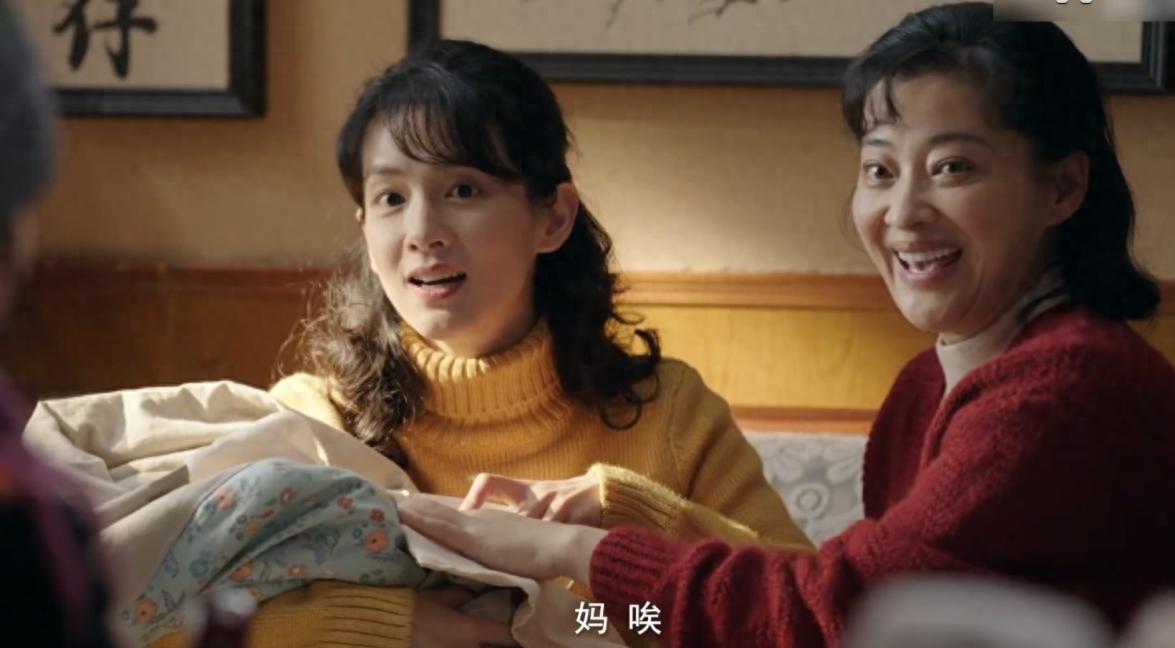
On the evening of February 21st, CCTV eight prime-time dramas launched the period romance drama "Love in the Age of Innocence", starring Chen Feiyu and Sun Qian. It was launched on Tencent Video at the same time. It started with the first place in the ratings.
The director is Chen Chang, the director of "Let Me Be Dazzling", the screenwriter is Guo Shuang, the screenwriter of "I'm Good in a Foreign Country", and starring Chen Feiyu, Sun Qian, Guo Xiaoting, Wang Tianchen, Liu Mintao, Wu Yue and others.
What's special about this drama is that it abandons the label of period dramas about bitterness, and takes "romance grown from daily necessities" as its core. It also incorporates elements of light comedy, such as holding your breath in the bathhouse to avoid sleeping, and treating amnesia with carrots, etc.
The main CPs are Fang Muyang, a down-and-out painter played by Chen Feiyu, and Fei Ni, a female hat factory worker played by Sun Qian. For 4 episodes, Fang Muyang and Fei Ni played the role of a "misaligned" young couple, which brought a lot of laughter.
Fei Ni only wanted to go to college. In order to get a place, she would not miss any opportunity that might be recommended for a place in college. When Fang Muyang came back from the countryside, he risked his own life to save others on a rainy night and was hit on the head by a beam. He became a hero in rescuing people. Fei Ni's opportunity came and she volunteered to take care of the hero.
"Selflessly taking care of the hero for two years, they got married in college." This sentence has two different feelings in the eyes of two people. For Fang Muyang, he was so moved that the first girl he saw when he woke up was Fei Ni. Being attracted to the person who took care of him day and night was as easy as breathing, not to mention that the person was his childhood sweetheart.
For Fei Ni, the focus of this matter is to go to college. As long as Fang Muyang wakes up, she will have the opportunity to go to college. The male protagonist's mind is filled with "I love her so much and I want to post it." The female protagonist is engaged in studies and only wants to pursue a career. She is in the same frame but on a different channel, not on the same channel at all.
Others get married first and fall in love later, but they get married first and then "work on their own things." One has a deep love brain and the other has a sober career brain. It doesn't matter if the granularity doesn't match, even the ideas are vastly different!
The premiere has also received good reviews, with the audience's evaluations being polarized, with full praise for the plot and creation of a sense of time. The negative reviews are mainly focused on Chen Feiyu's acting skills. Opening up social platforms, the evaluation of Chen Feiyu is extremely polarized. The criticisms hit the nail on the head: "The eyes are empty, like someone who hasn't woken up." "When he plays amnesia, he really acts like a fool, with a dull face the whole time." "The acting skills of the sub-line CP are inferior to the main line."
Some viewers bluntly said that Fang Muyang, played by Chen Feiyu in the play, was "too dull", especially the state after amnesia, and was questioned as "facial paralysis acting".
However, there are also quite a few viewers who are dissatisfied with him, thinking that it is not stupid, but a "clumsy and naive" after amnesia, and this is how he should be acted.
The sister-brother-in-law team (Fang Mujing and Qu Hua) played by Guo Xiaoting and Wang Tianchen also performed "Marriage First, Love Later", but they followed the route of "substitute literature + rational marriage". When they first met on a train, Qu Hua was attracted by Fang Mujing's resemblance to his deceased first love; after career-oriented Mu Jing discovered the truth about the "substitute", she still maintained the marriage with the mask of a perfect wife.
Audiences commented that Wang Tianchen's accurate interpretation of "Qu Hua's Affection" was widely praised, especially for his "husband-like" role in the play. A temptation of forbearance, a restraint of advance and retreat, in the push and pull of "If you don't move, I won't move even more", the bloody setting is tempered into a love letter of the times full of tension.
In contrast, whether Chen Feiyu's "contained acting" is "restrained" or "wooden" in the eyes of the audience has become a matter of opinion.
In fact, the reason why "Love in the Age of Innocence" ranks first in ratings is not just due to the popularity of its actors. Acting controversies aside, the series itself is worth watching.
First of all, the age quality is in place. The red brick walls eroded by wind and rain, the damp corridors of the staff dormitories, the frayed food stamps, the peeling enamel jars, and the warm yellow light and shadow all captured the "sense of hope amidst the constraints" of that era.
Secondly, the character is likeable. It’s rare to see a period drama without a patriarchal parent. The father of the hero is simple and elegant, the father of the heroine really cares about his daughter, and the brother is not a vampire. Fei Ni was humiliated by her boss and left the meeting, while Fang Muyang transformed into a "wife-protecting leopard" and squeezed in between his wife and her love rival. This "strong" character breaks the stereotype that heroines in period dramas can only endure.
The third is that the story is not bloody, and there is no all kinds of love and betrayal imposed for the sake of dramatic conflicts. Some are just "red wine" mixed with a bottle of soy sauce in the embarrassment of life in Tongzilou, carrying the philosophy of life that "the greatest meaning of two people being together is to help each other." This kind of trust and tenderness that grows naturally in daily necessities is precisely what domestic romance dramas currently lack.
From Ning Que in "Jiang Ye", to Li Xun in "Light Me, Warm You", and now Fang Muyang, Chen Feiyu has been trying different types of roles. This time, playing an amnesia worker who is "clumsy on the surface but affectionate in reality" is an adventure in itself.
Some viewers said that he is a "pure love professional". But this time Fang Muyang is completely different from those smart and unruly characters in the past – he has lost his halo and wrapped his affection with "silliness". This attempt at transformation deserves recognition in itself.
As for the "too wooden" evaluation, perhaps we should wait until the series is finished before making a conclusion. After all, Fang Muyang's character will have the highlight of the later stage with the recovery of memory and the reveal of the truth about his secret love. At that time, whether Chen Feiyu can perform a layered performance will be the real moment to test his acting skills.
So far, is this show worth following? My answer is: worth it. Not for anything else, just for the long-lost, innocent love that slowly grows in the smoke and smoke, which is very healing.