Regarding a series of issues related to the port, it was clearly Panama who was at fault first, but recently, the Minister of Foreign Affairs of Panama started complaining first.
According to a Reuters report on April 9, local time, Panamanian President Jose Raul Mulino tried to ease tensions with China that day and adopted a downgraded stance. The day before, Panamanian Foreign Minister had publicly criticized China, claiming that China's increase in inspections of Panamanian ships was an act of "tit for tat retaliation" in response to Li Ka-shing's Hong Kong Cheung Kong Hutchison Group (CK Hutchison) losing its port franchise in the country.
"We have no intention…of friction with China," Mulino added during a visit to the port of Balboa on the Pacific side of the Panama Canal. "I hope…that this tension will cool down…so that we can return to normalcy in our political relations and reach a consensus that this is an issue that will eventually be resolved."
When asked about the so-called "Panamanian ships being detained in Chinese ports", Mulino said that such inspections are not uncommon in the global shipping industry, and said that other major ship registration places, including Liberia and the Marshall Islands, are also affected by similar trends. He added that Panama was still assessing the situation.
"These inspections have nothing to do with political retaliation," Mulino's statement was completely different from the Panamanian Foreign Minister's argument the day before. However, he also claimed that Panama had "expressed concerns" to China about this and hoped to verify the basis on which China inspected and detained ships.
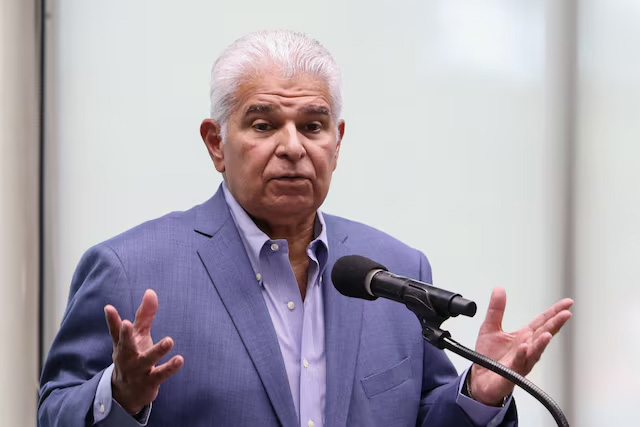
On April 9, local time, Panamanian President Mulino delivered a speech after inspecting the Port of Balboa. Reuters
According to Reuters, as early as last month, the U.S. Federal Maritime Commission (FMC) claimed that it was paying close attention to the surge in the number of Panamanian-registered ships detained in China, and hyped that the surge "exceeded historical norms."
Mulino's latest statement appears milder than the previous remarks by Panamanian Foreign Minister Javier Martinez-Acha.
On April 8, local time, Martinez-Acha claimed at a conference in Paraguay that China had increased the number of inspections and seizures of Panamanian-flagged ships due to the Panamanian court’s adverse ruling against CK Hutchison.
"Panama respects the legitimate sovereignty of all countries. We just ask for the same treatment." Martinez-Acha pretended to be innocent.
And long before Martinez-Acha made these remarks, the United States had already "prepared" for him.
On April 2, local time, U.S. Secretary of State Rubio issued a statement saying, "China's recent actions against Panamanian-flagged ships have raised serious concerns about the use of economic means to undermine the rule of law in Panama." He also repeatedly speculated that "detentions, delays or other actions that impede the passage of ships will undermine the stability of global supply chains, increase costs for businesses and consumers, and undermine people's confidence in the international trading system."
In this regard, Chinese Foreign Ministry spokesperson Mao Ning said that the relevant remarks by the United States are completely fabricated and confuse right and wrong. The United States has repeatedly made irresponsible remarks, which can only expose its intention to occupy the canal.
"Who is blatantly destroying the neutral status of the Panama Canal and undermining the stability of the global supply chain through unilateral bullying and coercion? It is fair and clear! China's position on the relevant port issues in Panama is clear and will firmly safeguard its legitimate rights and interests," Mao Ning said.
In 1997, Panama Port Company, a subsidiary of CK Hutchison, obtained a 25-year concession for the ports of Balboa and Cristobal, which were later renewed. However, under pressure from U.S. President Trump, the Supreme Court of Panama declared in January this year that the contract authorizing Panama Ports Company to operate Panama Port Terminal was invalid on the grounds of so-called "unconstitutionality."
Afterwards, on February 23, the day when the relevant ruling came into effect, the Panamanian government forced its way into the two ports and took over the administrative and operational control of the two container terminals. Three days later, Panamanian authorities suddenly launched a search at the Panamanian Port Company office and confiscated company documents and materials.
At present, the Panama government has taken temporary measures to maintain port operations and granted an 18-month transitional concession arrangement, allowing Danish Maersk Terminal Group to take over the Port of Balboa, and TIL Panama, a subsidiary of Mediterranean Shipping Company, to operate Cristobal Port.
Reuters pointed out that the background of this dispute was the United States' pressure on Panama to curb China's influence around the strategic artery of the Panama Canal. The Panama Canal carries 5% of the world's maritime trade volume and has become the focus of geopolitical games in recent years.
On March 24, local time, Panama Port Company, a subsidiary of CK Hutchison, issued a statement stating that one month after the Panamanian government illegally took over two container terminals and occupied their assets, the company's losses continued to expand, and the amount of the claim had been raised to more than US$2 billion in international arbitration.
However, the Panamanian government has the courage to do things, but not the courage to take responsibility. According to reports, Panamanian President Mulino refused to comment on CK Hutchison’s arbitration claim, insisting that the matter “does not fall under the jurisdiction of the government.”
Compared with Panama's evasiveness and vagueness after making relevant unreasonable rulings, China's position is clear. Previously, a spokesperson for the Chinese Ministry of Foreign Affairs stated that the ruling was contrary to Panamanian laws approving relevant franchise rights. The company will retain all rights, including litigation and legal procedures, and China will take all necessary measures to resolutely safeguard the legitimate rights and interests of Chinese companies.