
The Development Of Private Banks Accelerates: WeBank Takes The Lead, And Xishang Bank Is Approved For Establishment
The 19th private bank was approved to establish this time a bank targeting the Internet of Things - Banking Channel - Hexun.com
The 19th private bank was approved to establish this time a bank targeting the Internet of Things - Banking Channel - Hexun.com
In today's increasingly fierce academic involution, a nationally recognized higher education diploma has long become the "hard currency" for workplace promotion, public postgraduate entrance examinations, and professional title evaluation. For dream chasers in Yunnan, the higher education self-study examination has become the preferred path to self-improvement due to its flexible learning model and extremely high academic qualifications. However, the road to self-study exams is never smooth. Problems such as scattered test sites, changing policies, insufficient self-discipline, and no one to guide them have discouraged many candidates. At this time, choosing a professional and reliable self-study examination service organization has become the key to passing the customs - Yunnan Pan-Asia Self-study Education Service Center is the "academic escort" tailor-made for Yunnan self-study candidates.
Yunnan Pan-Asia Self-Study Education Service Center is a professional organization focusing on self-study education services. Its core service targets include all candidates from Kunming University of Science and Technology, Yunnan University, Yunnan Normal University, Yunnan University of Finance and Economics, Chinese People's Police University, Southwest Jiaotong University, Kunming Medical University and other higher education self-study examination institutions in Yunnan Province. Relying on high-quality undergraduate teaching resources, the center is deeply involved in the field of self-study examination services, breaking down barriers to self-study, and providing candidates with full-process and all-round education and teaching services, making the self-study examination journey more worry-free, more efficient, and more secure.
For self-study candidates, the biggest troubles are "blind preparation" and "no one to guide". Data from the Yunnan Provincial Education Examination Agency shows that the average pass rate for self-study exams is only 18%, and the pass rate for naked exams is as low as 15%. Many candidates are either unable to start with the heavy textbooks, have missed the policy changes, or have given up halfway due to lack of self-discipline. The Yunnan Pan-Asia Self-Study Education Service Center has accurately solved these pain points and built a "full-chain service system" to protect the entire process from registration consultation to successful graduation.
In the early stage of preparation for the exam, the center provides professional self-study registration consulting services, patiently answers candidates' questions about application requirements, major selection, examination procedures, school advantages, etc., assists candidates in completing the registration procedures, and accurately matches the colleges and majors that suit their career plans - whether it is Kunming University of Science and Technology. Whether it is science and engineering majors, education majors from Yunnan Normal University, economics and management majors from Yunnan University of Finance and Economics, medical majors from Kunming Medical University, or specialty majors from China People's Police University and Southwest Jiaotong University, candidates can find the most suitable improvement path for themselves under the guidance of the center.
During the preparation process, the center empowers candidates in all aspects to break the limitations of self-study. Different from the boring and inefficient traditional self-study, the center provides candidates with diversified learning support: exclusive teaching aids accurately fit the exam syllabus, sort out the core test points, and avoid blind reading; the live + recorded dual-mode course system allows repeated learning anytime, anywhere, and is suitable for The fragmented time of vocational candidates; professional tutoring software and question brushing software accurately target high-frequency test points, making the review more targeted; regular pre-exam tutoring and mock exams are organized to restore exam scenarios, help candidates become familiar with question types, check for omissions and fill in gaps, and improve test-taking abilities.
What’s even more considerate is that the center is equipped with a professional inspection and management team to provide daily inspection and promotion services, promptly reminding candidates of key information such as study progress, exam time, policy changes, etc., to help candidates overcome procrastination and maintain efficient preparation for the exam. At the same time, the complete student service and management system tracks the learning status of candidates throughout the process, and promptly answers various problems encountered during the learning process, so that candidates are no longer alone on the self-study exam, and truly have "someone to manage, someone to teach, and someone to help."
When it comes to improving your academic qualifications, choice is more important than hard work. For Yunnan candidates who want to improve their academic qualifications through self-study examinations, the Yunnan Pan-Asia Self-study Education Service Center is both a professional guide and a solid backing. Here, you don’t need to worry about unfamiliar policies, no way to prepare for the exam, and no need to endure the loneliness and confusion of preparing for the exam alone. Learning resources are at your fingertips, and professional services are with you throughout the process, allowing you to easily solve self-study problems and realize your academic dream efficiently.
If you are also eager to improve yourself and unlock new possibilities in life through self-examination, please take the initiative to contact us. Our professional team will tailor a preparation plan for you to help you successfully obtain your own undergraduate degree!
According to Jimu News, staff from the First Inspection Bureau of the Shanghai Taxation Bureau responded that “matters related to this matter are being handled in accordance with laws and regulations and procedures. The specific content shall be subject to the official information released by the tax department.”
Ju Jingyi's studio issued a statement saying that Ju Jingyi has always strictly abided by national laws and regulations, actively performed citizens' tax and other obligations in accordance with the law, and has actively cooperated to complete relevant spot checks and inspection procedures.
Ju Jingyi once signed an artist contract with Shanghai Siba Culture Media Group Co., Ltd. (hereinafter referred to as "Siba Media"). The two parties have had disputes over contracts and other issues since 2024.
Ju Jingyi issued a statement
Ju Jingyi’s photo shoot for a magazine triggered a lawsuit
Siba Media once sued the magazine
According to Jimu News, the projects in which Ju Jingyi participated in activities from June to December 2024 are listed. The picture shows that on July 30, 2024, Ju Jingyi's project was the cover and cover blockbuster of the August issue of "Wonderland".
A search by a Red Star News reporter found that Siba Media had sued the magazine regarding the shooting situation of this magazine.
The civil ruling shows that Siba Media proposed that on August 16, 2013, it signed the "S Exclusive Artist Contract" with Ju, and signed a supplementary agreement on September 10, 2018, stipulating that Siba Media is Ju's only exclusive agency and has the exclusive authority to represent Ju's image and any form of performing arts activities worldwide. Without the written consent of Siba Media, no unit or individual may act as an agent for Ju's performing arts activities. At the same time, Siba Media has the exclusive right to use Ju’s name, portrait, image and voice, and no third party may use it without permission. The exclusive brokerage period is from August 16, 2013 to August 15, 2033.
Siba Media believed that the magazine had cooperated with Ju without Siba's permission, and used Ju to take multiple cover photos, inside page photos and a large amount of promotional materials for the magazine "WonXXXXXXX." sponsored by it, and publicly sold the magazine containing Ju's portrait and name. In this regard, Siba Group sued the magazine, believing that it had violated its exclusive brokerage rights, etc., and demanded that the magazine be removed from the shelves, the promotional content be deleted, and compensation for losses totaling 300,000 yuan.
In this case, Ju was listed as the third person. However, the magazine raised an objection to the jurisdiction, and the court approved it. On October 9, 2025, the court made a ruling and the case was transferred to the People's Court of Haidian District, Beijing. The reporter did not find the latest developments in the case.
In addition, Ju was also listed as the third party in a labor contract dispute. According to the verdict, from June 15 to 18, 2024, Ju participated in "Hunan Satellite TV Happy Night" as an artist of the Siba Group. Ju's hairstylist accompanied him. During the period, he incurred labor costs of 9,000 yuan and transportation fees of 188.8 yuan. The hairstylist sued Siba Group, claiming that payment was delayed and repeated negotiations were fruitless.
Previously, Siba Group had stated that it had paid money to hairstylists many times, with the appendix "labor fees", "car fare", "reimbursement", etc. Siba Group believes that Ju has an independent status in the company, and hiring a stylist is a personal need. The company has not signed a labor contract with the stylist. This is a cooperation between the stylist and Ju. The previous labor fees were paid through Ju’s activity reimbursement fees, and it believes that Ju should pay. The court did not support the decision, and the first instance ordered Siba Media to pay the costs. The reporter did not find out whether the case would be appealed.
Ju Jingyi fashion photos and images according to Visual China
Contract disputes between the two parties have triggered at least two lawsuits
Siba Media announced that it will report with real names at a certain date
The dispute between Siba and Ju Jingyi has been on the hot searches many times. According to content released by Ju Jingyi's studio on March 31 and content released by Siba Media on March 26, the dispute between the two parties is in the normal trial process.
The main focus of the dispute between the two parties is whether Siba Media will still be Ju Jingyi's agency after June 2024. On May 10, 2024, Ju Jingyi’s studio “Ju Jingyi_Official” registered on Weibo. On December 9, 2024, Ju Jingyi fully registered Shanghai Jushi Shunli Film and Television Culture Studio (sole proprietorship).
Siba Media once said that the two parties signed a supplementary agreement on September 10, 2018. As of June 18, 2024, the first phase of partial cooperation between the two parties based on the SNH48 girl group management agreement has been successfully completed. According to the terms of the supplementary agreement, it has officially transitioned to the second phase of cooperation based on the artist management agreement. In this regard, Ju Jingyi pointed out that the decision not to renew was made in June 2024, and was completely unaware of the supplementary agreement in 2018.
For this reason, Ju Jingyi sued Siba Media in 2024 and applied for handwriting identification of Ju Jingyi’s signature in the supplementary agreement. Regarding the appraisal results, both parties disagreed. Siba Media said that it did not conclude that the supplementary agreement was not signed by Ju Jingyi herself; Ju Jingyi’s lawyer entrusted the appraisal opinion that it was impossible to determine that the signature was written by Ju Jingyi herself. The case was withdrawn by Ju Jingyi on September 10, 2025.
In October 2025, Ju Jingyi entrusted a lawyer to reorganize relevant evidence and file a lawsuit. The two sides also had differences over Ju Jingyi's income. Ju Jingyi’s attorney stated that Siba Media has repeatedly colluded with affiliated companies over a long period of time to conceal the true amount of performing arts income by signing “double contracts” and withhold and misappropriate Ju Jingyi’s performing arts income. In this regard, Siba Media stated that the company has set up a personal studio for Ju Jingyi, equipped with multiple full-time staff, and invested 160 million yuan to customize film and television works for her. As of May 2024, it has settled and paid a total of more than 100 million yuan before tax to Ju Jingyi, and paid a monthly fixed income of 250,000 yuan before tax, etc.
It is also in this income dispute that Siba Media proposed a "Supplementary Statement on the Taxation of Artists' Income in accordance with the Law," stating that "the artists' income disclosed below is the formal and legitimate income that our company has fulfilled its withholding and payment obligations in accordance with the contract and has paid taxes to the tax authorities in the jurisdiction in accordance with the law. It can withstand any form of tax verification. However, if there are any other forms of undeclared or unreported income in accordance with the law, Our company will not bear any responsibility for taxable income.” The next day, Siba Media issued a final notice, saying, “Our company will make a public, real-name report on the suspected serious economic crimes of you and your associate Tu Moumou to the relevant national regulatory agencies, the media and the public on a certain date based on the large number of facts we have learned for a long time and your various misdeeds.”
Red Star News reporters tried to contact Siba Media many times, but the calls were not connected.
After decades of "painstaking efforts", Japan's so-called "counterattack capability" - that is, the "ability to attack enemy bases" finally became a reality on March 31. The Japanese Ministry of Defense announced on the same day that the Ground Self-Defense Force has completed the deployment of domestically produced "Type 25 land-based anti-ship missiles" at the Kenjun Station in Kumamoto City and the domestically produced "Type 25 high-speed glide bombs" at the Fuji Station in Shizuoka Prefecture. This also represents the official turning point in Japan's defense policy, which previously advocated "exclusive defense".
The missile is launched from a ground vehicle-mounted launcher and has a range of approximately 1,000 kilometers.
The so-called "Type 25 land-based anti-ship missile" is actually the "Improved Type 12 land-based anti-ship missile" that has repeatedly made headlines in the media. As a newly developed stealth cruise missile, it is launched from a ground vehicle-mounted launcher and has a range of about 1,000 kilometers. Kyodo News Agency of Japan unabashedly claimed that its strike range can cover some coastal areas of mainland China.
The "Type 25 high-speed gliding bomb" is Japan's domestically produced hypersonic missile mentioned many times in the Japanese defense white paper - "high-speed gliding bomb for island defense." Although the "island defense" in its name makes it sound like a "defensive weapon," the missile is actually an out-and-out attack "fang."
missile launch screen
According to data previously released by Japanese media, the "Type 25 high-speed gliding bomb" adopts a boosted gliding technology route and has the ability to sustain flight exceeding Mach 5 in the atmosphere and maneuvering orbit characteristics. It is difficult for existing air defense systems to effectively counter it. In other words, this missile is currently Japan's long-range weapon with the best penetration capability. What is currently being deployed is only the initial model, which is actually more similar to a medium-to-short-range ballistic missile with terminal maneuverable orbit change, with a range of about 500-900 kilometers.
The Block 2A model, planned to be deployed starting from fiscal year 2027, will have a range increased to 2,000 kilometers. It will adopt a double-cone layout and its overall penetration capability will be more prominent. Deployed from the Japanese mainland, its range has covered the entire Korean Peninsula, most key areas in the Russian Far East including Vladivostok, and major coastal cities in China. Which Japanese island needs such a long range and such a powerful penetration capability to defend it?
The final version of the missile, the Block 2B model, is planned to be put into service in the early 2030s, with a range further increased to about 3,000 kilometers. It will adopt a waverider design and have stronger mobile penetration capabilities. In terms of range, the missile's strike range covers a large part of China. Considering that its Block 2A model has already covered the main targets in North Korea and the Russian Far East, it can be said that the Block 2B model of this missile is an offensive weapon specially developed by Japan to target China.
As the Japanese media stated, these two missiles, which are clearly characterized by the Ministry of Defense as having "counterattack capabilities," have broken the "exclusive defense" policy that Japan has adhered to since the end of World War II. They also represent the final "result" of the Japanese Liberal Democratic Party's long-term efforts to break through the restrictions of Japan's pacifist constitution.
Screenshots from Japanese media reports
Since the beginning of this century, the Liberal Democratic Party has semi-publicly discussed that Japan should have the "preemptive" capability to "launch attacks on enemy bases" in the name of dealing with North Korean missiles. In 2009, for the first time, the Liberal Democratic Party explicitly wrote "having the ability to attack enemy bases" in a formal policy recommendation document; in 2013, Shinzo Abe's cabinet included "the ability to attack enemy bases" in the "Defense Plan Outline" discussion, raising the possibility of "preemptive strike", further strengthening the offensive nature of this capability; in August 2017, then Defense Minister Itsunori Onodera began to formally consider the necessity of the Self-Defense Forces deploying offensive weapons to gain the ability to attack enemy bases.
In December 2022, the Japanese government officially adopted the new version of the "National Security Strategy", "Defense Plan Outline" and "Medium-term Defense Force Preparation Plan" (collectively known as the "Three Security Documents"). This is a fundamental shift in Japan's post-war defense policy. For the first time, it was clearly stated that Japan "develops and possesses a 'counterattack capability'", which is defined as "the ability to strike at enemy missile launch bases and other targets in order to prevent the enemy from attacking again when it is attacked by force", thus seeking the "legal basis" for Japan to strike at the enemy's homeland targets from a long distance.
What's even more ironic is that long before the new version of the "Three Security Documents" was passed, the development of the "Improved Type 12 land-based anti-ship missile" had been officially launched in 2020 - that is to say, the Ministry of Defense began to develop this offensive weapon before the relevant Japanese domestic regulations "permitted" the Self-Defense Forces to obtain "counterattack capabilities."
From these signs, it can be confirmed that Japan has already made deliberate efforts to develop offensive "fangs" against neighboring countries. Japan's continued breakthroughs in "remilitarization" deserve high vigilance from the international community.
What is even more disturbing is that Chinese Foreign Ministry spokesperson Mao Ning revealed on March 31 that the Self-Defense Forces officer who broke into the Chinese Embassy in Japan with a knife suddenly changed his mind after the Self-Defense Forces received a nine-month reserve cadre training course. What ideas did the Self-Defense Forces instill in him during this process? What education was given?
Why do you need to set up your own dedicated IP?
Many people ask as soon as they come up, wouldn't it be better to directly use a ready-made proxy IP service? Why bother setting up your own server? This is true, but not entirely true. If you only use it occasionally, such as checking information, then it is enough to just use the dynamic residential IP provided by a service provider like ipipgo, which is convenient and worry-free. But if you are doing a job that requires IP, such as requiring a stable connection for a long time, or having extremely high requirements for the purity of the IP (you know), then an exclusive IP that is completely controlled by you will have great advantages.
The most direct benefit is gachas. This IP is only for your use. No one has done anything messy with it before, so the risk of being blocked is naturally low. The second is estabilizar. The line and bandwidth are exclusive to you. It will not be like the IP in the shared pool, where the speed is fast and slow, and the connection is disconnected at every turn. Finally, it is controllable. You can configure it however you want, giving you full freedom.
Choosing the right server is half the battle
The first step in setting up a proxy server is to get an overseas cloud server. If you choose the wrong step, there will be many pitfalls later. Don't just look at the cheap price, the key is the quality of the line. For example, if your target users are mainly in Southeast Asia, then if you choose a server on the West Coast of the United States, it may be higher.
Here is a little tip. You can first find a service provider like ipipgo. They provide static residential proxy IPs, covering high-quality ISPs around the world, and the lines are very stable. You can buy a short-term one first and test the speed of connecting to different computer rooms from the target area to help you determine which computer room is most suitable. This is much more reliable than blind selection. ipipgo has 500,000+ static residential IP resources, which are accurate to city-level positioning. It is very suitable for this kind of preliminary testing.
There is no need to pursue top-end server configurations. The basic configuration of 1 core and 1G memory is enough to run a proxy service. The key point is that the bandwidth must be sufficient, preferably one that is billed by traffic or that provides relatively generous bandwidth.
Step by step configuration of Squid proxy service
After the server is installed, we have to install the agent software on it. Here we use the most classic Squid as an example. It is stable and relatively simple to configure. The following is a set of almost universal installation and basic configuration processes. You can just follow the commands.
Connect to your server using SSH, update the system and install Squid:
sudo apt update
sudo apt install squid -y
After the installation is complete, it is a good habit to back up the default configuration file:
sudo cp /etc/squid/squid.conf /etc/squid/squid.conf.backup
Next, let’s modify Squid’s main configuration file /etc/squid/squid.conf. You can open it with nano or vim editor.
sudo nano /etc/squid/squid.conf
Find or add the following key configuration items. Note, it is very important to replace `your_server_ip` with the actual public IP address of your server!
 设置Squid监听的端口和IP,这里表示监听所有IP的3128端口
http_port 3128
 定义访问控制列表(ACL)
acl localnet src 0.0.0.0/0   这里简单允许所有来源,生产环境要收紧
 允许定义的ACL进行访问
http_access allow localnet
 默认拒绝所有其他访问(这条规则通常默认存在,确保它在最后)
http_access deny all
 可见主机名,填写你的服务器IP或域名
visible_hostname your_server_ip
After saving and exiting, start the Squid service and set it to start automatically at boot:
sudo systemctl start squid
sudo systemctl enable squid
Don’t forget to release the 3128 port we just set in the server’s fire proxy (taking UFW as an example):
sudo ufw allow 3128
Now, your exclusive proxy server is theoretically up and running! You can try configuring the proxy in the local network tool. Fill in your server IP for the address and 3128 for the port.
Don’t be careless about security settings
The server is exposed on the public Internet, and security is a top priority. The above configuration is for testing whether it works. If you really want to use it, you can't be so "open".
First, restrict access to IP. It's best to only allow IP addresses you commonly use to connect to the proxy. Change `acl localnet src 0.0.0.0/0` in the configuration to `acl myoffice src your office IP/32`, and then change `http_access allow localnet` to `http_access allow myoffice`.
Second, change the port. 3128 is the default port and is easily scanned. Changing to a less commonly used high port, such as 54321, can reduce a lot of unnecessary harassment.
Third, consider certification. If it is inconvenient to restrict IP, you can add username and password authentication to the agent. Squid supports multiple authentication methods, such as Basic Auth. Although it is not top-level security, it is better than nothing.
Common rollover scenes and first aid guide (QA)
Q1: There is no response at all after connecting to the agent. It times out?
A: 90% of the time it’s a network problem. First ping your server IP and see if it makes any sense. If it fails, the server may not be started or the fire proxy may not have a port opened. If the ping succeeds but the proxy cannot be connected, go back and check whether the port settings in the Squid configuration file and the order of the http_access rules are correct.
Q2: It worked fine at first, but suddenly I can’t connect?
A: First check the server status sudo systemctl status squid to see if the Squid process has crashed. If the service is good, it is likely that your IP has been recognized as a proxy IP by the target website and has been blocked. This is why for high-frequency and high-demand services, I recommend directly using ipipgo’s exclusive IP solution. They provide pure residential IP, and the probability of being blocked is much lower, which saves worry.
Q3: The speed is as slow as a snail, what should I do?
A: Speed is affected by server bandwidth, line quality, and physical distance. You can try changing the location of the server room or upgrading the server bandwidth. If you have extreme requirements for speed, such as TikTok live broadcast without lag, then the ordinary VPS you set up may not be enough. You can consider ipipgo's TikTok solution, which is a specially optimized exclusive high-speed channel.
Q4: How do you choose to build and use a service like ipipgo yourself?
A: It depends on your needs. Build it yourself, the cost is controllable, and it is completely independent. It is suitable for technology enthusiasts or users with specific customization needs. Using ipipgo's services is essentially solving problems with professionalism. You don’t need to worry about trivial matters such as server maintenance, IP blocking, and line optimization. They provide a dynamic residential IP pool of up to 90 million+, static residential IPs that are pure and stable, and various solutions for specific scenarios (such as cross-border e-commerce, data collection), allowing you to focus more on the business itself. For the vast majority of enterprises and users pursuing stable efficiency, the latter has a higher input-output ratio.
Two final words
Deploying an exclusive proxy server from scratch is a very fulfilling thing. It can help you deeply understand what a network proxy is all about. But we have to be realistic, not all scenarios are suitable for you to toss around. If your business requires high availability, high anonymity, or large-scale IP resources, then it is often a wiser choice to leave professional matters to professional service providers, such as ipipgo. Their products such as static residential agents and cross-border dedicated lines are designed for this type of demand. Hopefully this guide will help you make the decision that’s best for you.
Drawing red envelopes, applying for loans, recruiting partners... Nowadays, private banks that lack offline branches are also racking their brains and constantly using tricks to attract new customers and enhance user stickiness. On May 31, WeBank’s wild cash red envelopes attracted attention: According to the rules of the event, users only need to follow the WeBank official account and if their total assets at the end of the day on May 29 are greater than 1,000 yuan, they can participate in a cash red envelope lottery of up to 516 yuan. A reporter from Beijing Business Daily noticed that marketing activities similar to those of WeBank are not uncommon. They currently include Xinwang Bank, Suning Bank and other institutions, which have recently launched activities such as "recruiting partners" and "upgrading loan grouping". From the perspective of the industry, fancy ways of attracting new customers reflect the Internet traffic anxiety and operating bottlenecks of many private banks. However, how to clarify marketing boundaries and control the risks of attracting new customers is also a question that many private banks need to think about.

Fancy new promotions
On May 31, WeBank’s official WeChat released news about the “Financial Management Carnival and Red Packet Rain” event, claiming that “100% prizes will be given, up to 516 yuan.” Judging from the specific operating rules, users need to pay attention to the WeBank official account. If the total assets at the end of the day on May 29 are greater than 1,000 yuan, they can click on the bank's WeChat official account to participate in the lottery on May 31.
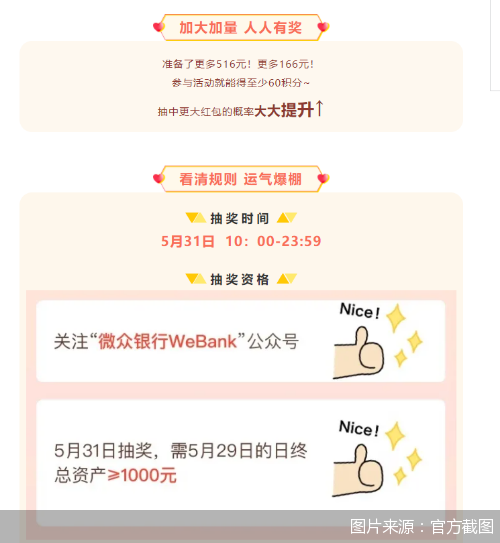
On June 1, a reporter from Beijing Business Daily tried to experience the event. After clicking to follow, the page displayed "This event has ended." However, the reporter noticed that such marketing activities of WeBank are not uncommon. In addition to the red envelope activities, WeBank has also launched a number of wool benefits such as "earning phone bills" and "receiving 60 yuan". Among them, "earning phone bills" can be participated in by purchasing financial products. The qualification to participate is only for users who have never bought a current deposit+. "Receive 60 yuan" requires users to repay the bound credit card through WeBank Card/current deposit+, and only the first credit card repayment will be rewarded every month.
In response to this activity, the relevant person in charge of WeBank said in an interview with a Beijing Business Daily reporter, "This activity is mainly to give back to our bank's loyal customers, invite loyal customers to experience our bank's new products and use our bank's new functions, and establish stronger connections with customers."
However, because the qualifications to participate in some activities are only open to new users, WeBank marketing is also regarded by industry insiders as a need to attract new users. Although it helps to increase business traffic, this type of customer acquisition method also pushes up the bank's operating costs, which will inevitably lead to the phenomenon of users "grabbing wool".
In this regard, the relevant person in charge of WeBank added, "The delivery channels of our activities are all through our own App and mini-program channels, and are not released to the outside world, so it does not involve external new acquisitions. Since the customers are all known customers of our bank, it does not involve 'wool'. We do not agree with the method of acquiring new customers regardless of cost, and we do not agree with the use of 'wool' to activate customers."
In fact, not only WeBank, but also Beijing Business Daily reporters noticed that Xinwang Bank, Suning Bank, etc. have launched various marketing activities to attract new customers and promote activity.
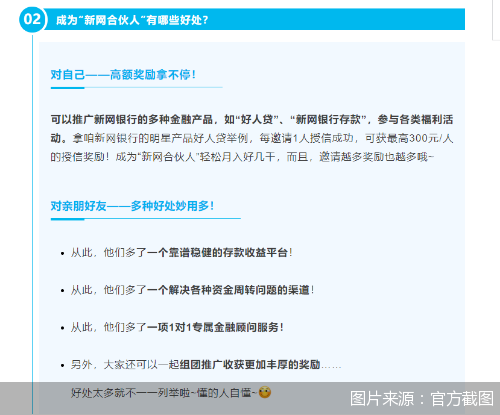
Recently, Xinwang Bank has been recruiting "Xinwang Partners". Applying for "Partner" can promote Xinwang Bank's various financial products, such as "Haoren Loan", "Xinwang Bank Deposit", etc. It is said that "every time you invite a friend and successfully apply for credit Haoren Loan, you can earn up to 300 yuan."
In addition, Suning Bank has also launched an upgraded group loan activity. Within 72 hours, group members with 2-5 people can enjoy a half-year 10% interest rate discount, 6-9 people can enjoy a half-year 15% interest rate discount, and 10 or more people can enjoy a half-year 20% interest rate discount. Multiple IOUs can be used within half a year from the issuance date.

In response to various issues such as the transformation of the effectiveness of relevant marketing activities and risk control, reporters from Beijing Business Daily conducted interviews with Xinwang Bank and Suning Bank, but did not receive a response from the latter as of press time.
Increase operating costs in disguised form
Constrained by the restrictions on offline outlets, private banks have come up with new ideas and launched customer marketing wars. According to industry insiders, this move is mainly to acquire customers, attract deposits, and enhance the brand awareness of the institution.
As Zhou Maohua, an analyst at the financial markets department of China Everbright Bank (601818, Stock Bar), pointed out, for banks, this type of marketing can help enhance bank brand awareness and increase business flow, but at the same time, it should be noted that the customer stability brought by these various marketing methods is not necessarily good, and it also pushes up bank operating costs to a certain extent. Banks may transfer liability costs to the asset side, further pushing up the financing costs of small and micro and private enterprises.
"Due to network restrictions, private banks rely more on online channels to acquire new users and promote products. Especially after regulatory policies stipulate that deposits and financial management products cannot be sold through Internet platforms, the necessity for private banks to carry out marketing activities through their own channels has further increased." Yu Baicheng, president of Lingyi Research Institute, told the Beijing Business Daily reporter that lottery draws, cash rebates, group purchases, and partner promotions are conventional marketing methods to acquire customers and increase activity. Not only private banks, but also other banks and Internet companies have used them.
However, it should be noted that many private banks have encountered many hiccups in their exploration of attracting new customers. For example, Suning Bank has previously promoted the upgrading loan partner game, but industry insiders bluntly stated that this online new model has multiple marketing risks. In addition, many local banks have launched a "Pinduoduo" type group loan marketing model, and this type of marketing model has also attracted regulatory attention.
From the perspective of the industry, through the means of partners, fission-type recruitment can be quickly carried out, but this model also hides multiple marketing risks.
Zhou Maohua said that the potential risks of this type of marketing method are: first, it will lead to an increase in the bank's operating costs; second, there may be induced lending, pushing up residents' debt leverage, which is not conducive to protecting the legitimate rights and interests of consumers; third, this method of customer acquisition may weaken the bank's risk control effect, which is not conducive to the bank's stable operation.
Banks themselves are operating risk institutions, and risk control is their lifeline. Zhou Maohua said that institutions need to pay attention to whether these marketing methods lead to a reduction in risk control requirements, whether they affect the institution's sound and sustainable operations, whether they significantly increase the operating costs of financial institutions, etc. Institutions need to remain in awe of financial risks and regulatory systems, and the bottom line is to prevent local systemic risks from occurring.
Su Xiaorui, a senior observer in the banking industry, also said that on the one hand, institutions' recruitment activities are to develop new users and obtain business scale growth, and on the other hand, they are also to resist fierce external market competition, enhance brand awareness, and consolidate their industry position. However, institutions need to pay attention to the fact that financial marketing promotions need to comply with relevant regulatory norms. In addition, the choice of relying on self-owned channels or external third-party channels is also worthy of further consideration.
Be wary of multiple red lines
Recently, a reporter from the Beijing Business Daily learned from a bank practitioner that on the one hand, banks cannot absorb deposits through non-self-operated channels. In addition, they also face many constraints in cooperation with Internet companies on the loan side. Under the multiple impacts of limited scale, single qualifications, geographical restrictions, etc., small and medium-sized banks have increasingly smaller development space and increasing operating pressure.
It has to be said that there is indeed a certain pressure on private banks at present, mainly due to fierce competition among domestic peers and changes in the domestic regulatory environment. Private banks' liabilities and operating pressure have increased. However, Zhou Maohua also pointed out that it is also important to note that private banks are small in scale, have no corresponding outlets, and have low operating costs; market-oriented operating mechanisms and services, high awareness, and high operating efficiency during the period; clear domestic equity structures, flexible incentive mechanisms, and relatively active innovation; at the same time, the domestic economy is gradually getting rid of the impact of the epidemic, and support policies are not making sharp turns. The economy and corporate operations are steadily recovering, the vitality of micro entities is gradually released, and the operating prospects of private banks are gradually improving.
"For us, it is more about maintaining insights into the industry or customers and responding quickly. This is also the starting point for maintaining our survival soil or moat." said the aforementioned bank practitioner.
However, as the cost of online marketing continues to rise, banks, as financial institutions that need to operate stably, must also consider more issues in marketing. When it comes to marketing red lines, Yu Baicheng told a reporter from Beijing Business Daily that banks should first consider the business conversion rate of investment and not invest too much to affect the financial situation. The discount rate should also be reasonable and not over-subsidize; second, banks should pay attention to marketing compliance and consider marketing plans. The adaptability and rationality of the product should be recommended to the right people, and promotion should not be exaggerated. Pay attention to the supervision of partner behavior in partner marketing; third, pay attention to the risks of Internet marketing, do a good job in product and risk control of activities, and be careful of being ripped off by professional groups.
Regarding the subsequent development of private banks, Su Xiaorui suggested that licensed financial institutions need to establish and improve internal control systems for financial marketing and publicity, strengthen behavioral supervision of business partners, and improve customer service mechanisms related to the protection of financial consumers' rights and interests.
Beijing Business Daily reporter Yue Pinyu Liu Sihong
With the strength of Musk Amway, Dogecoin quickly stood out from the circle and became one of the most popular currencies in the Year of the Ox. After Dogecoin became popular, various animal coins have won enthusiastic onlookers and caused heated discussions.
Dogecoin is known as "dogcoin/dogcoin" and was born on December 8, 2013. Based on script algorithms, Dogecoin is the second largest virtual currency in the world after Bitcoin in terms of number of users. The authors of this article are Jackson Palmer, an Australian brand and marketing expert, and Palmer, a programmer from Portland, Oregon, USA.
Data shows that under the strong Musk of Amway, Dogecoin has risen by 3412% and 441% in the past three months and the past 30 days respectively.

Perhaps inspired by Dogecoin, Shiba-Inu-coin-Shib was created in the last two days and spread among the cryptocurrency community. According to the official introduction, Shib is an experiment in decentralized spontaneous community building. Shib token, nicknamed the Dogecoin killer, is the first token in the community, allowing users to hold 100 million or even trillions of tokens. Shib is an ERC-20 token and the price can be controlled below 1 cent. Shib will also be traded on Shiba Swaps, which is also its incentive token. Shiba Swap will be launched at the end of April.
Data shows that Shib has grown by 1278.72% in the past seven days.
Akita-Inu-Akita is a *decentralized community experiment where half of the tokens are sent to vitalik buterin and the other half are locked in the Uniswap pool and the keys are burned. It is the same as Shiba-Inu, but the token index is different. Akita Coin is inspired by Elon Musk and Dogecoin.
Data shows that Akita has grown by 16,811% in the past seven days.
It’s not just the rise of dog money. The entire Animal Coin Tray caught the attention of the market. There are also Aragonese ants in the animal coin collection. Aragon is an open source project based on the Ethereum blockchain. It aims to be a decentralized autonomous organization (DAO) that allows stakeholders to vote on the future development and direction of the project. Aragon uses ERC-20 token ant to facilitate voting and governance of the project. The Aragon Network is a digital governance organization controlled by tokens. Its goal is to create an ecosystem that allows any organization, entrepreneur, and investor to collaborate efficiently and securely, free of technical vulnerabilities and malicious actors.
The organization on the Aragon network chain will take Aragon as the core and consist of a decentralized autonomous organization (DAO) with entity language and a decentralized application (DAPP) on the web. Initially, Aragon Core will focus on capitalized corporate organizations, but is modular enough to accommodate other types of organizations as well.

However, compared with the crazy Dogecoin market, Ant’s increase is not large, with an increase of 96% in the past three months.
It is worth mentioning that the Coin Security Smart Chain (BSC) is also included in the Animal Coin channel. The BSC Bunny team is committed to supporting the underlying DeFi ecosystem by providing users with a simple way to automatically combine income through the binance smart chain. BSC has risen 105.47% in the past 30 days.
In addition, there is the Pig Protocol, which offers a simple solution: all coins are in the wallet, there can be no rugs, and it is *decentralized; yields multiply automatically, without complex asset matching, liquidity and risk of variable losses. Pigs are a highly productive and frictionless agricultural substitute. There is a 5% tax on each transaction: 3% is locked in working capital; 2% is allocated to pig farmers based on the proportion of pigs in stock. The price of pigs has increased by +310.00% in the past 30 days.

In addition, many items on the market, such as pikas, rabbits and foxes, are also included in the animal currency list. However, from the data point of view, the increase in the Dogecoin series is more obvious. However, with regard to the hype about animal currencies, industry insiders believe that it is difficult for new entrants to obtain high returns on already rising cryptocurrencies such as Bitcoin. On the contrary, they are prone to hyping conceptual currencies. The dog money has increased dozens of times in a short period, as well as the previous community accumulation and KOL support. Other currencies that are rising rapidly, as well as currencies influenced by this concept, can easily become tools for short-term speculation, and also remind new entrants not to be too aggressive.
Article title: Is Dogecoin setting off a new round of bubble after Animal Coin?
Article link: https://www.btchangqing.cn/239220.html
Update time: April 22, 2021
Most of the content on this site is collected from the Internet. If the content infringes upon your rights, please contact us and we will deal with it as soon as possible.
 On The Eve Of The Spring Festival In 2026, A Political Earthquake Occurred In Kyrgyzstan, And President Sadr Zhaparov Took Ruthless Measures2026-03-02Comments(0)
 The Damaged Waterfront Greenway In Miaoxing Town, Baoshan District Is In Urgent Need Of Repair, Affecting Residents’ Leisure And Fitness2026-03-16Comments(0)
 How Many Schools Does Beijing Language And Culture University Have? Introduction To Admission Batches And Score Lines2026-03-16Comments(0)
 German McDonald's Ramadan Ad: Empty Boxes During The Day, Ready To Eat At Sunset, Respecting Fasting Customs And Winning Praise2026-03-05Comments(0)