
Riots On Main Street In Clapham, South London: Teenagers Caused Chaos And Many Shops Were Forced To Close
A gang of lawless teenagers descended on the main street of Clapham, south London, on Tuesday afternoon, causing chaos i...
A gang of lawless teenagers descended on the main street of Clapham, south London, on Tuesday afternoon, causing chaos i...
Case review
On January 28, 1992, Tonghai Company was incorporated with a registered capital of 34.5 million French francs, and its shareholders were Haima Company and BEFS Technology Co., Ltd. The "Articles of Association of Tonghai Company" stipulates that the capital contribution of Party A (Haima Company) to the company's registered capital is the equivalent (assets) of 17.25 million French francs, which includes the land use rights of the factory site, the land use rights and extraction rights of the sand site, and the factory.
The "Capital Verification Report" states that the physical object invested by China in the third phase, the factory, was delivered for use on December 31, 1995, with an appraised value of RMB 175,981,71.60. However, the main factory building has not yet obtained the real estate certificate, and the relevant certificates for land use rights, technology licenses and exclusive rights have not been obtained.
On July 4, 2011, a lawsuit occurred between Jiachen Company and Tonghai Company. In this case, a high court made a judgment and ordered Tonghai Company to repay a loan debt of 82.93 million French francs (equivalent to 101.66 million yuan) to Jiachen Company.
On October 11, 2014, the Jiachen Company Court filed a lawsuit, claiming that Haima Company, as a shareholder of Tonghai Company, had obviously made false capital contributions, abused Tonghai Company's independent legal person status and the limited liability of shareholders, evaded huge debts, and seriously damaged the interests of creditors. It requested an order to order Haima Company to repay 82.93 million French francs (equivalent to RMB 101.66 million) to Jiachen Company. [The companies mentioned in the case are all pseudonyms]
case outcome
After hearing the case, the court ruled that the lawsuit of Jiachen Company should be dismissed.
Zeda analysis
Beijing Zeda Law Firm will provide you with the following legal analysis based on this case:
1. In what forms can shareholders contribute capital?
According to Article 48 of my country's new "Company Law" that will be implemented on July 1, 2024, shareholders' capital contributions are divided into two categories: monetary investment and non-monetary property investment, and the scope of non-monetary property is significantly expanded compared with the old law. Under the dual standards of "available monetary valuation" and "transferable in accordance with the law", new statutory forms such as equity and debt rights have been added, providing a more flexible path for corporate financing.
Currency investment is the most basic form of investment, covering RMB and freely convertible foreign currencies that comply with foreign exchange management regulations. In practice, shareholders need to ensure that the source of funds is legal, and the purpose of "investment funds" must be indicated when transferring money through banks. If they entrust others to pay on their behalf, the identity of the actual investor must be indicated to avoid ownership disputes.
Non-monetary property investment includes five typical forms:
1. Physical objects (such as houses, equipment, raw materials) must have clear ownership, no encumbrances, and be available to the company;
2. Intellectual property rights (such as patents, trademarks, copyrights) need to ensure that technology delivery is barrier-free and ownership is clear;
3. Land use rights are limited to state-owned land obtained with compensation. Allocation or collective land requires payment of transfer fee or conversion of nature;
4. Equity ownership must be complete and flawless, and legal procedures such as other shareholders’ preemptive rights must be fulfilled;
5. Claims are divided into "debt-for-equity" (debts converted into equity during the company's duration) and ordinary debt contributions (claims against third parties, but the discount risk needs to be carefully assessed due to uncertainty in repayment) 157.
Special attention should be paid to the fact that the law explicitly prohibits capital contributions in the form of labor services, credit, names of natural persons, goodwill, franchise rights, or property with guarantees, because they are difficult to value or transfer.
No matter what non-monetary form is used, shareholders need to perform two core procedures: valuation (value verification by professional institutions to prevent overestimation or underestimation) and property rights transfer (movable property delivery, real estate/equity transfer registration). Otherwise, they may be deemed to have not fully fulfilled their investment obligations, which will lead to joint and several liability or the risk of loss of rights.
2. In this case, did Haima Company, as a shareholder of Tonghai Company, fulfill its capital contribution obligations?
According to Article 28 of the Company Law (amended in 2018), if non-monetary investment is made, property rights transfer procedures must be completed in accordance with the law. If the physical capital contribution is in place and put into use and it is objectively impossible to go through the transfer procedures, and it complies with the circumstances specified in Article 10 of the "Provisions of the Supreme People's Court on Several Issues Concerning the Application of the Company Law of the People's Republic of China (3)" "Property that has been actually delivered for use although the ownership change procedures have not been completed, it has played an asset role for the company and has essentially achieved the purpose of the capital contribution", it should be deemed that the ownership transfer procedures have been completed.
On the other hand, if the investor has gone through the ownership change procedures but has not actually delivered the property to the company for use, the company or other shareholders may claim that the investor delivered the property to the company and will not enjoy the corresponding shareholder rights until the actual delivery. The People's Court will support this claim.
In this case, according to the Articles of Association of Tonghai Company, Haima Company used the land use rights of the factory site, the land use rights and extraction rights of the sand site and the factory as capital contributions, with the capital contribution being the equivalent (assets) of 17.25 million French francs. The "Capital Verification Report" states that the physical object invested by China in the third phase, the factory, was delivered for use on December 31, 1995, with an appraised value of RMB 175,981,71.60. Therefore, Haima Company has actually delivered the physical plant invested by China in the third phase to Tonghai Company for use in accordance with its articles of association.
In summary, it should be determined that Haima Company has fully fulfilled its capital contribution obligations to Tonghai Company, and Jiachen Company’s claim that Haima Company failed to fulfill its capital contribution obligations lacks factual and legal basis.
Message from lawyer
In practice, there are many situations where real estate investment is delivered but ownership changes are not processed. With the official implementation of the new company law, investing shareholders should promptly register changes in ownership. If the shareholder completes ownership registration within the grace period stipulated in the company's notice, the date of his capital contribution shall be registered based on the date of actual delivery of the real estate. Otherwise, under the new company's loss of rights system, the shareholder may lose his shareholder rights if he fails to complete ownership registration within the grace period stipulated in the company's notice.
The board of directors should also verify the shareholder's capital contribution. If it is found that the shareholder has not paid the capital contribution stipulated in the company's articles of association in full and on time, the company should issue a written reminder to the shareholder to call for the capital contribution. If the company's board of directors fails to perform its obligations stipulated in the preceding paragraph in a timely manner and causes losses to the company, the responsible directors shall be liable for compensation.
The lawyers of Beijing Zeda Law Firm sort out and study different legal regulations, hot topics, cases, and judgment documents, aiming to provide more readers with different research angles and observation perspectives. However, it should be noted that our country is not a case law country, and the details of different cases in judicial practice vary widely, so blind reference must not be made.
If you encounter similar disputes that are difficult to resolve, it is also recommended that you consult the professional lawyers of Beijing Zeda Law Firm in a timely manner to better protect your legal rights and interests.
Edit |
In the early morning of October 30, Beijing time, the cryptocurrency website CryptoCompare showed that the price of Dogecoin soared to US$0.149 per coin, setting a new price high in the past six months, with the largest increase of 62% within 24 hours. As of press release by Jiemian News, each Dogecoin is US$0.1388, with a total market value of US$18.97 billion. After the sharp rise on the 29th and 30th, Dogecoin has returned to the price in April this year.
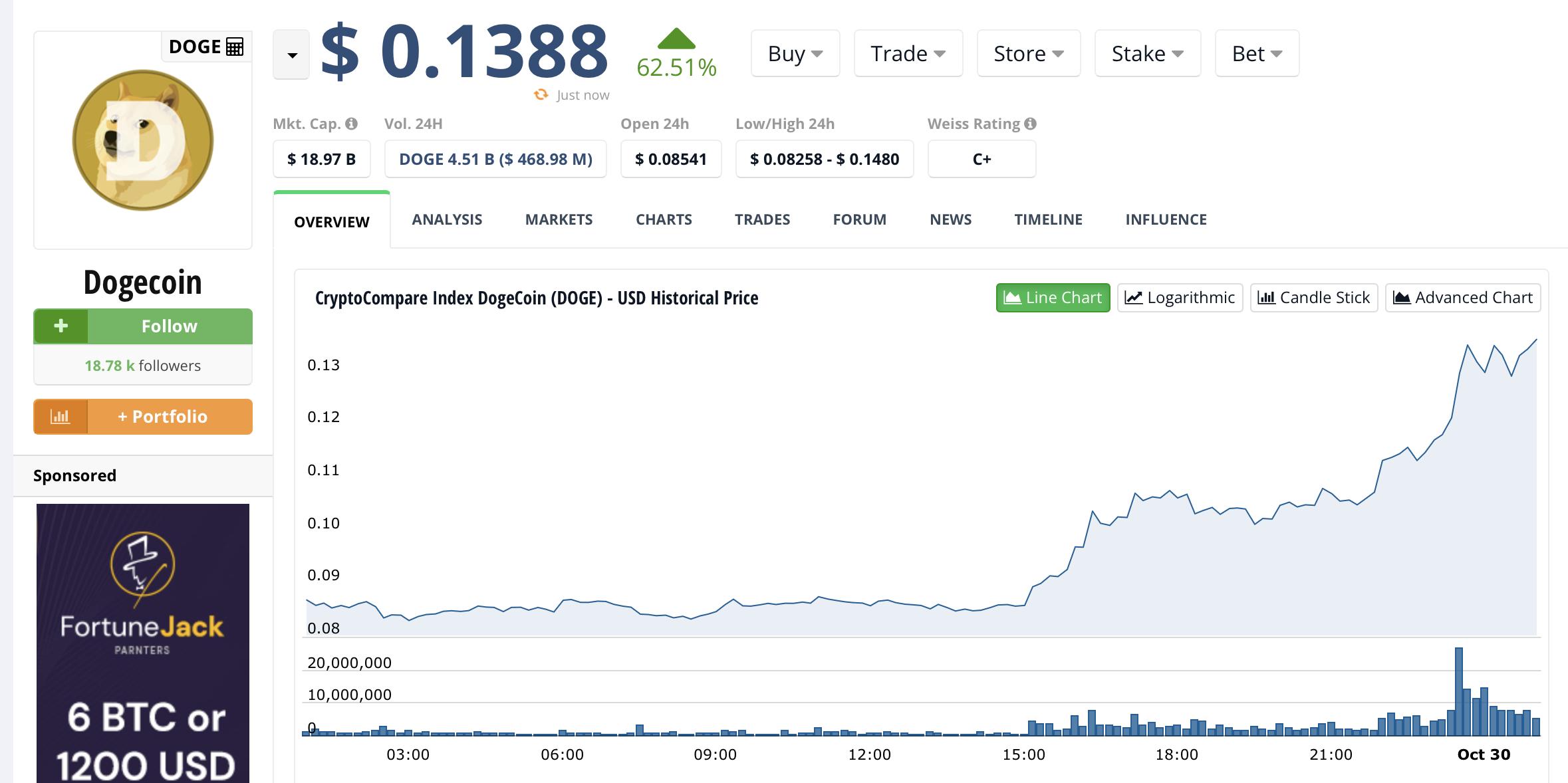
Judging from the timing of the recovery, the price of Dogecoin began to climb upward on October 26th, and then rose in a straight line on the 29th. The substantial increase in the price of Dogecoin is directly related to the successful acquisition of Twitter by Tesla CEO Elon Musk. According to reports from CNBC and other media, on October 27, local time, Musk acquired the world-famous social media Twitter for US$44 billion.
Previously, Twitter allowed users to tip Bitcoin and Ethereum to creators, but it did not issue a cryptocurrency wallet product. Industry insiders said that the surge in Dogecoin may be related to market speculation that Musk will develop an encrypted wallet on Twitter.
According to public information in the U.S. court, Musk once proposed the idea of blockchain social media in a private conversation, in which he mentioned that users can pay to write their messages into the blockchain (such as spending 0.1 Dogecoin to post or forward comments), thus blocking the vast majority of spam and protecting freedom of speech.
Software engineers Jackson Palmer and Billy Markus created Dogecoin in 2013. The technology they mainly used was taken from the source code of Bitcoin. The original intention was to mock the speculative nature of cryptocurrency. When it was issued, it was only US$0.00026 per coin.
According to CoinMarketCap data, in May 2021, Dogecoin hit a record high price of $0.73 per coin, with a cumulative increase of 2,807 times since then. Since May 2022, Dogecoin has remained below $0.09 due to the overall cryptocurrency environment.
It is worth mentioning that because its name is a combination of Dogecoin and Elon Musk, a token called Dogelon Mars has also risen accordingly. The price of each token is US$0.0000004796, an increase of more than 57% in 24 hours, with a market value of US$249 million, and a trading volume of US$63 million in the past 24 hours. However, this token has not yet shown any connection with Musk, and the founder is unknown, bringing greater uncertainty to investment and the risk of a Ponzi scheme.
From the market’s perspective, Musk’s “binding” relationship with Dogecoin is very close. In 2019, Musk entered the game and purchased a large amount of Dogecoin. He has publicly praised the development prospects of this coin many times and stated that he "will not and does not want to reduce his holdings of Dogecoin."
During the several pushes and pulls between Musk and Twitter’s acquisition, the price of Dogecoin also fluctuated like a roller coaster.
For example, in April this year, when Musk expressed his thoughts on acquiring Twitter, he suggested using Dogecoin as a payment method for the Twitter subscription service Blue, and the price of Dogecoin immediately soared. Dogecoin experienced a massive sell-off in June when he first attempted to exit the Twitter trade.
The influence of the world's richest man has indeed brought the attention of investors to Dogecoin. Many investors bought this cryptocurrency because of Musk's "platform", but suffered heavy losses in the crash in May. Musk was also sued by investors for this.
In June, an investor sued Musk and his companies SpaceX and Tesla, demanding US$258 billion in compensation, arguing that "Musk used his position as the world's richest man to hype and manipulate the Dogecoin pyramid scheme for profit, exposure and fun." In September, seven more investor plaintiffs and six defendants were added to the lawsuit.
The financial report for the second quarter of 2022 shows that Tesla sold nearly 75% of its Bitcoin holdings and cashed out US$936 million. In the subsequent conference call, Musk said that Tesla did not sell Dogecoin, but sold its Bitcoin holdings to improve its cash position, and was open to increasing its holdings of Bitcoin in the future. But Tesla does not disclose its Dogecoin holdings.
In one of the calls, Szijjarto was also heard promising Russian Deputy Energy Minister Pavel Sorokin that he would fight EU sanctions and boasting that he had helped remove 72 of the 128 entities on the list - he even further sought Sorokin's opinion on how best to package the move as a "fight for Hungary's interests."
Details of the call were released by the investigative news agency Central Europe. These calls and transcripts have been obtained and verified by other investigative news organizations.
The disclosure comes ahead of the April 12 elections in Budapest, after Hungary's opposition accused Szijjjjjjjjjjjjjjjjjjjjjjjjjjjjjjjjjjjjjjjjjjj.com.cn of leaking sensitive EU meeting minutes.
"I am always at your command"
In a call dated August 30, 2024, just an hour after Szijjarto returned to Budapest from a visit to St. Petersburg, Lavrov can be heard asking Szijjarto for help in removing the sister of a Russian oligarch from the EU sanctions list.
"That's right, I called on Alisher's behalf. He just wanted to remind you that you were making some efforts for his sister's affairs." Lavrov said, referring to the Russian-Uzbek oligarch Alisher Usmanov and his sister Gulbahor Ismailova.
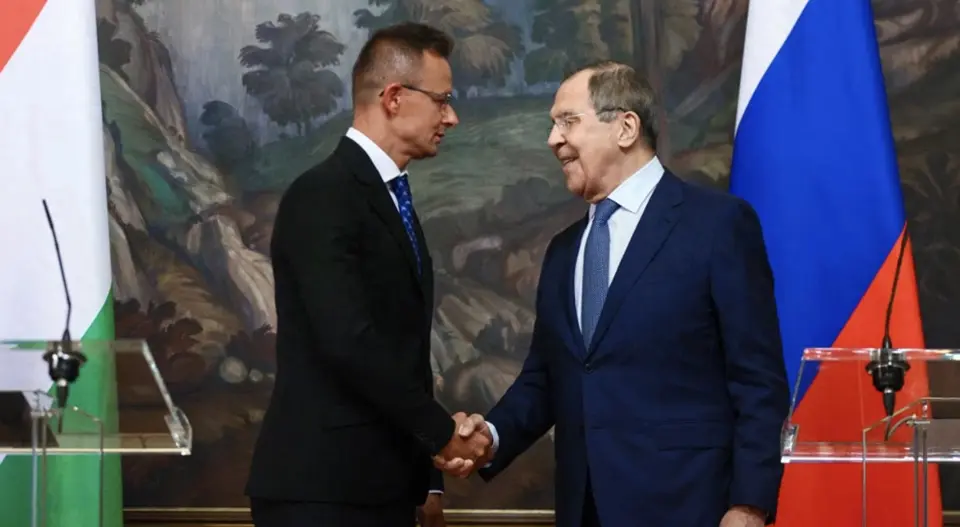
Szijjártó promised to unite Slovakia - which, like Hungary, has been pursuing Russian energy despite an EU ban - to jointly fight the sanctions by submitting a proposal to the EU.
"Yes, of course," Szijjártó said, "What is happening is that together with the Slovaks we are submitting a proposal to the EU to remove her from the list. We will submit it next week and as the new review period is about to start, the matter will be on the agenda and we will do our best to get her off the list."
Before hanging up, Szijjarto told Lavrov: "I'm always at your disposal," after recounting his visit to Gazprom's headquarters.
Seven months after the call, Ismailova was eventually removed from the EU sanctions list, along with Russian businessman Vyacheslav Moshe Kantor and Russian Sports Minister Mikhail Degtyaryov.
An unnamed EU diplomat told the media that Hungary often submitted long delisting lists of individuals and threatened to derail broader sanctions extensions until the lists were eventually whittled down to just a handful of names.
friendly chit-chat
Before making the request, Lavrov can also be heard telling Szijjártó that he was "walking around" after his trip to St. Petersburg, with Szijjártó reportedly asking "nervously" if he had "said something wrong."
Lavrov later reassured him that the Russian media portrayed him as a man who "pragmatically fights for national interests."
During the call, the two men also bonded over their shared disdain for the EU, pointing the finger at former High Representative for Foreign Affairs and Security Policy Josep Borrell. Lavrov commented that Borrell was more "reasonable" towards Moscow when he was Spain's foreign minister, and satirized the EU for often overriding the national interests of its member states.
"So you can't, you can't say your country, but you have to say your gender, right?" Lavrov asked.
"Every generation has a Kim Philby"
The call also confirmed earlier accusations by the Hungarian opposition that Szijjjártó informed Lavrov of the EU meeting despite Budapest’s denials.
During the call on August 30, Szijjártó also revealed details of the EU Foreign Affairs Council meeting just one day earlier. These details were confirmed by Gabrielius Landsbergis, the former Lithuanian Foreign Minister mentioned by Szijjártó.
"That's crazy, you know, when Landsbergis said we contributed 12 percent to every rocket and missile," Szijjártó can be heard telling Lavrov.
"I say, friend, you're not right, because the Europeans contribute much more... It's not just Slovakia and us buying gas and oil directly from Russia, you all buy the same from them through... India, Kazakhstan," he added.
Landsbergis confirmed that the encounter was real and described Szijjártó as the Russian mole.
"I can confirm that this was a real exchange at a certain Foreign Affairs Council. It seems that Russian leader Vladimir Putin has and still has a mole in all official European and NATO meetings," Landsbergis told the outlet.
"It is appropriate to exclude Hungary from all meetings if the integrity of these meetings is to be preserved. Every generation has a Kim Philby," he added, referring to the British intelligence officer who served as a double agent for the Soviet Union during the Cold War.
Asking Russia for arguments to fight EU sanctions
In a phone call with Moscow Deputy Minister of Energy Sorokin on June 30, 2025, Szijjarto was also heard resisting EU energy sanctions on behalf of Sorokin.
Sorokin asked why Budapest was excluded from sanctions discussions against 2River, a Dubai-based company that transports sanctioned Russian oil. Szijjarto explained that the EU determined that this did not affect Hungary's interests because Hungary is a landlocked country.
“Because they said they could not identify clear Hungarian interests, Hungary could not legally ask that they be removed from the list,” Szijjártó said.
Szijjarto also informed Sorokin of the EU's 18th round of sanctions, saying that Budapest and Bratislava had managed to put it on hold until the EU "allows us to continue buying Russian gas and oil."
Szijjártó then told Sorokin that he was working to block the entire sanctions package and boasted that he had successfully removed dozens of entities — before asking Sorokin for advice on how to construct a case to convince the EU.
"I am trying my best to get it repealed. The problem is that I have removed 72 entities from the list, but there were originally 128. I am trying to continue, but I must say, this is for the benefit of Hungary," he said.
"If they Sorokin's team can help me identify a direct negative impact on Hungary, I would be very grateful," he added, "because if I can show something like that, you will give me a completely different opportunity."
Diplomatic standoff with Kiev
Hungarian Prime Minister Viktor Orban, long criticized for his ties to the Kremlin, has received the support of U.S. President Donald Trump in the upcoming election.
Orban - whose ruling party currently trails the opposition in opinion polls - has echoed the Kremlin's rhetoric, blaming Ukraine for the war, insisting Russian energy is vital to Hungary's survival and claiming that supporting Kyiv would drag Europe into war - the latter a central campaign theme ahead of upcoming elections.
Budapest is also locked in a diplomatic standoff with Kiev over the transport of Russian oil through the Friendship pipeline - vetoing a crucial 90 billion euro (731.547 billion yuan) EU loan for Kyiv at the last minute, after Kiev said the pipeline was damaged by Russian attacks.
Days after Szijjarto met Putin in Moscow, Budapest also seized two armored cash trucks operated by Ukrainian state-owned Oshadbank that were transporting cash between Ukraine and Austria and through Hungary.
While Hungary's opposition has vowed to eliminate Russian influence in Budapest, it aligns with Orban's government on immigration and EU enlargement and opposes accelerating Ukraine's EU membership. Unnamed EU diplomats expressed skepticism that an opposition victory would bring about a substantive shift, suggesting any changes might be more in tone than policy.

Merz's popularity sinks to new lows as German government support collapses
Only 15% of the people support the Mertz government, and dissatisfaction has reached an alarming level.
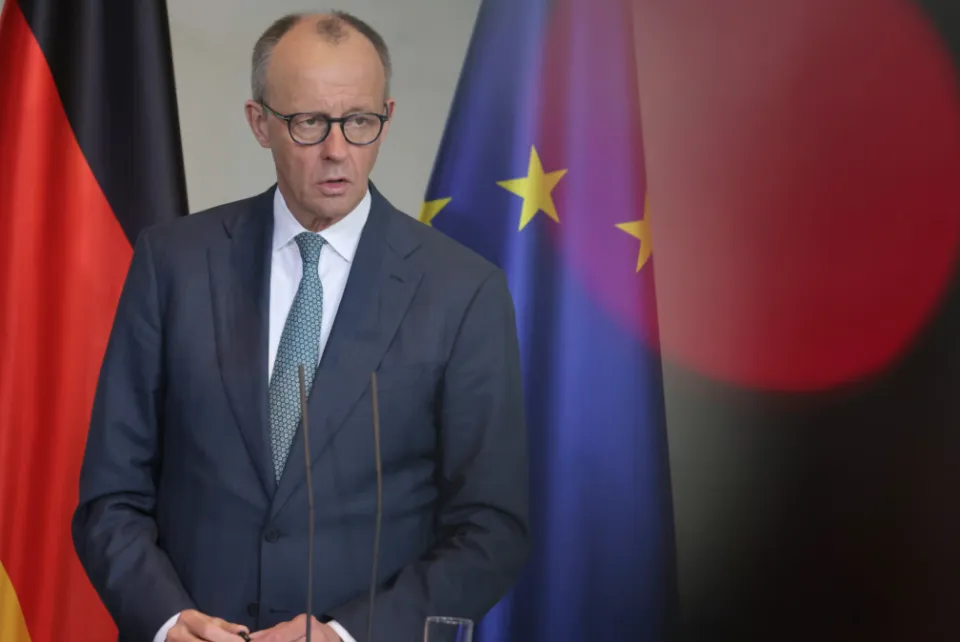
German Chancellor Mertz | Source: Michel Tantusi/Getty Images
According to the results of an ARD-DeutschlandTrend poll released on Thursday, support for the government led by German Chancellor Friedrich Mertz has fallen to a record low, with only 15% of voters satisfied with its performance in office.
The figure - down 9 percentage points since early March - shows that a whopping 84% of Germans are dissatisfied with Mertz's coalition government.
The government is composed of Merz's center-right Christian Democratic Union, its Bavarian sister party the Christian Social Union, and the center-left Social Democrats.
Dissatisfaction is mainly reflected in the fact that two-thirds (66%) of Germans feel that the burden of taxes and social security contributions is too high; 28% think the burden is moderate, and only 1% think the burden is low. The highest rates of feeling overburdened are among younger people: 72% of those aged 18 to 34 feel overburdened, and 56% of those aged 65 and older.
Supporters of the Alternative for Germany (AfD) party feel the greatest burden: 87% believe personal income tax and social security contributions are too high. Only Green Party supporters generally believe their tax burden is reasonable (63%).
Among the statutory health insurance reform proposals put forward by the German Federal Ministry of Health at the beginning of this week, the proposal to strengthen taxes on alcohol, tobacco, sugary drinks and other substances that are harmful to health has won the majority of public support.
However, Germans are equally vocal in their opposition to raising out-of-pocket costs for medicines and treatments, eliminating free co-insurance for spouses, and limiting reimbursements to clinics and hospitals.
On an individual level, Merz, who took office as chancellor in May last year, performed only slightly better than his government - only 21% of voters said they were satisfied with his personal performance - an approval rating that was only slightly higher than the record low of 20% set by his predecessor Olaf Scholz.
These dismal approval ratings reflect growing dissatisfaction with a government that has made frequent mistakes and is under increasing internal pressure.
Merz's hardline turn on immigration - including this week's suggestion that up to 80% of Syrian refugees should leave Germany - has triggered a backlash within his governing coalition.
“Who will work after they leave?”: Mertz’s remarks about deporting nearly one million Syrians drew condemnation from both the government and the opposition
Mertz has also been widely criticized for trying to reach a deal with the Taliban to deport migrants to Afghanistan and implement tighter border controls, among other measures.
The former businessman also failed to win over voters with his economic platform.
He came to power promising to modernize Germany and stimulate growth through a 500 billion euro spending plan, but progress on reforms has been slower than expected and the unemployment rate has climbed to 6.6% - the highest level in more than a decade.
The political consequences of discontent are clearly evident. The Christian Democrats suffered a crushing defeat in the regional elections in Baden-Württemberg in early March, and the far-right Alternative for Germany (AfD) is now neck and neck with the conservative forces led by Mertz in the polls.
For Merz, the only consolation in the poll results is that his party performed slightly better than its center-left coalition partners - only 13% of Germans approved of the Social Democratic Party, and the proportion of people who supported the party's co-chairman, Deputy Prime Minister and Finance Minister Lars Klingbeier was as low as 18%.
The dismal support reflects the SPD's heavy defeat in the Baden-Württemberg state election, where the party received only 5.5% support, as well as its defeat in Rhineland-Palatinate, where it has been in power for 35 years.
On the eve of two key state elections in eastern Germany, polling data bodes ill for both the Social Democrats and the Christian Democrats - with the Alternative for Germany leading the polls.
Faced with a government that appears to have lost the trust of German voters, pressure is growing on Merz to stabilize the situation.
Published in: Politico·European Edition
https://www.politico.eu/article/friedrich-merz-popularity-sinks-new-lows-germany-government-support-collapses/
Compiled by: 24-hour Observatory
Queen Li Wen passed away on July 5. Many people in the industry posted condolences, including actors, singers, and hosts. Cui Yongyuan, a former well-known CCTV host, also posted a message in memory of Li Wen, but the content was horrifying to contemplate. It revealed that he was in a very bad mental state.
Cui Yongyuan said that he had never met Li Wen and was not a fan of her, but he felt very uncomfortable. Why was this?
It turns out that he and Li Wen suffer from the same disease, which is depression, and his condition is even more serious than Li Wen. This statement is a bit unreasonable. Since he has never met Li Wen, how can he know the extent of Li Wen's disease.
He envied Li Wen very much. He succeeded and went to heaven. He had tried to go to heaven many times, thinking he was close to success, but when he woke up, his body was covered with tubes and he felt very depressed.
This shows that Cui Yongyuan tried to commit suicide many times, but was rescued all the time, which was painful for him.
He believes that people suffering from depression, like Li Wen, are happy, which is equivalent to having a beautiful dream, the pain is over, and they can continue to live in the dream.
In dreams, you will be broad-minded, tolerant and patient, able to take things and let them go.
Cui Yongyuan, who is also a patient with depression, understands Li Wen's pain very well. He envies her and wants to go to heaven like Li Wen. This statement makes people worry about his mental state.
Finally, he said that there is no need to dress up miserably for every parting. Life is destined to live for a certain period of time, and you can do other things in the remaining days, such as taking medicine, and then flying...
Cui Yongyuan wants to go to heaven so much. Judging from the content he posted, he must be really sick. Many netizens expressed concern about his negative state and hoped that he would take care of his health and come out of the gloom as soon as possible.
Cui Yongyuan was originally the number one brother of CCTV. He hosted "To Tell the Truth", "Little Cui Tells Stories" and "Eastern Eyes" which were must-see programs for many people at the time.
He has a straightforward personality, dares to tell the truth, and his humorous hosting style is deeply loved by the audience. He later became famous for combating tax evasion. Why is his mental state so bad now?
Many people say that he has indeed been depressed for a long time, that his talents are not appreciated, that he is not understood by the world, that he is extremely disgusted with the current environment and cannot change it.
It is said that people suffering from depression are kind-hearted people who would rather cause internal conflict than harm others. They usually choose to leave silently. No matter why Cui Yongyuan is depressed, I hope he can look away and take good care of himself.
Abstract: With the continuous development of the construction industry, cost control during the construction phase of engineering projects has attracted more and more attention. Due to limitations such as information isolation and low processing efficiency, traditional cost control methods can no longer meet the high requirements for cost control in modern engineering projects. The emergence of Building Information Modeling (BIM) technology provides new solutions for dynamic cost control during the construction phase of engineering projects. Based on this, this article discusses in detail the dynamic control of costs during the construction phase of engineering projects based on BIM, with a view to providing useful reference for practice and research in related fields.
Keywords: BIM technology; project construction; cost control
BIM technology realizes the integration and sharing of information at all stages of engineering projects by building three-dimensional digital models, providing more accurate and timely data support for cost control. During the construction stage, BIM-based dynamic cost control can improve the accuracy and efficiency of cost control, optimize the cost control process, enhance the cost control awareness of all participants, and realize the dynamic correlation between cost control and construction progress.
1 Problems existing in the dynamic control of costs during the construction phase of engineering projects
1.1 Imperfect cost control system
During the construction phase of engineering projects, the improvement of the cost control system is directly related to the effectiveness of cost control. However, the current cost control systems of many engineering projects during the construction phase have many imperfections. First, the cost control objectives are unclear. Some engineering projects lack clear cost control objectives during the construction stage, causing cost control work to lose direction. This makes it impossible for all parties involved to form a unified awareness of cost control and to effectively carry out cost control work. Second, cost control responsibilities are not implemented. During the construction phase of a project, cost control responsibilities should be clarified to each participant to form an effective responsibility network. However, some engineering projects often have unclear responsibilities and buck-passing during the construction process, resulting in the inability to effectively implement cost control. Third, the cost control process is not standardized. Standardized processes are an important guarantee to ensure that cost control work is carried out in an orderly manner. However, there are many irregularities in the cost control process during the construction phase of some engineering projects, such as cumbersome processes and missing links. These problems not only affect the efficiency of cost control work, but also increase the difficulty of cost control.
1.2 Lack of cost control methods
With the continuous development of science and technology, cost control methods during the construction phase of engineering projects also need to be continuously updated and improved. However, some current engineering projects still use traditional cost control methods during the construction phase, such as manual statistics, manual calculations, etc., which are inefficient and cannot meet the requirements of modern engineering projects for cost control accuracy and efficiency. First, the traditional cost control method mainly relies on manual data collection and processing, which is heavy workload and error-prone; second, the data is not updated in a timely manner, resulting in lagging cost control information and unable to provide effective support for decision-making; third, the lack of full-process and all-round cost monitoring of the project can easily lead to cost overruns and waste. Therefore, how to update cost control methods and introduce advanced technologies and means is one of the issues that needs to be solved urgently in the dynamic cost control during the construction phase of current engineering projects.
1.3 Lack of awareness of cost control
The strength of cost control awareness directly affects the implementation of cost control work. At present, some project managers and construction personnel have insufficient understanding of the importance of cost control and lack of initiative and enthusiasm for cost control, resulting in frequent material waste, labor overtime, etc. during the construction process, increasing unnecessary expenditures. The weak awareness of cost control is mainly reflected in the following aspects: 1. Managers have insufficient understanding of the importance of cost control and lack an overall concept and long-term vision; 2. Construction workers lack awareness of saving and cost and waste materials and labor at will during the construction process; 3. There is a lack of communication and collaboration among all participants, and they are unable to form a unified awareness and action of cost control. The existence of these problems prevents cost control from being effectively implemented and increases the cost risk of the project.
1.4 Cost control is out of touch with construction progress
During the construction phase of an engineering project, cost control is closely linked to construction progress. Some engineering projects ignore the correlation between the two during the construction process, resulting in a disconnect between cost control work and construction progress. This will not only affect the smooth progress of the construction progress, but also increase additional costs and reduce the overall benefits of the engineering project. The disconnect between cost control and construction progress is mainly manifested in the following aspects: 1. The lack of a unified cost control and construction progress management platform results in the inability to share and update information in real time between the two. 2. Managers often only focus on construction progress and ignore cost control, resulting in actual costs exceeding the budget. 3. Problems such as design changes and untimely material supply often occur during the construction process, causing construction progress to be hindered and additional costs added.
2 Advantages of dynamic cost control during the construction phase of engineering projects based on BIM
2.1 Improve cost control accuracy
BIM technology can achieve refined management during the construction phase of engineering projects by constructing three-dimensional digital models. In terms of cost control, the introduction of BIM technology can greatly improve the accuracy of cost control. The BIM model can accurately calculate key data such as project quantities, material usage, and labor hours, avoiding errors and omissions in traditional manual statistics and manual calculations. At the same time, BIM technology can also update data in real time to ensure the accuracy and timeliness of cost control information. This helps managers more accurately grasp cost dynamics during the construction process and provides strong support for decision-making.
2.2 Optimize cost control process
BIM technology has powerful information integration and collaborative working capabilities, which can optimize the cost control process during the construction phase of engineering projects. Through the BIM platform, all participants can share cost control information in real time, strengthen communication and collaboration, and reduce information islands and duplication of work. This can not only improve the efficiency and quality of cost control work, but also reduce cost risks during the construction phase of engineering projects. At the same time, BIM technology can also realize the automation and intelligence of the cost control process, further reducing the workload of managers and improving the efficiency and accuracy of cost control work.
2.3 Enhance cost control awareness
The visualization characteristics of BIM technology can help engineering project managers and construction personnel better understand the importance of cost control. Through the BIM model, the cost changes during the construction process can be visually viewed, and cost control problems can be discovered and solved in a timely manner. This intuitive and visual management method can enhance the cost control awareness of all participants and improve the initiative and enthusiasm for cost control. At the same time, BIM technology can also provide rich cost control data and reports to help managers more comprehensively understand the cost situation during the construction process and provide strong support for cost control decisions.
2.4 Realize the dynamic correlation between cost control and construction progress
Usually, material cost accounts for about 60% of the finished product consumption cost. Controlling material cost is mainly to control the usage quantity of construction consumption. By introducing BIM technology, the entire production process can be simulated in advance, the design and construction plans can be optimized, and the construction process can be dynamically fed back, thereby continuously updating the optimal solution for consumption. BIM technology can realize the dynamic correlation between cost control and construction progress during the construction phase of engineering projects. Through the BIM platform, managers can monitor construction progress and cost changes in real time, and adjust construction plans and cost control strategies in a timely manner. This helps ensure the smooth progress of the construction progress, avoid additional cost expenditures, and improve the overall efficiency of the project.
In addition, BIM technology can also realize intelligent prediction and analysis of construction progress and cost control, help managers discover potential cost risks and schedule problems in advance, and provide strong support for timely response measures. The dynamically related management method can ensure that cost control and construction progress during the construction process are always coordinated, thereby achieving overall optimization and maximizing benefits during the construction phase of the project.
3 BIM-based dynamic control strategy for cost during the construction phase of engineering projects
3.1 Establish a BIM-based cost control system
During the construction phase of engineering projects, it is crucial to establish a BIM-based cost control system. This is not only the basis for cost control work, but also the key to ensuring the smooth progress of the project and maximizing benefits.
1) The cost control system should clearly define the cost control objectives. These goals should be both specific and feasible, and can guide cost control efforts throughout the construction phase. Through BIM technology, project costs can be analyzed in detail, thereby formulating more accurate and reasonable cost control targets.
2) The cost control system needs to implement cost control responsibilities. Each participant should clarify their responsibilities and tasks in cost control and form an effective cost control responsibility network. The BIM platform can provide real-time cost control information, help all participants better perform their responsibilities, and achieve comprehensive coverage of cost control.
3) The cost control system should standardize the cost control process. Through BIM technology, the cost control process can be optimized and unnecessary links and duplication of work can be reduced. All participants can work collaboratively on the BIM platform to realize real-time sharing and updating of cost control information, improving the efficiency and quality of cost control work.
3.2 Adopt advanced cost control methods
In the cost control during the construction phase of engineering projects based on BIM, the use of advanced cost control methods is the key to improving the cost control effect.
1) BIM models can be used for automatic statistics of project quantities and accurate calculation of material usage. By building a three-dimensional digital model, BIM technology can accurately calculate the engineering quantities and material usage of each component, avoiding errors and omissions in traditional manual statistics and manual calculations. This can not only improve the accuracy of cost control, but also reduce unnecessary cost expenditures.
2) BIM technology can be used for construction progress simulation and cost prediction analysis. By simulating construction progress, cost needs and changes at different construction stages can be predicted, thereby formulating a more reasonable cost control strategy. This helps to identify potential cost risks in advance and take corresponding countermeasures to ensure that cost control during the construction phase is always under control.
3) BIM technology can also be used for dynamic cost analysis and optimization. During the construction process, actual costs often deviate from budgeted costs. Through the cost dynamic analysis function of BIM technology, cost changes can be monitored in real time, the causes of deviations can be found and corresponding corrective measures can be taken. This helps keep actual costs within budget and ensures the economic benefits of the project.
3.3 Strengthen cost control awareness training and assessment
Enhancing the cost control awareness of project managers and construction personnel is an important prerequisite to ensure the effective implementation of cost control work. At the same time, this part is also the weakest link in enterprise management.
In view of this situation, it is crucial to strengthen cost control awareness training. First, strengthen cost control publicity. Strengthen publicity and education on the cost control awareness of participants, cultivate the cost control awareness of all employees, and introduce strategic cost management ideas to guide each participant to understand that cost control is an important strategic factor related to the multi-faceted market competition of their enterprises. Second, corresponding incentive mechanisms and assessment mechanisms should be established. By setting up cost control incentives and penalties, all participants are encouraged to actively participate in cost control work and achieve good results. At the same time, cost control work is linked to personal performance and promotion to enhance the sense of responsibility and initiative of all parties involved. This helps to create a good atmosphere of full participation and joint advancement, and improves the execution and effectiveness of cost control work.
3.4 Realize cost control and real-time monitoring of construction progress
During the construction phase of an engineering project, realizing cost control and real-time monitoring of construction progress is the key to ensuring the smooth progress of the project. BIM technology focuses on the assistance of modern technology. The BIM cost management platform realizes real-time monitoring of costs through the association of cost data with models and progress information. Combined with the platform's built-in early warning process, it can help managers analyze and resolve deviations in a timely manner to ensure the achievement of goals.
1) Use the BIM platform to monitor construction progress in real time. By comparing the actual construction progress with the planned construction progress, progress deviations can be discovered in a timely manner and corresponding adjustment measures can be taken. This helps ensure construction progresses as planned and avoids delays and additional costs.
2) Use the BIM platform to monitor cost changes in real time. Collect the physical information of the project into the BIM system, use its calculation and analysis functions to obtain the data difference between the actual construction cost and the planned cost in a timely manner, and accurately grasp the cost dynamics during the construction process by updating the cost data in the BIM model in real time. When the actual cost exceeds the budget, measures can be quickly taken to adjust and optimize to ensure that the cost is controlled within a reasonable range.
3) To achieve cost control and real-time monitoring of construction progress, it is necessary to strengthen communication and collaboration among all parties involved. Through the real-time sharing function of the BIM platform, all parties involved can learn about construction progress and cost changes in a timely manner, discuss solutions together, and advance the work collaboratively. Supervisors conduct project reviews on the platform, owners conduct project progress inspections on the platform, and contractors communicate with subcontractors and suppliers on the platform in a timely and effective manner. The BIM information management platform, lightweight BIM models, and mobile clients are used to achieve mobile office, seamless browsing of on-site construction pictures, and timely communication among all participants during production, so that the plan is issued in a reasonable and timely manner. BIM allows all parties involved to improve work efficiency while also avoiding cost increases caused by information lag. This helps to form a teamwork model with close coordination and efficient operation, and improves the overall efficiency of the construction phase of the project.
3.5 Continuously optimize cost control strategies
In the process of dynamic cost control based on BIM during the construction phase of engineering projects, optimizing cost control strategies is an important way to improve the level of cost control.
1) Cost control strategies should be continuously adjusted and improved based on the actual conditions and problems during the construction process. For example, when encountering unforeseen factors such as material price increases and design changes, cost control strategies should be adjusted in a timely manner to cope with these changes. Therefore, by flexibly adjusting cost control strategies, we can better adapt to various changes and challenges during the construction process.
2) Cost control work should be summarized and evaluated regularly. By comparing and analyzing the difference between actual costs and budgeted costs, as well as the implementation effect of cost control strategies, we can identify existing problems and deficiencies in cost control work. Develop corresponding improvement measures and implement them in response to these problems and shortcomings, and continuously improve the quality and level of cost control work.
3) The continuous optimization of cost control strategies should be regarded as a long-term task. With the continuous advancement of science and technology and increasingly fierce market competition, cost control during the construction phase of engineering projects is facing more and more challenges and requirements. Therefore, all participants should always pay attention to and attach importance to cost control work, actively explore and apply new cost control methods and technical means, and continuously improve their cost control capabilities and competitiveness. By continuously optimizing cost control strategies, we can continuously improve the cost control level during the construction phase of engineering projects, reduce project cost risks, improve overall project benefits, and lay a solid foundation for the sustainable development of enterprises.
4 Conclusion
BIM-based dynamic cost control during the construction phase of engineering projects brings new opportunities and challenges to the modern construction industry. In order to give full play to the advantages of BIM technology in cost control, it is necessary to establish a BIM-based cost control system, adopt advanced cost control methods, and strengthen cost control awareness training. At the same time, realizing real-time monitoring of cost control and construction progress, and continuously optimizing cost control strategies are also the keys to ensuring the success of dynamic cost control based on BIM.
[Fund Project] Southwest Jiaotong University Hope College's 2023 school-level quality engineering project "Research on smart education in the context of the digital era - taking "Intelligent Construction Technology and Equipment" as an example" (No. 2023013).
 State-owned Land Transfer Revenue Will Decline From January To February 2026, And Oil Prices May Return To The 9 Yuan Era2026-03-27Comments(0)
 OKX Safe Download Guide From The Official Website: Multi-Steps To Ensure File Integrity2026-03-30Comments(0)
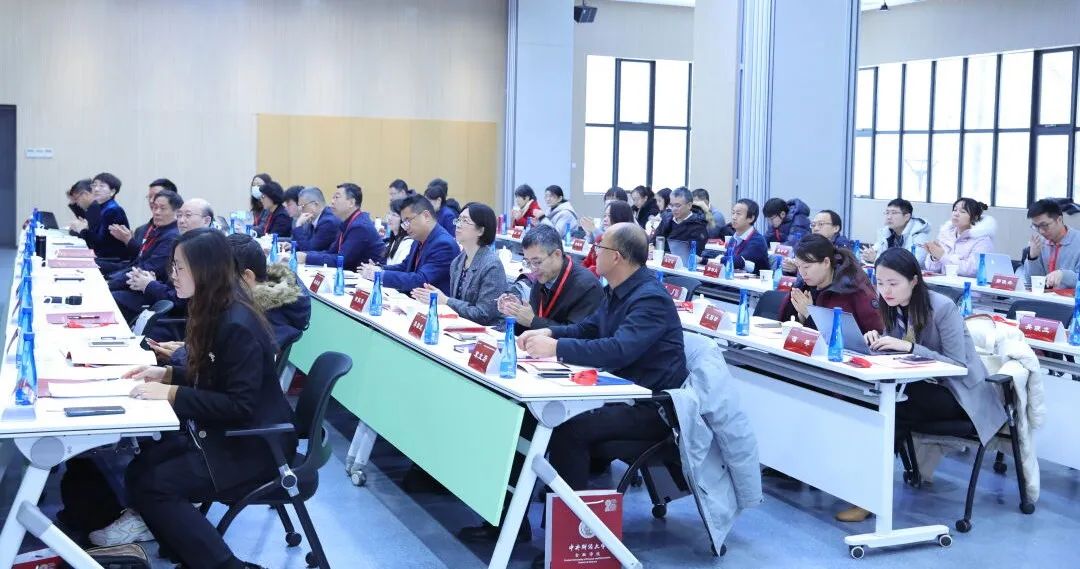 Our School Successfully Held A Seminar On The Ideological And Political Construction Of Financial Professional Courses2026-03-27Comments(0)
 The Man Called In Sick Multiple Times, But The Company Fired Him Because He Took More Than 16,000 Steps On WeChat2026-03-07Comments(0)
 Behind The Tense Situation In East Asia: Japan Is Testing Multiple Fronts, And Lai Ching-lai Raises Risks In The Taiwan Strait2026-02-25Comments(0)